battery TOYOTA RAV4 EV 2012 1.G Owners Manual
[x] Cancel search | Manufacturer: TOYOTA, Model Year: 2012, Model line: RAV4 EV, Model: TOYOTA RAV4 EV 2012 1.GPages: 520, PDF Size: 8.29 MB
Page 466 of 520
466 5-2. Steps to take in an emergency
Emergency start functionWhen the EV system does not start, the following steps can be used
as an interim measure to start the EV system if the “POWER” switch
is functioning normally. Set the parking brake.
Set the “POWER” switch to the ACCESSORY mode.
Push and hold the “POWER” switch for about 15 seconds
while depressing the brake pedal firmly.
Even if the EV system can be st arted using the above steps, the sys-
tem may be malfunctioning. Have th e vehicle checked by your Toyota
dealer.
■ The interior lights and headlights do not turn on, or the horn
does not sound.
One of the following may be the cause of the problem:
●One or both of the 12-volt ba ttery terminals may be discon-
nected.
● The 12-volt battery may be discharged. ( P. 470)
Contact your Toyota dealer if the problem cannot be repaired, or if
repair procedures are unknown.
STEP 1
STEP 2
STEP 3
Page 468 of 520
468
5-2. Steps to take in an emergency
If the electronic key does not operate properly
Locking and unlocking the doors with the mechanical key
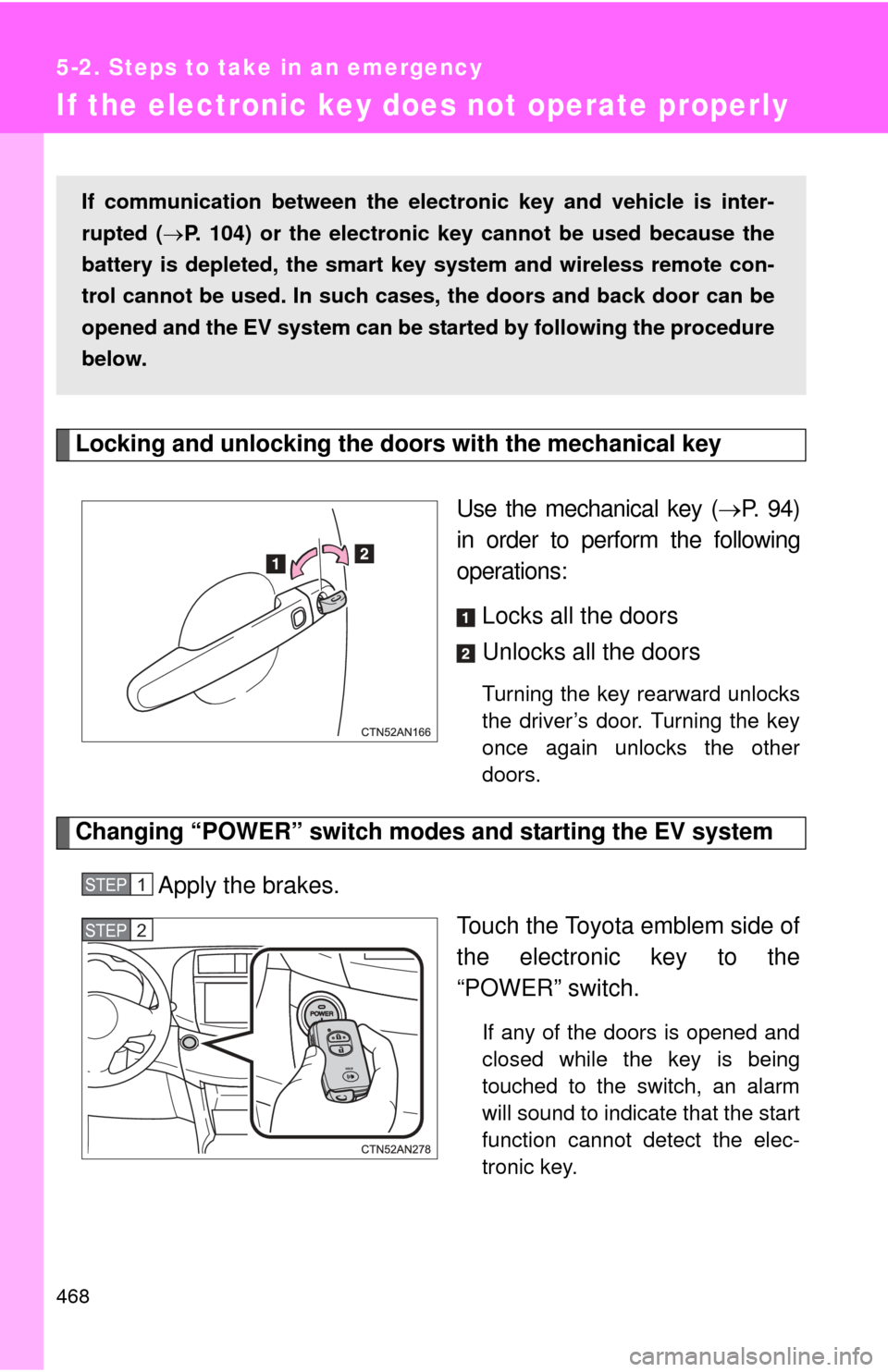
Use the mechanical key ( P. 94)
in order to perform the following
operations:
Locks all the doors
Unlocks all the doors
Turning the key rearward unlocks
the driver’s door. Turning the key
once again unlocks the other
doors.
Changing “POWER” switch modes and starting the EV system
Apply the brakes. Touch the Toyota emblem side of
the electronic key to the
“POWER” switch.
If any of the doors is opened and
closed while the key is being
touched to the switch, an alarm
will sound to indicate that the start
function cannot detect the elec-
tronic key.
If communication between the electronic key and vehicle is inter-
rupted (P. 104) or the electronic key cannot be used because the
battery is depleted, the smart key system and wireless remote con-
trol cannot be used. In such cases, the doors and back door can be
opened and the EV system can be started by following the procedure
below.
STEP 1
STEP 2
Page 469 of 520
5
When trouble arises
469
5-2. Steps to take in an emergency
To change “POWER” switch modes:
Within 10 seconds of the buzze
r sounding, release the brake
pedal and press the “POWER” switch. Modes can be changed
each time the switch is pressed. ( P. 202)
To start the EV system:
Press the “POWER” switch within 10 seconds of the buzzer
sounding, keeping the brake pedal depressed.
In the event that the EV system still cannot be operated, contact your
Toyota dealer.
■ Stopping the EV system
Set the parking brake, push the P position switch and press the “POWER”
switch as you normally do when stopping the EV system.
■ Replacing the key battery
As the above procedure is a temporary measure, it is recommended that the
electronic key battery be replaced immediately when the battery is depleted.
(P. 383)
STEP 3
Page 470 of 520

470
5-2. Steps to take in an emergency
If the vehicle 12-volt batter y is discharged
The following procedures may be used to start the EV system if the
vehicle’s 12-volt battery is discharged.
You can also call your Toyota deal er or a qualified repair shop.
If you have a set of jumper (or booster) cables and a second vehi-
cle with a 12-volt battery, you c an jump start your vehicle following
the steps below.
Open the hood.
Connect the jumper cables accord ing to the following procedure:
Connect a positive jumper cable clamp to the positive (+) battery
terminal on your vehicle.
Connect the clamp on the other e nd of the positive cable to the
positive (+) battery termin al on the second vehicle.
Connect a negative cable clamp to the negative (-) battery termi-
nal on the second vehicle.
Connect the clamp at the other end of the negative cable to a
solid, stationary, unpainted metallic point away from the battery
and any moving parts as shown in the illustration.
STEP 1
STEP 2
Page 471 of 520
5
When trouble arises
471
5-2. Steps to take in an emergency
Start the engine of the second vehicle. Increase the engine
speed slightly and maintain that level for approximately 5
minutes to recharge the 12-v
olt battery of your vehicle.
Open and close any of the door s of your vehicle with the
“POWER” switch off.
Maintain the engine speed of the second vehicle and start
the EV system of your vehicle by turning the “POWER”
switch to ON mode.
Make sure the “READY” indicator comes on. If the indicator
does not come on, contact your Toyota dealer.
Once the EV system has started, remove the jumper cables
in the exact reverse order from which they were connected.
Once the EV system starts, hav e the vehicle inspected at your
Toyota dealer as soon as possible.STEP 3
STEP 4
STEP 5
STEP 6
STEP 7
Page 472 of 520
472 5-2. Steps to take in an emergency
■Starting the EV system when the 12-volt battery is discharged
The EV system cannot be started by push-starting.
■ To prevent 12-volt battery discharge
●Turn off the headlights and the navigation system while the EV system is
off.
● Turn off any unnecessary electrical components when the vehicle is run-
ning at a low speed for an extended period, such as in heavy traffic.
■ When the 12-volt battery is removed or discharged
●The EV system may not start. (P. 363)
● If the 12-volt battery discharges while the shift position is in P, it may not
be possible to shift the shift position to other positions.
In this case, the vehicle cannot be moved without lifting both front wheels
because the front wheels will be locked. ( P. 413)
● The power windows must be initialized. ( P. 147)
■ Charging the 12-volt battery
The electricity stored in the 12-volt battery will discharge gradually even
when the vehicle is not in use, due to natural discharge and the draining
effects of certain electrical appliances. If the vehicle is left for a long time, the
12-volt battery may discharge, and the EV system may be unable to start.
(The 12-volt battery recharges automatically while the EV system is operat-
ing.)
Page 473 of 520
5
When trouble arises
473
5-2. Steps to take in an emergency
CAUTION
■
Avoiding 12-volt battery fires or explosions
Observe the following precautions to prevent accidentally igniting the flam-
mable gas that may be emitted from the 12-volt battery:
●Make sure each jumper cable is connected to the correct terminal and that
it is not unintentionally in contact with any other than the intended terminal.
● Do not allow the other end of the jumper cable connected to the “+” termi-
nal to come into contact with any other parts or metal surfaces in the area,
such as brackets or unpainted metal.
● Do not allow the + and - clamps of the jumper cables to come into contact
with each other.
● Do not smoke, use matches, cigarette lighters or allow open flame near
the 12-volt battery.
■ 12-volt battery precautions
The 12-volt battery contains poisonous and corrosive acidic electrolyte,
while related parts contain lead and lead compounds. Observe the following
precautions when handling the 12-volt battery:
●When working with the 12-volt battery, always wear safety glasses and
take care not to allow any 12-volt battery fluids (acid) to come into contact
with skin, clothing or the vehicle body.
● Do not lean over the 12-volt battery.
● In the event that battery fluid comes into contact with the skin or eyes,
immediately wash the affected area with water and seek medical attention.
Place a wet sponge or cloth over the affected area until medical attention
can be received.
● Always wash your hands after handling the 12-volt battery support, termi-
nals, and other battery-related parts.
● Do not allow children near the 12-volt battery.
Page 475 of 520

5
When trouble arises
475
5-2. Steps to take in an emergency
If your vehicle overheats
Correction proceduresStop the vehicle in a safe place and turn off the air condition-
ing system.
Check to see if steam is coming out from under the hood.
If you see steam: Stop the EV system. Carefully lift the hood after the steam
subsides and then restart the EV system.
If you do not see steam: Leave the EV system operating and carefully lift the hood.
Check to see if the cooling fans are operating.
If the fans are operating: Wait until “High Battery Temp” disappears and then stop the
EV system.
If the fans are not operating: Stop the EV system immediately and contact your Toyota
dealer.
After “High Battery Temp” disap-
pears, check the motor/traction
battery coolant level and inspect
the cooling system for leaks.
There are 2 powertrain coolant
reservoirs. Make sure to check
both of them.
If “High Battery Temp” is shown on the multi-information display, the
vehicle may be overheating.
If the message does not disappear after driving for a little while, fol-
low the correction procedu re as described below.
STEP 1
STEP 2
STEP 3
STEP 4
Page 476 of 520

476 5-2. Steps to take in an emergency
If necessary, add motor/traction
battery coolant up to the “F” or
“FULL” line.
Add after confirming the type of
coolant. (P. 357)
Water can be used in an emer-
gency if motor/traction battery
coolant is unavailable.
Have the vehicle checked at nearest Toyota dealer as soon as possi-
ble.
STEP 5
CAUTION
■ To prevent an accident or injury when inspecting under the hood of
your vehicle
● If steam is seen coming from under the hood, do not open the hood until
the steam has subsided. The motor compartment may be very hot, caus-
ing serious injury such as burns.
● Check that the indicator on the “POWER” switch and the “READY” indica-
tor are off.
● When the “READY” indicator is illuminated, the cooling fans may su\
ddenly
start to operate. Do not touch or approach the fans. Doing so may lead to
fingers, clothes or tools getting caught, resulting in an accidental injury.
● Do not loosen the coolant reservoir cap while the EV system and radiator
are hot.
Serious injury, such as burns, may result from hot coolant and steam
released under pressure.
NOTICE
■When adding motor/traction battery coolant
Wait until the EV system has cooled down before adding motor/traction bat-
tery coolant.
When adding coolant, do so slowly. Adding cool coolant to a hot EV system
too quickly can cause damage to the EV system.
Page 484 of 520

484 6-1. Specifications
Tr a c t i o n m o t o r
Traction battery
TypeAC Induction
TypeLithium-ion battery
Overall voltage (Reference) 386 V