roof TOYOTA RAV4 EV 2012 1.G User Guide
[x] Cancel search | Manufacturer: TOYOTA, Model Year: 2012, Model line: RAV4 EV, Model: TOYOTA RAV4 EV 2012 1.GPages: 520, PDF Size: 8.29 MB
Page 259 of 520

259
2-5. Driving information
2
When driving
CAUTION
■
Utility vehicle precautions
Always observe the following precautions to minimize the risk of serious per-
sonal injury or damage to your vehicle:
●In a rollover crash, an unbelted person is significantly more likely to die
than a person wearing a seat belt. Therefore, the driver and all passengers
should fasten their seat belts whenever the vehicle is moving.
● Avoid sharp turns or abrupt maneuvers, if at all possible. Failure to operate
this vehicle correctly may result in loss of control or vehicle rollover caus-
ing death or serious injury.
● Avoid loading any items on the roof that will raise the vehicle’s center of
gravity.
● Always slow down in gusty crosswinds. Because of its profile and taller
vehicle height, this vehicle is more sensitive to side winds than an ordinary
passenger car. Slowing down will allow you to have better control.
● This vehicle is an electric vehicle. Avoid driving through deep water that
may cause the battery pack, motor or motor controller to be submerged or
flooded. Furthermore, this vehicle is not suitable for off-road driving, unlike
conventional sport utility vehicles. When it is unavoidable to drive off-road
or in rugged terrain, do not drive at excessive speeds, jump, make sharp
turns, strike objects, etc. This may cause loss of control or vehicle rollover
causing death or serious injury. You are also risking expensive damage to
your vehicle’s suspension, chassis and traction batteries.
● Do not drive horizontally across steep slopes. Driving straight up or
straight down is preferred. Your vehicle (or any similar vehicle) can tip over
sideways much more easily than forward or backward.
Page 268 of 520
268
2-5. Driving information
Winter driving tips
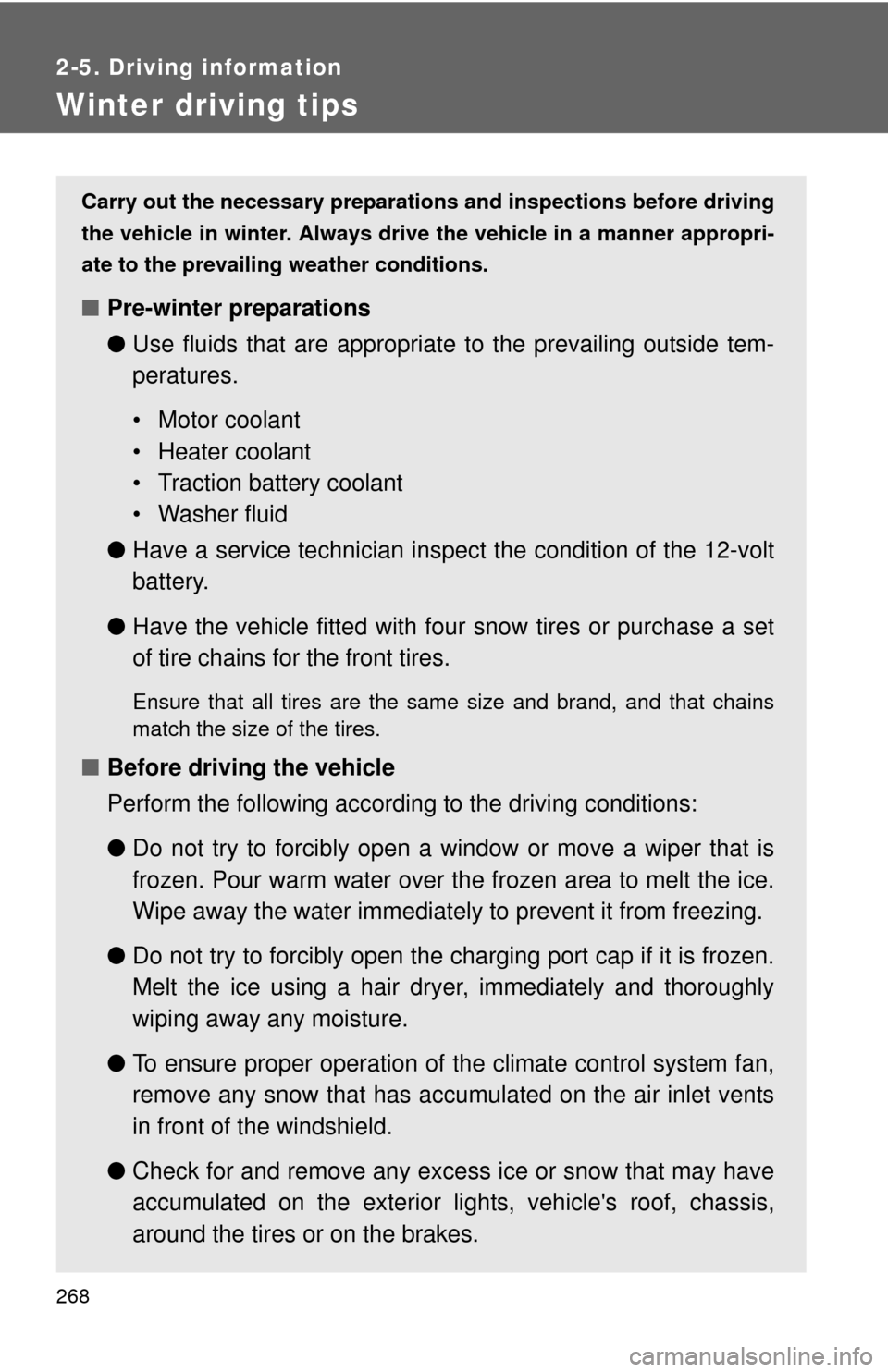
Carry out the necessary preparations and inspections before driving
the vehicle in winter. Always drive the vehicle in a manner appropri-
ate to the prevailing weather conditions.
■ Pre-winter preparations
●Use fluids that are appropriate to the prevailing outside tem-
peratures.
• Motor coolant
• Heater coolant
• Traction battery coolant
• Washer fluid
● Have a service technician inspec t the condition of the 12-volt
battery.
● Have the vehicle fitted with four snow tires or purchase a set
of tire chains for the front tires.
Ensure that all tires are the same size and brand, and that chains
match the size of the tires.
■Before driving the vehicle
Perform the following according to the driving conditions:
●Do not try to forcibly open a window or move a wiper that is
frozen. Pour warm water over the frozen area to melt the ice.
Wipe away the water immediately to prevent it from freezing.
● Do not try to forcibly open the charging port cap if it is frozen.
Melt the ice using a hair dryer, immediately and thoroughly
wiping away any moisture.
● To ensure proper operation of th e climate control system fan,
remove any snow that has accumulated on the air inlet vents
in front of the windshield.
● Check for and remove any excess ice or snow that may have
accumulated on the exterior li ghts, vehicle's roof, chassis,
around the tires or on the brakes.
Page 334 of 520
334
4-1. Maintenance and care
Cleaning and protecting the vehicle exterior
■Before washing the vehicle
Check that the charging port cap and charging port door on your vehicle are
closed properly.
■ Automatic car washes
●Fold the mirrors and remove the antenna before washing the vehicle.
Start washing from the front of the vehicle. Make sure to re-install the
antenna and extend the mirrors before driving.
● Brushes used in automatic car washes may scratch the vehicle surface
and harm your vehicle’s paint.
● In certain automatic car washes, the rear spoiler may interfere with
machine operation. This may prevent the vehicle from being cleaned
properly or result in damage to the rear spoiler.
■ High pressure car washes
Do not allow the nozzles of the car wash to come within close proximity \
of
the windows.
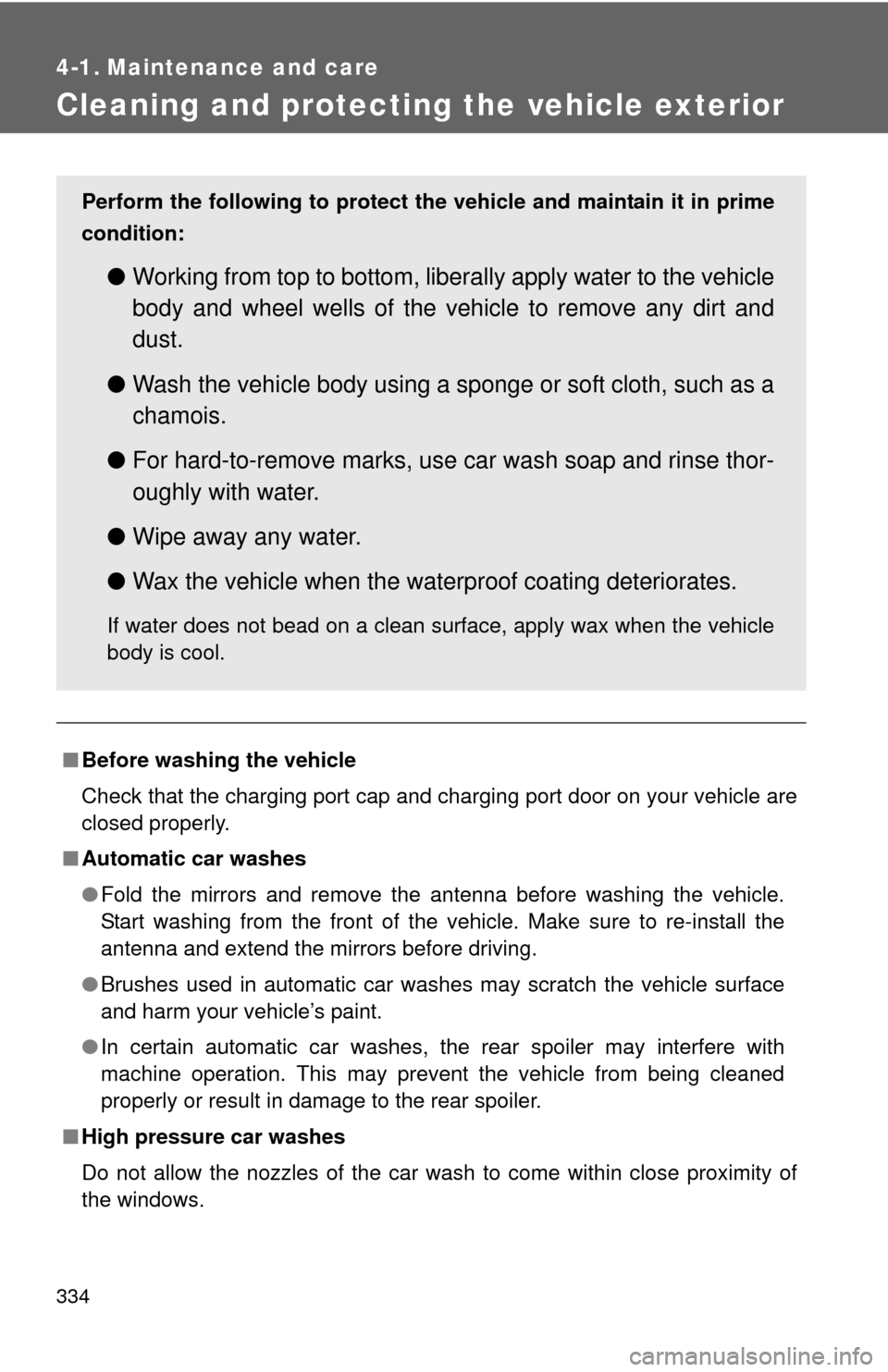
Perform the following to protect the vehicle and maintain it in prime
condition:
● Working from top to bottom, liber ally apply water to the vehicle
body and wheel wells of the vehicle to remove any dirt and
dust.
● Wash the vehicle body using a sponge or soft cloth, such as a
chamois.
● For hard-to-remove marks, use car wash soap and rinse thor-
oughly with water.
● Wipe away any water.
● Wax the vehicle when the waterproof coating deteriorates.
If water does not bead on a clean surface, apply wax when the vehicle
body is cool.
Page 464 of 520

464 5-2. Steps to take in an emergency
NOTICE
■When performing an emergency repair
●A tire should only be repaired with the emergency tire puncture repair
kit if the damage is caused by a sharp object such as a nail or screw
passing through the tire tread.
Do not remove the sharp object from the tire. Removing the object may
widen the opening and disenable emergency repair with the repair kit.
●The repair kit is not waterproof. Make sure that the repair kit is not
exposed to water, such as when it is being used in the rain.
●Do not put the repair kit directly onto dusty ground such as sand at the
side of the road. If the repair kit vacuums up dust etc., a malfunction
may occur.
■Precautions for the emergency tire puncture repair kit
●The repair kit power source should be 12 V DC suitable for vehicle
use. Do not connect the repair kit to any other source.
●If gasoline splatters on the repair kit, the repair kit may deteriorate.
Take care not to allow gasoline to contact it.
●Place the repair kit in the specifi ed storage location to prevent it from
being exposed to dirt or water.
●Store the repair kit out of reach of children.
●Do not disassemble or modify the repair kit. Do not subject parts such
as the air pressure indicator to impacts. This may cause a malfunction.
Page 495 of 520
495
6-1. Specifications
6
Vehicle specifications
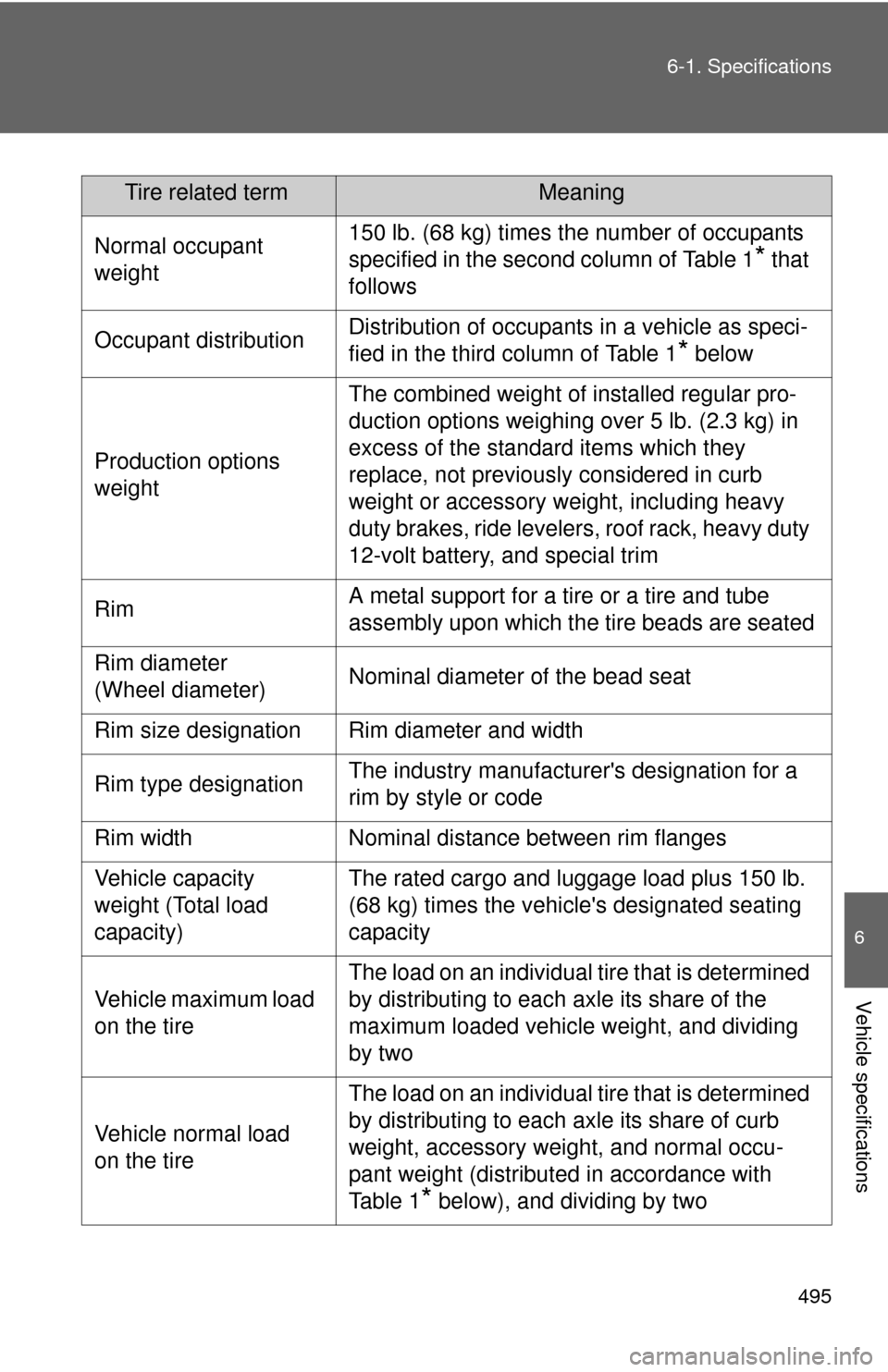
Tire related termMeaning
Normal occupant
weight 150 lb. (68 kg) times the number of occupants
specified in the second column of Table 1
* that
follows
Occupant distribution Distribution of occupants in a vehicle as speci-
fied in the third column of Table 1
* below
Production options
weight The combined weight of installed regular pro-
duction options weighing over 5 lb. (2.3 kg) in
excess of the standard items which they
replace, not previously considered in curb
weight or accessory weight, including heavy
duty brakes, ride levelers, roof rack, heavy duty
12-volt battery, and special trim
Rim A metal support for a tire or a tire and tube
assembly upon which the tire beads are seated
Rim diameter
(Wheel diameter) Nominal diameter of the bead seat
Rim size designation Rim diameter and width
Rim type designation The industry manufacturer's designation for a
rim by style or code
Rim width Nominal distance between rim flanges
Vehicle capacity
weight (Total load
capacity) The rated cargo and luggage load plus 150 lb.
(68 kg) times the vehicl
e's designated seating
capacity
Vehicle maximum load
on the tire The load on an individual tire that is determined
by distributing to each axle its share of the
maximum loaded vehicle weight, and dividing
by two
Vehicle normal load
on the tire The load on an individual tire that is determined
by distributing to each axle its share of curb
weight, accessory weight, and normal occu-
pant weight (distributed in accordance with
Ta b l e 1
* below), and dividing by two