warning light TOYOTA RAV4 EV 2012 1.G User Guide
[x] Cancel search | Manufacturer: TOYOTA, Model Year: 2012, Model line: RAV4 EV, Model: TOYOTA RAV4 EV 2012 1.GPages: 520, PDF Size: 8.29 MB
Page 155 of 520
155
1-9. Safety information
1
Before driving
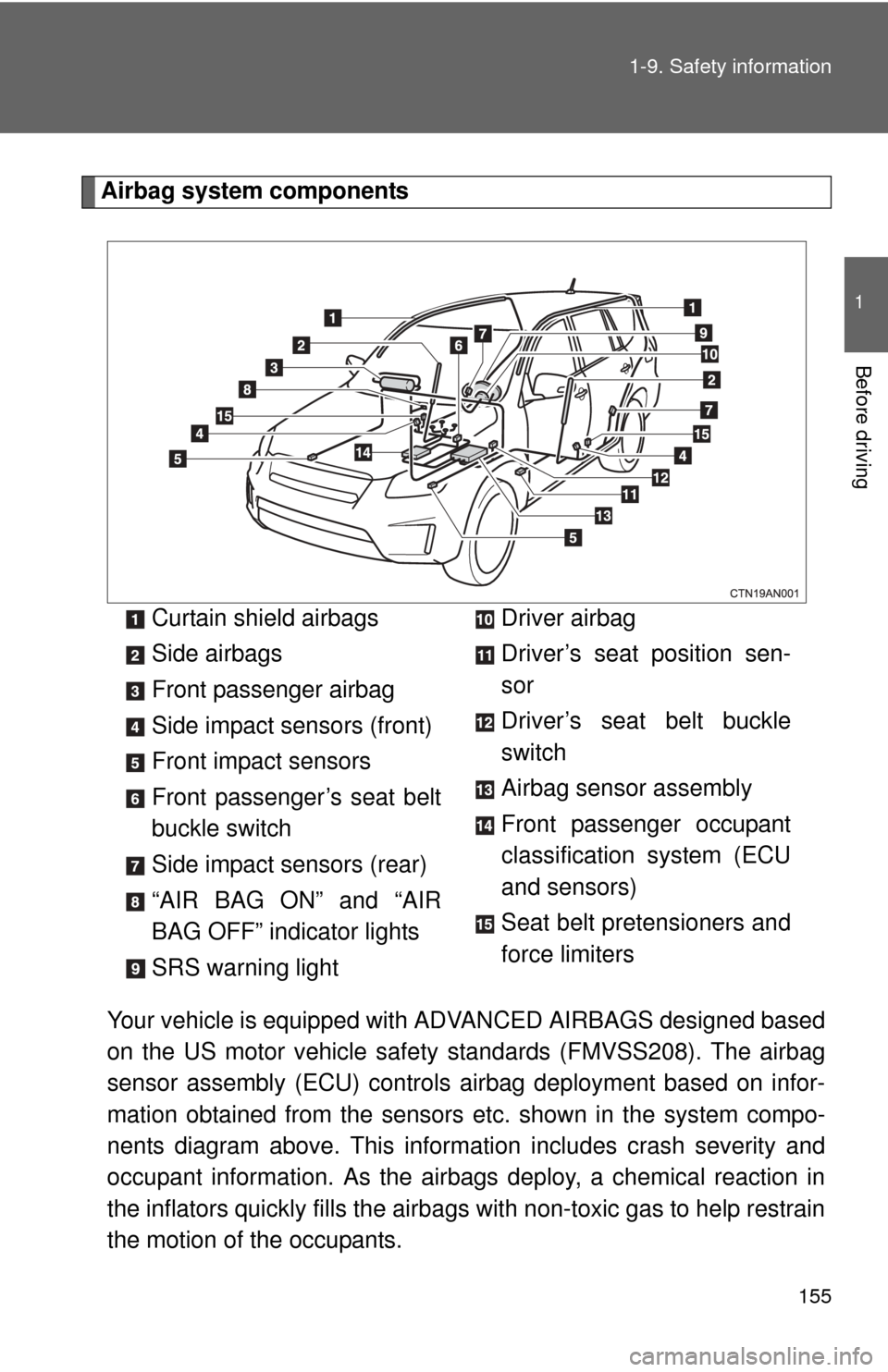
Airbag system components
Your vehicle is equipped with ADVANCED AIRBAGS designed based
on the US motor vehicle safety standards (FMVSS208). The airbag
sensor assembly (ECU) controls ai rbag deployment based on infor-
mation obtained from the sensors etc. shown in the system compo-
nents diagram above. This inform ation includes crash severity and
occupant information. As the air bags deploy, a chemical reaction in
the inflators quickly fills the airbag s with non-toxic gas to help restrain
the motion of the occupants. Curtain shield airbags
Side airbags
Front passenger airbag
Side impact sensors (front)
Front impact sensors
Front passenger’s seat belt
buckle switch
Side impact sensors (rear)
“AIR BAG ON” and “AIR
BAG OFF” indicator lights
SRS warning light
Driver airbag
Driver’s seat position sen-
sor
Driver’s seat belt buckle
switch
Airbag sensor assembly
Front passenger occupant
classification system (ECU
and sensors)
Seat belt pretensioners and
force limiters
Page 166 of 520
166
1-9. Safety information
Front passenger occupant classification system
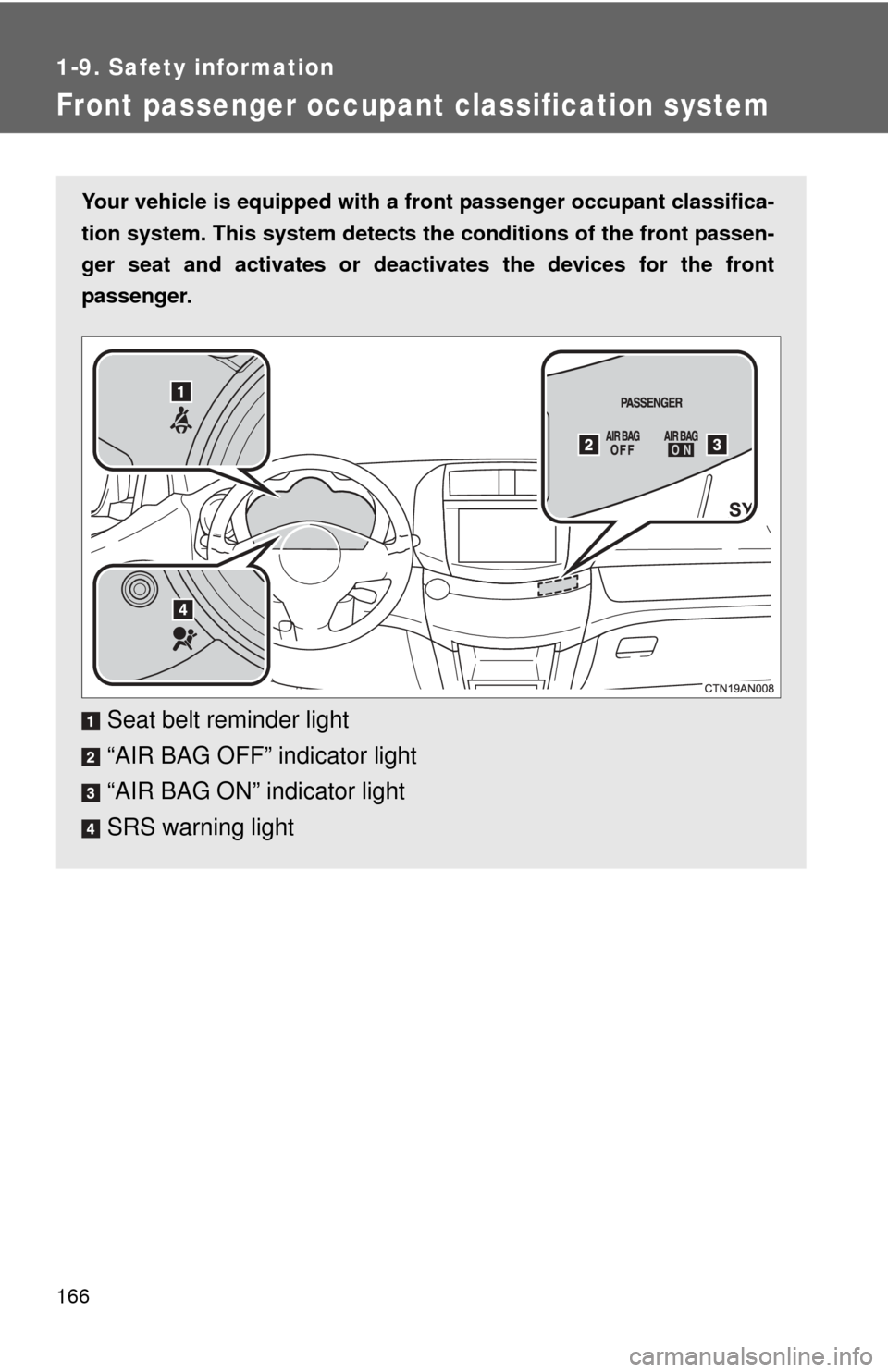
Your vehicle is equipped with a front passenger occupant classifica-
tion system. This system detects the conditions of the front passen-
ger seat and activates or deactiv ates the devices for the front
passenger.
Seat belt reminder light
“AIR BAG OFF” indicator light
“AIR BAG ON” indicator light
SRS warning light
Page 167 of 520

167
1-9. Safety information
1
Before driving
Conditions and operation of
the front passenger occupant
classification system
■ Adult*
1
■Child*3 or child restraint system*4
Indicator/
warning light “AIR BAG ON” and “AIR BAG OFF”
indicator lights “AIR BAG
ON”
SRS warning light Off
Seat belt reminder light
Flashing*2
Devices Front passenger airbag
Activated
Side airbag on the front passenger seat
Curtain shield airbag in the front passenger side
Front passenger's seat belt pretensioner
Indicator/
warning light “AIR BAG ON” and “AIR BAG OFF”
indicator lights “AIR BAG
OFF”*5
SRS warning light Off
Seat belt reminder light Flashing*
2
DevicesFront passenger airbag
Deactivated
Side airbag on the front passenger seat
Curtain shield airbag in the front passenger side Activated
Front passenger's seat belt pretensioner
Page 168 of 520

168 1-9. Safety information
■Unoccupied
■ There is a malfunction in the system
*
1: The system judges a person of adult size as an adult. When a smaller adult sits in the front passenger seat, the system may rec-
ognize him/her as a child depending on his/her physique and pos-
ture.
*
2: In the event the front passenger does not wear a seat belt.
*
3: When a larger child who has outgrown a child restraint system sits in the front passenger seat, the system may recognize him/
her as an adult depending on hi s/her physique or posture.
Indicator/
warning light “AIR BAG ON” and “AIR BAG OFF”
indicator lights Not illumi-
nated
SRS warning light Off
Seat belt reminder light
Devices Front passenger airbag
Deactivated
Side airbag on the front passenger seat
Curtain shield airbag in the front passenger side Activated
Front passenger's seat belt pretensioner Deactivated
Indicator/
warning light “AIR BAG ON” and “AIR BAG OFF”
indicator lights “AIR BAG
OFF”
SRS warning light On
Seat belt reminder light On
Devices Front passenger airbag
Deactivated
Side airbag on the front passenger seat
Curtain shield airbag in the front passenger side Activated
Front passenger's seat belt pretensioner
Page 171 of 520

171
1-9. Safety information
1
Before driving
CAUTION
■
Front passenger occupant cl assification system precautions
● If an adult sits in the front passenger seat, the “AIR BAG ON” indicator
light is illuminated. If the “AIR BAG OFF” indicator is illuminated, ask the
passenger to sit up straight, well back in the seat, feet on the floor, and
with the seat belt worn correctly. If the “AIR BAG OFF” indicator still
remains illuminated, either ask the passenger to move to the rear seat, or
if that is not possible, move the front passenger seat fully rearward.
● When it is unavoidable to install a forward-facing child restraint system on
the front passenger seat, install the child restraint system on the front pas-
senger seat in the proper order. ( P. 176)
● Do not modify or remove the front seats.
● Do not kick the front passenger seat or subject it to severe impact. Other-
wise, the SRS warning light may come on to indicate a malfunction of the
detection system. In this case, contact your Toyota dealer immediately.
● Child restraint systems installed on the rear seat should not contact the
front seatbacks.
● Do not use a seat accessory, such as a cushion and seat cover, that cov-
ers the seat cushion surface.
● Do not modify or replace the upholstery of the front seat.
Page 189 of 520
When driving2
189
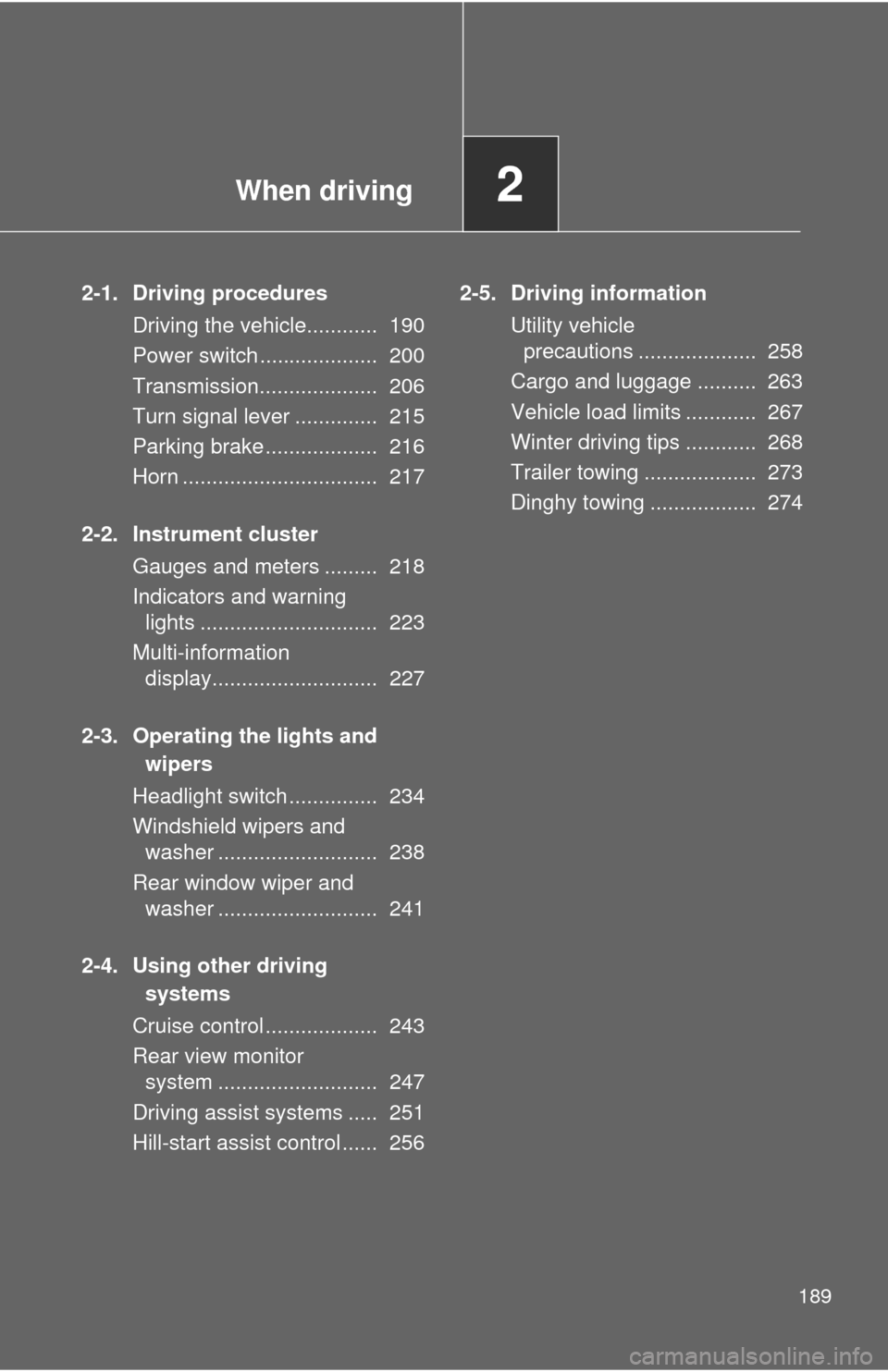
2-1. Driving proceduresDriving the vehicle............ 190
Power switch .................... 200
Transmission.................... 206
Turn signal lever .............. 215
Parking brake ................... 216
Horn ................................. 217
2-2. Instrument cluster Gauges and meters ......... 218
Indicators and warning lights .............................. 223
Multi-information display............................ 227
2-3. Operating the lights and wipers
Headlight switch ............... 234
Windshield wipers and washer ........................... 238
Rear window wiper and washer ........................... 241
2-4. Using other driving systems
Cruise control ................... 243
Rear view monitor system ........................... 247
Driving assist systems ..... 251
Hill-start assist control ...... 256 2-5. Driving information
Utility vehicle precautions .................... 258
Cargo and luggage .......... 263
Vehicle load limits ............ 267
Winter driving tips ............ 268
Trailer towing ................... 273
Dinghy towing .................. 274
Page 197 of 520

197
2-1. Driving procedures
2
When driving
CAUTION
●
Do not attach adhesive discs to the windshield or windows. Do not place
containers such as air fresheners on the instrument panel or dashboard.
Adhesive discs or containers may act as lenses, causing a fire in the vehi-
cle.
● Do not leave a door or window open if the curved glass is coated with a
metallized film such as a silver-colored one. Reflected sunlight may cause
the glass to act as a lens, causing a fire.
■ When taking a nap in the vehicle
Always turn the EV system off. Otherwise, you may accidentally move the
shift position or depress the accelerator pedal.
■ When braking the vehicle
●When the brakes are wet, drive more cautiously.
Braking distance increases when the brakes are wet, and may cause one
side of the vehicle to brake differently than the other side. Also the parking
brake may not securely hold the vehicle.
● If the electronically controlled brake system does not operate, do not fol-
low other vehicles closely and avoid hills or sharp turns that require brak-
ing.
In this case, braking is still possible, but the brake pedal should be
depressed more firmly than usual. Also, the braking distance will increase.
● The brake system consists of 2 individual hydraulic systems; if one of the
systems fails, the others will still operate. In this case, the brake pedal
should be depressed more firmly than usual and the braking distance will
increase. If this happens, do not continue to drive the vehicle. If the brake
system warning light comes on while driving, immediately stop the vehicle
in a safe place and contact your Toyota dealer.
Page 223 of 520
223
2-2. Instrument cluster
2
When driving
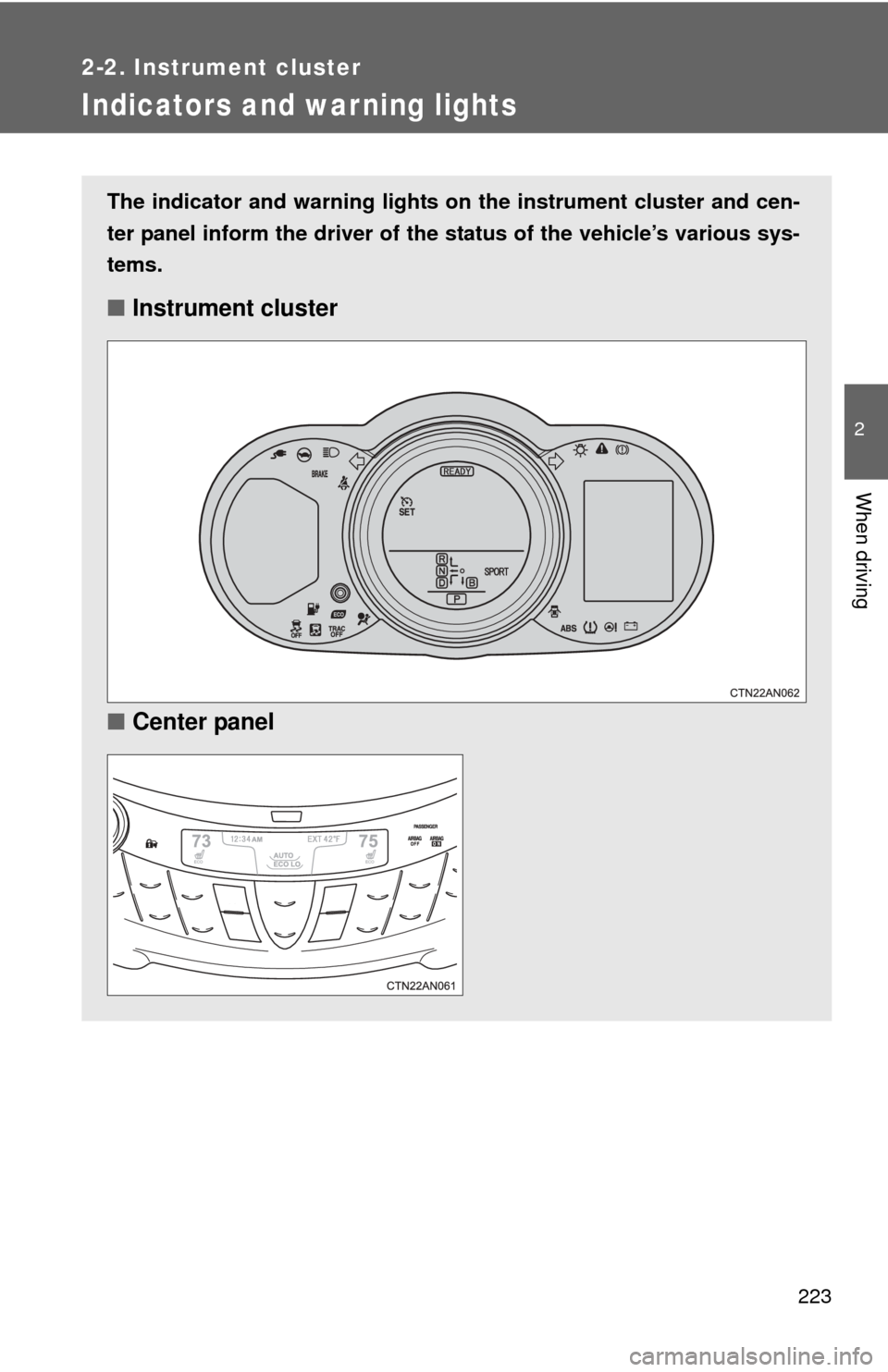
Indicators and war ning lights
The indicator and warning lights on the instrument cluster and cen-
ter panel inform the driver of the status of the vehicle’s various sys-
tems.
■ Instrument cluster
■ Center panel
Page 226 of 520
226 2-2. Instrument cluster
CAUTION
■If a safety system warning light does not come on
Should a safety system light such as the ABS and SRS airbag warning light
not come on when you start the EV system, this could mean that these sys-
tems are not available to help protect you in an accident, which could result
in death or serious injury. Have the vehicle inspected by your Toyota dealer
immediately if this occurs.
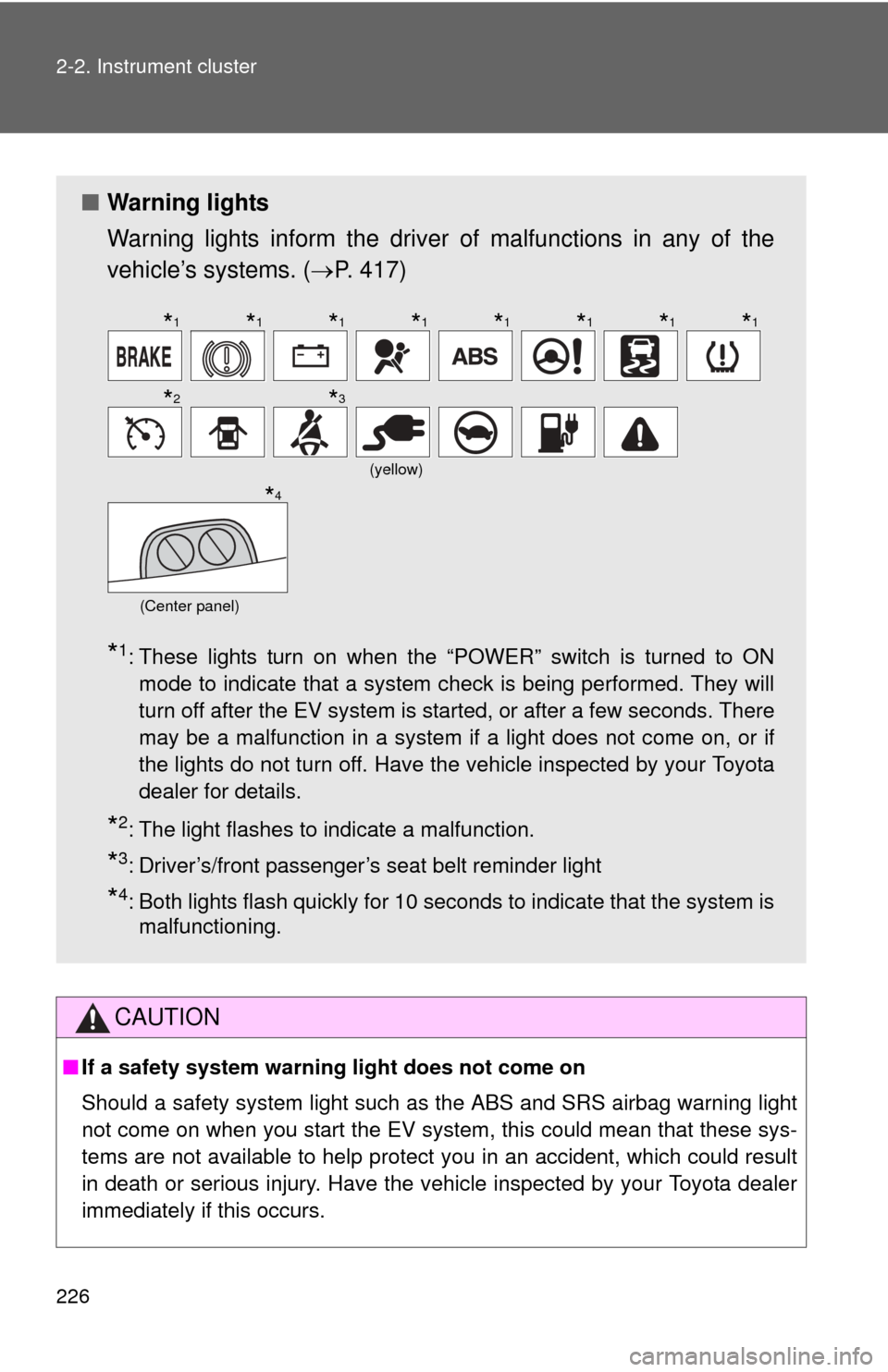
■ Warning lights
Warning lights inform the driver of malfunctions in any of the
vehicle’s systems. ( P. 417)
*1: These lights turn on when the “POWER” switch is turned to ON
mode to indicate that a system check is being performed. They will
turn off after the EV system is started, or after a few seconds. There
may be a malfunction in a system if a light does not come on, or if
the lights do not turn off. Have the vehicle inspected by your Toyota
dealer for details.
*2: The light flashes to indicate a malfunction.
*3: Driver’s/front passenger’s seat belt reminder light
*4: Both lights flash quickly for 10 seconds to indicate that the system ismalfunctioning.
(yellow)
(Center panel)
*1*1*1*1*1*1*1*1
*2*3
*4
Page 368 of 520
368 4-3. Do-it-yourself maintenance
■When to replace your vehicle's tires
Tires should be replaced if:
●You have tire damage such as cuts, splits, cracks deep enough to
expose the fabric, or bulges indicating internal damage.
●A tire goes flat repeatedly or cannot be properly repaired due to the
size or location of a cut or other damage.
If you are not sure, consult with your Toyota dealer.
■Replacing tires and wheels
If the ID code of the tire pressure warning valve and transmitter is not
registered, the tire pre ssure warning system will not work properly. After
driving for about 20 minutes, the tire pressure warning light blinks for 1
minute and stays on to indicate a system malfunction.
■Tire life
Any tire over 6 years old must be checked by a qualified technician even
if they have seldom or never been used or damage is not obvious.
■Routine tire inflation pressure checks
The tire pressure warning system doe s not replace routine tire inflation
pressure checks. Make sure to check tire inflation pressure as part of
your routine of daily vehicle checks.
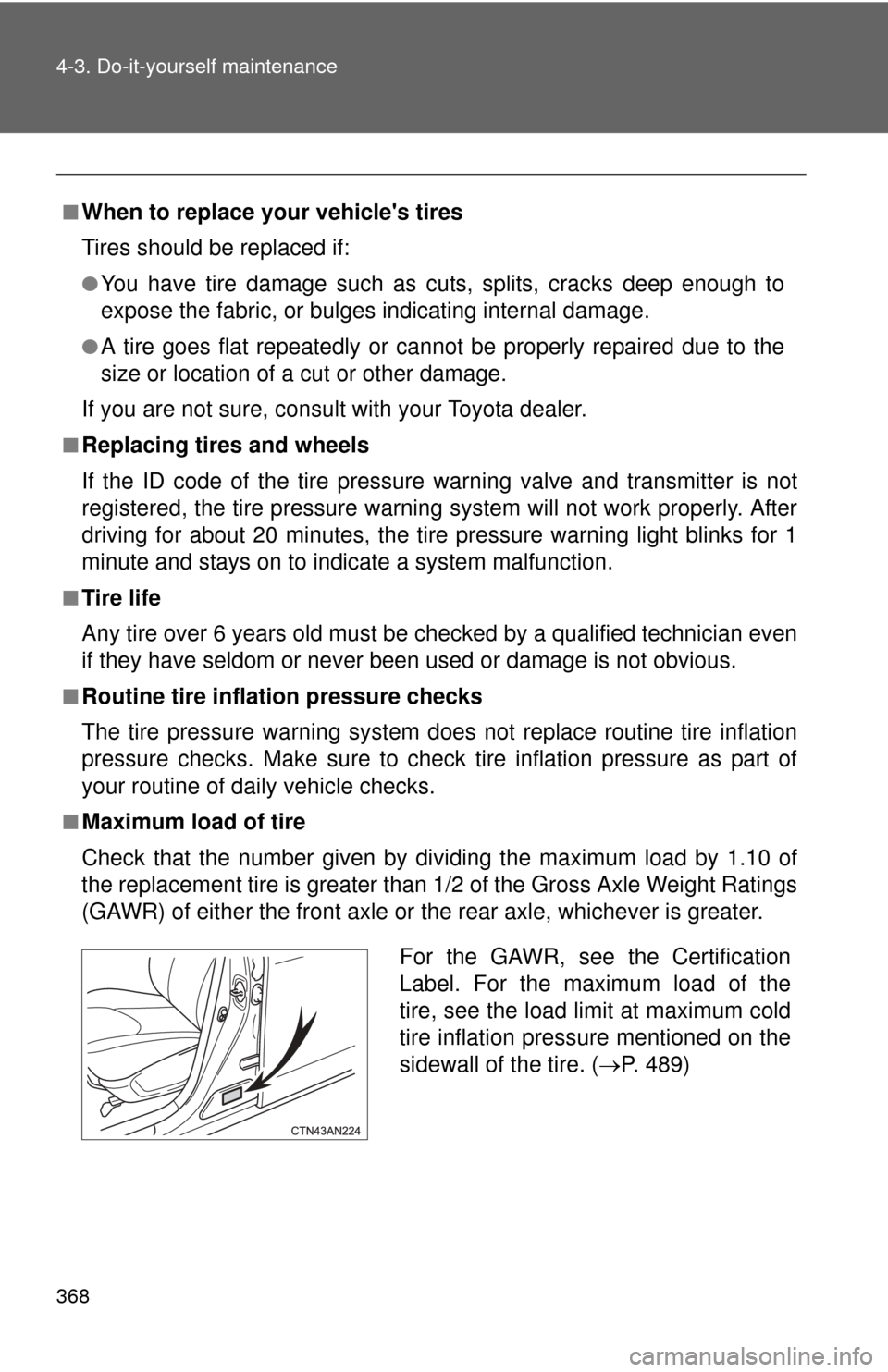
■Maximum load of tire
Check that the number given by di viding the maximum load by 1.10 of
the replacement tire is greater than 1/2 of the Gross Axle Weight Ratings
(GAWR) of either the front axle or the rear axle, whichever is greater.
For the GAWR, see the Certification
Label. For the maximum load of the
tire, see the load limit at maximum cold
tire inflation pressure mentioned on the
sidewall of the tire. (P. 489)