battery TOYOTA RAV4 EV 2013 1.G Manual PDF
[x] Cancel search | Manufacturer: TOYOTA, Model Year: 2013, Model line: RAV4 EV, Model: TOYOTA RAV4 EV 2013 1.GPages: 520, PDF Size: 7.4 MB
Page 363 of 520
363
4-3. Do-it-yourself maintenance
4
Maintenance and care
■
After recharging/reconnecting the 12-volt battery
●Unlocking the doors using the smart key system may not be possible
immediately after reconnecting the 12-volt battery. If this happens, use
the wireless remote control or the mechanical key to lock/unlock the
doors.
● Start the EV system with the “POWER” switch in ACCESSORY mode.
The EV system may not start with the “POWER” switch turned off. How-
ever, the EV system will operate normally from the second attempt.
● The “POWER” switch mode is recorded by the vehicle. If the 12-volt bat-
tery is reconnected, the vehicle will return the “POWER” switch mode to
the status it was in before the 12-volt battery was disconnected. Make
sure to turn the “POWER” switch off before disconnecting the 12-volt bat-
tery. Take extra care when connecting the 12-volt battery if the “POWER”
switch mode prior to discharge is unknown.
● When the 12-volt battery is reconnected, start the EV system, depress
the brake pedal, and confirm that it is possible to shift into each shift posi-
tion.
If the system will not start even after multiple attempts, contact your Toyota
dealer.
CAUTION
■ Chemicals in the 12-volt battery
The 12-volt battery contains poisonous and corrosive sulfuric acid and may
produce hydrogen gas which is flammable and explosive. To reduce the risk
of death or serious injury, take the following precautions while working on or
near the 12-volt battery:
●Do not cause sparks by touching the 12-volt battery terminals with tools.
● Do not smoke or light a match near the 12-volt battery.
● Avoid contact with eyes, skin and clothes.
● Never inhale or swallow electrolyte.
● Wear protective safety glasses when working near the 12-volt battery.
● Keep children away from the 12-volt battery.
Page 364 of 520
364 4-3. Do-it-yourself maintenance
CAUTION
■Where to safely charge the 12-volt battery
Always charge the 12-volt battery in an open area. Do not charge the 12-volt
battery in a garage or closed room where there is insufficient ventilation.
■ How to recharge the 12-volt battery
Only perform a slow charge (5 A or less). The 12-volt battery may explode if
charged at a quicker rate.
■ Emergency measures regarding electrolyte
●If electrolyte gets in your eyes
Flush your eyes with clean water for at least 15 minutes and get immedi-
ate medical attention. If possible, continue to apply water with a sponge or
cloth while traveling to the nearest medical facility.
● If electrolyte gets on your skin
Wash the affected area thoroughly. If you feel pain or burning, get medical
attention immediately.
● If electrolyte gets on your clothes
It can soak through clothing on to your skin. Immediately take off the cloth-
ing and follow the procedure above if necessary.
● If you accidentally swallow electrolyte
Drink a large quantity of water or milk. Get emergency medical attention
immediately.
NOTICE
■When recharging the 12-volt battery
Never recharge the 12-volt battery while the EV system is operating. Also,
be sure all accessories are turned off.
Page 371 of 520
371
4-3. Do-it-yourself maintenance
4
Maintenance and care
CAUTION
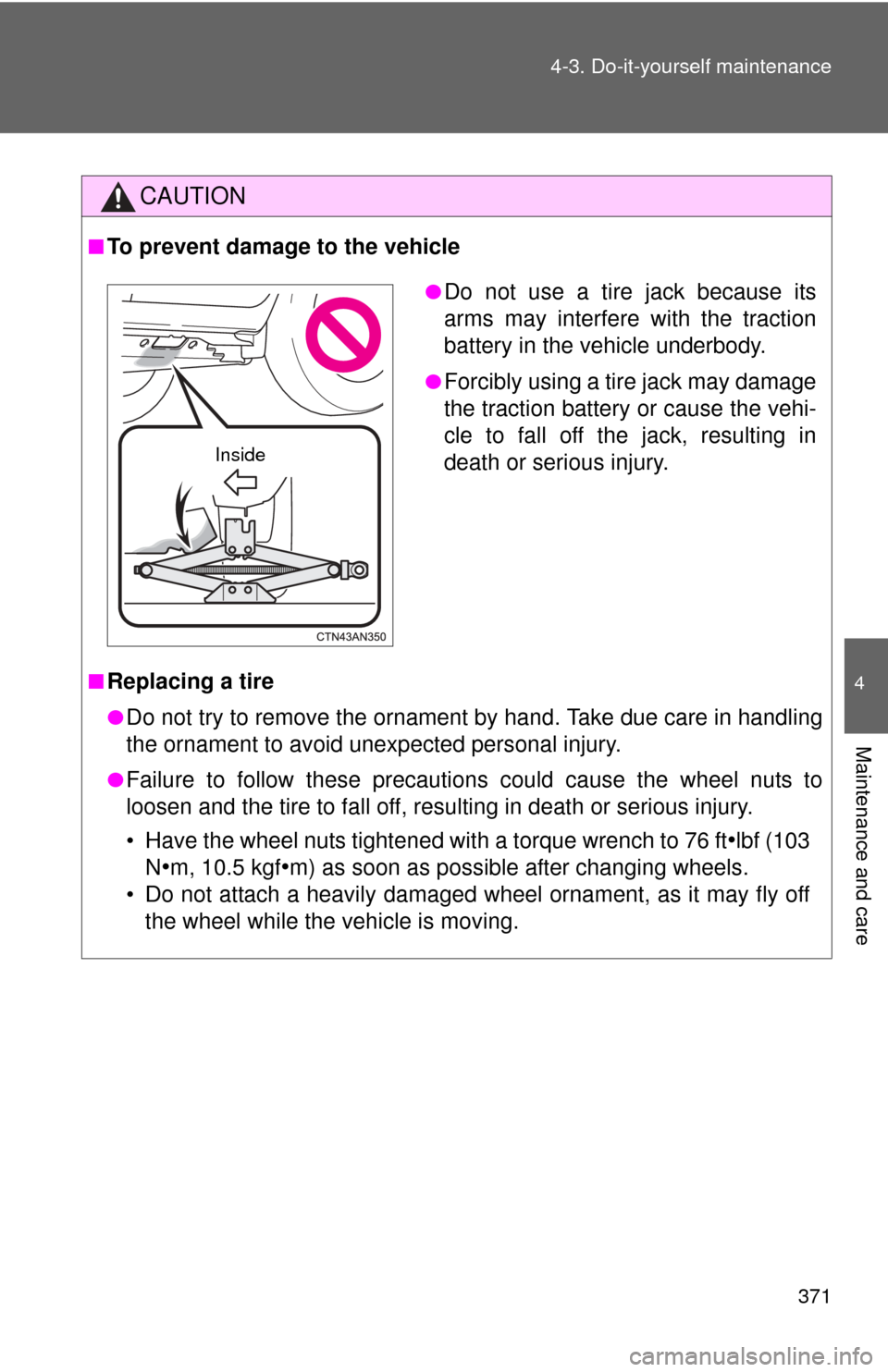
■To prevent damage to the vehicle
■Replacing a tire
●Do not try to remove the ornament by hand. Take due care in handling
the ornament to avoid unexpected personal injury.
●Failure to follow these precautions could cause the wheel nuts to
loosen and the tire to fall off, resulting in death or serious injury.
• Have the wheel nuts tightened with a torque wrench to 76 ft
•lbf (103
N
•m, 10.5 kgf•m) as soon as possible after changing wheels.
• Do not attach a heavily damaged wh eel ornament, as it may fly off
the wheel while the vehicle is moving.
●Do not use a tire jack because its
arms may interfere with the traction
battery in the vehicle underbody.
●Forcibly using a tire jack may damage
the traction battery or cause the vehi-
cle to fall off the jack, resulting in
death or serious injury.
Inside
Page 376 of 520

376 4-3. Do-it-yourself maintenance
■Effects of incorrect tire inflation pressure
Driving with incorrect tire inflation pressure ma y result in the following:
●Reduced traction battery efficiency
●Reduced driving comfort and tire life
●Reduced safety
●Damage to the drive train
If a tire needs frequent inflating, have it checked by your Toyota dealer.
■Instructions for checking tire inflation pressure
When checking tire inflation pressure, observe the following:
●Check only when the tires are cold.
If your vehicle has been parked for at least 3 hours or has not been
driven for more than 1 mile or 1.5 km, you will get an accurate cold
tire inflation pressure reading.
●Always use a tire pressure gauge.
The appearance of the tire can be mi sleading. In addition, tire infla-
tion pressure that is even just a few pounds off can affect ride quality
and handling.
●Do not reduce tire inflation pressure after driving. It is normal for tire
inflation pressure to be higher after driving.
●Never exceed the vehicle capacity weight.
Passengers and luggage weight should be placed so that the vehicle
is balanced.
Page 383 of 520
383
4-3. Do-it-yourself maintenance
4
Maintenance and care
Electronic key batter y
Replace the battery with a new one if it is depleted.
■You will need the following items:
●Flathead screwdriver
● Small flathead screwdriver
● Lithium battery CR1632
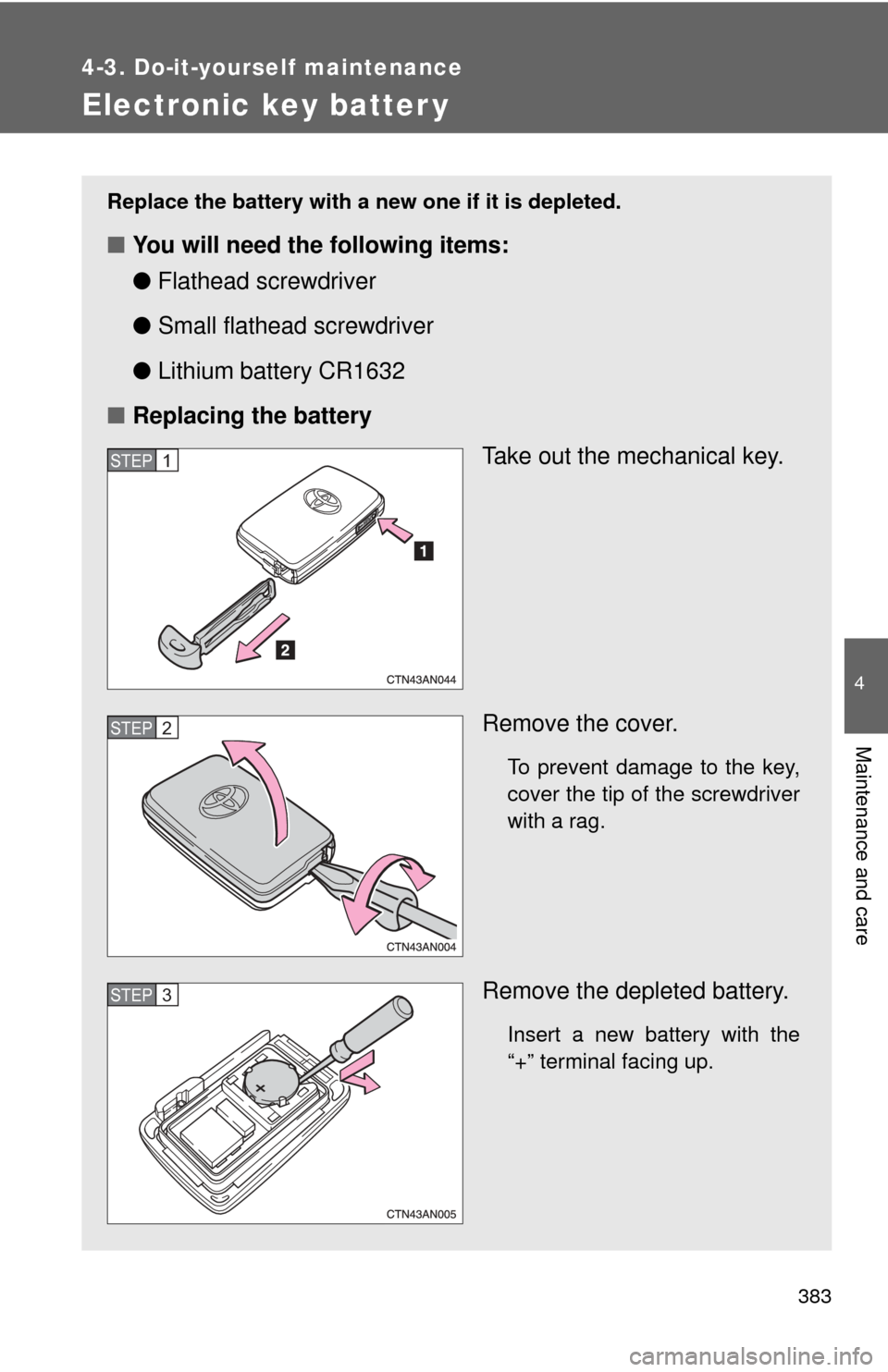
■ Replacing the battery
Take out the mechanical key.
Remove the cover.
To prevent damage to the key,
cover the tip of the screwdriver
with a rag.
Remove the depleted battery.
Insert a new battery with the
“+” terminal facing up.
STEP 1
STEP 2
STEP 3
Page 384 of 520
384 4-3. Do-it-yourself maintenance
■Use a CR1632 lithium battery
●Batteries can be purchased at your Toyota dealer, local electrical appli-
ance shops or camera stores.
● Replace only with the same or equivalent type recommended by the
manufacturer.
● Dispose of used batteries according to local laws.
■ If the electronic key battery is depleted
The following symptoms may occur.
●The smart key system and wireless remote control will not function prop-
erly.
● The operational range will be reduced.
CAUTION
■Removed electronic key battery and other parts
These parts are small and if swallowed by a child, they can cause choking.
Keep away from children. Failure to do so could result in death or serious
injury.
NOTICE
■For normal operation after re placing the electronic key battery
Observe the following precautions to prevent accidents.
● Always work with dry hands.
Moisture may cause the battery to rust.
● Do not touch or move any other component inside the remote control.
● Do not bend either of the battery terminals.
Page 389 of 520
389
4-3. Do-it-yourself maintenance
4
Maintenance and care
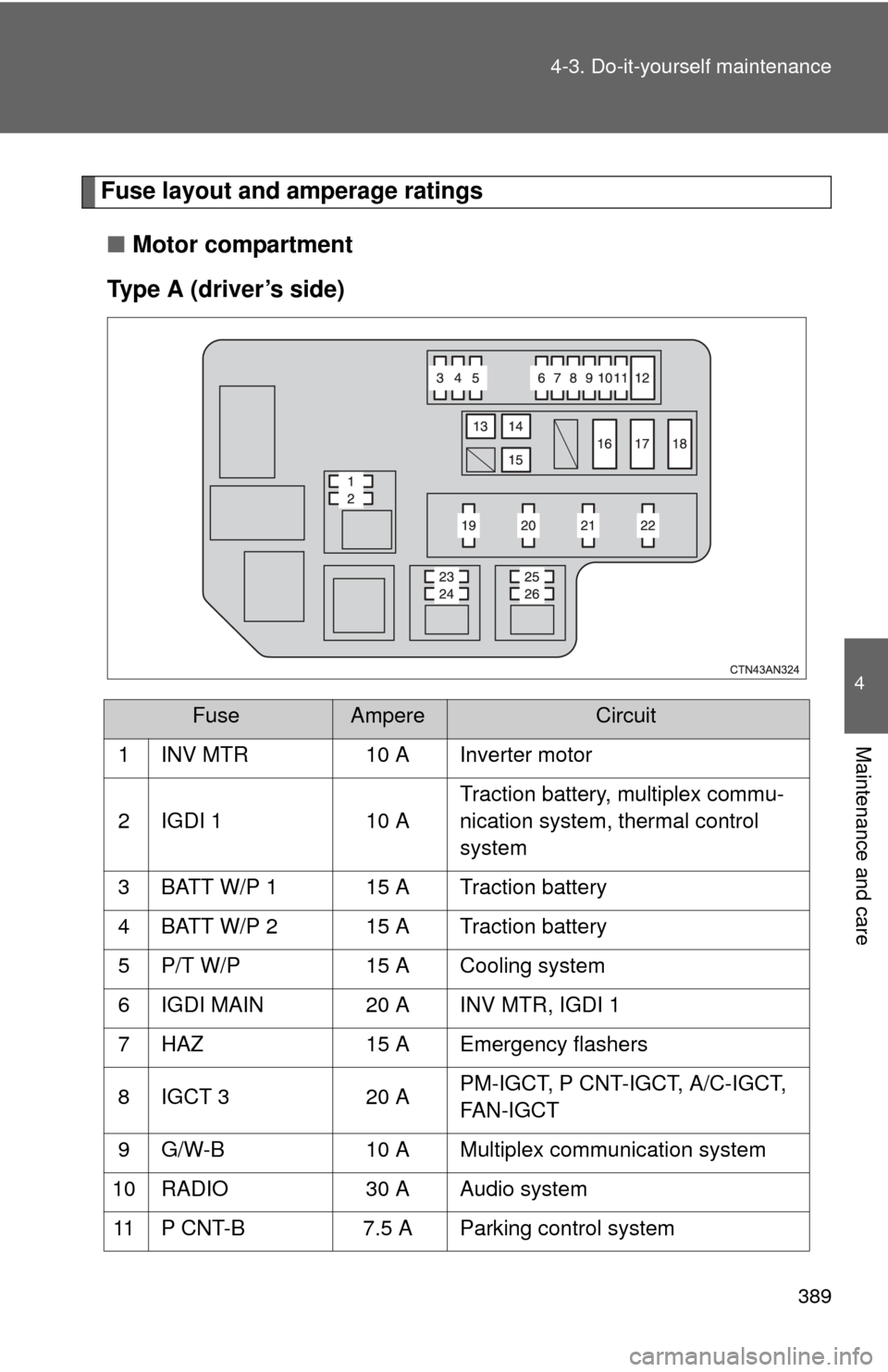
Fuse layout and amperage ratings
■ Motor compartment
Type A (driver’s side)
FuseAmpereCircuit
1 INV MTR 10 A Inverter motor
2 IGDI 1 10 A Traction battery, multiplex commu-
nication system, thermal control
system
3 BATT W/P 1 15 A Traction battery
4 BATT W/P 2 15 A Traction battery
5 P/T W/P 15 A Cooling system
6 IGDI MAIN 20 A INV MTR, IGDI 1
7 HAZ 15 A Emergency flashers
8 IGCT 3 20 A PM-IGCT, P CNT-IGCT, A/C-IGCT,
FA N -I G C T
9 G/W-B 10 A Multiplex communication system
10 RADIO 30 A Audio system 11 P CNT-B 7.5 A Parking control system
Page 390 of 520

390 4-3. Do-it-yourself maintenance
12 ABS 130 A Anti-lock brake system
13 ECB 1 50 AElectronically controlled brake sys-
tem
14 ECB 2 50 AElectronically controlled brake sys-
tem
15 W/P-IGCT 50 A P/T W/P, BATT W/P 1, BATT W/P 2
16 EPS 60 A Electric power steering
17 P/I 60 AIGCT-D, HORN, parking control
system, IG2
18 MAIN 60 AH-LP MAIN, DRL, ODS, smart key
system, ABS 2, steering lock sys-
tem, PM-B, ECU-B MAIN
19 CONTACTOR 15 A Traction battery, charging system
20 IG2 15 A Starting system
21
HORN 10 A Horn
22 IGCT-D 7.5 A Thermal control system, power
management ECU, parking control
system, multiplex communication
system
23 PM-IGCT 7.5 A Power management system
24 P CNT-IGCT 7.5 A Parking control system
25 A/C-IGCT 10 A Air conditioning system
26 FAN-IGCT 7.5 A Electric cooling fans
FuseAmpereCircuit
Page 392 of 520

392 4-3. Do-it-yourself maintenance
14 SMART7.5 A Smart key system
15 STRG LOCK 20 A Steering lock system
16 AM2 7.5 A Starting system
17 ABS 2 7.5 A Anti-lock brake system
18 PTC HTR 2 50 A Air conditioning system
19 PTC HTR 1 50 A Air conditioning system
20 PTC HTR 3 50 A Air conditioning system
21 CHARGER 5 A Charging system
22 IGCT 2 20 A THRML CTRL, G/W-IGCT
23 HV BATT 10 A Traction battery
24 PM-B 7.5 A Power management system
25 ODS 7.5 A Occupant classification system
26 HTR 50 A Air conditioning system
27 FAN 1 50 A Electric cooling fans
28 FAN 2 50 A Electric cooling fans
29 H-LP MAIN 40 A H-LP LH-LO, H-LP RH-LO, H-LP
LH-HI, H-LP RH-HI, manual head-
light leveling system, daytime run-
ning light system
30 ECU-B MAIN 30 A ECU-B 2, A/C-B
31 SPARE 5 A Spare fuse
32 SPARE 10 A Spare fuse
33 SPARE 20 A Spare fuse
FuseAmpereCircuit
Page 411 of 520
When trouble arises5
411
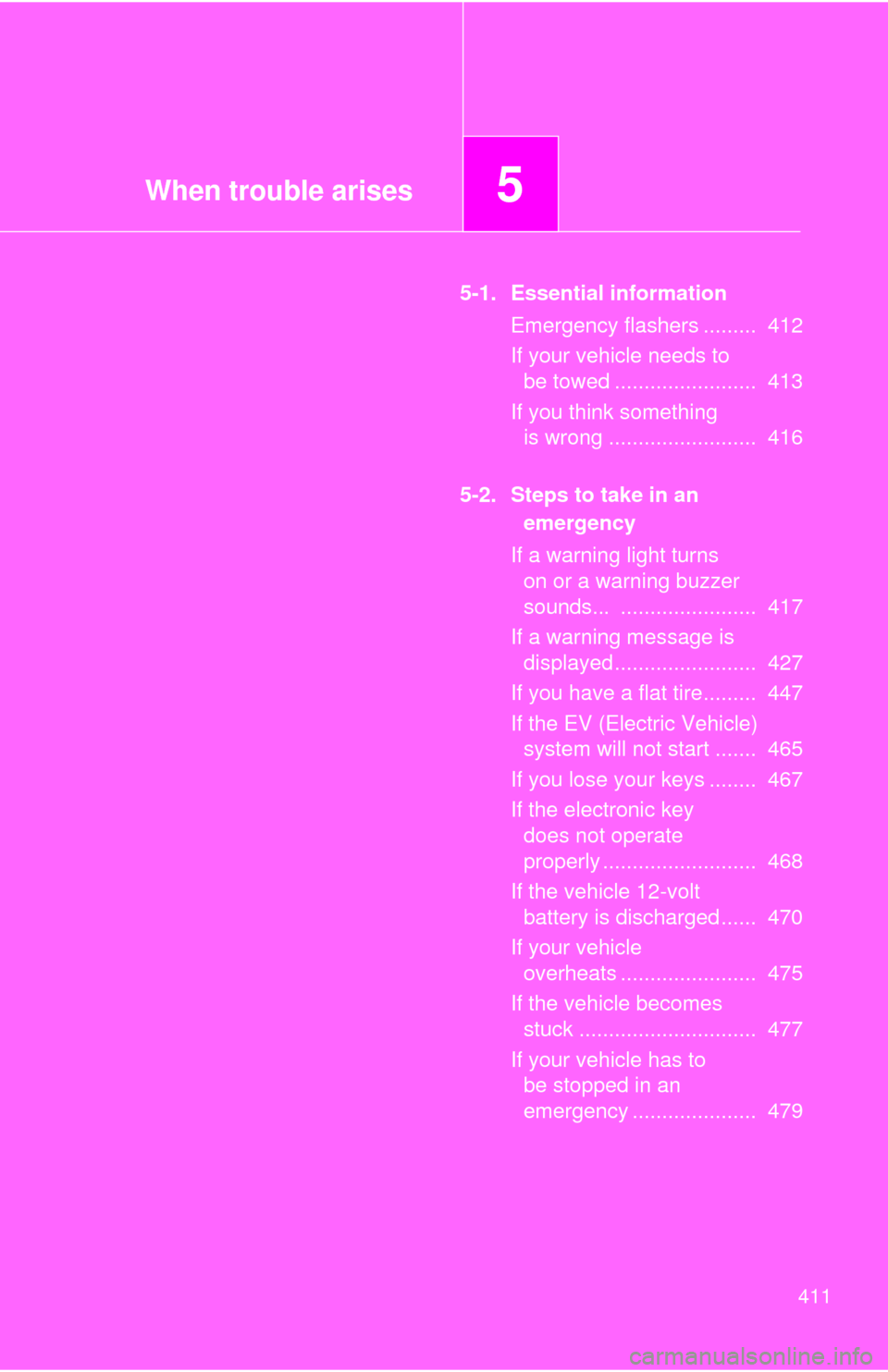
5-1. Essential informationEmergency flashers ......... 412
If your vehicle needs to be towed ........................ 413
If you think something is wrong ......................... 416
5-2. Steps to take in an emergency
If a warning light turns on or a warning buzzer
sounds... ....................... 417
If a warning message is displayed........................ 427
If you have a flat tire......... 447
If the EV (Electric Vehicle) system will not start ....... 465
If you lose your keys ........ 467
If the electronic key does not operate
properly .......................... 468
If the vehicle 12-volt battery is discharged ...... 470
If your vehicle overheats ....................... 475
If the vehicle becomes stuck .............................. 477
If your vehicle has to be stopped in an
emergency ..................... 479