brake TOYOTA RAV4 EV 2013 1.G Quick Reference Guide
[x] Cancel search | Manufacturer: TOYOTA, Model Year: 2013, Model line: RAV4 EV, Model: TOYOTA RAV4 EV 2013 1.GPages: 52, PDF Size: 8.18 MB
Page 33 of 52
OVERVIEWELECTRIC VEHICLE SYSTEM FEATURES/OPERATIONS
SAFETY AND EMERGENCY FEATURES
31
*
The regenerative brake is the equivalent of downshifting. Shift to “B” when
regenerative braking is desired (i.e. downhill driving, coasting to a stop, etc.).
Park button
Reverse
Neutral
Drive
Regenerative brake*
By increasing the motor’s output when compared to normal mode, the vehicle’s
acceleration power and maximum speed is increased. This mode provides a more
dynamic driving experience.
Refer to the Owner’s Manual for more details.
(1) Pull slightly
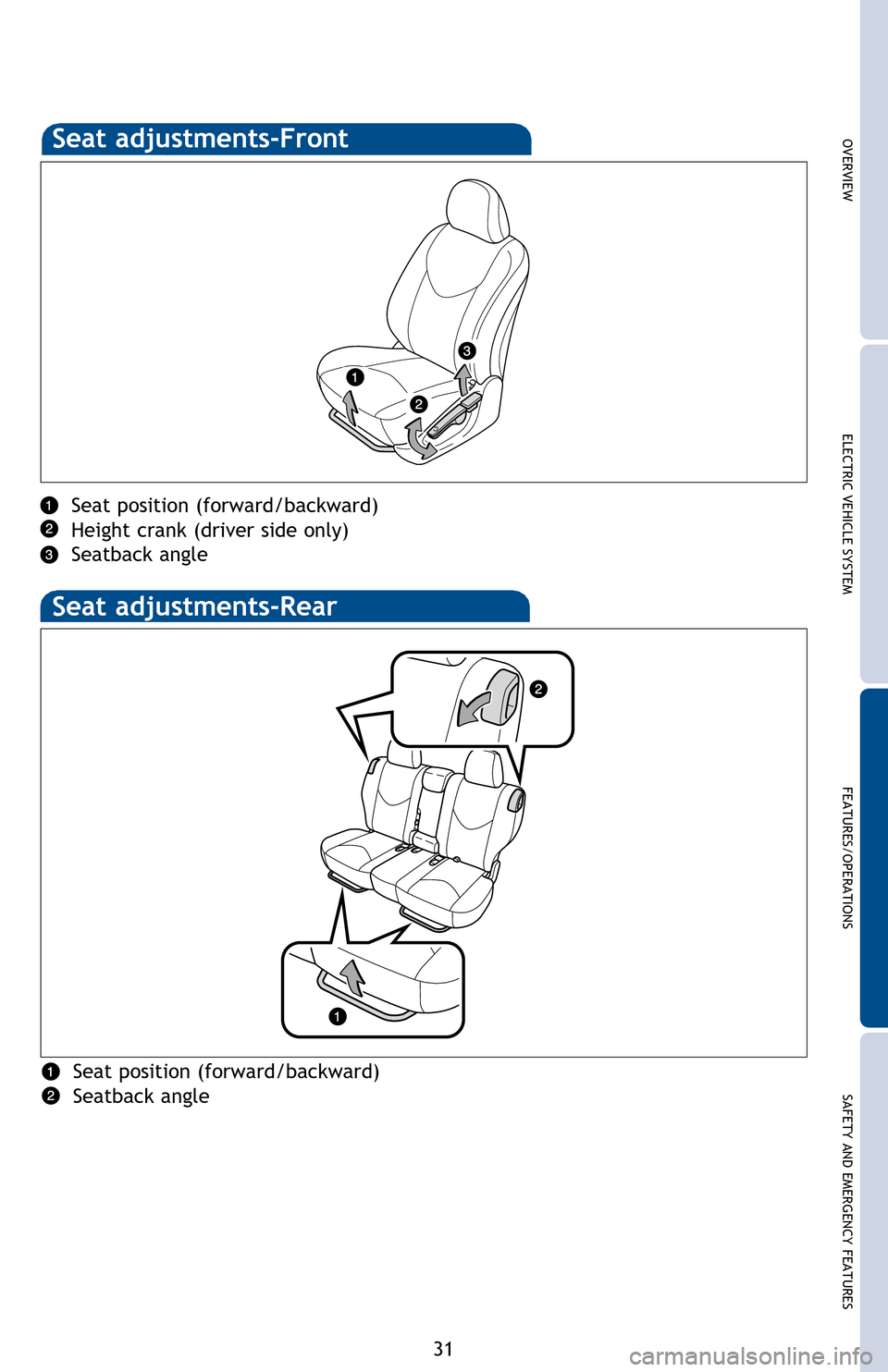
Seat adjustments-Rear
Seat position (forward/backward)
Seatback angle
Seat position (forward/backward)
Height crank (driver side only)
Seatback angle
Seat adjustments-Front
2013Rav4EV.indd 3112/3/12 11:39 PM
Page 34 of 52
32
FEATURES/OPERATIONS
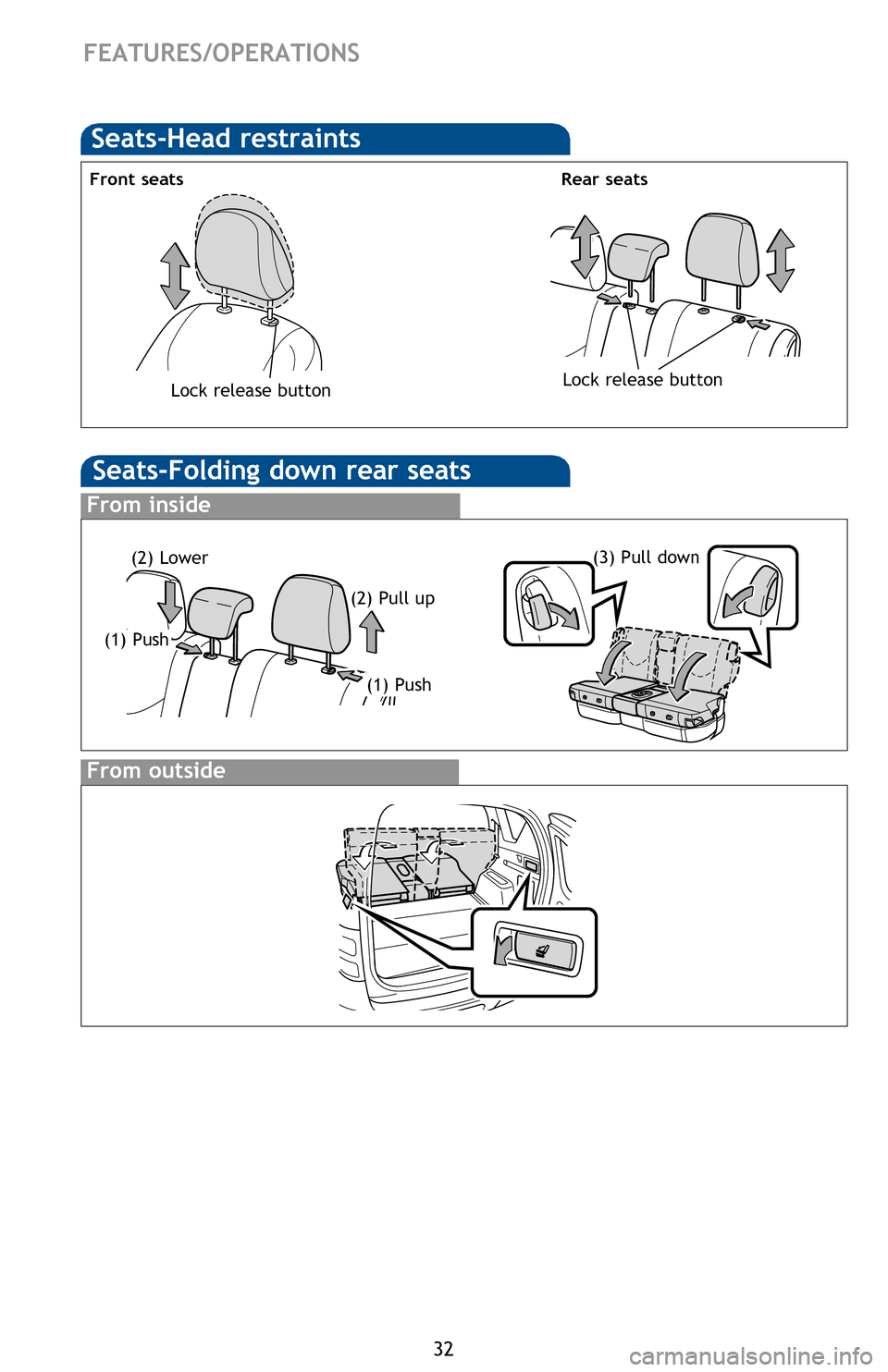
(2) Lower(3) Pull down
From inside
(1) Push
Seats-Folding down rear seats
(1) Push(2) Pull up
From outside
Seats-Head restraints
Front seatsRear seats
Lock release buttonLock release button
Lights & turn signals
Turn signals
Headlights
-Daytime Running Light system (DRL)
Automatically turns on the Daytime Running Lights after EV System is started
and parking brake released .
-Automatic light cut off system Automatically turns lights off after a delay
of 30 seconds, or the lock switch on remote may be pushed after locking.
2013Rav4EV.indd 3212/3/12 11:39 PM
Page 35 of 52
OVERVIEWELECTRIC VEHICLE SYSTEM FEATURES/OPERATIONS
SAFETY AND EMERGENCY FEATURES
33
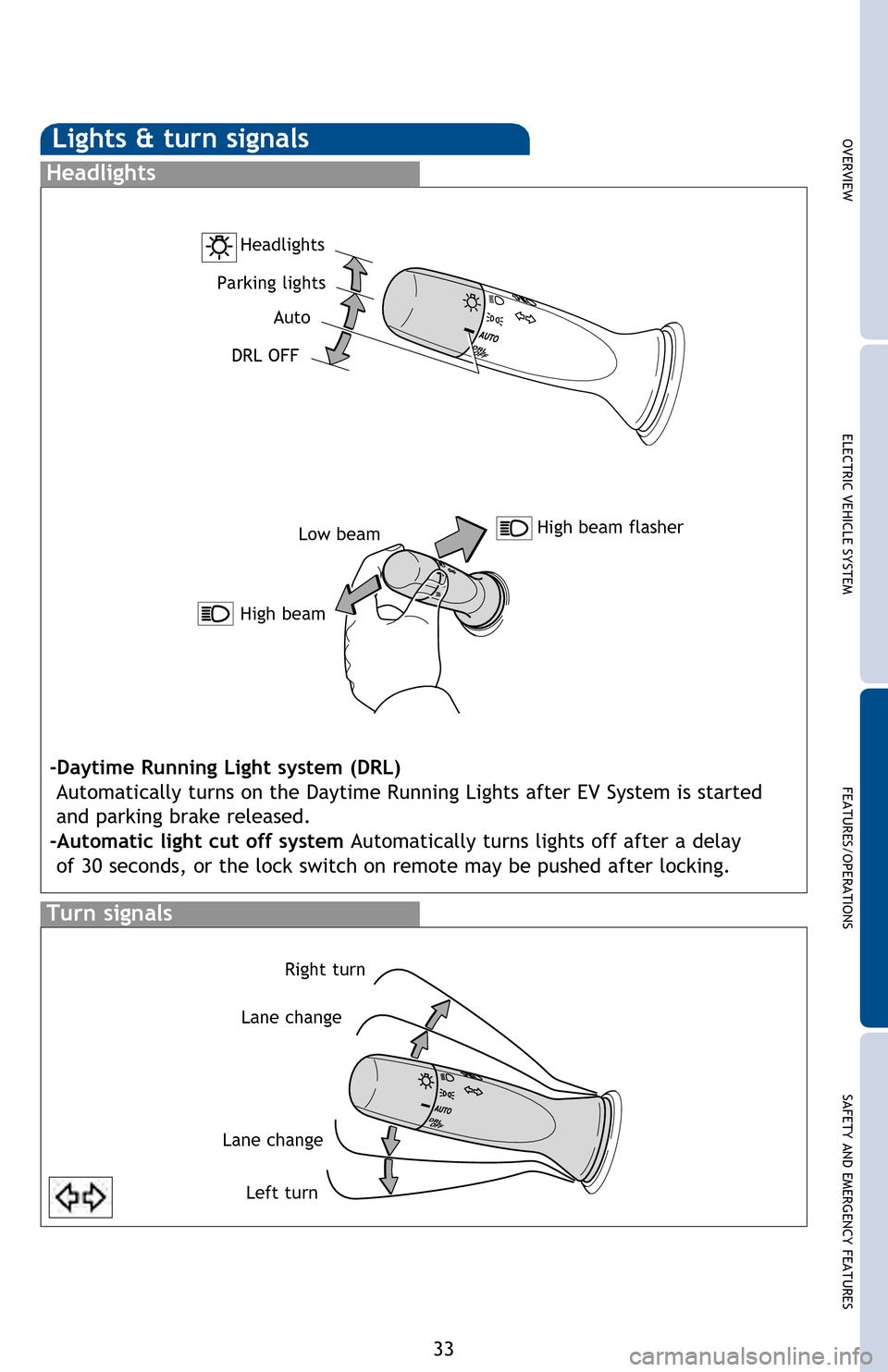
Lights & turn signals
Turn signals
Headlights
Low beam
-Daytime Running Light system (DRL)
Automatically turns on the Daytime Running Lights after EV System is started
and parking brake released .
-Automatic light cut off system Automatically turns lights off after a delay
of 30 seconds, or the lock switch on remote may be pushed after locking.
High beam flasher
High beam
Right turn
Lane change
Lane change Left turn
Headlights
Parking lights Auto
DRL OFF
2013Rav4EV.indd 3312/3/12 11:39 PM
Page 42 of 52
40
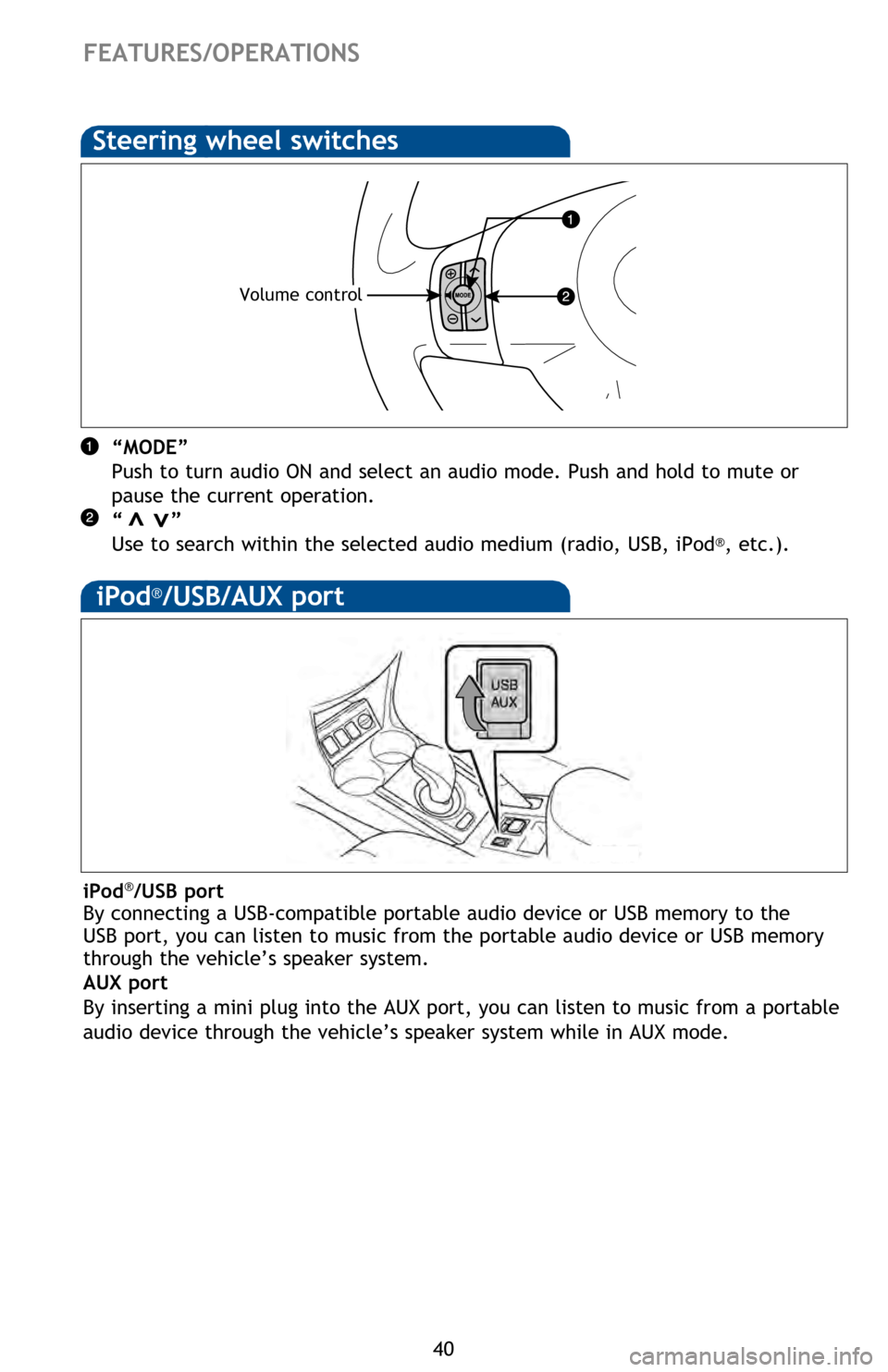
“MODE”
Push to turn audio ON and select an audio mode. Push and hold to mute or
pause the current operation.
“ ”
Use to search within the selected audio medium (radio, USB, iPod
®, etc.).>>
FEATURES/OPERATIONS
Volume control
iPod®/USB port
By connecting a USB-compatible portable audio device or USB memory to the
USB port, you can listen to music from the portable audio device or USB memory
through the vehicle’s speaker system.
AUX port
By inserting a mini plug into the AUX port, you can listen to music from a portable
audio device through the vehicle’s speaker system while in AUX mode.
Tilt and telescopic steering wheel
Hold wheel, push lever down, set angle and length, and return lever.
NOTE: Do not attempt to adjust while the vehicle is in motion.
Cruise control
Turning system ON/OFF
Functions
1 The set speed may also be cancelled by depressing the brake pedal.2 The set speed may be resumed once vehicle speed exceeds 25 mph.
Refer to the Owner’s Manual for more details.
Steering wheel switches
iPod®/USB/AUX port
2013Rav4EV.indd 4012/3/12 11:39 PM
Page 43 of 52
OVERVIEWELECTRIC VEHICLE SYSTEM FEATURES/OPERATIONS
SAFETY AND EMERGENCY FEATURES
41
“MODE”
Push to turn audio ON and select an audio mode. Push and hold to mute or
pause the current operation.
“ ”
Use to search within the selected audio medium (radio, USB, iPod
®, etc.).
iPod®/USB port
By connecting a USB-compatible portable audio device or USB memory to the
USB port, you can listen to music from the portable audio device or USB memory
through the vehicle’s speaker system.
AUX port
By inserting a mini plug into the AUX port, you can listen to music from a portable
audio device through the vehicle’s speaker system while in AUX mode.
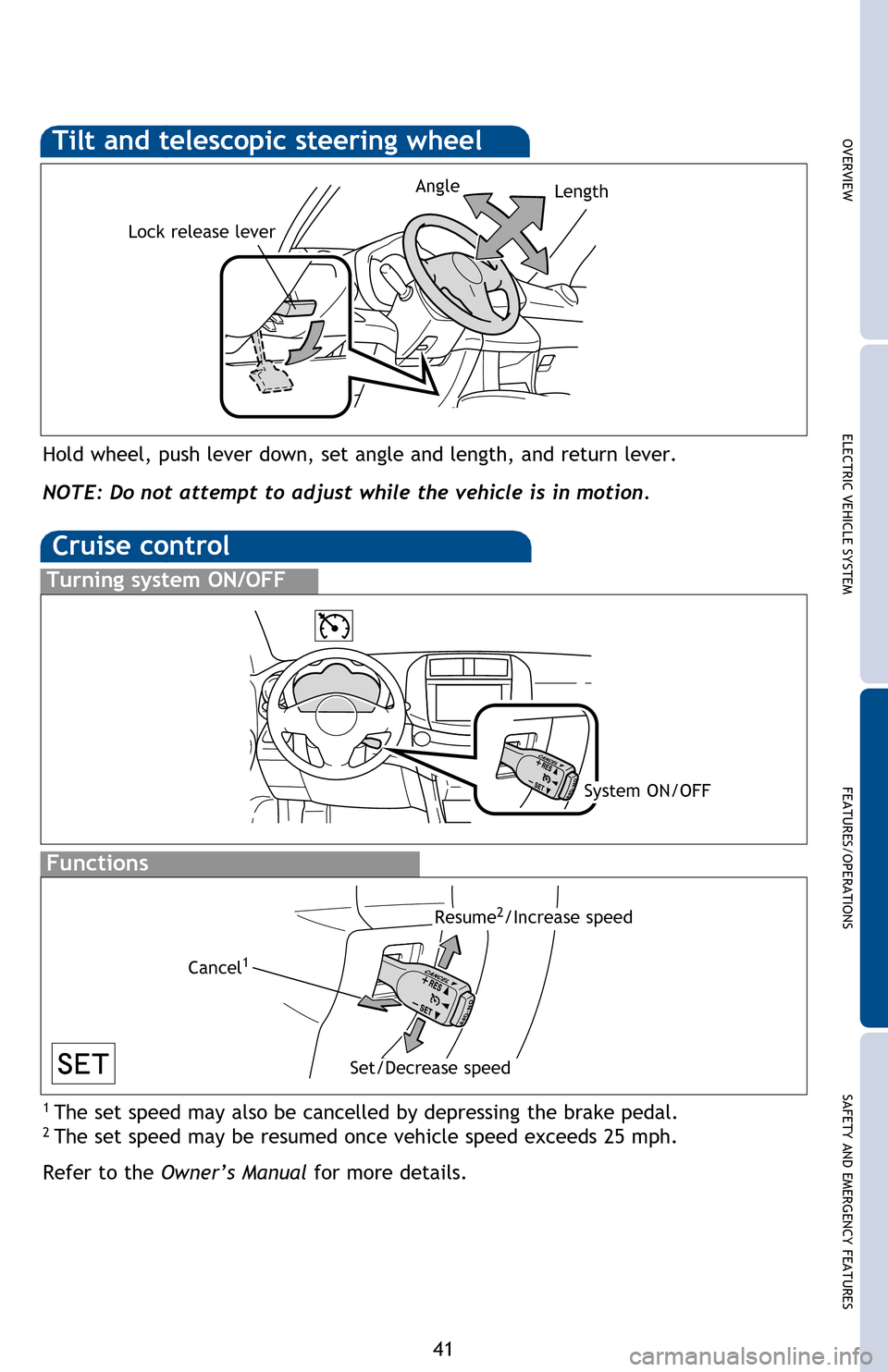
Tilt and telescopic steering wheel
Hold wheel, push lever down, set angle and length, and return lever.
NOTE: Do not attempt to adjust while the vehicle is in motion.
Lock release lever
AngleLength
Cruise control
Turning system ON/OFF
Functions
Resume2 /Increase speed
Set/Decrease speed
Cancel
1
1 The set speed may also be cancelled by depressing the brake
pedal.2 The set speed may be resumed once vehicle speed exceeds 25 mph.
Refer to the Owner’s Manual for more details.
System ON/OFF
2013Rav4EV.indd 4112/3/12 11:40 PM
Page 44 of 52
42
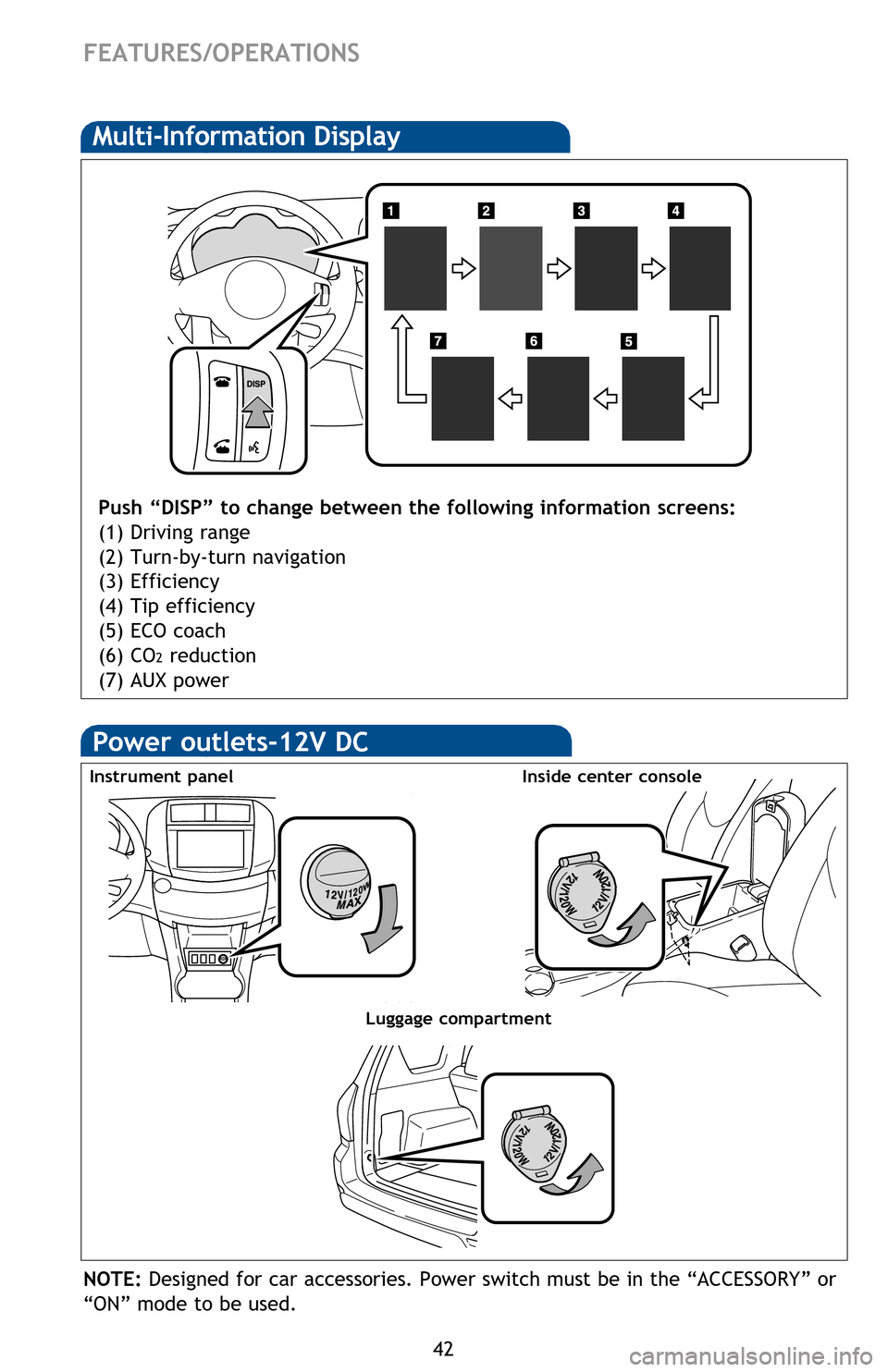
Power outlets-12V DC
NOTE: Designed for car accessories. Power switch must be in the “ACCESSORY” or
“ON” mode to be used.
FEATURES/OPERATIONS
Luggage compartment
HAC helps prevent rolling backwards on an incline. To engage, push further down
on brake pedal while at a complete stop until a beep sounds and slip indicator
illuminates. HAC holds for approximately two seconds after releasing brake pedal.
Refer to the Owner’s Manual for more details.
Multi-Information Display
Push “DISP” to change between the following information screens:
(1) Driving range
(2) Turn-by-turn navigation
(3) Efficiency
(4) Tip efficiency
(5) ECO coach
(6) CO
2 reduction
(7) AUX power
Inside center console
Instrument panel
Hill-start Assist Control (HAC)
The VSC OFF button is used to switch between modes related to the TRAC and VSC
functions.
Refer to Section 2-4 of the Owner’s Manual for more information.
VSC OFF button
2013Rav4EV.indd 4212/3/12 11:40 PM
Page 45 of 52
OVERVIEWELECTRIC VEHICLE SYSTEM FEATURES/OPERATIONS
SAFETY AND EMERGENCY FEATURES
43
NOTE: Designed for car accessories. Power switch must be in the “ACCESSORY” or
“ON” mode to be used.
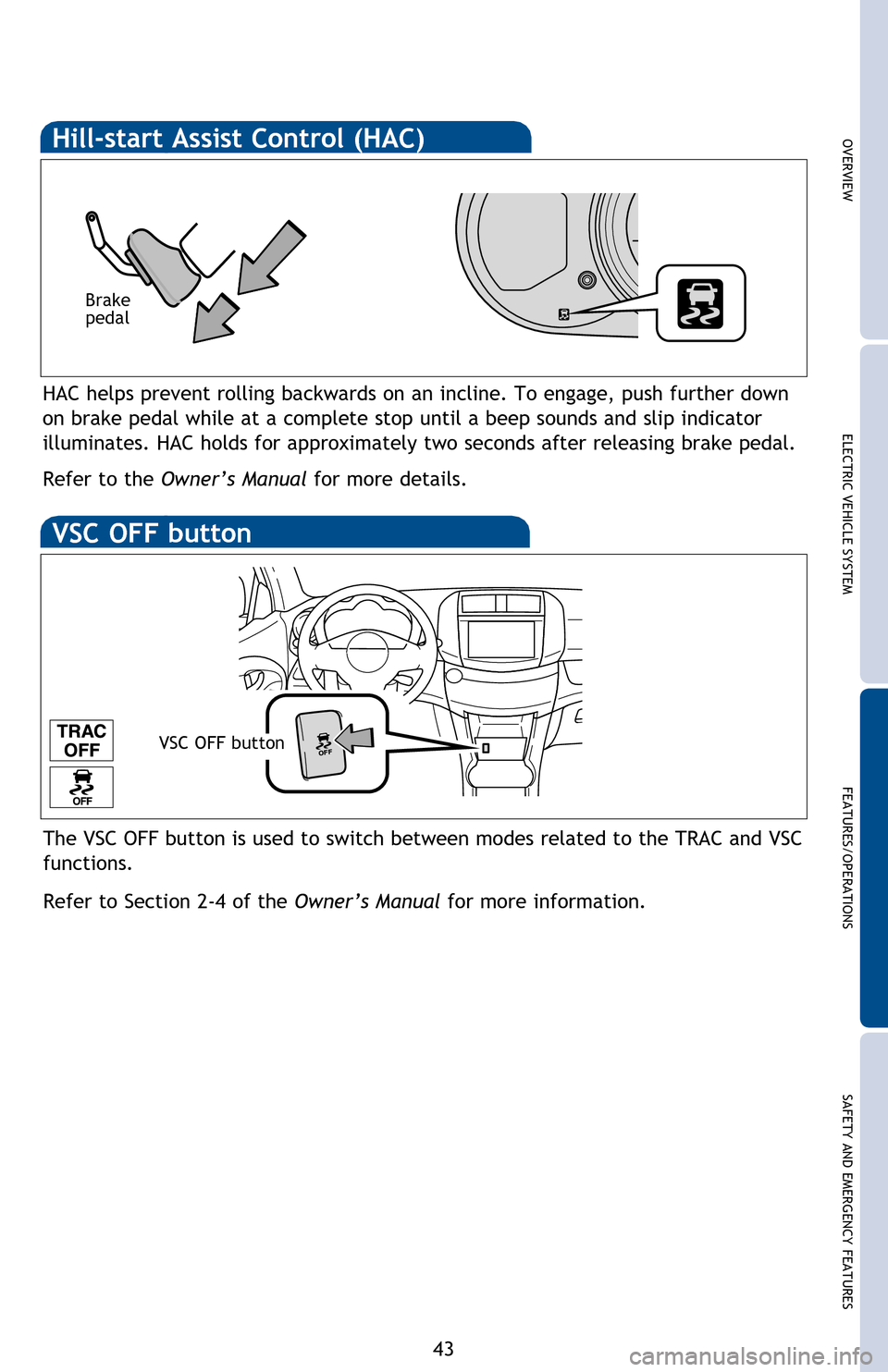
HAC helps prevent rolling backwards on an incline. To engage, push further down
on brake pedal while at a complete stop until a beep sounds and slip indicator
illuminates. HAC holds for approximately two seconds after releasing brake pedal.
Refer to the Owner’s Manual for more details.
Brake
pedal
Hill-start Assist Control (HAC)
The VSC OFF button is used to switch between modes related to the TRAC and VSC
functions.
Refer to Section 2-4 of the Owner’s Manual for more information.
VSC OFF button
VSC OFF button
2013Rav4EV.indd 4312/3/12 11:40 PM
Page 48 of 52
46
Star Safety SystemTM
VSC helps prevent loss of traction during cornering by reducing power from the EV
System and applying brake force to selected wheels.
Toyota’s VSC monitors steering angle and the direction your vehicle is traveling.
When it senses that the front or rear wheels begin to lose traction, VSC reduces
power from the EV System and applies braking to selected wheels. This helps
restore traction and vehicle control.
Vehicle Stability Control (VSC)
Anti-Lock Brake System (ABS)
ABS helps prevent brakes from locking up by “pulsing” brake pressure to each
wheel. This limits brake lockup and helps provide directional control for the
current road conditions.
Toyota’s ABS sensors detect which wheels are locking up and limits wheel lockup
by “pulsing” each wheel’s brakes independently. Pulsing releases brake pressure
repeatedly for fractions of a second. This helps the tires attain the traction that
current road conditions will allow, helping you to stay in directional control.
Brake Assist (BA)
Brake Assist is designed to detect sudden or “panic” braking, and then add braking
pressure to help decrease the vehicle’s stopping distance. When there’s only a
split second to react, Brake Assist can add additional brake pressure more quickly
than just the driver alone can. VSC helps prevent loss of traction during cornering by reducing power from the EV
System, and Traction Control helps maintain traction on loose gravel and wet, icy,
or uneven surfaces by applying brake force to the spinning wheel(s).
Toyota’s TRAC sensors are activated when one of the drive wheels starts to slip.
TRAC limits motor output and applies the brakes to the spinning wheel. This
transfers power to the wheels that still have traction to help keep you on track.
Traction Control (TRAC)
Electronic Brake Force Distribution (EBD)
Toyota’s ABS technology has Electronic Brake-force Distribution (EBD) to help
maintain control and balance when braking. Abrupt stops can cause a vehicle
to tilt forward, reducing the braking power of the rear wheels. EBD responds to
sudden stops by redistributing brake force to enhance the braking effectiveness of
all four wheels.
There are two types of Toyota floor mats: carpeted and all-weather. Each vehicle
has model-specific floor mats. Installation is easy.
To keep your floor mat properly positioned, follow these steps:
• Only use floor mats designed for your specific model.
• Use only one floor mat at a time, using the retaining hooks to keep the mat in
place.
• Install floor mats right side up.
Floor mat installation
SAFETY AND EMERGENCY FEATURES
All new Toyota vehicles come standard with the Star Safety SystemTM, which
combines Vehicle Stability Control (VSC), Traction Control (TRAC), Anti-lock Braking
System (ABS), Electronic Brake-force Distribution (EBD), Brake Assist (BA) and Smart
Stop Technology (SST).Smart Stop Technology automatically reduces driving torque when the accelerator
and brake pedals are pressed simultaneously.
SST engages when the accelerator is depressed first and the brakes are applied
firmly for longer than one-half second at speeds greater than five miles per hour.
SST doesn’t engage if the brake pedal is depressed before the accelerator pedal,
allowing vehicles to start on a steep hill and safely accelerate without rolling
backward.
Smart Stop Technology (SST)
2013Rav4EV.indd 4612/3/12 11:40 PM
Page 49 of 52
OVERVIEWELECTRIC VEHICLE SYSTEM FEATURES/OPERATIONS
SAFETY AND EMERGENCY FEATURES
47
VSC helps prevent loss of traction during cornering by reducing power from the EV
System and applying brake force to selected wheels.
Toyota’s VSC monitors steering angle and the direction your vehicle is traveling.
When it senses that the front or rear wheels begin to lose traction, VSC reduces
power from the EV System and applies braking to selected wheels. This helps
restore traction and vehicle control.
ABS helps prevent brakes from locking up by “pulsing” brake pressure to each
wheel. This limits brake lockup and helps provide directional control for the
current road conditions.
Toyota’s ABS sensors detect which wheels are locking up and limits wheel lockup
by “pulsing” each wheel’s brakes independently. Pulsing releases brake pressure
repeatedly for fractions of a second. This helps the tires attain the traction that
current road conditions will allow, helping you to stay in directional control.
Brake Assist is designed to detect sudden or “panic” braking, and then add braking
pressure to help decrease the vehicle’s stopping distance. When there’s only a
split second to react, Brake Assist can add additional brake pressure more quickly
than just the driver alone can. VSC helps prevent loss of traction during cornering by reducing power from the EV
System, and Traction Control helps maintain traction on loose gravel and wet, icy,
or uneven surfaces by applying brake force to the spinning wheel(s).
Toyota’s TRAC sensors are activated when one of the drive wheels starts to slip.
TRAC limits motor output and applies the brakes to the spinning wheel. This
transfers power to the wheels that still have traction to help keep you on track.
Toyota’s ABS technology has Electronic Brake-force Distribution (EBD) to help
maintain control and balance when braking. Abrupt stops can cause a vehicle
to tilt forward, reducing the braking power of the rear wheels. EBD responds to
sudden stops by redistributing brake force to enhance the braking effectiveness of
all four wheels.
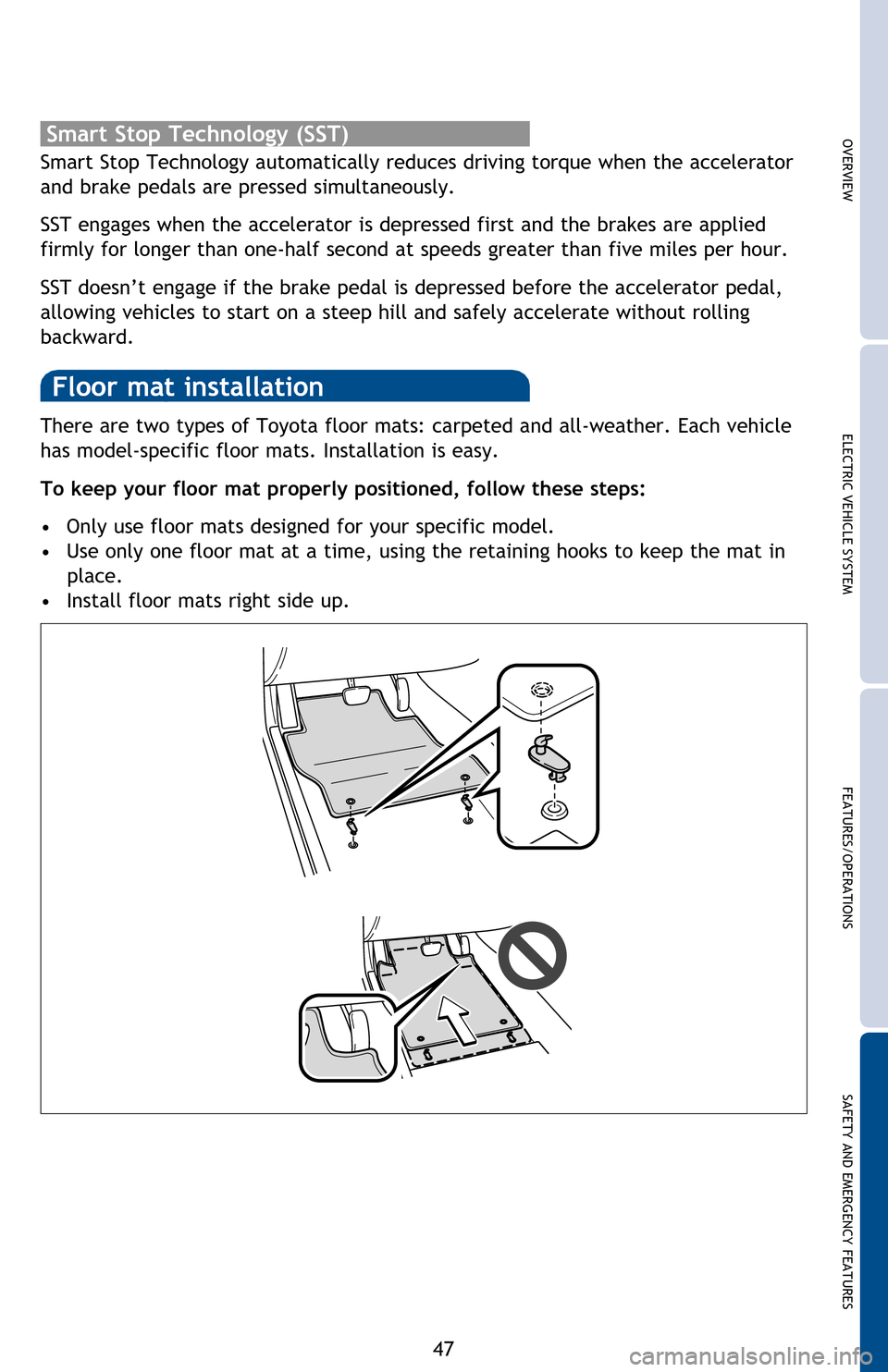
There are two types of Toyota floor mats: carpeted and all-weather. Each vehicle
has model-specific floor mats. Installation is easy.
To keep your floor mat properly positioned, follow these steps:
• Only
use floor mats designed for your specific model.
• Use
only one floor mat at a time, using the retaining hooks to keep the mat in
place.
•
Install
floor mats right side up.
Floor mat installation
SAFETY AND EMERGENCY FEATURES
All new Toyota vehicles come standard with the Star Safety SystemTM, which
combines Vehicle Stability Control (VSC), Traction Control (TRAC), Anti-lock Braking
System (ABS), Electronic Brake-force Distribution (EBD), Brake Assist (BA) and Smart
Stop Technology (SST).Smart Stop Technology automatically reduces driving torque when the accelerator
and brake pedals are pressed simultaneously.
SST engages when the accelerator is depressed first and the brakes are applied
firmly for longer than one-half second at speeds greater than five miles per hour.
SST doesn’t engage if the brake pedal is depressed before the accelerator pedal,
allowing vehicles to start on a steep hill and safely accelerate without rolling
backward.
Smart Stop Technology (SST)
2013Rav4EV.indd 4712/3/12 11:41 PM