fuel TOYOTA RAV4 HYBRID 2022 Owners Manual
[x] Cancel search | Manufacturer: TOYOTA, Model Year: 2022, Model line: RAV4 HYBRID, Model: TOYOTA RAV4 HYBRID 2022Pages: 752, PDF Size: 23.11 MB
Page 1 of 752
RAV4 HEV_OM_OM0R058U_(U)
1
2
3
4
5
6
7
8
9
10
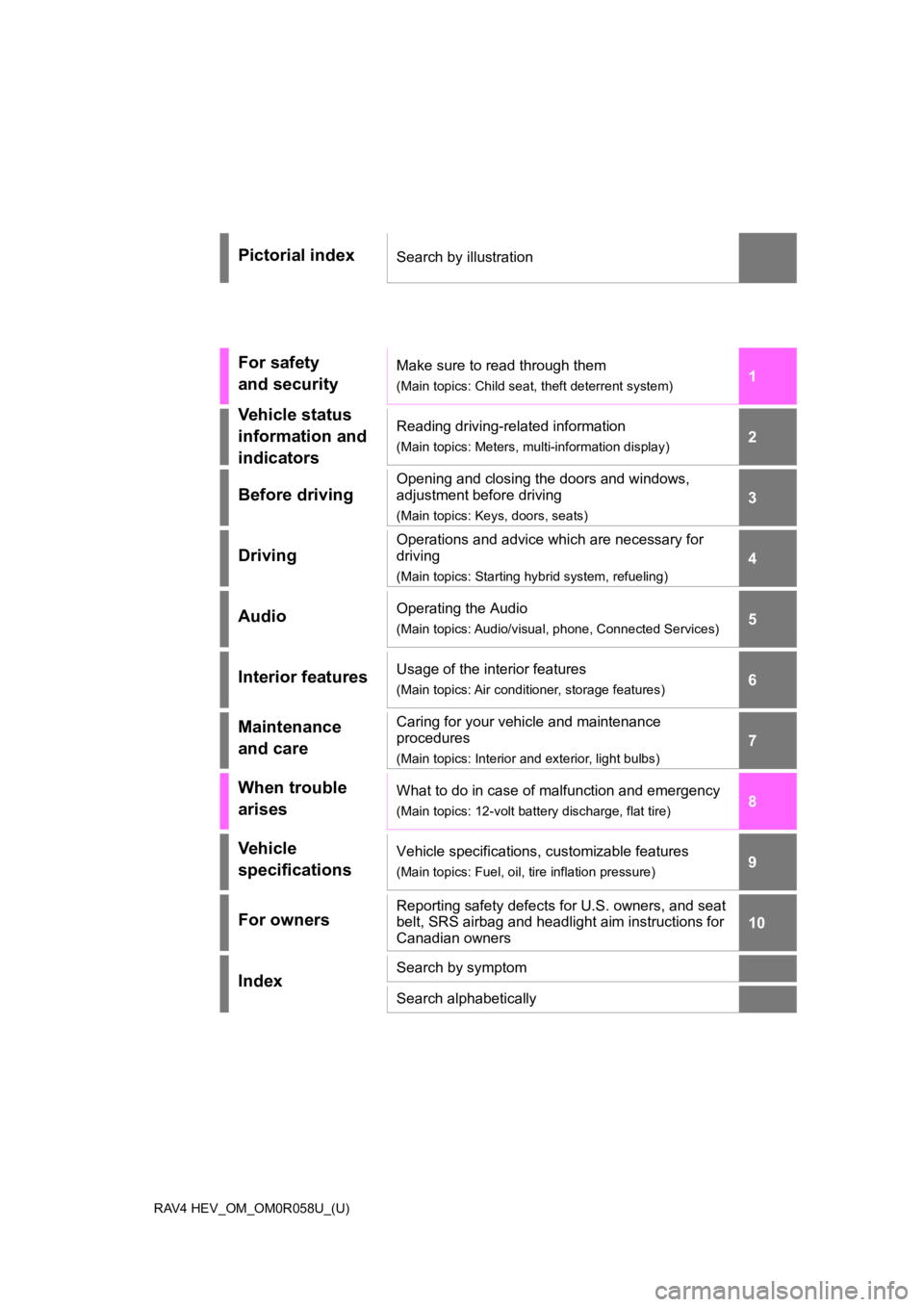
Pictorial indexSearch by illustration
For safety
and securityMake sure to read through them
(Main topics: Child seat, theft deterrent system)
Vehicle status
information and
indicatorsReading driving-related information
(Main topics: Meters, multi-information display)
Before driving
Opening and closing the doors and windows,
adjustment before driving
(Main topics: Keys, doors, seats)
Driving
Operations and advice which are necessary for
driving
(Main topics: Starting hybrid system, refueling)
AudioOperating the Audio
(Main topics: Audio/visual, phone, Connected Services)
Interior featuresUsage of the interior features
(Main topics: Air conditioner, storage features)
Maintenance
and careCaring for your vehicle and maintenance
procedures
(Main topics: Interior and exterior, light bulbs)
When trouble
arisesWhat to do in case of malfunction and emergency
(Main topics: 12-volt battery discharge, flat tire)
Vehicle
specificationsVehicle specifications, customizable features
(Main topics: Fuel, oil, tire inflation pressure)
For ownersReporting safety defects for U.S. owners, and seat
belt, SRS airbag and headlight aim instructions for
Canadian owners
IndexSearch by symptom
Search alphabetically
Page 3 of 752
3TABLE OF CONTENTS
1
2
3
4
5
6
7
8
9
10
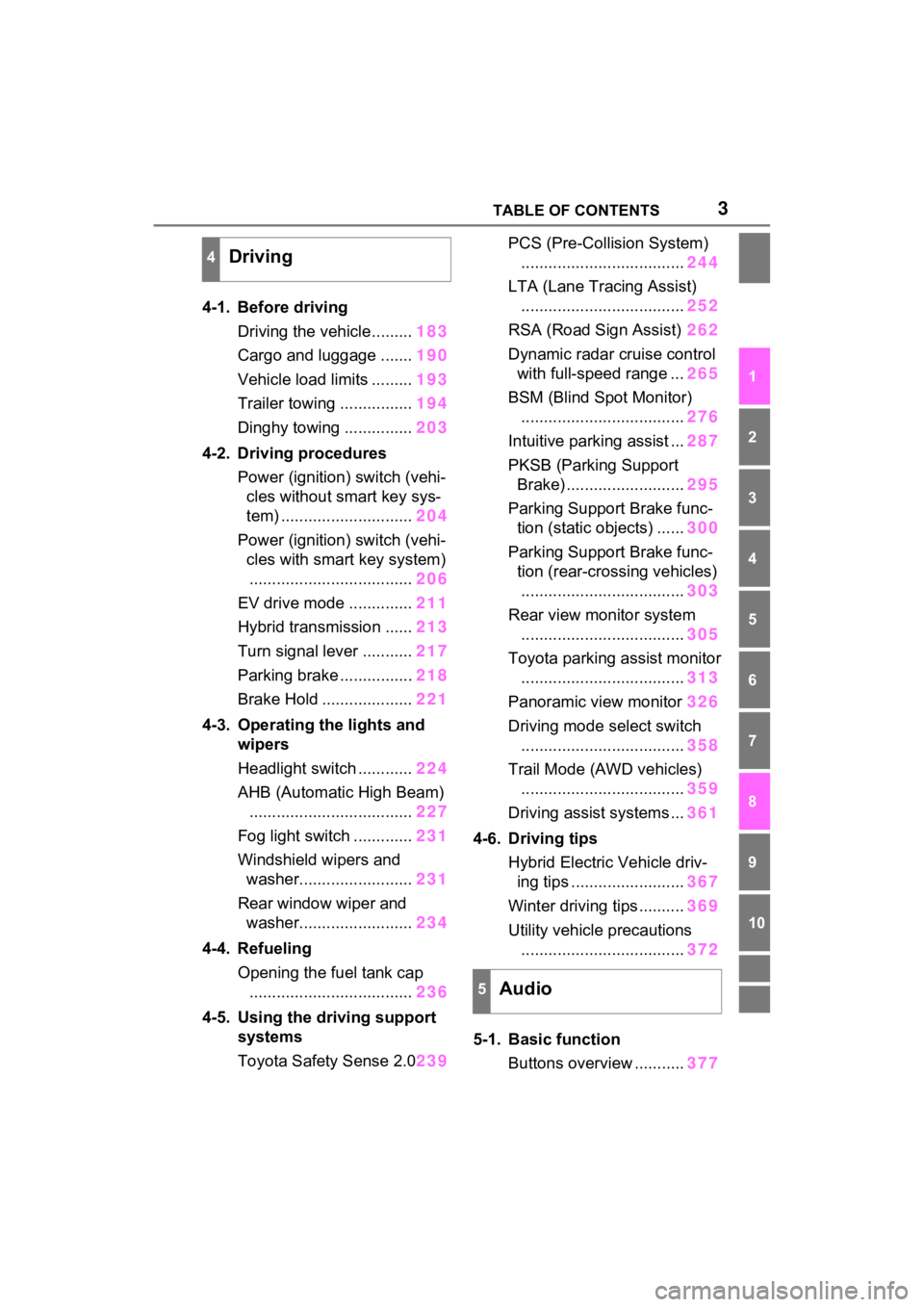
4-1. Before drivingDriving the vehicle......... 183
Cargo and luggage ....... 190
Vehicle load limits ......... 193
Trailer towing ................ 194
Dinghy towing ............... 203
4-2. Driving procedures Power (ignition) switch (vehi-cles without smart key sys-
tem) ............................. 204
Power (ignition) switch (vehi- cles with smart key system).................................... 206
EV drive mode .............. 211
Hybrid transmission ...... 213
Turn signal lever ........... 217
Parking brake ................ 218
Brake Hold .................... 221
4-3. Operating the lights and wipers
Headlight switch ............ 224
AHB (Automatic High Beam) .................................... 227
Fog light switch ............. 231
Windshield wipers and washer......................... 231
Rear window wiper and washer......................... 234
4-4. Refueling Opening the fuel tank cap.................................... 236
4-5. Using the driving support
systems
Toyota Safety Sense 2.0 239PCS (Pre-Collision System)
.................................... 244
LTA (Lane Tracing Assist) .................................... 252
RSA (Road Sign Assist) 262
Dynamic radar cruise control with full-speed range ... 265
BSM (Blind Spot Monitor) .................................... 276
Intuitive parking assist ... 287
PKSB (Parking Support Brake) .......................... 295
Parking Support Brake func- tion (static objects) ...... 300
Parking Support Brake func- tion (rear-crossing vehicles).................................... 303
Rear view monitor system .................................... 305
Toyota parking assist monitor .................................... 313
Panoramic view monitor 326
Driving mode s elect switch
.................................... 358
Trail Mode (AWD vehicles) .................................... 359
Driving assist systems ... 361
4-6. Driving tips Hybrid Electric Vehicle driv-ing tips ......................... 367
Winter d
riving tips .......... 369
Utility vehicle precautions .................................... 372
5-1. Basic function Buttons overview ........... 377
4Driving
5Audio
Page 6 of 752
6TABLE OF CONTENTS
Wireless remote control/elec-tronic key battery ......... 600
Checking and replacing fuses .................................... 603
Headlight aim ................ 606
Light bulbs..................... 607
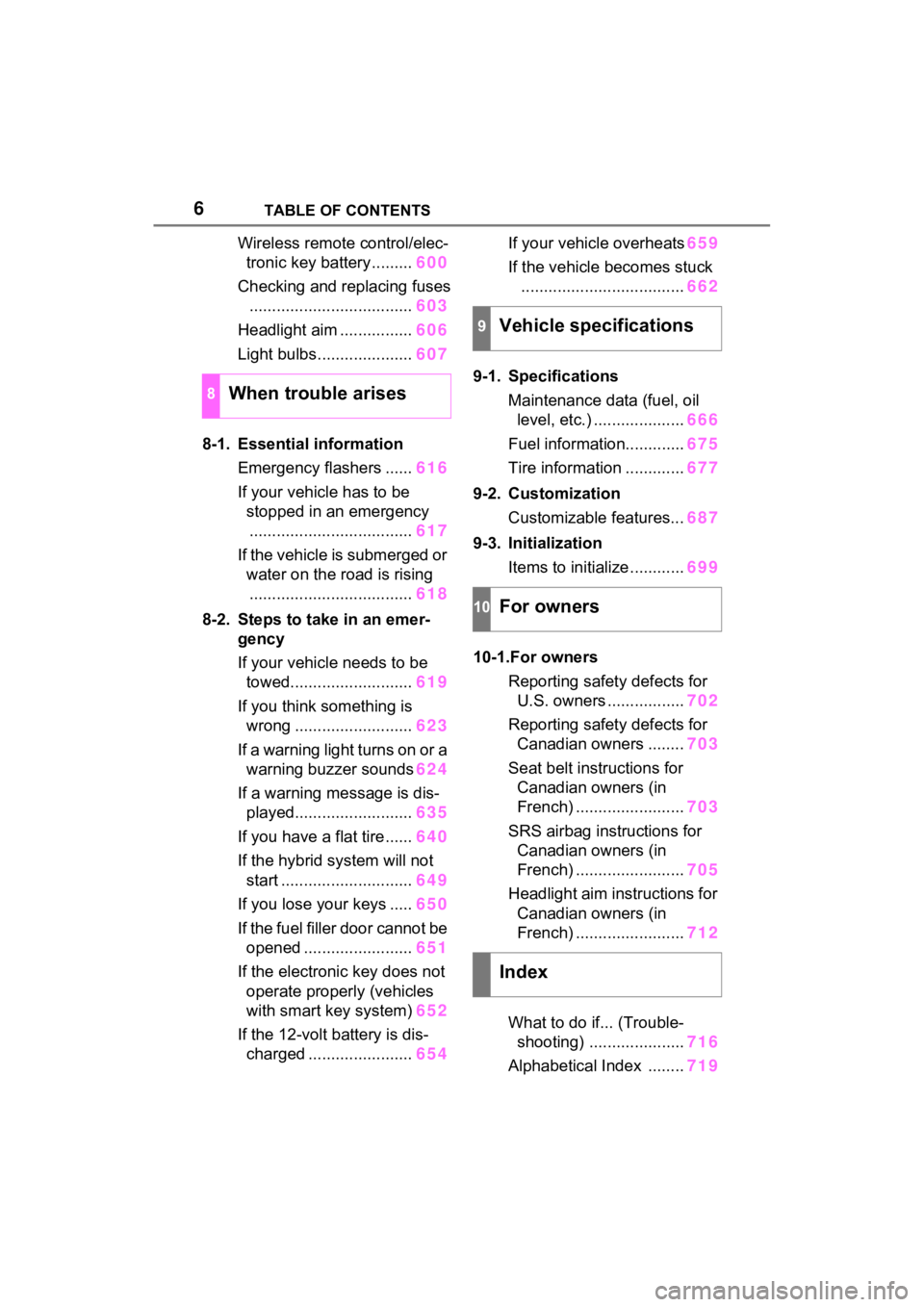
8-1. Essential information Emergency flashers ...... 616
If your vehicle has to be stopped in an emergency
.................................... 617
If the vehicle is submerged or water on the road is rising
.................................... 618
8-2. Steps to take in an emer- gency
If your vehicle needs to be
towed........................... 619
If you think something is wrong .......................... 623
If a warning light turns on or a warning buzzer sounds 624
If a warning message is dis- played.......................... 635
If you have a flat tire...... 640
If the hybrid system will not start ............................. 649
If you lose your keys ..... 650
If the fuel filler door cannot be opened ........................ 651
If the electronic key does not operate properly (vehicles
with smart key system) 652
If the 12-volt battery is dis- charged ....................... 654If your vehicle overheats
659
If the vehicle becomes stuck .................................... 662
9-1. Specifications Maintenance data (fuel, oil level, etc.) .................... 666
Fuel information............. 675
Tire information ............. 677
9-2. Customization Customizable features... 687
9-3. Initialization Items to initialize ............ 699
10-1.For owners Reporting safet y defects for
U.S. owners ................. 702
Reporting safet y defects for
Canadian owners ........ 703
Seat belt instructions for Canadian owners (in
French) ........................ 703
SRS airbag instructions for Canadian owners (in
French) ........................ 705
Headlight aim instructions for Canadian owners (in
French) ........................ 712
What to do if... (Trouble- shooting) ..................... 716
Alphabetical Index ........ 719
8When trouble arises
9Vehicle specifications
10For owners
Index
Page 8 of 752
8
Please note that this manual
applies to all models and
explains all equipment, including
options. Therefore, you may find
explanations for equipment not
installed on your vehicle and the
illustrations used may differ from
your vehicle.
All specifications provided in this
manual are current at the time of
printing. Over time, your vehicle
may receive updates that modify
the vehicle and make material in
this manual incomplete and/or
inaccurate. Because of Toyota’s
interest in continual product
improvement, Toyota reserves
the right to make changes to this
manual at any time without
notice.
If Toyota chooses to update the
manual, updated versions can
be viewed by selecting your
vehicle by model and year at the
following URL or on your mobile
device if you have access to the
Toyota app.
www.toyota.com/owners
Approximately five hours after
the hybrid system is turned off, you may hear sound coming
from under the vehicle for sev-
eral minutes. This is the sound
of a fuel evaporation leakage
check and, it does not indicate a
malfunction.
A wide variety of non-genuine
spare parts and accessories for
Toyota vehicles are currently
available in the market. You
should know that Toyota does
not warrant these products and
is not responsible for their per-
formance, repair, or replace-
ment, or for any damage they
may cause to, or adverse effect
they may have on, your Toyota
vehicle.
This vehicle should not be modi-
fied with non-genuine Toyota
products. Modification with non-
genuine Toyota products could
affect its performance, safety or
durability, and may even violate
governmental regulations. In
addition, damage or perfor-
mance problems resulting from
the modification may not be cov-
ered under warranty.
Also, remodeling like this will
have an effect on advanced
safety equipment such as
Toyota Safety Sense 2.0 and
there is a danger that it will not
For your information
Main Owner’s Manual
Noise from under vehicle
after turning off the hybrid
system
Accessories, spare parts
and modification of your
Toyota
Page 9 of 752

9
work properly or the danger that
it may work in situations where it
should not be working.
The installation of a mobile two-
way radio system in your vehicle
could affect electronic systems
such as:
Hybrid system
Multiport fuel injection sys-
tem/sequential multiport fuel
injection system
Toyota Safety Sense 2.0
Anti-lock brake system
SRS airbag system
Seat belt pretensioner system
Be sure to check with your
Toyota dealer for precautionary
measures or special instructions
regarding installation of a mobile
two-way radio system.
High voltage parts and cables
on the Hybrid Electric Vehicles
emit approximately the same
amount of electromagnetic
waves as the conventional gas-
oline powered vehicles or home
electronic appliances despite of
their electromagnetic shielding.
Unwanted noise may occur in
the reception of the mobile two-
way radio. The vehicle is equipped with
sophisticated computers that will
record certain data, such as:
• Engine speed/ Electric motor
speed (traction motor speed)
• Accelerator status
• Brake status
• Vehicle speed
• Operation status of the driving assist systems
• Images from the cameras Your vehicle is equipped with
cameras. Contact your
Toyota dealer for the location
of recording cameras.
• Hybrid battery (traction bat- tery) status
The recorded data varies
according to the vehicle grade
level and options with which it is
equipped.
These computers do not record
conversations or sounds, and
only record images outside of
the vehicle in certain situations.
Data Transmission
Your vehicle may transmit the data
recorded in these computers to
Toyota without notification to you.
Data usage
Toyota may use the data recorded
in this computer to diagnose mal-
functions, conduct research and
development, and improve quality.
Toyota will not disclose the
recorded data to a third party
except:
Installation of a mobile
two-way radio system
Vehicle data recording
Page 17 of 752
17Pictorial index
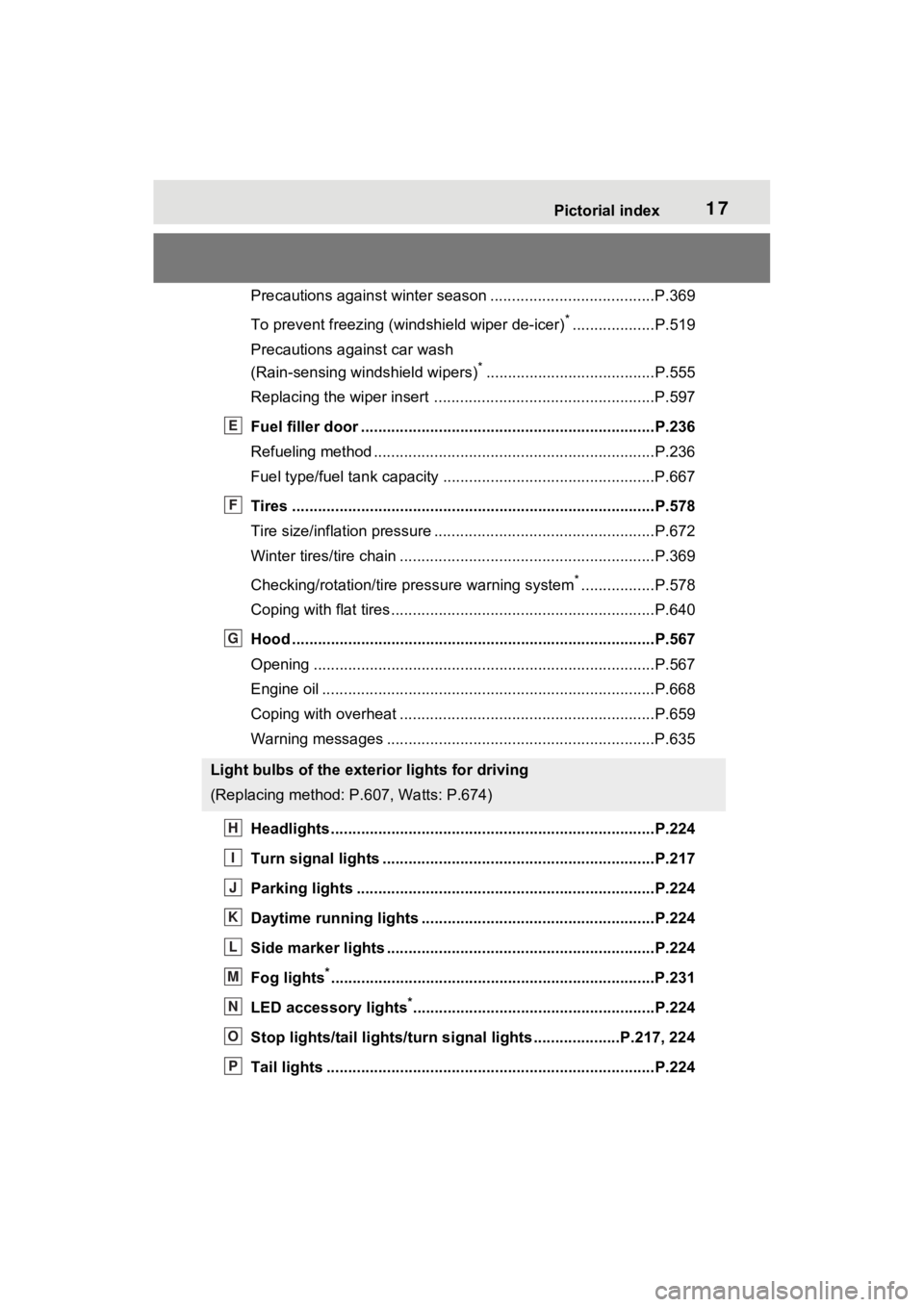
Precautions against winter season ......................................P.369
To prevent freezing (windshield wiper de-icer)
*...................P.519
Precautions against car wash
(Rain-sensing windshield wipers)
*.......................................P.555
Replacing the wiper insert .................................... ...............P.597
Fuel filler door ............................................... .....................P.236
Refueling method ............................................... ..................P.236
Fuel type/fuel tan k capacity .................................................P.667
Tires ....................................................................................P.578
Tire size/inflation pressure ................................... ................P.672
Winter tires/tire chain ........................................ ...................P.369
Checking/rotation/tire pressure warning system
*.................P.578
Coping with flat tires......................................... ....................P.640
Hood ....................................................................................P.567
Opening ........................................................ .......................P.567
Engine oil ..................................................... ........................P.668
Coping with overheat ........................................... ................P.659
Warning messages ..............................................................P.635
Headlights..................................................... ......................P.224
Turn signal lights ...............................................................P.217
Parking lights .....................................................................P.224
Daytime running lights .. ....................................................P.224
Side marker lights ............................................. .................P.224
Fog lights
*............................................................... ............P.231
LED accessory lights
*........................................................P.224
Stop lights/tail lights/turn s ignal lights ....................P.217, 224
Tail lights .................................................... ........................P.224
Light bulbs of the exterior lights for driving
(Replacing method: P.607, Watts: P.674)
E
F
G
H
I
J
K
L
M
N
O
P
Page 20 of 752

20Pictorial index
Energy monitor.....................................................................P.111
When the warning messages are displayed ........................ P.635
Turn signal lever ................................................................P.217
Headlight switch ................................................................P.224
Headlights/parking lights/tail lights/
license plate lights/day time running lights/LED accessory light s
*1
............................................................... ..............................P.224
Fog lights
*1............................................................... ............P.231
Windshield wiper and washer switch ..............................P.231
Rear window wiper and washer switch ...........................P.234
Usage.......................................................... .................P.231, 234
Adding washer fluid ..............................................................P.575
Warning messages ..............................................................P.635
Emergency flasher switch ....................................... ..........P.616
Hood lock release lever ........................................ .............P.567
Tilt and telescopic steering lock release lever ................P.157
Adjustment ..................................................... ......................P.157
Air conditioning system ............................. .......................P.514
Usage.......................................................... .........................P.514
Rear window defogger ........................................... ..............P.516
Audio
*1............................................................... .................P.377
Audio Plus
*1, 2
Premium Audio*1, 2
Fuel filler door opener swi tch ...........................................P.237
*1: If equipped
*2: Refer to “NAVIGATION AND MULTIMEDIA SYSTEM OWNER’S MAN-
UAL”.
E
F
G
H
I
J
K
L
Page 37 of 752

371-1. For safe use
1
For safety and security
Front passenger occupant classification system (ECU and sen-
sors)
Knee airbag
SRS warning light
Airbag sensor assembly
Your vehicle is equipped with ADVANCED AIRBAGS designed
based on the US motor vehicle safety standards (FMVSS208). The
airbag sensor assembly (ECU) cont rols airbag deployment based on
information obtained from the sensors etc. shown in the system
components diagram above. This in formation includes crash sever-
ity and occupant information. As the airbags deploy, a chemical
reaction in the inflators quickly fills the airbags with non-toxic gas to
help restrain the motion of the occupants.
■If the SRS airbags deploy
(inflate)
●Slight abrasions, burns, bruising
etc., may be sustained from SRS
airbags, due to the extremely high
speed deployment (inflation) by
hot gases.
●A loud noise and white powder will
be emitted.
●Parts of the airbag module (steer-
ing wheel hub, airbag cover and
inflator) as well as the front seats,
parts of the front and rear pillars,
and roof side rails, may be hot for
several minutes. T he airbag itself
may also be hot.
●The windshield may crack.
●The hybrid system will be stopped
and fuel supply to the engine will
be stopped. ( P.80)
●The brakes and st op lights will be
controlled automatically.
( P.362)
●The interior lights will turn on auto-
matically. ( P.525)
●The emergency flashers will turn
on automatically. ( P.616)
●For Safety Connect subscribers, if
any of the followin g situations occur, the system is designed to
send an emergency call to the
response center, notifying them of
the vehicle’s location (without
needing to push the “SOS” button)
and an agent will attempt to speak
with the occupants to ascertain
the level of emergency and assis-
tance required. If the occupants
are unable to communicate, the
agent automatically treats the call
as an emergency and helps to dis-
patch the necessary emergency
services. (
P.67)
• An SRS airbag is deployed.
• A seat belt pretensioner is acti- vated.
• The vehicle is involved in a severe rear-end collision.
■SRS airbag deployment condi-
tions (SRS front airbags)
●The SRS front airbags will deploy
in the event of an impact that
exceeds the set threshold level
(the level of forc e corresponding
to an approximately 12 - 18 mph
[20 - 30 km/h] frontal collision with
a fixed wall that does not move or
deform).
However, this threshold velocity will
be considerably higher in the follow-
ing situations:
N
O
P
Q
Page 71 of 752
711-3. Emergency assistance
1
For safety and security
cle’s location, assess the emer-
gency, and dispatch the
necessary assistance required.
If you accidentally press the “SOS”
button, tell the response-center
agent that you are not experiencing
an emergency.
■Enhanced Roadside Assis-
tance
Enhanced Roadside Assistance
adds GPS data to the already
included warranty-based Toyota
roadside service.
Subscribers can press the
“SOS” button to reach a Safety
Connect response-center agent,
who can help with a wide range
of needs, such as: towing, flat
tire, fuel delivery, etc. For a
description of the Enhanced
Roadside Assistance services
and their limitations, please see
the Safety Connect Terms and
Conditions, which are available
at Toyota.com in the United
States, Toyotapr.com in Puerto
Rico and Toyota.ca in Canada.
Important! Read this informa-
tion before using Safety Con-
nect.
■Exposure to radio fre-
quency signals
The Safety Connect system
installed in your vehicle is a low-
power radio transmitter and receiver. It receives and also
sends out radio frequency (RF)
signals.
In August 1996, the Federal
Communications Commission
(FCC) adopted RF exposure
guidelines with safety levels for
mobile wireless phones. Those
guidelines are consistent with
the safety standards previously
set by the following U.S. and
international standards bodies.
ANSI (American National
Standards Institute) C95.1
[1992]
NCRP (National Council on
Radiation Protection and
Measurement) Report 86
[1986]
ICNIRP (International Com-
mission on Non-Ionizing Radi-
ation Protection) [1996]
Those standards were based on
comprehensive and periodic
evaluations of the relevant sci-
entific literature. Over 120 scien-
tists, engineers, and physicians
from universities, and govern-
ment health agencies and
industries reviewed the avail-
able body of research to
develop the ANSI Standard
(C95.1).
The design of Safety Connect
complies with the FCC guide-
lines in addition to those stan-
dards.
Safety information for
Safety Connect
Page 72 of 752
721-4. Hybrid system
1-4.Hybrid system
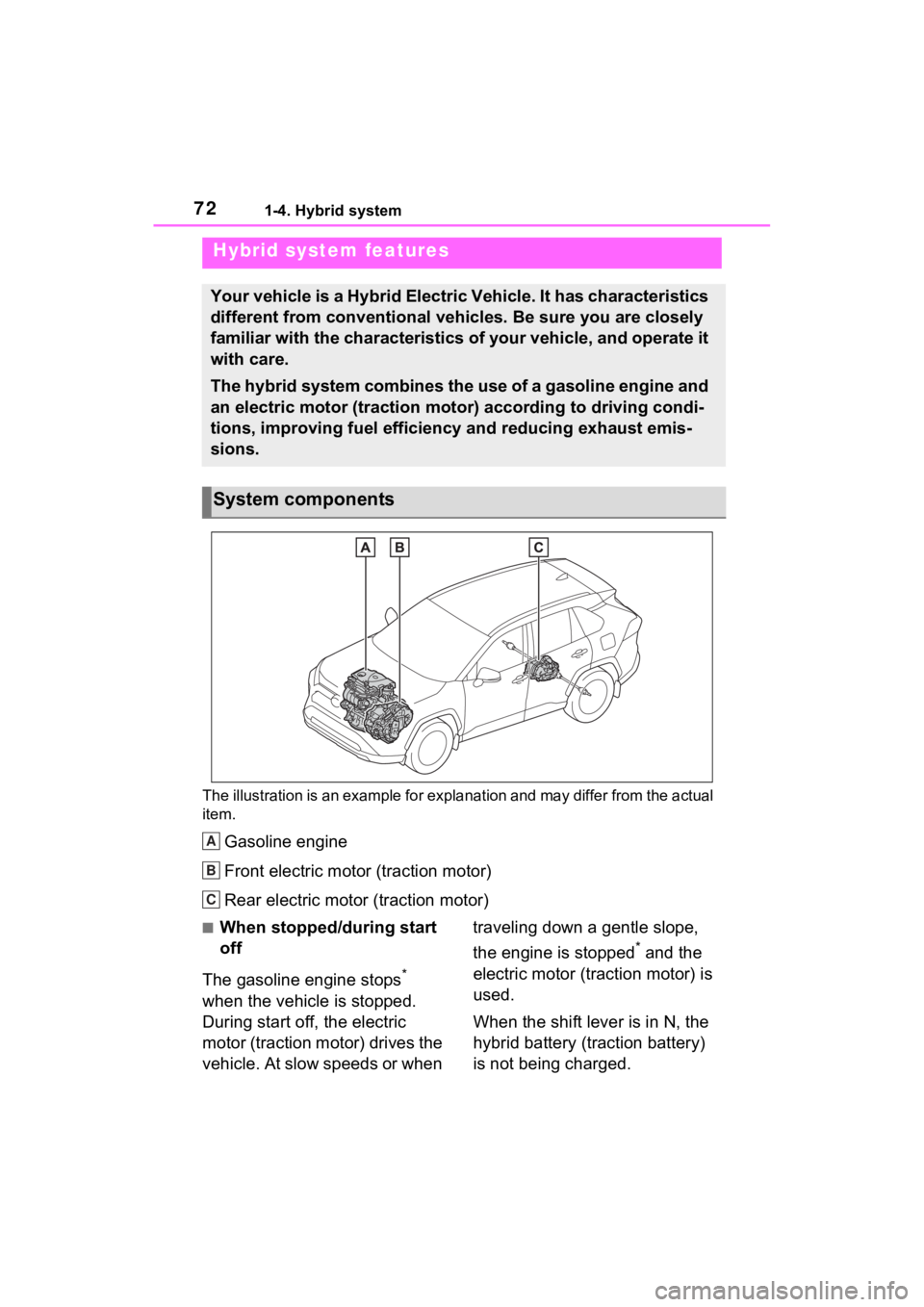
The illustration is an example for explanation and may differ from the actual
item.
Gasoline engine
Front electric motor (traction motor)
Rear electric motor (traction motor)
■When stopped/during start
off
The gasoline engine stops
*
when the vehicle is stopped.
During start off, the electric
motor (traction motor) drives the
vehicle. At slow speeds or when traveling down a gentle slope,
the engine is stopped
* and the
electric motor (traction motor) is
used.
When the shift lever is in N, the
hybrid battery (traction battery)
is not being charged.
Hybrid system features
Your vehicle is a Hybrid Electric Vehicle. It has characteristi cs
different from conventional vehicles. Be sure you are closely
familiar with the characteristics of your vehicle, and operate it
with care.
The hybrid system combines the use of a gasoline engine and
an electric motor (traction motor) according to driving condi-
tions, improving fuel efficiency and reducing exhaust emis-
sions.
System components
A
B
C