wheel TOYOTA RAV4 PRIME 2022 Owners Manual
[x] Cancel search | Manufacturer: TOYOTA, Model Year: 2022, Model line: RAV4 PRIME, Model: TOYOTA RAV4 PRIME 2022Pages: 624, PDF Size: 24.01 MB
Page 3 of 624

3TABLE OF CONTENTS
1
2
3
4
5
6
7
8
9
10
Back door ......................203
Smart key system ......... 217
4-3. Adjusting the seats Front seats .................... 222
Rear seats..................... 223
Driving position memory 225
Head restraints.............. 228
4-4. Adjusting the steering wheel and mirrors
Steering wheel .............. 230
Inside rear view mirror .. 231
Digital Rear-view Mirror 232
Outside rear view mirrors .................................... 242
4-5. Opening, closing the win- dows and moon roof
Power windows ............. 244
Moon roof ...................... 247
Panoramic moon roof.... 250
5-1. Before driving Driving the vehicle......... 256
Cargo and luggage ....... 263
Vehicle load limits ......... 266
Trailer towing ................ 267
Dinghy towing ............... 276
5-2. Driving procedures Power (ignition) switch .. 277
Hybrid transmission ...... 282
Turn signal lever ........... 286
Parking brake ................ 287
Brake Hold .................... 2915-3. Operating the lights and
wipers
Headlight switch ............ 293
AHB (Automatic High Beam) .................................... 296
Windshield wipers and washer ......................... 299
Rear window wiper and washer ......................... 302
5-4. Refueling Opening the fuel tank cap.................................... 304
5-5. Using the driving support systems
Toyota Safety Sense 2.0 307
PCS (Pre-Collision System) .................................... 313
LTA (Lane Tracing Assist) .................................... 321
RSA (Road Sign Assist) 331
Dynamic radar cruise control with full-speed range ... 334
BSM (Blind Spot Monitor) .................................... 345
Intuitive parking assist ... 355
PKSB (Parking Support Brake) .......................... 363
Parking Support Brake func- tion (static objects) ...... 368
Parking Support Brake func- tion (rear-crossing vehicles)
. ... ...
............................. 371
Driving mode s elect switch
.................................... 372
Trail Mode ..................... 374
Driving assist systems ... 375
5-6. Driving tips Winter driving tips .......... 382
5Driving
Page 4 of 624

4TABLE OF CONTENTS
Utility vehicle precautions.................................... 385
6-1. Using the air conditioning
system and defogger
Automatic air conditioning system ......................... 390
Remote Air Conditioning Sys- tem .............................. 399
Heated steering wheel/Front seat heaters/Front seat
heaters and ventilators/Rear
seat heaters ................ 401
6-2. Using the interior lights Interior lights list ............ 404
6-3. Using the storage features List of storage features . 407
Luggage compartment fea- tures ............................ 411
6-4. Using the other interior fea- tures
Other interior features ... 414
Power outlet (AC 120 V/1500 W)................................ 424
When the power outlet (AC 120 V 1500 W) cannot be
used properly .............. 430
Garage door opener...... 432
7-1. Maintenance and care Cleaning and protecting the vehicle exterior ............ 440
Cleaning and protecting the vehicle interior ............. 4437-2. Maintenance
Maintenance requirements.................................... 446
General maintenance .... 447
Emission inspection and maintenance (I/M) programs.................................... 450
7-3. Do-it-yourself maintenance Do-it-yourself service precau-tions ............................. 451
Hood .............................. 453
Positioning a floor jack .. 454
Engine compartment ..... 456
12-volt battery................ 462
Tires .............................. 464
Tire inflation pressure .... 474
Wheels .......................... 476
Air conditioning filter ...... 477
Cleaning the DC/DC Con- verter air intake vent and fil-
ter ................................ 480
Wiper insert replacement .................................... 483
Electronic key battery .... 487
Checking and replacing fuses .................................... 489
Headlight aim ................ 491
Light bulbs ..................... 492
8-1. Essential information Emergency flashers....... 498
If your vehicle has to be stopped in an emergency.................................... 499
6Interior features
7Maintenance and care
8When trouble arises
Page 19 of 624
19Pictorial index
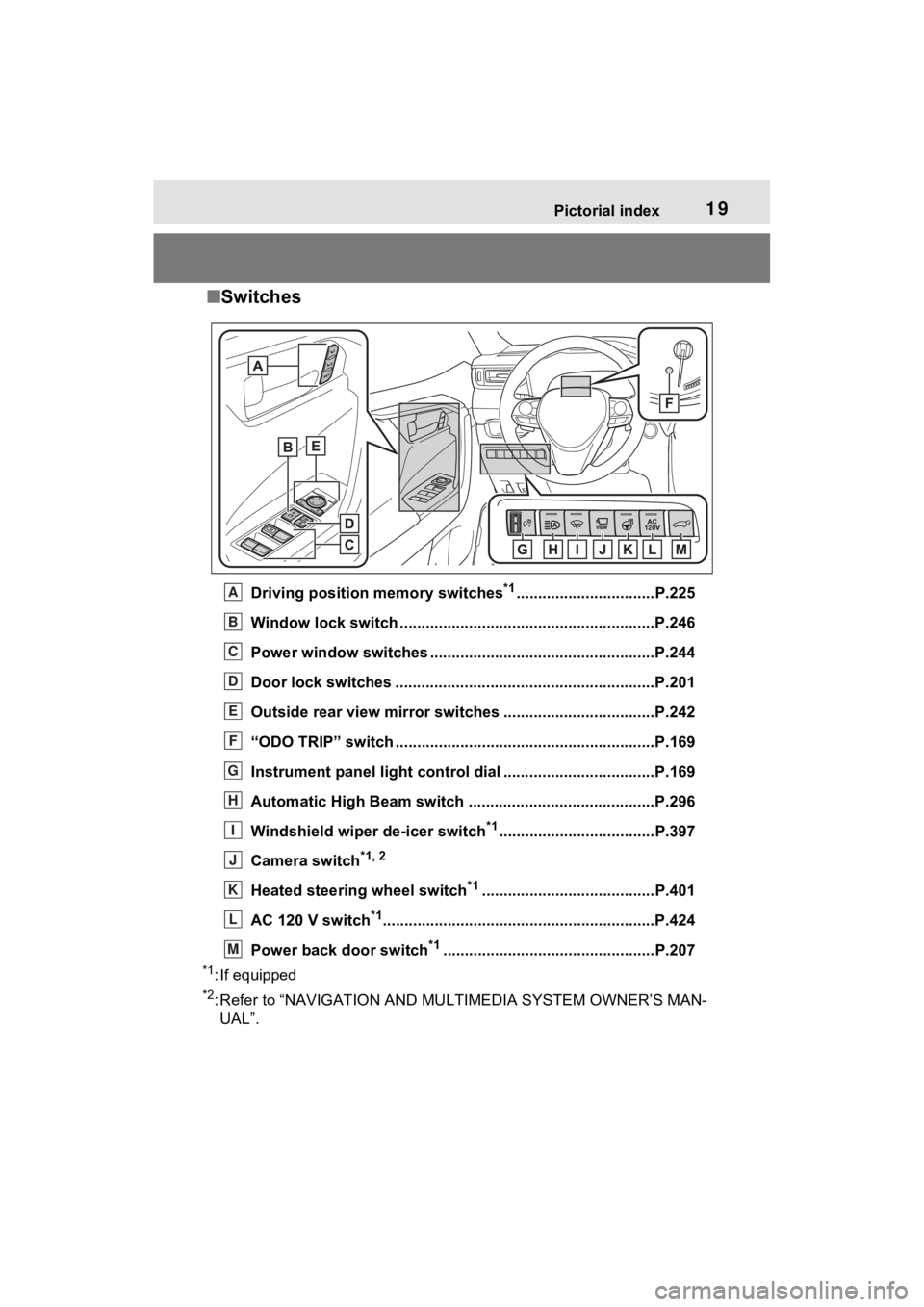
■Switches
Driving position memory switches*1................................P.225
Window lock switch ............................................. ..............P.246
Power window switches ....... .............................................P.244
Door lock switches ............................................................P.201
Outside rear view mirror swi tches ...................................P.242
“ODO TRIP” switch ............................................................P.169
Instrument panel light cont rol dial ...................................P.169
Automatic High Beam switch ..................................... ......P.296
Windshield wiper de-icer switch
*1....................................P.397
Camera switch
*1, 2
Heated steering wheel switch*1........................................P.401
AC 120 V switch
*1............................................................... P.424
Power back door switch
*1.................................................P.207
*1: If equipped
*2: Refer to “NAVIGATI ON AND MULTIMEDIA SYSTEM OWNER’S MAN-
UAL”.
A
B
C
D
E
F
G
H
I
J
K
L
M
Page 27 of 624
271-1. For safe use
1
For safety and security
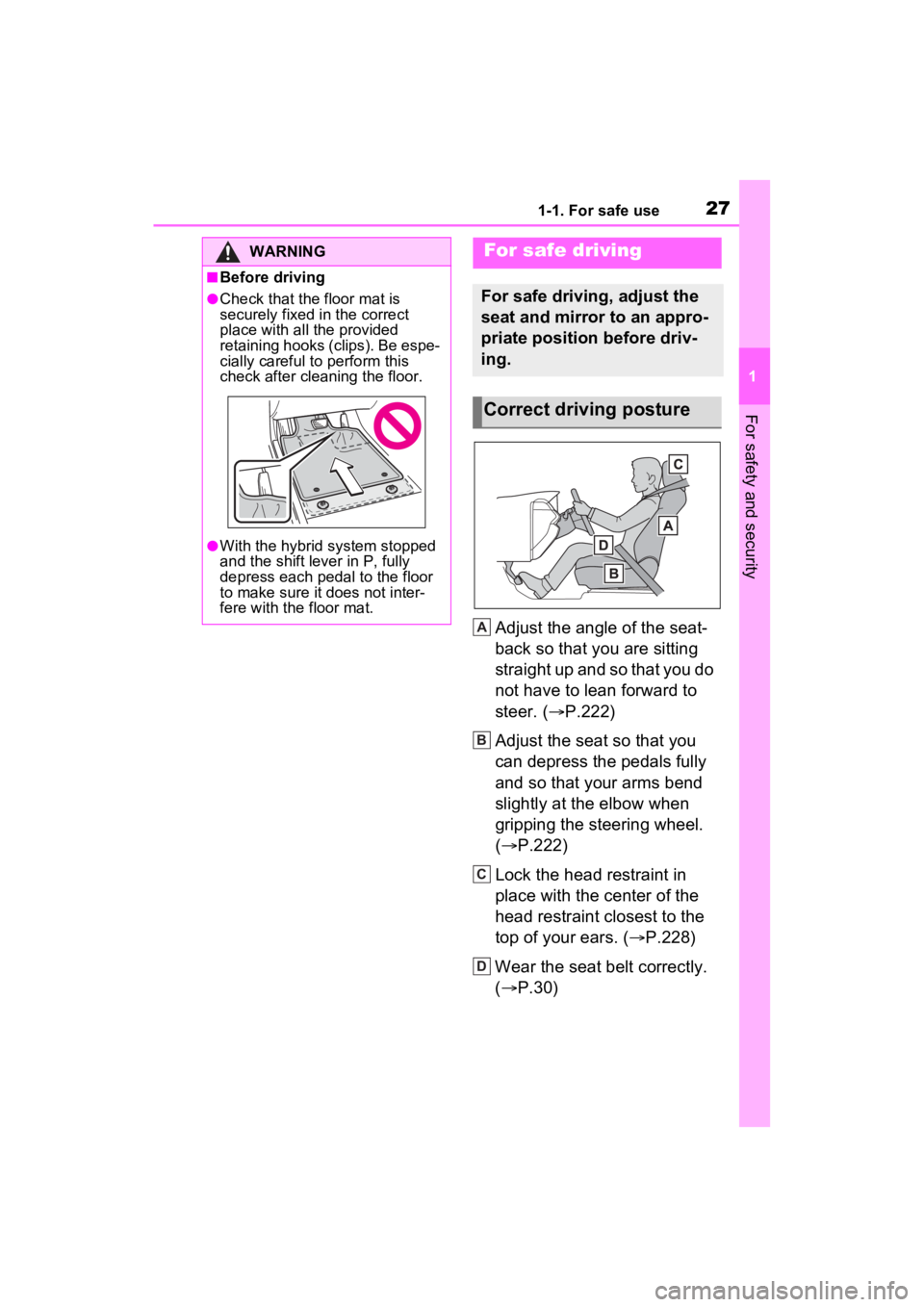
Adjust the angle of the seat-
back so that you are sitting
straight up and so that you do
not have to lean forward to
steer. (P.222)
Adjust the seat so that you
can depress the pedals fully
and so that your arms bend
slightly at the elbow when
gripping the steering wheel.
( P.222)
Lock the head restraint in
place with the center of the
head restraint closest to the
top of your ears. ( P.228)
Wear the seat belt correctly.
( P.30)
WARNING
■Before driving
●Check that the floor mat is
securely fixed in the correct
place with all the provided
retaining hooks (clips). Be espe-
cially careful to perform this
check after cleaning the floor.
●With the hybrid system stopped
and the shift lever in P, fully
depress each pedal to the floor
to make sure it does not inter-
fere with the floor mat.
For safe driving
For safe driving, adjust the
seat and mirror to an appro-
priate position before driv-
ing.
Correct driving posture
A
B
C
D
Page 36 of 624

361-1. For safe use
Driver airbag
Front passenger occupant classification sensors
Knee airbag
SRS warning light
Airbag sensor assembly
Your vehicle is equipped with ADVANCED AIRBAGS designed
based on the US motor vehicle safety standards (FMVSS208). The
airbag sensor assembly (ECU) cont rols airbag deployment based on
information obtained from the sensors etc. shown in the system
components diagram above. This in formation includes crash sever-
ity and occupant information. As the airbags deploy, a chemical
reaction in the inflators quickly fills the airbags with non-toxic gas to
help restrain the motion of the occupants.
■If the SRS airbags deploy
(inflate)
●Slight abrasions, burns, bruising
etc., may be sustained from SRS
airbags, due to the extremely high
speed deployment (inflation) by
hot gases.
●A loud noise and white powder will
be emitted.
●Parts of the airbag module (steer-
ing wheel hub, airbag cover and
inflator) as well as the front seats,
parts of the front and rear pillars,
and roof side rails, may be hot for
several minutes. T he airbag itself
may also be hot.
●The windshield may crack.
●The hybrid system will be stopped
and fuel supply to the engine will
be stopped. ( P.91)
●All of the doors will be unlocked.
( P.199)
●The brakes and st op lights will be
controlled automatically.
( P.376)
●The interior lights will turn on auto-
matically. ( P.405)
●The emergency flashers will turn
on automatically. ( P.498)
●For Safety Connect subscribers, if
any of the following situations
occur, the system is designed to
send an emergency call to the
response center, notifying them of
the vehicle’s location (without
needing to push the “SOS” button)
and an agent will attempt to speak
with the occupants to ascertain
the level of emergency and assis-
tance required. If the occupants
are unable to communicate, the
agent automatically treats the call
as an emergency and helps to dis-
patch the necessary emergency
services. ( P.65)
• An SRS airbag is deployed.
• A seat belt pretensioner is acti-
vated.
• The vehicle is involved in a severe
rear-end collision.
■SRS airbag deployment condi-
tions (SRS front airbags)
●The SRS front airbags will deploy
in the event of an impact that
exceeds the set threshold level
(the level of forc e corresponding
to an approximately 12 - 18 mph
[20 - 30 km/h] frontal collision with
a fixed wall that does not move or
deform).
However, this threshold velocity will
N
O
P
Q
R
Page 39 of 624
391-1. For safe use
1
For safety and security
vehicle was involved in an acci-
dent that was not severe enough
to cause the SRS side and curtain
shield airbags to inflate.
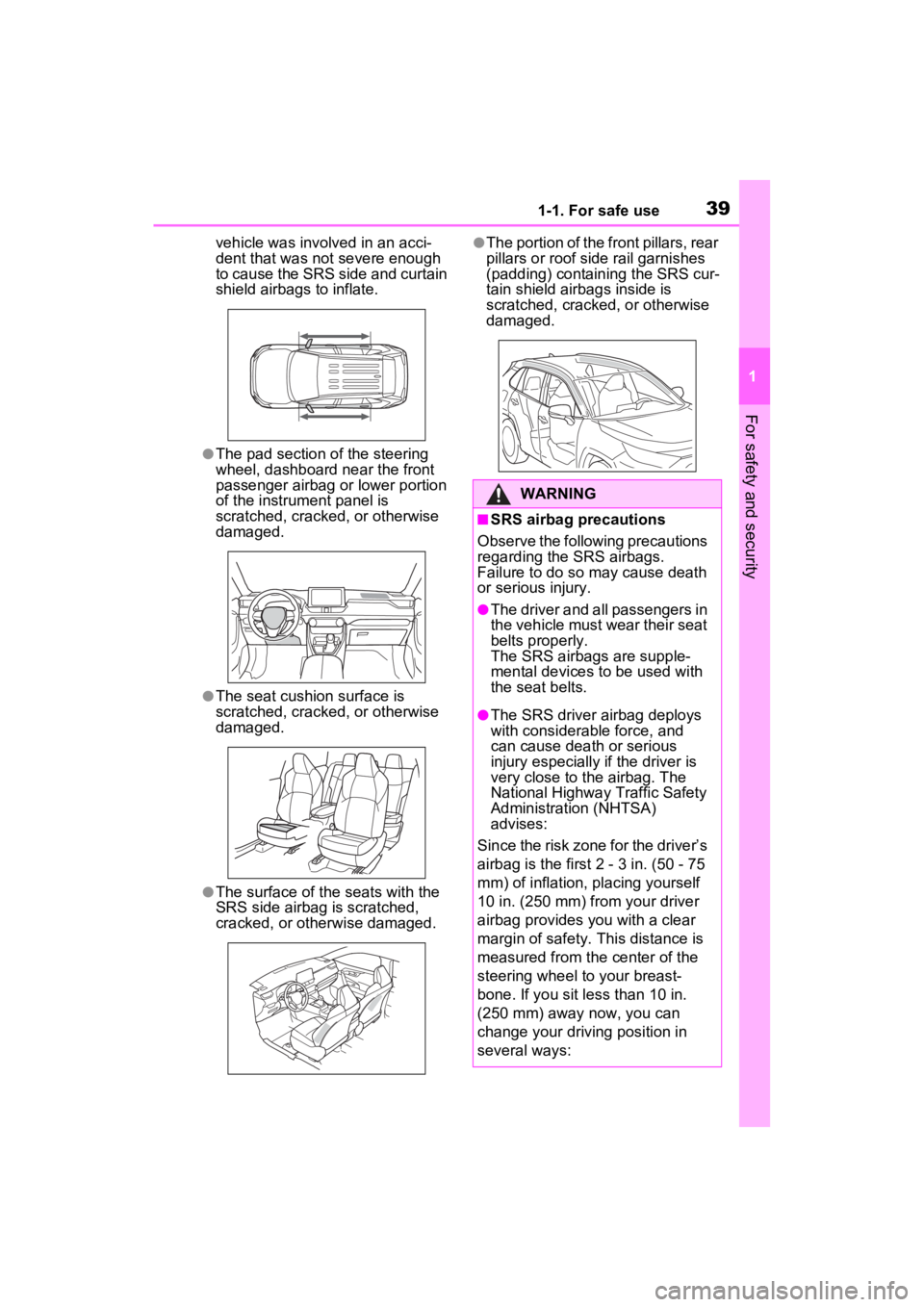
●The pad section of the steering
wheel, dashboard near the front
passenger airbag o r lower portion
of the instrument panel is
scratched, cracked, or otherwise
damaged.
●The seat cushion surface is
scratched, cracked, or otherwise
damaged.
●The surface of the seats with the
SRS side airbag is scratched,
cracked, or otherwise damaged.
●The portion of the front pillars, rear
pillars or roof side rail garnishes
(padding) containing the SRS cur-
tain shield airbags inside is
scratched, cracked, or otherwise
damaged.
WARNING
■SRS airbag precautions
Observe the following precautions
regarding the SRS airbags.
Failure to do so may cause death
or serious injury.
●The driver and all passengers in
the vehicle must wear their seat
belts properly.
The SRS airbags are supple-
mental devices to be used with
the seat belts.
●The SRS driver airbag deploys
with considerable force, and
can cause death or serious
injury especially if the driver is
very close to the airbag. The
National Highway Traffic Safety
Administration (NHTSA)
advises:
Since the risk zone for the driver’s
airbag is the first 2 - 3 in. (50 - 75
mm) of inflation, placing yourself
10 in. (250 mm) from your driver
airbag provides you with a clear
margin of safety. This distance is
measured from the center of the
steering wheel to your breast-
bone. If you sit less than 10 in.
(250 mm) away now, you can
change your driving position in
several ways:
Page 40 of 624
401-1. For safe use
WARNING
• Move your seat to the rear as far as you can while still reach-
ing the pedals comfortably.
• Slightly recline the back of the seat.
Although vehicle designs vary,
many drivers can achieve the
10 in. (250 mm) distance, even
with the driver seat all the way
forward, simply by reclining the
back of the seat somewhat. If
reclining the back of your seat
makes it hard to see the road,
raise yourself by using a firm,
non-slippery cushion, or raise
the seat if your vehicle has that
feature.
• If your steering wheel is adjust- able, tilt it downward. This
points the airbag toward your
chest instead of your head and
neck.
The seat should be adjusted as
recommended by NHTSA above,
while still maintaining control of
the foot pedals, steering wheel,
and your view of the instrument
panel controls.
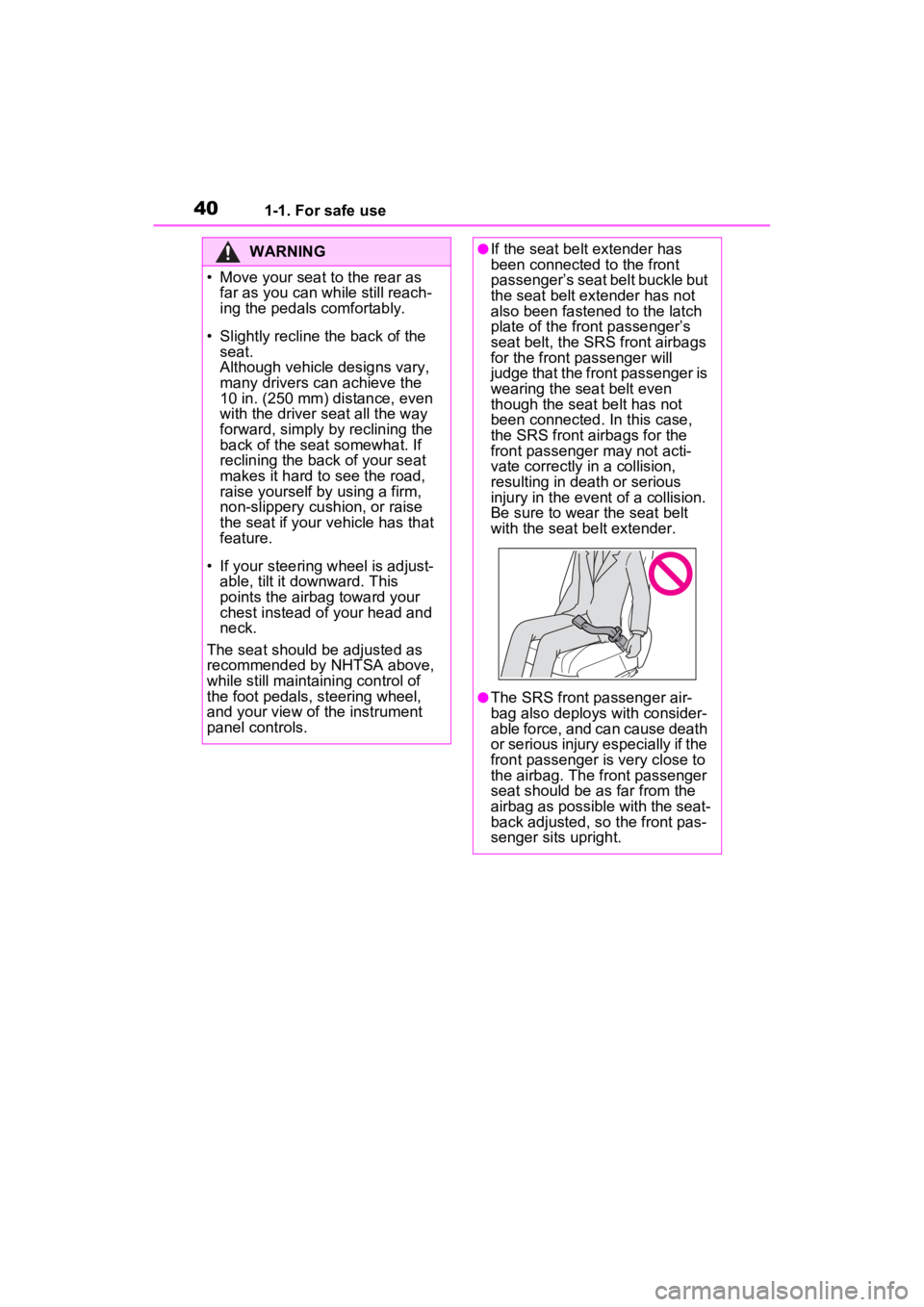
●If the seat belt extender has
been connected to the front
passenger’s seat belt buckle but
the seat belt extender has not
also been fastened to the latch
plate of the front passenger’s
seat belt, the SRS front airbags
for the front passenger will
judge that the front passenger is
wearing the seat belt even
though the seat belt has not
been connected. In this case,
the SRS front airbags for the
front passenger may not acti-
vate correctly in a collision,
resulting in death or serious
injury in the even t of a collision.
Be sure to wear the seat belt
with the seat belt extender.
●The SRS front passenger air-
bag also deploys with consider-
able force, and can cause death
or serious injury especially if the
front passenger is very close to
the airbag. The front passenger
seat should be as far from the
airbag as possible with the seat-
back adjusted, so the front pas-
senger sits upright.
Page 41 of 624
411-1. For safe use
1
For safety and security
WARNING
●Improperly seated and/or
restrained infants and children
can be killed or seriously injured
by a deploying airbag. An infant
or child who is too small to use
a seat belt should be properly
secured using a child restraint
system. Toyota strongly recom-
mends that all infants and chil-
dren be placed in the rear seats
of the vehicle and properly
restrained. The rear seats are
safer for infants and children
than the front pa ssenger seat.
( P.51)
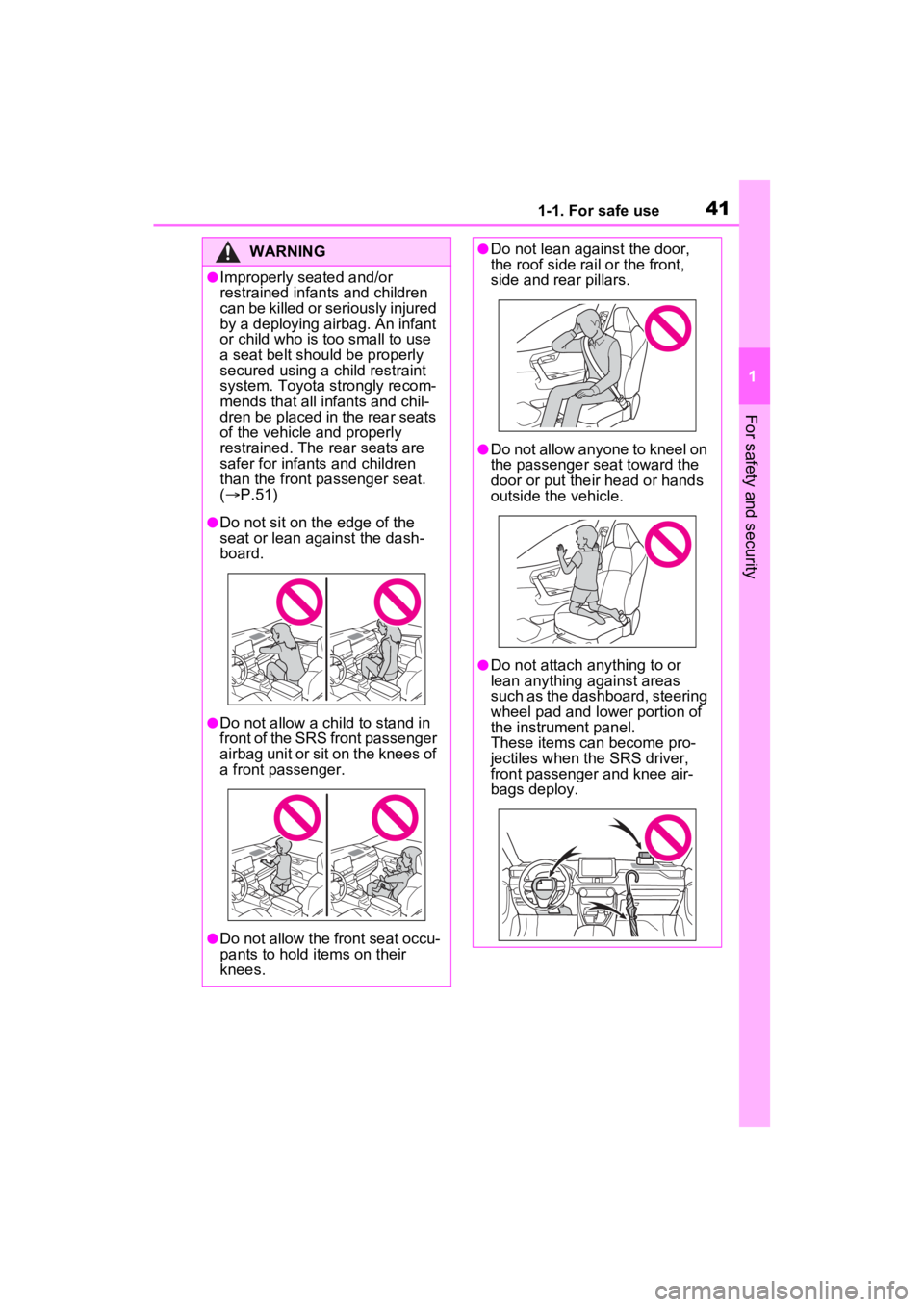
●Do not sit on the edge of the
seat or lean against the dash-
board.
●Do not allow a child to stand in
front of the SRS front passenger
airbag unit or sit on the knees of
a front passenger.
●Do not allow the front seat occu-
pants to hold items on their
knees.
●Do not lean against the door,
the roof side rail or the front,
side and rear pillars.
●Do not allow anyone to kneel on
the passenger seat toward the
door or put their head or hands
outside the vehicle.
●Do not attach anything to or
lean anything against areas
such as the dashboard, steering
wheel pad and lower portion of
the instrument panel.
These items can become pro-
jectiles when the SRS driver,
front passenger and knee air-
bags deploy.
Page 42 of 624
421-1. For safe use
WARNING
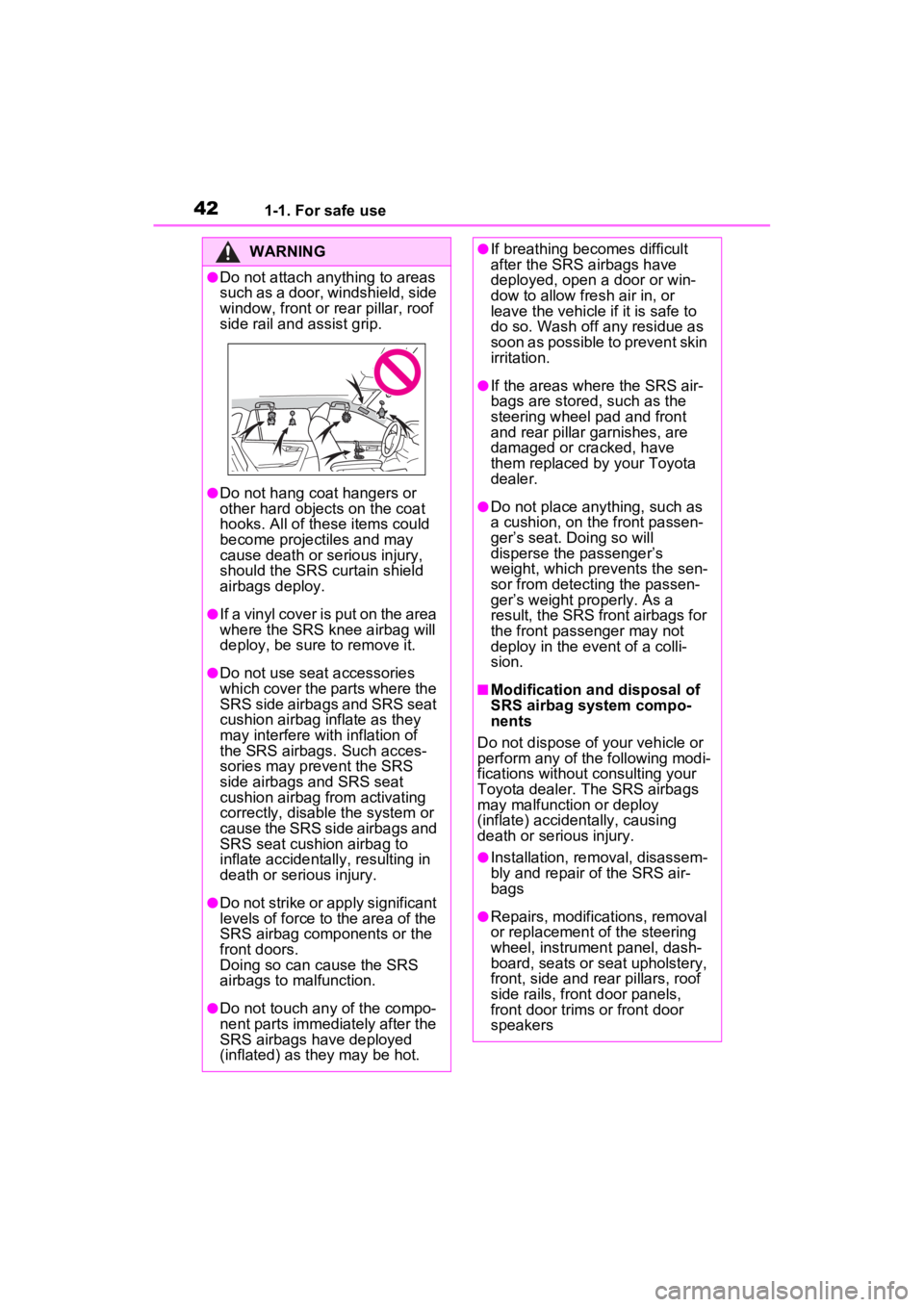
●Do not attach anything to areas
such as a door, windshield, side
window, front or rear pillar, roof
side rail and assist grip.
●Do not hang coat hangers or
other hard objects on the coat
hooks. All of these items could
become projectiles and may
cause death or serious injury,
should the SRS curtain shield
airbags deploy.
●If a vinyl cover is put on the area
where the SRS knee airbag will
deploy, be sure to remove it.
●Do not use seat accessories
which cover the parts where the
SRS side airbags and SRS seat
cushion airbag inflate as they
may interfere with inflation of
the SRS airbags. Such acces-
sories may prevent the SRS
side airbags and SRS seat
cushion airbag from activating
correctly, disable the system or
cause the SRS side airbags and
SRS seat cushion airbag to
inflate accidentally, resulting in
death or serious injury.
●Do not strike or apply significant
levels of force to the area of the
SRS airbag components or the
front doors.
Doing so can cause the SRS
airbags to malfunction.
●Do not touch any of the compo-
nent parts immediately after the
SRS airbags have deployed
(inflated) as they may be hot.
●If breathing becomes difficult
after the SRS airbags have
deployed, open a door or win-
dow to allow fresh air in, or
leave the vehicle if it is safe to
do so. Wash off any residue as
soon as possible to prevent skin
irritation.
●If the areas where the SRS air-
bags are stored, such as the
steering wheel pad and front
and rear pillar garnishes, are
damaged or cracked, have
them replaced by your Toyota
dealer.
●Do not place anything, such as
a cushion, on the front passen-
ger’s seat. Doing so will
disperse the passenger’s
weight, which prevents the sen-
sor from detecting the passen-
ger’s weight properly. As a
result, the SRS front airbags for
the front passenger may not
deploy in the event of a colli-
sion.
■Modification and disposal of
SRS airbag system compo-
nents
Do not dispose of your vehicle or
perform any of the following modi-
fications without consulting your
Toyota dealer. The SRS airbags
may malfunction or deploy
(inflate) accidentally, causing
death or serious injury.
●Installation, re moval, disassem-
bly and repair of the SRS air-
bags
●Repairs, modific ations, removal
or replacement of the steering
wheel, instrument panel, dash-
board, seats or seat upholstery,
front, side and rear pillars, roof
side rails, front door panels,
front door trims or front door
speakers
Page 89 of 624
892-1. Plug-in hybrid system
2
Plug-in hybrid system
WARNING
●Never touch, disassemble,
remove or replace the high volt-
age parts, cables or their con-
nectors.
●The hybrid system will become
hot after starting as the system
uses high voltage. Be careful of
both the high voltage and the
high temperature, and always
obey the caution labels
attached to the vehicle.
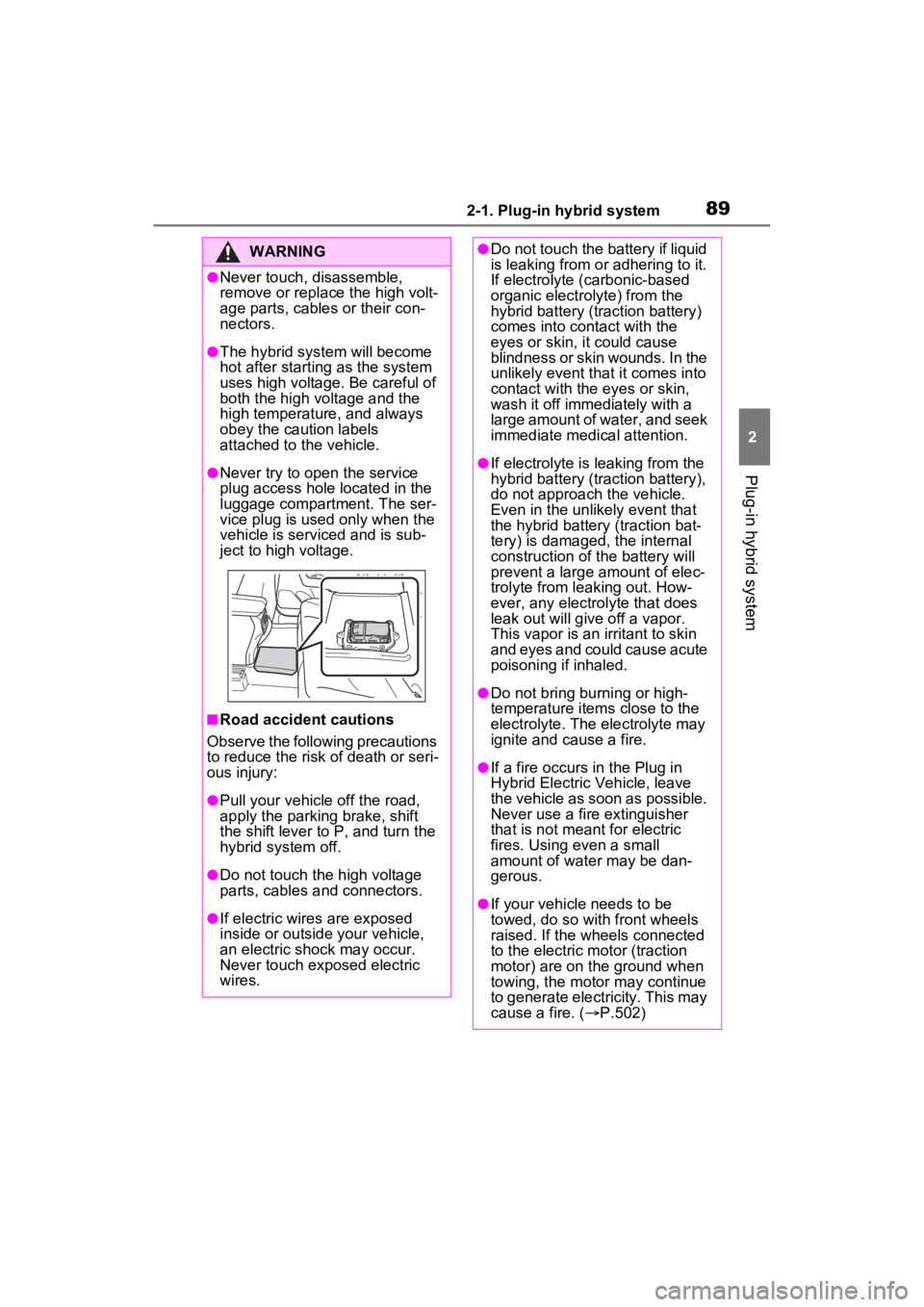
●Never try to open the service
plug access hole located in the
luggage compartment. The ser-
vice plug is used only when the
vehicle is serviced and is sub-
ject to high voltage.
■Road accident cautions
Observe the following precautions
to reduce the risk of death or seri-
ous injury:
●Pull your vehicle off the road,
apply the parking brake, shift
the shift lever to P, and turn the
hybrid system off.
●Do not touch the high voltage
parts, cables and connectors.
●If electric wires are exposed
inside or outside your vehicle,
an electric shock may occur.
Never touch exposed electric
wires.
●Do not touch the battery if liquid
is leaking from or adhering to it.
If electrolyte (carbonic-based
organic electrolyte) from the
hybrid battery (traction battery)
comes into contact with the
eyes or skin, it could cause
blindness or skin wounds. In the
unlikely event that it comes into
contact with the eyes or skin,
wash it off immediately with a
large amount of water, and seek
immediate medical attention.
●If electrolyte is leaking from the
hybrid battery (traction battery),
do not approach the vehicle.
Even in the unlikely event that
the hybrid battery (traction bat-
tery) is damaged, the internal
construction of the battery will
prevent a large amount of elec-
trolyte from leaking out. How-
ever, any electrolyte that does
leak out will give off a vapor.
This vapor is an irritant to skin
and eyes and could cause acute
poisoning if inhaled.
●Do not bring burning or high-
temperature items close to the
electrolyte. The electrolyte may
ignite and cause a fire.
●If a fire occurs in the Plug in
Hybrid Electric Vehicle, leave
the vehicle as soon as possible.
Never use a fire extinguisher
that is not meant for electric
fires. Using even a small
amount of water may be dan-
gerous.
●If your vehicle needs to be
towed, do so with front wheels
raised. If the wheels connected
to the electric motor (traction
motor) are on the ground when
towing, the motor may continue
to generate electricity. This may
cause a fire. ( P.502)