trailer TOYOTA SEQUOIA 2008 2.G User Guide
[x] Cancel search | Manufacturer: TOYOTA, Model Year: 2008, Model line: SEQUOIA, Model: TOYOTA SEQUOIA 2008 2.GPages: 596, PDF Size: 12.93 MB
Page 234 of 596
234 2-5. Driving information
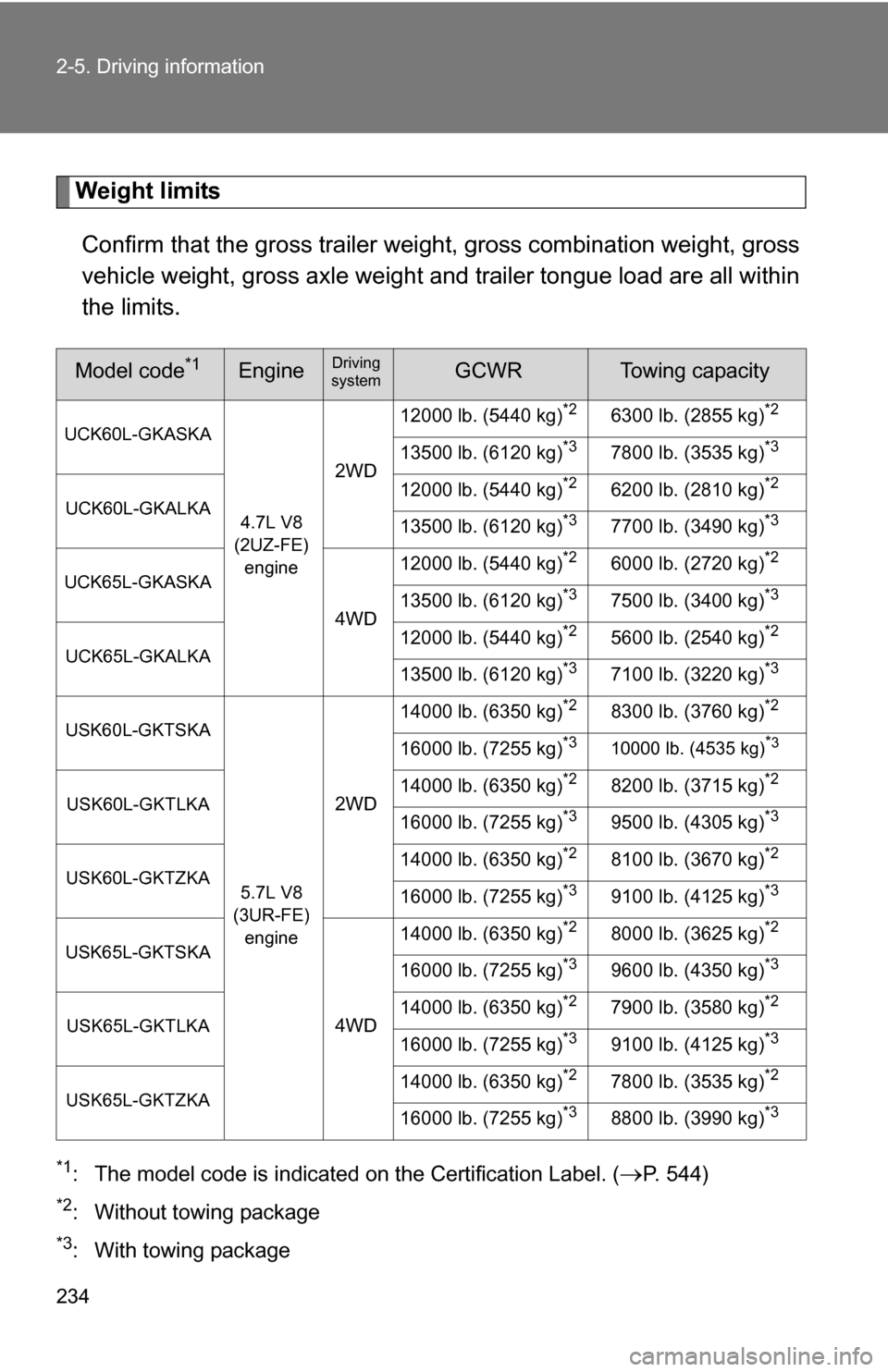
Weight limitsConfirm that the gross trailer weight, gross combination weight, gross
vehicle weight, gross axle weight and trailer tongue load are all within
the limits.
*1: The model code is indicated on the Certification Label. (P. 544)
*2: Without towing package
*3: With towing package
Model code*1EngineDriving
systemGCWRTowing capacity
UCK60L-GKASKA
4.7L V8
(2UZ-FE) engine
2WD 12000 lb. (5440 kg)
*26300 lb. (2855 kg)*2
13500 lb. (6120 kg)*37800 lb. (3535 kg)*3
UCK60L-GKALKA12000 lb. (5440 kg)*26200 lb. (2810 kg)*2
13500 lb. (6120 kg)*37700 lb. (3490 kg)*3
UCK65L-GKASKA
4WD12000 lb. (5440 kg)
*26000 lb. (2720 kg)*2
13500 lb. (6120 kg)*37500 lb. (3400 kg)*3
UCK65L-GKALKA12000 lb. (5440 kg)*25600 lb. (2540 kg)*2
13500 lb. (6120 kg)*37100 lb. (3220 kg)*3
USK60L-GKTSKA
5.7L V8
(3UR-FE) engine
2WD 14000 lb. (6350 kg)
*28300 lb. (3760 kg)*2
16000 lb. (7255 kg)*310000 lb. (4535 kg)*3
USK60L-GKTLKA14000 lb. (6350 kg)*28200 lb. (3715 kg)*2
16000 lb. (7255 kg)*39500 lb. (4305 kg)*3
USK60L-GKTZKA14000 lb. (6350 kg)*28100 lb. (3670 kg)*2
16000 lb. (7255 kg)*39100 lb. (4125 kg)*3
USK65L-GKTSKA
4WD14000 lb. (6350 kg)
*28000 lb. (3625 kg)*2
16000 lb. (7255 kg)*39600 lb. (4350 kg)*3
USK65L-GKTLKA14000 lb. (6350 kg)*27900 lb. (3580 kg)*2
16000 lb. (7255 kg)*39100 lb. (4125 kg)*3
USK65L-GKTZKA14000 lb. (6350 kg)*27800 lb. (3535 kg)*2
16000 lb. (7255 kg)*38800 lb. (3990 kg)*3
Page 235 of 596
235
2-5. Driving information
2
When driving
●
The gross trailer weight must never exceed towing capacity
described in the table above.
● The gross combination weight must never exceed the GCWR in the
table above.
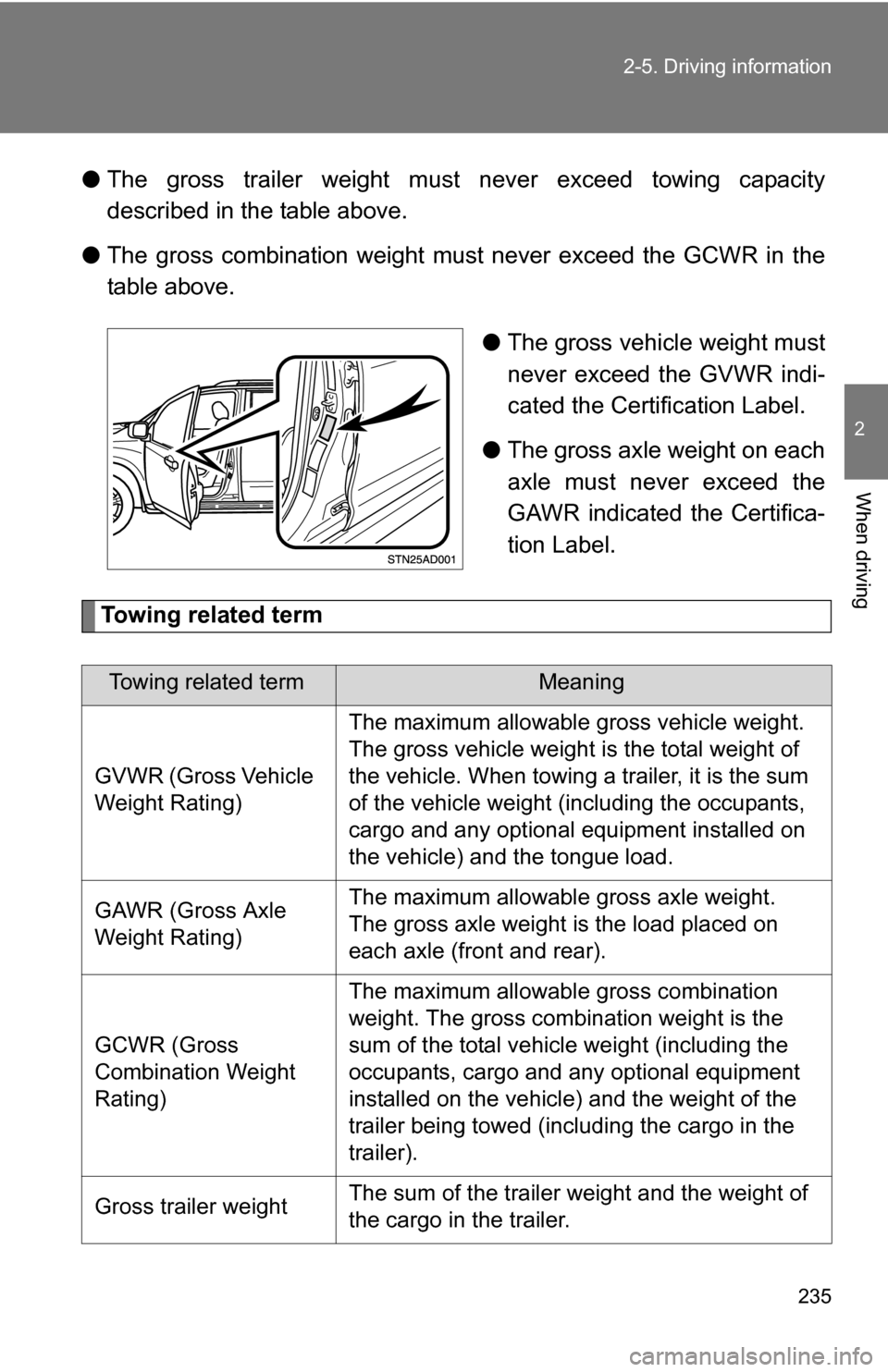
●The gross vehicle weight must
never exceed the GVWR indi-
cated the Certification Label.
● The gross axle weight on each
axle must never exceed the
GAWR indicated the Certifica-
tion Label.
Towing related term
Towing related termMeaning
GVWR (Gross Vehicle
Weight Rating)
The maximum allowable gross vehicle weight.
The gross vehicle weight is the total weight of
the vehicle. When towing a trailer, it is the sum
of the vehicle weight (including the occupants,
cargo and any optional equipment installed on
the vehicle) and the tongue load.
GAWR (Gross Axle
Weight Rating)The maximum allowable gross axle weight.
The gross axle weight is the load placed on
each axle (front and rear).
GCWR (Gross
Combination Weight
Rating)
The maximum allowabl e gross combination
weight. The gross combination weight is the
sum of the total vehicle weight (including the
occupants, cargo and any optional equipment
installed on the vehicle) and the weight of the
trailer being towed (including the cargo in the
trailer).
Gross trailer weightThe sum of the trailer weight and the weight of
the cargo in the trailer.
Page 236 of 596
236 2-5. Driving information
Trailer tongue load● A recommended tongue load varies in accordance with the types
of trailers or towing as described below.
● In order to ensure the recommended values shown below, the
trailer must be loaded by referring to the following instructions.
The trailer cargo load should be distributed so that the tongue load
is 9 to 11% of the gross trailer weight, not exceeding the following.
(Tongue load /Gross trailer weight x 100 = 9 to 11%)
If the gross trailer weight is over 2000 lbs. (907 kg), it is necessary
to use a sway control device with sufficient capacity.
If the gross trailer weight is over 5000 lbs. (2268 kg), it is neces-
sary to use a weight distributing hitch with sufficient capacity.
If using a weight distributing hitc h when towing, keep your vehicle
level with the ground.
Towing related termMeaning
Towing capacity
The maximum allowable gross trailer weight.
Towing capacity is calculated considering base
vehicle with necessary vehicle equipment and
150 pound driver.
Additional optional equipment, passengers and
cargo in the vehicle will reduce the towing
capacity, gross trailer weight includes the
trailer, cargo and necessary equipment for
towing.
Tongue loadThe load placed on the trailer hitch ball.
Page 237 of 596
237
2-5. Driving information
2
When driving
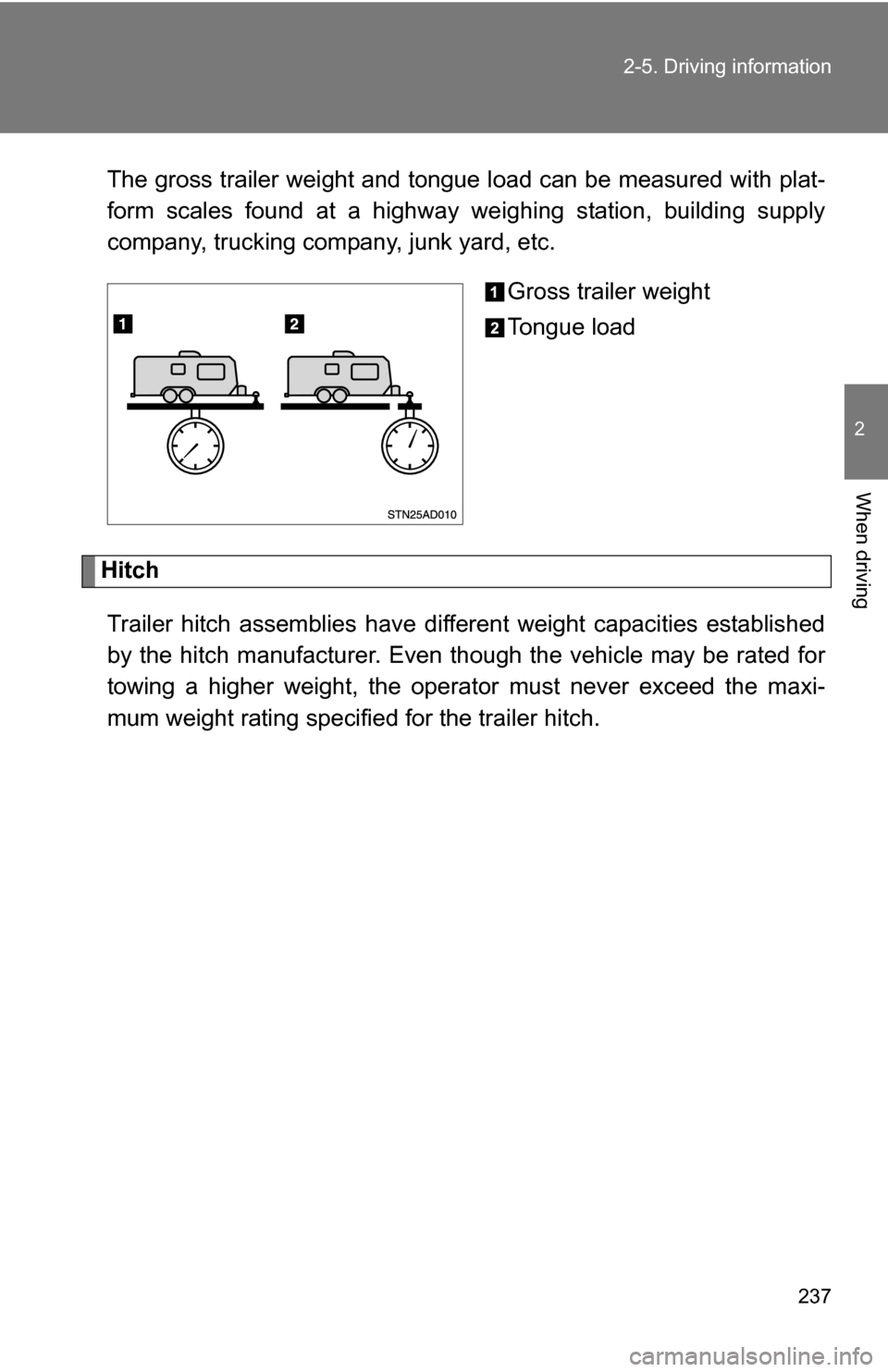
The gross trailer weight and tongue l
oad can be measured with plat-
form scales found at a highway weighing station, building supply
company, trucking company, junk yard, etc.
Gross trailer weight
Tongue load
Hitch
Trailer hitch assemblies have different weight capacities established
by the hitch manufacturer. Even th ough the vehicle may be rated for
towing a higher weight, the operat or must never exceed the maxi-
mum weight rating specified for the trailer hitch.
Page 238 of 596
238 2-5. Driving information
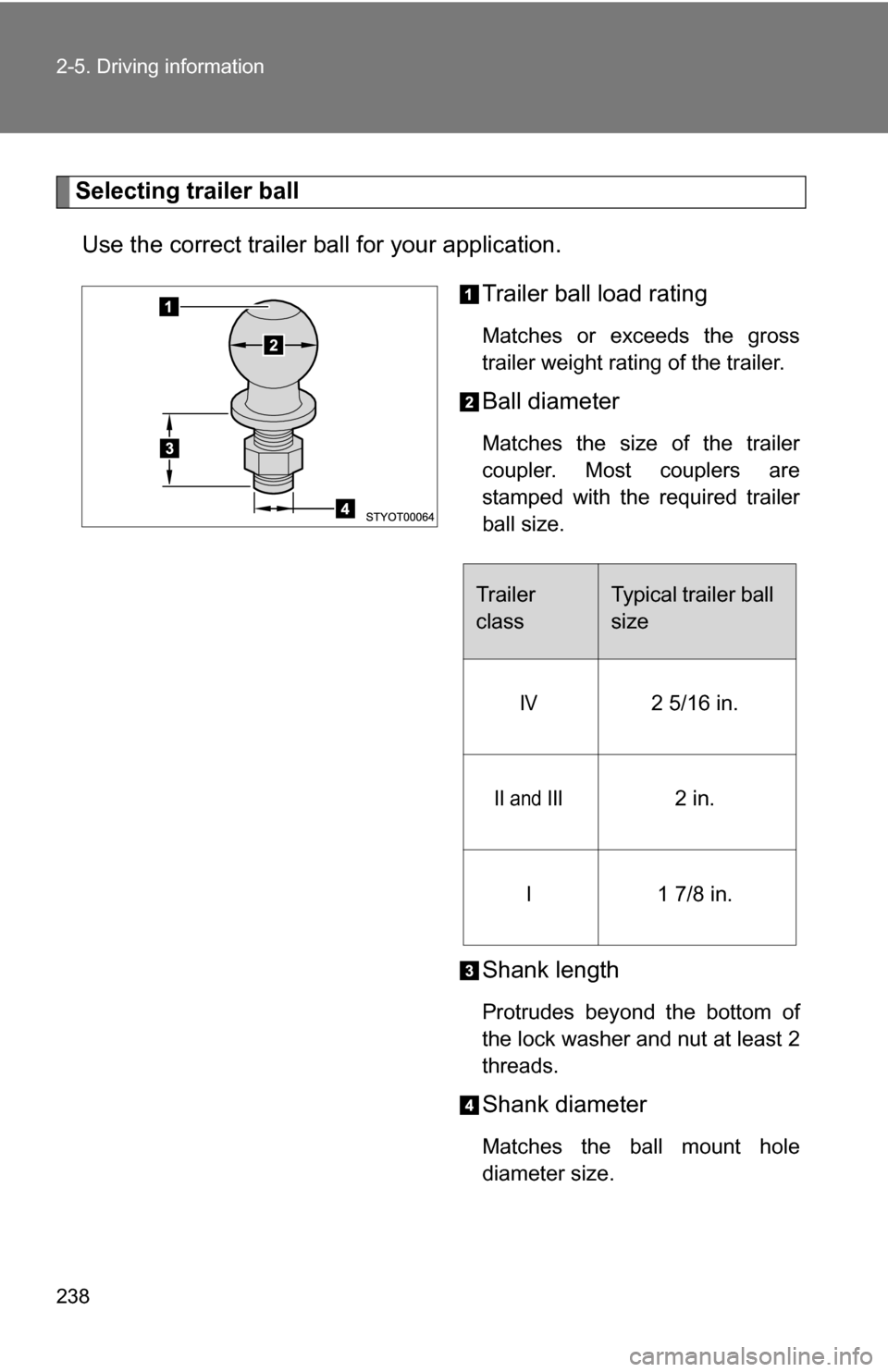
Selecting trailer ballUse the correct trailer ball for your application. Trailer ball load rating
Matches or exceeds the gross
trailer weight rating of the trailer.
Ball diameter
Matches the size of the trailer
coupler. Most couplers are
stamped with the required trailer
ball size.
Shank length
Protrudes beyond the bottom of
the lock washer and nut at least 2
threads.
Shank diameter
Matches the ball mount hole
diameter size.
Trailer
classTypical trailer ball
size
IV2 5/16 in.
II and III2 in.
I1 7/8 in.
Page 239 of 596
239
2-5. Driving information
2
When driving
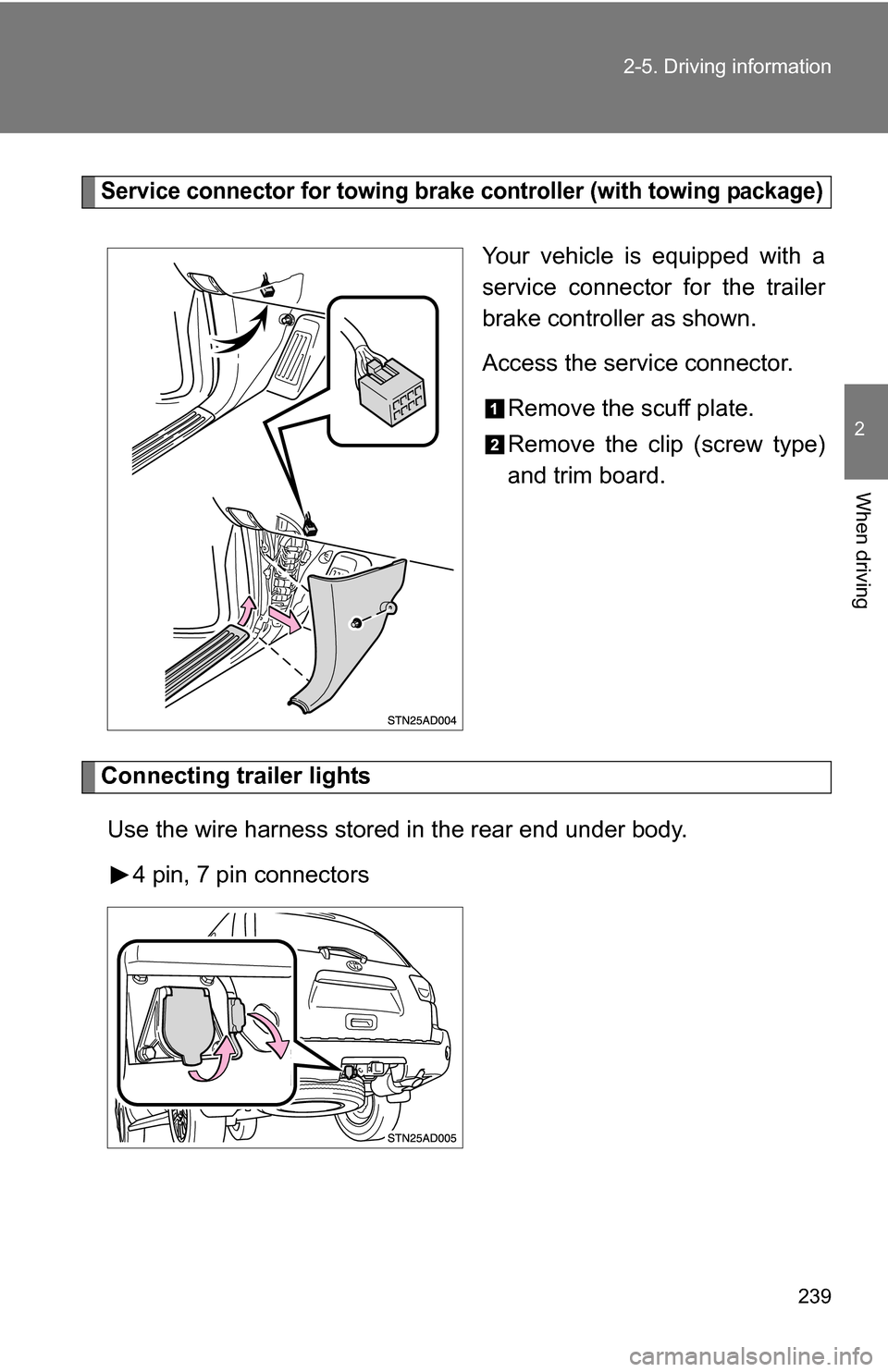
Service connector for towing brake controller (with towing package)
Your vehicle is equipped with a
service connector for the trailer
brake controller as shown.
Access the service connector.
Remove the scuff plate.
Remove the clip (screw type)
and trim board.
Connecting trailer lights
Use the wire harness stored in the rear end under body. 4 pin, 7 pin connectors
Page 240 of 596
240 2-5. Driving information
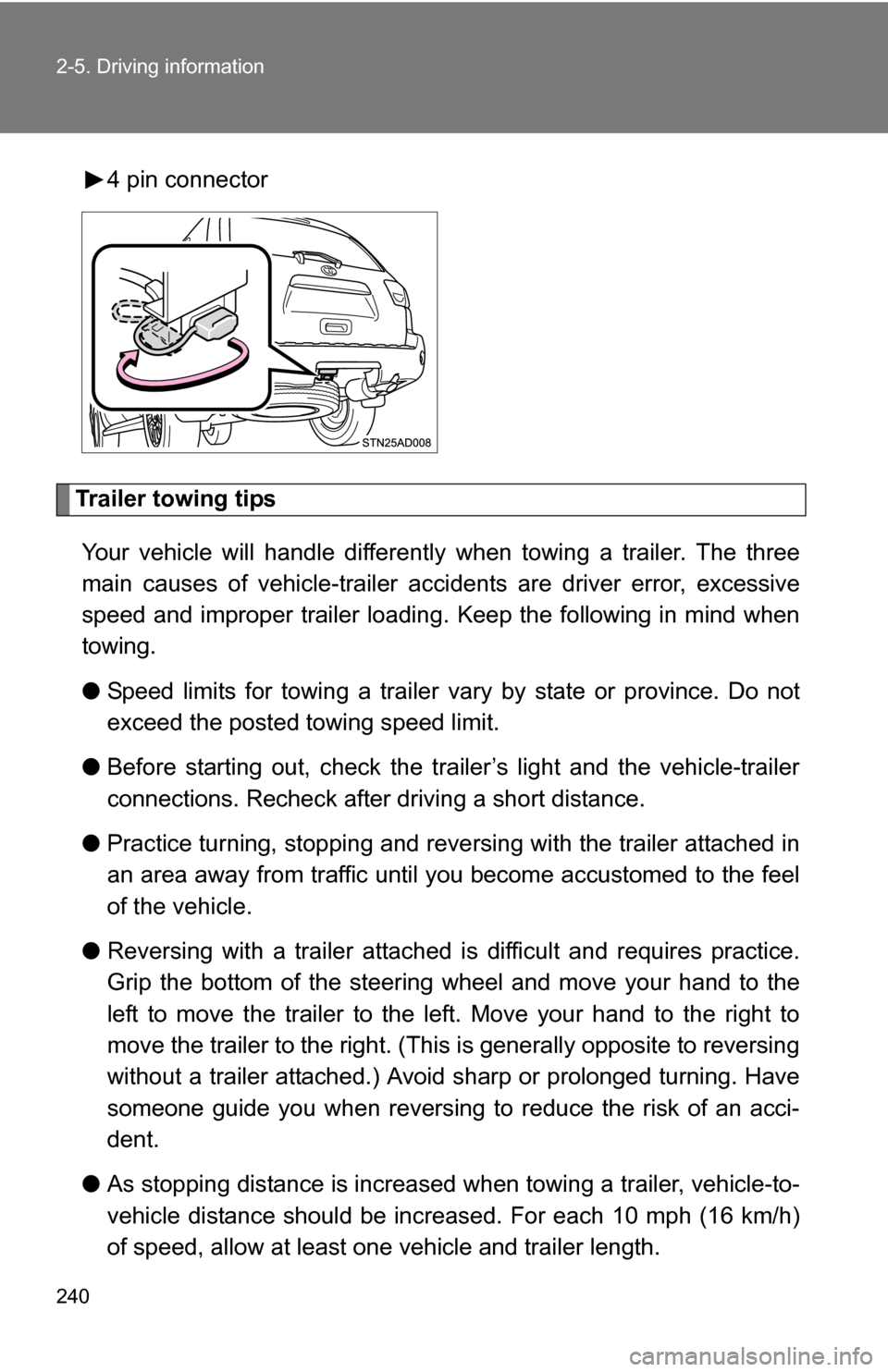
4 pin connector
Trailer towing tipsYour vehicle will handle differently when towing a trailer. The three
main causes of vehicle-trailer ac cidents are driver error, excessive
speed and improper trailer loading. Keep the following in mind when
towing.
● Speed limits for towing a trailer vary by state or province. Do not
exceed the posted towing speed limit.
● Before starting out, check the trailer’s light and the vehicle-trailer
connections. Recheck after driving a short distance.
● Practice turning, stopping and reve rsing with the trailer attached in
an area away from traffic until you become accustomed to the feel
of the vehicle.
● Reversing with a trailer attached is difficult and requires practice.
Grip the bottom of the steering wheel and move your hand to the
left to move the trailer to the left. Move your hand to the right to
move the trailer to the right. (This is generally opposite to reversing
without a trailer attached.) Avoid sharp or prolonged turning. Have
someone guide you when reversing to reduce the risk of an acci-
dent.
● As stopping distance is increased when towing a trailer, vehicle-to-
vehicle distance should be increased. For each 10 mph (16 km/h)
of speed, allow at least o ne vehicle and trailer length.
Page 241 of 596
241
2-5. Driving information
2
When driving
●
Avoid sudden braking as you may skid, resulting in jackknifing and
loss of control. This is especiall y true on wet or slippery surfaces.
● Avoid jerky starts or sudden acceleration.
● Avoid jerky steering and sharp turns, and slow down before mak-
ing a turn.
● Note that when making a turn, th e trailer wheels will be closer than
the vehicle wheels to the inside of the turn. Compensate by making
a larger than normal turning radius.
● Crosswinds and rough roads will adversely affect handling of your
vehicle and trailer, causing sway . Periodically check the rear to
prepare for being passed by large trucks or buses, which may
cause your vehicle and trailer to sway. If swaying occurs, firmly grip
the steering wheel, reduce speed immediately but gradually, and
steer straight ahead. Never increase speed. If you make no
extreme correction with the stee ring or brakes, your vehicle and
trailer will stabilize.
● Take care when passing other vehicles. Passing requires consider-
able distance. After passing a vehicle, do not forget the length of
your trailer, and be sure you hav e plenty of room before changing
lanes.
● In order to maintain engine braking efficiency when driving on a
long steep downgrade, do not use the transmission in D.
Transmission shift range position must be in 5 in the S mode (6-
speed models) or in 4 in the S mode (5-speed models).
● Due to the added load of the trailer, your vehicle’s engine may
overheat on hot days (at temperatures over 85°F [30°C]) when
driving up a long or steep grade. If the engine coolant temperature
gauge indicates overheating, immedi ately turn off the air condition-
ing (if in use), pull your vehicle off the road and stop in a safe spot.
( P. 536)
Page 242 of 596
242 2-5. Driving information
●Always place wheel blocks under both the vehicle and the trailer
wheels when parking. Apply the parking brake firmly, and put the
transmission in P. Avoid parking on a slope, but if unavoidable, do
so only after performing the following:
Apply the brakes and keep them applied.
Have someone place wheel bloc ks under both the vehicle and
trailer wheels.
When the wheel blocks are in place, release the brakes slowly
until the blocks absorb the load.
Apply the parking brake firmly.
Shift into P and turn off the engine.
● When restarting after parking on a slope:
With the transmission in P, start the engine. Be sure to keep
the brake pedal pressed.
Shift into D or R (if reversing).
Release the parking brake and brake pedal, and slowly pull or
back away from the wheel blocks. Stop and apply the brakes.
Have someone retrieve the blocks.
Page 243 of 596
243
2-5. Driving information
2
When driving
■
Before towing
Check that the following conditions are met:
●Ensure that your vehicle’s tires are properly inflated. ( P. 553)
● Trailer tires should be inflated according to the trailer manufacturer’s rec-
ommendation.
● All trailer lights work to be legal.
● All lights work each time you connect them.
● The trailer ball is set up at the proper height for the coupler on the t\
railer.
● The vehicle remains level when a loaded or unloaded trailer is hitched.
Do not drive if the vehicle is not level, and check for improper tongue
load, overloading, worn suspension, or other possible causes.
● The trailer cargo is securely loaded.
● The rear view mirrors conform to all applicable federal, state/provincial or
local regulations. If they do not, instal l rear view mirrors appropriate for
towing purposes.
● Depress TOW/HAUL button (if equipped)
■ When connecting and disconnecting a trailer
Set the electronically modulated air suspension system to MAN., or turn off
the engine, when the system is in N mode. (if equipped)
■ AVS (adaptive variable suspension system) (if equipped)
The suspension can be switched for improvement in driveability. ( P. 207)
■ Break-in schedule
●Toyota recommends that you do not use a new vehicle or a vehicle with
any new power train components (engine, transmission, differential,
wheel bearings, etc.) to tow a trailer for the first 500 miles (800 km) of
driving.
● Drive the vehicle at a speed of less than 50 mph (80 km/h) when towing a
trailer for another 500 miles (800 km/h).
● Avoid full throttle acceleration.
■ Maintenance
●If you tow a trailer, your vehicle will require more frequent maintenance
due to the additional load. (See “Scheduled Maintenance Guide” or
“Owner’s Manual Supplement”.)