weight TOYOTA SEQUOIA 2008 2.G User Guide
[x] Cancel search | Manufacturer: TOYOTA, Model Year: 2008, Model line: SEQUOIA, Model: TOYOTA SEQUOIA 2008 2.GPages: 596, PDF Size: 12.93 MB
Page 235 of 596
235
2-5. Driving information
2
When driving
●
The gross trailer weight must never exceed towing capacity
described in the table above.
● The gross combination weight must never exceed the GCWR in the
table above.
●The gross vehicle weight must
never exceed the GVWR indi-
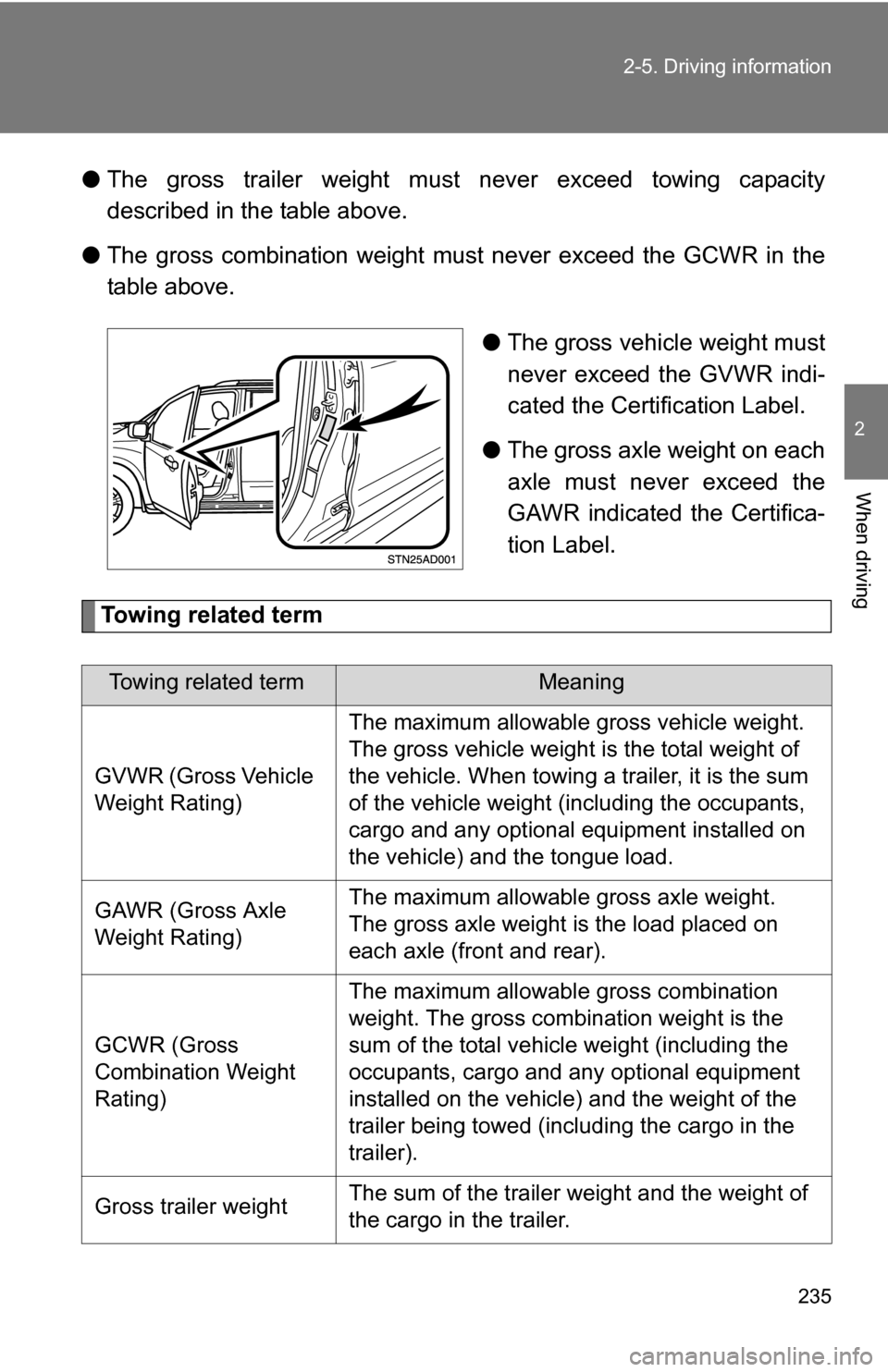
cated the Certification Label.
● The gross axle weight on each
axle must never exceed the
GAWR indicated the Certifica-
tion Label.
Towing related term
Towing related termMeaning
GVWR (Gross Vehicle
Weight Rating)
The maximum allowable gross vehicle weight.
The gross vehicle weight is the total weight of
the vehicle. When towing a trailer, it is the sum
of the vehicle weight (including the occupants,
cargo and any optional equipment installed on
the vehicle) and the tongue load.
GAWR (Gross Axle
Weight Rating)The maximum allowable gross axle weight.
The gross axle weight is the load placed on
each axle (front and rear).
GCWR (Gross
Combination Weight
Rating)
The maximum allowabl e gross combination
weight. The gross combination weight is the
sum of the total vehicle weight (including the
occupants, cargo and any optional equipment
installed on the vehicle) and the weight of the
trailer being towed (including the cargo in the
trailer).
Gross trailer weightThe sum of the trailer weight and the weight of
the cargo in the trailer.
Page 236 of 596
236 2-5. Driving information
Trailer tongue load● A recommended tongue load varies in accordance with the types
of trailers or towing as described below.
● In order to ensure the recommended values shown below, the
trailer must be loaded by referring to the following instructions.
The trailer cargo load should be distributed so that the tongue load
is 9 to 11% of the gross trailer weight, not exceeding the following.
(Tongue load /Gross trailer weight x 100 = 9 to 11%)
If the gross trailer weight is over 2000 lbs. (907 kg), it is necessary
to use a sway control device with sufficient capacity.
If the gross trailer weight is over 5000 lbs. (2268 kg), it is neces-
sary to use a weight distributing hitch with sufficient capacity.
If using a weight distributing hitc h when towing, keep your vehicle
level with the ground.
Towing related termMeaning
Towing capacity
The maximum allowable gross trailer weight.
Towing capacity is calculated considering base
vehicle with necessary vehicle equipment and
150 pound driver.
Additional optional equipment, passengers and
cargo in the vehicle will reduce the towing
capacity, gross trailer weight includes the
trailer, cargo and necessary equipment for
towing.
Tongue loadThe load placed on the trailer hitch ball.
Page 237 of 596
237
2-5. Driving information
2
When driving
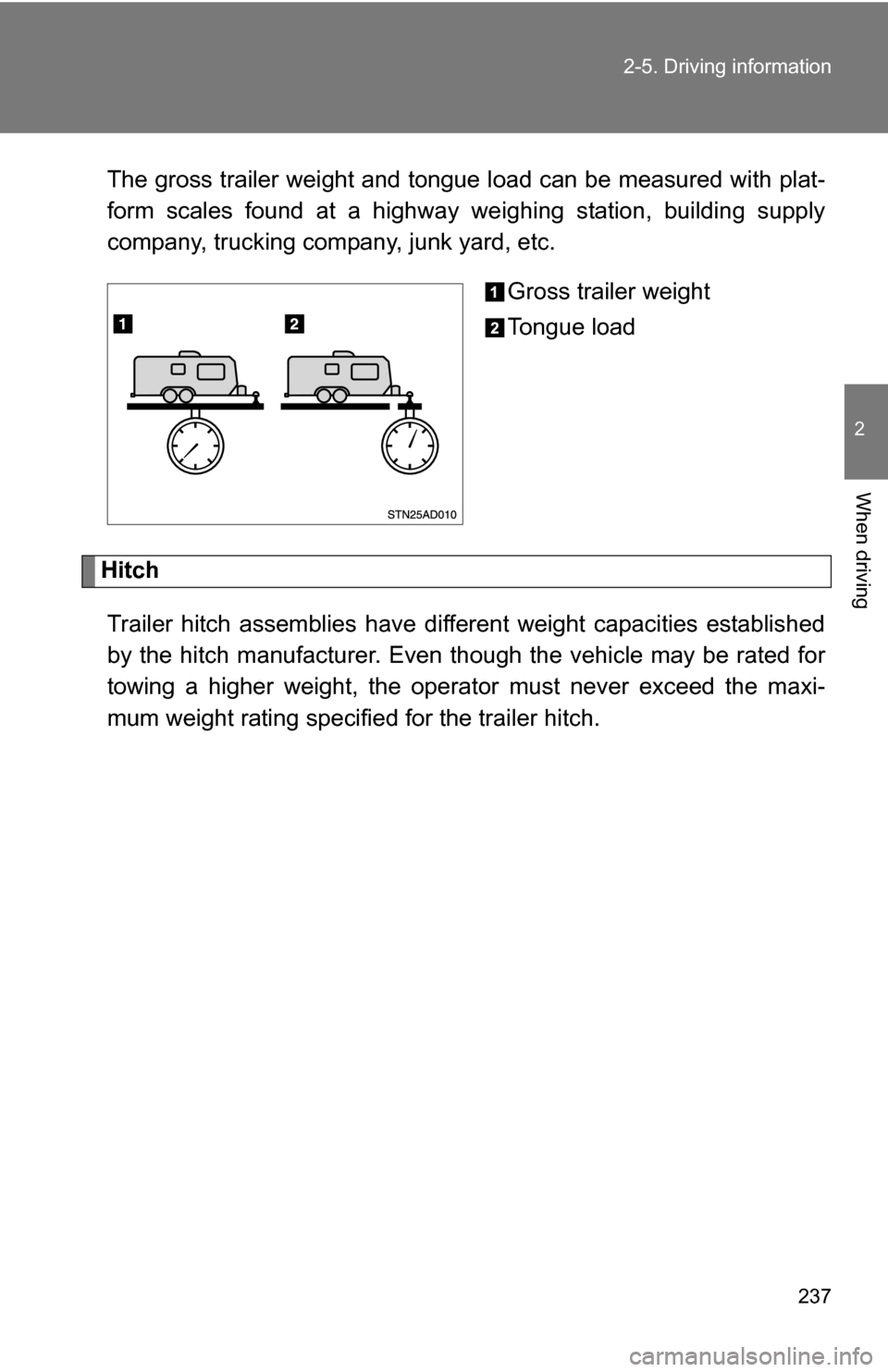
The gross trailer weight and tongue l
oad can be measured with plat-
form scales found at a highway weighing station, building supply
company, trucking company, junk yard, etc.
Gross trailer weight
Tongue load
Hitch
Trailer hitch assemblies have different weight capacities established
by the hitch manufacturer. Even th ough the vehicle may be rated for
towing a higher weight, the operat or must never exceed the maxi-
mum weight rating specified for the trailer hitch.
Page 238 of 596
238 2-5. Driving information
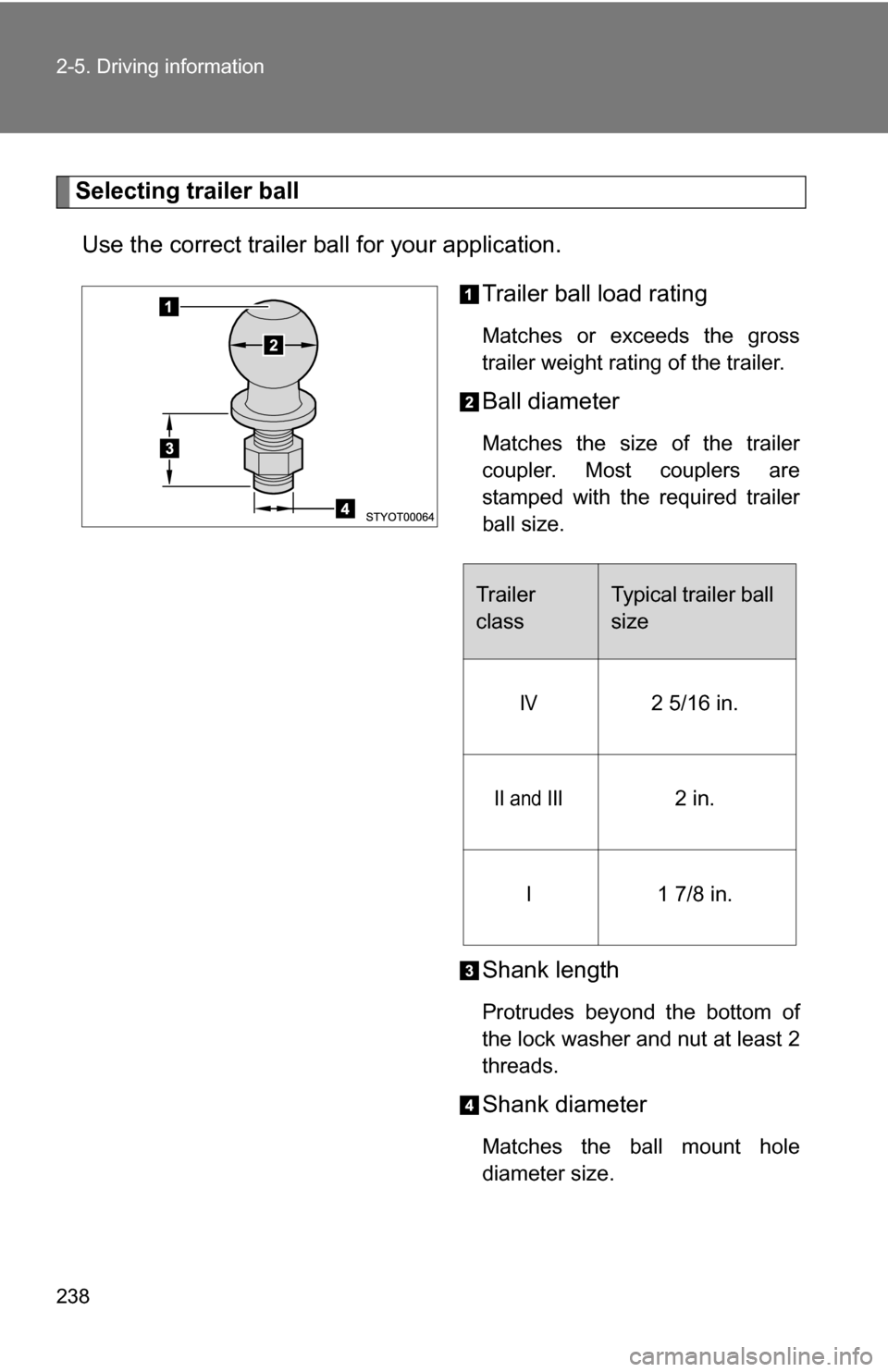
Selecting trailer ballUse the correct trailer ball for your application. Trailer ball load rating
Matches or exceeds the gross
trailer weight rating of the trailer.
Ball diameter
Matches the size of the trailer
coupler. Most couplers are
stamped with the required trailer
ball size.
Shank length
Protrudes beyond the bottom of
the lock washer and nut at least 2
threads.
Shank diameter
Matches the ball mount hole
diameter size.
Trailer
classTypical trailer ball
size
IV2 5/16 in.
II and III2 in.
I1 7/8 in.
Page 244 of 596
244 2-5. Driving information
●Retighten the fixing bolts of the towing ball and bracket after approxi-
mately 600 miles (1000 km).
CAUTION
■Trailer towing precautions
●Follow all the instructions described in this section. Failure to do so could
cause an accident resulting in death or serious injury.
● Exceeding the towing capacity, GVWR, GCWR or GAWR can cause an
accident resulting in death or serious injuries.
● To tow a trailer safely, use extreme care and drive the vehicle in accor-
dance with the trailer’s characteristics and operating conditions.
● The vehicle stability and braking performance are affected by trailer stabil-
ity, brake setting and performance, and the hitch.
■ To avoid accident or injury
●Speed limit for towing a trailer vary by state or province. Do not exceed the
posted towing speed limit.
● Do not exceed the trailer hitch assembly weight, gross vehicle weight,
gross axle weight and trailer tongue load capacities.
● Never load more weight in the back than in the front of the trailer. About
60% of the load should be in the front half of the trailer, and the remaining
40% in the rear.
● Do not use cruise control when you are towing.
● Slow down and downshift before descending steep or long downhill
grades. Do not make sudden downshifts.
● Avoid holding the brake pedal down too long or applying the brakes too
frequently. This could cause the brakes to overheat and result in reduced
braking efficiency.
● Do not tow the vehicle with the temporary spare tire installed.
■ Hitches
●If you wish to install a trailer hitch, contact your Toyota dealer.
● Use only a hitch that conforms to the gross trailer weight requirement.
● Follow the directions supplied by the hitch manufacturer.
● Lubricate the hitch ball with a light coat of grease.
Page 245 of 596
245
2-5. Driving information
2
When driving
CAUTION
■
Hitches
●Remove the trailer hitch whenever you are not towing a trailer. After
removing the hitch, seal any mounting hole in the vehicle body to prevent
entry of any substances into the vehicle.
■ When towing a trailer
●If the gross trailer weight exceeds 1000 lb. (453 kg), trailer brakes are
required. Toyota recommends trailers wi th brakes that conform to all appli-
cable federal and state/provincial regulations.
● Never tap into your vehicle’s hydraulic system, as this will lower the vehi-
cle’s braking effectiveness.
● Never tow a trailer without using a safety chain securely attached to both
the trailer and the vehicle. If damage occurs to the coupling unit or hitch
ball, there is danger of the trailer wandering into another lane.
NOTICE
■When installing a trailer hitch
●Use only the position recommended by your Toyota dealer. Do not install
the trailer hitch on the bumper; this may cause body damage.
● Do not use axle-mounted hitches, as they can cause damage to the axle
housing, wheel bearing, wheels or tires.
■ Safety chain
A safety chain must always be used between the towing vehicle and the
trailer. Leave sufficient slack in the chain for turns. The chain should cross
under the trailer tongue to prevent the tongue from dropping to the ground in
the case that it becomes damaged or separated. For the correct safety chain
installation procedure, ask your Toyota dealer.
■ Do not directly splice trailer lights
Directly splicing trailer lights may damage your vehicle’s electrical system
and cause a malfunction.
Page 399 of 596
399
3-7. Other interior features
3
Interior features
■
The seat heaters can be used when
The engine switch is in the ON position.
■ When not in use
Front seat: Turn the dial fully downward. The indicator turns off.
Rear seat (vehicles with rear console box): Push lightly on the opposite side.
The indicator turns off.
CAUTION
■Burns
●Use caution when seating the following persons in a seat with the seat
heater on to avoid the possibility of burns:
• Babies, small children, the elderly, the sick and the disabled
• Persons with sensitive skin
• Persons who are fatigued
• Persons who have taken alcohol or drugs that induce sleep (sleeping
drugs, cold remedies, etc.)
● Do not cover the seat with anything when using the seat heater.
Using the seat heater with a blanket or cushion increases the temperature
of the seat and may lead to overheating.
NOTICE
■To prevent seat heater damage
Do not put unevenly weighted objects on the seat and do not stick sharp
objects (needles, nails, etc.) into the seat.
■ To prevent battery discharge
Turn the switches off when the engine is not running.
Page 401 of 596
401
3-7. Other interior features
3
Interior features
CAUTION
■
Burns
●Use caution when seating the following persons in a seat with the seat
heater on to avoid the possibility of burns:
• Babies, small children, the elderly, the sick and the disabled
• Persons with sensitive skin
• Persons who are fatigued
• Persons who have taken alcohol or drugs that induce sleep (sleeping
drugs, cold remedies, etc.)
● Do not cover the seat with anything when using the seat heater.
Using the seat heater with a blanket or cushion increases the temperature
of the seat and may lead to overheating.
NOTICE
■To prevent seat heater damage
Do not put unevenly weighted objects on the seat and do not stick sharp
objects (needles, nails, etc.) into the seat.
■ To prevent battery discharge
Turn the switches off when the engine is not running.
Page 457 of 596
457
4-3. Do-it-yourself maintenance
4
Maintenance and care
■Replacing tires and wheels
If the ID code of the tire pressure warning valve and transmitter is not
registered, the tire pre
ssure warning system will not work properly. After
driving for about 20 minutes, the ti re pressure warning light comes on
after blinking for 1 minute to indicate a system malfunction.
■Tire life
Any tire over 6 years old must be checked by a qualified technician even
if they have seldom or never been used or damage is not obvious.
■If the tread wears down below 0.16 in. (4 mm) on snow tires
The effectiveness of snow tires is lost.
■Low profile tires
Generally, low profile tires will wear more rapidly and tire grip perfor-
mance will be reduced on snowy and/or icy roads when compared to
standard tires. Be sure to use snow tires or snow chains on snowy and/
or icy roads and drive carefully at a speed appropriate for road and
weather conditions.
■Maximum load of tire
Check that the maximum load of the re placed tire is greater than 1/2 of
the Gross Axle Weight Ratings (GAWR) of either the front axle or the
rear axle, whichever is greater.
As for the maximum load of the tire, see the load limit at maximum cold
tire inflation pressure mentioned on the sidewall of the tire, and as for the
Gross Axle Weight Ratings (GAWR) , see the Certification Label.
( P. 461, 558).
■Tire types
1 Summer tires
Summer tires are high-speed performance tires best suited to highway
driving under dry conditions. Since summer tires do not have the same
traction performance as snow tire s, summer tires are inadequate for
driving on snow-covered or icy roads. For driving on snow-covered
roads or icy roads, the use of snow tires is recommended. When
installing snow tires, be sure to replace all four tires.
Page 463 of 596
463
4-3. Do-it-yourself maintenance
4
Maintenance and care
■Instructions for checking tire inflation pressure
When checking tire inflation pressure, observe the following:
●Check only when the tires are cold.
If your vehicle has been parked for at least 3 hours and has not been
driven for more than 1 mile or
1.5 km, you will get an accurate cold
tire inflation pressure reading.
●Always use a tire pressure gauge.
The appearance of the tire can be mi sleading. In addition, tire infla-
tion pressures that are even just a few pounds off can degrade ride
and handling.
●Do not bleed or reduce tire inflation pressure after driving. It is normal
for the tire inflation pressure to be higher after driving.
●Never exceed the vehicle capacity weight.
Passengers and luggage weight should be placed so that the vehicle
is balanced.
CAUTION
■Proper inflation is critical to save tire performance
Keep your tires properly inflated.
Otherwise, the following conditions may occur and result in an accident
causing death or serious injury.
●Excessive wear
●Uneven wear
●Poor handling
●Possibility of blowouts resu lting from overheated tires
●Poor sealing of the tire bead
●Wheel deformation and/or tire separation
●A greater possibility of tire damage from road hazards