warning TOYOTA SEQUOIA 2008 2.G Workshop Manual
[x] Cancel search | Manufacturer: TOYOTA, Model Year: 2008, Model line: SEQUOIA, Model: TOYOTA SEQUOIA 2008 2.GPages: 596, PDF Size: 12.93 MB
Page 515 of 596
5
When trouble arises
515
5-2. Steps to take in an emergency
Follow the correction procedures.
After taking the specified steps to correct the suspected problem,
check that the warning light turns off.
Warning lightDetailsCorrection procedure
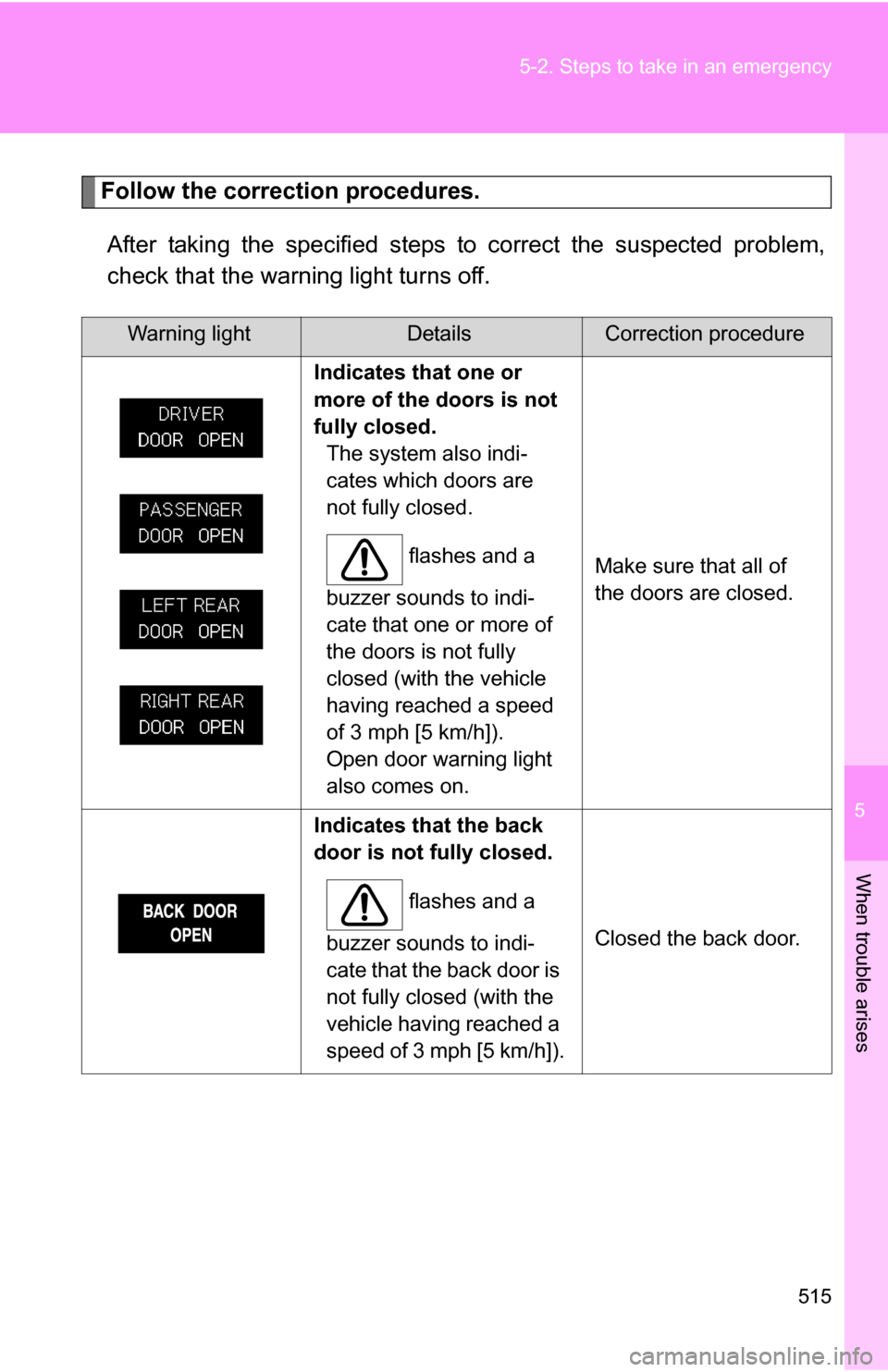
Indicates that one or
more of the doors is not
fully closed. The system also indi-
cates which doors are
not fully closed.
flashes and a
buzzer sounds to indi-
cate that one or more of
the doors is not fully
closed (with the vehicle
having reached a speed
of 3 mph [5 km/h]).
Open door warning light
also comes on. Make sure that all of
the doors are closed.
Indicates that the back
door is not fully closed. flashes and a
buzzer sounds to indi-
cate that the back door is
not fully closed (with the
vehicle having reached a
speed of 3 mph [5 km/h]). Closed the back door.
Page 516 of 596
516 5-2. Steps to take in an emergency
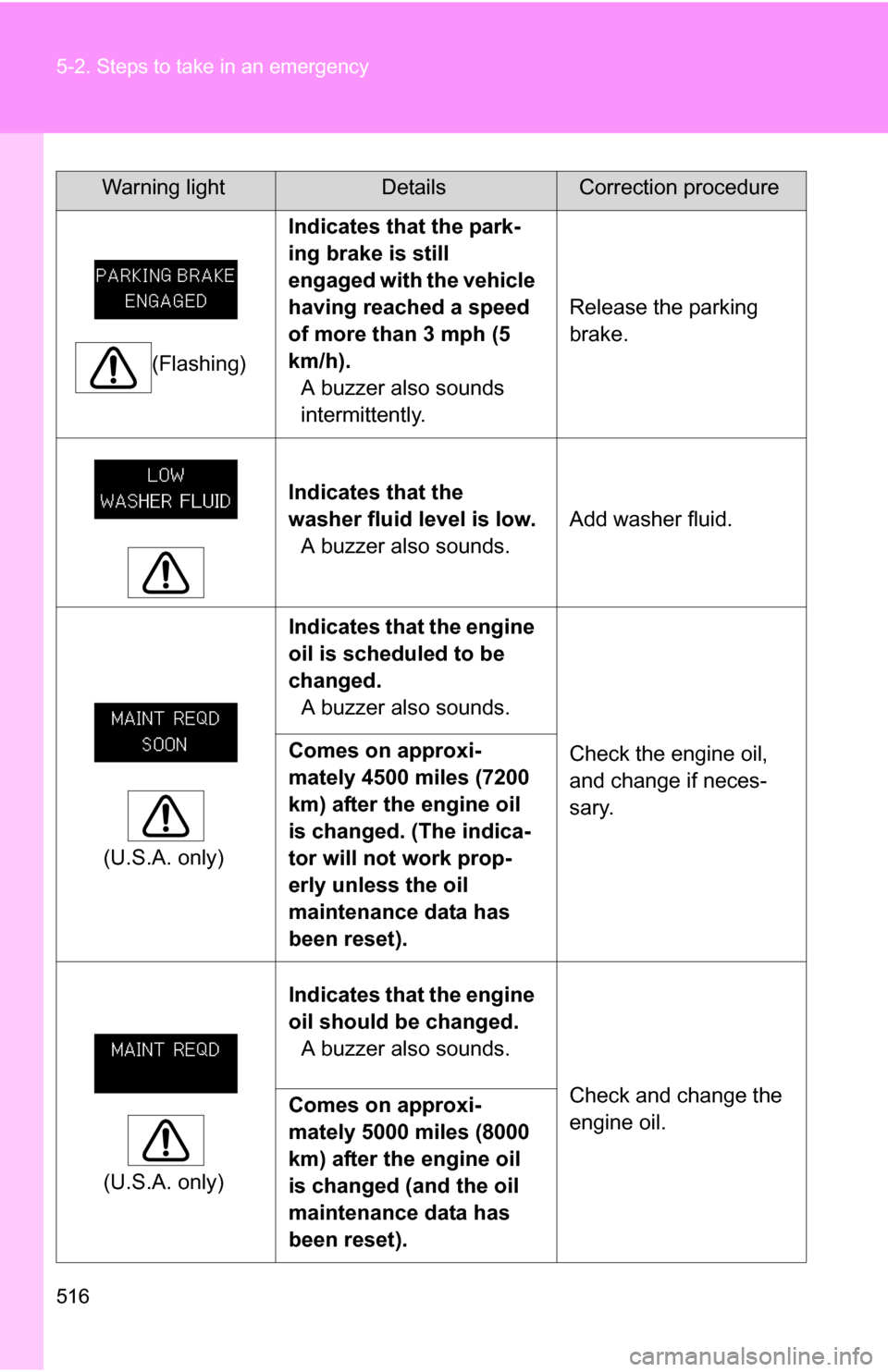
(Flashing)Indicates that the park-
ing brake is still
engaged with the vehicle
having reached a speed
of more than 3 mph (5
km/h).
A buzzer also sounds
intermittently. Release the parking
brake.
Indicates that the
washer fluid level is low. A buzzer also sounds. Add washer fluid.
(U.S.A. only) Indicates that the engine
oil is scheduled to be
changed.
A buzzer also sounds.
Check the engine oil,
and change if neces-
sary.
Comes on approxi-
mately 4500 miles (7200
km) after the engine oil
is changed. (The indica-
tor will not work prop-
erly unless the oil
maintenance data has
been reset).
(U.S.A. only) Indicates that the engine
oil should be changed.
A buzzer also sounds.
Check and change the
engine oil.
Comes on approxi-
mately 5000 miles (8000
km) after the engine oil
is changed (and the oil
maintenance data has
been reset).
Warning lightDetailsCorrection procedure
Page 517 of 596
5
When trouble arises
517
5-2. Steps to take in an emergency
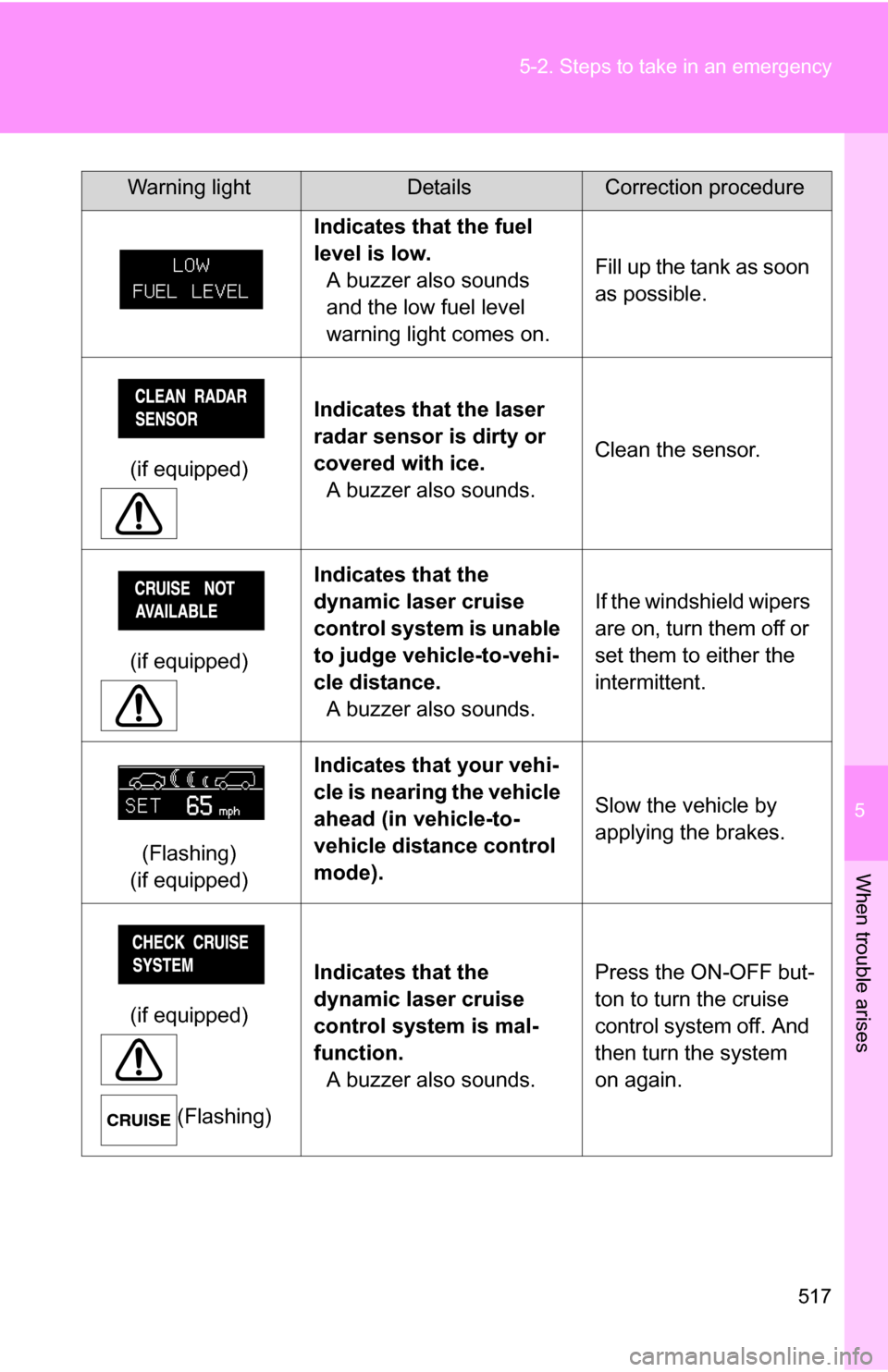
Indicates that the fuel
level is low.
A buzzer also sounds
and the low fuel level
warning light comes on. Fill up the tank as soon
as possible.
(if equipped) Indicates that the laser
radar sensor is dirty or
covered with ice.
A buzzer also sounds. Clean the sensor.
(if equipped) Indicates that the
dynamic laser cruise
control system is unable
to judge vehicle-to-vehi-
cle distance.
A buzzer also sounds. If the windshield wipers
are on, turn them off or
set them to either the
intermittent.
(Flashing)
(if equipped) Indicates that your vehi-
cle is nearing the vehicle
ahead (in vehicle-to-
vehicle distance control
mode).
Slow the vehicle by
applying the brakes.
(if equipped) (Flashing) Indicates that the
dynamic laser cruise
control system is mal-
function.
A buzzer also sounds. Press the ON-OFF but-
ton to turn the cruise
control system off. And
then turn the system
on again.
Warning lightDetailsCorrection procedure
Page 518 of 596
518 5-2. Steps to take in an emergency
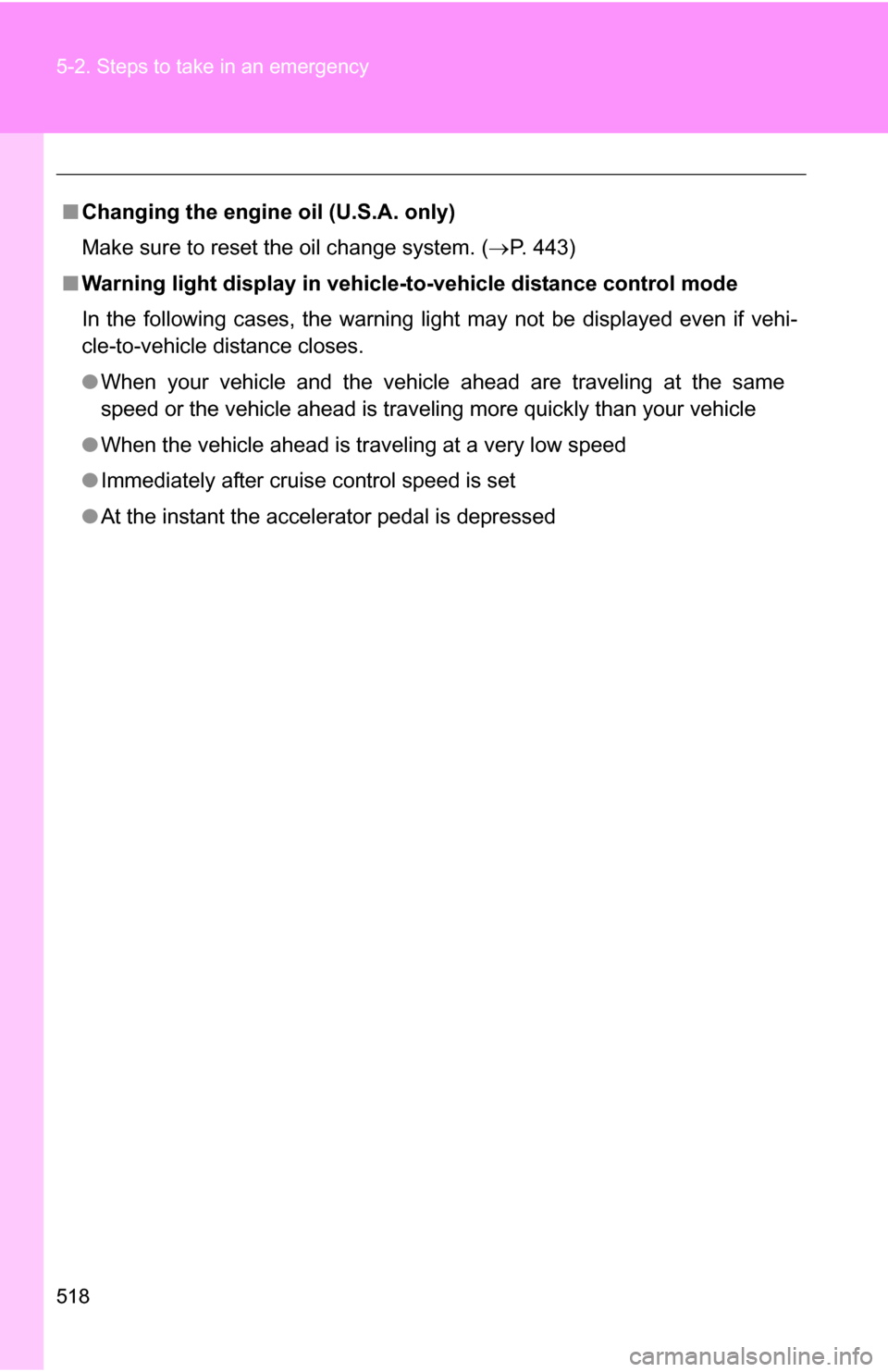
■Changing the engine oil (U.S.A. only)
Make sure to reset the oil change system. ( P. 443)
■ Warning light display in vehicle -to-vehicle distance control mode
In the following cases, the warning light may not be displayed even if vehi-
cle-to-vehicle distance closes.
● When your vehicle and the vehicle ahead are traveling at the same
speed or the vehicle ahead is traveling more quickly than your vehicle
● When the vehicle ahead is traveling at a very low speed
● Immediately after cruise control speed is set
● At the instant the accelerator pedal is depressed
Page 525 of 596
5
When trouble arises
525
5-2. Steps to take in an emergency
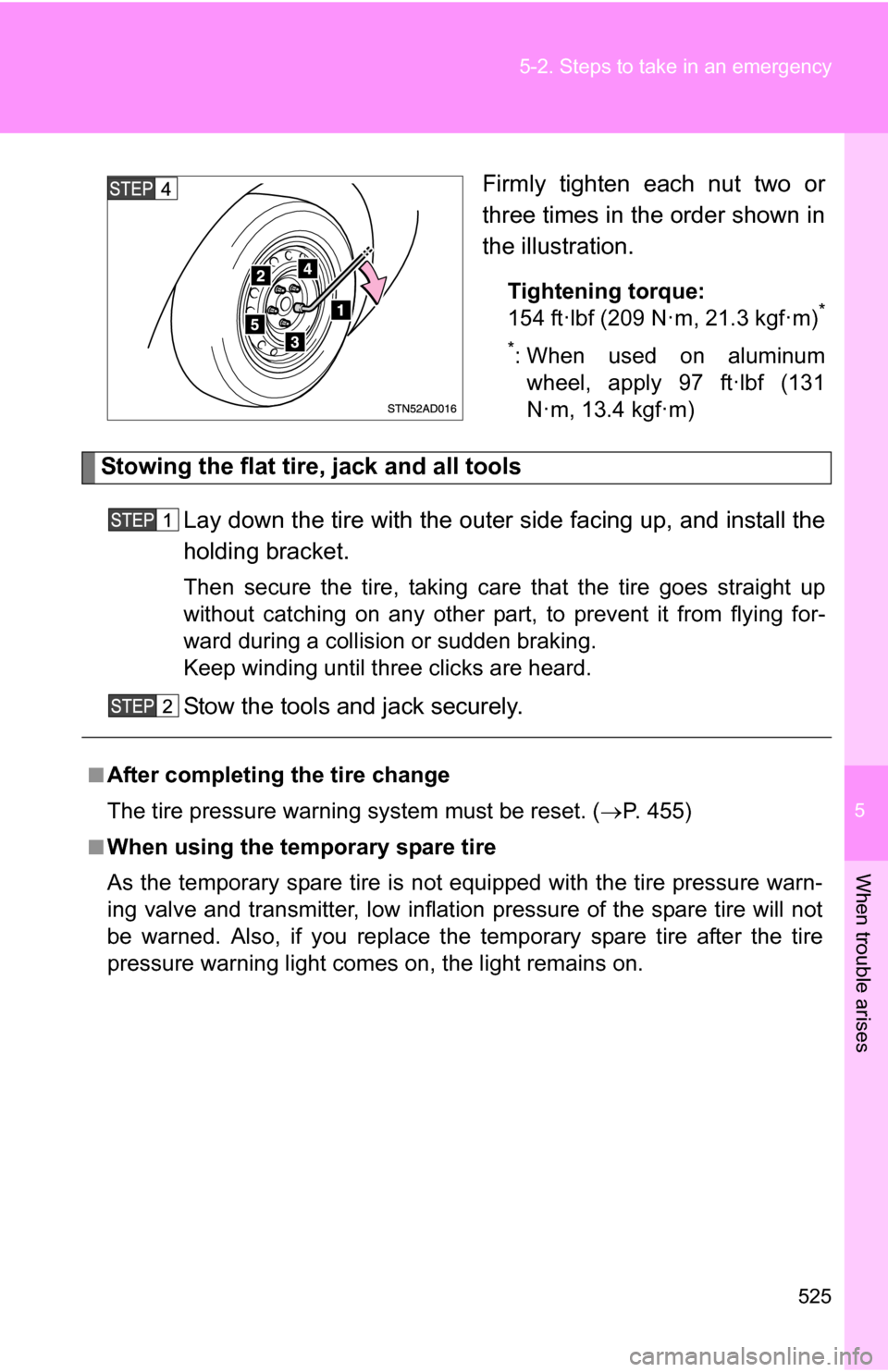
Firmly tighten each nut two or
three times in the order shown in
the illustration.
Tightening torque:
154 ft·lbf (209 N·m, 21.3 kgf·m)*
*
: When used on aluminum wheel, apply 97 ft·lbf (131
N·m, 13.4 kgf·m)
Stowing the flat tire, jack and all tools
Lay down the tire with the outer side facing up, and install the
holding bracket.
Then secure the tire, taking care that the tire goes straight up
without catching on any other part, to prevent it from flying for-
ward during a collision or sudden braking.
Keep winding until three clicks are heard.
Stow the tools and jack securely.
■After completing the tire change
The tire pressure warning system must be reset. (P. 455)
■When using the temporary spare tire
As the temporary spare tire is not equipped with the tire pressure warn-
ing valve and transmitter, low inflation pressure of the spare tire will not
be warned. Also, if you replace the temporary spare tire after the tire
pressure warning light comes on, the light remains on.
Page 528 of 596
528 5-2. Steps to take in an emergency
CAUTION
■When the spare tire is attached
The vehicle speed may not be correctly detected, and the following sys-
tems may not operate correctly:
●ABS & Brake assist
●VSC
●TRAC
●A-TRAC
●AUTO LSD
●Cruise control
●Navigation system
Also, not only can the following syste m not be utilized fully, it may actu-
ally negatively effect t he drive-train components:
●4WD system
NOTICE
■Do not drive the vehicle with a flat tire.
Do not continue driving with a flat tire.
Driving even a short distance with a flat tire can damage the tire and the
wheel beyond repair.
■When replacing the tires
●When removing or fitting the wheels, tires or the tire pressure warning
valve and transmitter, contact your Toyota dealer as the tire pressure
warning valve and transmitter may be damaged if not handled cor-
rectly.
●Replace the grommets for the tire pressure warning valves and trans-
mitters as well.
■To avoid damaging the tire pressure warning valves and transmit-
ters
Do not use liquid sealants on flat tires.
Page 562 of 596
562 6-1. Specifications
■Treadwear
The treadwear grade is a comparative rating based on the wear
rate of the tire when tested und er controlled conditions on a
specified government test course.
For example, a tire graded 150 would wear one and a half (1 - 1/2)
times as well on the government course as a tire graded 100.
The relative performance of tires depends upon the actual conditions
of their use, however, and may depart significantly from the norm due
to variations in driving habits, service practices and differences in
road characteristics and climate.
■ Traction AA, A, B, C
The traction grades, from highest to lowest, are AA, A, B and C,
and they represent the tire’s ab ility to stop on wet pavement as
measured under controlled cond itions on specified government
test surfaces of asphalt and concrete.
A tire marked C may have poor traction performance.
Warning: The traction grade assigned to this tire is based on braking
(straight ahead) traction tests and does not include cornering
(turning) traction.
■ Temperature A, B, C
The temperature grades are A (the highest), B, and C,
representing the tire’s resistance to the generation of heat and its
ability to dissipate heat when te sted under controlled conditions on
a specified indoor laboratory test wheel.
Sustained high temperature can cause the material of the tire to
degenerate and reduce tire life, and excessive temperature can lead
to sudden tire failure.
The grade C corresponds to a level of performance which all
passenger car tires must meet under the Federal Motor Vehicle
Safety Standard No. 109.
Grades B and A represent higher levels of performance on the
laboratory test wheel than the minimum required by law.
Page 563 of 596
563
6-1. Specifications
6
Vehicle specifications
Warning: The temperature grades for this tire are established for a
tire that is properly inflated and not overloaded.
Excessive speed, underinflation,
or excessive loading, either
separately or in combination, can cause heat buildup and possible
tire failure.
Glossary of tire terminology
Tire related termMeaning
Cold tire inflation
pressure
Tire pressure when the vehicle has been
parked for three hours or more, or has not
been driven more than 1 mile or 1.5 km under
that condition
Maximum inflation
pressureThe maximum cold inflated pressure to which a
tire may be inflated, s hown on the sidewall of
the tire
Recommended
inflation pressureCold tire inflation pressure recommended by a
manufacturer
Accessory weight
The combined weight (in excess of those
standard items which may be replaced) of
transmission, power steering, power brakes,
power windows, power seats, radio and heater,
to the extent that these items are available as
factory-installed equipment (whether installed
or not)
Curb weight
The weight of a motor vehicle with standard
equipment, including the maximum capacity of
fuel, oil and coolant, and if so equipped, air
conditioning and additional weight optional
engine
Maximum loaded
vehicle weight
The sum of:
(a) Curb weight
(b) Accessory weight
(c) Vehicle capacity weight
(d) Production options weight
Page 573 of 596
573
6-2. Customization
6
Vehicle specifications
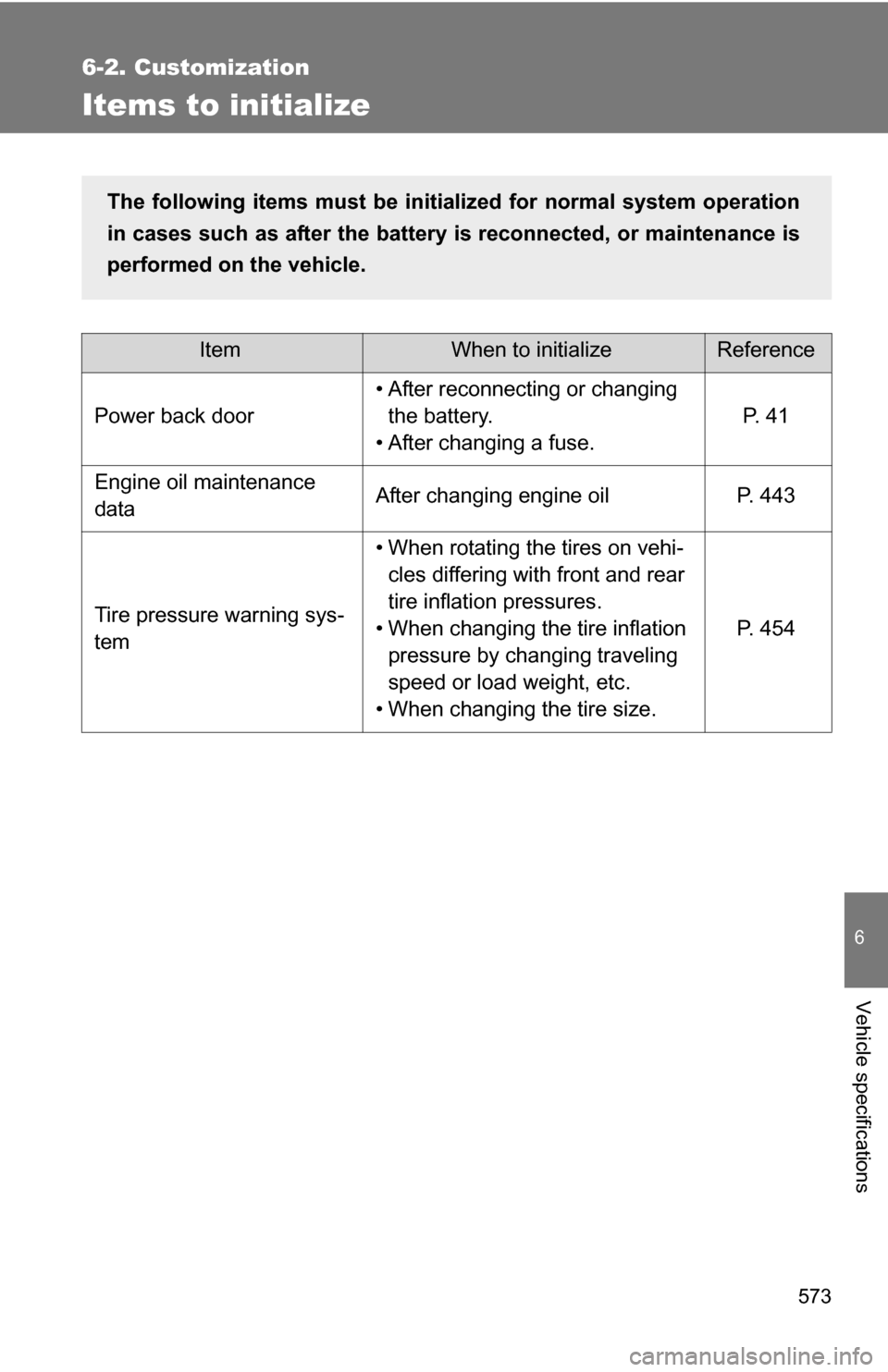
Items to initialize
ItemWhen to initializeReference
Power back door
• After reconnecting or changing the battery.
• After changing a fuse.
P. 4 1
Engine oil maintenance
dataAfter changing engine oilP. 443
Tire pressure warning sys-
tem
• When rotating the tires on vehi- cles differing with front and rear
tire inflation pressures.
• When changing the tire inflation pressure by changing traveling
speed or load weight, etc.
• When changing the tire size.
P. 454
The following items must be initia lized for normal system operation
in cases such as after the battery is reconnected, or maintenance is
performed on the vehicle.
Page 583 of 596
583
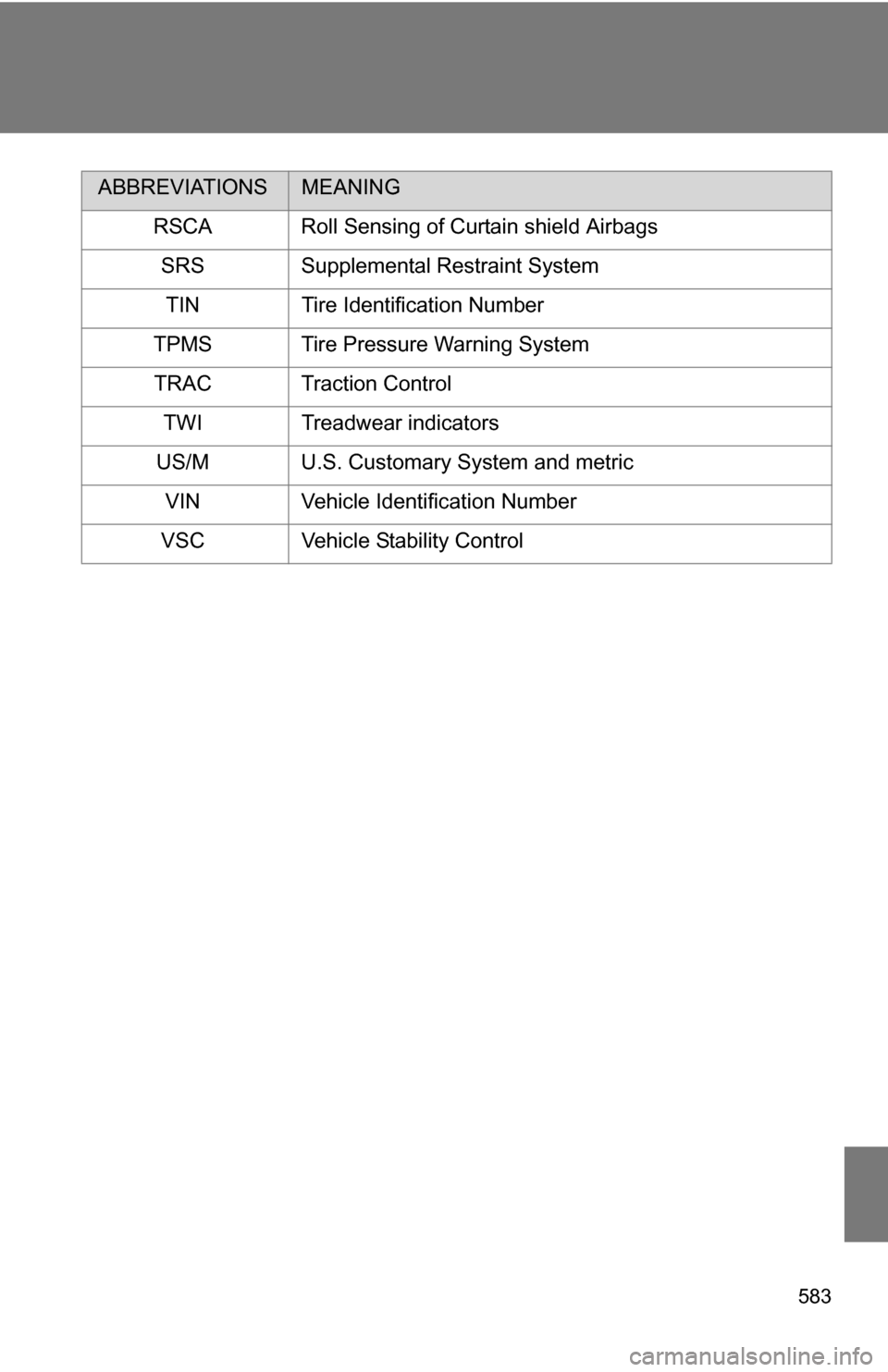
RSCA Roll Sensing of Curtain shield AirbagsSRS Supplemental Restraint SystemTIN Tire Identification Number
TPMS Tire Pressure Warning System TRAC Traction Control TWI Treadwear indicators
US/M U.S. Customary System and metric VIN Vehicle Identification Number
VSC Vehicle Stability Control
ABBREVIATIONSMEANING