towing TOYOTA SEQUOIA 2008 2.G Owners Manual
[x] Cancel search | Manufacturer: TOYOTA, Model Year: 2008, Model line: SEQUOIA, Model: TOYOTA SEQUOIA 2008 2.GPages: 596, PDF Size: 12.93 MB
Page 3 of 596
1
2
3
4
5
6
7
3
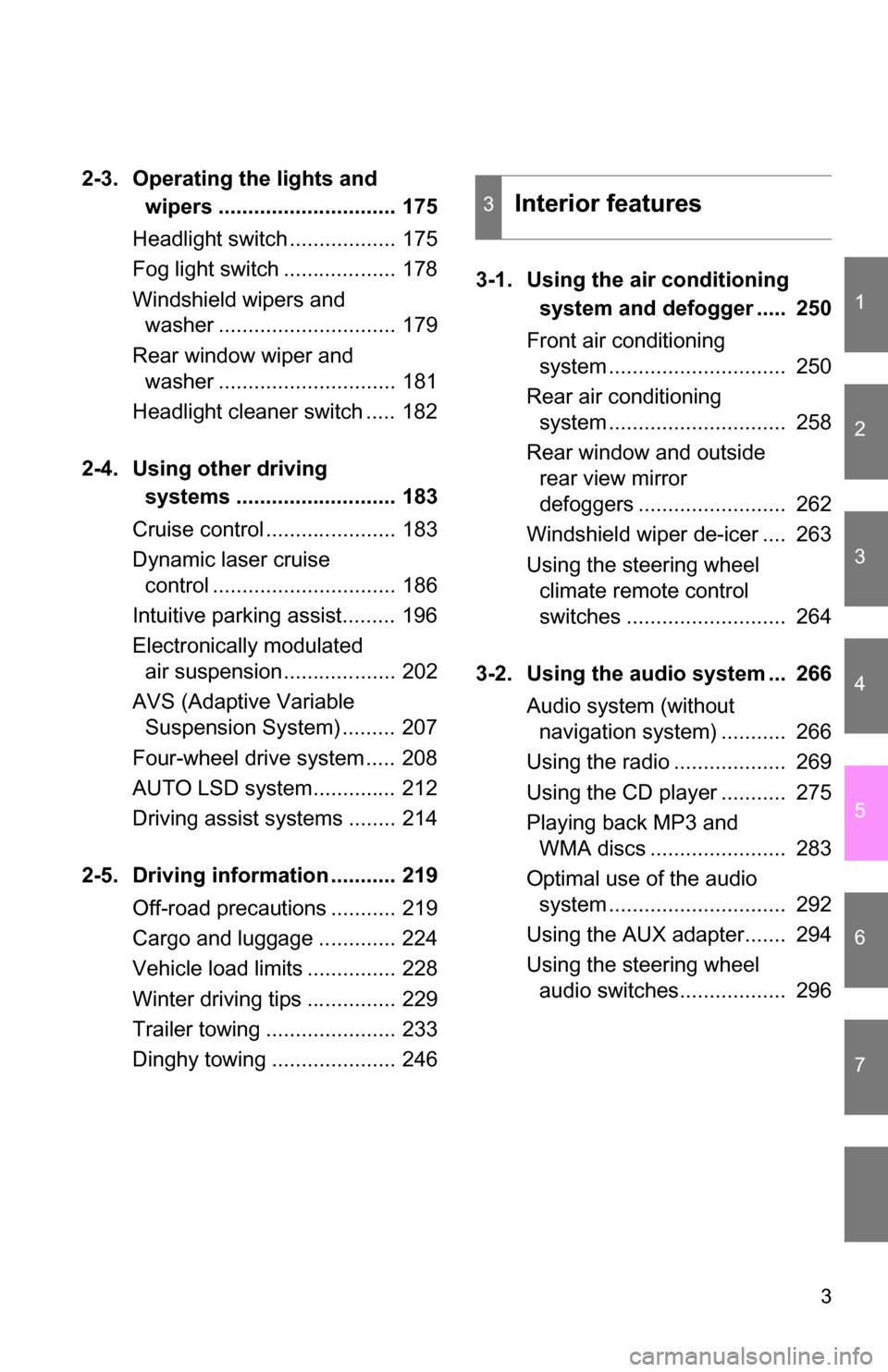
2-3. Operating the lights and wipers .............................. 175
Headlight switch .................. 175
Fog light switch ................... 178
Windshield wipers and washer .............................. 179
Rear window wiper and washer .............................. 181
Headlight cleaner switch ..... 182
2-4. Using other driving systems ........................... 183
Cruise control ...................... 183
Dynamic laser cruise control ............................... 186
Intuitive parking assist......... 196
Electronically modulated air suspension................... 202
AVS (Adaptive Variable Suspension System) ......... 207
Four-wheel drive system ..... 208
AUTO LSD system.............. 212
Driving assist systems ........ 214
2-5. Driving information ........... 219 Off-road precautions ........... 219
Cargo and luggage ............. 224
Vehicle load limits ............... 228
Winter driving tips ............... 229
Trailer towing ...................... 233
Dinghy towing ..................... 246 3-1. Using the air conditioning
system and defogger ..... 250
Front air conditioning system .............................. 250
Rear air conditioning system .............................. 258
Rear window and outside rear view mirror
defoggers ......................... 262
Windshield wiper de-icer .... 263
Using the steering wheel climate remote control
switches ........................... 264
3-2. Using the audio system ... 266 Audio system (without navigation system) ........... 266
Using the radio ................... 269
Using the CD player ........... 275
Playing back MP3 and WMA discs ....................... 283
Optimal use of the audio system .............................. 292
Using the AUX adapter....... 294
Using the steering wheel audio switches.................. 296
3Interior features
Page 135 of 596
When driving2
135
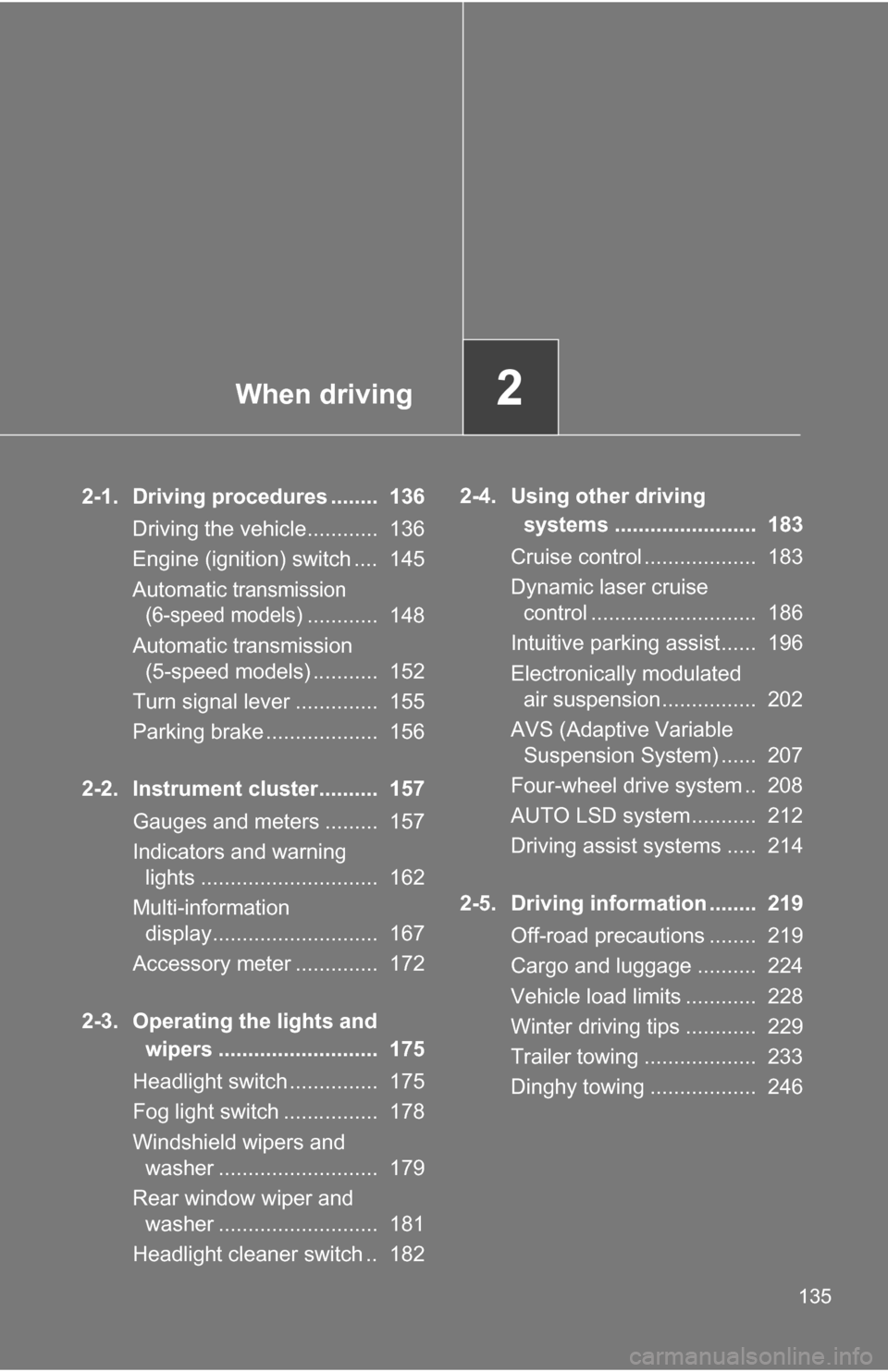
2-1. Driving procedures ........ 136Driving the vehicle............ 136
Engine (ignition) switch .... 145
Automatic
transmission
(6-speed models)
............ 148
Automatic transmission (5-speed models) ........... 152
Turn signal lever .............. 155
Parking brake ................... 156
2-2. Instrument cluster.......... 157 Gauges and meters ......... 157
Indicators and warning lights .............................. 162
Multi-information display............................ 167
Accessory meter .............. 172
2-3. Operating the lights and wipers ........................... 175
Headlight switch ............... 175
Fog light switch ................ 178
Windshield wipers and washer ........................... 179
Rear window wiper and washer ........................... 181
Headlight cleaner switch .. 182 2-4. Using other driving
systems ........................ 183
Cruise control ................... 183
Dynamic laser cruise control ............................ 186
Intuitive parking assist...... 196
Electronically modulated air suspension ................ 202
AVS (Adaptive Variable Suspension System) ...... 207
Four-wheel drive system .. 208
AUTO LSD system........... 212
Driving assist systems ..... 214
2-5. Driving information ........ 219 Off-road precautions ........ 219
Cargo and luggage .......... 224
Vehicle load limits ............ 228
Winter driving tips ............ 229
Trailer towing ................... 233
Dinghy towing .................. 246
Page 150 of 596
150 2-1. Driving procedures
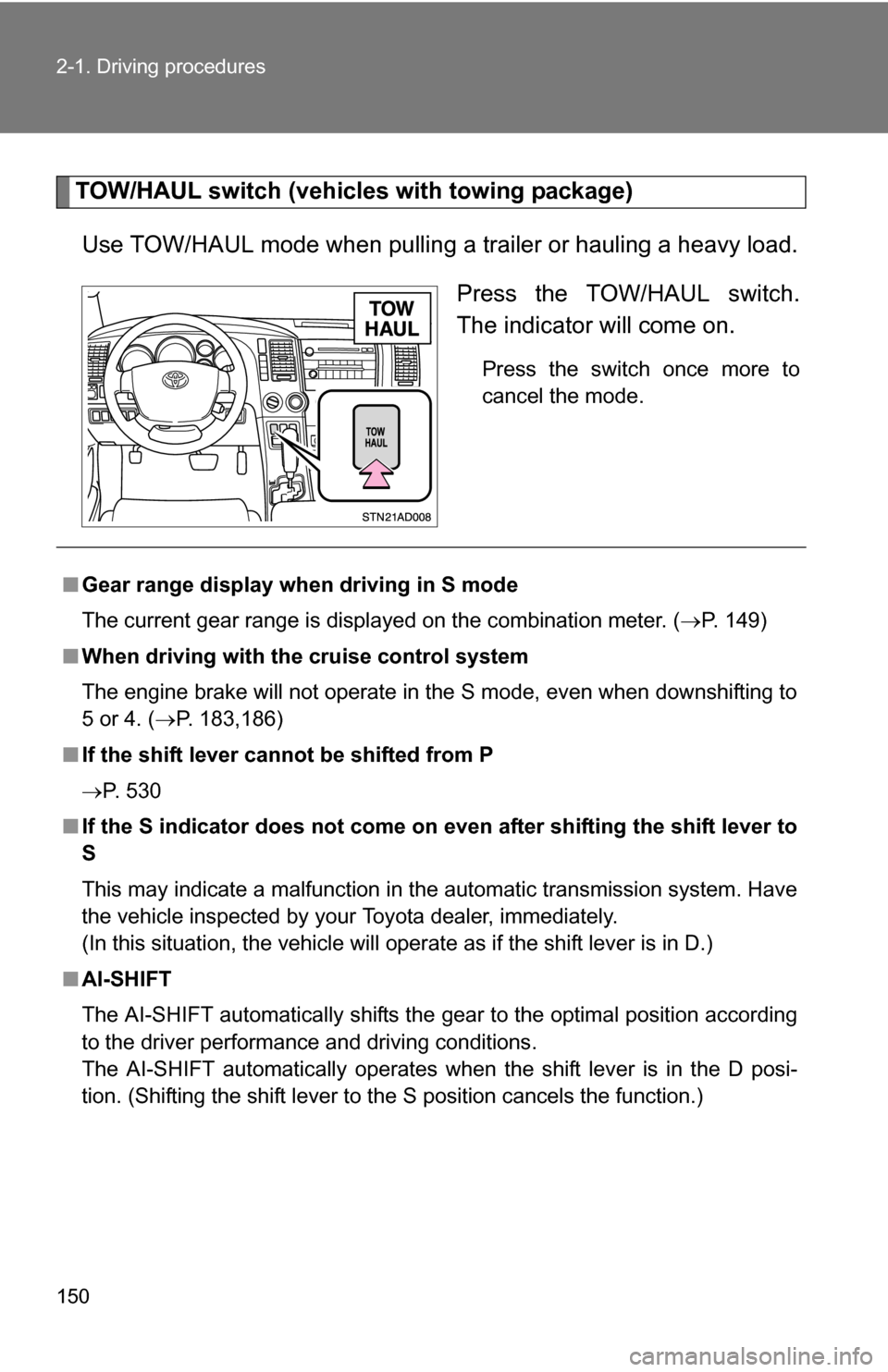
TOW/HAUL switch (vehicles with towing package)Use TOW/HAUL mode when pulling a trailer or hauling a heavy load. Press the TOW/HAUL switch.
The indicator will come on.
Press the switch once more to
cancel the mode.
■Gear range display when driving in S mode
The current gear range is displayed on the combination meter. ( P. 149)
■ When driving with the cruise control system
The engine brake will not operate in the S mode, even when downshifting to
5 or 4. ( P. 183,186)
■ If the shift lever cannot be shifted from P
P. 530
■ If the S indicator does not come on even after shifting the shift lever to
S
This may indicate a malfunction in the automatic transmission system. Have
the vehicle inspected by your Toyota dealer, immediately.
(In this situation, the vehicle will operate as if the shift lever is in D.)
■ AI-SHIFT
The AI-SHIFT automatically shifts the gear to the optimal position according
to the driver performance and driving conditions.
The AI-SHIFT automatically operates when the shift lever is in the D posi-
tion. (Shifting the shift lever to the S position cancels the function.)
Page 194 of 596
194 2-4. Using other driving systems
CAUTION
■When the laser radar sensor may not be correctly detecting the vehicle
ahead
● Vehicles that cut in suddenly
● Vehicles traveling at low speeds
● Vehicles that are not moving
● Vehicles with small rear ends (trailers with no load on board etc.)
● Motorcycles traveling in the same lane
■ Conditions under which the vehicle -to-vehicle distance control may
not function correctly
Apply the brakes as necessary in the following conditions as the laser radar
sensor may not be able to correctly detect vehicles ahead, and an accident
may result.
● When water or snow thrown up by the surrounding vehicles hinders the
functioning of the sensor
● When your vehicle is pointing upwards (caused by a heavy load in the lug-
gage compartment, etc.)
● When the road curves or when the lanes are narrow
● When steering wheel operation or your position in the lane is unstable
● When towing a trailer
■ To ensure the laser rada r sensor functions correctly
Do not do the following to the sensor as doing so may cause the sensor not
to function correctly and could result in an accident.
● Stick or attach anything to them
● Leave them dirty
● Disassemble, subject them to strong shocks
● Modify or paint them
● Replace them with non-genuine parts
Page 200 of 596
200 2-4. Using other driving systems
■Sensor detection information
●Certain vehicle conditions and the surrounding environment may affect
the ability of a sensor to correctly detect an obstacle. Particular instances
where this may occur are listed below.
• There is dirt, snow or ice on a sensor.
• A sensor is frozen.
• A sensor is covered in any way.
• The vehicle is leaning considerably to one side.
• On an extremely bumpy road, on an incline, on gravel, or on grass.
• The vicinity of the vehicle is noisy due to vehicle horns, motorcycle
engines, air brakes of large vehicles, or other loud noises producing
ultrasonic waves.
• There is another vehicle equipped with parking assist sensors in the vicinity.
• A sensor is coated with a sheet of spray or heavy rain.
• The vehicle is equipped with a fender pole or radio antenna.
• A bumper or sensor receives a strong impact.
• The vehicle is approaching a tall or right-angled curb.
• In harsh sunlight or intense cold weather.
• The area directly under the bumpers is not detected. Objects lower than the sensors or thin stakes etc. may be detected ini-
tially, but as they draw closer, they may cease to be detected.
• A towing hitch is mounted to the vehicle.
• A non-genuine Toyota suspension (lowered suspension etc.) is installed.
• When attaching a two-way radio antenna.
• When a towing eyelet is mounted on your vehicle.
• When the bumper is damaged.
In addition to the examples above, there are instances in which, because of
their shapes, signs and other objects may be judged by a sensor to be closer
than they are.
● The shape of the obstacle may prevent a sensor from detecting it. Pay
particular attention to the following obstacles:
• Wires, fences, ropes, etc.
• Cotton, snow and other materials that absorb radio waves
• Sharply-angled objects
Page 207 of 596
207
2-4. Using other driving systems
2
When driving
AVS (Adaptive Variable Suspension System) (if equipped)
■Driving mode
●Sport mode is suitable for winding mountain road driving, high speed
driving or towing a trailer.
● Normal mode is suitable for ordinary driving.
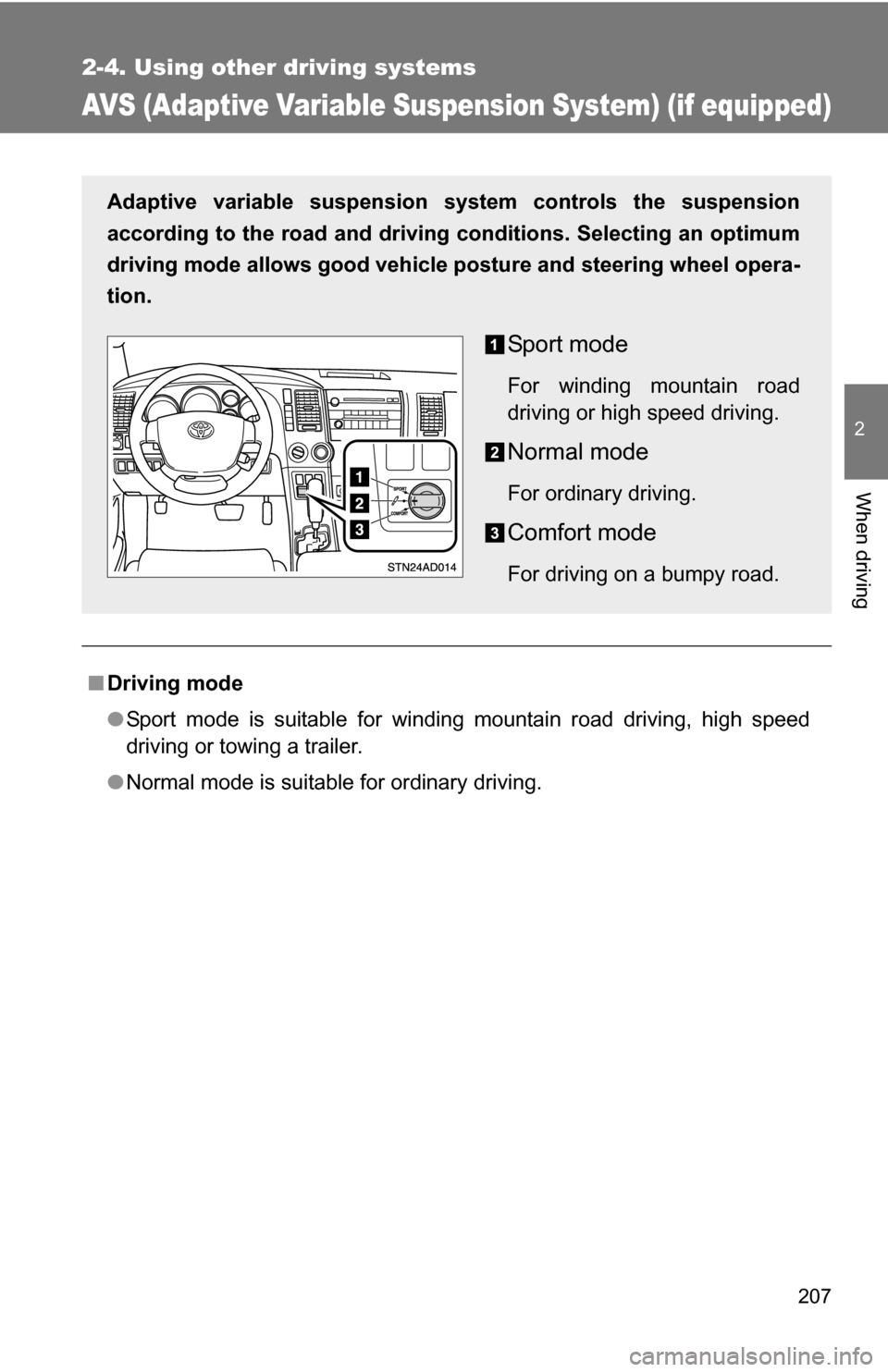
Adaptive variable suspension system controls the suspension
according to the road and driving conditions. Selecting an optimum
driving mode allows good vehicle posture and steering wheel opera-
tion.
Sport mode
For winding mountain road
driving or high speed driving.
Normal mode
For ordinary driving.
Comfort mode
For driving on a bumpy road.
Page 225 of 596
225
2-5. Driving information
2
When driving
(6) If your vehicle will be towing a tr
ailer, load from your trailer will be
transferred to your vehicle. Consult this manual to determine how
this reduces the available cargo and luggage load capacity of your
vehicle.
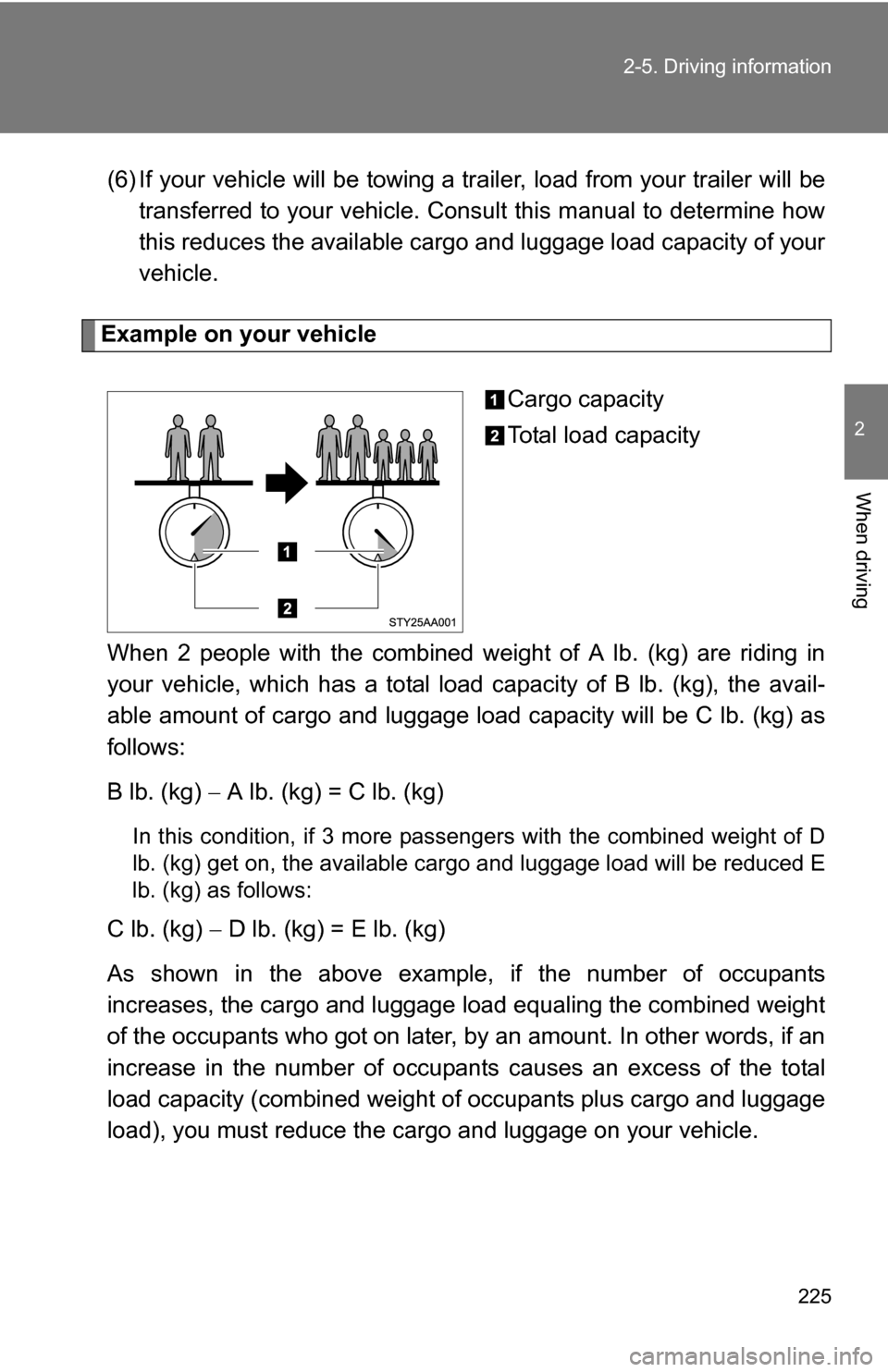
Example on your vehicle
Cargo capacity
Total load capacity
When 2 people with the combined weight of A lb. (kg) are riding in
your vehicle, which has a total load capacity of B lb. (kg), the avail-
able amount of cargo and luggage load capacity will be C lb. (kg) as
follows:
B lb. (kg) A lb. (kg) = C lb. (kg)
In this condition, if 3 more passengers with the combined weight of D
lb. (kg) get on, the available carg o and luggage load will be reduced E
lb. (kg) as follows:
C lb. (kg) D lb. (kg) = E lb. (kg)
As shown in the above example, if the number of occupants
increases, the cargo and luggage load equaling the combined weight
of the occupants who got on later, by an amount. In other words, if an
increase in the number of occupants causes an excess of the total
load capacity (combined weight of occupants plus cargo and luggage
load), you must reduce the ca rgo and luggage on your vehicle.
Page 228 of 596
228
2-5. Driving information
Vehicle load limits
■Total load capacity and seating capacity
These details are also described on the tire and loading information
label. (P. 461)
CAUTION
■Overloading the vehicle
Do not overload the vehicle.
It may not only cause damage to the ti res, but also degrade steering and
braking ability, resulting in an accident.
Vehicle load limits include total load capacity, seating capacity,
towing capacity and cargo capacity.
■ Total load capacity: ( P. 543)
Total load capacity means the combined weight of occupants,
cargo and luggage.
■ Seating capacity:
With separated type second seat—
7 occupants (Front 2, Rear 5)
With bench type second seat—
8 occupants (Front 2, Rear 6)
Seating capacity means the ma ximum number of occupants
whose estimated average weight is 150 lb. (68 kg) per person.
Even if the number of occupants are within the seating capacity,
do not exceed the total load capacity.
■ Towing capacity: ( P. 234, 543)
Towing capacity means the maximum gross trailer weight (trailer
weight plus its cargo weight) that your vehicle is able to tow.
■ Cargo capacity
Cargo capacity may increase or decrease depending on the
weight and the number of occupants.
Page 233 of 596
233
2-5. Driving information
2
When driving
Trailer towing
Your vehicle is designed primarily as a passenger carrying vehicle.
Towing a trailer will have an adverse effect on handling, perfor-
mance, braking, durability, and fuel consumption. For your safety
and the safety of others , do not overload the vehicle or trailer.
To tow a trailer safely, use extreme care and drive the vehicle in
accordance with the trailer’s char acteristics and operating condi-
tions.
The vehicle stability and braking performance are affected by trailer
stability, brake setting and performance, and the hitch.
Toyota warranties do not apply to damage or malfunction caused by
towing a trailer for commercial purposes.
Contact your Toyota dealer for fu rther information about additional
requirements such as a towing kits, etc.
Page 234 of 596
234 2-5. Driving information
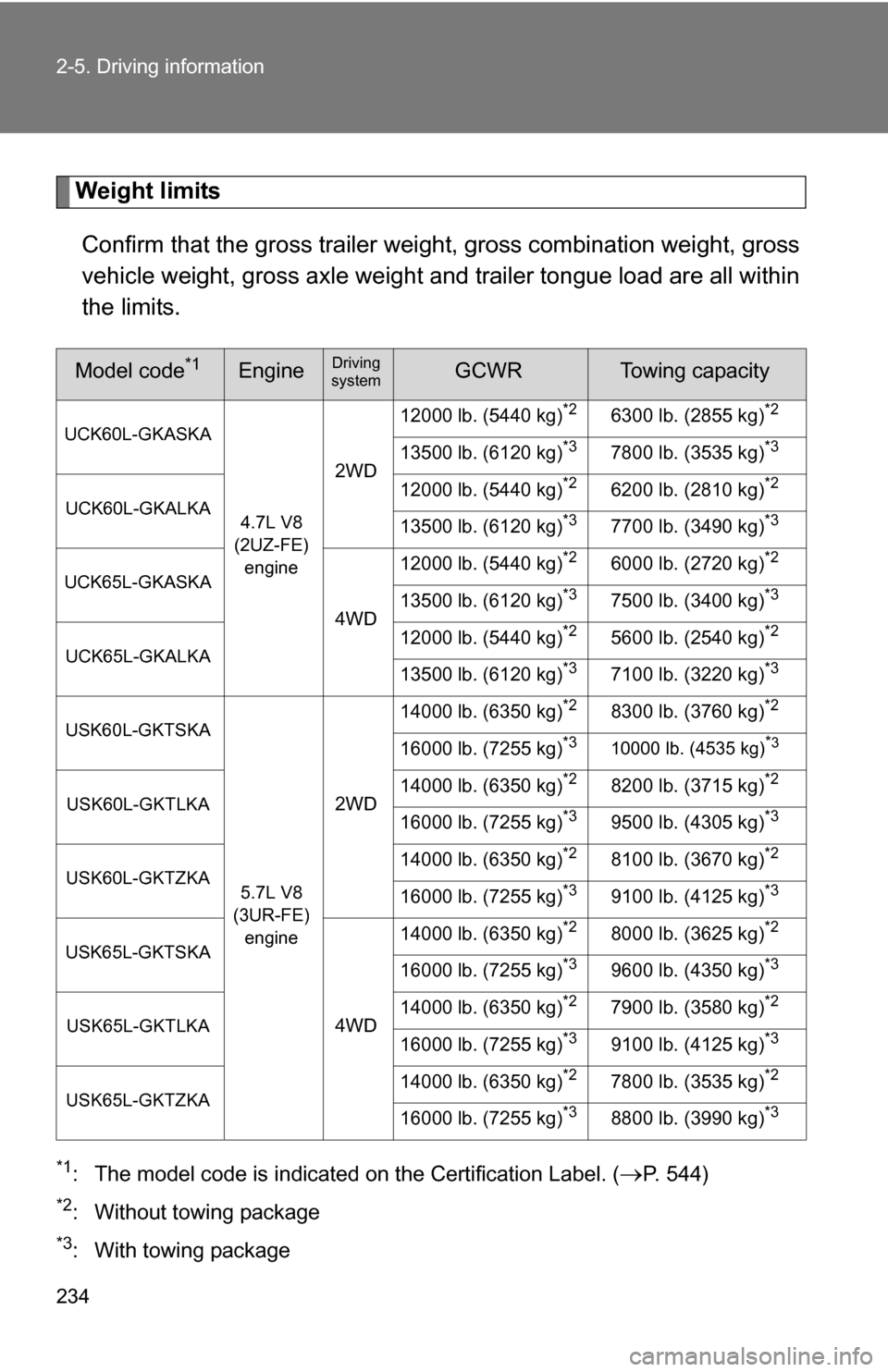
Weight limitsConfirm that the gross trailer weight, gross combination weight, gross
vehicle weight, gross axle weight and trailer tongue load are all within
the limits.
*1: The model code is indicated on the Certification Label. (P. 544)
*2: Without towing package
*3: With towing package
Model code*1EngineDriving
systemGCWRTowing capacity
UCK60L-GKASKA
4.7L V8
(2UZ-FE) engine
2WD 12000 lb. (5440 kg)
*26300 lb. (2855 kg)*2
13500 lb. (6120 kg)*37800 lb. (3535 kg)*3
UCK60L-GKALKA12000 lb. (5440 kg)*26200 lb. (2810 kg)*2
13500 lb. (6120 kg)*37700 lb. (3490 kg)*3
UCK65L-GKASKA
4WD12000 lb. (5440 kg)
*26000 lb. (2720 kg)*2
13500 lb. (6120 kg)*37500 lb. (3400 kg)*3
UCK65L-GKALKA12000 lb. (5440 kg)*25600 lb. (2540 kg)*2
13500 lb. (6120 kg)*37100 lb. (3220 kg)*3
USK60L-GKTSKA
5.7L V8
(3UR-FE) engine
2WD 14000 lb. (6350 kg)
*28300 lb. (3760 kg)*2
16000 lb. (7255 kg)*310000 lb. (4535 kg)*3
USK60L-GKTLKA14000 lb. (6350 kg)*28200 lb. (3715 kg)*2
16000 lb. (7255 kg)*39500 lb. (4305 kg)*3
USK60L-GKTZKA14000 lb. (6350 kg)*28100 lb. (3670 kg)*2
16000 lb. (7255 kg)*39100 lb. (4125 kg)*3
USK65L-GKTSKA
4WD14000 lb. (6350 kg)
*28000 lb. (3625 kg)*2
16000 lb. (7255 kg)*39600 lb. (4350 kg)*3
USK65L-GKTLKA14000 lb. (6350 kg)*27900 lb. (3580 kg)*2
16000 lb. (7255 kg)*39100 lb. (4125 kg)*3
USK65L-GKTZKA14000 lb. (6350 kg)*27800 lb. (3535 kg)*2
16000 lb. (7255 kg)*38800 lb. (3990 kg)*3