light TOYOTA SEQUOIA 2010 2.G User Guide
[x] Cancel search | Manufacturer: TOYOTA, Model Year: 2010, Model line: SEQUOIA, Model: TOYOTA SEQUOIA 2010 2.GPages: 660, PDF Size: 12.29 MB
Page 19 of 660
19
*: Refer to “Navigation System Owner’s Manual”
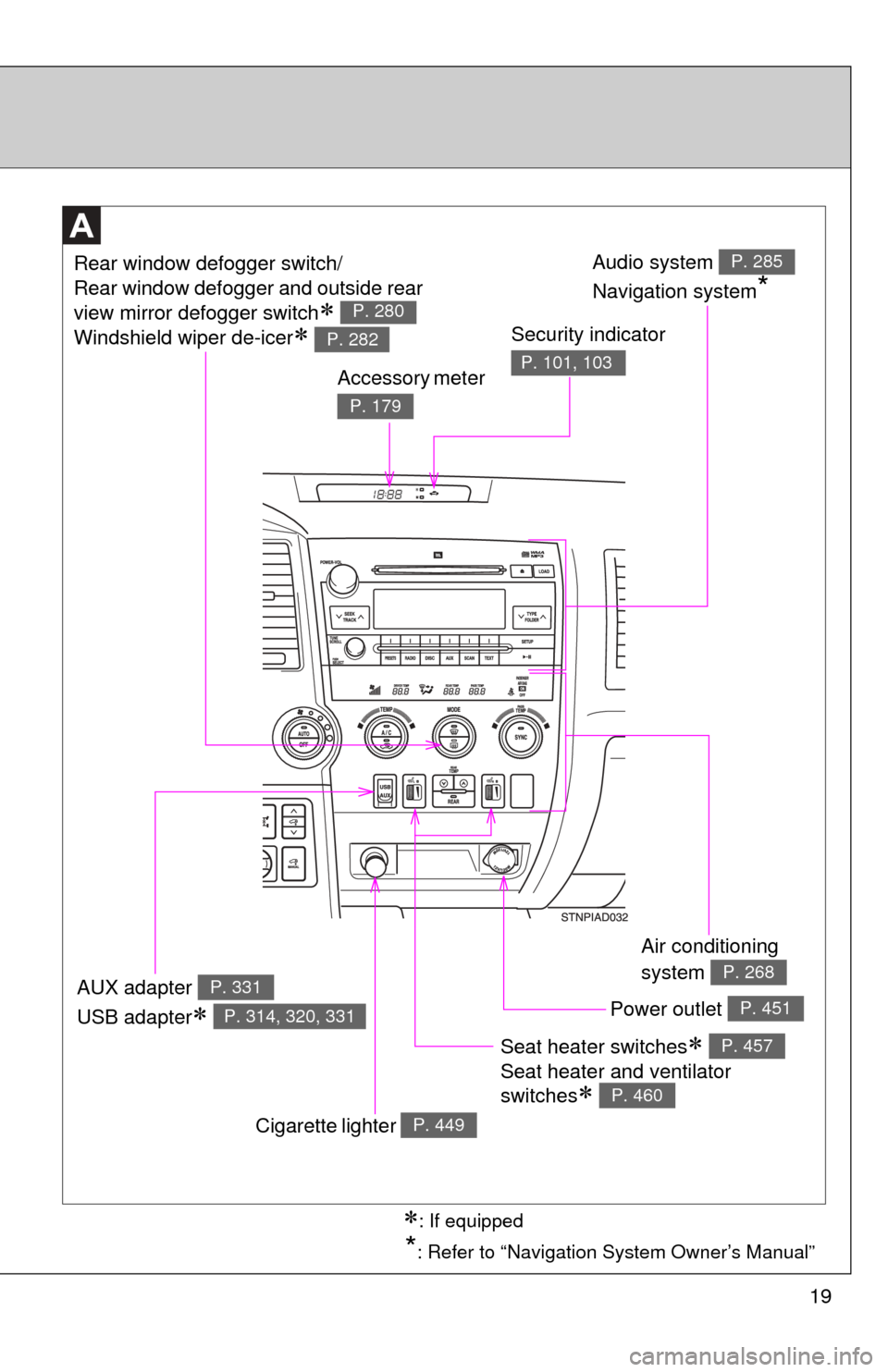
Seat heater switches
Seat heater and ventilator
switches
P. 457
P. 460
Air conditioning
system
P. 268
Power outlet P. 451
Audio system
Navigation system
*
P. 285Rear window defogger switch/
Rear window defogger and outside rear
view mirror defogger switch
Windshield wiper de-icer
P. 280
P. 282Security indicator
P. 101, 103Accessory meter
P. 179
Cigarette lighter P. 449
AUX adapter
USB adapter
P. 331
P. 314, 320, 331
: If equipped
Page 23 of 660
23
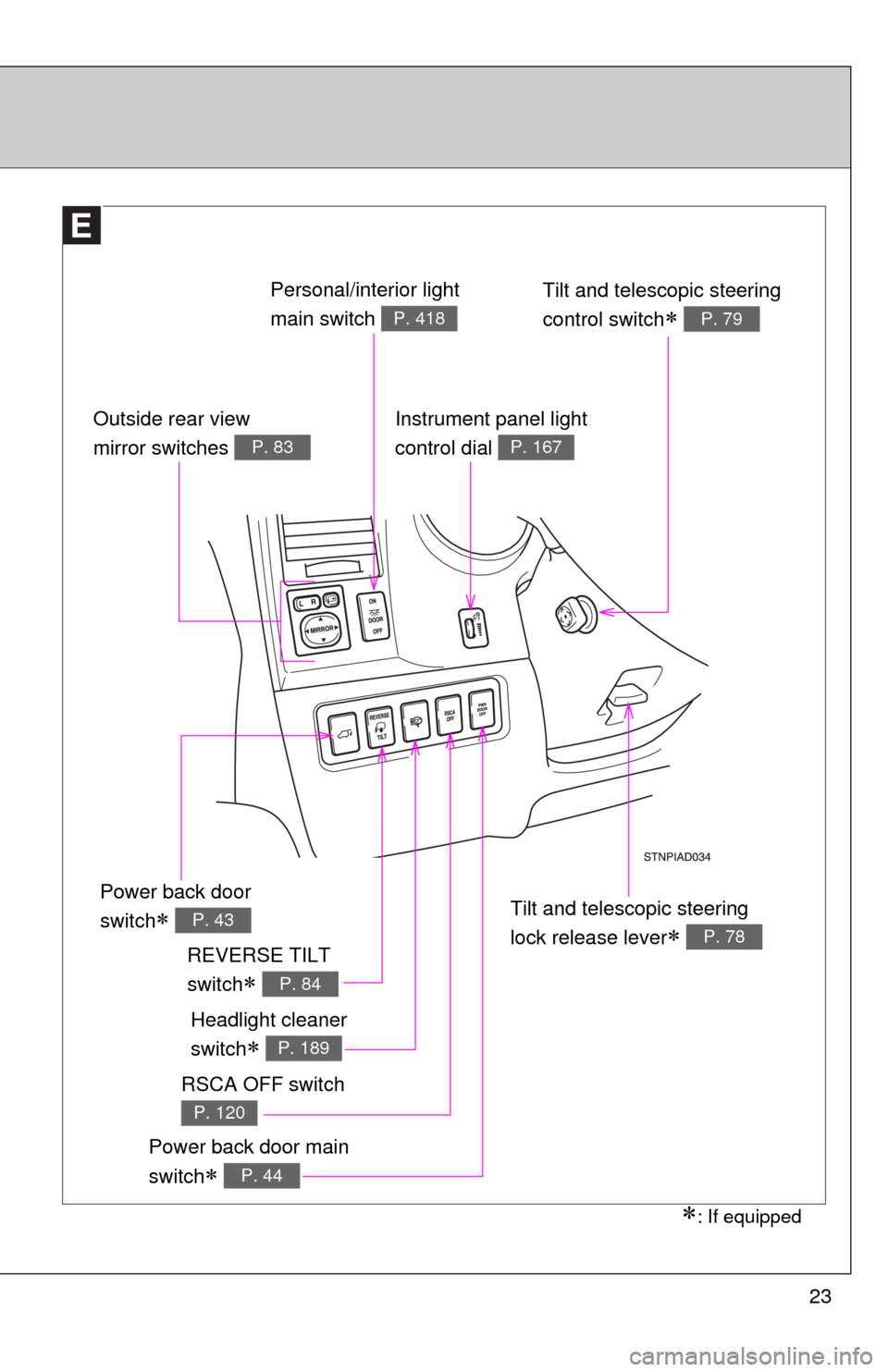
Instrument panel light
control dial
P. 167
Power back door main
switch
P. 44
: If equipped
Outside rear view
mirror switches
P. 83
Tilt and telescopic steering
lock release lever
P. 78
Personal/interior light
main switch
P. 418
Power back door
switch
P. 43
Headlight cleaner
switch
P. 189
RSCA OFF switch
P. 120
Tilt and telescopic steering
control switch
P. 79
REVERSE TILT
switch
P. 84
Page 28 of 660

28
CAUTION
■General precautions while driving
Driving under the influence: Never drive your vehicle when under the influ-
ence of alcohol or drugs that have impaired your ability to operate your vehi-
cle. Alcohol and certain drugs delay reaction time, impair judgment and
reduce coordination, which could lead to an accident that could result in
death or serious injury.
Defensive driving: Always drive defensively. Anticipate mistakes that other
drivers or pedestrians might make and be ready to avoid accidents.
Driver distraction: Always give your full attention to driving. Anything that dis-
tracts the driver, such as adjusting controls, talking on a cellular phone or
reading can result in a collision with resulting death or serious injury to you,
your occupants or others.
■ General precaution regarding children’s safety
Never leave children unattended in the vehicle, and never allow children to
have or use the key.
Children may be able to start the vehicle or shift the vehicle into neutral.
There is also a danger that children may injure themselves by playing with
the cigarette lighter, the windows, the moon roof, or other features of the
vehicle. In addition, heat build-up or extremely cold temperatures inside the
vehicle can be fatal to children.
Page 32 of 660
32
1-1. Key information
Keys
■When required to leave a key to the vehicle with a parking attendant
Lock the glove box as circumstances demand. ( P. 422)
Carry the master key for your own use and leave the valet key only with the
attendant.
■ Key number plate
Keep the plate in a safe place such as your wallet, not in the vehicle. In the
event that a key is lost, a new key can be made by your Toyota dealer using
the key number plate. ( P. 594)
NOTICE
■To prevent key damage
●Do not subject the keys to strong shocks, expose them to high tempera-
tures by placing them in direct sunlight, or get them wet.
● Do not expose the keys to electromagnetic materials or attach any mate-
rial that blocks electromagnetic waves to the key surface.
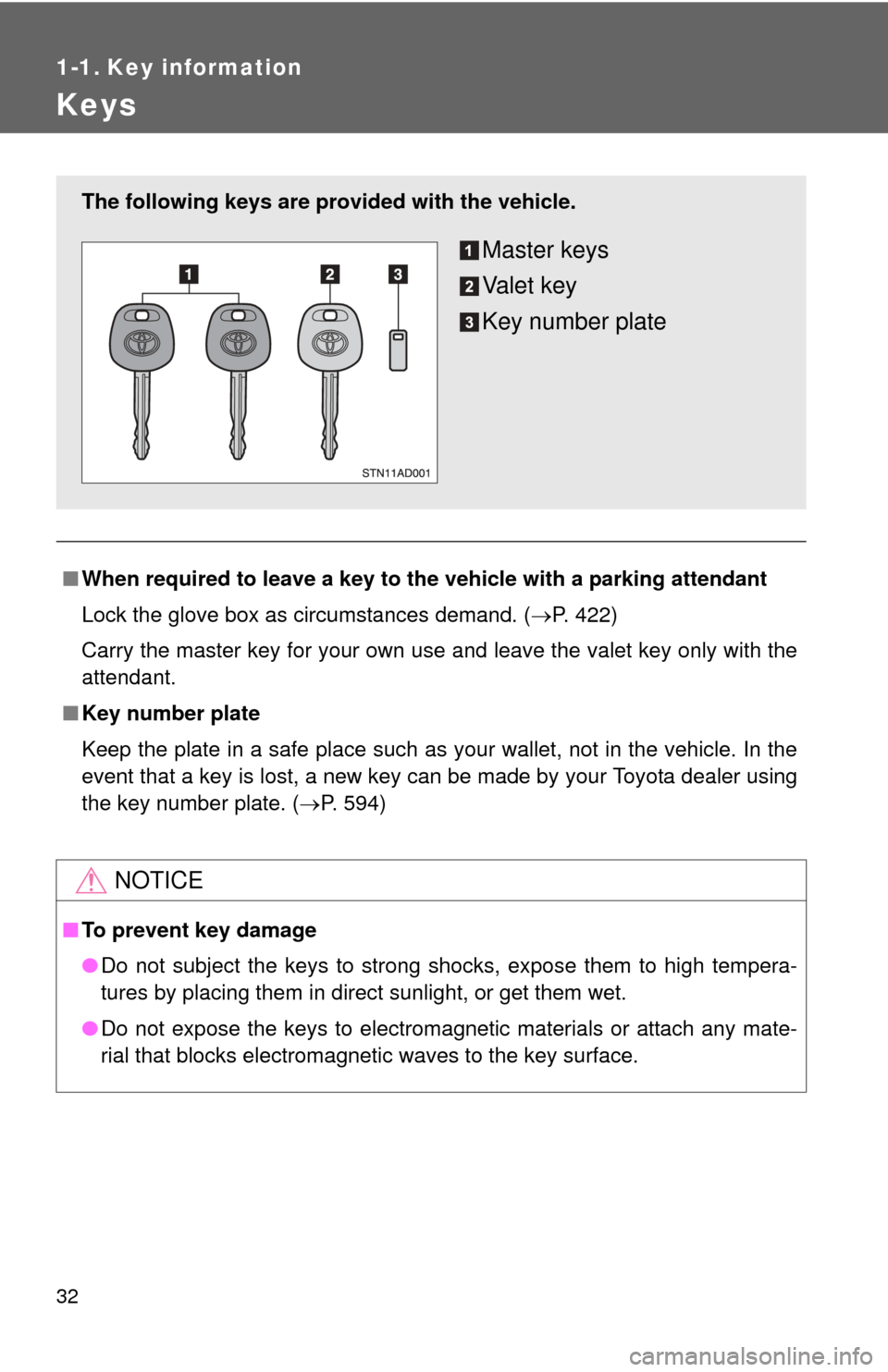
The following keys are provid ed with the vehicle.
Master keys
Va l e t k e y
Key number plate
Page 34 of 660
34 1-2. Opening, closing and locking the doors
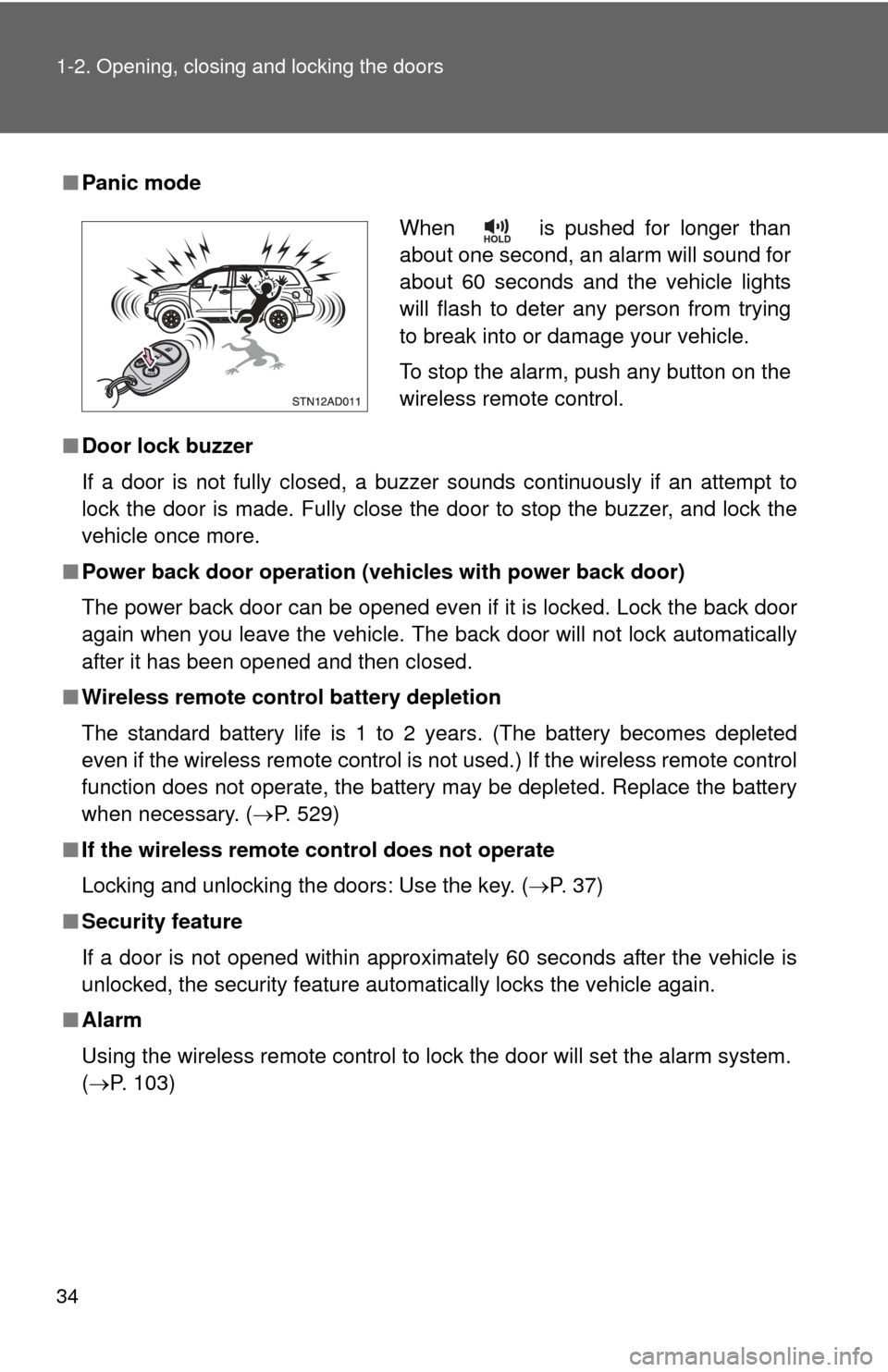
■Panic mode
■ Door lock buzzer
If a door is not fully closed, a buzzer sounds continuously if an attempt to
lock the door is made. Fully close the door to stop the buzzer, and lock the
vehicle once more.
■ Power back door operation (veh icles with power back door)
The power back door can be opened even if it is locked. Lock the back door
again when you leave the vehicle. The back door will not lock automatically
after it has been opened and then closed.
■ Wireless remote control battery depletion
The standard battery life is 1 to 2 years. (The battery becomes depleted
even if the wireless remote control is not used.) If the wireless remot\
e control
function does not operate, the battery may be depleted. Replace the battery
when necessary. ( P. 529)
■ If the wireless remote control does not operate
Locking and unlocking the doors: Use the key. ( P. 37)
■ Security feature
If a door is not opened within approximately 60 seconds after the vehicle is
unlocked, the security feature automatically locks the vehicle again.
■ Alarm
Using the wireless remote control to lock the door will set the alarm sy\
stem.
(P. 103)
When is pushed for longer than
about one second, an alarm will sound for
about 60 seconds and the vehicle lights
will flash to deter any person from trying
to break into or damage your vehicle.
To stop the alarm, push any button on the
wireless remote control.
Page 45 of 660
45
1-2. Opening, closing and locking the doors
1
Before driving
■
The power back door can be opened when
●The engine switch is in the ON position, and the shift lever is in P.
● The engine switch is off or in the ACC position.
■ Jam protection function (vehicles with power back door)
If anything obstructs the power back door while it is closing/opening, the
back door will automatically operate in the opposite direction.
■ If the power back door does not work
The back door must be initialized. To initialize, close the back door com-
pletely by hand and unlock the back door.
■ Back door closer (vehicl es with power back door)
In the event that the back door is left slightly open, the back door closer will
automatically close it to the fully closed position.
■ Fall-down protection function (vehicles with power back door)
While the power back door is opening automatically, applying excessive
force to it will stop the opening operation to prevent the power back door
from rapidly falling down.
■ Customization that can be co nfigured at Toyota dealer
Settings (e.g. power back door) can be changed.
(Customizable features P. 632)
CAUTION
Observe the following precautions.
Failing to do so may result in death or serious injury.
■Caution while driving
Keep the back door closed.
If the back door is open, the luggage will be thrown out and exhaust gases
will enter the vehicle.
Page 50 of 660
50 1-3. Adjustable components (seats, mirrors, steering wheel)
CAUTION
■Seat adjustment
●Be careful that the seat does not hit passengers or luggage.
● Do not recline the seat more than necessary when the vehicle is in motion
to reduce the risk of sliding under the lap belt.
If the seat is too reclined, the lap belt may slide past the hips and apply
restraint forces directly to the abdomen or your neck may contact the
shoulder belt, increasing the risk of death or serious injury in the event of
an accident.
● Manual seat only: After adjusting the seat, make sure that the seat is
locked in position.
■ After folding a seat (vehicles with seatback table)
Observe the following precautions. Failure to do so may result in death or
serious injury.
●Make sure that the seat and seatback are securely locked in position by
lightly rocking the seat back and forth.
● Do not sit on the folded seatback.
■ Caution while driving (vehicles with seatback table)
Do not fold the seatback forward to set up the seatback table while the vehi-
cle is moving.
Page 60 of 660
60 1-3. Adjustable components (seats, mirrors, steering wheel)
CAUTION
■When adjusting a rear seat
●Be careful that the seat does not hit passengers or luggage.
● Do not recline the seat more than necessary when the vehicle is in motion
to reduce the risk of sliding under the lap belt. If the seat is too reclined,
the lap belt may slide past the hips and apply restraint forces directly to the
abdomen or your neck may contact the shoulder belt, increasing the risk of
death or serious injury in the event of an accident.
● Do not depress the second seat release pedal from the third seat while t\
he
second seat is occupied.
● Be careful not to get your hands or feet caught in the seat.
■ Before folding down a rear seat
Do not fold down a rear seat when there are passengers sitting in the rear
seats or when there is luggage placed on/under the rear seats.
■ After adjusting a seat
Observe the following precautions. Failure to do so may result in death or
serious injury.
●Make sure that the seat and seatback are securely locked in position by
lightly rocking them back and forth.
● Check that the seat belts are not twisted or caught under the seat.
NOTICE
■When folding down the seats
The seat belts and buckles must be stowed.
■ Second seatback board weight capacity
Do not place any object heavier than 220 lb. (100 kg) on the second seat-
back board.
■ Before sliding the center second seat to the most forward position
(vehicles with bench type second seat)
Ensure that the cup holder on the front console box is closed.
Page 73 of 660
73
1-3. Adjustable components (s
eats, mirrors, steering wheel)
1
Before driving
■Emergency locking retractor (ELR)
The retractor will lock the belt during a sudden stop or on impact. It may also
lock if you lean forward too quickly. A slow, easy motion will allow the belt to
extend so that you can move around fully.
■ Automatic locking retractor (ALR)
When a passenger’s shoulder belt is completely extended and then
retracted even slightly, the belt is locked in that position and cannot be
extended. This feature is used to hold the child restraint system (CRS) firmly.
To free the belt again, fully retract the belt and then pull the belt out once
more. ( P. 130)
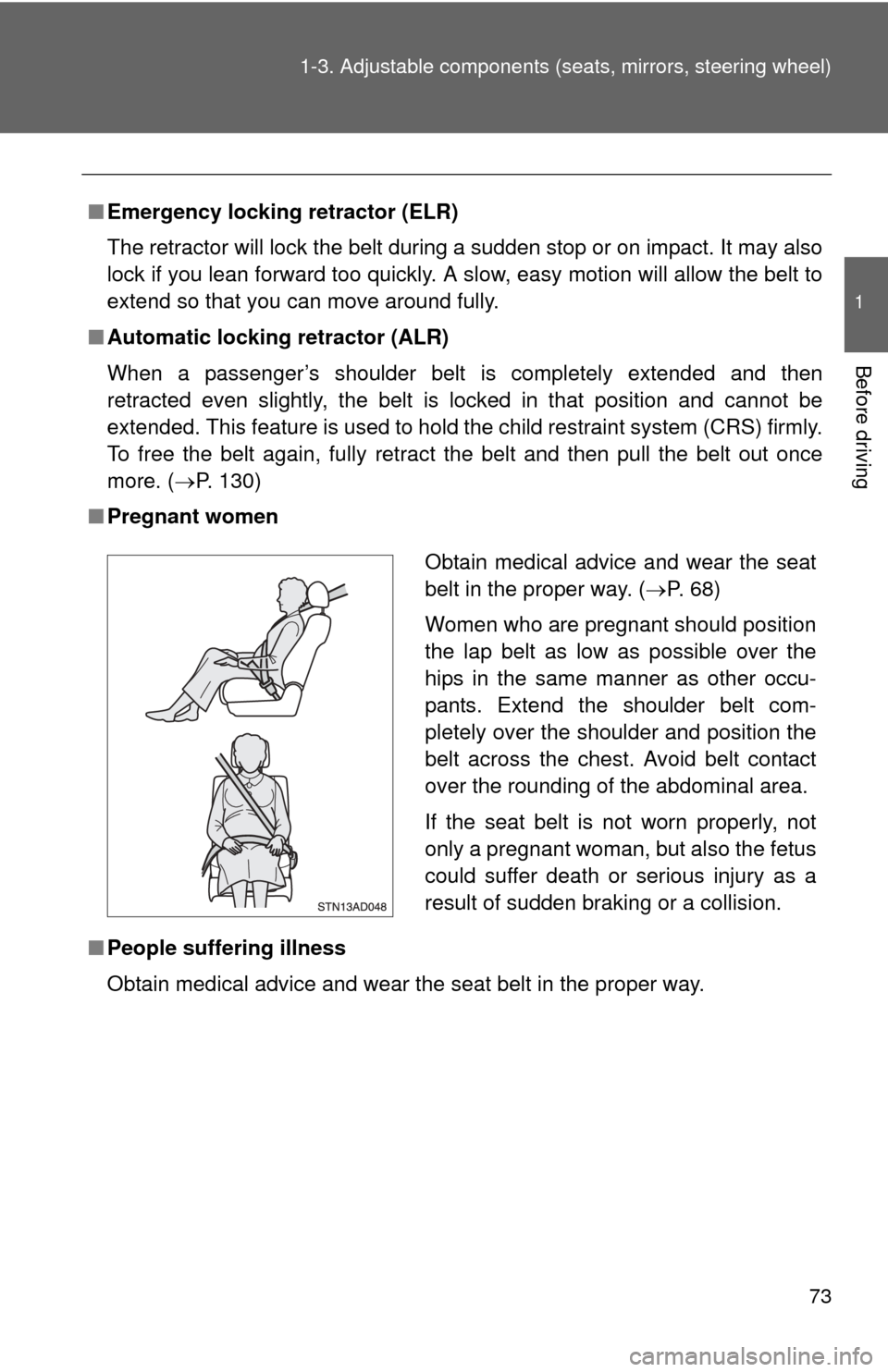
■ Pregnant women
■ People suffering illness
Obtain medical advice and wear the seat belt in the proper way.
Obtain medical advice and wear the seat
belt in the proper way. ( P. 68)
Women who are pregnant should position
the lap belt as low as possible over the
hips in the same manner as other occu-
pants. Extend the shoulder belt com-
pletely over the shoulder and position the
belt across the chest. Avoid belt contact
over the rounding of the abdominal area.
If the seat belt is not worn properly, not
only a pregnant woman, but also the fetus
could suffer death or serious injury as a
result of sudden braking or a collision.
Page 80 of 660
80
1-3. Adjustable components (seats, mirrors, steering wheel)
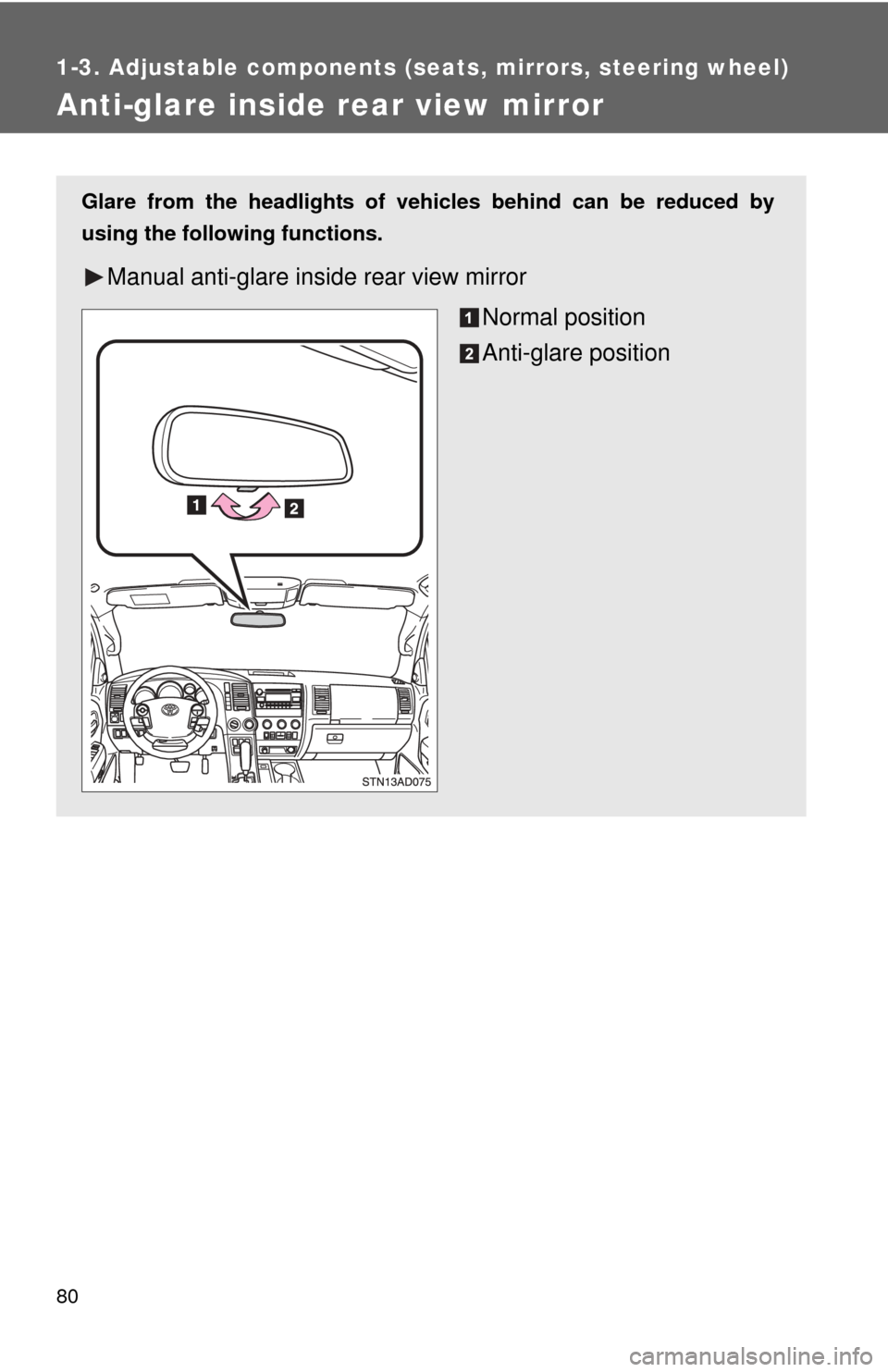
Anti-glare inside rear view mirror
Glare from the headlights of vehicles behind can be reduced by
using the following functions.
Manual anti-glare inside rear view mirrorNormal position
Anti-glare position