warning lights TOYOTA SEQUOIA 2010 2.G Owners Manual
[x] Cancel search | Manufacturer: TOYOTA, Model Year: 2010, Model line: SEQUOIA, Model: TOYOTA SEQUOIA 2010 2.GPages: 660, PDF Size: 12.29 MB
Page 2 of 660

TABLE OF CONTENTSIndex
2
1-1. Key informationKeys ..................................... 32
1-2. Opening, closing and locking the doors
Wireless remote control ....... 33
Side doors ............................ 37
Back door ............................. 42
1-3. Adjustable components (seats, mirrors, steering
wheel)
Front seats ........................... 47
Rear seats ............................ 51
Driving position memory (driver’s seat) ..................... 61
Head restraints ..................... 64
Seat belts ............................. 68
Steering wheel (manually adjustable type) .................. 78
Steering wheel (power-adjustable type)...... 79
Anti-glare inside rear view mirror .................................. 80
Outside rear view mirrors ..... 83
Roof luggage carrier............. 87
1-4. Opening and closing the windows and moon roof
Power windows .................... 89
Power back window ............. 91
Moon roof ............................. 93 1-5. Refueling
Opening the fuel tank cap..... 96
1-6. Theft deterrent system Engine immobilizer system .............................. 101
Alarm .................................. 103
1-7. Safety information Correct driving posture ....... 106
SRS airbags ....................... 108
Front passenger occupant classification system ......... 121
Child restraint systems ....... 126
Installing child restraints ..... 130
2-1. Driving procedures Driving the vehicle .............. 144
Engine (ignition) switch....... 153
Automatic
transmission........ 156
Turn signal lever ................. 160
Parking brake ..................... 161
Horn .................................... 162
2-2. Instrument cluster Gauges and meters ............ 163
Indicators and warning lights ................................. 168
Multi-information display ..... 173
Accessory meter ................. 179
1Before driving
2When driving
Page 109 of 660
109
1-7. Safety information
1
Before driving
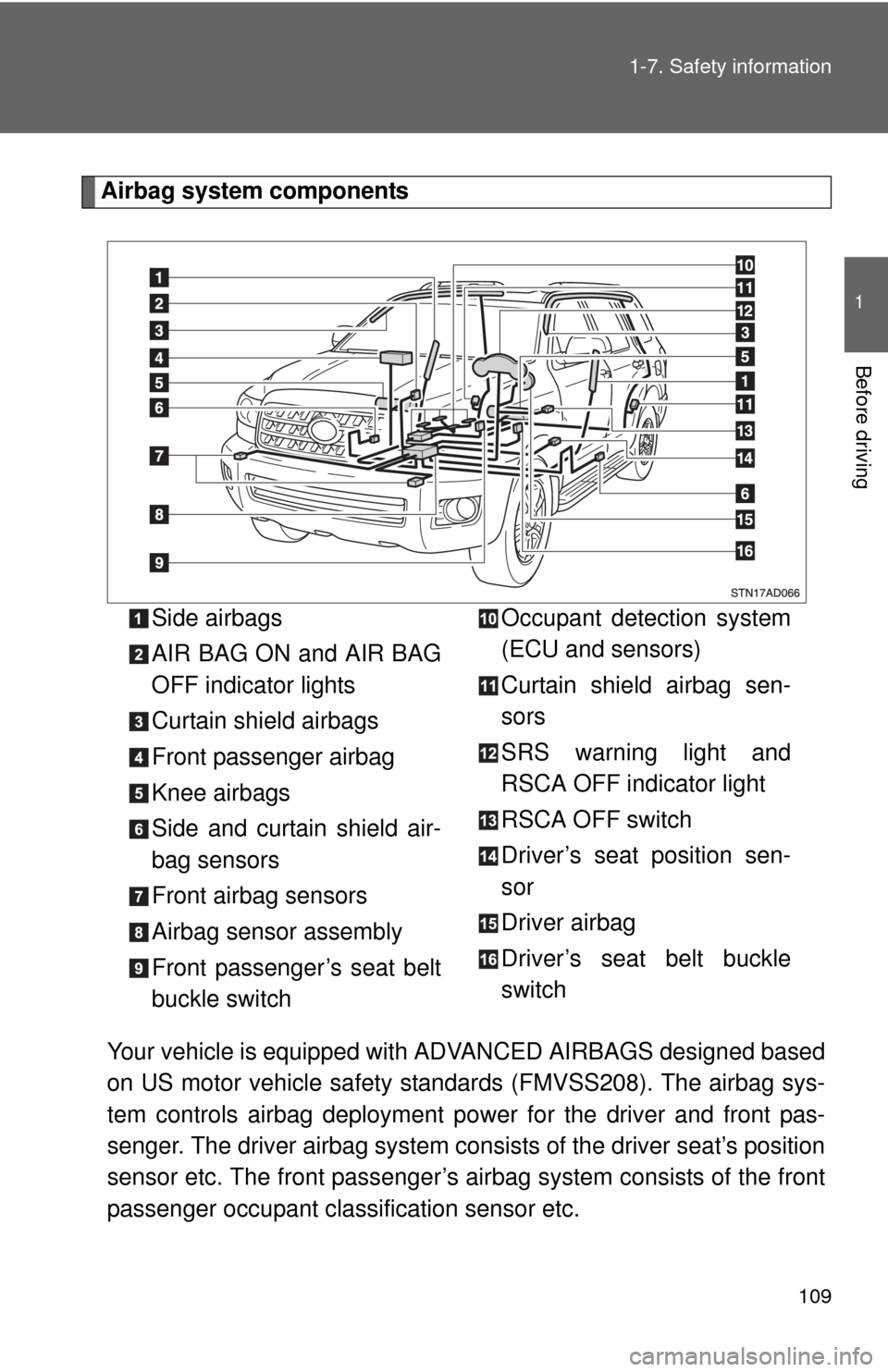
Airbag system components
Your vehicle is equipped with ADVANCED AIRBAGS designed based
on US motor vehicle safety standards (FMVSS208). The airbag sys-
tem controls airbag deployment po wer for the driver and front pas-
senger. The driver airbag system consists of the driver seat’s position
sensor etc. The front passenger’s airbag system consists of the front
passenger occupant classification sensor etc. Side airbags
AIR BAG ON and AIR BAG
OFF indicator lights
Curtain shield airbags
Front passenger airbag
Knee airbags
Side and curtain shield air-
bag sensors
Front airbag sensors
Airbag sensor assembly
Front passenger’s seat belt
buckle switch
Occupant detection system
(ECU and sensors)
Curtain shield airbag sen-
sors
SRS warning light and
RSCA OFF indicator light
RSCA OFF switch
Driver’s seat position sen-
sor
Driver airbag
Driver’s seat belt buckle
switch
Page 110 of 660

110 1-7. Safety information
The main SRS airbag system components are shown above. The
SRS airbag system is controlled by the airbag sensor assembly. The
airbag sensor assembly consists of a safing sensor and an airbag
sensor.
In certain types of severe frontal or side impacts, the SRS airbag sys-
tem triggers the airbag inflators. A chemical reaction in the inflators
quickly fills the airbags with non-toxic gas to help restrain the motion
of the occupants.
■ SRS warning light
This warning light system monitors the airbag sensor assembly, front airbag
sensors, side and curtain shield airbag sensor assemblies, curtain shield air-
bag sensor assemblies, driver’s seat position sensor, driver’s seat belt
buckle switch, front passenger occupant classification system, AIR BAG ON
and AIR BAG OFF indicator lights, front passenger’s seat belt buckle switch,
front seat belt pretensioner assemblies, RSCA OFF indicator light, inflators,
interconnecting wiring and power sources. ( P. 567)
■ If the SRS airbags deploy (inflate)
●Bruising and slight abrasions may result from contact with a deploying
(inflating) SRS airbag.
● A loud noise and white powder will be emitted.
● Parts of the airbag module (steering wheel hub, airbag cover and inflator)
as well as the front seats, and parts of the front and rear pillars and roof
side rail, may be hot for several minutes. The airbag itself may also be
hot.
● The front windshield may crack.
Page 122 of 660

122 1-7. Safety information
Conditions and operation of the front passenger occupant
classification system
■ Adult*
1
■Child*3 or child restraint system*4
Indicator/
warning light AIR BAG ON and AIR BAG OFF indica-
tor lights AIR BAG ON
SRS warning light Off
Front passenger’s seat belt reminder light
Flashing*2
Devices Front passenger airbag
Activated
Front passenger knee airbag
Side airbag on the front passenger seat
Curtain shield airbag in the front passen- ger side
Front passenger’s seat belt pretensioner
Indicator/
warning light AIR BAG ON and AIR BAG OFF indica-
tor lights AIR BAG
OFF*
5
SRS warning light Off
Front passenger’s seat belt reminder light Flashing*
2
DevicesFront passenger airbag
Deactivated
Front passenger knee airbag
Side airbag on the front passenger seat
Activated
Curtain shield airbag in the front passen-
ger side
Front passenger’s seat belt pretensioner
Page 123 of 660

123
1-7. Safety information
1
Before driving
■
Unoccupied
■ There is a malfunction in the system
*
1:The system judges a person of adult size as an adult. When a smaller adult sits in the front passenger seat, the system may rec-
ognize him/her as a child depending on his/her physique and pos-
ture.
*
2:In the event the front passenger does not wear a seat belt.
Indicator/
warning light AIR BAG ON and AIR BAG OFF indica-
tor lights Not illumi-
nated
SRS warning light Off
Front passenger’s seat belt reminder
light
Devices Front passenger airbag
Deactivated
Front passenger knee airbag
Side airbag on the front passenger seat Activated
Curtain shield airbag in the front passen-
ger side
Front passenger’s seat belt pretensioner Deactivated
Indicator/
warning light AIR BAG ON and AIR BAG OFF indica-
tor lights AIR BAG
OFF
SRS warning light On
Front passenger’s seat belt reminder light Off
Devices Front passenger airbag
Deactivated
Front passenger knee airbag
Side airbag on the front passenger seat
Activated
Curtain shield airbag in the front passen-
ger side
Front passenger’s seat belt pretensioner
Page 143 of 660
When driving2
143
2-1. Driving proceduresDriving the vehicle............ 144
Engine (ignition) switch .... 153
Automatic
transmission..... 156
Turn signal lever .............. 160
Parking brake ................... 161
Horn ................................. 162
2-2. Instrument cluster Gauges and meters ......... 163
Indicators and warning lights .............................. 168
Multi-information display............................ 173
Accessory meter .............. 179
2-3. Operating the lights and wipers
Headlight switch ............... 182
Fog light switch ................ 185
Windshield wipers and washer ........................... 186
Rear window wiper and washer ........................... 188
Headlight cleaner switch ............................. 189 2-4. Using other driving systems
Cruise control ................... 190
Dynamic laser cruise control ............................ 193
Intuitive parking assist...... 204
Rear view monitor system ........................... 210
Electronically modulated air suspension ................ 216
AVS (Adaptive Variable Suspension System) ...... 221
Four-wheel drive system ........................... 222
AUTO LSD system........... 227
Driving assist systems ..... 229
2-5. Driving information Off-road precautions ........ 235
Cargo and luggage .......... 240
Vehicle load limits ............ 244
Winter driving tips ............ 245
Trailer towing ................... 249
Dinghy towing .................. 265
Page 168 of 660
168
2-2. Instrument cluster
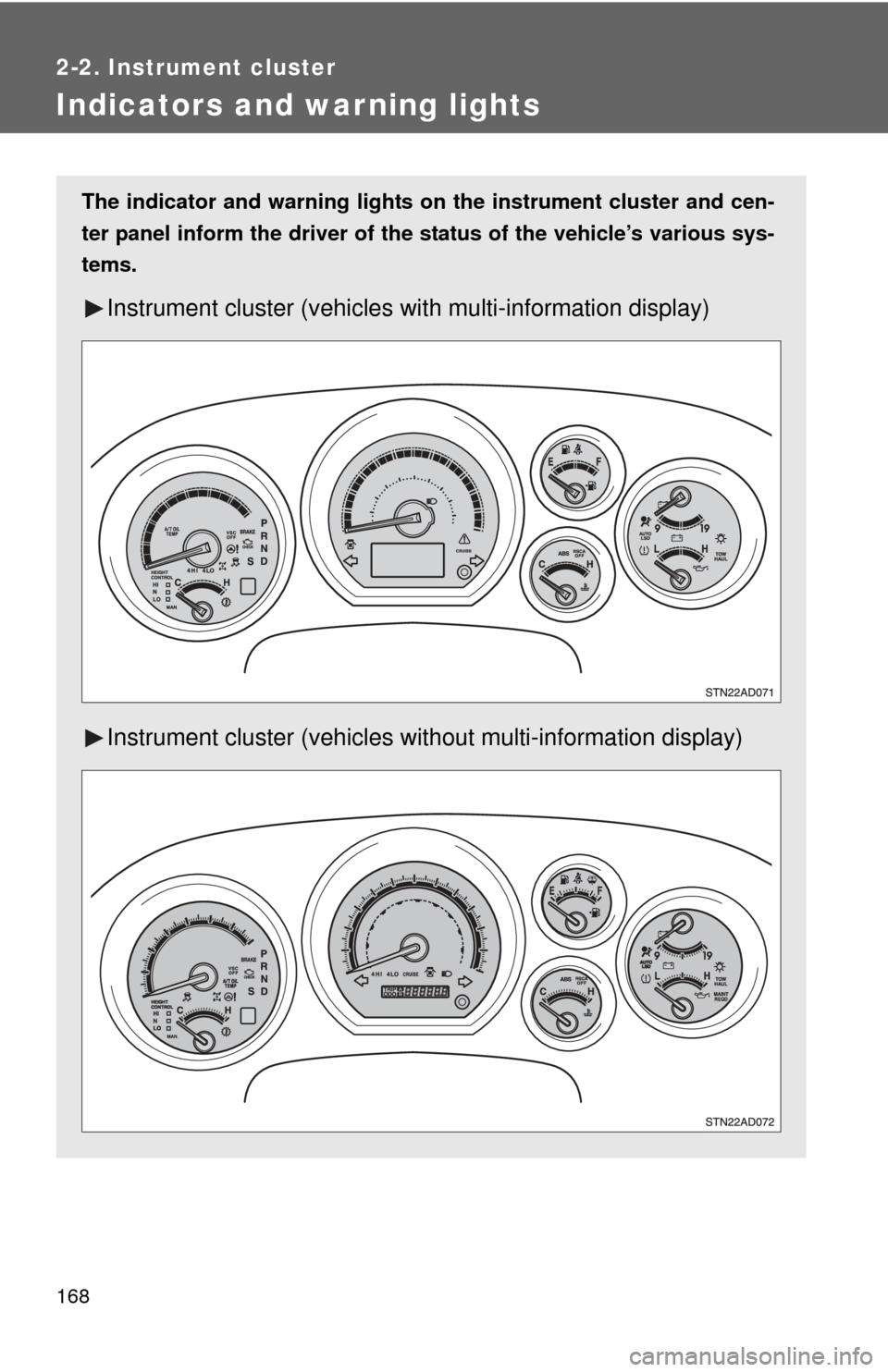
Indicators and warning lights
The indicator and warning lights on the instrument cluster and cen-
ter panel inform the driver of the status of the vehicle’s various sys-
tems.
Instrument cluster (vehicles with multi-information display)
Instrument cluster (vehicles without multi-information display)
Page 171 of 660
171
2-2. Instrument cluster
2
When driving
■
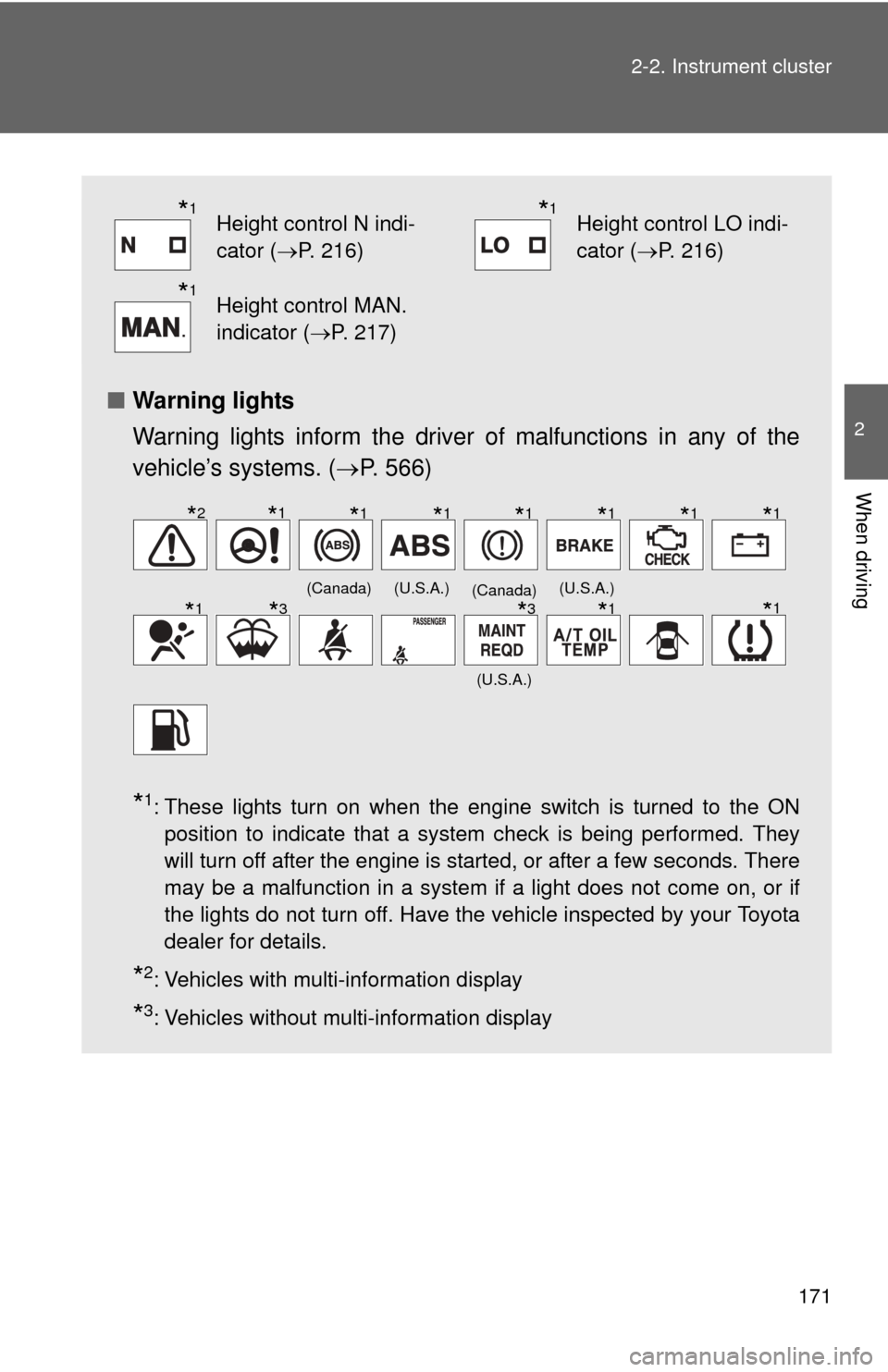
Warning lights
Warning lights inform the driver of malfunctions in any of the
vehicle’s systems. ( P. 566)
*1: These lights turn on when the engine switch is turned to the ON
position to indicate that a system check is being performed. They
will turn off after the engine is started, or after a few seconds. There
may be a malfunction in a system if a light does not come on, or if
the lights do not turn off. Have the vehicle inspected by your Toyota
dealer for details.
*2: Vehicles with multi-information display
*3: Vehicles without multi-information display
*1Height control N indi-
cator (P. 216)*1Height control LO indi-
cator (P. 216)
*1Height control MAN.
indicator ( P. 217)
(Canada)(U.S.A.)(Canada)(U.S.A.)
(U.S.A.)
*2*1*1*1*1*1*1*1
*1*3*3*1*1
Page 176 of 660

176 2-2. Instrument cluster
Press the SELECT RESET button to customize the items.
*: Default setting
ItemsScreen textSelect in this order
To select Unit A
or Unit B
(P. 181)
UNITS
Door lock/
unlock warning
functionKEYLESS ENTRY
FEEDBACK
Time for auto-
matic door lock
functionKEYLESS ENTRY
RELOCK TIMER
Double switch
operation to
unlock all the
doorsKEYLESS ENTRY
ALL DOORS
UNLOCK
Automatic door
locking functionDOOR AUTO
LOCKING
Automatic door
unlocking func-
tionDOOR AUTO
UNLOCKING
Time period
before lights
turn off (if a door
is opened and
closed, and
engine switch is
in ACC or
LOCK)
HEADLAMPS AUTO
OFF TIMER
Time period
before lights
turn offCOURTESY LAMPS
OFF TIMER
Reset to default
settingHOLD RESET
TO RESTORE
DEFAULT SETTINGS
Unit B
Unit A
LAMPS + TONE*LAMPS
TONE
OFF
60 SECONDS*120 SECONDS
30 SECONDS OFF
2 PRESSES*1 PRESS
SHIFT OUT
OF PARKABOVE 12 MPH*
(20 km/h)
OFF
SHIFT TO PARK*DRIVER DOOR
OPEN
OFF
30 SECONDS*60 SECONDS
90 SECONDS
0 SECONDS
15 SECONDS*30 SECONDS
8 SECONDS
Page 198 of 660

198 2-4. Using other driving systems
Example of follow-up cruising (when following a vehicle driving
slower than the set speed):
When the speed is set to 62 mph (100 km/h) and the vehicle ahead
is driving at 50 mph (80 km/h)
The system continues follow-up cruising while adjusting for changes in the
speed of the vehicle ahead in order to maintain the vehicle-to-vehicle dis-
tance set by the driver.
Example of acceleration (when there are no longer vehicles driving
slower than the set speed in the lane ahead):
When the speed is set to 62 mph (100 km/h) and the vehicle ahead
driving at 50 mph (80 km/h) is out of the lane
When the vehicle ahead of you executes a lane change, the system
slowly accelerates until the set vehicle speed is reached. The system then
returns to fixed speed cruising.
■Fine adjustment of the set speed
Adjustment of the set speed by the following speed can be made by lightly
pressing the lever up or down and releasing it.
In the constant speed control mode: Approximately 1.0 mph (1.6 km/h)
In the vehicle-to-vehicle distance control mode:U.S.A.: Approximately 5 mph (8 km/h)
Canada: Approximately 3 mph (5 km/h)
■ Dynamic laser cruise control warning lights, display and buzzers
Warning lights, display and buzzers are used to indicate a system malfunc-
tion or to alert you to the need for caution while driving. ( P. 575)
■ The dynamic laser cruise can be set when
●The shift lever is in D or the shift range position must be in between 4 and
6 in S mode.
● Vehicle speed is above approximately 27 mph (45 km/h).
■ Accelerating
The vehicle can be accelerated normally.