engine TOYOTA SEQUOIA 2011 2.G Repair Manual
[x] Cancel search | Manufacturer: TOYOTA, Model Year: 2011, Model line: SEQUOIA, Model: TOYOTA SEQUOIA 2011 2.GPages: 688, PDF Size: 14.76 MB
Page 201 of 688
201
2-4. Using other
driving systems
2
When driving
■Changing the vehicle -to-vehicle distance
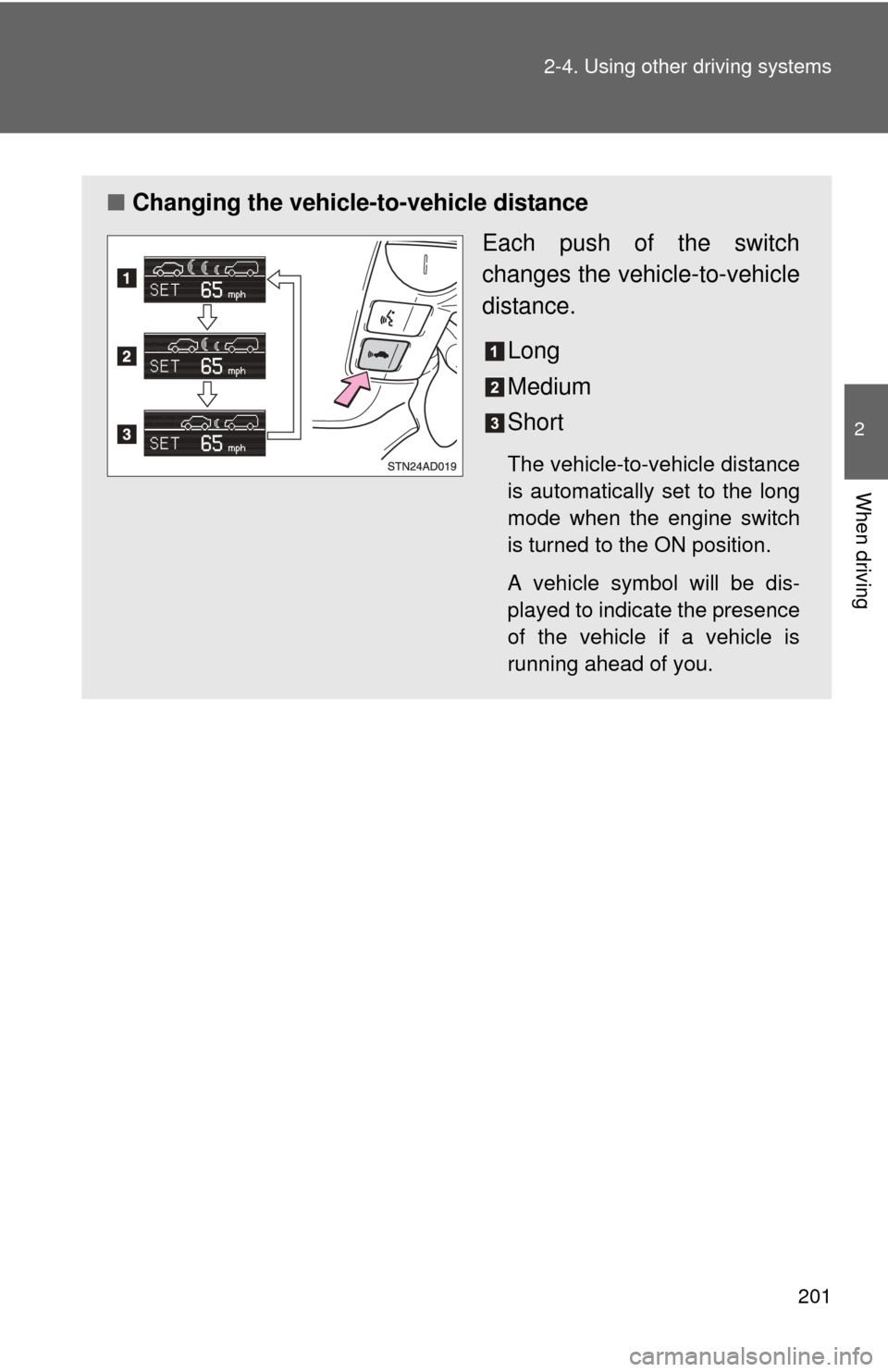
Each push of the switch
changes the vehi cle-to-vehicle
distance.
Long
Medium
Short
The vehicle-to-vehicle distance
is automatically set to the long
mode when the engine switch
is turned to the ON position.
A vehicle symbol will be dis-
played to indicate the presence
of the vehicle if a vehicle is
running ahead of you.
Page 209 of 688
209
2-4. Using other driving systems
2
When driving
Intuitive parking assist
: If equipped
The intuitive parking assist is designed to inform you of the approxi-
mate distance between your vehicle and an obstruction by indicator
and buzzer when parking the veh icle. This system uses sensors to
detect obstructions.
This system works when the engine switch is in the ON position and
the shift lever is not in P.
Back and rear corner sensors work only when the shift lever is in
R.
Front corner sensors work when:
● The shift lever is in R
● The shift lever is not in P or R and vehicle speed is approximate
6 mph (10 km/h) or less.
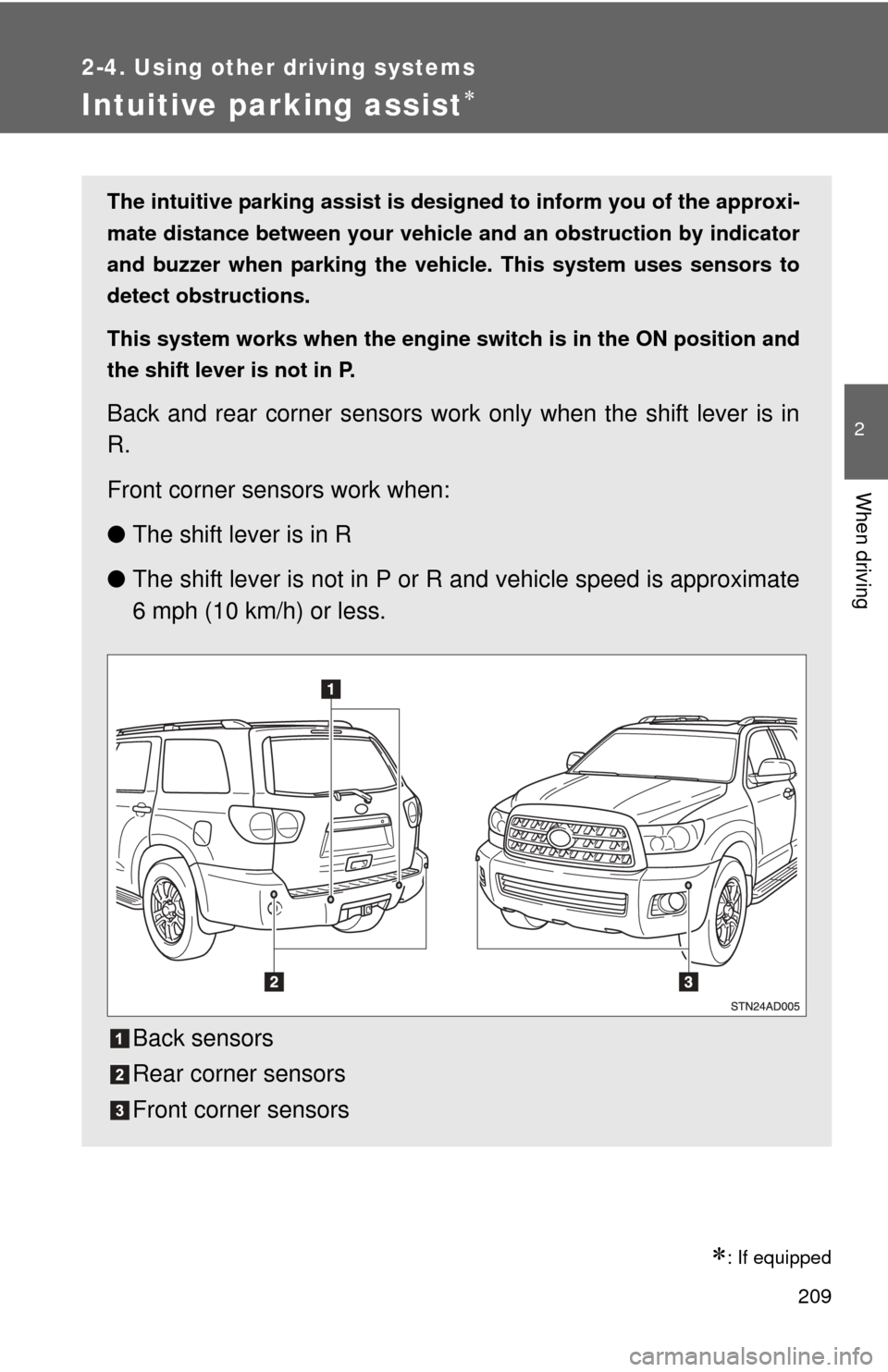
Back sensors
Rear corner sensors
Front corner sensors
Page 214 of 688

214 2-4. Using other driving systems
■Sensor detection information
●Certain vehicle conditions and the surrounding environment may affect
the ability of a sensor to correctly detect an obstacle. Particular instances
where this may occur are listed below.
• There is dirt, snow or ice on a sensor.
• A sensor is frozen.
• A sensor is covered in any way.
• The vehicle is leaning considerably to one side.
• On an extremely bumpy road, on an incline, on gravel, or on grass.
• The vicinity of the vehicle is noisy due to vehicle horns, motorcycle
engines, air brakes of large vehicles, or other loud noises producing
ultrasonic waves.
• There is another vehicle equipped with parking assist sensors in the vicinity.
• A sensor is coated with a sheet of spray or heavy rain.
• The vehicle is equipped with a fender pole or radio antenna.
• A bumper or sensor receives a strong impact.
• The vehicle is approaching a tall or right-angled curb.
• In harsh sunlight or intense cold weather.
• The area directly under the bumpers is not detected. Objects lower than the sensors or thin stakes etc. may be detected ini-
tially, but as they draw closer, they may cease to be detected.
• A towing hitch is mounted to the vehicle.
• A non-genuine Toyota suspension (lowered suspension etc.) is installed.
• When attaching a two-way radio antenna.
• When a towing eyelet is mounted on your vehicle.
• When the bumper is damaged.
In addition to the examples above, there are instances in which, because of
their shapes, signs and other objects may be judged by a sensor to be closer
than they are.
● The shape of the obstacle may prevent a sensor from detecting it. Pay
particular attention to the following obstacles:
• Wires, fences, ropes, etc.
• Cotton, snow and other materials that absorb sound waves
• Sharply-angled objects
• Low obstacles
Page 218 of 688
218 2-4. Using other driving systems
■The rear view monitor system can be operated when
The shift lever is in R and the engine switch is ON.
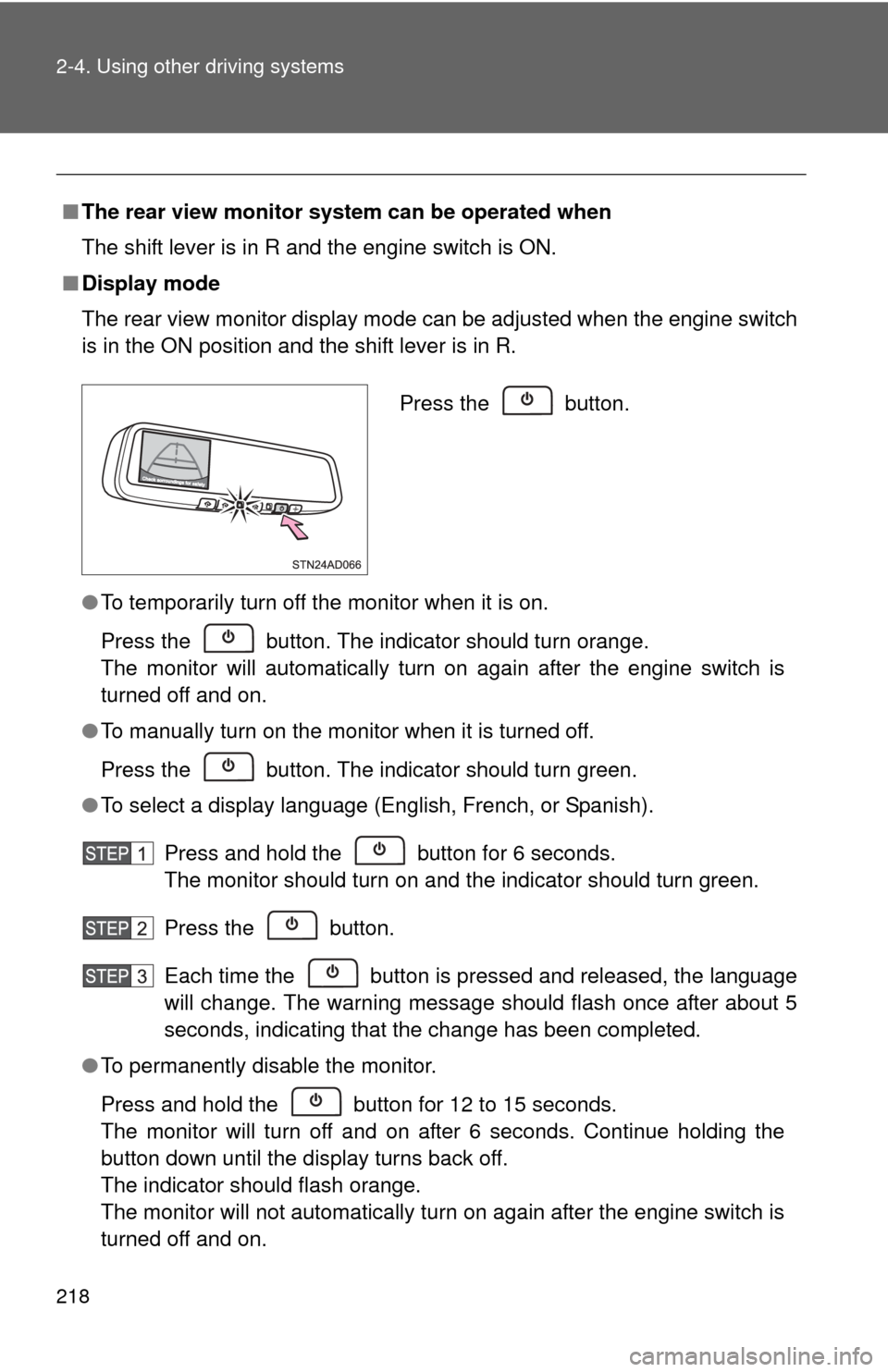
■ Display mode
The rear view monitor display mode can be adjusted when the engine switc\
h
is in the ON position and the shift lever is in R.
●To temporarily turn off the monitor when it is on.
Press the button. The indicator should turn orange.
The monitor will automatically turn on again after the engine switch is
turned off and on.
● To manually turn on the monitor when it is turned off.
Press the button. The indicator should turn green.
● To select a display language (English, French, or Spanish).
Press and hold the button for 6 seconds.
The monitor should turn on and the indicator should turn green.
Press the button.
Each time the button is pressed and released, the language
will change. The warning message should flash once after about 5
seconds, indicating that the change has been completed.
● To permanently disable the monitor.
Press and hold the button for 12 to 15 seconds.
The monitor will turn off and on after 6 seconds. Continue holding the
button down until the display turns back off.
The indicator should flash orange.
The monitor will not automatically turn on again after the engine switch is
turned off and on.
Press the button.
Page 223 of 688
223
2-4. Using other driving systems
2
When driving
Electronically modulated air suspension
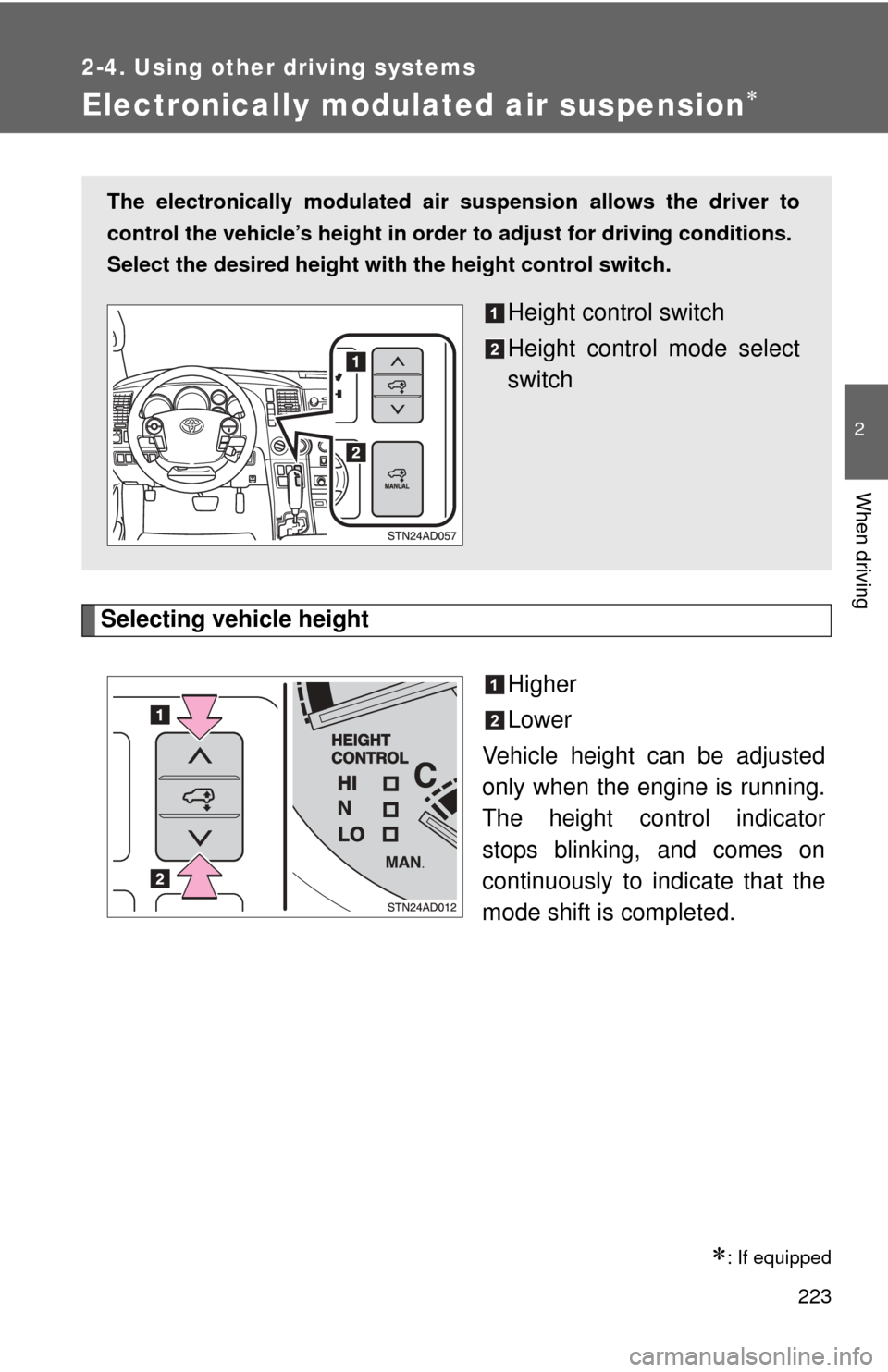
Selecting vehicle heightHigher
Lower
Vehicle height can be adjusted
only when the engine is running.
The height control indicator
stops blinking, and comes on
continuously to in dicate that the
mode shift is completed.
: If equipped
The electronically modulated air suspension allows the driver to
control the vehicle’s height in orde r to adjust for driving conditions.
Select the desired height with the height control switch.
Height control switch
Height control mode select
switch
Page 225 of 688

225
2-4. Using other
driving systems
2
When driving
■Automatic leveling function
Regardless of the number of occupants or the luggage load, vehicle height
in any mode is always adjusted to a fixed height by the automatic leveling
function.
■ When HI mode is selected
The vehicle height will change to N mode when driving at the speeds of 18
mph (30 km/h).
■ When LO mode is selected
●The vehicle height will change to N mode when vehicle speed exceeds 7
mph (12 km/h).
● This mode allows for easy access to the vehicle (getting in and out) and
easy loading and unloading.
■ The electronically modulated air suspen sion will not operate in the fol-
lowing cases:
● The underbody of the vehicle is touching the surface of the road.
● The area around the suspension is covered with ice.
The height control indicators will blink, turn off and then turn on continuously
to indicate that the electronically modulated air suspension is not opera-
tional.
To re-enable operation, turn off the engine and then restart it.
■ Even if you hear an operating noise
This does not indicate a problem in the electronically modulated air suspen-
sion.
■ If there is a problem somewhere in the electronically modulated air
suspension
The height control MAN. indicator will behave as follows:
●The indicator will not come on when the engine switch is turned on.
● The indicator will blink.
Although the vehicle may be driven, have the vehicle inspected by your Toy-
ota dealer.
Page 226 of 688
226 2-4. Using other driving systems
CAUTION
■The electronically modulated air susp ension must be turned off in the
following circumstances:
Otherwise, the automatic leveling function may cause the vehicle’s height to
change, resulting in an unexpected accident.
● When driving through water such as shallow streams (Put the vehicle
height in HI mode and turn off the electronically modulated air suspension.
Drive at 18 mph [30 km/h] or slower.)
● When jacking up the vehicle, installing tire chains or tying the vehicle with
chains/wires for transportation via flat bed truck (Turn the system to the
manual mode and stop the engine.)
● When the vehicle must be towed (Put the vehicle height in N mode and
turn the system to the manual mode.)
● When the vehicle gets stuck (Turn the system to the manual mode.)
● When disconnecting a trailer (Put the vehicle height in LO mode and turn
the system to the manual mode.)
■ Selecting the correct height mode
Observe the following precautions to prevent accidents.
Failure to do so may cause damage to parts of the vehicle, as well as dan-
gerous handling characteristics, which may lead to fatal or injury accidents.
●Before you lower the vehicle’s height, check under the vehicle to make
sure that no one is there.
● The HI mode should be used for off-road driving conditions.
As the vehicle’s center of gravity is higher in this setting, the vehicle may
become unstable when turning abruptly.
● Do not select HI mode when you load cargo on the roof luggage carrier.
This may result in a loss of control or vehicle rollover.
Page 232 of 688

232 2-4. Using other driving systems
■If the 4LO indicator, 4HI indicator or the center differential lock indica-
tor blinks
● If the 4LO indicator continues to blink when shifting between 4H and 4L,
stop the vehicle completely, move the shift lever to N and operate the
switch again.
● If the shift lever is moved before the 4LO indicator turns on/off, the trans-
fer mode may not be shifted completely. The transfer mode disengages
both the front and rear driveshafts from the powertrain and allows the
vehicle to move regardless of the shift position. (At this time, the indicator
blinks and the buzzer sounds.)
Therefore, the vehicle is free to roll even if the automatic transmission is in
P. You or someone else could be seriously injured. You must complete the
shifting of the transfer mode.
To complete the shifting, stop the vehicle completely, return the shift lever
to N, and confirm that the shift was completed (The indicator turns on/off).
● If the engine coolant temperature is too low, transfer mode may not be
able to shift. When the engine is warmer, turn the switch again.
If the 4LO indicator, 4HI indicator or the center differential lock indicator con-
tinues to blink even after attempting the above, there may be a malfunction
in the engine, the brake system or the four-wheel drive system. In this case,
you may not be able to shift between 2WD and 4H, 4H and 4L, and the cen-
ter differential lock may not be operable. Have the vehicle inspected by your
Toyota dealer immediately.
■ Shifting to 4L position
The VSC OFF indicator will come on.
If the center differential is locked, VSC is automatically turned off.
Page 234 of 688
234
2-4. Using other driving systems
AUTO LSD system
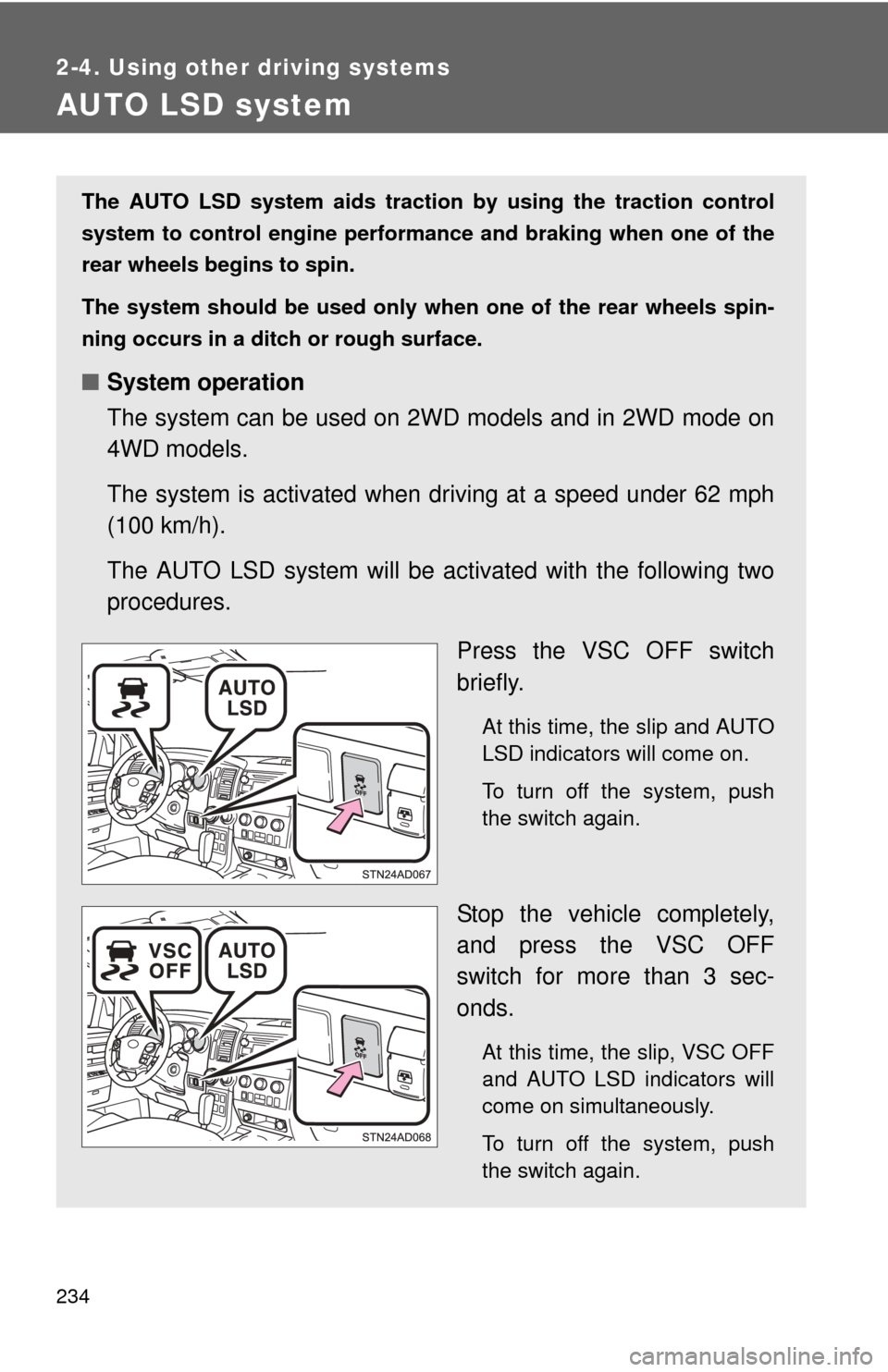
The AUTO LSD system aids traction by using the traction control
system to control engine performance and braking when one of the
rear wheels begins to spin.
The system should be used only wh en one of the rear wheels spin-
ning occurs in a ditch or rough surface.
■ System operation
The system can be used on 2W D models and in 2WD mode on
4WD models.
The system is activated when dr iving at a speed under 62 mph
(100 km/h).
The AUTO LSD system will be ac tivated with the following two
procedures.
Press the VSC OFF switch
briefly.
At this time, the slip and AUTO
LSD indicators will come on.
To turn off the system, push
the switch again.
Stop the vehicle completely,
and press the VSC OFF
switch for more than 3 sec-
onds.
At this time, the slip, VSC OFF
and AUTO LSD indicators will
come on simultaneously.
To turn off the system, push
the switch again.
Page 235 of 688
235
2-4. Using other
driving systems
2
When driving
When the AUTO LSD system is operating
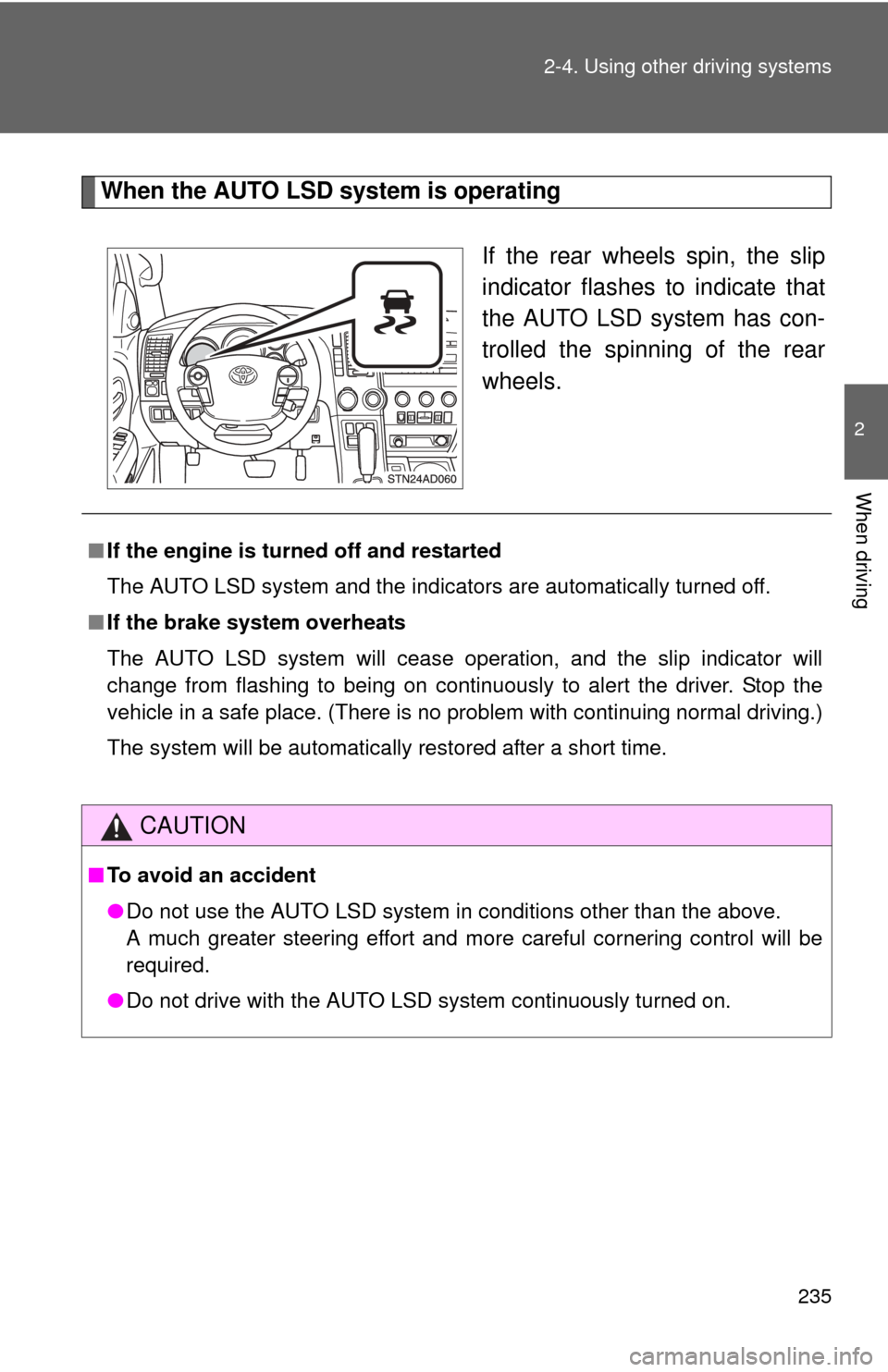
If the rear wheels spin, the slip
indicator flashes to indicate that
the AUTO LSD system has con-
trolled the spinning of the rear
wheels.
■If the engine is turned off and restarted
The AUTO LSD system and the indicators are automatically turned off.
■ If the brake system overheats
The AUTO LSD system will cease operation, and the slip indicator will
change from flashing to being on continuously to alert the driver. Stop the
vehicle in a safe place. (There is no problem with continuing normal driving.)
The system will be automatically restored after a short time.
CAUTION
■To avoid an accident
●Do not use the AUTO LSD system in conditions other than the above.
A much greater steering effort and more careful cornering control will be
required.
● Do not drive with the AUTO LSD system continuously turned on.