Pump TOYOTA SEQUOIA 2011 2.G Owners Manual
[x] Cancel search | Manufacturer: TOYOTA, Model Year: 2011, Model line: SEQUOIA, Model: TOYOTA SEQUOIA 2011 2.GPages: 688, PDF Size: 14.76 MB
Page 5 of 688

1
2
3
4
5
6
7
5
Luggage compartment features ............................. 480
Garage door opener............ 485
Compass ............................. 491
4-1. Maintenance and care Cleaning and protecting the vehicle exterior............ 498
Cleaning and protecting the vehicle interior............. 500
4-2. Maintenance Maintenance requirements ..................... 503
General maintenance.......... 505
Emission inspection and maintenance (I/M)
programs........................... 508
4-3. Do-it-yourself maintenance Do-it-yourself service precautions ....................... 509
Hood ................................... 513
Engine compartment ........... 514
Tires .................................... 529
Tire inflation pressure ......... 536
Wheels ................................ 540
Air conditioning filter............ 542
Wireless remote control battery ............................... 545
Checking and replacing fuses ................................. 547
Light bulbs........................... 558 5-1. Essential information
Emergency flashers............ 572
If your vehicle needs to be towed....................... 573
If you think something is wrong ............................... 579
Fuel pump shut off system .............................. 580
Event data recorder ............ 581
5-2. Steps to take in an emergency If a warning light turns on or a warning buzzer
sounds.............................. 583
If a warning message is displayed (vehicles with
multi-information
display) ............................. 592
If you have a flat tire ........... 597
If the engine will not start.... 608
If the shift lever cannot be shifted from P ................... 610
If you lose your keys........... 611
If the vehicle battery is discharged........................ 612
If your vehicle overheats .... 615
If the vehicle becomes stuck ................................. 618
If your vehicle has to be stopped in
an emergency .................. 619
4Maintenance and care
5When trouble arises
Page 101 of 688
101
1-5. Refueling
1
Before driving
■
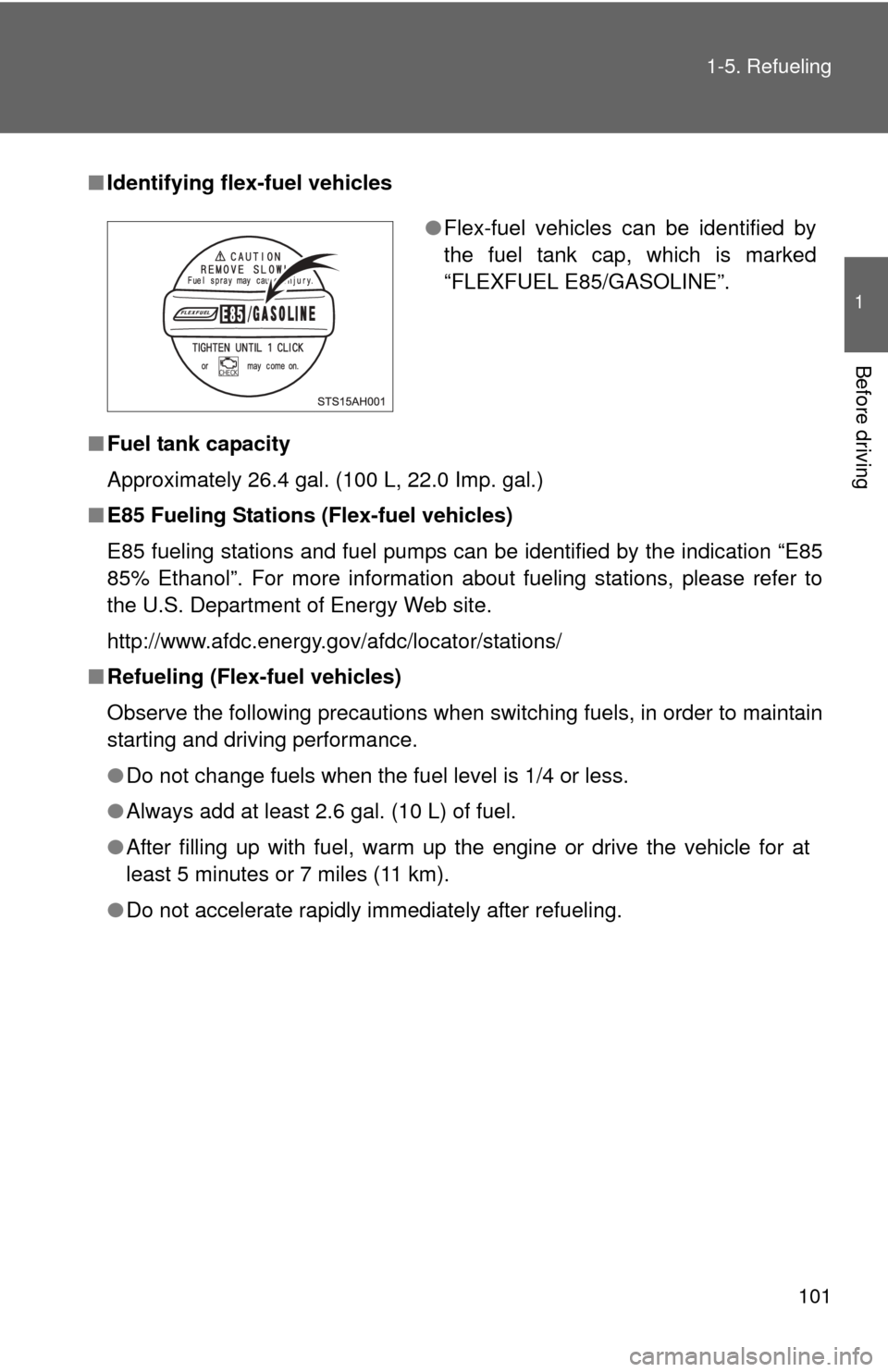
Identifying flex-fuel vehicles
■ Fuel tank capacity
Approximately 26.4 gal. (100 L, 22.0 Imp. gal.)
■ E85 Fueling Stations (Flex-fuel vehicles)
E85 fueling stations and fuel pumps can be identified by the indication “E85
85% Ethanol”. For more information about fueling stations, please refer to
the U.S. Department of Energy Web site.
http://www.afdc.energy.gov/afdc/locator/stations/
■ Refueling (Flex-fuel vehicles)
Observe the following precautions when switching fuels, in order to maintain
starting and driving performance.
●Do not change fuels when the fuel level is 1/4 or less.
● Always add at least 2.6 gal. (10 L) of fuel.
● After filling up with fuel, warm up the engine or drive the vehicle for at
least 5 minutes or 7 miles (11 km).
● Do not accelerate rapidly immediately after refueling.
●Flex-fuel vehicles can be identified by
the fuel tank cap, which is marked
“FLEXFUEL E85/GASOLINE”.
Page 154 of 688
154 2-1. Driving procedures
CAUTION
■Exhaust gases
Exhaust gases include harmful carbon monoxide (CO) that is colorless and
odorless. Inhaling exhaust gases may lead to death or a serious health haz-
ard.
●If the vehicle is in a poorly ventilated area, stop the engine. In a closed
area, such as a garage, exhaust gases may collect and enter the vehicle.
This may lead to death or a serious health hazard.
● The exhaust should be checked occasionally. If there is a hole or crack
caused by corrosion, damage to a joint or abnormal exhaust noise, be
sure to have the vehicle inspected and repaired by your Toyota dealer.
Failure to do so may allow exhaust gases to enter the vehicle, resulting in
death or a serious health hazard.
■ When taking a nap in the vehicle
Always turn the engine off. Otherwise, you may accidentally move the shift
lever or depress the accelerator pedal, which could cause an accident or fire
due to engine overheating. Additionally, if the vehicle is parked in a poorly
ventilated area, exhaust gases may collect and enter the vehicle, leadin\
g to
death or a serious health hazard.
■ When braking the vehicle
●When the brakes are wet, drive more cautiously.
Braking distance increases when the brakes are wet, and may cause one
side of the vehicle to brake differently than the other side. Also the parking
brake may not securely hold the vehicle.
● If the power brake assist function does not operate, do not follow other
vehicles closely and avoid downhills or sharp turns that require braking.
In this case, braking is still possible, but it will require more force on the
pedal than usual. Braking distance may also increase.
● Do not pump the brake pedal if the engine stalls.
Each push on the brake pedal uses up the reserve for the power-assisted
brakes.
Page 155 of 688
155
2-1. Driving procedures
2
When driving
CAUTION
■
When braking the vehicle
●The brake system consists of 2 individual hydraulic systems: If one of the
systems fails, the other will still operate. In this case, the brake pedal
should be depressed more firmly than usual and braking distance
becomes longer.
Do not drive your vehicle with only a single brake system. Have your
brakes fixed immediately.
NOTICE
■When driving the vehicle
●Do not depress the accelerator and brake pedals at the same time during
driving. If the brake pedal is depressed while driving with the accelerator
pedal depressed, driving torque may be restrained.
● Do not use the accelerator pedal or depress the accelerator and brake
pedals at the same time to hold the vehicle on a hill.
■ When parking the vehicle
Always put the shift lever in P.
Failure to do so may cause the vehicle to move or the vehicle may acceler-
ate suddenly if the accelerator pedal is accidentally depressed.
■ Avoiding damage to vehicle parts
●Do not turn the steering wheel fully in either direction and hold it there for a
long time.
Doing so may damage the power steering pump.
● When driving over bumps in the road, drive as slowly as possible to avoid
damaging the wheels, underside of the vehicle, etc.
Page 192 of 688

192 2-3. Operating the lights and wipers
■The windshield wiper and washer can be operated when
The engine switch must be in the ON position.
■ If no windshield washer fluid sprays
Check that the washer nozzles are not blocked and if there is washer fluid in
the windshield washer fluid reservoir.
NOTICE
■When the windshield is dry
Do not use the wipers, as they may damage the windshield.
■ When there is no washer fluid spray from the nozzle
Damage to the washer fluid pump may be caused if the lever is pulled
toward you and held continually.
■ When a nozzle becomes blocked
In this case, contact your Toyota dealer.
Do not try to clear it with a pin or other object. The nozzle will be damaged.
Washer/wiper dual opera-
tion
Wipers will automatically oper-
ate a couple of times after the
washer squirts.
Page 194 of 688
194
2-3. Operating the lights and wipers
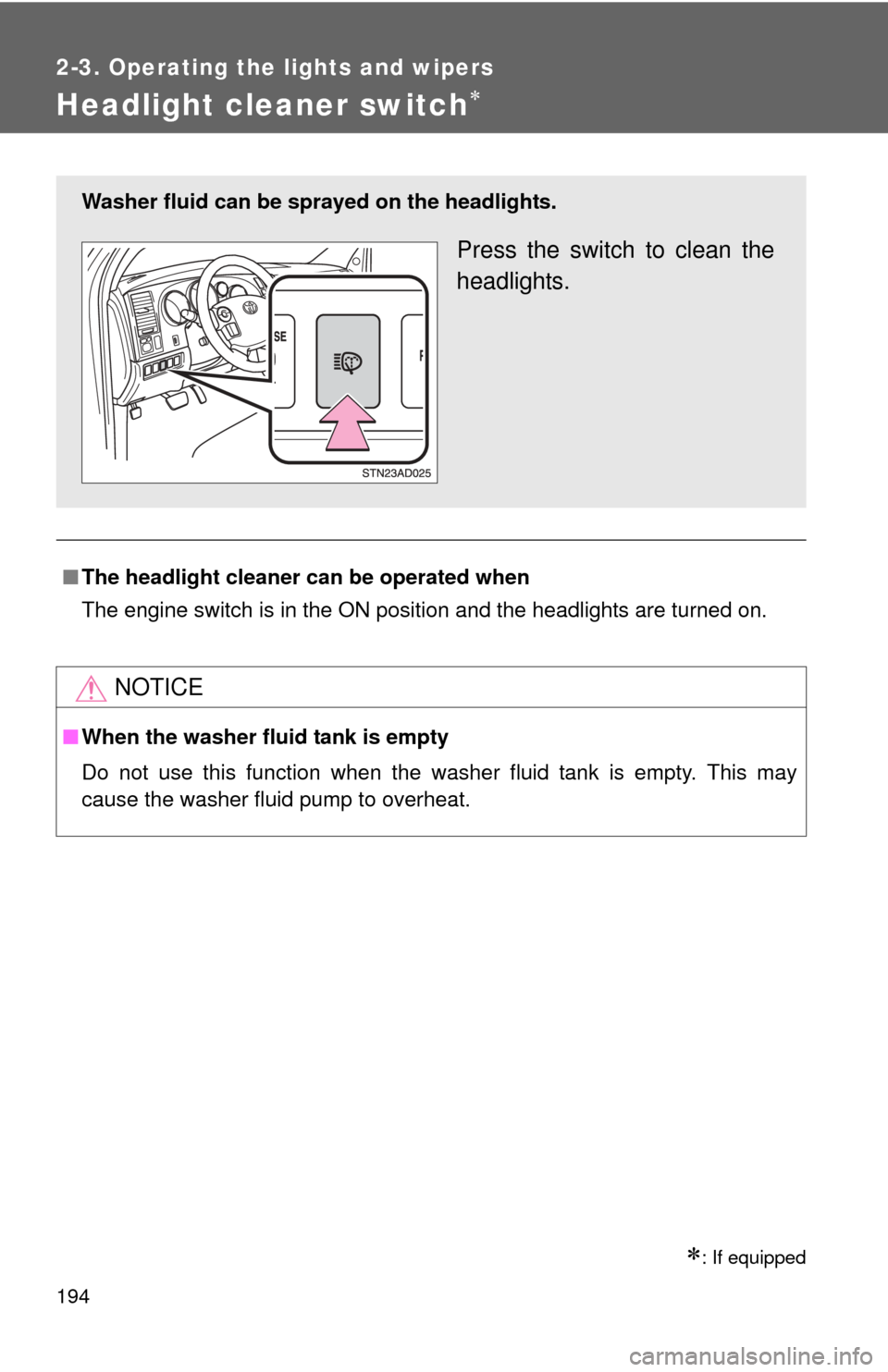
Headlight cleaner switch
: If equipped
■The headlight cleaner can be operated when
The engine switch is in the ON position and the headlights are turned on.
NOTICE
■When the washer fluid tank is empty
Do not use this function when the washer fluid tank is empty. This may
cause the washer fluid pump to overheat.
Washer fluid can be sprayed on the headlights.
Press the switch to clean the
headlights.
Page 519 of 688
519
4-3. Do-it-yourself maintenance
4
Maintenance and care
Engine coolant
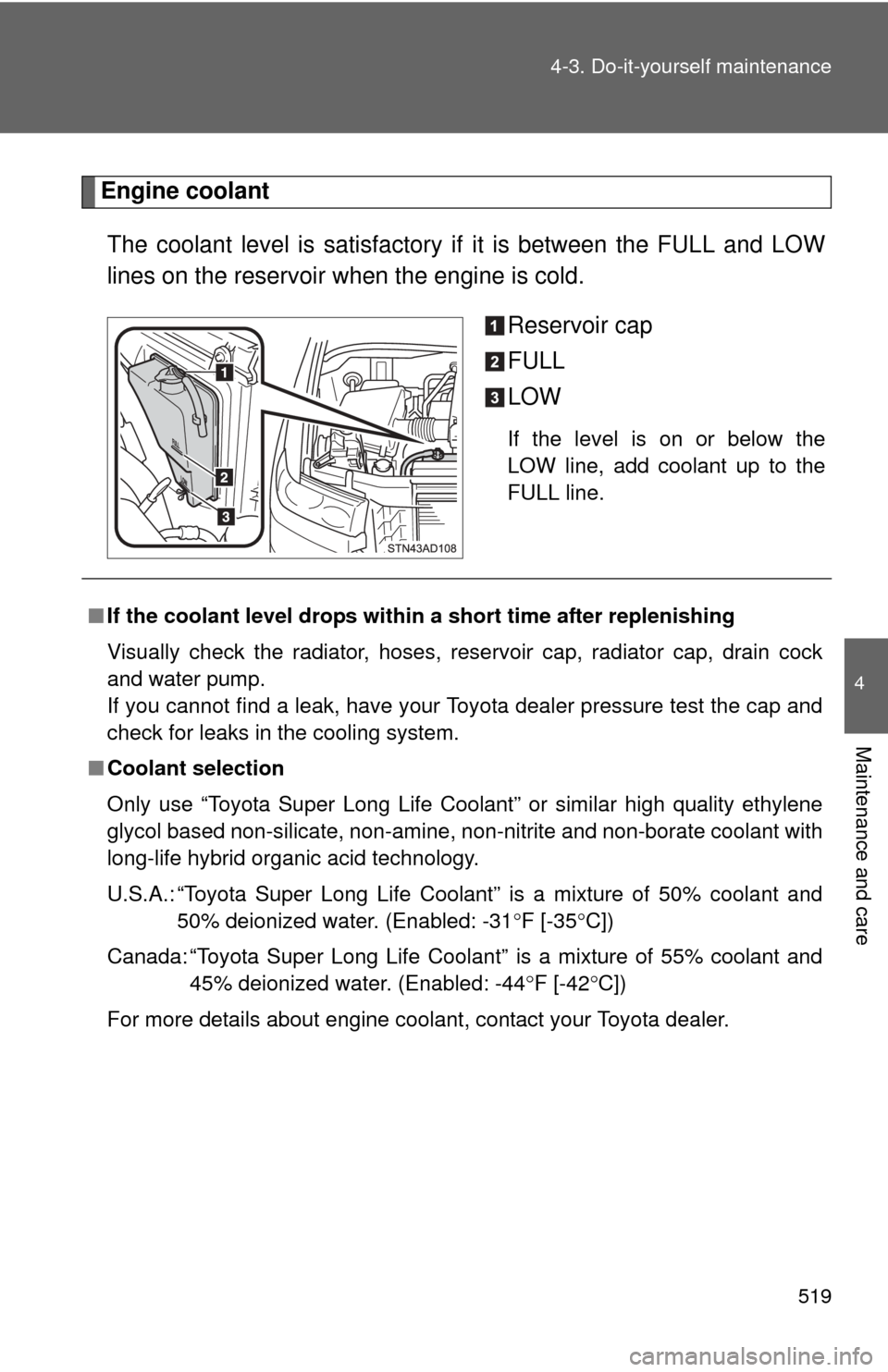
The coolant level is satisfactory if it is between the FULL and LOW
lines on the reservoir when the engine is cold.
Reservoir cap
FULL
LOW
If the level is on or below the
LOW line, add coolant up to the
FULL line.
■If the coolant level drops within a short time after replenishing
Visually check the radiator, hoses, reservoir cap, radiator cap, drain cock
and water pump.
If you cannot find a leak, have your Toyota dealer pressure test the cap and
check for leaks in the cooling system.
■ Coolant selection
Only use “Toyota Super Long Life Coolant” or similar high quality ethylene
glycol based non-silicate, non-amine, non-nitrite and non-borate coolant with
long-life hybrid organic acid technology.
U.S.A.: “Toyota Super Long Life Coolant” is a mixture of 50% coolant and 50% deionized water. (Enabled: -31 F [-35 C])
Canada: “Toyota Super Long Life Coolant” is a mixture of 55% coolant and 45% deionized water. (Enabled: -44 F [-42 C])
For more details about engine coolant, contact your Toyota dealer.
Page 524 of 688
524 4-3. Do-it-yourself maintenance
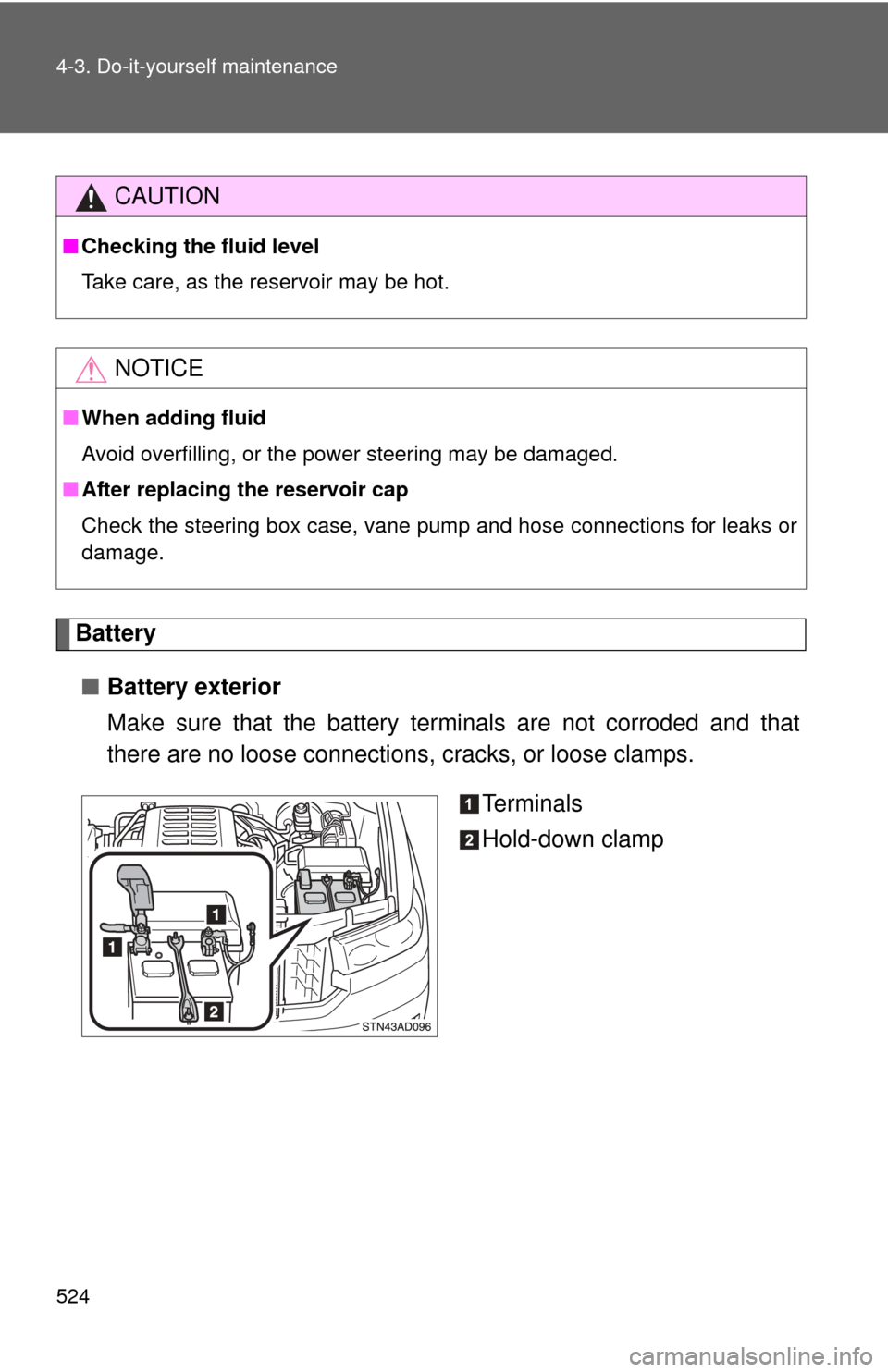
Battery■ Battery exterior
Make sure that the battery terminals are not corroded and that
there are no loose connections, cracks, or loose clamps.
Te r m i n a l s
Hold-down clamp
CAUTION
■Checking the fluid level
Take care, as the reservoir may be hot.
NOTICE
■When adding fluid
Avoid overfilling, or the power steering may be damaged.
■ After replacing the reservoir cap
Check the steering box case, vane pump and hose connections for leaks or
damage.
Page 552 of 688
552 4-3. Do-it-yourself maintenance
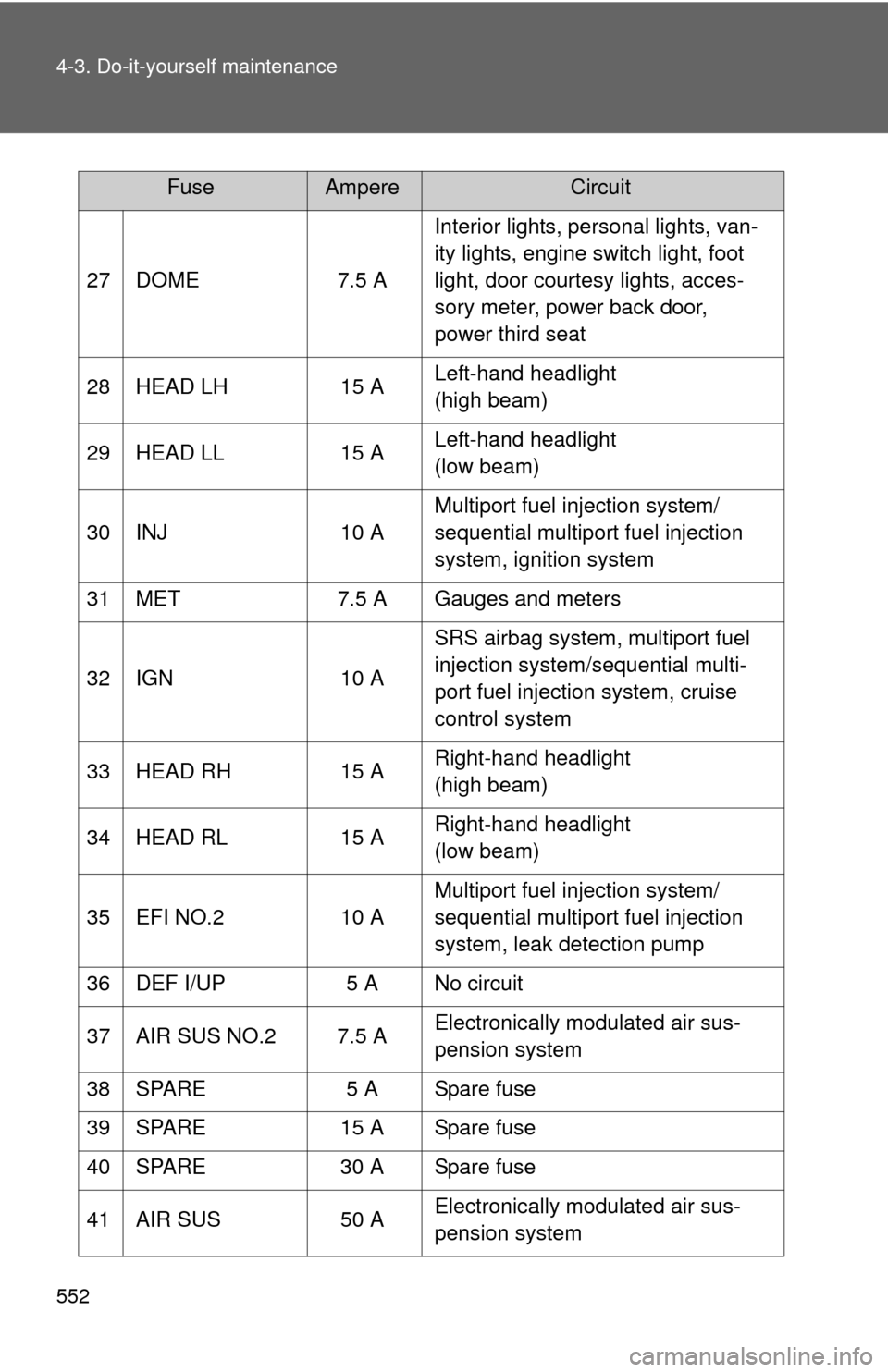
27 DOME7.5 AInterior lights, personal lights, van-
ity lights, engine switch light, foot
light, door courtesy lights, acces-
sory meter, power back door,
power third seat
28 HEAD LH 15 ALeft-hand headlight
(high beam)
29 HEAD LL 15 ALeft-hand headlight
(low beam)
30 INJ 10 AMultiport fuel injection system/
sequential multiport fuel injection
system, ignition system
31 MET 7.5 A Gauges and meters
32 IGN 10 ASRS airbag system, multiport fuel
injection system/sequential multi-
port fuel injection system, cruise
control system
33 HEAD RH 15 ARight-hand headlight
(high beam)
34 HEAD RL 15 ARight-hand headlight
(low beam)
35 EFI NO.2 10 AMultiport fuel injection system/
sequential multiport fuel injection
system, leak detection pump
36 DEF I/UP 5 A No circuit
37 AIR SUS NO.2 7.5 A Electronically modulated air sus-
pension system
38 SPARE 5 A Spare fuse
39 SPARE 15 A Spare fuse
40 SPARE 30 A Spare fuse
41 AIR SUS 50 AElectronically modulated air sus-
pension system
FuseAmpereCircuit
Page 553 of 688
553
4-3. Do-it-yourself maintenance
4
Maintenance and care
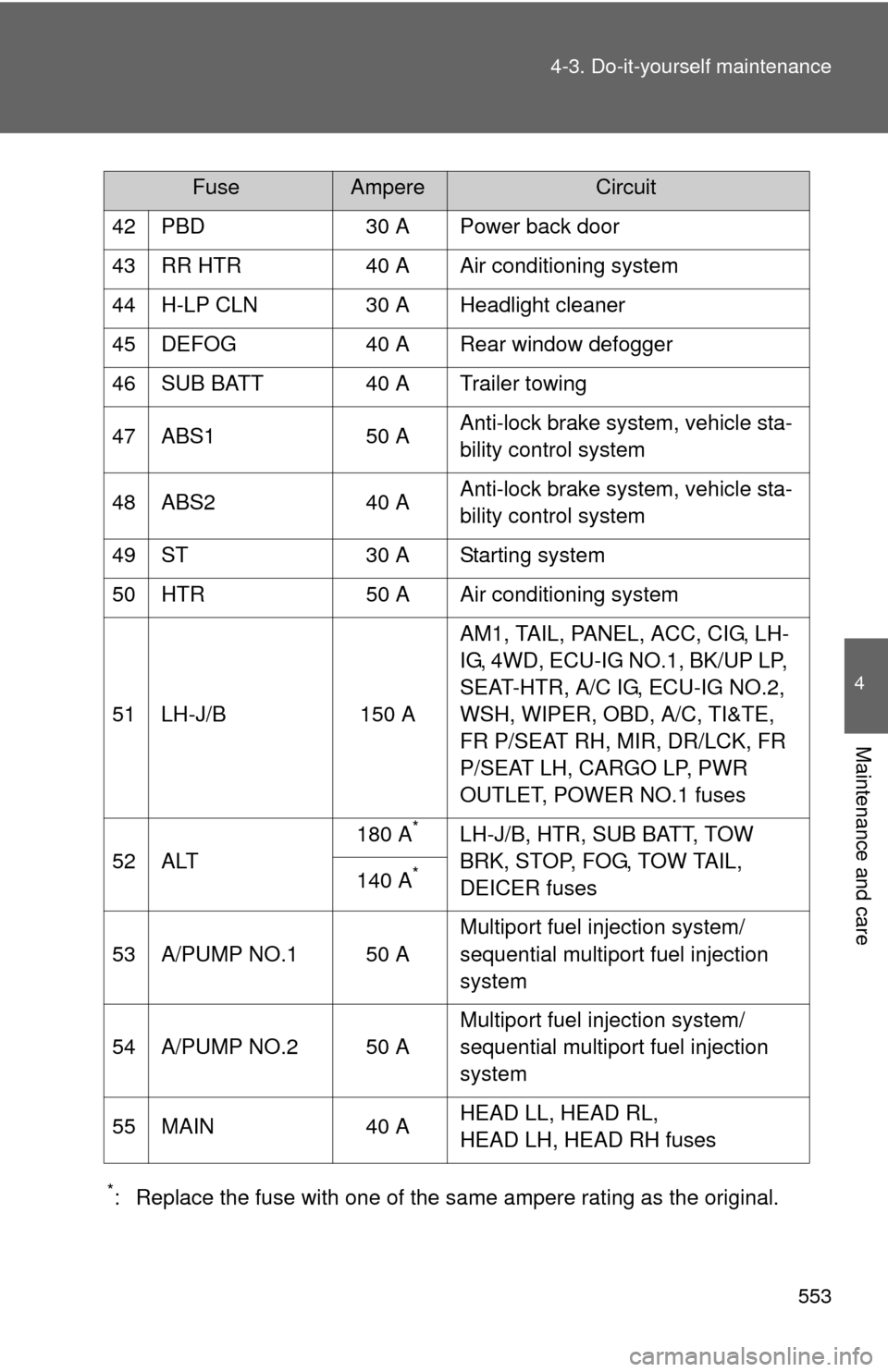
*: Replace the fuse with one of the same ampere rating as the original.
42 PBD 30 A Power back door
43 RR HTR 40 A Air conditioning system
44 H-LP CLN 30 A Headlight cleaner
45 DEFOG 40 A Rear window defogger
46 SUB BATT 40 A Trailer towing
47 ABS1 50 A
Anti-lock brake system, vehicle sta-
bility control system
48 ABS2 40 A Anti-lock brake system, vehicle sta-
bility control system
49 ST 30 A Starting system
50 HTR 50 A Air conditioning system
51 LH-J/B 150 A AM1, TAIL, PANEL, ACC, CIG, LH-
IG, 4WD, ECU-IG NO.1, BK/UP LP,
SEAT-HTR, A/C IG, ECU-IG NO.2,
WSH, WIPER, OBD, A/C, TI&TE,
FR P/SEAT RH, MIR, DR/LCK, FR
P/SEAT LH, CARGO LP, PWR
OUTLET, POWER NO.1 fuses
52 ALT 180 A
*LH-J/B, HTR, SUB BATT, TOW
BRK, STOP, FOG, TOW TAIL,
DEICER fuses
140 A
*
53 A/PUMP NO.1 50 A Multiport fuel injection system/
sequential multiport fuel injection
system
54 A/PUMP NO.2 50 A Multiport fuel injection system/
sequential multiport fuel injection
system
55 MAIN 40 A HEAD LL, HEAD RL,
HEAD LH, HEAD RH fuses
FuseAmpereCircuit