automatic transmission TOYOTA SEQUOIA 2013 2.G User Guide
[x] Cancel search | Manufacturer: TOYOTA, Model Year: 2013, Model line: SEQUOIA, Model: TOYOTA SEQUOIA 2013 2.GPages: 740, PDF Size: 15.34 MB
Page 267 of 740
267
2-5. Driving information
2
When driving
NOTICE
■
To prevent the water damage
●Take all necessary safety measures to ensure that water damage to the
engine or other components does not occur.
● Water entering the engine air intake will cause severe engine damage.
● Water entering the automatic transmission will cause deterioration in shift
quality, locking up of your transmission accompanied by vibration, and ulti-
mately damage.
● Water can wash the grease from wheel bearings, causing rusting and pre-
mature failure, and may also enter the differentials, transmission and
transfer case, reducing the gear oil’s lubricating qualities.
■ When you drive through water
If driving through water, such as when crossing shallow streams, first check
the depth of the water and the bottom of the river bed for firmness. Drive
slowly and avoid deep water.
■ Inspection after off-road driving
●Sand and mud that has accumulat ed in brake drums and around brake
discs may affect braking efficiency and may damage brake system compo-
nents.
● Always perform a maintenance inspection after each day of off-road driv-
ing that has taken you through rough terrain, sand, mud, or water. For
scheduled maintenance information, refer to the “Scheduled Maintenance
Guide” or “Owner’s Manual Supplement”.
Page 293 of 740
293
2-5. Driving information
2
When driving
●
Always place wheel blocks under both the vehicle’s and the
trailer’s wheels when parking. Ap ply the parking brake firmly, and
put the transmission in P. Avoid pa rking on a slope, but if unavoid-
able, do so only after performing the following:
Apply the brakes and keep them applied.
Have someone place wheel blo cks under both the vehicle’s
and trailer’s wheels.
When the wheel blocks are in pl ace, release the brakes slowly
until the blocks absorb the load.
Apply the parking brake firmly.
Shift into P and turn off the engine.
● When restarting after parking on a slope:
With the transmission in P, start the engine. On vehicles with
an automatic transmission, be sure to keep the brake pedal
pressed.
Shift into a forward gear. If reversing, shift into R.
Release the parking brake and brake pedal, and slowly pull or
back away from the wheel blocks. Stop and apply the brakes.
Have someone retrieve the blocks.
Page 557 of 740
557
4-2. Maintenance
4
Maintenance and care
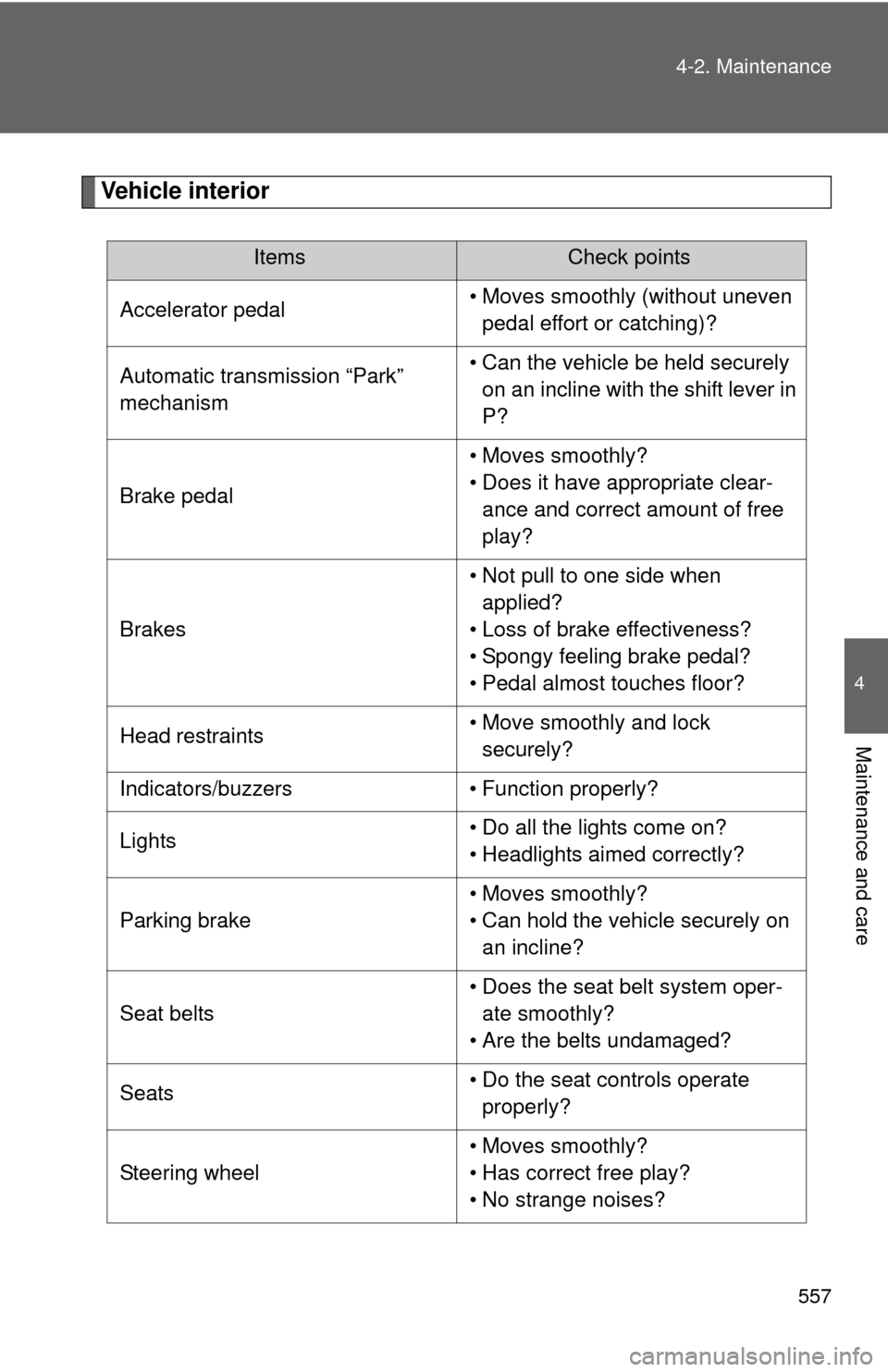
Vehicle interior
ItemsCheck points
Accelerator pedal • Moves smoothly (without uneven
pedal effort or catching)?
Automatic transmission “Park”
mechanism • Can the vehicle be held securely
on an incline with the shift lever in
P?
Brake pedal • Moves smoothly?
• Does it have appropriate clear-
ance and correct amount of free
play?
Brakes • Not pull to one side when
applied?
• Loss of brake effectiveness?
• Spongy feeling brake pedal?
• Pedal almost touches floor?
Head restraints • Move smoothly and lock
securely?
Indicators/buzzers • Function properly?
Lights • Do all the lights come on?
• Headlights aimed correctly?
Parking brake • Moves smoothly?
• Can hold the vehicle securely on
an incline?
Seat belts • Does the seat belt system oper-
ate smoothly?
• Are the belts undamaged?
Seats • Do the seat controls operate
properly?
Steering wheel • Moves smoothly?
• Has correct free play?
• No strange noises?
Page 561 of 740
561
4-3. Do-it-yourself maintenance
4
Maintenance and care
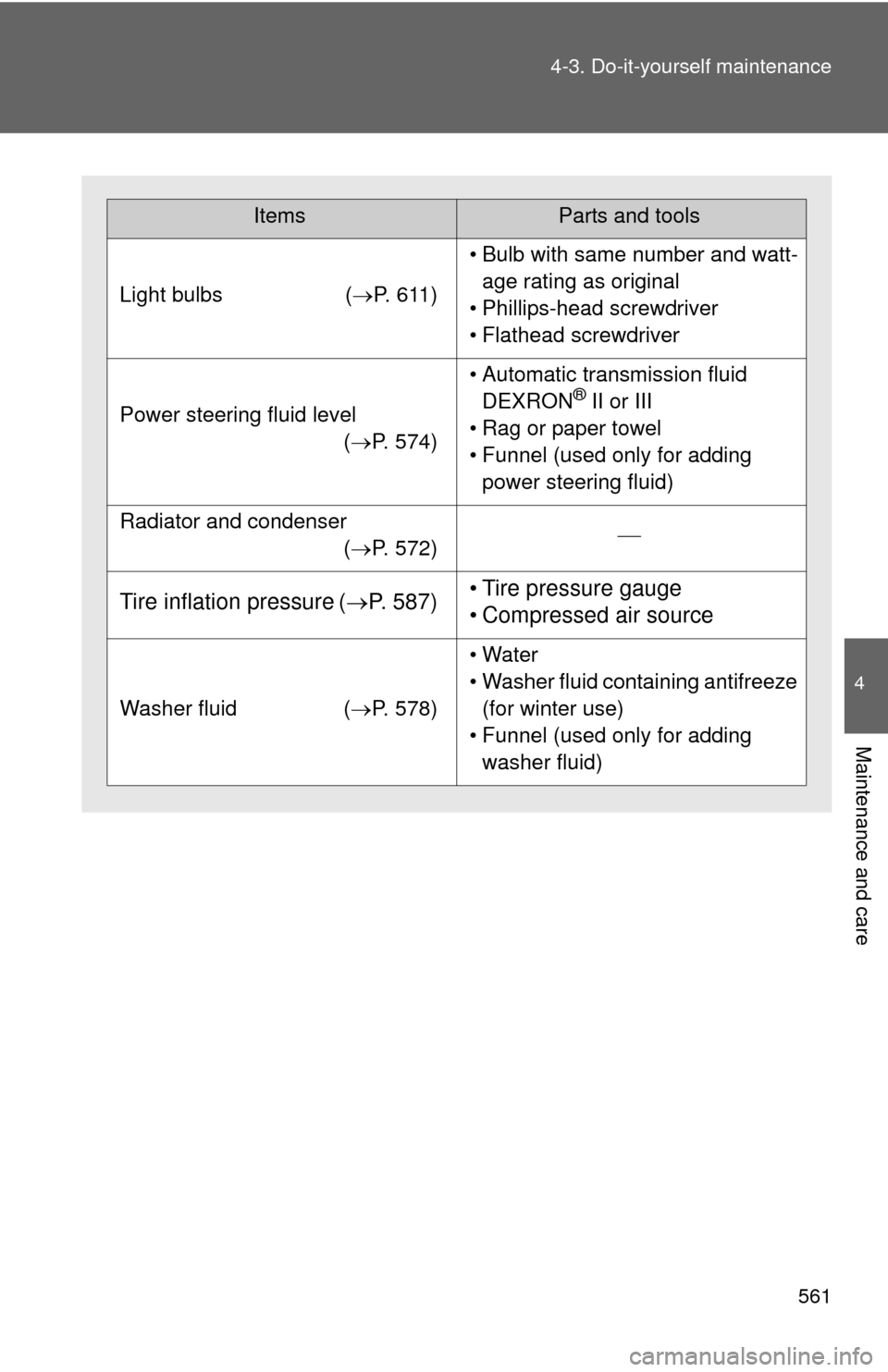
ItemsParts and tools
Light bulbs
(P. 611)
• Bulb with same number and watt-
age rating as original
• Phillips-head screwdriver
• Flathead screwdriver
Power steering fluid level (P. 574)
• Automatic transmission fluid
DEXRON® II or III
• Rag or paper towel
• Funnel (used only for adding power steering fluid)
Radiator and condenser (P. 572)
Tire inflation pressure ( P. 587)• Tire pressure gauge
• Compressed air source
Washer fluid (P. 578)
• Water
• Washer fluid containing antifreeze
(for winter use)
• Funnel (used only for adding washer fluid)
Page 574 of 740
574 4-3. Do-it-yourself maintenance
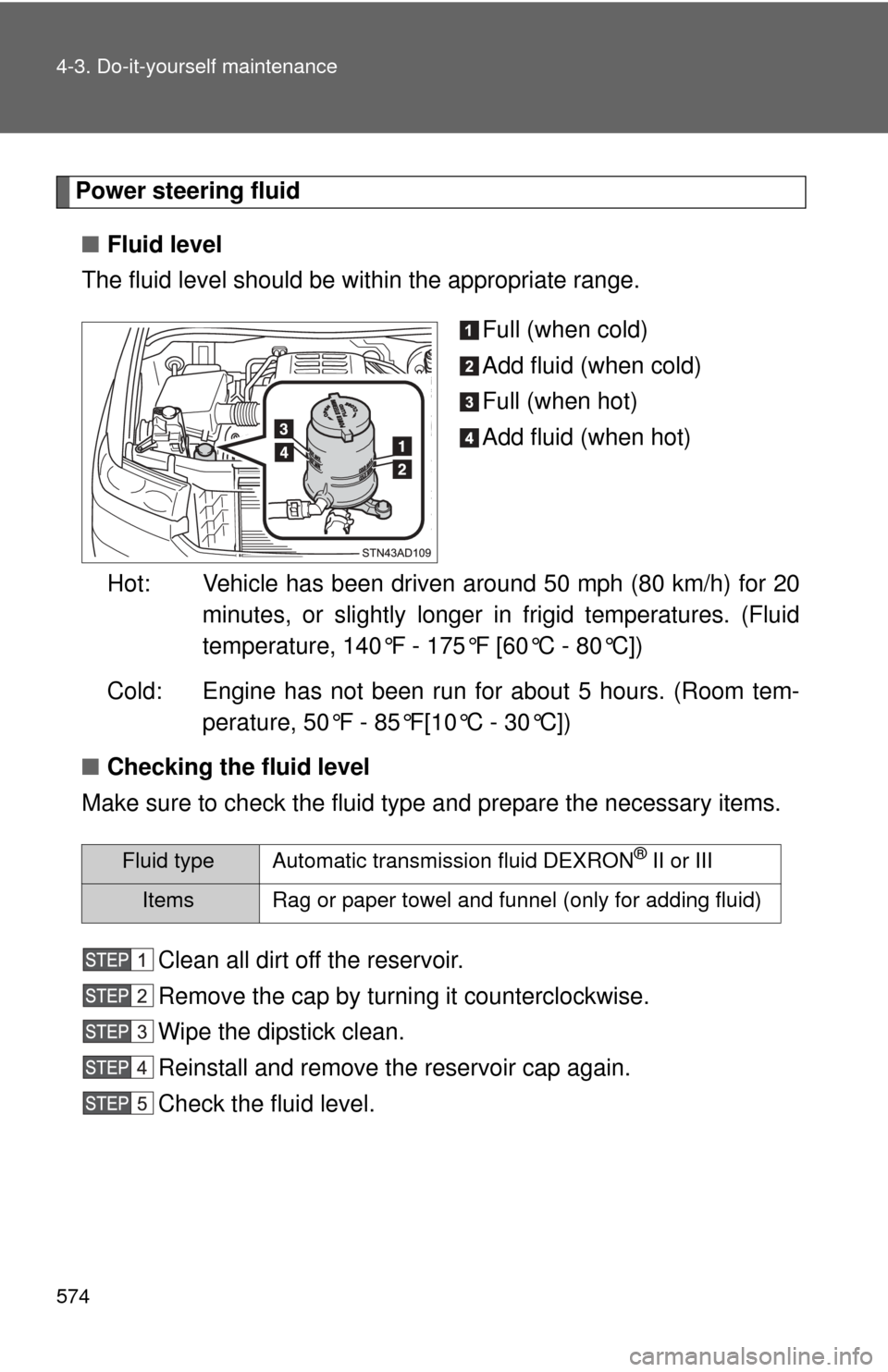
Power steering fluid■ Fluid level
The fluid level should be within the appropriate range.
Full (when cold)
Add fluid (when cold)
Full (when hot)
Add fluid (when hot)
Hot: Vehicle has been driven around 50 mph (80 km/h) for 20 minutes, or slightly longer in frigid temperatures. (Fluid
temperature, 140°F - 175°F [60°C - 80°C])
Cold: Engine has not been run for about 5 hours. (Room tem- perature, 50°F - 85°F[10°C - 30°C])
■ Checking the fluid level
Make sure to check the fluid type and prepare the necessary items.
Clean all dirt off the reservoir.
Remove the cap by turning it counterclockwise.
Wipe the dipstick clean.
Reinstall and remove the reservoir cap again.
Check the fluid level.
Fluid type Automatic transmission fluid DEXRON® II or III
Items Rag or paper towel and funnel (only for adding fluid)
Page 631 of 740
5
When trouble arises
631
5-1. Essential information
If you think something is wrong
If you notice any of the following symptoms, your vehicle probably
needs adjustment or repair. Contact your Toyota dealer as soon as
possible.
■ Visible symptoms
●Fluid leaks under the vehicle
(Water dripping from the air cond itioning after use is normal.)
● Flat-looking tires or uneven tire wear
● Engine coolant temperature g auge needle continually points
higher or lower than normal
● Voltmeter continually points higher or lower than normal
● Engine oil pressure gauge continually points higher or lower
than normal
● Automatic transmission fluid temperature gauge needle con-
tinually points higher or lower than normal (if equipped)
■ Audible symptoms
●Changes in exhaust sound
● Excessive tire squeal when cornering
● Strange noises related to the suspension system
● Pinging or other noises related to the engine
■ Operational symptoms
●Engine misfire, stumbling or running rough
● Appreciable loss of power
● Vehicle pulls heavily to one side when braking
● Vehicle pulls heavily to one side when driving on a level road
● Loss of brake effectiveness, s pongy feeling, pedal almost
touches the floor
Page 634 of 740
634 5-2. Steps to take in an emergency
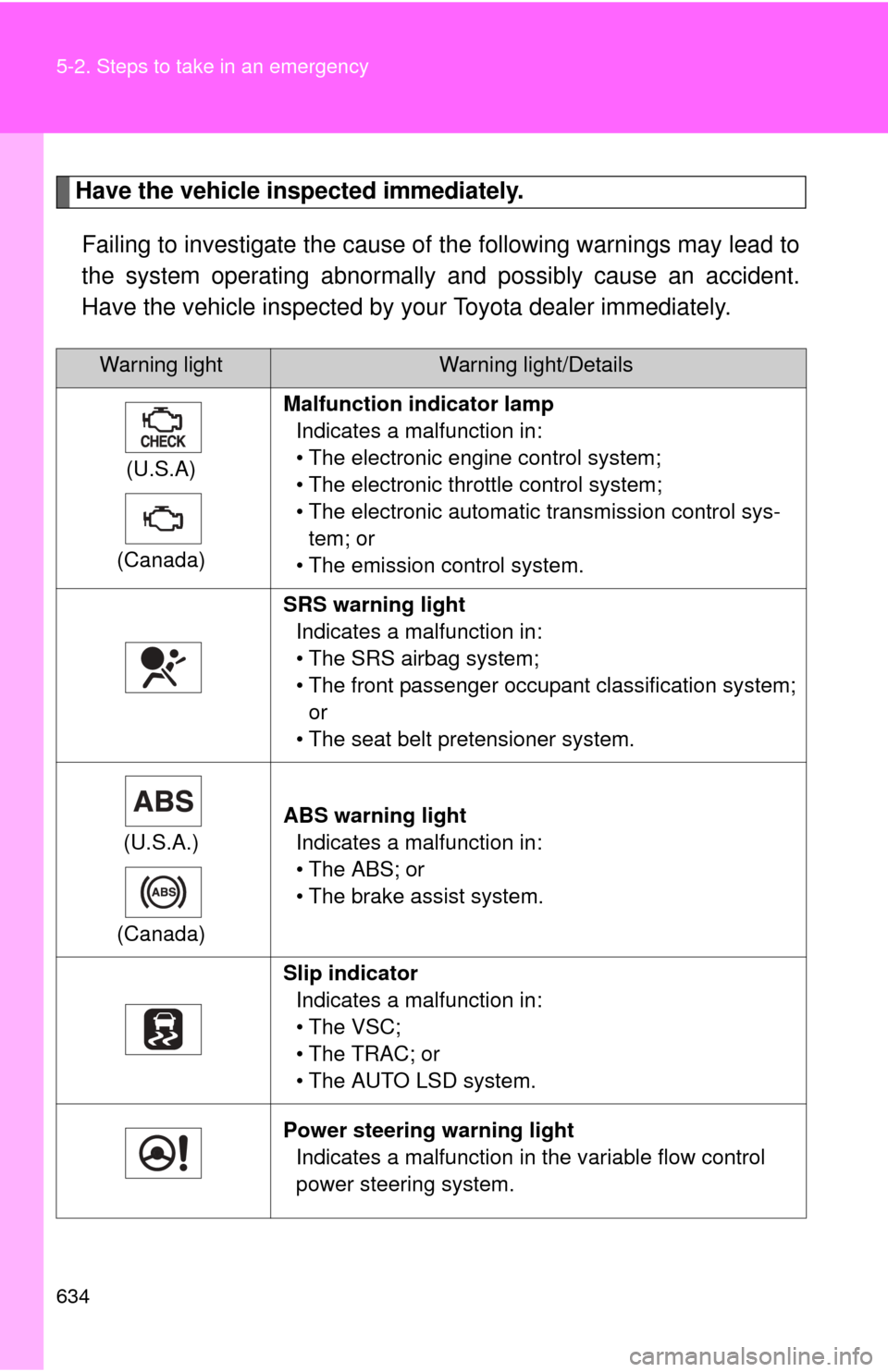
Have the vehicle inspected immediately.Failing to investigate the cause of the following warnings may lead to
the system operating abnormally and possibly cause an accident.
Have the vehicle inspected by your Toyota dealer immediately.
Warning lightWarning light/Details
(U.S.A)
(Canada) Malfunction indicator lamp
Indicates a malfunction in:
• The electronic engine control system;
• The electronic throttle control system;
• The electronic automatic transmission control sys-tem; or
• The emission control system.
SRS warning light Indicates a malfunction in:
• The SRS airbag system;
• The front passenger occupant classification system; or
• The seat belt pretensioner system.
(U.S.A.)
(Canada) ABS warning light
Indicates a malfunction in:
• The ABS; or
• The brake assist system.
Slip indicator Indicates a malfunction in:
• The VSC;
• The TRAC; or
• The AUTO LSD system.
Power steering warning light Indicates a malfunction in the variable flow control
power steering system.
Page 636 of 740
636 5-2. Steps to take in an emergency
*4
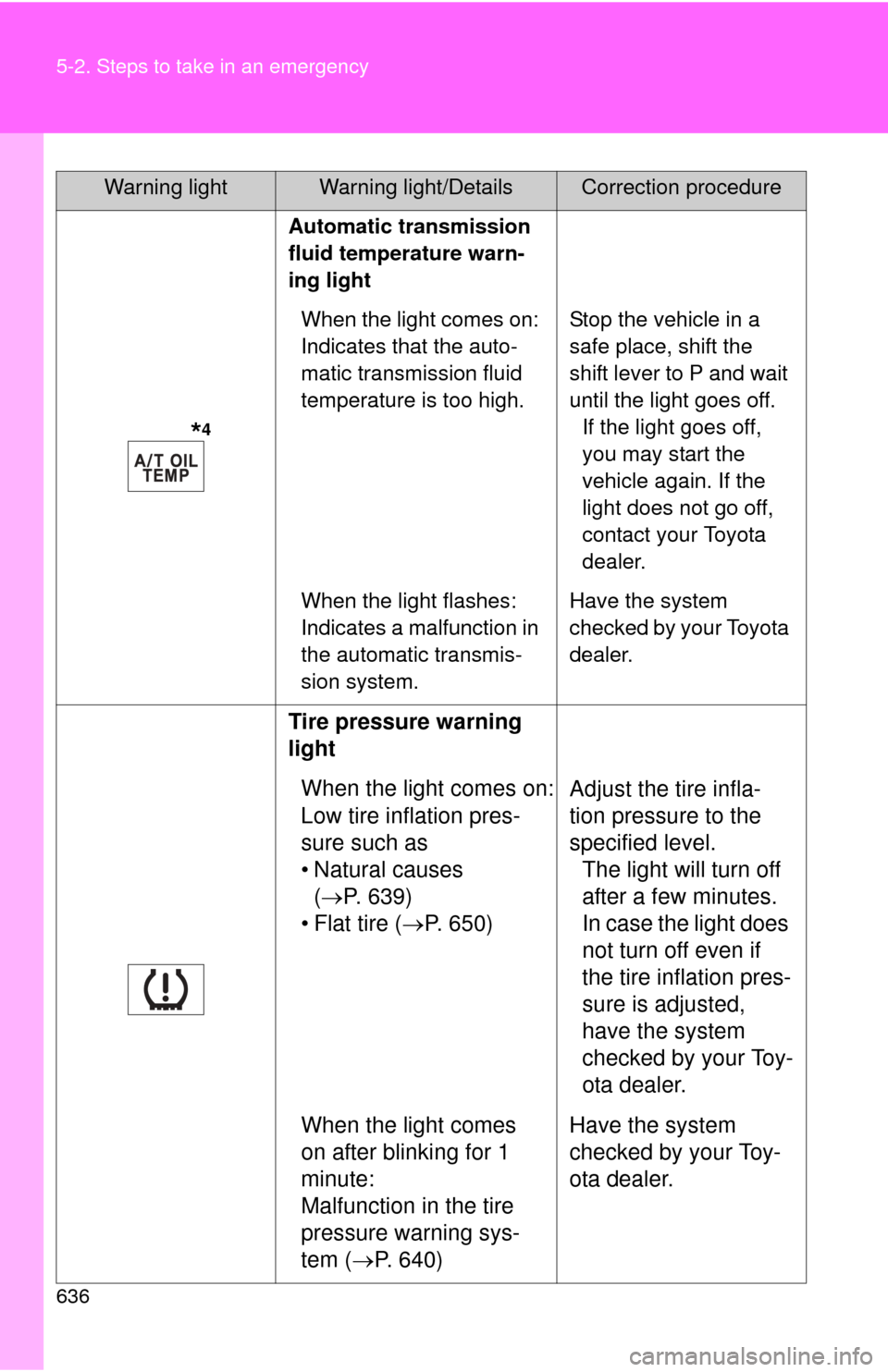
Automatic transmission
fluid temperature warn-
ing lightWhen the light comes on:
Indicates that the auto-
matic transmission fluid
temperature is too high. Stop the vehicle in a
safe place, shift the
shift lever to P and wait
until the light goes off.
If the light goes off,
you may start the
vehicle again. If the
light does not go off,
contact your Toyota
dealer.
When the light flashes:
Indicates a malfunction in
the automatic transmis-
sion system. Have the system
checked by your Toyota
dealer.
Tire pressure warning
light
When the light comes on:
Low tire inflation pres-
sure such as
• Natural causes ( P. 639)
• Flat tire ( P. 650) Adjust the tire infla-
tion pressure to the
specified level.
The light will turn off
after a few minutes.
In case the light does
not turn off even if
the tire inflation pres-
sure is adjusted,
have the system
checked by your Toy-
ota dealer.
When the light comes
on after blinking for 1
minute:
Malfunction in the tire
pressure warning sys-
tem ( P. 640) Have the system
checked by your Toy-
ota dealer.
Warning lightWarning light/DetailsCorrection procedure
Page 646 of 740
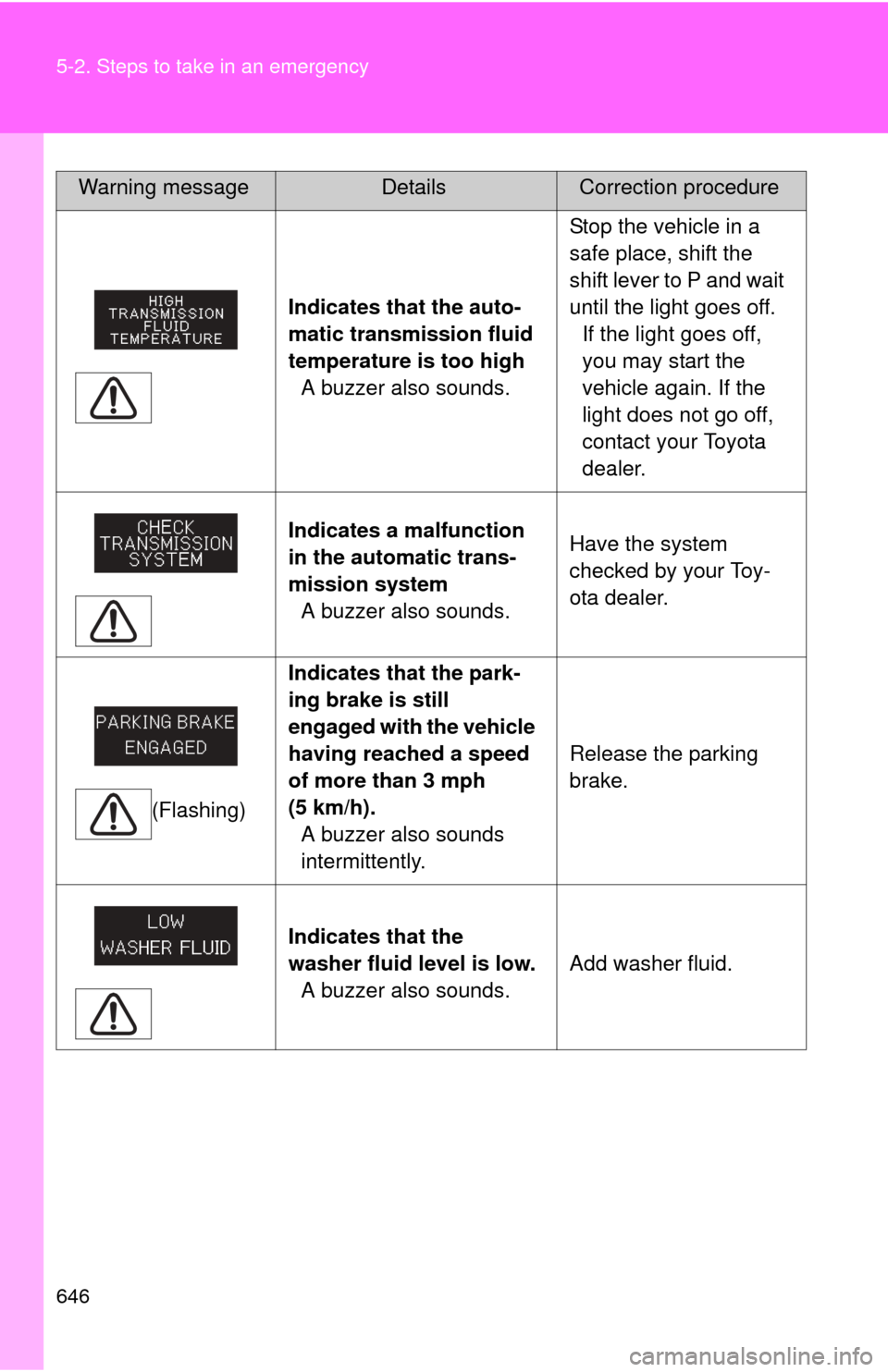
646 5-2. Steps to take in an emergency
Indicates that the auto-
matic transmission fluid
temperature is too highA buzzer also sounds. Stop the vehicle in a
safe place, shift the
shift lever to P and wait
until the light goes off.
If the light goes off,
you may start the
vehicle again. If the
light does not go off,
contact your Toyota
dealer.
Indicates a malfunction
in the automatic trans-
mission system A buzzer also sounds. Have the system
checked by your Toy-
ota dealer.
(Flashing) Indicates that the park-
ing brake is still
engaged with the vehicle
having reached a speed
of more than 3 mph
(5 km/h).
A buzzer also sounds
intermittently. Release the parking
brake.
Indicates that the
washer fluid level is low. A buzzer also sounds. Add washer fluid.
Warning messageDetailsCorrection procedure
Page 683 of 740
683
6-1. Specifications
6
Vehicle specifications
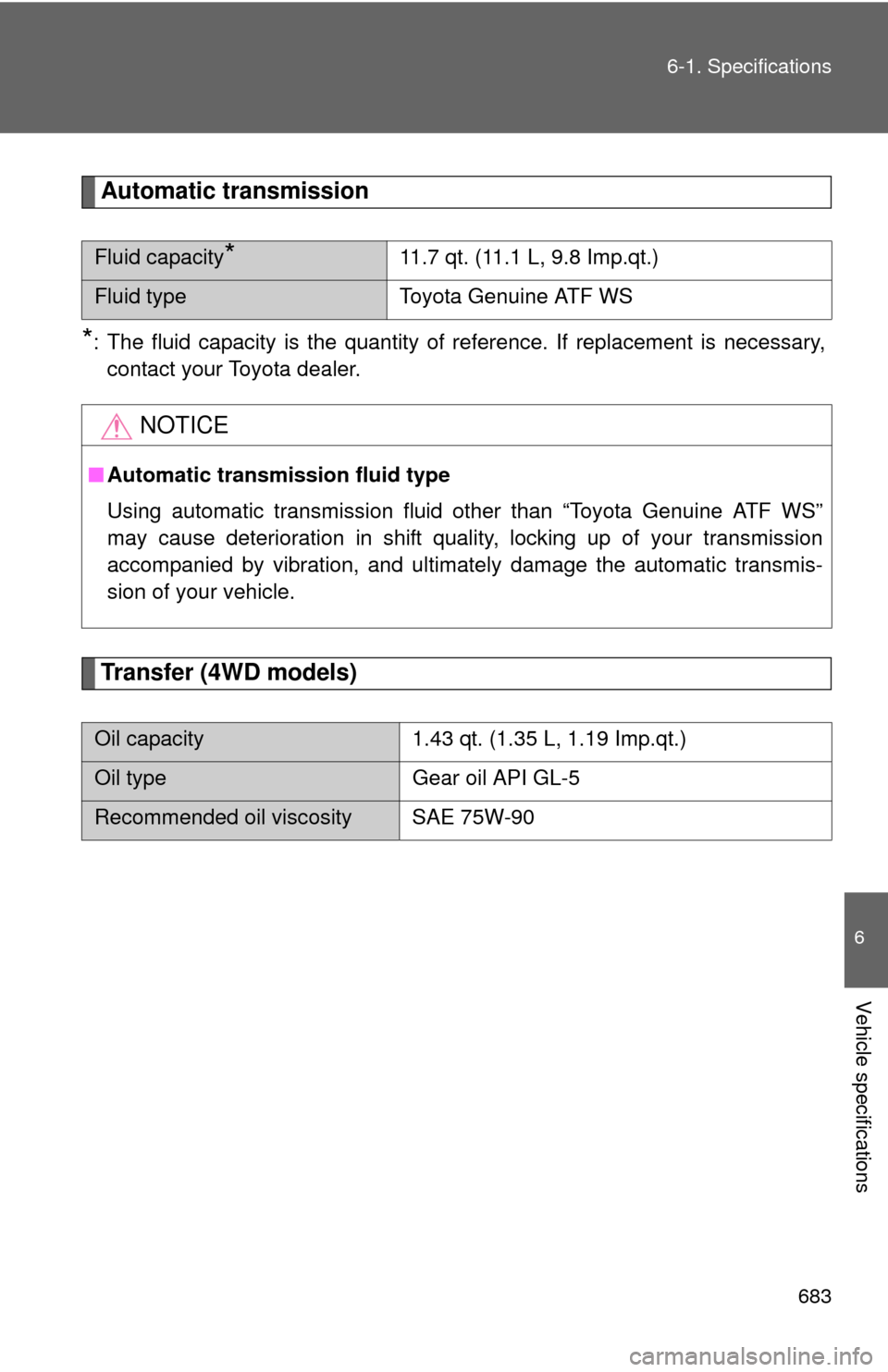
Automatic transmission
*: The fluid capacity is the quantity of reference. If replacement is necessary,
contact your Toyota dealer.
Transfer (4WD models)
Fluid capacity*11.7 qt. (11.1 L, 9.8 Imp.qt.)
Fluid type Toyota Genuine ATF WS
NOTICE
■Automatic transmission fluid type
Using automatic transmission fluid other than “Toyota Genuine ATF WS”
may cause deterioration in shift quality, locking up of your transmission
accompanied by vibration, and ultimately damage the automatic transmis-
sion of your vehicle.
Oil capacity 1.43 qt. (1.35 L, 1.19 Imp.qt.)
Oil typeGear oil API GL-5
Recommended oil viscosity SAE 75W-90