lock TOYOTA SEQUOIA 2017 2.G Owners Manual
[x] Cancel search | Manufacturer: TOYOTA, Model Year: 2017, Model line: SEQUOIA, Model: TOYOTA SEQUOIA 2017 2.GPages: 576, PDF Size: 12.76 MB
Page 466 of 576

466 5-1. Essential information
NOTICE
■To prevent damage to the vehicle when towing using a wheel-lift
type truck
●Do not tow the vehicle from the rear when the engine switch is in the
LOCK position or the key is removed.
The steering lock mechanism is not strong enough to hold the front
wheels straight.
●When raising the vehicle, ensure adequate ground clearance for tow-
ing at the opposite end of the raised vehicle. Without adequate clear-
ance, the vehicle could be damaged while being towed.
■To prevent damage to the vehicle when towing with a sling-type
truck
Do not tow with a sling-type truck, either from the front or rear.
■To prevent damage to the vehicle during emergency towing
Do not secure cables or chains to the suspension components.
Page 468 of 576
468
5-1. Essential information
Fuel pump shut off system
Follow the procedure below to restart the engine after the system is
activated.
Turn the engine switch to the ACC or LOCK position.
Restart the engine.
NOTICE
■Before starting the engine
Inspect the ground under the vehicle.
If you find that fuel has leaked onto the ground, the fuel system has been
damaged and is in need of repair. Do not restart the engine.
To minimize the risk of fuel leakage when the engine stalls or an
airbag inflates upon collision, the fuel pump shut off system stops
supplying fuel to the engine.
Page 475 of 576
5
When trouble arises
475
5-2. Steps to take in an emergency
■
Four-wheel drive system warning buzzer
The buzzer indicated that the transfer mode is not selected correctly.
■ Key reminder buzzer
The buzzer indicates that the key has not been removed (with the engine
switch in the ACC or LOCK position and the driver’s door opened).
■ Open moon roof reminder buzzer
The buzzer indicate that the moon roof is still opened (with the engine switch
in the ACC or LOCK position and the driver’s door opened).
■ If the malfunction indicator lamp comes on while driving
First check the following:
● Is your vehicle low on gas?
If it is, refuel the vehicle immediately.
● Is the fuel tank cap loose?
If it is, tighten it securely.
The light will go off after taking several driving trips.
If the light does not go off even after several trips, contact your Toyota dealer
as soon as possible.
■ Front passenger detection sensor and passenger seat belt reminder
If luggage or other load is placed on the front passenger seat, depending on
its weight, the reminder light to flash and buzzer to sound.
■
When the tire pressure warning light comes on
Check the tire inflation pressure and adjust to the appropriate level.
Pushing the tire pressure warning reset switch does not turn off the tire
pressure warning light.
■The tire pressure warning light may turn on due to natural causes
The tire pressure warning light may turn on due to natural causes such
as natural air leaks or tire inflat ion pressure changes caused by tem-
perature. In this case, adjusting the tire inflation pressure will turn off the
warning light (after several minutes).
Page 488 of 576
488 5-2. Steps to take in an emergency
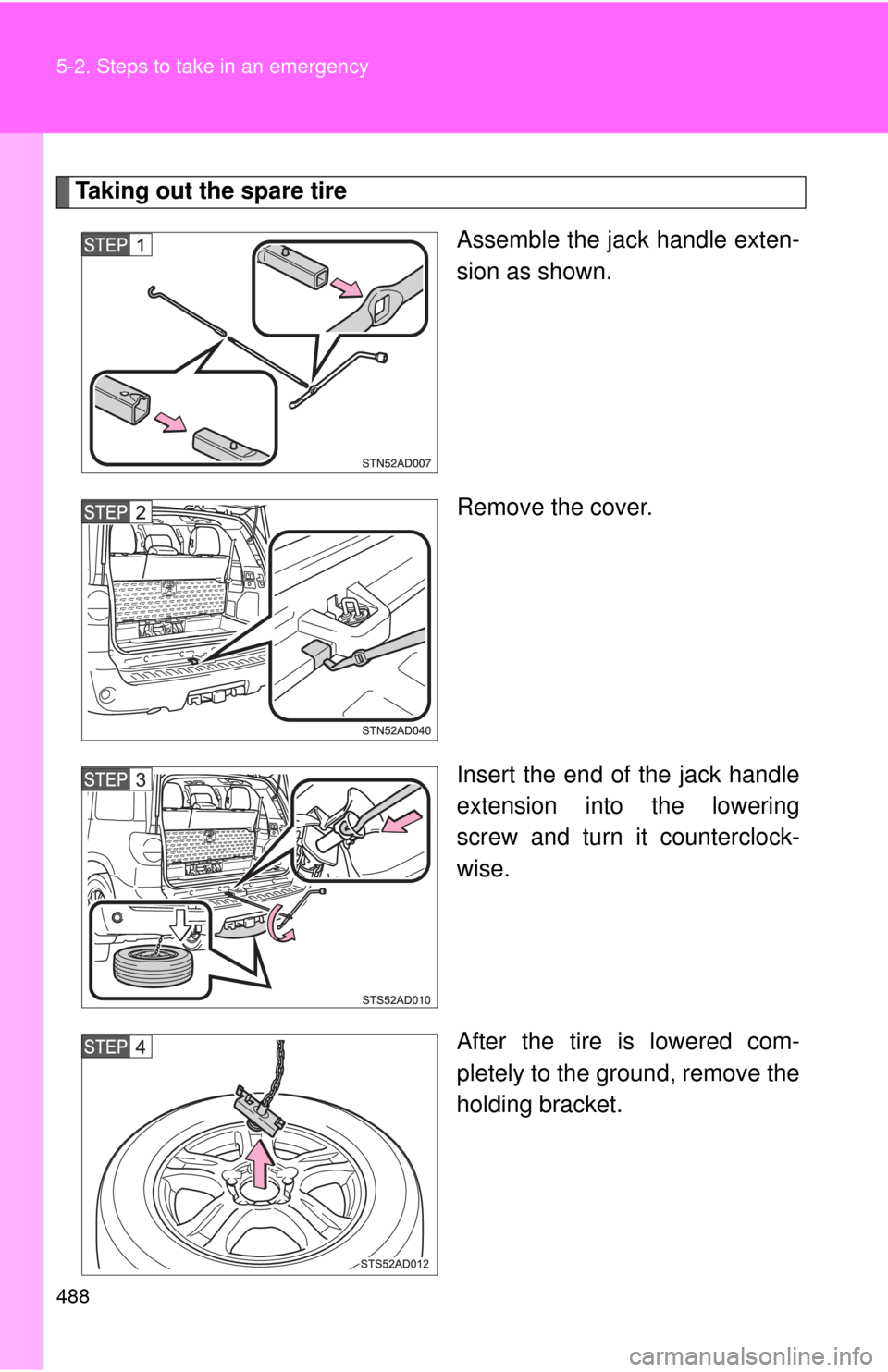
Taking out the spare tireAssemble the jack handle exten-
sion as shown.
Remove the cover.
Insert the end of the jack handle
extension into the lowering
screw and turn it counterclock-
wise.
After the tire is lowered com-
pletely to the ground, remove the
holding bracket.
Page 492 of 576
492 5-2. Steps to take in an emergency
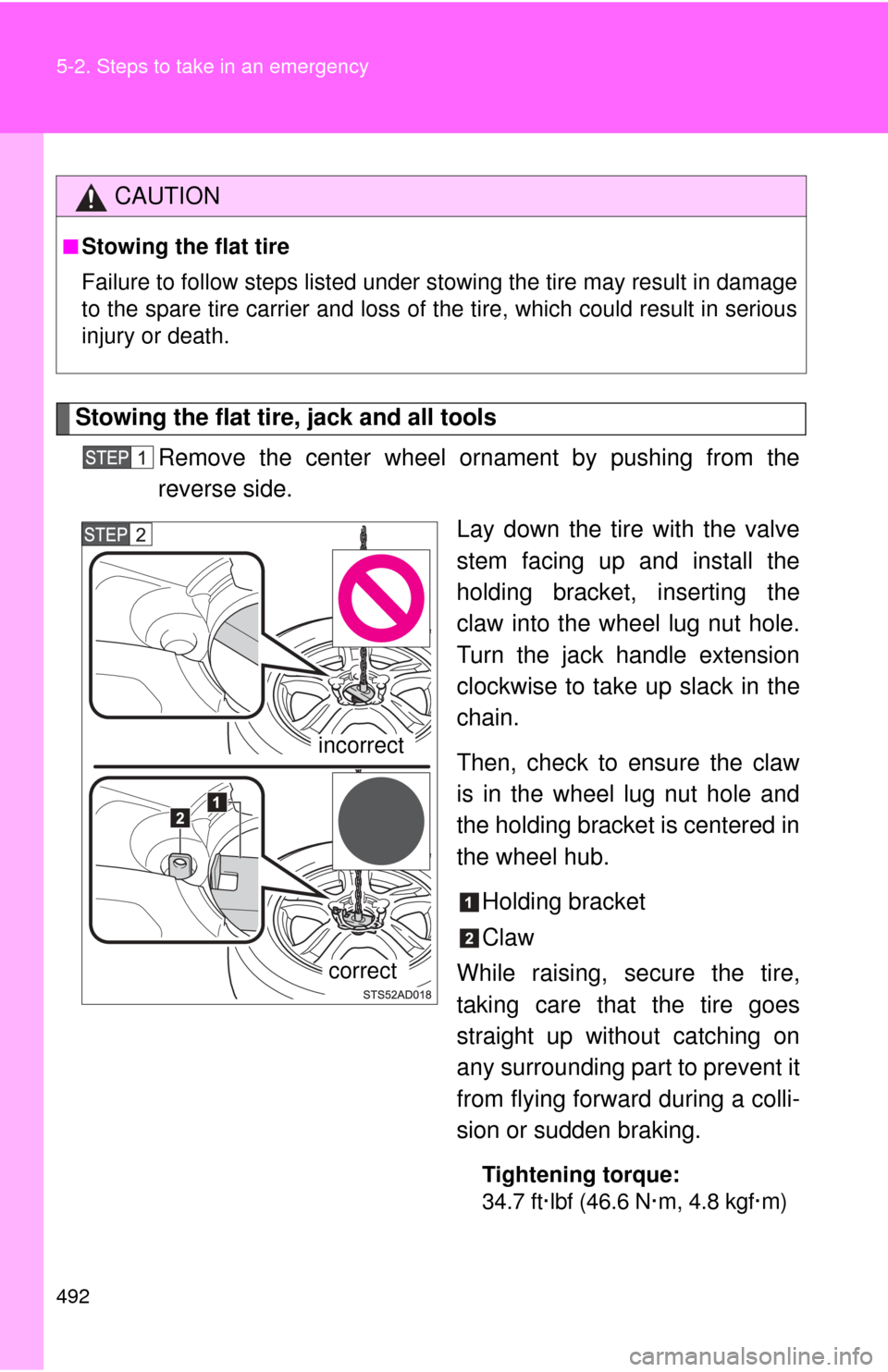
Stowing the flat tire, jack and all toolsRemove the center wheel ornament by pushing from the
reverse side. Lay down the tire with the valve
stem facing up and install the
holding bracket, inserting the
claw into the wheel lug nut hole.
Turn the jack handle extension
clockwise to take up slack in the
chain.
Then, check to ensure the claw
is in the wheel lug nut hole and
the holding bracket is centered in
the wheel hub.
Holding bracket
Claw
While raising, se cure the tire,
taking care that the tire goes
straight up without catching on
any surrounding part to prevent it
from flying forward during a colli-
sion or sudden braking.
Tightening torque:
34.7 ft·lbf (46.6 N·m, 4.8 kgf·m)
CAUTION
■Stowing the flat tire
Failure to follow steps listed under st owing the tire may result in damage
to the spare tire carrier and loss of the tire, which could result in serious
injury or death.
incorrect
correct
Page 497 of 576
5
When trouble arises
497
5-2. Steps to take in an emergency
If the engine will not start
If the engine still does not start after following the correct starting
procedure ( →P. 158) or releasing the steering lock ( →P. 159), confirm
the following points.
■ The engine will not start even when the starter motor oper-
ates normally.
One of the following may be the cause of the problem.
● There may not be sufficient fuel in the vehicle’s tank.
Refuel the vehicle. ( →P. 100)
Flex-fuel vehicles: The type of fuel may be different. When
refueling, add the same type of fuel, if available.
After adding a different type of fuel, the engine may run
roughly and driving performance may be reduced for a while
when the engine is first started. In this case, wait until the
engine runs normally.
● The engine may be flooded.
Try to restart the engine once more following correct starting
procedures.
● There may be a malfunction in the engine immobilizer system.
(→ P. 105)
■ The starter motor turns over slowly, the interior lights and
headlights are dim, or the hor n does not sound or sounds at
a low volume.
One of the following may be the cause of the problem.
● The battery may be discharged. ( →P. 501)
● The battery terminal connec tions may be loose or corroded.
Page 499 of 576
5
When trouble arises
499
5-2. Steps to take in an emergency
If the shift lever cannot be shifted from P
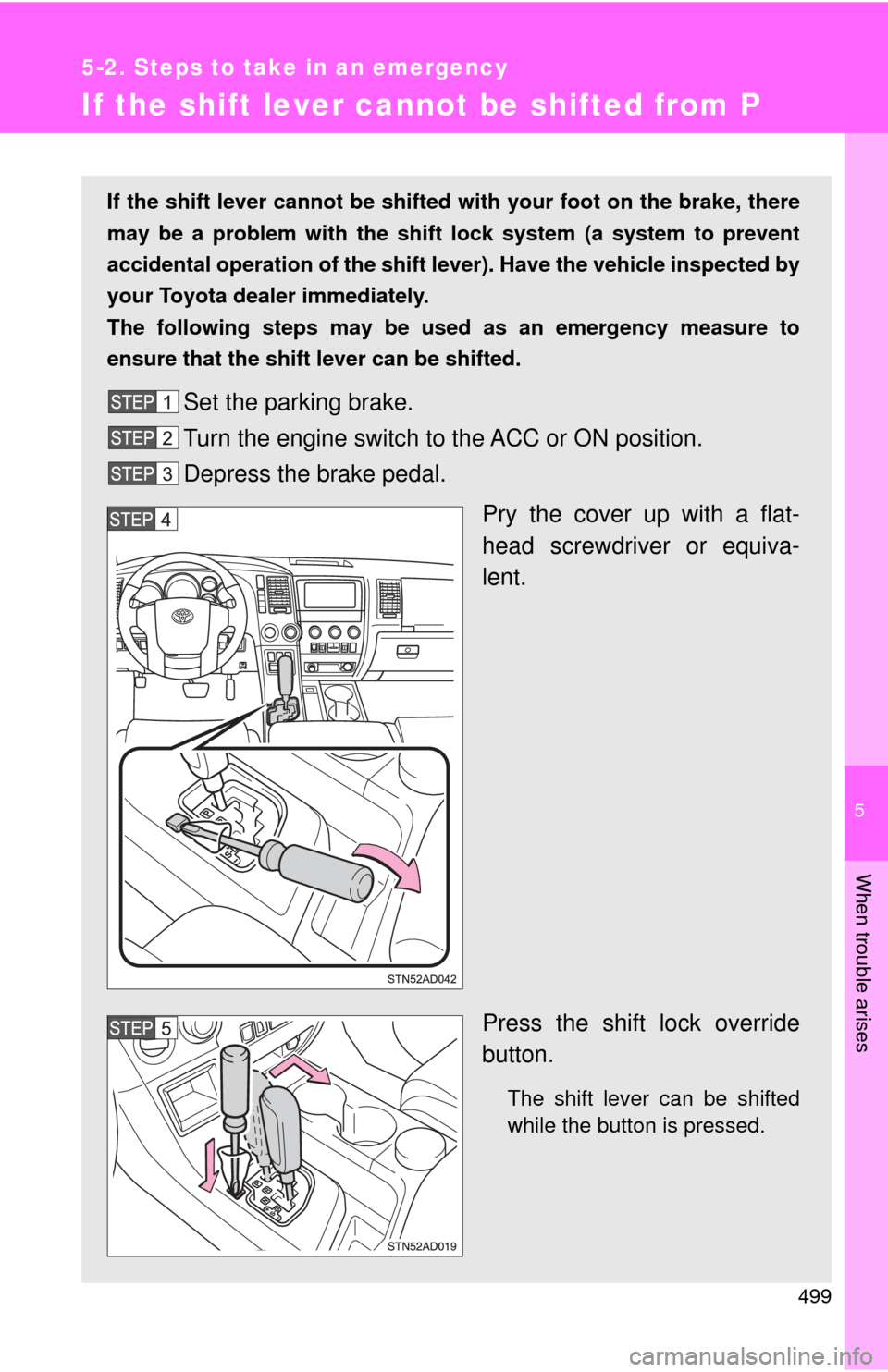
If the shift lever cannot be shifted with your foot on the brake, there
may be a problem with the shift lock system (a system to prevent
accidental operation of the shift l ever). Have the vehicle inspected by
your Toyota dealer immediately.
The following steps may be used as an emergency measure to
ensure that the shift lever can be shifted.
Set the parking brake.
Turn the engine switch to the ACC or ON position.
Depress the brake pedal.
Pry the cover up with a flat-
head screwdriver or equiva-
lent.
Press the shift lock override
button.
The shift lever can be shifted
while the button is pressed.
Page 501 of 576
5
When trouble arises
501
5-2. Steps to take in an emergency
If the vehicle battery is discharged
The following procedures may be used to start the engine if the
vehicle’s battery is discharged.
You can call your Toyota dealer or qualified repair shop.
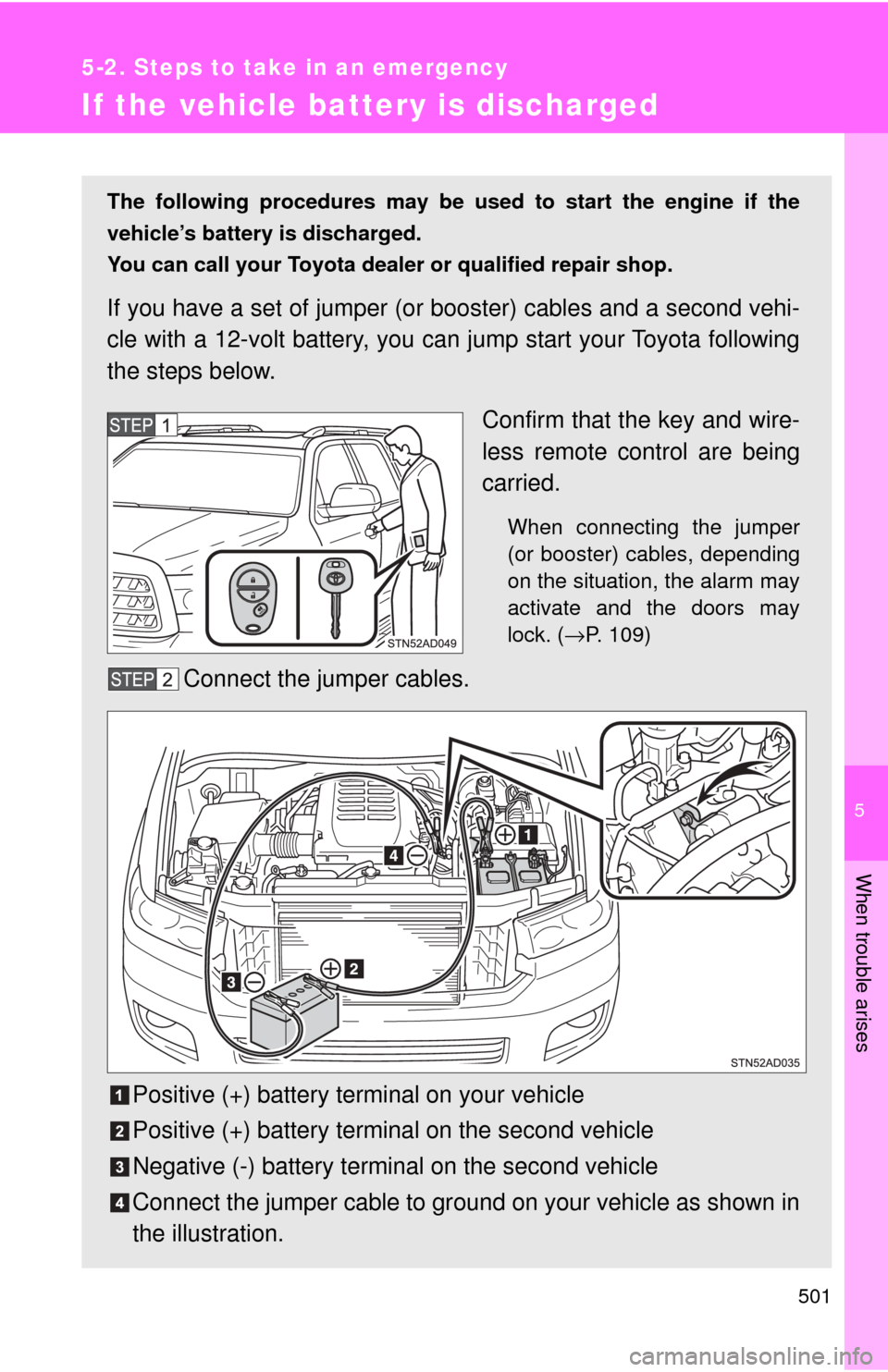
If you have a set of jumper (or booster) cables and a second vehi-
cle with a 12-volt battery, you can jump start your Toyota following
the steps below.
Confirm that the key and wire-
less remote control are being
carried.
When connecting the jumper
(or booster) cables, depending
on the situation, the alarm may
activate and the doors may
lock. (→P. 109)
Connect the jumper cables.
Positive (+) battery terminal on your vehicle
Positive (+) battery terminal on the second vehicle
Negative (-) battery terminal on the second vehicle
Connect the jumper cable to ground on your vehicle as shown in
the illustration.
Page 510 of 576

510 5-2. Steps to take in an emergency
CAUTION
■If the engine has to be turned off while driving
●Power assist for the brakes and steering wheel will be lost, making the
brake pedal harder to depress and the steering wheel heavier to turn.
Decelerate as much as possible before turning off the engine.
● Never attempt to remove the key, as doing so will lock the steering wheel.
Page 514 of 576
514 6-1. Specifications
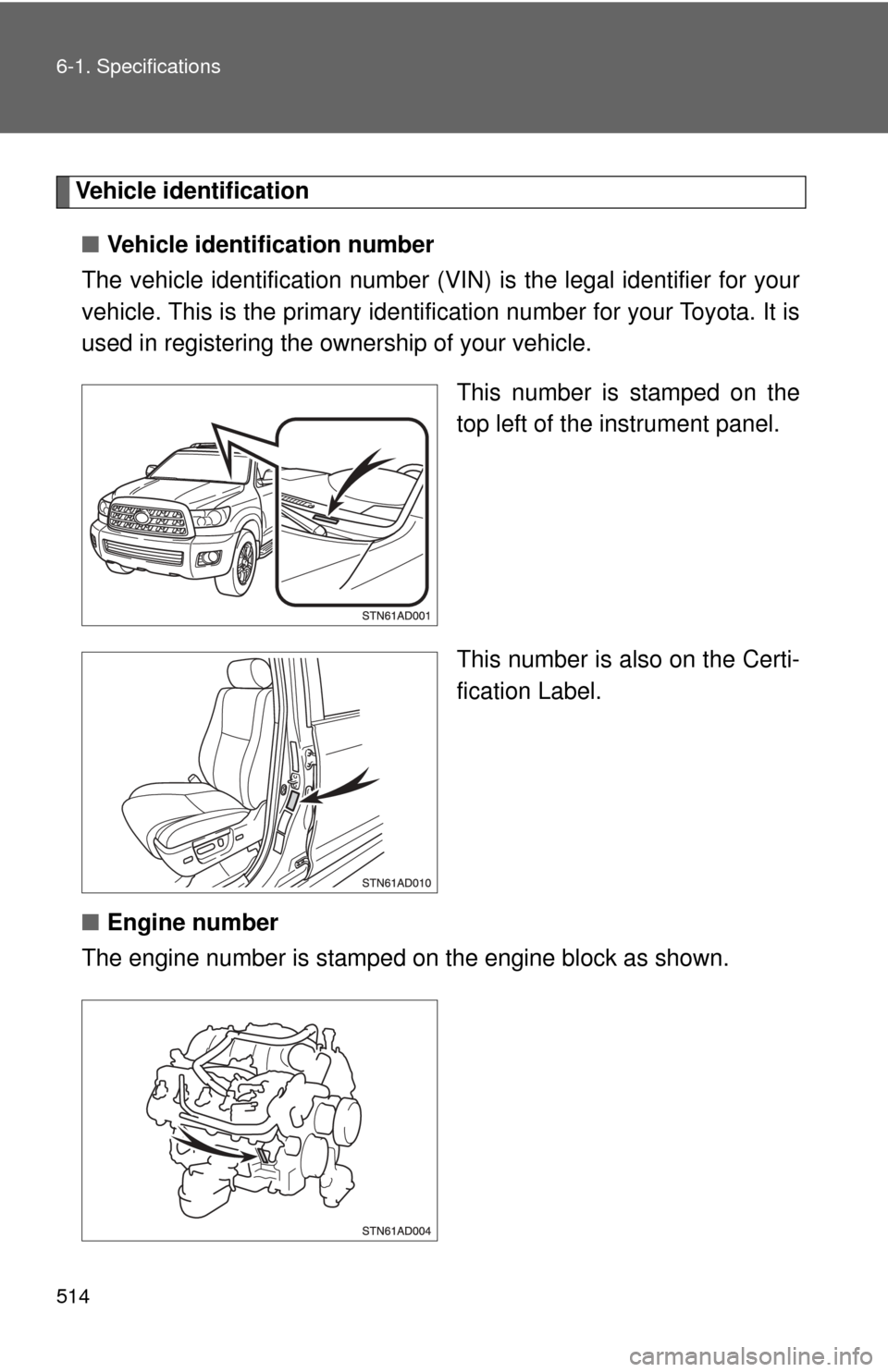
Vehicle identification■ Vehicle identification number
The vehicle identificati on number (VIN) is the legal identifier for your
vehicle. This is the primary identific ation number for your Toyota. It is
used in registering the ownership of your vehicle.
This number is stamped on the
top left of the instrument panel.
This number is also on the Certi-
fication Label.
■ Engine number
The engine number is stamped on the engine block as shown.