Tire size TOYOTA SEQUOIA 2017 2.G User Guide
[x] Cancel search | Manufacturer: TOYOTA, Model Year: 2017, Model line: SEQUOIA, Model: TOYOTA SEQUOIA 2017 2.GPages: 576, PDF Size: 12.76 MB
Page 428 of 576
428 4-3. Do-it-yourself maintenance
■When replacing wheels
The wheels of your Toyota are equipped with tire pressure warning
valves and transmitters (except for spare tire) that allow the tire pressure
warning system to provide advanced warning in the event of a loss in tire
inflation pressure. Whenever wheels are replaced, the tire pressure
warning valves and transmitte rs must be installed. (→P. 417)
CAUTION
■When replacing wheels
●Do not use wheels that are a different size from those recommended in
the Owner’s Manual, as this may re sult in loss of handling control.
●Never use an inner tube in a leaking wheel which is designed for a
tubeless tire. Doing so may result in an accident, causing death or seri-
ous injury.
■When installing the wheel nuts
●Never use oil or grease on the wheel bolts or wheel nuts.
Oil and grease may cause the wheel nuts to be excessively tightened,
leading to bolt or disc wheel damage. In addition, the oil or grease can
cause the wheel nuts to loosen and the wheel may fall off, causing an
accident and resulting in death or serious injury. Remove any oil or
grease from the wheel bolts or wheel nuts.
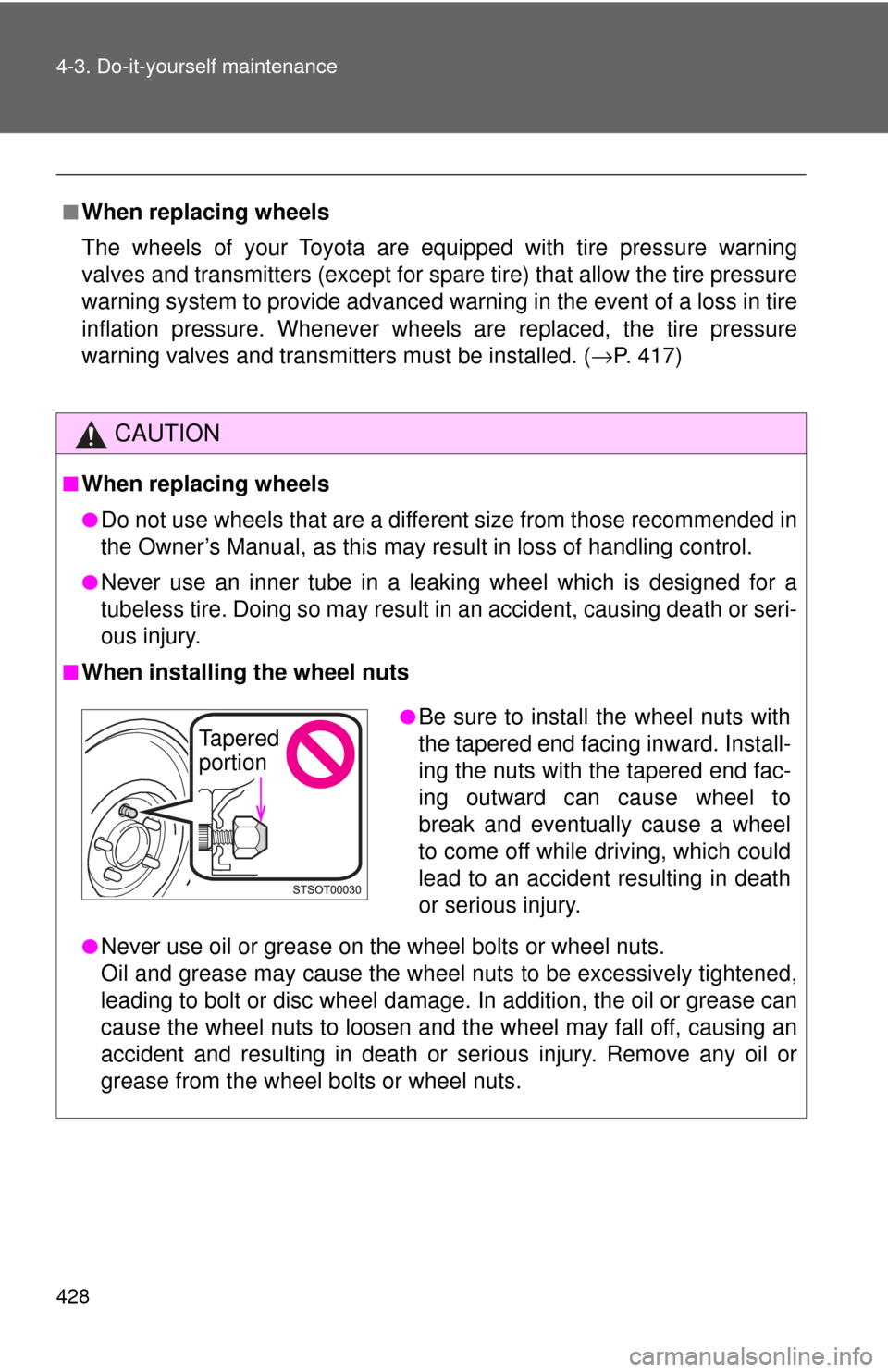
●Be sure to install the wheel nuts with
the tapered end facing inward. Install-
ing the nuts with the tapered end fac-
ing outward can cause wheel to
break and eventually cause a wheel
to come off while driving, which could
lead to an accident resulting in death
or serious injury.Tapered
portion
Page 478 of 576

478 5-2. Steps to take in an emergency
CAUTION
■Maintenance of the tire
Each tire, including the spare (if provided), should be checked monthly
when cold and inflated to the inflation pressure recommended by the
vehicle manufacturer on the vehicle placard or tire inflation pressure
label (tire and load information label). (If your vehicle has tires of a differ-
ent size than the size indicated on the vehicle placard or tire inflation
pressure label [tire and load information label], you should determine the
proper tire inflation pr essure for those tires.)
As an added safety feature, your vehicle has been equipped with a tire
pressure monitoring system (TPMS-ti re pressure warning system) that
illuminates a low tire pressure telltal e (tire pressure warning light) when
one or more of your tires is sign ificantly under-inflated. Accordingly,
when the low tire pressu re telltale (tire pressure warning light) illumi-
nates, you should stop and check your tires as soon as possible, and
inflate them to the proper pressure. Driving on a significantly under-
inflated tire causes the tire to overheat and can lead to tire failure.
Under-inflation also reduces fuel effi ciency and tire tread life, and may
affect the vehicle’s handling and stopping ability.
Please note that the TPMS (tire pressure warning system) is not a sub-
stitute for proper tire main tenance, and it is the driver’s responsibility to
maintain correct tire pressure, even if under-inflation has not reached the
level to trigger illumination of the TPMS low tire pressure telltale (tire
pressure warning light).
Your vehicle has also been equipped with a TPMS (tire pressure warning
system) malfunction indicator to indi cate when the system is not operat-
ing properly. The TPMS (tire pressure warning system) malfunction indi-
cator is combined with the low tire pressure telltale (tire pressure
warning light). When the system de tects a malfunction, the telltale will
flash for approximately one minute an d then remain continuously illumi-
nated. This sequence will continue upon subsequent vehicle start-ups as
long as the malfunction exists. When the malfunction indicator is illumi-
nated, the system may not be able to detect or signal low tire pressure
as intended.
Page 521 of 576
521
6-1. Specifications
6
Vehicle specifications
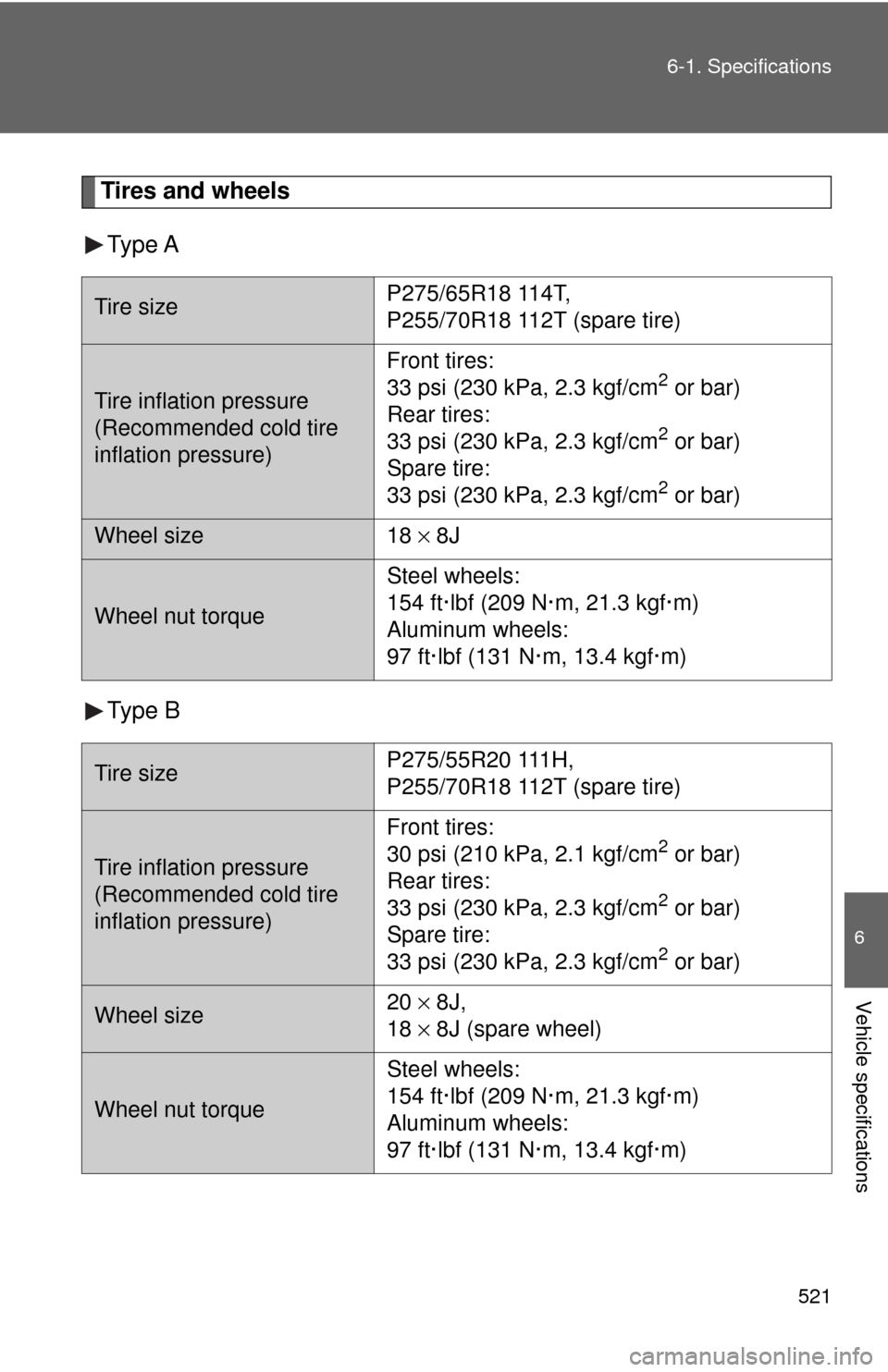
Tires and wheels
Type A
Type B
Tire size P275/65R18 114T,
P255/70R18 112T (spare tire)
Tire inflation pressure
(Recommended cold tire
inflation pressure)Front tires:
33 psi (230 kPa, 2.3 kgf/cm
2 or bar)
Rear tires:
33 psi (230 kPa, 2.3 kgf/cm
2 or bar)
Spare tire:
33 psi (230 kPa, 2.3 kgf/cm
2 or bar)
Wheel size 18 × 8J
Wheel nut torque Steel wheels:
154 ft·lbf (209 N·m, 21.3 kgf·m)
Aluminum wheels:
97 ft·lbf (131 N·m, 13.4 kgf·m)
Tire size
P275/55R20 111H,
P255/70R18 112T (spare tire)
Tire inflation pressure
(Recommended cold tire
inflation pressure)Front tires:
30 psi (210 kPa, 2.1 kgf/cm
2 or bar)
Rear tires:
33 psi (230 kPa, 2.3 kgf/cm
2 or bar)
Spare tire:
33 psi (230 kPa, 2.3 kgf/cm
2 or bar)
Wheel size 20
× 8J,
18 × 8J (spare wheel)
Wheel nut torque Steel wheels:
154 ft·lbf (209 N·m, 21.3 kgf·m)
Aluminum wheels:
97 ft·lbf (131 N·m, 13.4 kgf·m)
Page 528 of 576
528
6-1. Specifications
Tire information
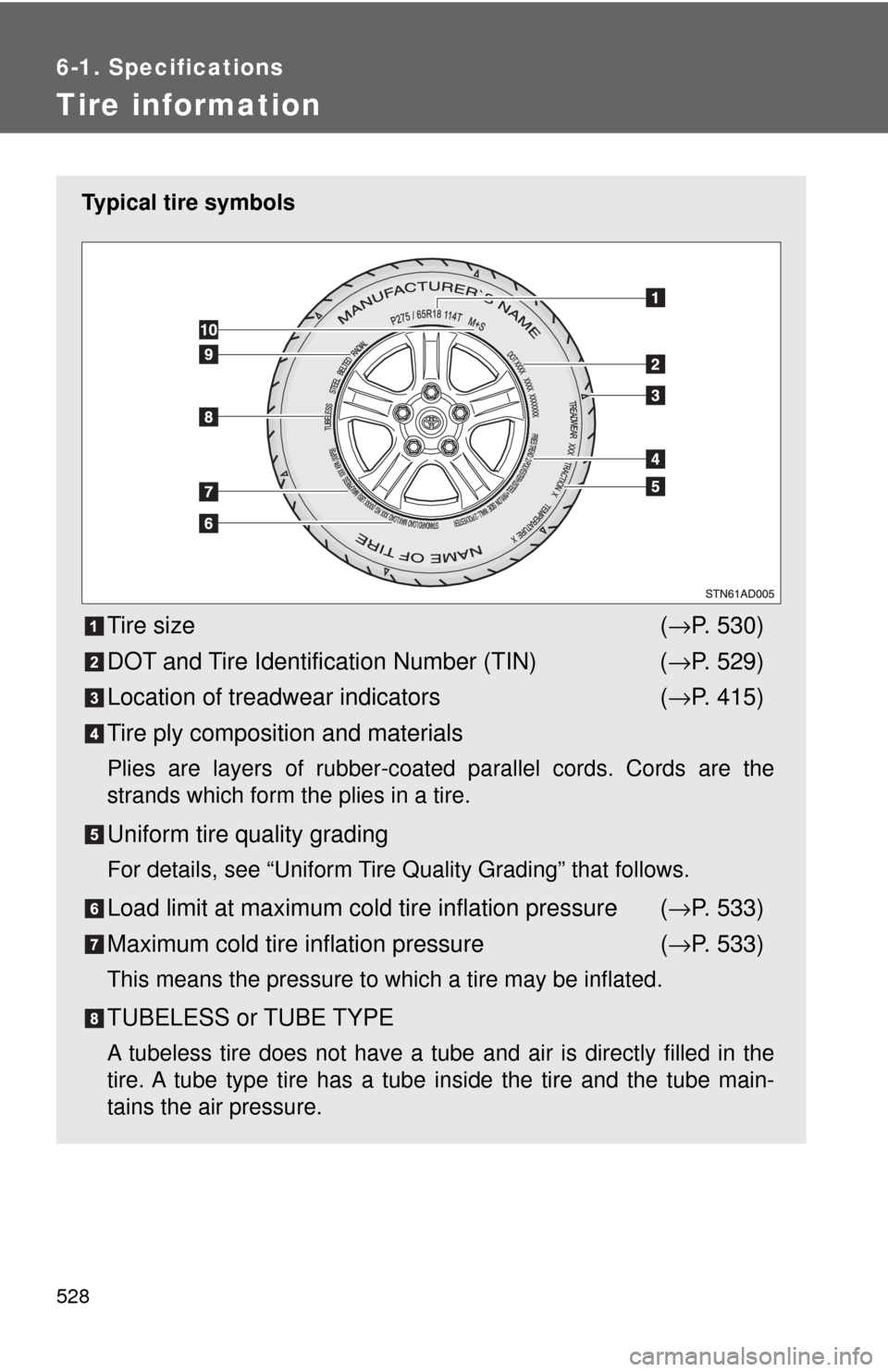
Typical tire symbols
Tire size(→ P. 530)
DOT and Tire Identification Number (TIN) (→ P. 529)
Location of treadwear indicators (→ P. 415)
Tire ply composition and materials
Plies are layers of rubber-coated parallel cords. Cords are the
strands which form the plies in a tire.
Uniform tire quality grading
For details, see “Uniform Tire Quality Grading” that follows.
Load limit at maximum cold tire inflation pressure ( →P. 533)
Maximum cold tire inflation pressure ( →P. 533)
This means the pressure to which a tire may be inflated.
TUBELESS or TUBE TYPE
A tubeless tire does not have a tube and air is directly filled in the
tire. A tube type tire has a tube inside the tire and the tube main-
tains the air pressure.
Page 529 of 576
529
6-1. Specifications
6
Vehicle specifications
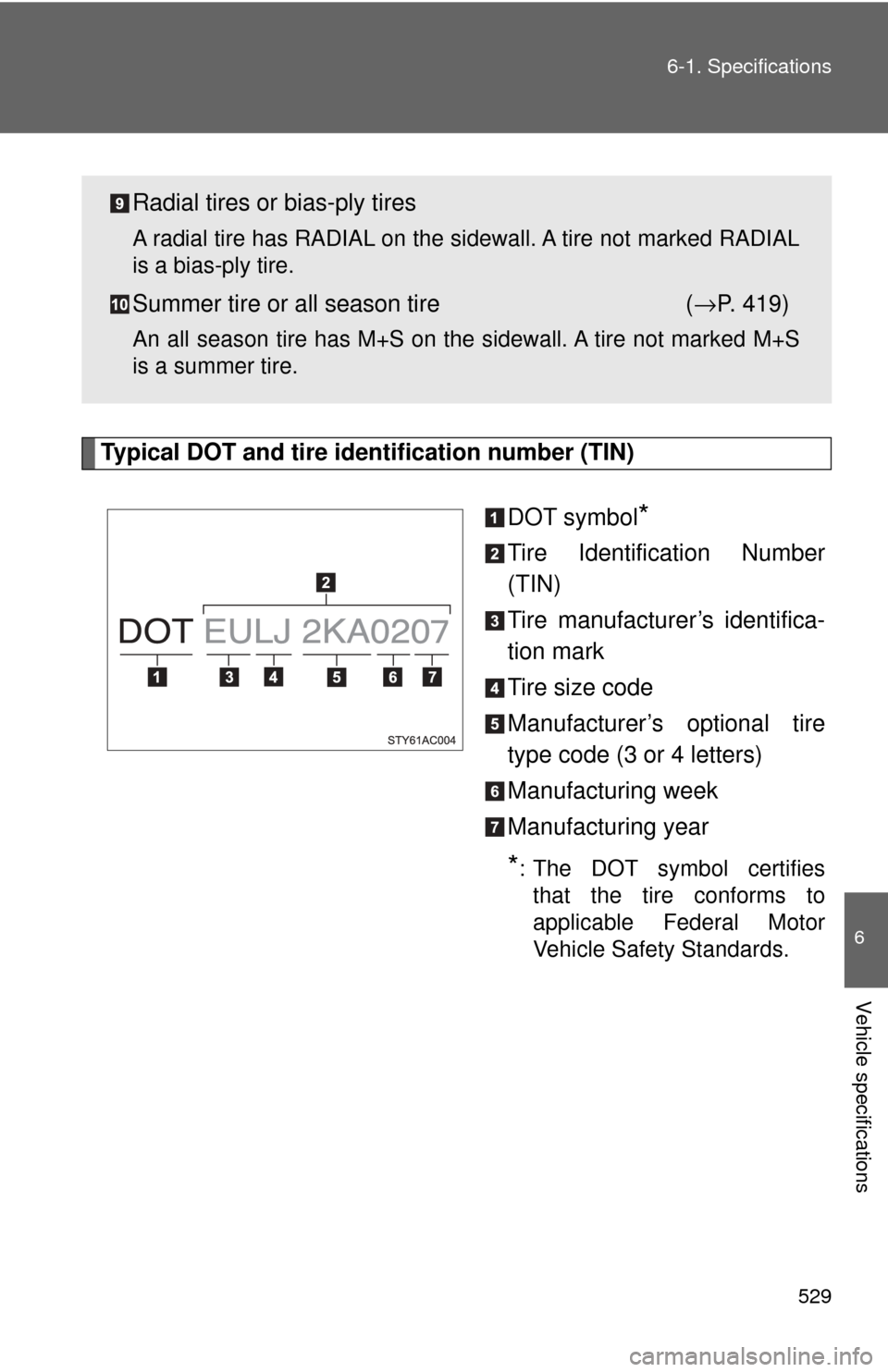
Typical DOT and tire identification number (TIN)
DOT symbol
*
Tire Identification Number
(TIN)
Tire manufacturer’s identifica-
tion mark
Tire size code
Manufacturer’s optional tire
type code (3 or 4 letters)
Manufacturing week
Manufacturing year
*: The DOT symbol certifiesthat the tire conforms to
applicable Federal Motor
Vehicle Safety Standards.
Radial tires or bias-ply tires
A radial tire has RADIAL on the sidewall. A tire not marked RADIAL
is a bias-ply tire.
Summer tire or all season tire (→ P. 419)
An all season tire has M+S on the sidewall. A tire not marked M+S
is a summer tire.
Page 530 of 576
530 6-1. Specifications
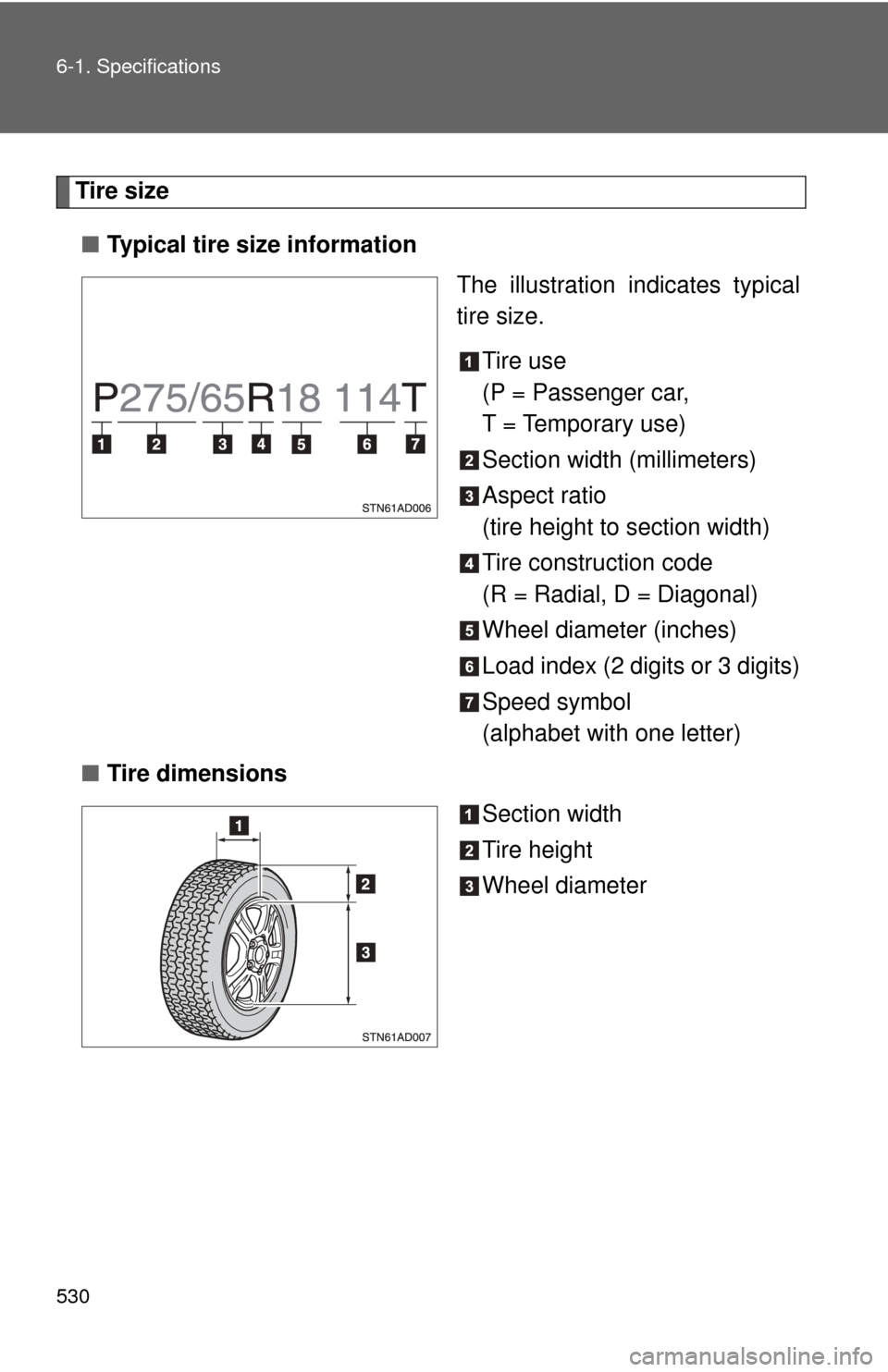
Tire size■ Typical tire size information
The illustration indicates typical
tire size.
Tire use
(P = Passenger car,
T = Temporary use)
Section width (millimeters)
Aspect ratio
(tire height to section width)
Tire construction code
(R = Radial, D = Diagonal)
Wheel diameter (inches)
Load index (2 digits or 3 digits)
Speed symbol
(alphabet with one letter)
■ Tire dimensions
Section width
Tire height
Wheel diameter
Page 534 of 576
534 6-1. Specifications
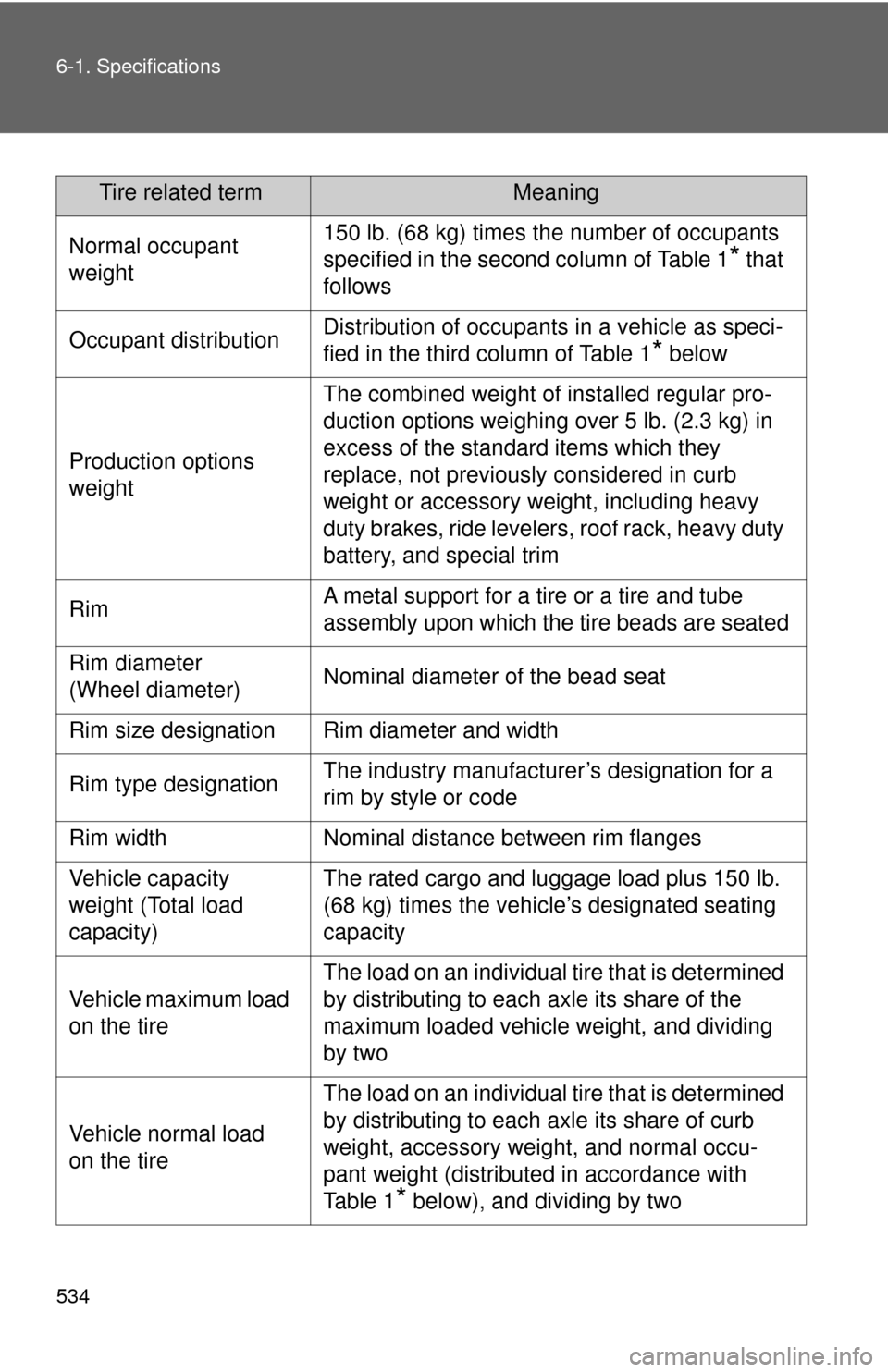
Tire related termMeaning
Normal occupant
weight150 lb. (68 kg) times the number of occupants
specified in the second column of Table 1
* that
follows
Occupant distributionDistribution of occupants in a vehicle as speci-
fied in the third column of Table 1
* below
Production options
weight
The combined weight of installed regular pro-
duction options weighing over 5 lb. (2.3 kg) in
excess of the standard items which they
replace, not previously considered in curb
weight or accessory weight, including heavy
duty brakes, ride levelers, roof rack, heavy duty
battery, and special trim
RimA metal support for a tire or a tire and tube
assembly upon which the tire beads are seated
Rim diameter
(Wheel diameter)Nominal diameter of the bead seat
Rim size designationRim diameter and width
Rim type designationThe industry manufacturer’s designation for a
rim by style or code
Rim widthNominal distance between rim flanges
Vehicle capacity
weight (Total load
capacity)The rated cargo and luggage load plus 150 lb.
(68 kg) times the vehicle’s designated seating
capacity
Vehicle maximum load
on the tire
The load on an individual tire that is determined
by distributing to each axle its share of the
maximum loaded vehicle weight, and dividing
by two
Vehicle normal load
on the tire
The load on an individual tire that is determined
by distributing to each axle its share of curb
weight, accessory weight, and normal occu-
pant weight (distributed in accordance with
Ta b l e 1
* below), and dividing by two
Page 543 of 576
543
6-2. Customization
6
Vehicle specifications
Items to initialize
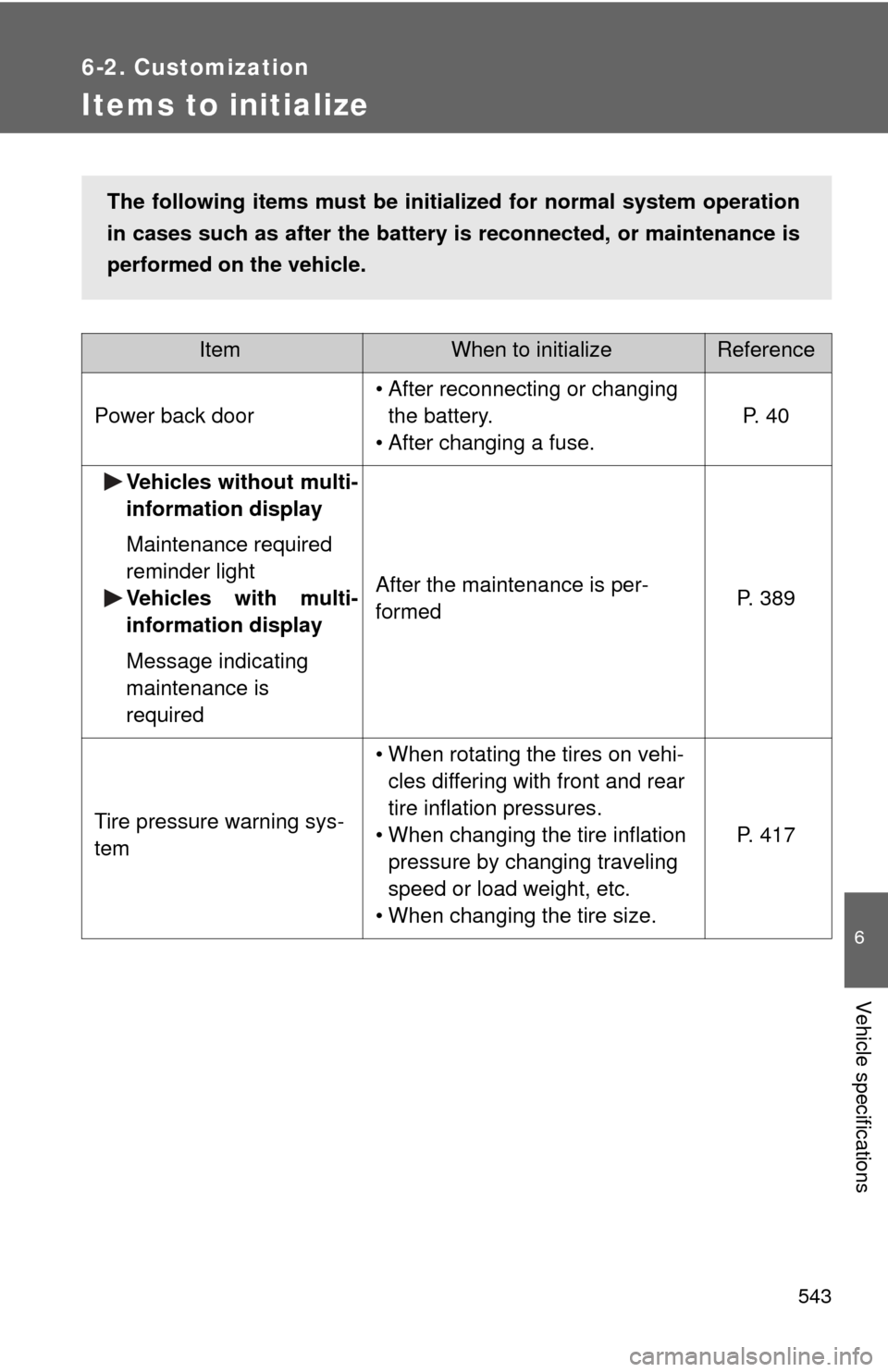
ItemWhen to initializeReference
Power back door
• After reconnecting or changing the battery.
• After changing a fuse.
P. 4 0
Vehicles without multi-
information display
Maintenance required
reminder light
Vehicles with multi-
information display
Message indicating
maintenance is
required
After the maintenance is per-
formedP. 389
Tire pressure warning sys-
tem
• When rotating the tires on vehi- cles differing with front and rear
tire inflation pressures.
• When changing the tire inflation pressure by changing traveling
speed or load weight, etc.
• When changing the tire size.
P. 417
The following items must be initia lized for normal system operation
in cases such as after the battery is reconnected, or maintenance is
performed on the vehicle.
Page 571 of 576
571
Alphabetical index
Tachometer .............................. 168
Tail lights
Replacing light bulbs ............ 447
Switch ................................... 187
Wattage ................................ 522
Talk switch
*
Telephone switch*
Theft deterrent system Alarm .................................... 107
Engine immobilizer system... 105
Tire inflation pressure ............ 423
Tire information
Glossary ............................... 533
Size ...................................... 530
Tire identification number ..... 529
Uniform tire quality grading ............................... 531
Tires Chains .................................. 267
Checking .............................. 415
If you have a flat tire ............. 486
Inflation pressure .......... 423, 521
Information ........................... 528
Replacing ............................. 486
Rotating tires ........................ 416
Size ...................................... 521
Snow tires............................. 266
Tire pressure warning system........................ 416, 472 Tissue pocket ...........................327
Tools .........................................486
Total load capacity...................264
Towing
Dinghy towing........................290
Emergency towing.................461
Trailer towing.........................270
Trailer weight rating.......272, 513
Traction control........................246
TRAC .........................................246
Trip information .......................178
Trip meter .................................168
Turn signal lights Replacing light bulbs .............447
Switch....................................165
Wattage .................................522
Valet key .....................................30
Vanity lights Vanity lights ...........................341
Wattage .................................522
Vanity mirrors...........................341
Vehicle data recordings ............24
Vehicle identification number ...................................514
Vehicle stability control...........246
VSC............................................246
T
*: Refer to “NAVIGATION SYSTEM OWNER’S MANUAL”.
V