mirror TOYOTA SEQUOIA 2017 2.G Workshop Manual
[x] Cancel search | Manufacturer: TOYOTA, Model Year: 2017, Model line: SEQUOIA, Model: TOYOTA SEQUOIA 2017 2.GPages: 576, PDF Size: 12.76 MB
Page 88 of 576
88
1-3. Adjustable components (seats, mirrors, steering wheel)
Roof luggage carrier
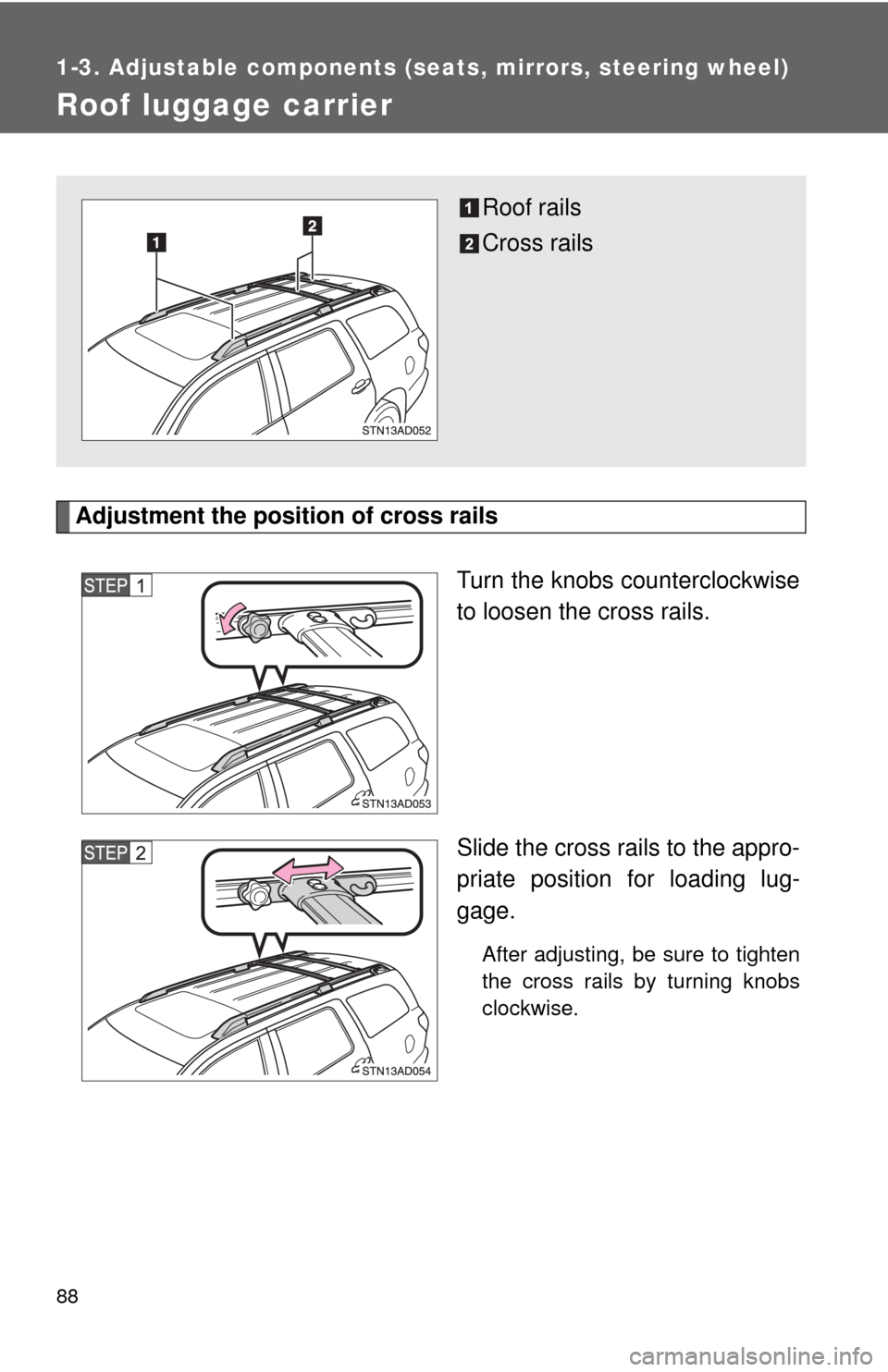
Adjustment the position of cross railsTurn the knobs counterclockwise
to loosen the cross rails.
Slide the cross rails to the appro-
priate position for loading lug-
gage.
After adjusting, be sure to tighten
the cross rails by turning knobs
clockwise.
Roof rails
Cross rails
Page 89 of 576

89
1-3. Adjustable components (s
eats, mirrors, steering wheel)
1
Before driving
CAUTION
■Cross rail adjustment
Make sure the cross rails are locked securely by applying pressure forward
and rearward.
Failure to do so may cause an accident, death or serious injury in the event
of emergency braking or a collision.
■ When loading cargo
Observe the following precautions:
●Place the cargo so that its weight is distributed evenly between the front
and rear axles.
● If loading long or wide cargo, never exceed the vehicle overall length or
width. ( →P. 512)
● Before driving, make sure the cargo is securely fastened to the roof lug-
gage carrier.
● Loading cargo on the roof luggage carrier will raise the vehicle’s center of
gravity. Avoid high speeds, sudden starts, sharp turns, sudden braking or
abrupt maneuvers, otherwise unexpected loss of control or vehicle rollover
may occur.
● If driving for a long distance, on rough roads, or at high speeds, stop the
vehicle occasionally during the trip to make sure the cargo remains
securely fastened.
● Do not exceed 150 lb. (68 kg) cargo weight on the roof luggage carrier.
NOTICE
■When loading the luggage
Be careful not to scratch the surface of the moon roof.
Page 152 of 576
152 2-1. Driving procedures
CAUTION
■When driving the vehicle
●Do not adjust the position of the steering wheel, the seat, or the inside or
outside rear view mirrors while driving.
Doing so may result in a loss of vehicle control that can cause accidents
that may result in death or serious injury.
● Always check that all passengers’ arms, heads or other parts of their bod-
ies are not outside the vehicle, as this may result in death or serious injury.
● Do not drive in excess of the speed limit. Even if the legal speed limit per-
mits it, do not drive over 85 mph (140 km/h) unless your vehicle has high-
speed capability tires. Driving over 85 mph (140 km/h) may result in tire
failure, loss of control and possible injury. Be sure to consult a tire dealer
to determine whether the tires on your vehicle are high-speed capability
tires or not before driving at such speeds.
● If you drive through deep water over about 20 in. (500 mm) in depth, put
the vehicle height in the HI mode using the height control switch and then
change to manual mode by pushing the height control mode select switch.
Drive your vehicle at 18 mph (30 km/h) or less. Do not drive through water
deeper than about 28 in. (700 mm) even if the vehicle height is in “HI”
mode.
■ When driving on slippery road surfaces
●Sudden braking, acceleration and steering may cause tire slippage and
reduce your ability to control the vehicle, resulting in an accident.
● Sudden changes in engine speed, such as engine braking caused by up-
shifting or down-shifting, may cause the vehicle to skid, resulting in an
accident.
● After driving through a puddle, lightly depress the brake pedal to make
sure that the brakes are functioning properly. Wet brake pads may prevent
the brakes from functioning properly. If the brakes on only one side are wet
and not functioning properly, steering control may be affected, resulting in
an accident.
■ When shifting the shift lever
●Be careful not to shift the shift lever with the accelerator pedal depressed.
This may lead to unexpected rapid acceleration of the vehicle that may
cause an accident and result in death or serious injury.
Page 174 of 576
![TOYOTA SEQUOIA 2017 2.G Workshop Manual 174 2-2. Instrument cluster
Center panel
Outside rear view mirrors [vehicles with BSM (Blind Spot Moni-
tor)]](/img/14/6786/w960_6786-173.png "TOYOTA SEQUOIA 2017 2.G Workshop Manual 174 2-2. Instrument cluster
Center panel
Outside rear view mirrors [vehicles with BSM (Blind Spot Moni-
tor)]")
174 2-2. Instrument cluster
Center panel
Outside rear view mirrors [vehicles with BSM (Blind Spot Moni-
tor)]
Page 175 of 576
175
2-2. Instrument cluster
2
When driving
■
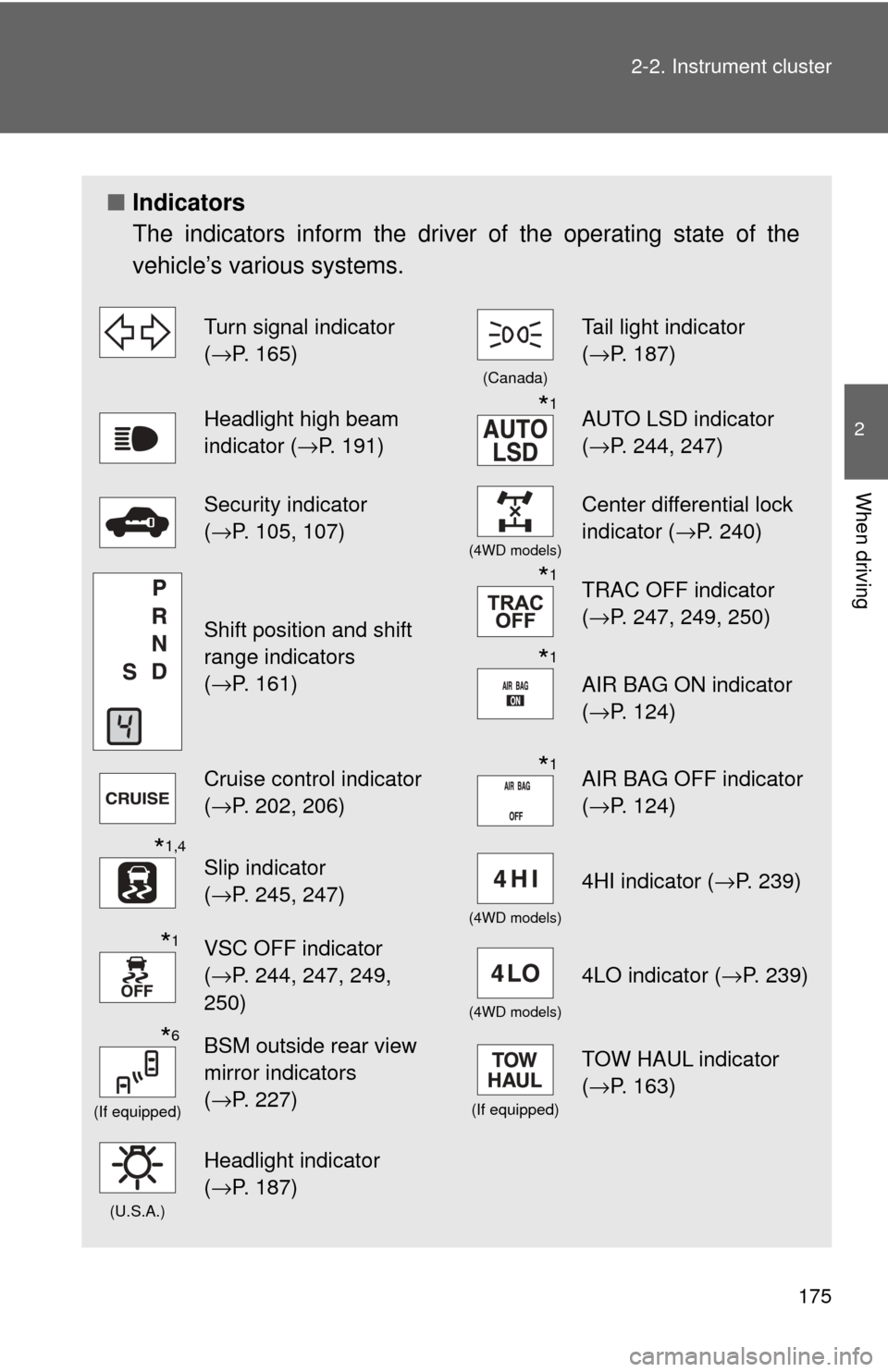
Indicators
The indicators inform the driver of the operating state of the
vehicle’s various systems.
Turn signal indicator
( →P. 165)
(Canada)
Tail light indicator
( →P. 187)
Headlight high beam
indicator ( →P. 191)*1AUTO LSD indicator
(→P. 244, 247)
Security indicator
(→P. 105, 107)
(4WD models)
Center differential lock
indicator ( →P. 240)
Shift position and shift
range indicators
(→P. 161)
*1TRAC OFF indicator
( →P. 247, 249, 250)
*1
AIR BAG ON indicator
(→P. 124)
Cruise control indicator
(→P. 202, 206)*1AIR BAG OFF indicator
( →P. 124)
*1,4
Slip indicator
(→P. 245, 247)
(4WD models)
4HI indicator ( →P. 239)
*1VSC OFF indicator
(→P. 244, 247, 249,
250)
(4WD models)
4LO indicator ( →P. 239)
*6
(If equipped)
BSM outside rear view
mirror indicators
(→P. 227)
(If equipped)
TOW HAUL indicator
( →P. 163)
(U.S.A.)
Headlight indicator
(→P. 187)
Page 177 of 576
177
2-2. Instrument cluster
2
When driving
CAUTION
■
If a safety system warning light does not come on
Should a safety system light such as ABS and the SRS airbag warning light
not come on when you start the engine, this could mean that these systems
are not available to help protect you in an accident, which could result in
death or serious injury. Have the vehicle inspected by your Toyota dealer
immediately if this occurs.
*6: In order to confirm operation, the BSM outside rear view mirror indi-
cators illuminate in the following situations:
• When the engine switch is turned to the ON position while the BSM main switch is set to ON.
• When the BSM main switch is set to ON while the engine switch is in the ON position.
If the system is functioning correctly, the BSM outside rear view mirror
indicators will turn off after a few seconds.
If the BSM outside rear view mirror indicators do not illuminate or do
not turn off, there may be a malfunction with the system.
If this occurs, have the vehicle inspected by your Toyota dealer.
Page 227 of 576
227
2-4. Using other driving systems
2
When driving
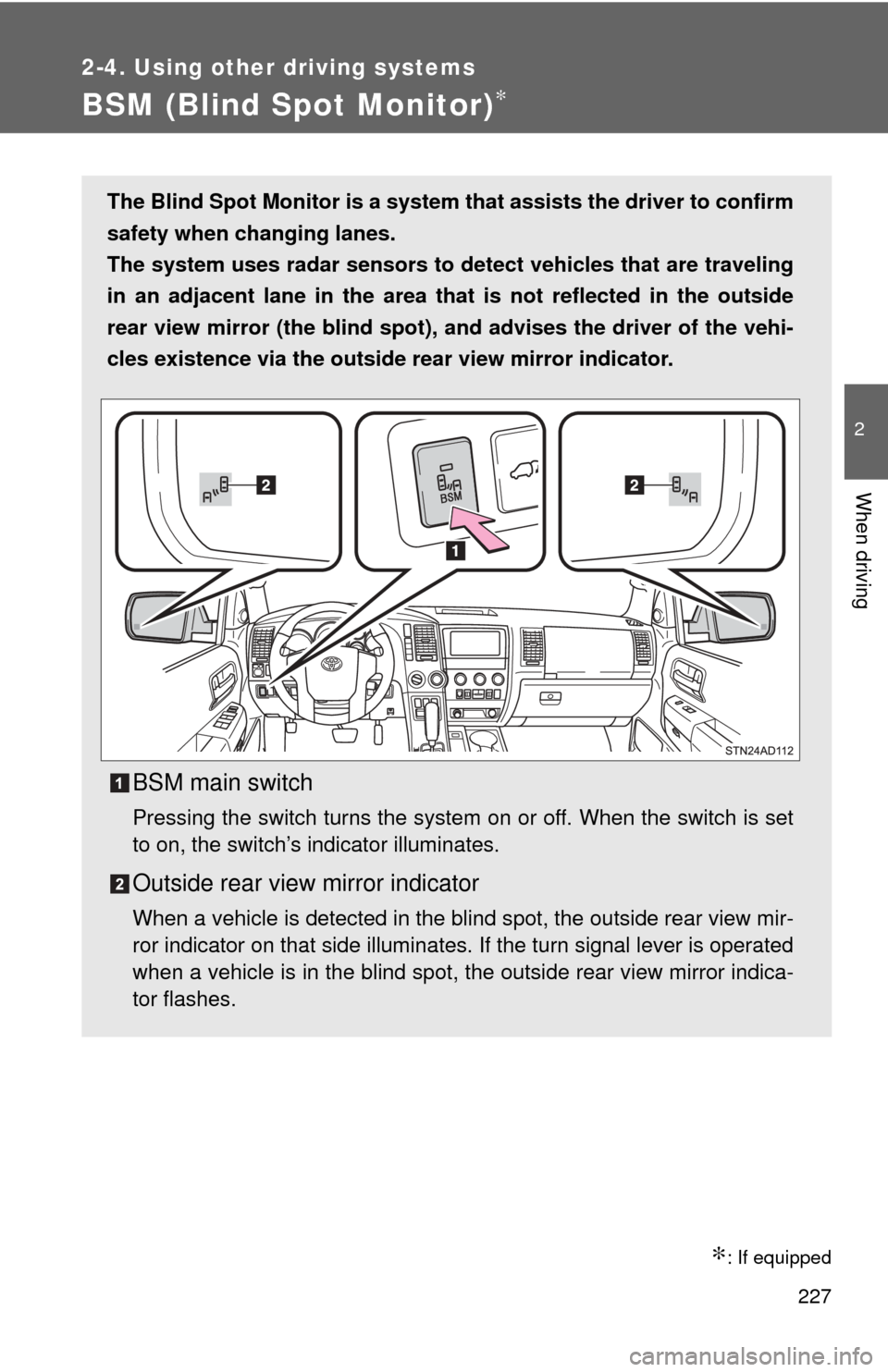
BSM (Blind Spot Monitor)∗
∗: If equipped
The Blind Spot Monitor is a system that assists the driver to confirm
safety when changing lanes.
The system uses radar sensors to detect vehicles that are traveling
in an adjacent lane in the area that is not reflected in the outside
rear view mirror (the blind spot), and advises the driver of the vehi-
cles existence via the outside rear view mirror indicator.
BSM main switch
Pressing the switch turns the system on or off. When the switch is set
to on, the switch’s indicator illuminates.
Outside rear view mirror indicator
When a vehicle is detected in the blind spot, the outside rear view mir-
ror indicator on that side illuminates. If the turn signal lever is operated
when a vehicle is in the blind spot, the outside rear view mirror indica-
tor flashes.
Page 230 of 576

230 2-4. Using other driving systems
●Instances of the Blind Spot Monitor unnecessarily detecting a vehicle
and/or object may increase under the following conditions:
• When there is only a short distance between your vehicle and a guard-
rail, wall etc.
• When there is only a short distance between your vehicle and a follow- ing vehicle
• When vehicle lanes are narrow and a vehicle driving 2 lanes across from your vehicle enters the detection area
■ The outside rear view mi rror indicators visibility
When under strong sunlight, the outside rear view mirror indicator may b\
e
difficult to see.
■ When there is a malfunction in the system
If a system malfunction is detected due to any of the following reasons,
warning messages will be displayed: ( →P. 480)
● There is a malfunction with the sensors
● The sensors have become dirty
● The outside temperature is extremely high or low
● The sensor voltage has become abnormal
■ Certification for the BSM
For vehicles sold in the U.S.A.
FCC ID: OAYBSDTX
This device complies with part 15 of the FCC Rules. Operation is subject to
the following three conditions:
(1) This device may not cause harmful interference.
(2) This device must accept any interference received, including interference that may cause undesired operation.
(3) This device may only work when the vehicle is in operation pursuant to § 15.252 (a) (4).
FCC WARNING
Changes or modifications not expressly approved by the party responsible
for compliance could void the user’s authority to operate the equipment.
Page 266 of 576
266
2-5. Driving information
Winter driving tips
Carry out the necessary preparations and inspections before driving
the vehicle in winter. Always drive the vehicle in a manner appropri-
ate to the prevailing weather conditions.
■ Pre-winter preparations
●Use fluids that are appropriate to the prevailing outside tem-
peratures.
• Engine oil
• Engine coolant
• Washer fluid
● Have a service technician inspect the level and specific grav-
ity of battery electrolyte.
● Have the vehicle fitted with four snow tires or purchase a set
of tire chains for the rear tires.
Ensure that all tires are the same size and brand, and that chains
match the size of the tires.
■Before driving the vehicle
Perform the following according to the driving conditions.
●Do not try to forcibly open a window, scrape an outside rear
view mirror surface or move a wi per or outside rear view mir-
ror that is frozen. Pour warm water over the frozen area to
melt the ice. Wipe away the water immediately to prevent it
from freezing.
● To ensure proper operation of th e climate control system fan,
remove any snow that has accumulated on the air inlet vents
in front of the windshield.
● Remove any ice that has accumu lated on the vehicle chassis.
● Periodically check for and remove any excess ice or snow
that may have accumulated in the wheel well or on the
brakes.
Page 285 of 576
285
2-5. Driving information
2
When driving
■
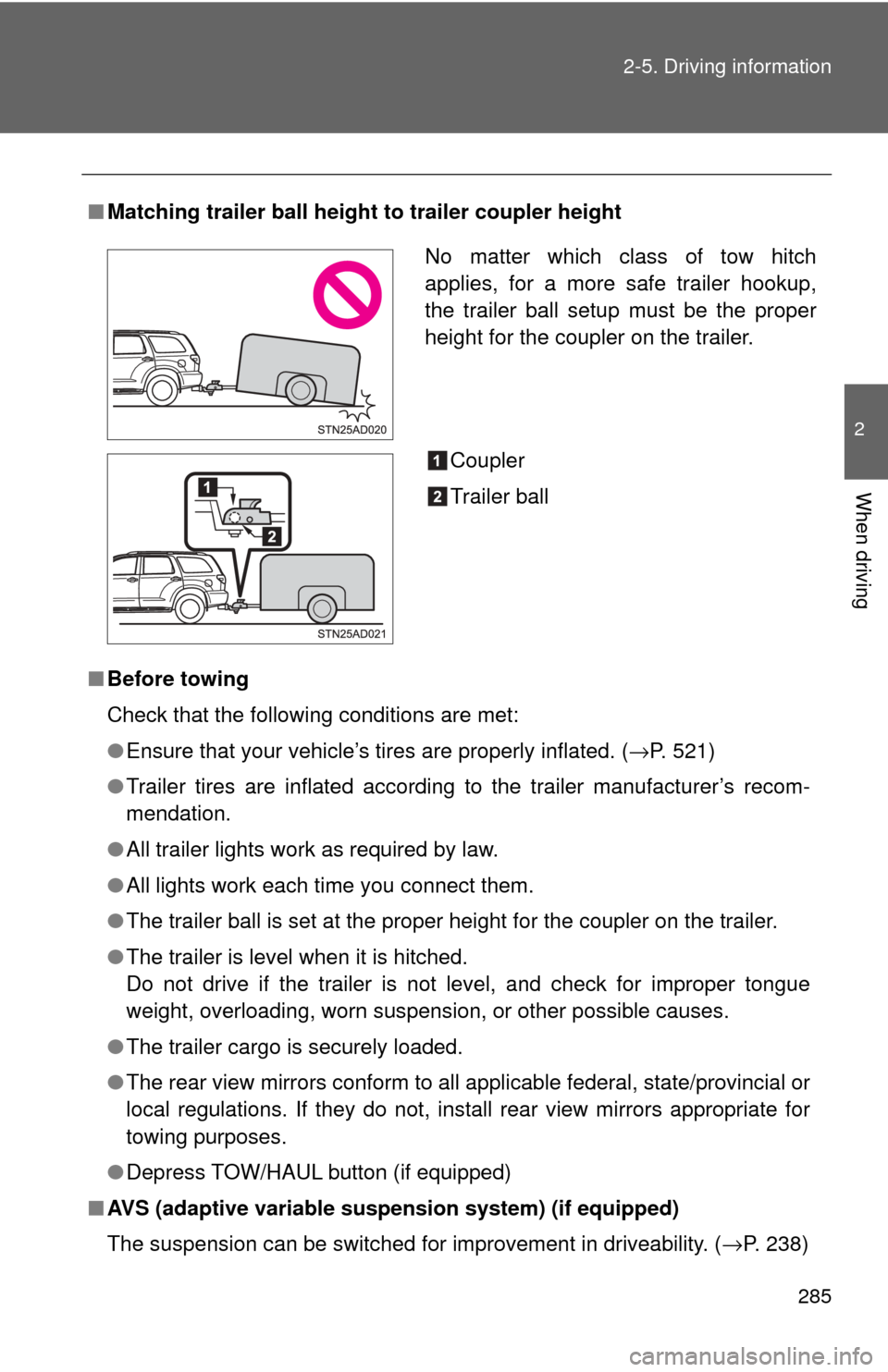
Matching trailer ball height to trailer coupler height
■ Before towing
Check that the following conditions are met:
●Ensure that your vehicle’s tires are properly inflated. ( →P. 521)
● Trailer tires are inflated according to the trailer manufacturer’s recom-
mendation.
● All trailer lights work as required by law.
● All lights work each time you connect them.
● The trailer ball is set at the proper height for the coupler on the trai\
ler.
● The trailer is level when it is hitched.
Do not drive if the trailer is not level, and check for improper tongue
weight, overloading, worn suspension, or other possible causes.
● The trailer cargo is securely loaded.
● The rear view mirrors conform to a ll applicable federal, state/provincial or
local regulations. If they do not, install rear view mirrors appropriate for
towing purposes.
● Depress TOW/HAUL button (if equipped)
■ AVS (adaptive variable suspension system) (if equipped)
The suspension can be switched for improvement in driveability. ( →P. 238)
No matter which class of tow hitch
applies, for a more safe trailer hookup,
the trailer ball setup must be the proper
height for the coupler on the trailer.
Coupler
Trailer ball