engine oil TOYOTA SEQUOIA 2022 User Guide
[x] Cancel search | Manufacturer: TOYOTA, Model Year: 2022, Model line: SEQUOIA, Model: TOYOTA SEQUOIA 2022Pages: 592, PDF Size: 10.82 MB
Page 415 of 592

4156-3. Do-it-yourself maintenance
6
Maintenance and care
SEQUOIA_OM_USA_OM0C047U
WARNING
The engine compartment contains many mechanisms and fluids that may
move suddenly, become hot, or become electrically energized. To avoid death
or serious injury, observe the following precautions.
■ When working on the engine compartment
● Keep hands, clothing and tools away from the moving fan and engine
drive belt.
● Be careful not to touch the engine, radiator, exhaust manifold, etc. right
after driving as they may be hot. Oil and other fluids may also be hot.
● Do not leave anything that may burn easily, such as paper and r ags, in the
engine compartment.
● Do not smoke, cause sparks or expose an open flame to fuel or t he bat-
tery. Fuel and battery fumes are flammable.
● Be extremely cautious when working on the battery. It contains poisonous
and corrosive sulfuric acid.
■ When working near the electric cooling fan or radiator grille
Be sure the engine switch is off. With the engine switch on, th e electric cool-
ing fans may automatically start to run if the air conditioning is on and/or the
coolant temperature is high. ( P. 422)
■ Safety glasses
Wear safety glasses to prevent flying or falling material, fluid spray, etc.
from getting in your eyes.
NOTICE
■If you remove the air cleaner filter
Driving with the air cleaner filter removed may cause excessive engine wear
due to dirt in the air.
Page 417 of 592
4176-3. Do-it-yourself maintenance
6
Maintenance and care
SEQUOIA_OM_USA_OM0C047U
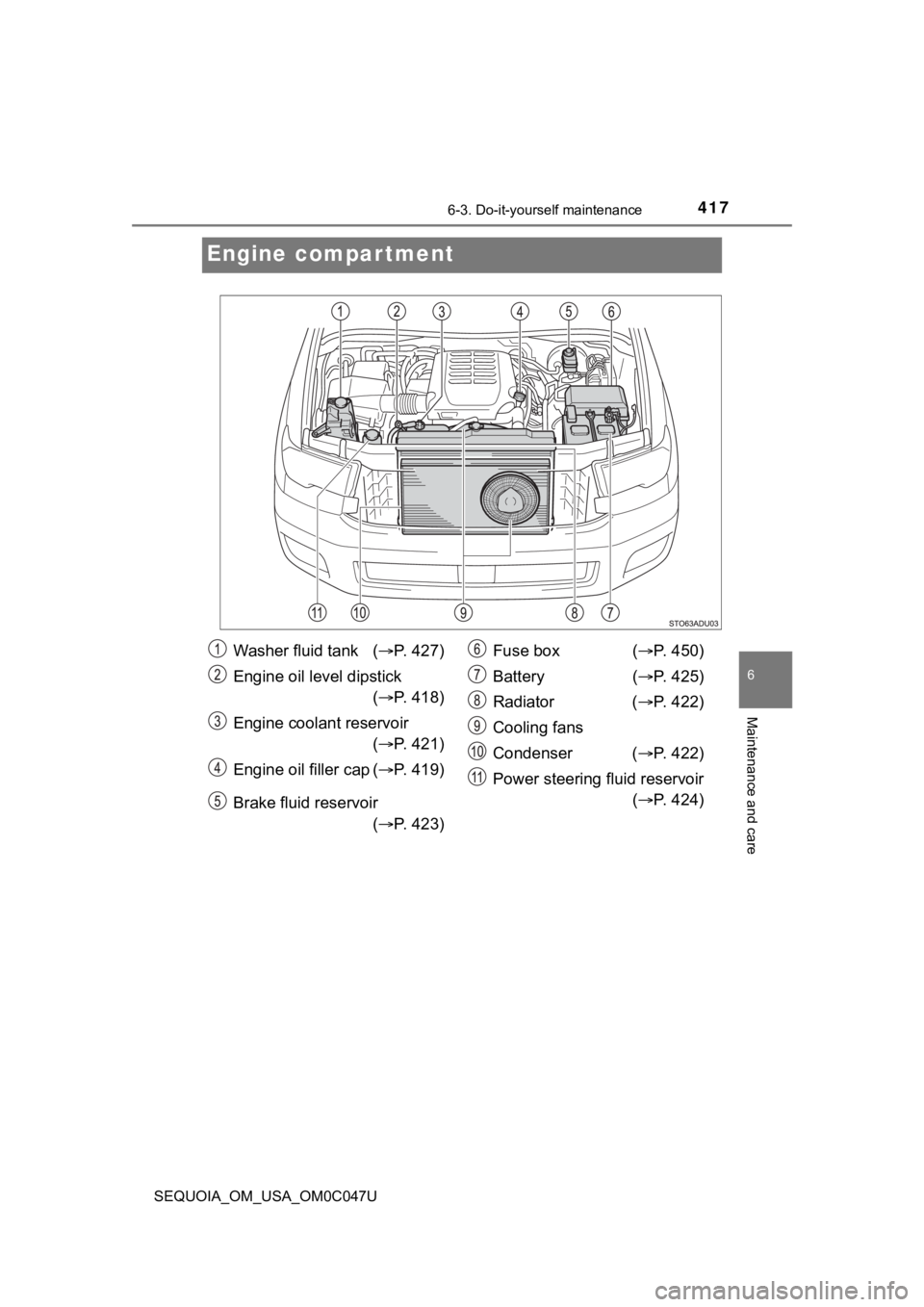
Engine compartment
Washer fluid tank (P. 427)
Engine oil level dipstick ( P. 418)
Engine coolant reservoir ( P. 421)
Engine oil filler cap ( P. 419)
Brake fluid reservoir ( P. 423) Fuse box (
P. 450)
Battery ( P. 425)
Radiator ( P. 422)
Cooling fans
Condenser ( P. 422)
Power steering fluid reservoir ( P. 424)
Page 418 of 592
4186-3. Do-it-yourself maintenance
SEQUOIA_OM_USA_OM0C047U
With the engine at operating temperature and turned off, check the oil
level on the dipstick.
■Checking the engine oil
Park the vehicle on level ground. After warming up the engine
and turning it off, wait more than 5 minutes for the oil to dra in
back into the bottom of the engine.
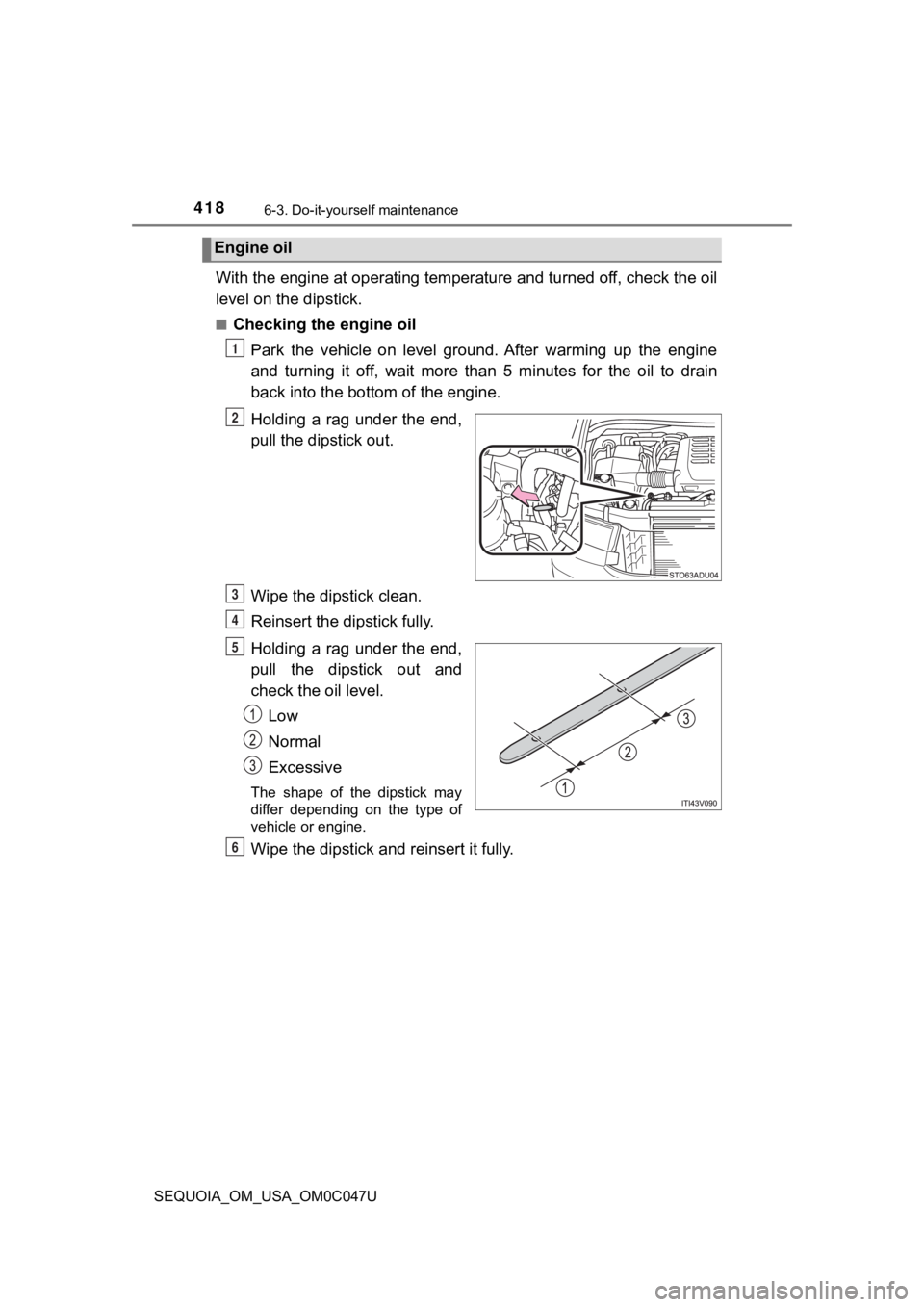
Holding a rag under the end,
pull the dipstick out.
Wipe the dipstick clean.
Reinsert the dipstick fully.
Holding a rag under the end,
pull the dipstick out and
check the oil level.
Low
Normal
Excessive
The shape of the dipstick may
differ depending on the type of
vehicle or engine.
Wipe the dipstick and reinsert it fully.
Engine oil
1
2
3
4
5
6
Page 419 of 592
4196-3. Do-it-yourself maintenance
6
Maintenance and care
SEQUOIA_OM_USA_OM0C047U■
Adding engine oil
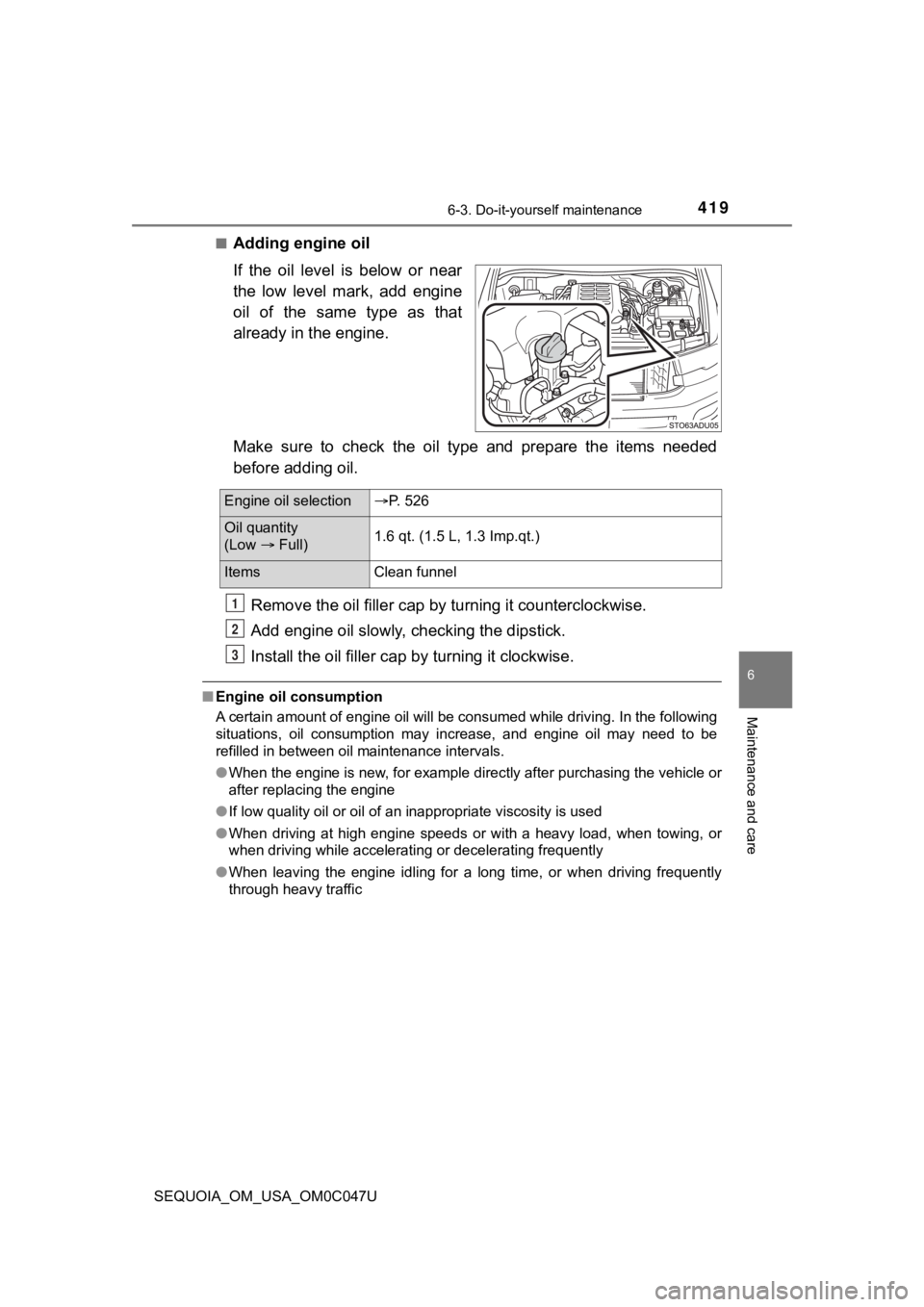
If the oil level is below or near
the low level mark, add engine
oil of the same type as that
already in the engine.
Make sure to check the oil type and prepare the items needed
before adding oil.
Remove the oil fille r cap by turning it counterclockwise.
Add engine oil slowly, checking the dipstick.
Install the oil filler cap by turning it clockwise.
■Engine oil consumption
A certain amount of engine oil will be consumed while driving. In the following
situations, oil consumption may increase, and engine oil may ne ed to be
refilled in between oil maintenance intervals.
● When the engine is new, for example directly after purchasing t he vehicle or
after replacing the engine
● If low quality oil or oil of an inappropriate viscosity is used
● When driving at high engine speeds or with a heavy load, when t owing, or
when driving while accelerating or decelerating frequently
● When leaving the engine idling for a long time, or when driving frequently
through heavy traffic
Engine oil selection P. 526
Oil quantity
(Low Full) 1.6 qt. (1.5 L, 1.3 Imp.qt.)
Items
Clean funnel
1
2
3
Page 420 of 592

4206-3. Do-it-yourself maintenance
SEQUOIA_OM_USA_OM0C047U
WARNING
■Used engine oil
● Used engine oil contains potentially harmful contaminants which may
cause skin disorders such as inflammation and skin cancer, so c are
should be taken to avoid prolonged and repeated contact. To remove used
engine oil from your skin, wash thoroughly with soap and water.
● Dispose of used oil and filters only in a safe and acceptable manner. Do
not dispose of used oil and filters in household trash, in sewers or onto the
ground.
Call your Toyota dealer, service station or auto parts store for information
concerning recycling or disposal.
● Do not leave used engine oil within the reach of children.
NOTICE
■To prevent serious engine damage
Check the oil level on a regular basis.
■ When replacing the engine oil
● Be careful not to spill engine oil on the vehicle components.
● Avoid overfilling, or the engine could be damaged.
● Check the oil level on the dipstick every time you refill the v ehicle.
● Be sure the engine oil filler cap is properly tightened.
Page 470 of 592
4707-2. Steps to take in an emergency
SEQUOIA_OM_USA_OM0C047U
If you think something is wrong
●Fluid leaks un der the vehicle.
(Water dripping from the air conditioning a fter use is normal.)
● Flat-looking tires or uneven tire wear
● Engine coolant temperature gauge needle continually points high er
than normal.
● Voltmeter continually points higher or lower than normal
● Engine oil pressure gauge continually points higher or lower th an
normal
● Changes in exhaust sound
● Excessive tire squeal when cornering
● Strange noises related to the suspension system
● Pinging or other noises related to the engine
● Engine misses, stumbli ng or running roughly
● Appreciable loss of power
● Vehicle pulls heavily to one side when braking
● Vehicle pulls heavily to one s ide when driving on a level road
● Loss of brake effectiveness, spongy feeling, pedal almost touch es
the floor
If you notice any of the followi ng symptoms, your vehicle proba -
bly needs adjustment or repair. Contact your Toyota dealer as
soon as possible.
Visible symptoms
Audible symptoms
Operational symptoms
Page 526 of 592
5268-1. Specifications
SEQUOIA_OM_USA_OM0C047U
*: The engine oil capacity is a reference quantity to be used when changing
the engine oil. Warm up and turn off the engine, wait more than 5 minutes,
and check the oil level on the dipstick.
■
Engine oil selection
“Toyota Genuine Motor Oil” is used in your Toyota vehicle. Use
Toyota approved “Toyota Genuine Motor Oil” or equivalent to sat -
isfy the following grade and viscosity.
Oil grade: ILSAC GF-6A multigrade engine oil
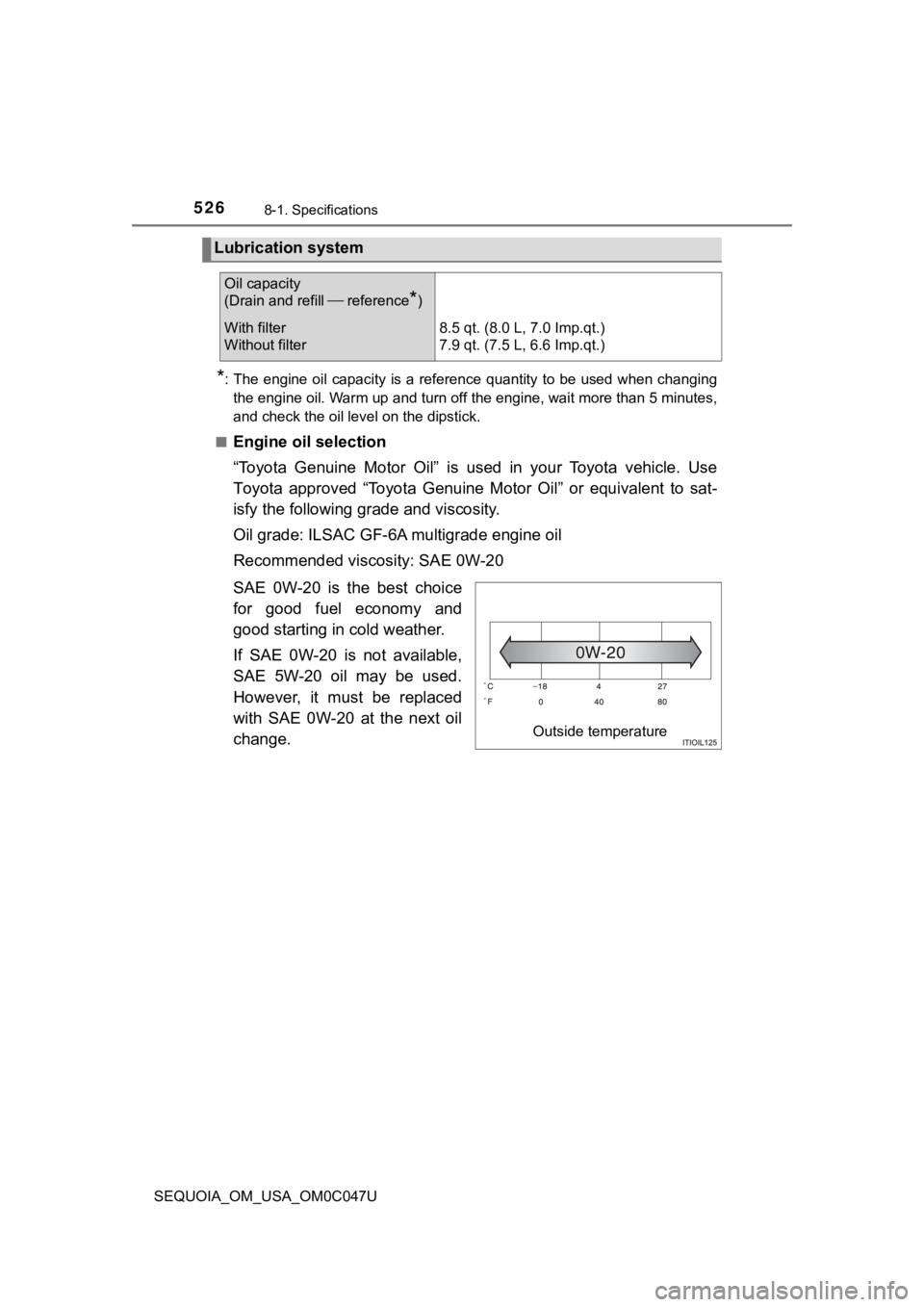
Recommended viscosity: SAE 0W-20
SAE 0W-20 is the best choice
for good fuel economy and
good starting in cold weather.
If SAE 0W-20 is not available,
SAE 5W-20 oil may be used.
However, it must be replaced
with SAE 0W-20 at the next oil
change.
Lubrication system
Oil capacity
(Drain and refill reference
*)
With filter
Without filter8.5 qt. (8.0 L, 7.0 Imp.qt.)
7.9 qt. (7.5 L, 6.6 Imp.qt.)
Outside temperature
Page 527 of 592

5278-1. Specifications
8
Vehicle specifications
SEQUOIA_OM_USA_OM0C047U
Oil viscosity (0W-20 is explained here as an example):
• The 0W in 0W-20 indicates the characteristic of the oil which allows cold startability. Oils wi th a lower value before the W allow
for easier starting of the engine in cold weather.
• The 20 in 0W-20 indicates the vi scosity characteristic of the oil
when the oil is at high temperature. An oil with a higher visco sity
(one with a higher value) may be better suited if the vehicle i s
operated at high speeds, or un der extreme load conditions.
How to read oil container label:
The International Lubricant Speci-
fication Advisory Committee
(ILSAC) Certification Mark is
added to some oil containers to
help you select the oil you should
use.
Page 542 of 592
5428-1. Specifications
SEQUOIA_OM_USA_OM0C047U
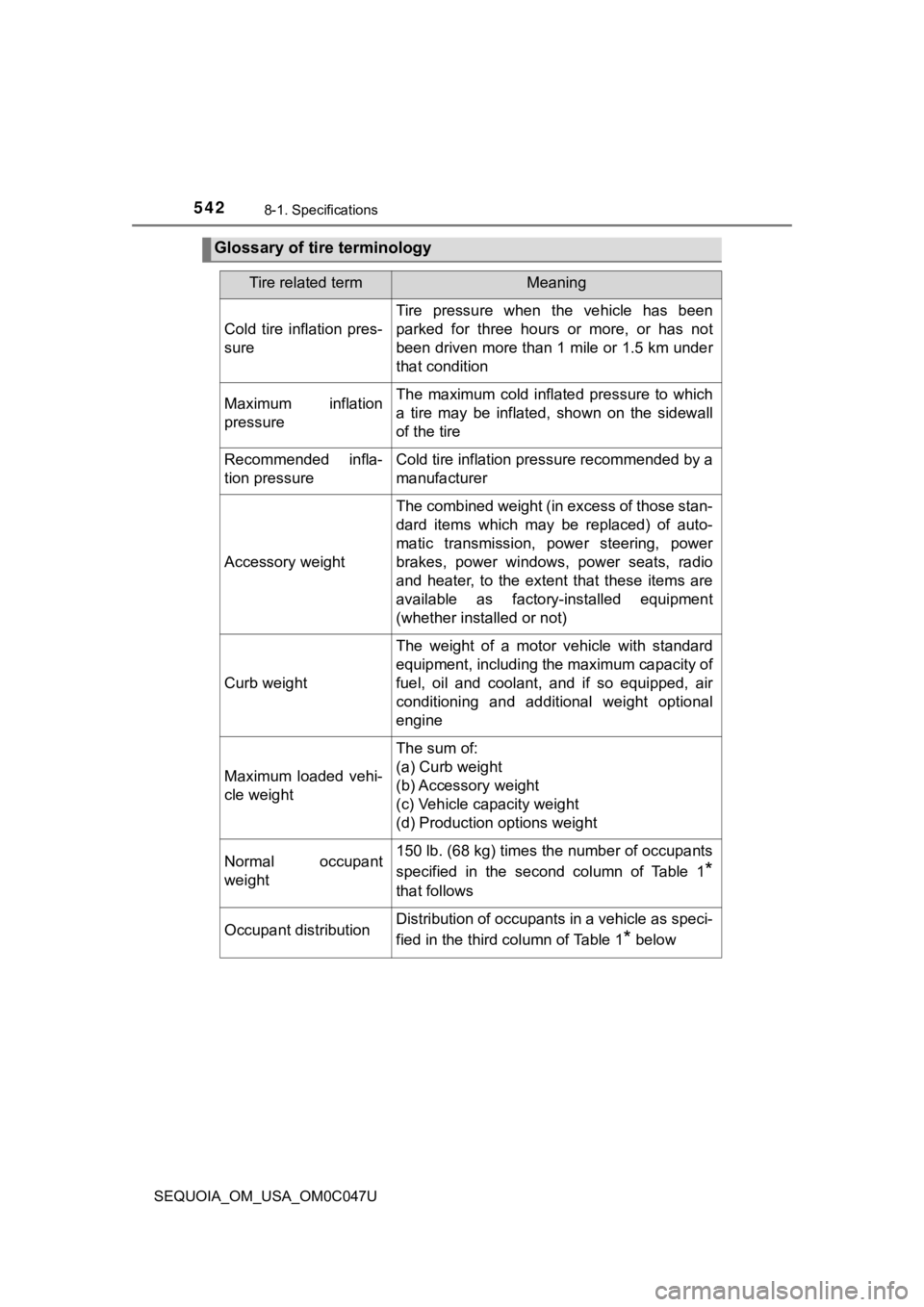
Glossary of tire terminology
Tire related termMeaning
Cold tire inflation pres-
sure
Tire pressure when the vehicle has been
parked for three hours or more, or has not
been driven more than 1 mile or 1.5 km under
that condition
Maximum inflation
pressureThe maximum cold inflated pressure to which
a tire may be inflated, shown on the sidewall
of the tire
Recommended infla-
tion pressureCold tire inflation pressure recommended by a
manufacturer
Accessory weight
The combined weight (in excess of those stan-
dard items which may be replaced) of auto-
matic transmission, power steering, power
brakes, power windows, power seats, radio
and heater, to the extent that these items are
available as factory-installed equipment
(whether installed or not)
Curb weight
The weight of a motor vehicle with standard
equipment, including the maximum capacity of
fuel, oil and coolant, and if so equipped, air
conditioning and additional weight optional
engine
Maximum loaded vehi-
cle weight
The sum of:
(a) Curb weight
(b) Accessory weight
(c) Vehicle capacity weight
(d) Production options weight
Normal occupant
weight150 lb. (68 kg) times the number of occupants
specified in the second column of Table 1
*
that follows
Occupant distributionDistribution of occupants in a vehicle as speci-
fied in the third column of Table 1
* below
Page 581 of 592

581Alphabetical index
SEQUOIA_OM_USA_OM0C047U
EDR (Event data recorder) ........ 11
Electronically modulated air suspension ....................... 311
Emergency flashers ................ 462
Emergency, in case of
If a warning buzzer sounds ................................ 472
If a warning light turns on ....................................... 472
If a warning message
is displayed......................... 481
If the engine will not start ...... 507
If the vehicle battery is discharged .......................... 511
If the vehicle is submerged or water on
the road is rising ................. 465
If you have a flat tire ............. 493
If you think something is wrong .............................. 470
If your vehicle becomes stuck ................................... 518
If your vehicle has to be stopped in an emergency ... 463
If your vehicle needs to be towed ......................... 466
If your vehicle overheats ....... 515 Engine
Compartment ........................ 417
Engine switch ....................... 214
Hood ..................................... 416
How to start the engine......... 214
Identification number ............ 524
If the engine will not start ...... 507
Ignition switch
(engine switch) ................... 214
Overheating .......................... 515
Engine coolant......................... 421
Capacity................................ 528
Checking............................... 421
Preparing and checking before winter ...................... 336
Engine coolant temperature gauge ....................................... 94
Engine immobilizer system ...... 76
Engine oil ................................. 418 Capacity................................ 526
Checking............................... 418
Preparing and checking before winter ...................... 336
Engine switch .......................... 214
Event data recorder (EDR)........ 11
E