roof TOYOTA SEQUOIA 2022 Owner's Manual
[x] Cancel search | Manufacturer: TOYOTA, Model Year: 2022, Model line: SEQUOIA, Model: TOYOTA SEQUOIA 2022Pages: 592, PDF Size: 10.82 MB
Page 187 of 592
1874-1. Before driving
4
Driving
SEQUOIA_OM_USA_OM0C047U
Cargo and luggage
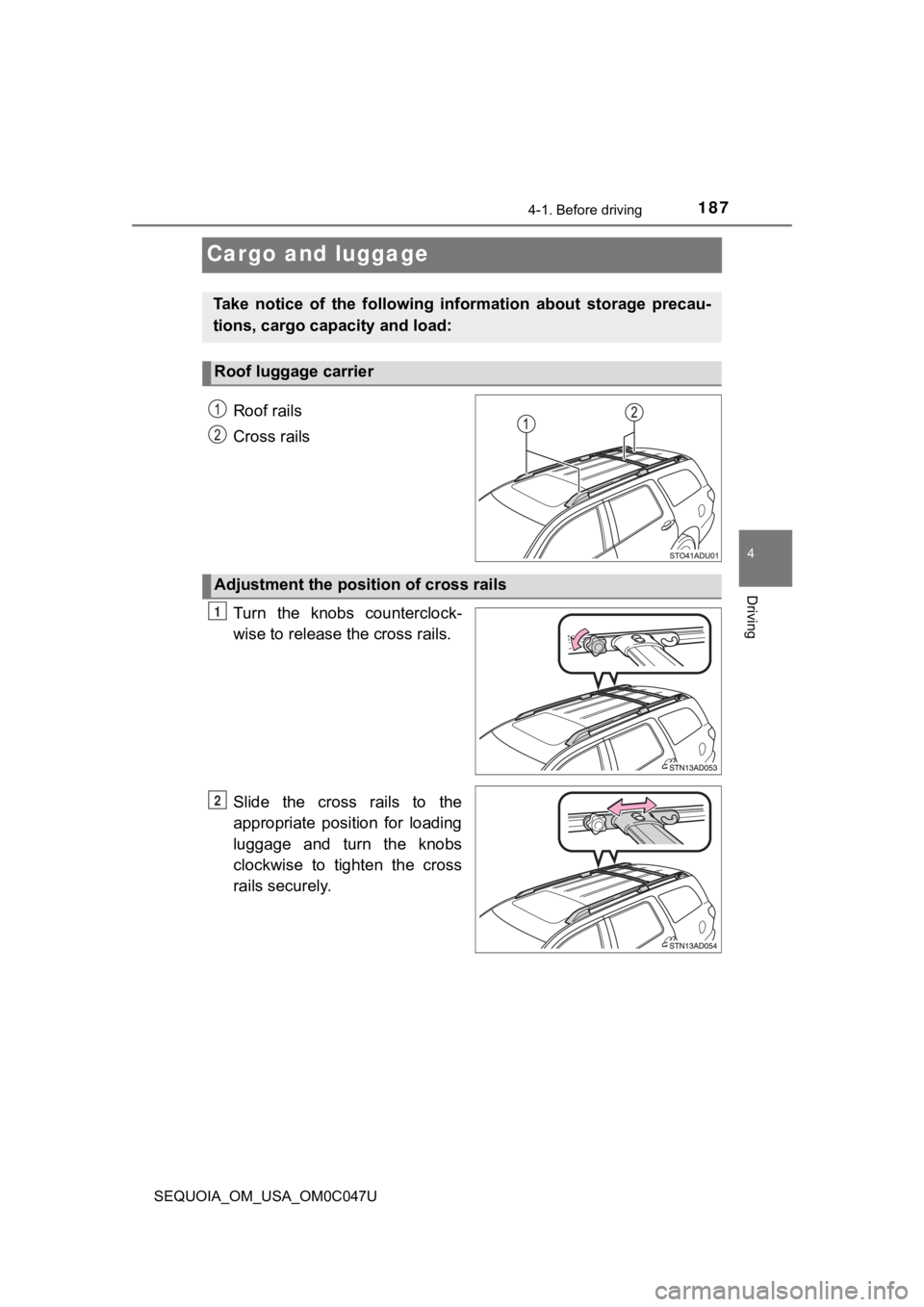
Roof rails
Cross rails
Turn the knobs counterclock-
wise to release the cross rails.
Slide the cross rails to the
appropriate position for loading
luggage and turn the knobs
clockwise to tighten the cross
rails securely.
Take notice of the following information about storage precau-
tions, cargo capacity and load:
Roof luggage carrier
Adjustment the position of cross rails
1
2
Page 191 of 592
1914-1. Before driving
4
Driving
SEQUOIA_OM_USA_OM0C047U
WARNING
■Capacity and distribution
●Do not exceed the maximum axle weight rating or the total vehicle
weight rating.
●Even if the total load of occupant’s weight and the cargo load is less
than the total load capacity, do not apply the load unevenly. I mproper
loading may cause deterioration of steering or braking control which
may cause death or serious injury.
■When loading cargo on the roof luggage carrier
Observe the following precautions:
●Place the cargo so that its weight is distributed evenly betwee n the
front and rear axles.
●If loading long or wide cargo, never exceed the vehicle overall length
or width. ( P. 522)
●Before driving, make sure the cargo is securely fastened on the roof
luggage carrier.
●Loading cargo on the roof luggage carrier will make the center of grav-
ity of the vehicle higher. Avoid high speeds, sudden starts, sharp turns,
sudden braking or abrupt maneuvers, otherwise it may result in loss of
control or vehicle rollover due to failure to operate this vehi cle correctly
and result in death or serious injury.
●If driving for a long distance, on rough roads, or at high spee ds, stop
the vehicle now and then during the trip to make sure the cross rails
are fixed securely and that the cargo remains in its place.
●Do not exceed 150 lb. (68 kg) cargo weight on the roof luggage carrier.
Page 192 of 592

1924-1. Before driving
SEQUOIA_OM_USA_OM0C047U
WARNING
■Cross rail adjustment
Make sure the cross rails are locked securely by pushing forward and
rearward them.
Failure to do so may cause an accident or serious injury in the event of
emergency braking or a collision.
NOTICE
■Cross rail adjustment
Do not remove the cross rail stoppers, or the moon roof may be damage
when it is tilted.
■When loading cargo on the roof luggage carrier
Be careful not to scratch the surface of the moon roof.
Page 314 of 592

3144-5. Using the driving support systems
SEQUOIA_OM_USA_OM0C047U
WARNING
■The electronically modulated air suspension must be turned off in the
following circumstances:
Otherwise, the automatic leveling function may cause the vehicle’s height to
change, and you may catch part of your body in the vehicle, resulting in an
unexpected accident:
● When driving through water such as shallow streams (Put the veh icle
height in “HI” mode and turn off the electronically modulated a ir suspen-
sion. Drive at 18 mph [30 km/h] or slower.)
● When jacking up the vehicle, installing tire chains or tying th e vehicle with
chains/wires for transportation via flat bed truck (Turn the system to the
manual mode and stop the engine.)
● When the vehicle must be towed (Put the vehicle height in “N” mode and
turn the system to the manual mode.)
● When the vehicle gets stuck (Turn the system to the manual mode .)
● When disconnecting a trailer (Put the vehicle height in “N” mod e and turn
the system to the manual mode.)
■ Selecting the correct height mode
Observe the following precautions to prevent accidents.
Failure to do so may cause damage to parts of the vehicle, as w ell as dan-
gerous handling characteristics, which may lead to fatal or inj ury accidents.
● Before you lower the vehicle’s height, check under the vehicle to make
sure that no one is there.
● “HI” mode should only be used when driving on rough roads, for example
when driving off-road.
Because the vehicle’s center of gravity will become higher when in the
mode, the vehicle may become unstable when turning abruptly, resulting
in an accident.
● Do not select “HI” mode when you load cargo on the roof luggage carrier.
Because the vehicle’s center of gravity will become higher when in the
mode, the vehicle may become unstable when turning abruptly, resulting
in an accident.
Page 332 of 592

3324-6. Driving tips
SEQUOIA_OM_USA_OM0C047U
WARNING
■Off-road vehicle precautions
Always observe the following precautions to minimize the risk of death, seri-
ous injury or damage to your vehicle:
● In a rollover crash, an unbelted person is significantly more likely to die
than a person wearing a seat belt. Therefore, the driver and al l passengers
should always fasten their seat belts.
● Avoid sharp turns or abrupt maneuvers, if at all possible.
Failure to operate this vehicle correctly may result in loss of control or
vehicle rollover causing death or serious injury.
● Loading cargo on the roof luggage carrier will make the center of the vehi-
cle gravity higher. Avoid high speeds, sudden starts, sharp turns, sudden
braking or abrupt maneuvers, otherwise it may result in loss of control or
vehicle rollover due to failure to operate this vehicle correct l y.
● Always slow down in gusty crosswinds. Because of its profile and higher
center of gravity, your vehicle is more sensitive to side winds than an ordi-
nary passenger car. Slowing down will allow you to have better control.
● When driving off-road or in rugged terrain, do not drive at excessive
speeds, jump, make sharp turns, strike objects, etc. This may cause loss
of control or vehicle rollover causing death or serious injury. You are also
risking expensive damage to your vehicle’s suspension and chass is.
● Do not drive horizontally across steep slopes. Driving straight up or
straight down is preferred. Your vehicle (or any similar off-road vehicle)
can tip over sideways much more easily than forward or backward.
Page 337 of 592
3374-6. Driving tips
4
Driving
SEQUOIA_OM_USA_OM0C047U
Perform the following according to the driving conditions:
● Do not try to forcibly open a window or move a wiper that is fr ozen.
Pour warm water over the frozen area to melt the ice. Wipe away
the water immediately to prevent it from freezing.
● To ensure proper operation of the climate control system fan,
remove any snow that has accumulated on the air inlet vents in
front of the windshield.
● Check for and remove any excess ic e or snow that may have accu-
mulated on the exterior lights, vehicle’s roof, chassis, around the
tires or on the brakes.
● Remove any snow or mud from the bottom of your shoes before
getting in the vehicle.
Accelerate the vehicle slowly, keep a safe distance between you and
the vehicle ahead, and drive at a reduced speed suitable to roa d con-
ditions.
● Park the vehicle and move the shift lever to P without setting the
parking brake. The parking brake may freeze up, preventing it from
being released. If the vehicle is parked without setting the pa rking
brake, make sure t o block the wheels.
Failure to do so may be dangerou s because it may cause the vehi-
cle to move unexpectedly, pos sibly leading to an accident.
● If the vehicle is parked without setting the parking brake, confirm
that the shift lever c annot be moved out of P
*.
*: The shift lever will be locked if it is attempted to be shifte d from P to any
other position without depressing the brake pedal. If the shift lever can be
shifted from P, there may be a problem with the shift lock syst em. Have the
vehicle inspected by your Toyota dealer immediately.
Before driving the vehicle
When driving the vehicle
When parking the vehicle
Page 352 of 592
3525-1. Using the air conditioning system and defogger
SEQUOIA_OM_USA_OM0C047U■
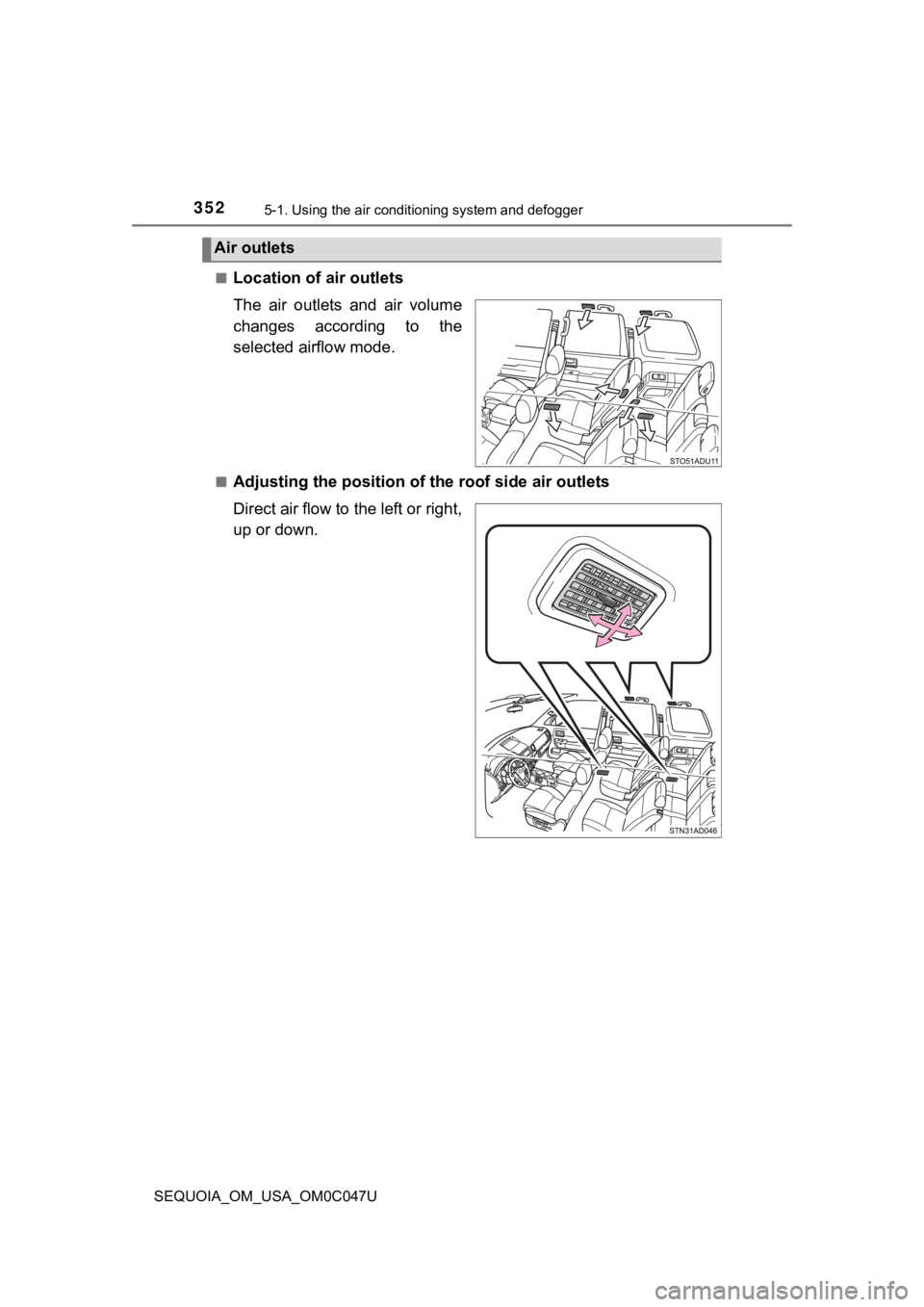
Location of a
ir outlets
The air outlets and air volume
changes according to the
selected airflow mode.
■Adjusting the position of the roof side air outlets
Direct air flow to the left or right,
up or down.
Air outlets
Page 397 of 592
3975-4. Other interior features
5
Interior features
SEQUOIA_OM_USA_OM0C047U■
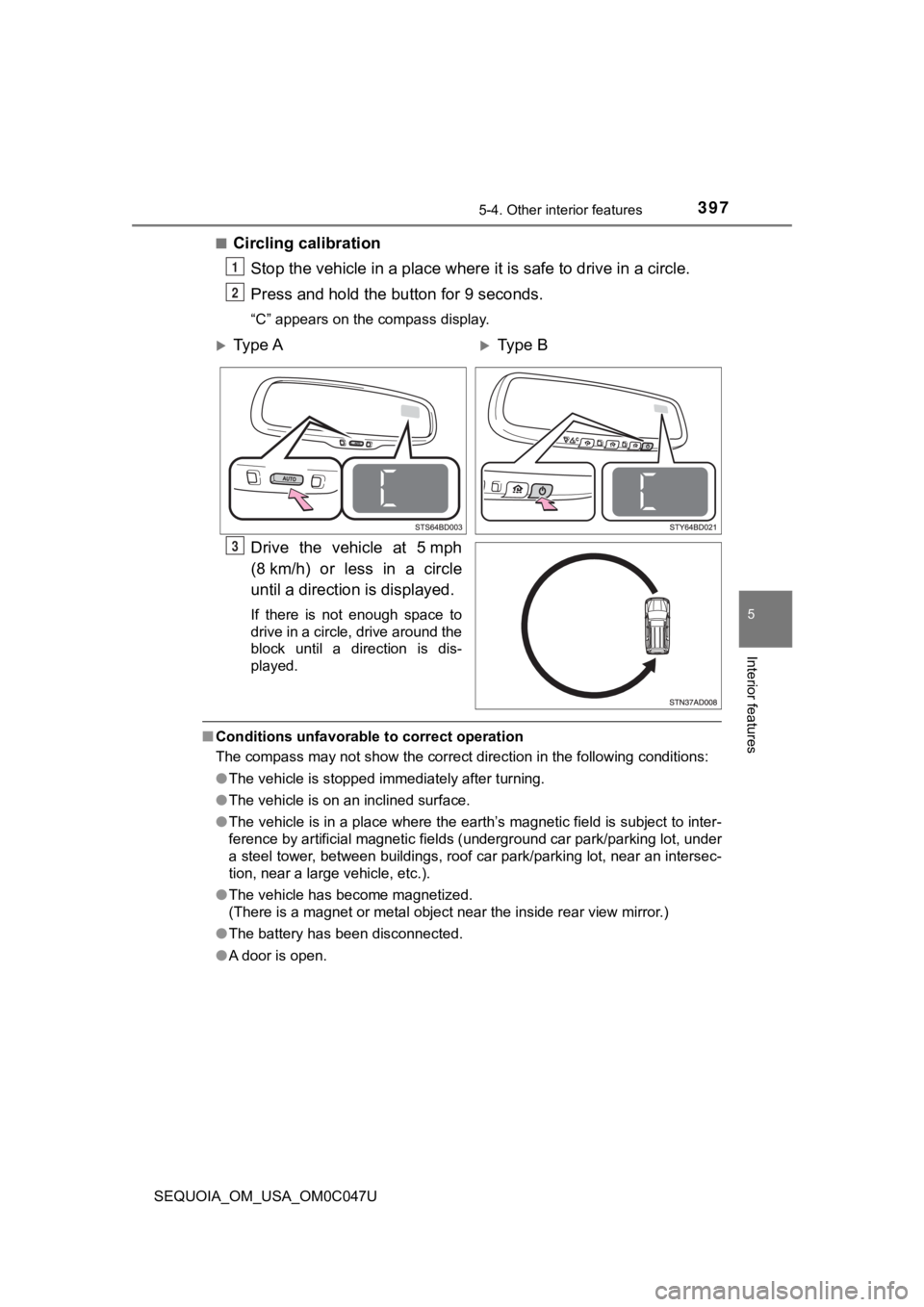
Circling calibration
Stop the vehicle in a place where it is safe to drive in a circle.
Press and hold the bu tton for 9 seconds.
“C” appears on the compass display.
Drive the vehicle at 5 mph
(8 km/h) or less in a circle
until a direction is displayed.
If there is not enough space to
drive in a circle, drive around the
block until a direction is dis-
played.
■Conditions unfavorable to correct operation
The compass may not show the correct direction in the following conditions:
● The vehicle is stopped immediately after turning.
● The vehicle is on an inclined surface.
● The vehicle is in a place where the earth’s magnetic field is subject to inter-
ference by artificial magnetic fields (underground car park/par king lot, under
a steel tower, between buildings, roof car park/parking lot, near an intersec-
tion, near a large vehicle, etc.).
● The vehicle has become magnetized.
(There is a magnet or metal object near the inside rear view mi rror.)
● The battery has been disconnected.
● A door is open.
1
2
Ty p e AType B
3
Page 398 of 592

3985-4. Other interior features
SEQUOIA_OM_USA_OM0C047U
WARNING
■While driving the vehicle
Do not adjust the display. Be sure to adjust the display only when the vehi-
cle is stopped.
■ When doing the circling calibration
Be sure to secure a wide space, and watch out for people and vehicles in
the neighborhood. Do not violate any local traffic rules while performing cir-
cling calibration.
NOTICE
■To avoid the compass malfunctions
Do not place magnets or any metal objects near the inside rear view mirror.
Doing this may cause a malfunction of the compass sensor.
■ To ensure normal operation of the compass
● Do not perform circling calibration of the compass in a place w here the
earth’s magnetic field is subject to interference by artificial magnetic fields.
● During calibration, do not operate electric systems (moon roof, power win-
dows, etc.) as they may interfere with the calibration.
Page 400 of 592
4006-1. Maintenance and care
SEQUOIA_OM_USA_OM0C047U
Cleaning and protecting the vehicle
exterior
● Working from top to bottom, liberally apply water to the vehicl e
body, wheel wells and underside of the vehicle to remove any di rt
and dust.
● Wash the vehicle body using a sponge or soft cloth, such as a
chamois.
● For hard-to-remove marks, use car wash soap and rinse thoroughl y
with water.
● Wipe away any water.
● Wax the vehicle when the wate rproof coating deteriorates.
If water does not bead on a clean surface, apply wax when the vehicle
body is cool.
■Automatic car washes
●Fold the mirrors before washing the vehicle. Start washing from the front of
the vehicle. Make sure to extend the mirrors before driving.
● Brushes used in automatic car washes may scratch the vehicle su rface,
parts (wheel, etc.) and harm your vehicle’s paint.
● In certain automatic car washes, rear spoiler may interfere wit h machine
operation. This may prevent t he vehicle from being cleaned properly or
result in damage to the rear spoiler.
Perform the following to protect the vehicle and maintain it in
prime condition: