tire type TOYOTA SEQUOIA HYBRID 2023 User Guide
[x] Cancel search | Manufacturer: TOYOTA, Model Year: 2023, Model line: SEQUOIA HYBRID, Model: TOYOTA SEQUOIA HYBRID 2023Pages: 628, PDF Size: 14.27 MB
Page 486 of 628
4866-3. Do-it-yourself maintenance
Owners Manual_USA_M0C043_en
When replacing wheels, care
should be taken to ensure that
they are equivalent to those
removed in load capacity, diam-
eter, rim width and inset
*.
Replacement wheels are avail-
able at your Toyota dealer.
*: Conventionally referred to as off- set.
Toyota does not recommend
using the following:
Wheels of different sizes or
types
Used wheels
Bent wheels that have been
straightened
■When replacing wheels
The wheels of your vehicle are
equipped with tire pressure warning
valves and transmitters that allow
the tire pressure warning system to
provide advance warning in the
event of a loss in tire inflation pres-
sure. Whenever wheels are
replaced, the tire pressure warning
valves and transmitters must be
installed. ( P.478)
Wheels
If a wheel is bent, cracked or
heavily corroded, it should
be replaced. Otherwise, the
tire may separate from the
wheel or cause a loss of
handling control.
Wheel selection
WARNING
■When replacing wheels
●Do not use wheels that are a dif-
ferent size from those recom-
mended in the Owner’s Manual
or certification label, as this may
result in a loss of handling con-
trol.
●Never use an inner tube in a
leaking wheel which is designed
for a tubeless tire.
Doing so may result in an acci-
dent, causing death or serious
injury.
■When installing the wheel
nuts
Never use oil or grease on the
wheel bolts or wheel nuts. Oil and
grease may cause the wheel nuts
to be excessively tightened, lead-
ing to bolt or disc wheel damage.
In addition, the oil or grease can
cause the wheel nuts to loosen
and the wheel may fall off, caus-
ing an accident and resulting in
death or serious injury. Remove
any oil or grease from the wheel
bolts or wheel nuts.
■Use of defective wheels pro-
hibited
Do not use cracke d or deformed
wheels. Doing so could cause the
tire to leak air during driving, pos-
sibly causing an accident.
Page 506 of 628
5067-2. Steps to take in an emergency
Owners Manual_USA_M0C043_en
WARNING
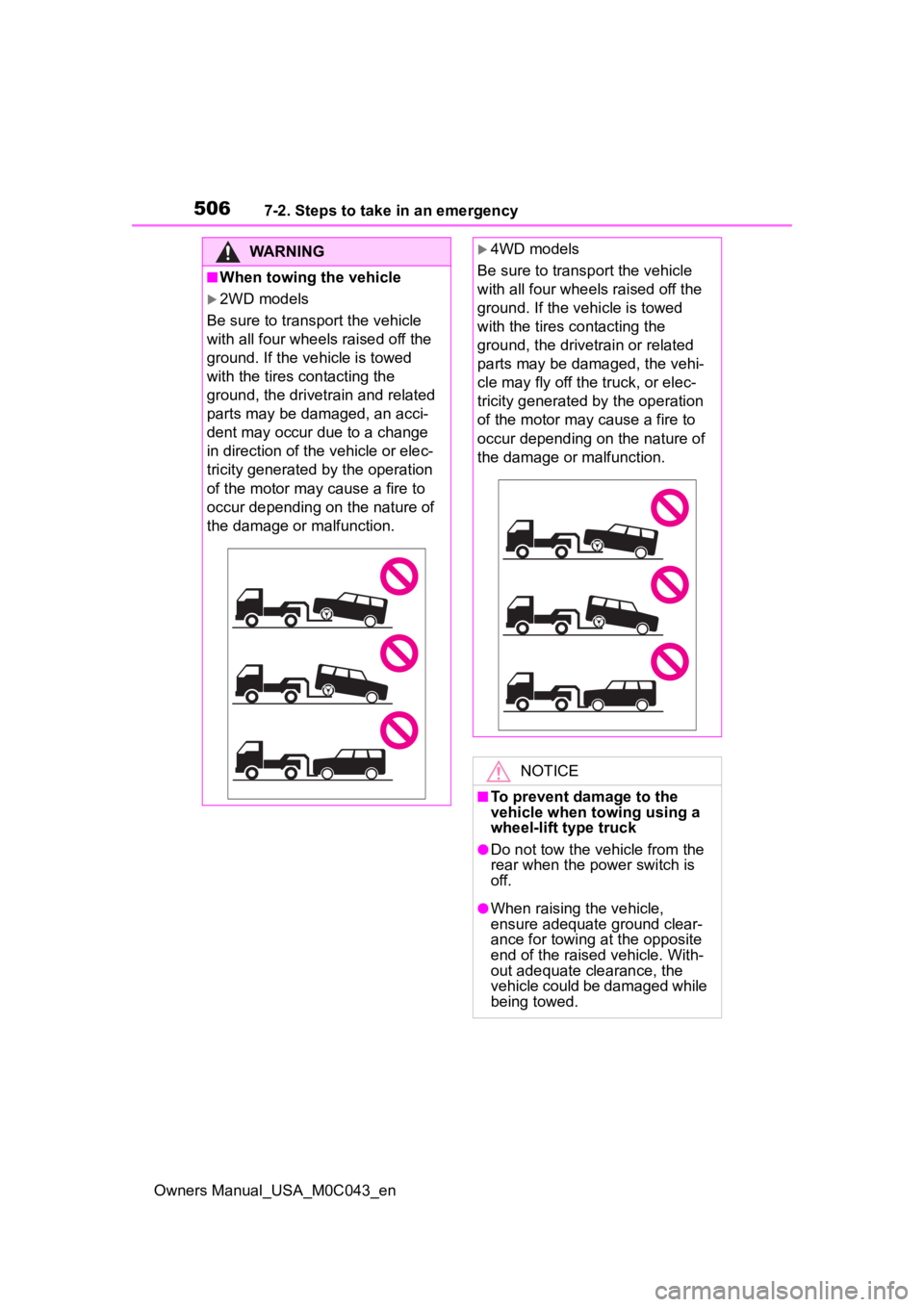
■When towing the vehicle
2WD models
Be sure to transport the vehicle
with all four wheels raised off the
ground. If the vehicle is towed
with the tires contacting the
ground, the drivetrain and related
parts may be damaged, an acci-
dent may occur due to a change
in direction of the vehicle or elec-
tricity generated by the operation
of the motor may cause a fire to
occur depending on the nature of
the damage or malfunction.
4WD models
Be sure to transp ort the vehicle
with all four wheels raised off the
ground. If the vehicle is towed
with the tires co ntacting the
ground, the drivetrain or related
parts may be damaged, the vehi-
cle may fly off the truck, or elec-
tricity generated by the operation
of the motor may cause a fire to
occur depending o n the nature of
the damage or malfunction.
NOTICE
■To prevent damage to the
vehicle when t owing using a
wheel-lift type truck
●Do not tow the vehicle from the
rear when the power switch is
off.
●When raising the vehicle,
ensure adequate ground clear-
ance for towing at the opposite
end of the raised vehicle. With-
out adequate clearance, the
vehicle could be damaged while
being towed.
Page 507 of 628
5077-2. Steps to take in an emergency
Owners Manual_USA_M0C043_en
7
When trouble arises
When using a flat-bed truck to
transport the vehicle, use tire
strapping belts. Refer to the
owner’s manual of the flat-bed
truck for the tire strapping
method.
In order to suppress vehicle
movement during transporta-
tion, set the parking brake and
turn the power switch off.
Your vehicle has not towing
hook. If towing is necessary, we
recommend having your vehicle
towed by your Toyota dealer or
commercial towing service.
Fluid leaks under the vehicle.
(Water dripping from the air
conditioning after use is nor-
mal.)
Flat-looking tires or uneven
tire wear
Engine coolant temperature
gauge needle continually
points higher than normal.
Voltmeter continually points
higher or lower than normal.
Engine oil pressure gauge
continually points lower than
normal.
Automatic transmission fluid
temperature warning mes-
sage is displayed
Changes in exhaust sound
Excessive tire squeal when
cornering
Strange noises related to the
suspension system
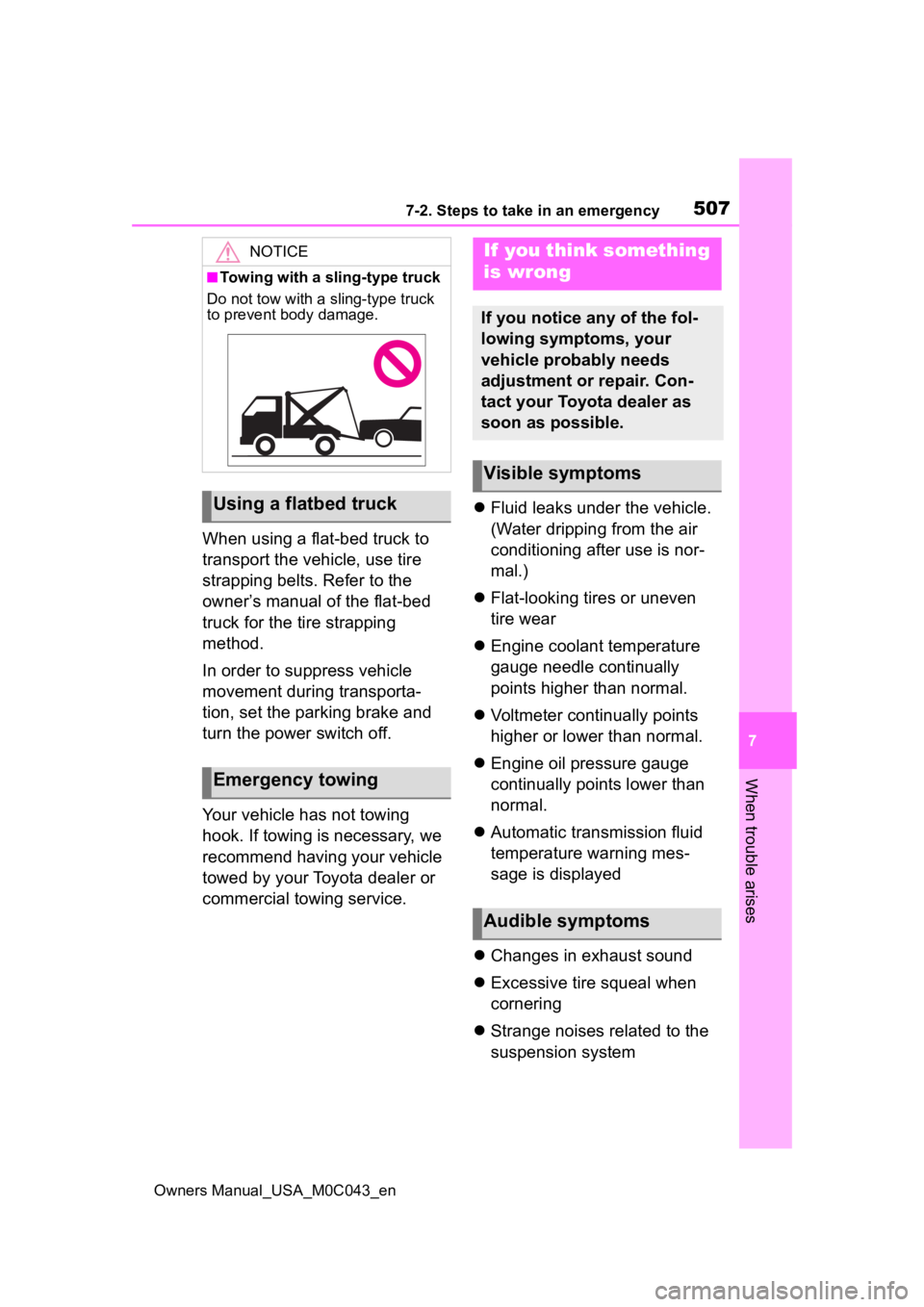
NOTICE
■Towing with a sling-type truck
Do not tow with a sling-type truck
to prevent body damage.
Using a flatbed truck
Emergency towing
If you think something
is wrong
If you notice any of the fol-
lowing symptoms, your
vehicle probably needs
adjustment or repair. Con-
tact your Toyota dealer as
soon as possible.
Visible symptoms
Audible symptoms
Page 532 of 628
5327-2. Steps to take in an emergency
Owners Manual_USA_M0C043_en
One of the following may be the
cause of the problem:
The electronic key may not be
functioning properly.
( P.535)
There may not be sufficient
fuel in the vehicle’s tank.
Refuel the vehicle.
There may be a malfunction
in the immobilizer system.
( P.83)
The hybrid system may be
malfunctioning due to an elec-
trical problem such as elec-
tronic key battery depletion or
a blown fuse. However,
depending on the type of mal-
function, an interim measure
is available to start the hybrid
system. ( P.533)
The temperature of the hybrid
battery (traction battery) may
be extremely low (below
NOTICE
■Do not drive the vehicle with
a flat tire
Do not continue driving with a flat
tire.
Driving even a short distance with
a flat tire can damage the tire and
the wheel beyond repair.
■Driving with tire chains and
the temporary spare tire
Do not fit tire chains to the tempo-
rary spare tire.
Tire chains may damage the vehi-
cle body and adversely affect driv-
ing performance.
■When stowing the flat tire
Ensure that there is no object
caught between the tire and the
vehicle underbody.
■When replacing the tires
When removing or fitting the
wheels, tires or the tire pressure
warning valve and transmitter,
contact your Toyota dealer as the
tire pressure warning valve and
transmitter may be damaged if not
handled correctly.
■To avoid damage to the tire
pressure warning valves and
transmitters
When a tire is repaired with liquid
sealants, the tire pressure warn-
ing valve and transmitter may not
operate properly. If a liquid seal-
ant is used, contact your Toyota
dealer or other qualified service
shop as soon as possible. Make
sure to replace the tire pressure
warning valve and transmitter
when replaci ng the tire. (P.478)
If the hybrid system
will not star t
Reasons for the hybrid sys-
tem not starting vary
depending on the situation.
Check the following and
perform the appropriate
procedure:
The hybrid system will not
start even though the cor-
rect starting procedure is
being followed. ( P.212)
Page 555 of 628
5558-1. Specifications
Owners Manual_USA_M0C043_en
8
Vehicle specifications
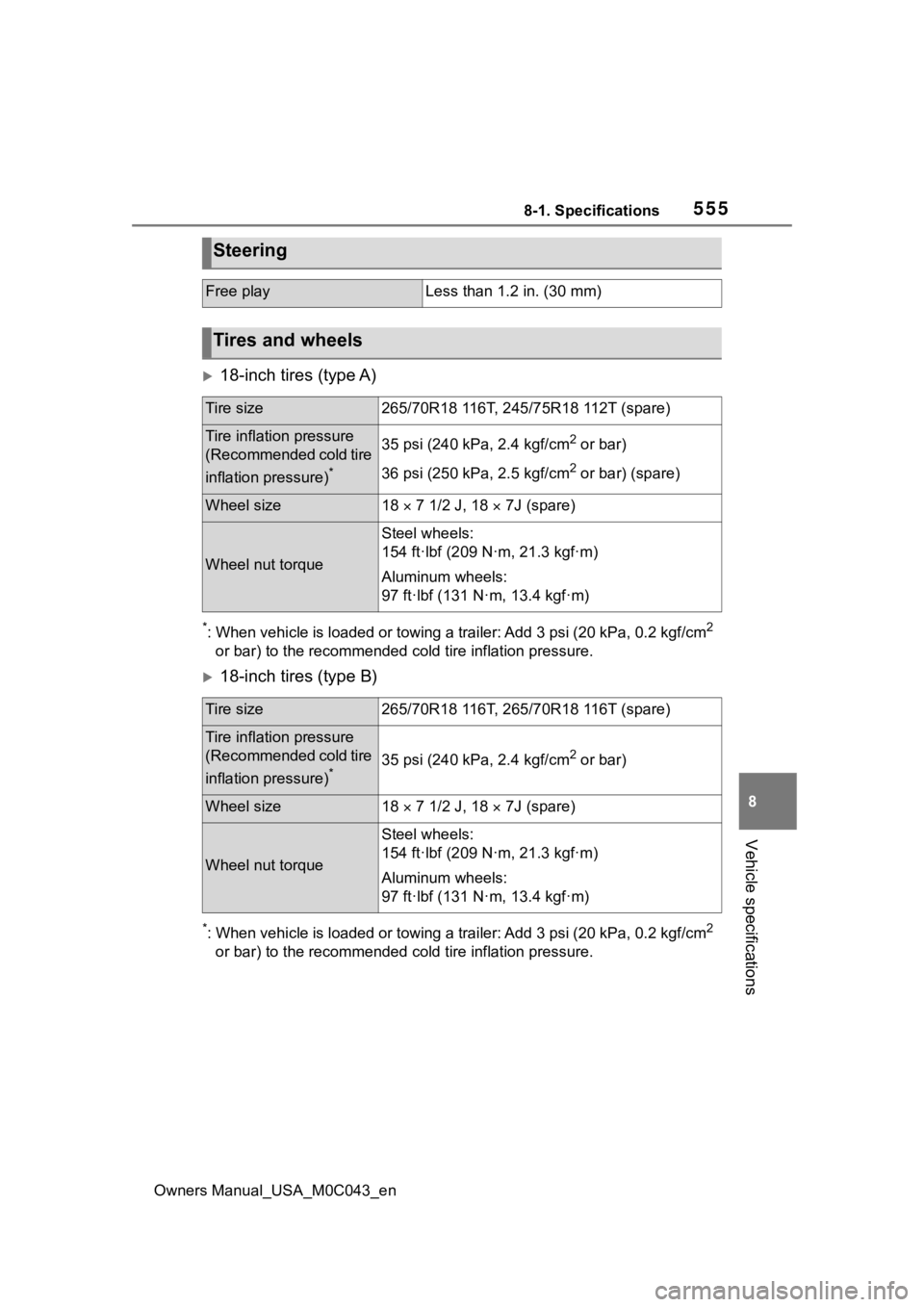
18-inch tires (type A)
*: When vehicle is loaded or towing a trailer: Add 3 psi (20 kPa, 0.2 kgf/cm2
or bar) to the recommended cold tire inflation pressure.
18-inch tires (type B)
*: When vehicle is loaded or towing a trailer: Add 3 psi (20 kPa, 0.2 kgf/cm2
or bar) to the recommended cold tire inflation pressure.
Steering
Free playLess than 1.2 in. (30 mm)
Tires and wheels
Tire size265/70R18 116T, 245/75R18 112T (spare)
Tire inflation pressure
(Recommended cold tire
inflation pressure)
*
35 psi (240 kPa, 2.4 kgf/cm2 or bar)
36 psi (250 kPa, 2.5 kgf/cm
2 or bar) (spare)
Wheel size18 7 1/2 J, 18 7J (spare)
Wheel nut torque
Steel wheels:
154 ft·lbf (209 N·m, 21.3 kgf·m)
Aluminum wheels:
97 ft·lbf (131 N·m, 13.4 kgf·m)
Tire size265/70R18 116T, 265/70R18 116T (spare)
Tire inflation pressure
(Recommended cold tire
inflation pressure)
*35 psi (240 kPa, 2.4 kgf/cm2 or bar)
Wheel size18 7 1/2 J, 18 7J (spare)
Wheel nut torque
Steel wheels:
154 ft·lbf (209 N·m, 21.3 kgf·m)
Aluminum wheels:
97 ft·lbf (131 N·m, 13.4 kgf·m)
Page 556 of 628
5568-1. Specifications
Owners Manual_USA_M0C043_en
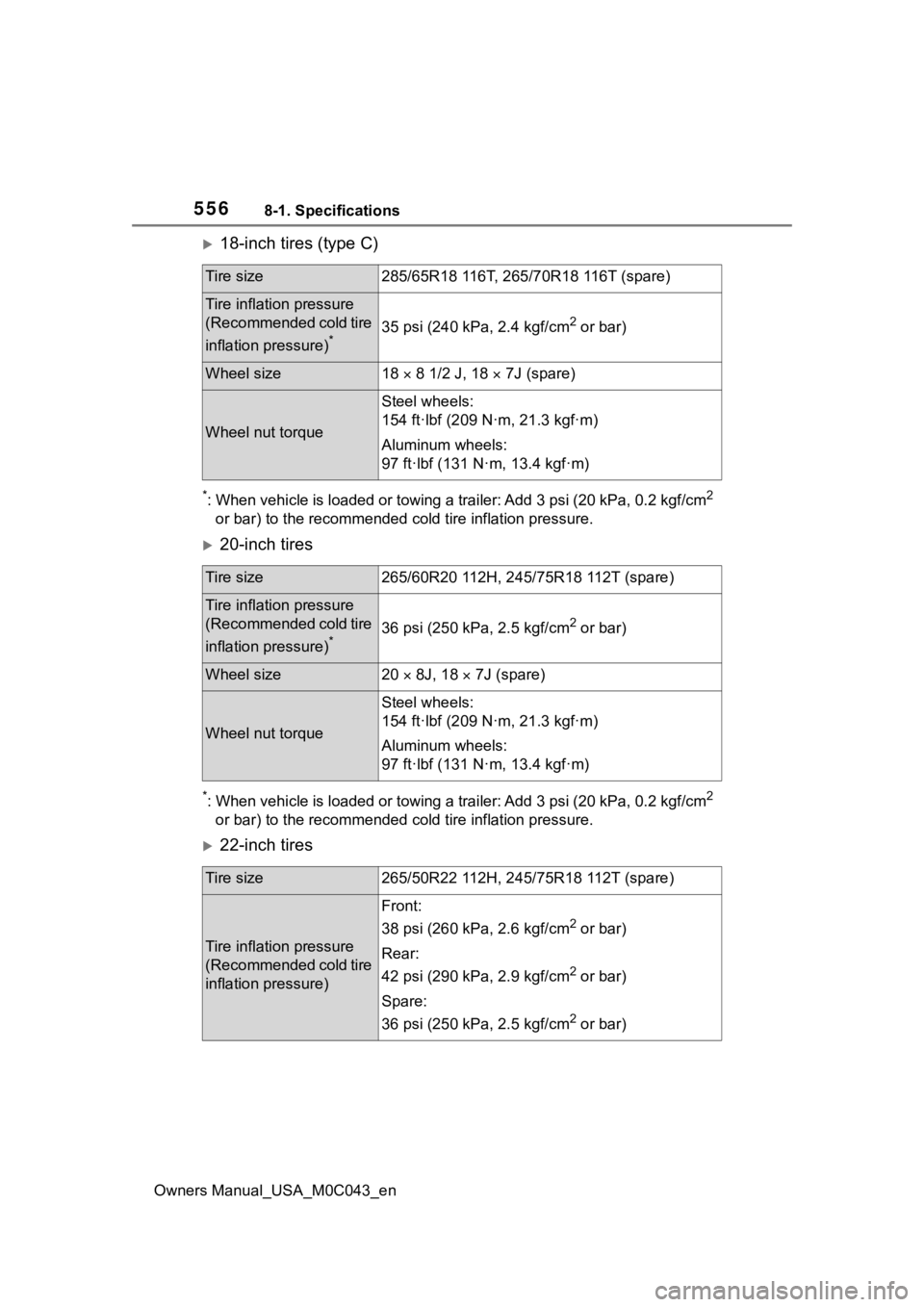
18-inch tires (type C)
*: When vehicle is loaded or towing a trailer: Add 3 psi (20 kPa, 0.2 kgf/cm2
or bar) to the recommended cold tire inflation pressure.
20-inch tires
*: When vehicle is loaded or towing a trailer: Add 3 psi (20 kPa, 0.2 kgf/cm2
or bar) to the recommended cold tire inflation pressure.
22-inch tires
Tire size285/65R18 116T, 265/70R18 116T (spare)
Tire inflation pressure
(Recommended cold tire
inflation pressure)
*35 psi (240 kPa, 2.4 kgf/cm2 or bar)
Wheel size18 8 1/2 J, 18 7J (spare)
Wheel nut torque
Steel wheels:
154 ft·lbf (209 N·m, 21.3 kgf·m)
Aluminum wheels:
97 ft·lbf (131 N·m, 13.4 kgf·m)
Tire size265/60R20 112H, 245/75R18 112T (spare)
Tire inflation pressure
(Recommended cold tire
inflation pressure)
*36 psi (250 kPa, 2.5 kgf/cm2 or bar)
Wheel size20 8J, 18 7J (spare)
Wheel nut torque
Steel wheels:
154 ft·lbf (209 N·m, 21.3 kgf·m)
Aluminum wheels:
97 ft·lbf (131 N·m, 13.4 kgf·m)
Tire size265/50R22 112H, 245/75R18 112T (spare)
Tire inflation pressure
(Recommended cold tire
inflation pressure)
Front:
38 psi (260 kPa, 2.6 kgf/cm
2 or bar)
Rear:
42 psi (290 kPa, 2.9 kgf/cm
2 or bar)
Spare:
36 psi (250 kPa, 2.5 kgf/cm
2 or bar)
Page 560 of 628
5608-1. Specifications
Owners Manual_USA_M0C043_en
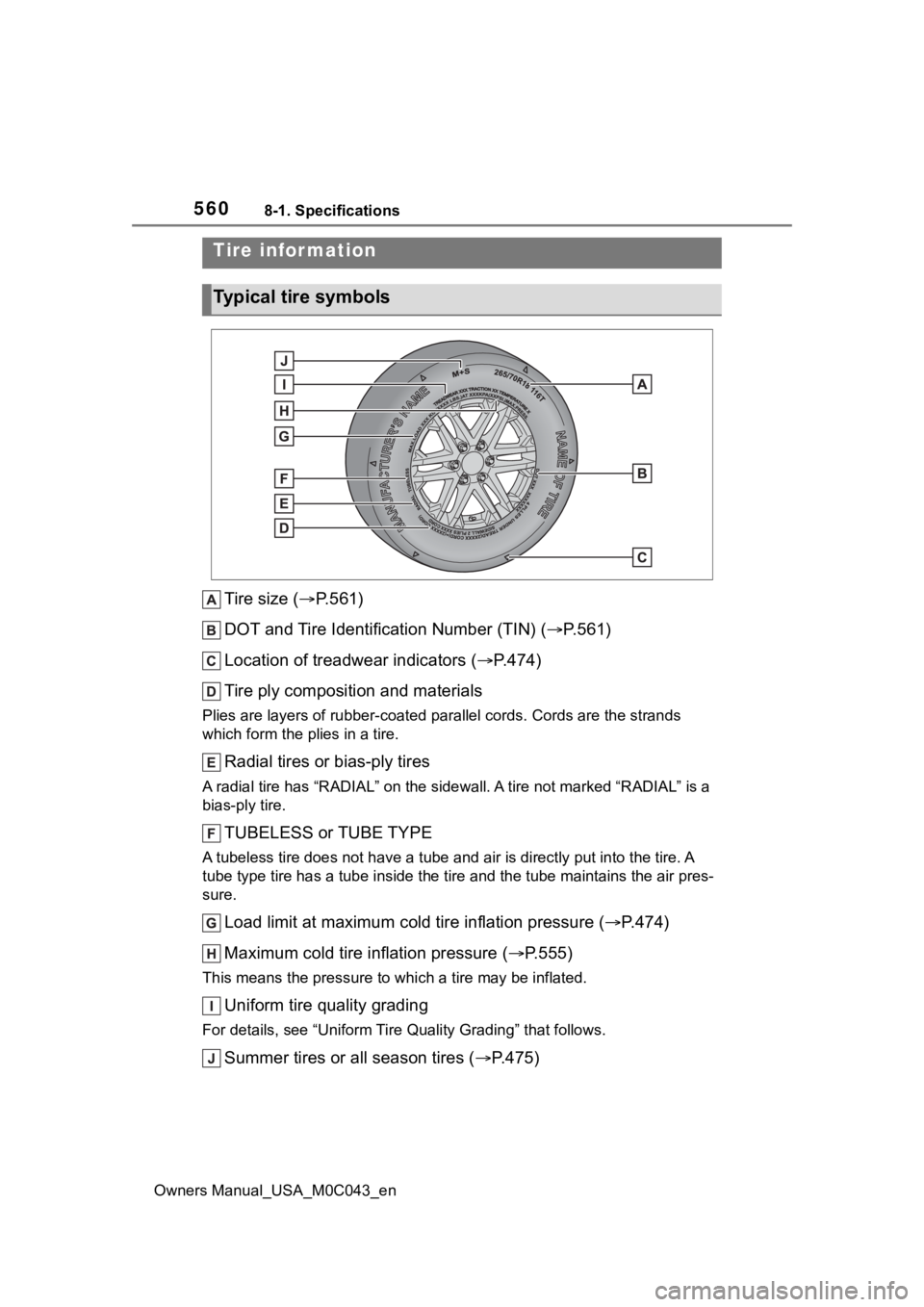
Tire size (P.561)
DOT and Tire Identification Number (TIN) ( P.561)
Location of treadwear indicators ( P.474)
Tire ply composition and materials
Plies are layers of rubber-coat ed parallel cords. Cords are the strands
which form the pl ies in a tire.
Radial tires or bias-ply tires
A radial tire has “RADIAL” on the sidewall. A tire not marked “ RADIAL” is a
bias-ply tire.
TUBELESS or TUBE TYPE
A tubeless tire does not have a tube and air is directly put into the tire. A
tube type tire has a tube inside t he tire and the tube maintains the air pres-
sure.
Load limit at maximum cold tire inflation pressure (P.474)
Maximum cold tire inflation pressure ( P.555)
This means the pressure to w hich a tire may be inflated.
Uniform tire quality grading
For details, see “Uniform Tire Quality Grading” that follows.
Summer tires or all season tires ( P.475)
Tire information
Typical tire symbols
Page 561 of 628
5618-1. Specifications
Owners Manual_USA_M0C043_en
8
Vehicle specifications
An all season tire has “M+S” on the sidewal l. A tire not marked “M+S” is a
summer tire.
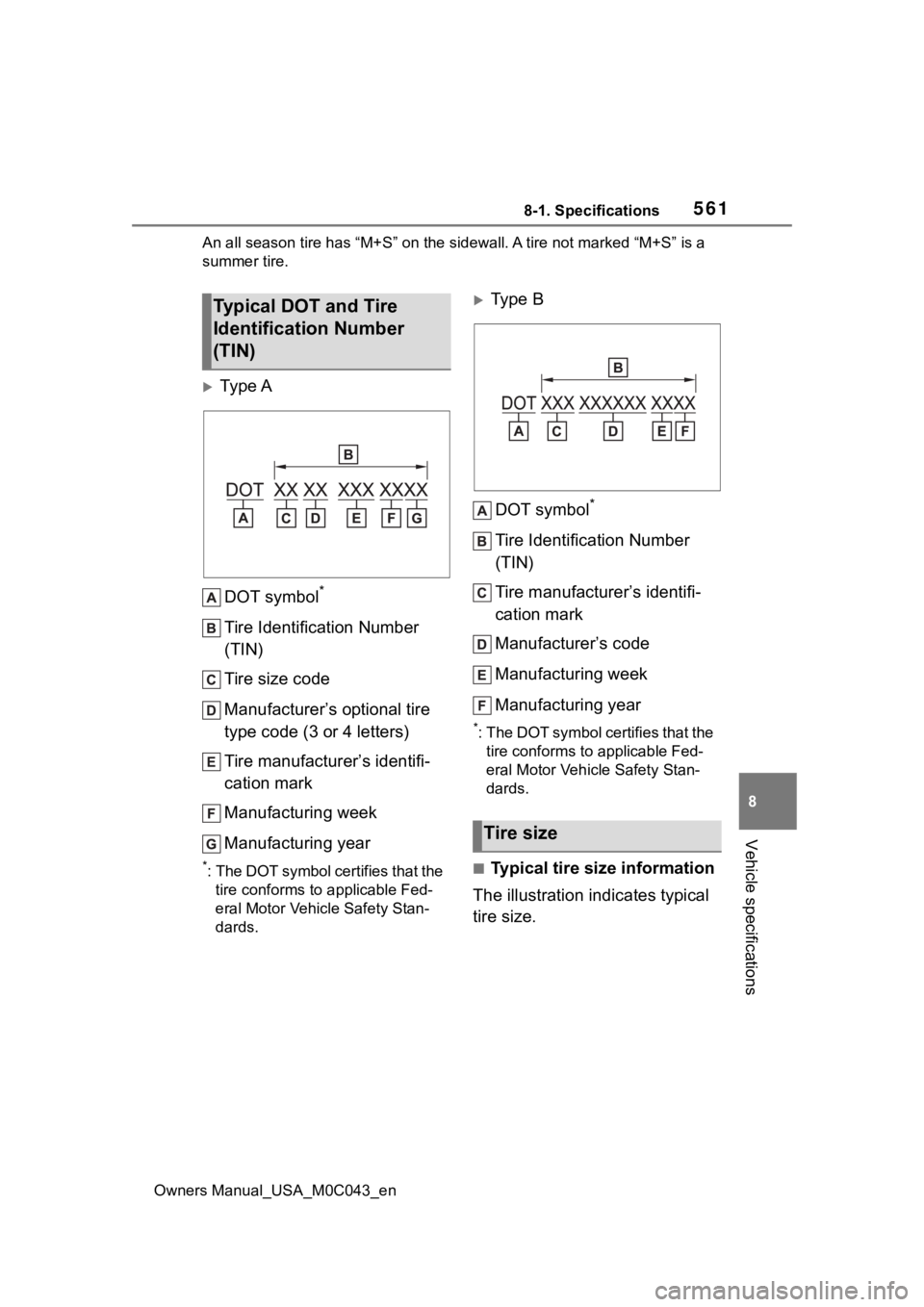
Ty p e A
DOT symbol
*
Tire Identification Number
(TIN)
Tire size code
Manufacturer’s optional tire
type code (3 or 4 letters)
Tire manufacturer’s identifi-
cation mark
Manufacturing week
Manufacturing year
*: The DOT symbol certifies that the tire conforms to applicable Fed-
eral Motor Vehicle Safety Stan-
dards.
Type B
DOT symbol
*
Tire Identification Number
(TIN)
Tire manufacturer’s identifi-
cation mark
Manufacturer’s code
Manufacturing week
Manufacturing year
*: The DOT symbol ce rtifies that the
tire conforms to applicable Fed-
eral Motor Vehicle Safety Stan-
dards.
■Typical tire size information
The illustration indicates typical
tire size.
Typical DOT and Tire
Identification Number
(TIN)
Tire size
Page 565 of 628
5658-1. Specifications
Owners Manual_USA_M0C043_en
8
Vehicle specifications
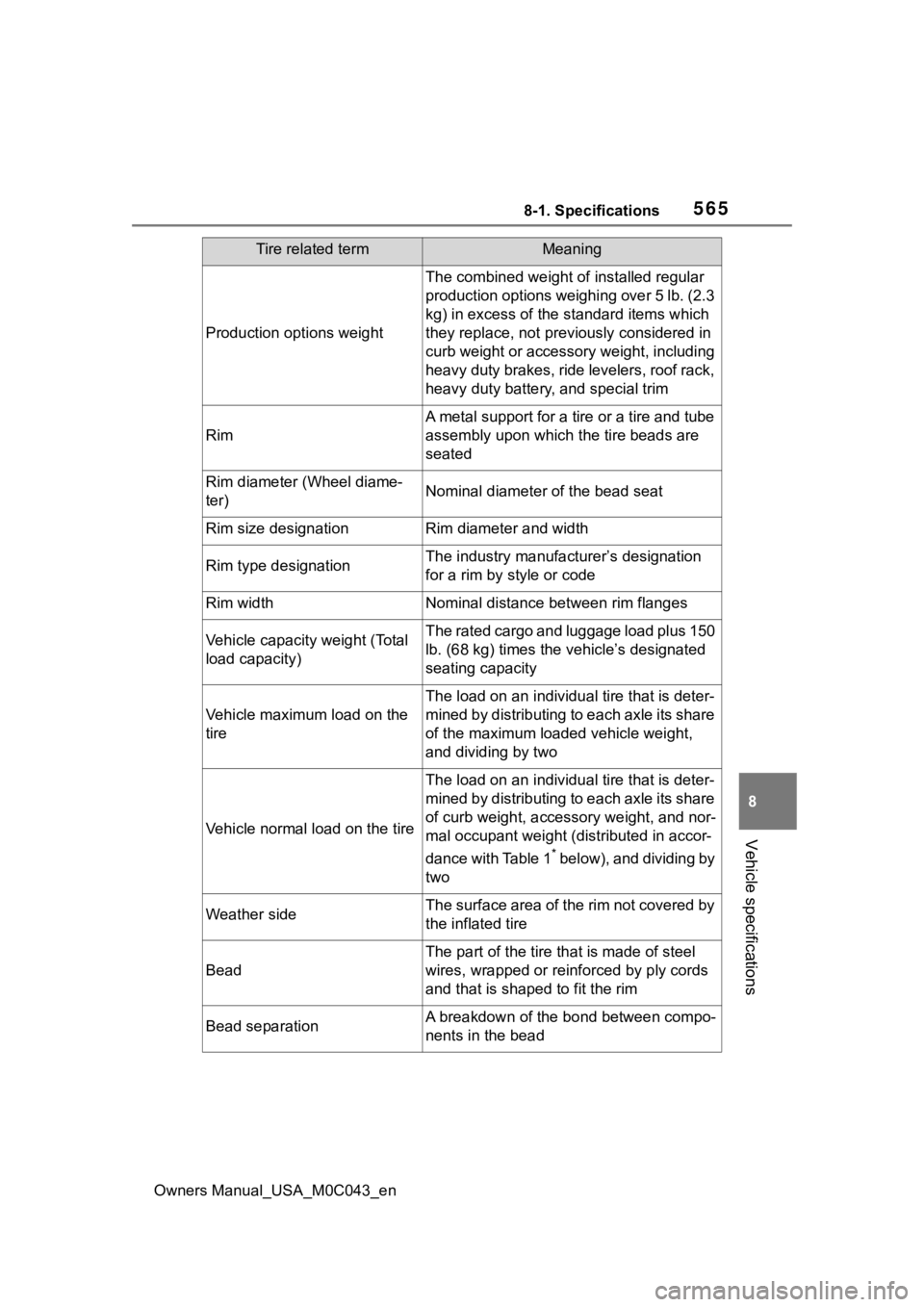
Production options weight
The combined weight of installed regular
production options weighing over 5 lb. (2.3
kg) in excess of the standard items which
they replace, not previously considered in
curb weight or accessory weight, including
heavy duty brakes, ride levelers, roof rack,
heavy duty battery, and special trim
Rim
A metal support for a tire or a tire and tube
assembly upon which the tire beads are
seated
Rim diameter (Wheel diame-
ter)Nominal diameter o f the bead seat
Rim size designationRim diameter and width
Rim type designationThe industry manufacturer’s designation
for a rim by style or code
Rim widthNominal distance between rim flanges
Vehicle capacity weight (Total
load capacity)The rated cargo and luggage load plus 150
lb. (68 kg) times the vehicle’s designated
seating capacity
Vehicle maximum load on the
tire
The load on an individua l tire that is deter-
mined by distributing to each axle its share
of the maximum loaded vehicle weight,
and dividing by two
Vehicle normal load on the tire
The load on an individua l tire that is deter-
mined by distributing to each axle its share
of curb weight, accessory weight, and nor-
mal occupant weight (distributed in accor-
dance with Table 1
* below), and dividing by
two
Weather sideThe surface area of the rim not covered by
the inflated tire
Bead
The part of the tire that is made of steel
wires, wrapped or reinforced by ply cords
and that is shaped to fit the rim
Bead separationA breakdown of the bond between compo-
nents in the bead
Tire related termMeaning
Page 628 of 628
628
Owners Manual_USA_M0C043_en
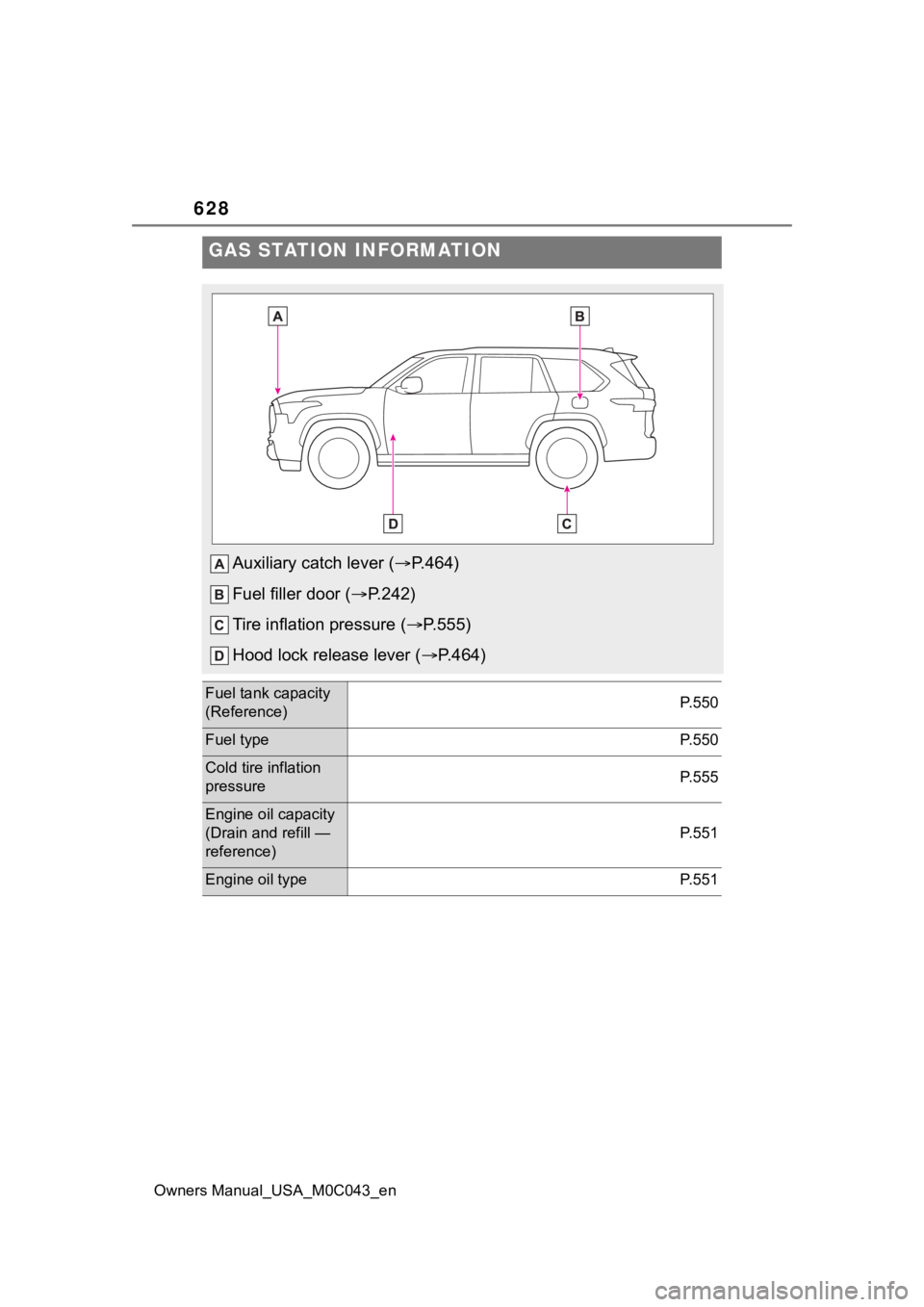
GAS STATION INFORMATION
Auxiliary catch lever (P.464)
Fuel filler door ( P.242)
Tire inflation pressure ( P.555)
Hood lock release lever ( P.464)
Fuel tank capacity
(Reference)P.550
Fuel typeP.550
Cold tire inflation
pressureP.555
Engine oil capacity
(Drain and refill —
reference)
P.551
Engine oil typeP.551