service TOYOTA SEQUOIA HYBRID 2023 Owner's Manual
[x] Cancel search | Manufacturer: TOYOTA, Model Year: 2023, Model line: SEQUOIA HYBRID, Model: TOYOTA SEQUOIA HYBRID 2023Pages: 628, PDF Size: 14.27 MB
Page 507 of 628
5077-2. Steps to take in an emergency
Owners Manual_USA_M0C043_en
7
When trouble arises
When using a flat-bed truck to
transport the vehicle, use tire
strapping belts. Refer to the
owner’s manual of the flat-bed
truck for the tire strapping
method.
In order to suppress vehicle
movement during transporta-
tion, set the parking brake and
turn the power switch off.
Your vehicle has not towing
hook. If towing is necessary, we
recommend having your vehicle
towed by your Toyota dealer or
commercial towing service.
Fluid leaks under the vehicle.
(Water dripping from the air
conditioning after use is nor-
mal.)
Flat-looking tires or uneven
tire wear
Engine coolant temperature
gauge needle continually
points higher than normal.
Voltmeter continually points
higher or lower than normal.
Engine oil pressure gauge
continually points lower than
normal.
Automatic transmission fluid
temperature warning mes-
sage is displayed
Changes in exhaust sound
Excessive tire squeal when
cornering
Strange noises related to the
suspension system
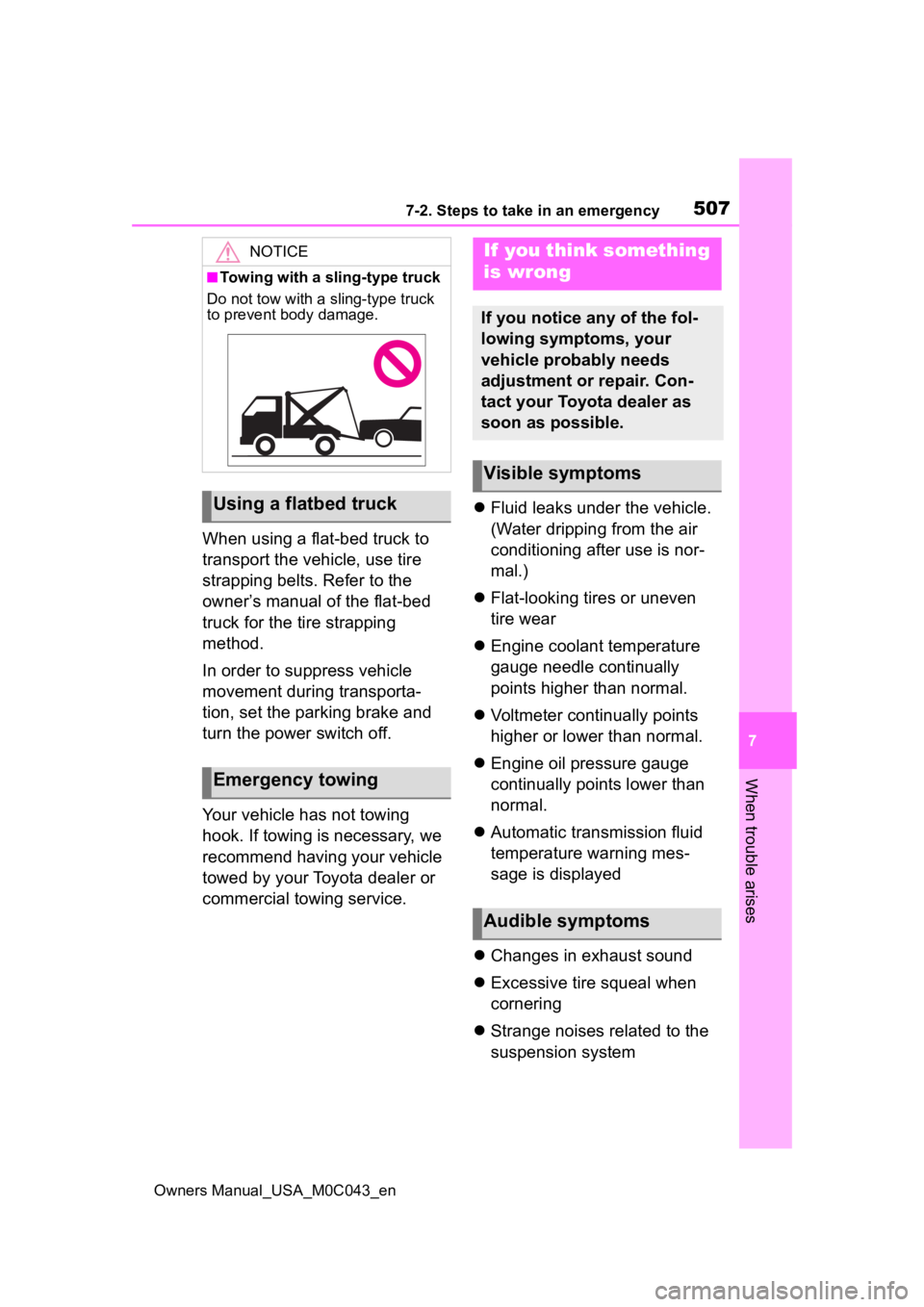
NOTICE
■Towing with a sling-type truck
Do not tow with a sling-type truck
to prevent body damage.
Using a flatbed truck
Emergency towing
If you think something
is wrong
If you notice any of the fol-
lowing symptoms, your
vehicle probably needs
adjustment or repair. Con-
tact your Toyota dealer as
soon as possible.
Visible symptoms
Audible symptoms
Page 532 of 628
5327-2. Steps to take in an emergency
Owners Manual_USA_M0C043_en
One of the following may be the
cause of the problem:
The electronic key may not be
functioning properly.
( P.535)
There may not be sufficient
fuel in the vehicle’s tank.
Refuel the vehicle.
There may be a malfunction
in the immobilizer system.
( P.83)
The hybrid system may be
malfunctioning due to an elec-
trical problem such as elec-
tronic key battery depletion or
a blown fuse. However,
depending on the type of mal-
function, an interim measure
is available to start the hybrid
system. ( P.533)
The temperature of the hybrid
battery (traction battery) may
be extremely low (below
NOTICE
■Do not drive the vehicle with
a flat tire
Do not continue driving with a flat
tire.
Driving even a short distance with
a flat tire can damage the tire and
the wheel beyond repair.
■Driving with tire chains and
the temporary spare tire
Do not fit tire chains to the tempo-
rary spare tire.
Tire chains may damage the vehi-
cle body and adversely affect driv-
ing performance.
■When stowing the flat tire
Ensure that there is no object
caught between the tire and the
vehicle underbody.
■When replacing the tires
When removing or fitting the
wheels, tires or the tire pressure
warning valve and transmitter,
contact your Toyota dealer as the
tire pressure warning valve and
transmitter may be damaged if not
handled correctly.
■To avoid damage to the tire
pressure warning valves and
transmitters
When a tire is repaired with liquid
sealants, the tire pressure warn-
ing valve and transmitter may not
operate properly. If a liquid seal-
ant is used, contact your Toyota
dealer or other qualified service
shop as soon as possible. Make
sure to replace the tire pressure
warning valve and transmitter
when replaci ng the tire. (P.478)
If the hybrid system
will not star t
Reasons for the hybrid sys-
tem not starting vary
depending on the situation.
Check the following and
perform the appropriate
procedure:
The hybrid system will not
start even though the cor-
rect starting procedure is
being followed. ( P.212)
Page 559 of 628
5598-1. Specifications
Owners Manual_USA_M0C043_en
8
Vehicle specifications
■Non-recommendation of the
use of gasoline containing MMT
Some gasoline contains an octane
enhancing additive called MMT
(Methylcyclopentadienyl Manga-
nese Tricarbonyl).
Toyota does not recommend the use
of gasoline that contains MMT. If
fuel containing MMT is used, your
emission control system may be
adversely affected.
The malfunction indicator lamp on
the instrument cluster may come on.
If this happens, contact your Toyota
dealer for service.
■If your engine knocks
●Consult your Toyota dealer.
●You may occasionally notice light
knocking for a short time while
accelerating or dr iving uphill. This
is normal and there is no need for
concern.
NOTICE
■Notice on fuel quality
●Do not use impro per fuels. If
improper fuels are used, the
engine will be damaged.
●Do not use leaded gasoline.
Leaded gasoline can cause
damage to your vehicle’s three-
way catalytic converters caus-
ing the emission control system
to malfunction.
●Do not use gasohol other than
the type previously stated.
Other gasohol may cause fuel
system damage or vehicle per-
formance problems.
●Using unleaded gasoline with
an octane number or rating
lower than the l evel previously
stated will cause persistent
heavy knocking.
At worst, this will lead to engine
damage.
■Fuel-related poor driveability
If poor driveability (poor hot start-
ing, vaporization, engine knock-
ing, etc.) is encountered after
using a different type of fuel, dis-
continue the use of that type of
fuel.
■When refueling with gasohol
Take care not to spill gasohol. It
can damage your vehicle’s paint.
Page 563 of 628

5638-1. Specifications
Owners Manual_USA_M0C043_en
8
Vehicle specifications
tion on uniform tire quality grad-
ing.
Your Toyota dealer will help answer
any questions you may have as you
read this information.
■DOT quality grades
All passenger vehicle tires must
conform to Federal Safety
Requirements in addition to
these grades. Quality grades
can be found where applicable
on the tire sidewall between
tread shoulder and maximum
section width.
For example: Treadwear 200 Trac-
tion AA Temperature A
■Treadwear
The treadwear grade is a com-
parative rating based on the
wear rate of the tire when tested
under controlled conditions on a
specified government test
course.
For example, a tire graded 150
would wear one and a half (1 - 1/2)
times as well on the government
course as a tire graded 100.
The relative perfo rmance of tires
depends upon the actual conditions
of their use. Performance may differ
significantly from the norm due to
variations in driving habits, service
practices and differences in road
characteristics and climate.
■Traction AA, A, B, C
The traction grades, from high-
est to lowest, are AA, A, B and
C, and they represent the tire’s
ability to stop on wet pavement as measured under controlled
conditions on specified govern-
ment test surfaces of asphalt
and concrete.
A tire marked C may have poor
traction performance.
Warning: The traction grade
assigned to this tire is based on
braking (straight ahead) traction
tests and does not include corner-
ing (turning) traction.
■Temperature A, B, C
The temperature grades are A
(the highest), B, and C, repre-
senting the tire’s resistance to
the generation of heat and its
ability to dissipate heat when
tested under controlled condi-
tions on a specified indoor labo-
ratory test wheel.
Sustained high temperature can
cause the material of the tire to
degenerate and reduce tire life, and
excessive temperature can lead to
sudden tire failure.
Grade C corresponds to a level of
performance which all passenger
car tires must meet under the Fed-
eral Motor Vehicle Safety Standard
No. 109.
Grades B and A represent higher
levels of performance on the labo-
ratory test wheel than the minimum
required by law.
Warning: The temperature grades
of a tire assume tha t it is properly
inflated and not overloaded.
Excessive speed, underinflation, or
excessive loading, either sepa-
rately or in combination, can cause
heat buildup and possible tire fail-
ure.
Page 610 of 628

610Alphabetical Index
Owners Manual_USA_M0C043_en
S
Safety Connect ......................... 70
Seat belt reminder light ......... 515
Seat belts .................................. 29 Adjusting the seat belt shoulder anchor height ....................... 34
Automatic Locking Retractor .. 31
Child restraint system installation ............................................. 56
Cleaning and maintaining the seat belt.............................. 453
Emergency Locking Retractor 31
How to wear your seat belt..... 30
How your child should wear the seat belt................................ 30
Pregnant women, proper seat belt use................................. 29
Reminder light and buzzer ... 515
Seat belt comfort guide .. 35, 585
Seat belt extender .................. 30
Seat belt pretensioners .......... 36
SRS warning light................. 510
Seat heaters ............................ 415
Seat position memory ............ 152
Seat ventilators ...................... 415
Seating capacity ............. 197, 549
Seats ................................ 144, 145 Adjustment ................... 144, 145
Adjustment precautions........ 144
Child seats/child restraint system installation ............................ 54
Cleaning ............................... 453
Driving position memory....... 152
Head restraints ..................... 155
Power easy access system .. 152
Properly sitting in the seat ...... 27
Seat heaters ......................... 415
Seat position memory .......... 152
Seat ventilators .................... 415 Sensor
Automatic headlight system .228
Automatic High Beam system...........................................231
BSM (Blind Spot M onitor) .....287
Digital Rear-view Mirror ........164
Dynamic radar cruise control with full-speed range ..........244
Inside rear view mirror ..........160
Intuitive parking assist ..........294
LTA (Lane Tracing Assist) .....261
Parking Support Brake function (rear-crossing vehicles) ......287
Parking Support Brake function (static objects) ....................294
PCS (Pre-Collisio n System) .244
Radar sensor ........................244
Rain-sensing windshield wipers ...........................................237
RCTA (Rear Cross Traffic Alert) ...........................................287
Service plug ..............................78
Shift lever ................................218 Automatic transm ission ........217
If th e s hif t le ver ca n no t b e s hif te d from P .................................218
Shift lever light........................418
Shift lock system ....................218
Side airbags ..............................37
Side marker lights Light switch...........................228
Replacing light bulbs ............498
Side mirrors Adjustment ...........................170
BSM (Blind Spot M onitor) .....286
Folding..................................171
Heaters .................................408
Mirror position me mory.........152
RCTA (Rear Cross Traffic Alert) ...........................................301