warning TOYOTA SIENNA 2000 Owner's Guide
[x] Cancel search | Manufacturer: TOYOTA, Model Year: 2000, Model line: SIENNA, Model: TOYOTA SIENNA 2000Pages: 282, PDF Size: 7.4 MB
Page 265 of 282
00 SIENNA(U)
259
If the new fuse immediately blows out,
there is a problem with the electrical sys-
tem. Have your Toyota dealer correct it as
soon as possible.
CAUTION
Never use a fuse with a higher am-
perage rating, or any other object, in
place of a fuse. This may cause ex-
tensive damage and possibly a fire.
Adding washer fluid
If any washer does not work or low
windshield washer fluid level warning
light comes on, the washer tank may be
empty. Add washer fluid.
You may use plain water as washer fluid.
However, in cold areas where tempera-
tures range below freezing point, use
washer fluid containing antifreeze. This
product is available at your Toyota dealer
and most auto parts stores. Follow the
manufacturer’s directions for how much to
mix with water.
NOTICE
Do not use engine antifreeze or any
other substitute because it may dam-
age your vehicle’s paint.
Replacing light bulbs—
The following illustrations show how to
gain access to the bulbs. When replacing
a bulb, make sure the ignition switch and
light switch are off. Use bulbs with the
wattage ratings given in the table.
CAUTION
Halogen bulbs have pressurized gas
inside and require special handling.
They can burst or shatter if scratched
or dropped. Hold a bulb only by its
plastic or metal case. Do not touch
the glass part of a bulb with bare
hands.
NOTICE
Only use a bulb of the listed type.
ProCarManuals.com
Page 277 of 282
00 SIENNA(U)
271
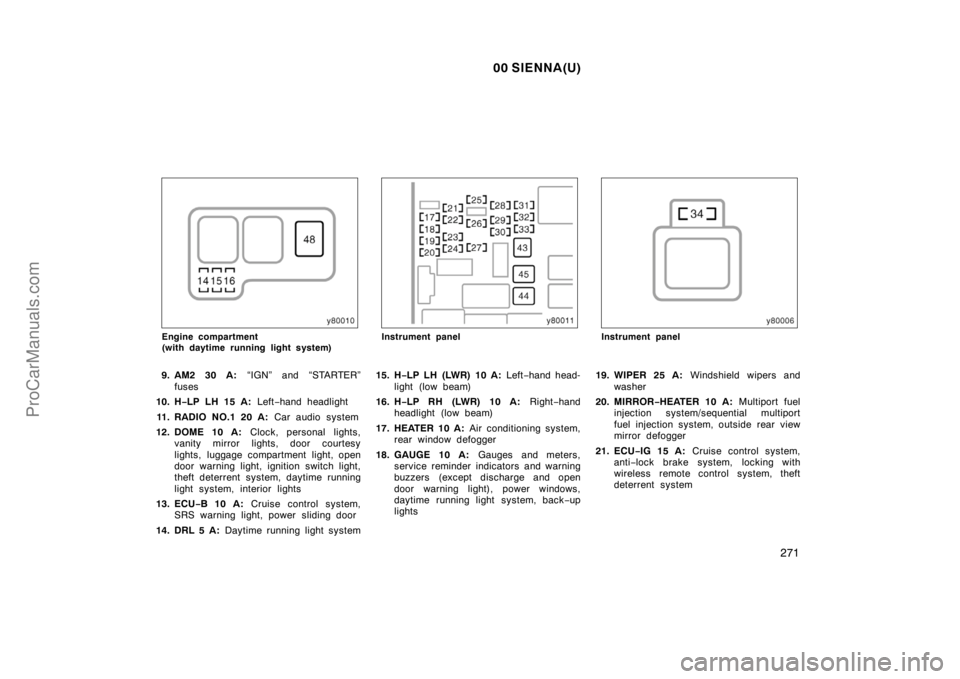
Engine compartment
(with daytime running light system)
9. AM2 30 A: “IGN” and “STARTER”
fuses
10. H−LP LH 15 A: Left−hand headlight
11. RADIO NO.1 20 A: Car audio system
12. DOME 10 A: Clock, personal lights,
vanity mirror lights, door courtesy
lights, luggage compartment light, open
door warning light, ignition switch light,
theft deterrent system, daytime running
light system, interior lights
13. ECU−B 10 A: Cruise control system,
SRS warning light, power sliding door
14. DRL 5 A: Daytime running light system
Instrument panel
15. H−LP LH (LWR) 10 A: Left−hand head-
light (low beam)
16. H−LP RH (LWR) 10 A: Right−hand
headlight (low beam)
17. HEATER 10 A: Air conditioning system,
rear window defogger
18. GAUGE 10 A: Gauges and meters,
service reminder indicators and warning
buzzers (except discharge and open
door warning light), power windows,
daytime running light system, back−up
lights
Instrument panel
19. WIPER 25 A: Windshield wipers and
washer
20. MIRROR−HEATER 10 A: Multiport fuel
injection system/sequential multiport
fuel injection system, outside rear view
mirror defogger
21. ECU−IG 15 A: Cruise control system,
anti−lock brake system, locking with
wireless remote control system, theft
deterrent system
ProCarManuals.com
Page 281 of 282

00 SIENNA(U)
275
Traction AA, A, B, C—The traction
grades, from highest to lowest, are AA, A,
B, and C, and they represent the tire’s
ability to stop on wet pavement as mea-
sured under controlled conditions on spe-
cified government test surfaces of asphalt
and concrete. A tire marked C may have
poor traction performance.
Warning: The traction grade assigned to
this tire is based on braking (straight
ahead) traction tests and does not include
cornering (turning) traction.
Temperature A, B, C—The temperature
grades are A (the highest), B, and C,
representing the tire’s resistance to the
generation of heat and its ability to dissi-
pate heat when tested under controlled
conditions on a specified indoor laboratory
test wheel. Sustained high temperature
can cause the material of the tire to de-
generate and reduce tire life, and exces-
sive temperature can lead to sudden tire
failure. The grade C corresponds to a lev-
el of performance which all passenger car
tires must meet under the Federal Motor
Vehicle Safety Standard No.109. Grades B
and A represent higher levels of perfor-
mance on the laboratory test wheel than
the minimum required by law.Warning: The temperature grades for this
tire are established for a tire that is prop-
erly inflated and not overloaded. Exces-
sive speed, underinflation, or excessive
loading, either separately or in combina-
tion, can cause heat buildup and possible
tire failure.
ProCarManuals.com