ECO mode TOYOTA SIENNA 2007 Service Owner's Manual
[x] Cancel search | Manufacturer: TOYOTA, Model Year: 2007, Model line: SIENNA, Model: TOYOTA SIENNA 2007Pages: 3000, PDF Size: 52.26 MB
Page 430 of 3000
ES–1242GR-FE ENGINE CONTROL SYSTEM – SFI SYSTEM
ES
DESCRIPTION
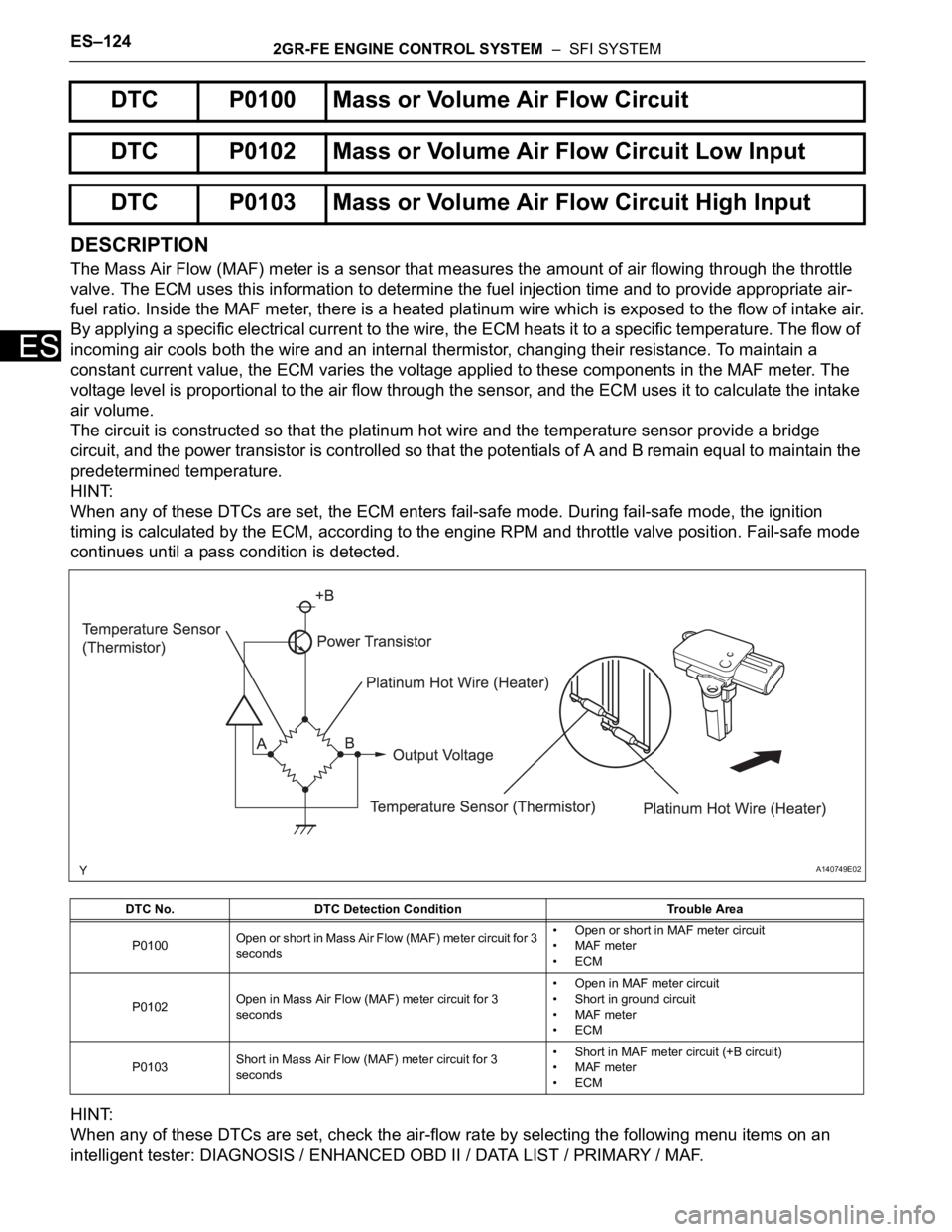
The Mass Air Flow (MAF) meter is a sensor that measures the amount of air flowing through the throttle
valve. The ECM uses this information to determine the fuel injection time and to provide appropriate air-
fuel ratio. Inside the MAF meter, there is a heated platinum wire which is exposed to the flow of intake air.
By applying a specific electrical current to the wire, the ECM heats it to a specific temperature. The flow of
incoming air cools both the wire and an internal thermistor, changing their resistance. To maintain a
constant current value, the ECM varies the voltage applied to these components in the MAF meter. The
voltage level is proportional to the air flow through the sensor, and the ECM uses it to calculate the intake
air volume.
The circuit is constructed so that the platinum hot wire and the temperature sensor provide a bridge
circuit, and the power transistor is controlled so that the potentials of A and B remain equal to maintain the
predetermined temperature.
HINT:
When any of these DTCs are set, the ECM enters fail-safe mode. During fail-safe mode, the ignition
timing is calculated by the ECM, according to the engine RPM and throttle valve position. Fail-safe mode
continues until a pass condition is detected.
HINT:
When any of these DTCs are set, check the air-flow rate by selecting the following menu items on an
intelligent tester: DIAGNOSIS / ENHANCED OBD II / DATA LIST / PRIMARY / MAF.
DTC P0100 Mass or Volume Air Flow Circuit
DTC P0102 Mass or Volume Air Flow Circuit Low Input
DTC P0103 Mass or Volume Air Flow Circuit High Input
DTC No. DTC Detection Condition Trouble Area
P0100Open or short in Mass Air Flow (MAF) meter circuit for 3
seconds• Open or short in MAF meter circuit
• MAF meter
•ECM
P0102Open in Mass Air Flow (MAF) meter circuit for 3
seconds• Open in MAF meter circuit
• Short in ground circuit
• MAF meter
•ECM
P0103Short in Mass Air Flow (MAF) meter circuit for 3
seconds• Short in MAF meter circuit (+B circuit)
• MAF meter
•ECM
A140749E02
Page 438 of 3000
ES–1322GR-FE ENGINE CONTROL SYSTEM – SFI SYSTEM
ES
DESCRIPTION
The Intake Air Temperature (IAT) sensor, mounted on the Mass Air Flow (MAF) meter, monitors the IAT.
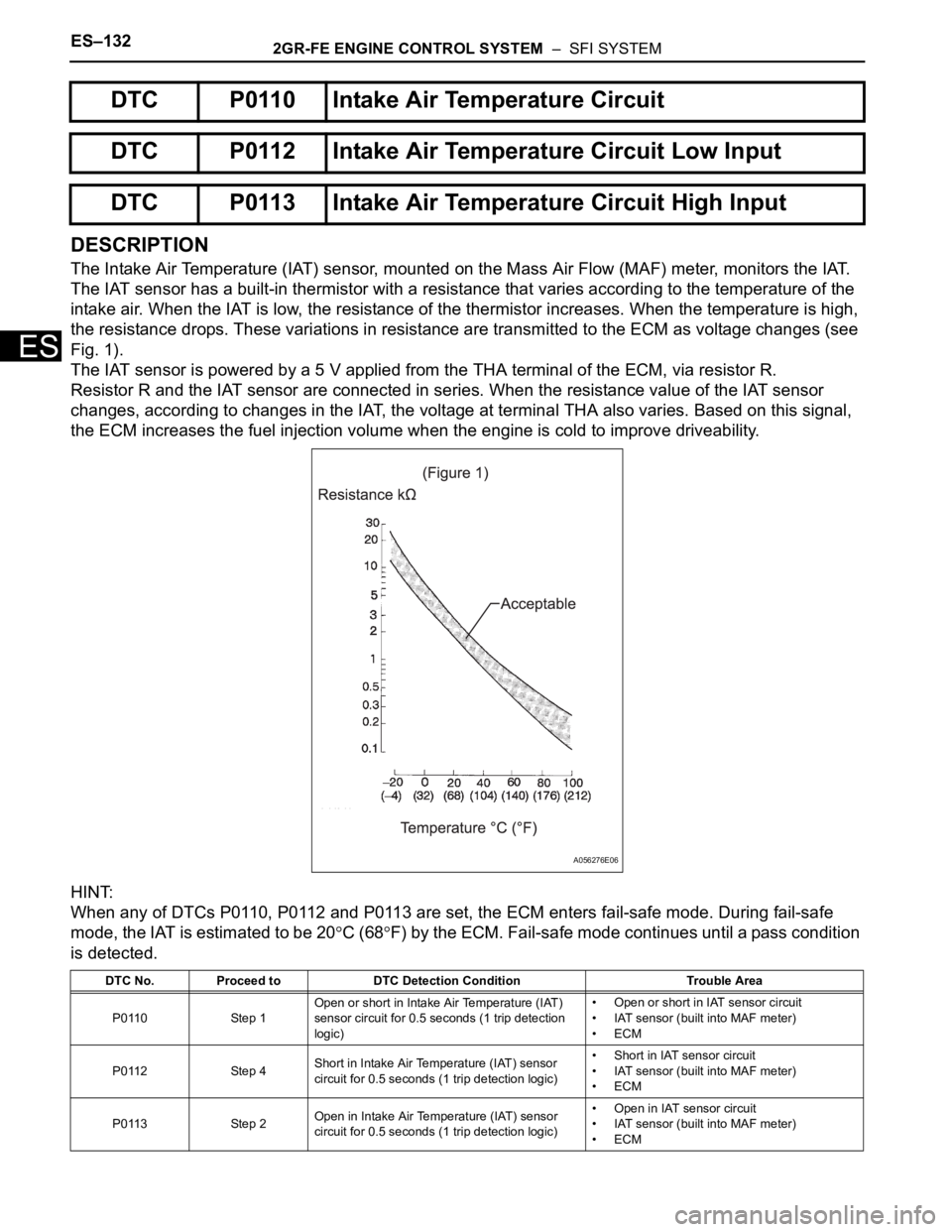
The IAT sensor has a built-in thermistor with a resistance that varies according to the temperature of the
intake air. When the IAT is low, the resistance of the thermistor increases. When the temperature is high,
the resistance drops. These variations in resistance are transmitted to the ECM as voltage changes (see
Fig. 1).
The IAT sensor is powered by a 5 V applied from the THA terminal of the ECM, via resistor R.
Resistor R and the IAT sensor are connected in series. When the resistance value of the IAT sensor
changes, according to changes in the IAT, the voltage at terminal THA also varies. Based on this signal,
the ECM increases the fuel injection volume when the engine is cold to improve driveability.
HINT:
When any of DTCs P0110, P0112 and P0113 are set, the ECM enters fail-safe mode. During fail-safe
mode, the IAT is estimated to be 20
C (68F) by the ECM. Fail-safe mode continues until a pass condition
is detected.
DTC P0110 Intake Air Temperature Circuit
DTC P0112 Intake Air Temperature Circuit Low Input
DTC P0113 Intake Air Temperature Circuit High Input
DTC No. Proceed to DTC Detection Condition Trouble Area
P0110 Step 1Open or short in Intake Air Temperature (IAT)
sensor circuit for 0.5 seconds (1 trip detection
logic)• Open or short in IAT sensor circuit
• IAT sensor (built into MAF meter)
•ECM
P0112 Step 4Short in Intake Air Temperature (IAT) sensor
circuit for 0.5 seconds (1 trip detection logic)• Short in IAT sensor circuit
• IAT sensor (built into MAF meter)
•ECM
P0113 Step 2Open in Intake Air Temperature (IAT) sensor
circuit for 0.5 seconds (1 trip detection logic)• Open in IAT sensor circuit
• IAT sensor (built into MAF meter)
•ECM
A056276E06
Page 447 of 3000

2GR-FE ENGINE CONTROL SYSTEM – SFI SYSTEMES–141
ES
DESCRIPTION
A thermistor is built into the Engine Coolant Temperature (ECT) sensor, of which the resistance value
varies according to the ECT.
The structure of the sensor and its connection to the ECM are the same as those of the Intake Air
Temperature (IAT) sensor.
HINT:
When any of DTCs P0115, P0117 and P0118 are set, the ECM enters fail-safe mode. During fail-safe
mode, the ECT is estimated to be 80
C (176F) by the ECM. Fail-safe mode continues until a pass
condition is detected.
HINT:
When any of these DTCs are set, check the ECT by selecting the following menu items on the intelligent
tester: DIAGNOSIS / ENHANCED OBD II / DATA LIST / PRIMARY / COOLANT TEMP.
MONITOR DESCRIPTION
The Engine Coolant Temperature (ECT) sensor is used to monitor the ECT. The ECT sensor has a
thermistor with a resistance that varies according to the temperature of the engine coolant. When the
coolant temperature becomes low, the resistance in the thermistor increases. When the temperature
becomes high, the resistance drops.
These variations in resistance are reflected in the voltage output from the sensor. The ECM monitors the
sensor voltage and uses this value to calculate the ECT. When the sensor output voltage deviates from
the normal operating range, the ECM interprets this as a fault in the ECT sensor and sets a DTC.
Example:
If the sensor voltage output is -40
C (-40F) for 0.5 seconds or more, the ECM determines that there is an
open in the ECT sensor circuit, and sets DTC P0118. Conversely, if the voltage output is more than 140
C
(284
F) for 0.5 seconds or more, the ECM determines that there is a short in the sensor circuit, and sets
DTC P0117.
If the malfunction is not repaired successfully, a DTC is set 0.5 seconds after the engine is next started.
MONITOR STRATEGY
DTC P0115 Engine Coolant Temperature Circuit
DTC P0117 Engine Coolant Temperature Circuit Low Input
DTC P0118 Engine Coolant Temperature Circuit High Input
DTC No. Proceed to DTC Detection Condition Trouble Area
P0115 Step 1Open or short in Engine Coolant Temperature
(ECT) sensor circuit for 0.5 seconds (1 trip
detection logic)• Open or short in ECT sensor circuit
• ECT sensor
•ECM
P0117 Step 4Short in Engine Coolant Temperature (ECT)
sensor circuit for 0.5 seconds (1 trip detection
logic)• Short in ECT sensor circuit
• ECT sensor
•ECM
P0118 Step 2Open in Engine Coolant Temperature (ECT)
sensor circuit for 0.5 seconds (1 trip detection
logic)• Open in ECT sensor circuit
• ECT sensor
•ECM
Temperature Displayed Malfunctions
-40
C (-40F) Open circuit
140
C (284F) or higher Short circuit
Related DTCsP0115: Engine coolant temperature sensor open/short (Fluctuating)
P0117: Engine coolant temperature sensor short (Low electrical voltage)
P0118: Engine coolant temperature sensor open (High electrical voltage)
Page 467 of 3000
2GR-FE ENGINE CONTROL SYSTEM – SFI SYSTEMES–161
ES
FAIL-SAFE
When this DTC, as well as other DTCs relating to ETCS (Electronic Throttle Control System)
malfunctions, is set, the ECM enters fail-safe mode. During fail-safe mode, the ECM cuts the current to
the throttle actuator off, and the throttle valve is returned to a 6.5
throttle angle by the return spring. The
ECM then adjusts the engine output by controlling the fuel injection (intermittent fuel-cut) and ignition
timing, in accordance with the accelerator pedal opening angle, to allow the vehicle to continue at a
minimal speed. If the accelerator pedal is depressed slowly, the vehicle can be driven slowly.
Fail-safe mode continues until a pass condition is detected, and the ignition switch is then turned off.
INSPECTION PROCEDURE
HINT:
Read freeze frame data using the intelligent tester. The ECM records vehicle and driving condition
information as freeze frame data the moment a DTC is stored. When troubleshooting, freeze frame data
can be helpful in determining whether the vehicle was running or stopped, whether the engine was
warmed up or not, whether the air-fuel ratio was lean or rich, as well as other data recorded at the time of
a malfunction.
(a) Connect the intelligent tester to the DLC3.
(b) Turn the ignition switch to the ON position.
(c) Turn the tester ON.
(d) Enter the following menus: DIAGNOSIS / ENHANCED
OBD II / DTC INFO / CURRENT CODES.
(e) Read the DTC.
Result
HINT:
If any DTCs other than P0121 are output, troubleshoot
those DTCs first.
B
A
1CHECK ANY OTHER DTC OUTPUT (IN ADDITION TO DTC P0121)
Display (DTC output) Proceed to
P0121 A
P0121 and other DTCs B
GO TO DTC CHART
REPLACE THROTTLE BODY
Page 486 of 3000
ES–1802GR-FE ENGINE CONTROL SYSTEM – SFI SYSTEM
ES
OK
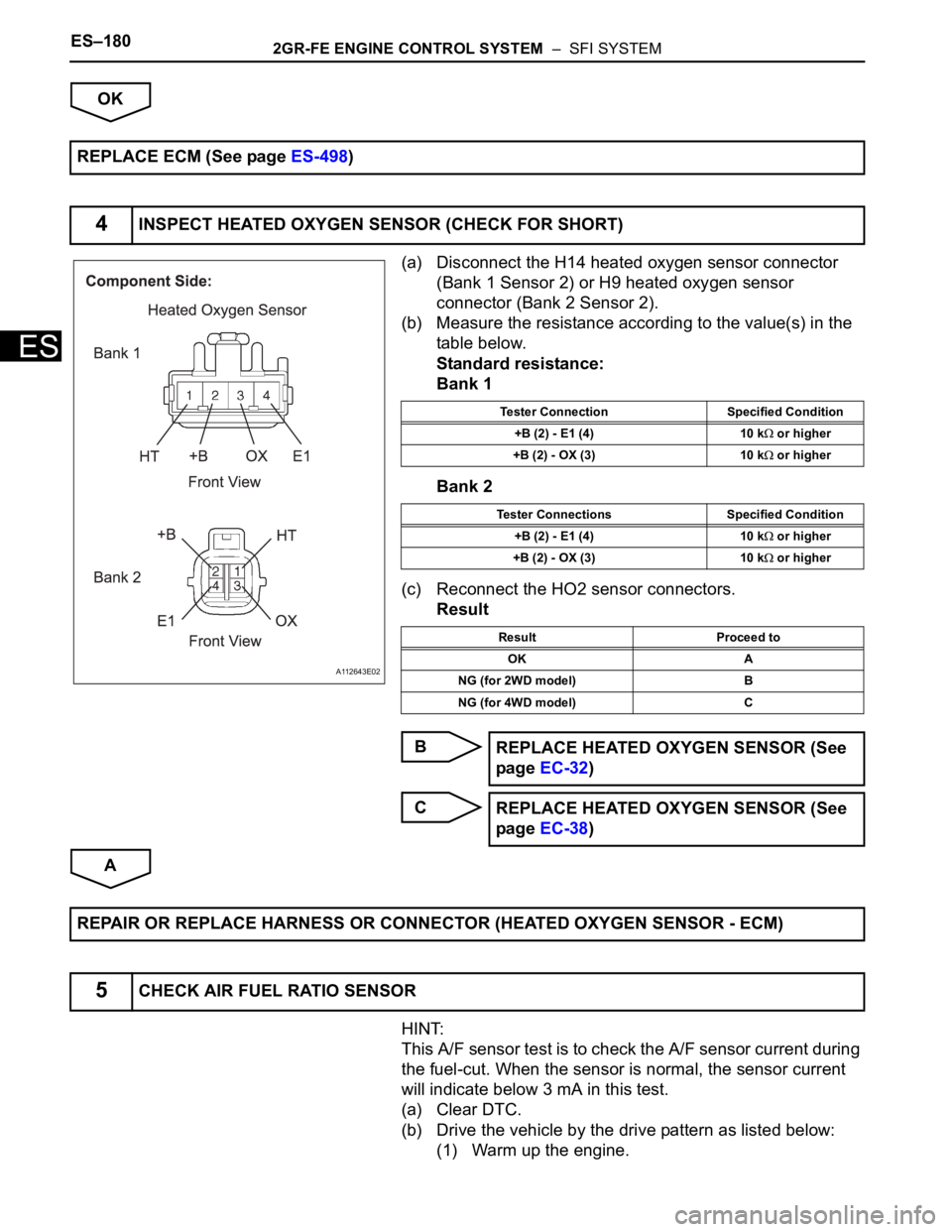
(a) Disconnect the H14 heated oxygen sensor connector
(Bank 1 Sensor 2) or H9 heated oxygen sensor
connector (Bank 2 Sensor 2).
(b) Measure the resistance according to the value(s) in the
table below.
Standard resistance:
Bank 1
Bank 2
(c) Reconnect the HO2 sensor connectors.
Result
B
C
A
HINT:
This A/F sensor test is to check the A/F sensor current during
the fuel-cut. When the sensor is normal, the sensor current
will indicate below 3 mA in this test.
(a) Clear DTC.
(b) Drive the vehicle by the drive pattern as listed below:
(1) Warm up the engine. REPLACE ECM (See page ES-498)
4INSPECT HEATED OXYGEN SENSOR (CHECK FOR SHORT)
A112643E02
Tester Connection Specified Condition
+B (2) - E1 (4) 10 k
or higher
+B (2) - OX (3) 10 k
or higher
Tester Connections Specified Condition
+B (2) - E1 (4) 10 k
or higher
+B (2) - OX (3) 10 k
or higher
Result Proceed to
OK A
NG (for 2WD model) B
NG (for 4WD model) C
REPLACE HEATED OXYGEN SENSOR (See
page EC-32)
REPLACE HEATED OXYGEN SENSOR (See
page EC-38)
REPAIR OR REPLACE HARNESS OR CONNECTOR (HEATED OXYGEN SENSOR - ECM)
5CHECK AIR FUEL RATIO SENSOR
Page 491 of 3000
2GR-FE ENGINE CONTROL SYSTEM – SFI SYSTEMES–185
ES
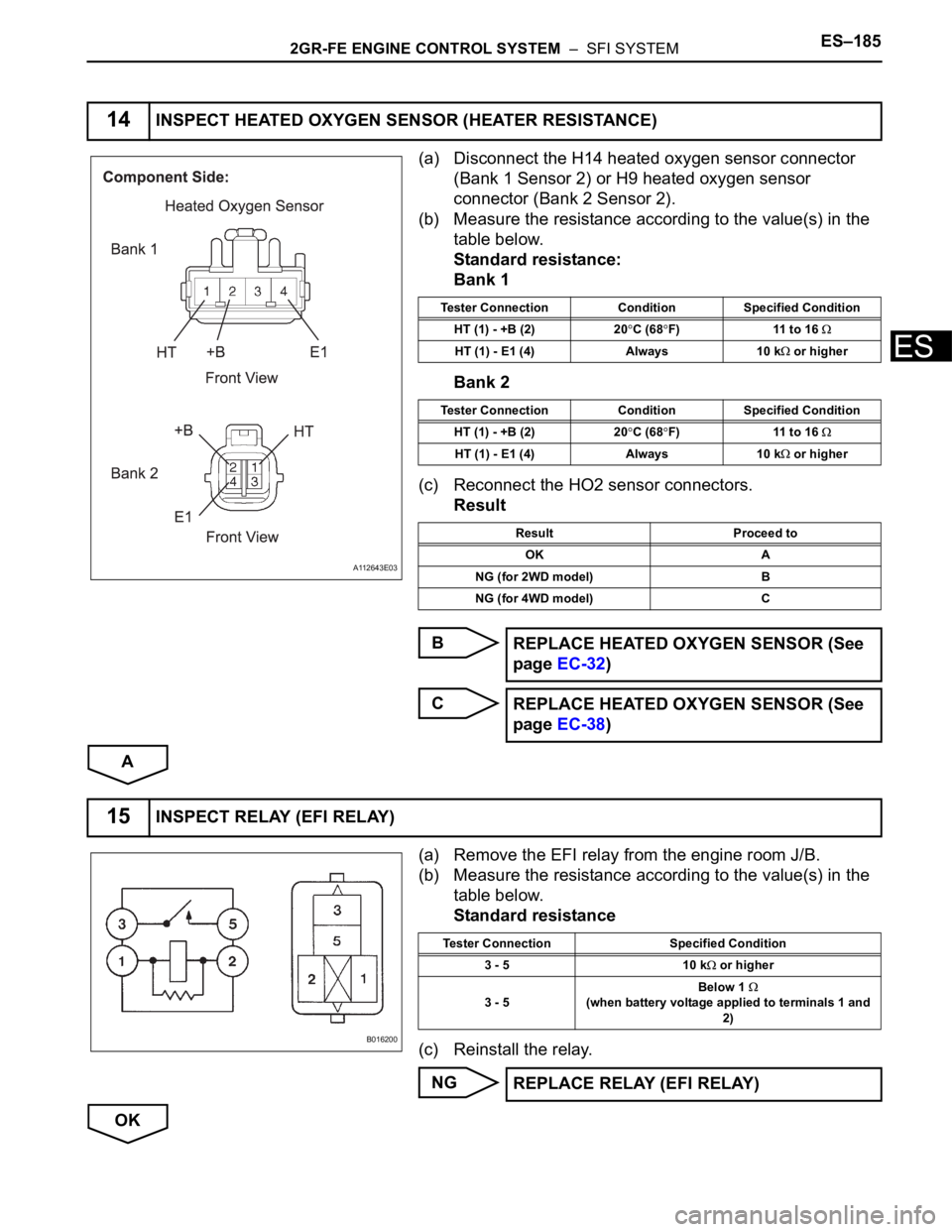
(a) Disconnect the H14 heated oxygen sensor connector
(Bank 1 Sensor 2) or H9 heated oxygen sensor
connector (Bank 2 Sensor 2).
(b) Measure the resistance according to the value(s) in the
table below.
Standard resistance:
Bank 1
Bank 2
(c) Reconnect the HO2 sensor connectors.
Result
B
C
A
(a) Remove the EFI relay from the engine room J/B.
(b) Measure the resistance according to the value(s) in the
table below.
Standard resistance
(c) Reinstall the relay.
NG
OK
14INSPECT HEATED OXYGEN SENSOR (HEATER RESISTANCE)
A112643E03
Tester Connection Condition Specified Condition
HT (1) - +B (2) 20
C (68F) 11 to 16
HT (1) - E1 (4) Always 10 k or higher
Tester Connection Condition Specified Condition
HT (1) - +B (2) 20
C (68F) 11 to 16
HT (1) - E1 (4) Always 10 k or higher
Result Proceed to
OK A
NG (for 2WD model) B
NG (for 4WD model) C
REPLACE HEATED OXYGEN SENSOR (See
page EC-32)
REPLACE HEATED OXYGEN SENSOR (See
page EC-38)
15INSPECT RELAY (EFI RELAY)
B016200
Tester Connection Specified Condition
3 - 5 10 k
or higher
3 - 5Below 1
(when battery voltage applied to terminals 1 and
2)
REPLACE RELAY (EFI RELAY)
Page 502 of 3000
ES–1962GR-FE ENGINE CONTROL SYSTEM – SFI SYSTEM
ES
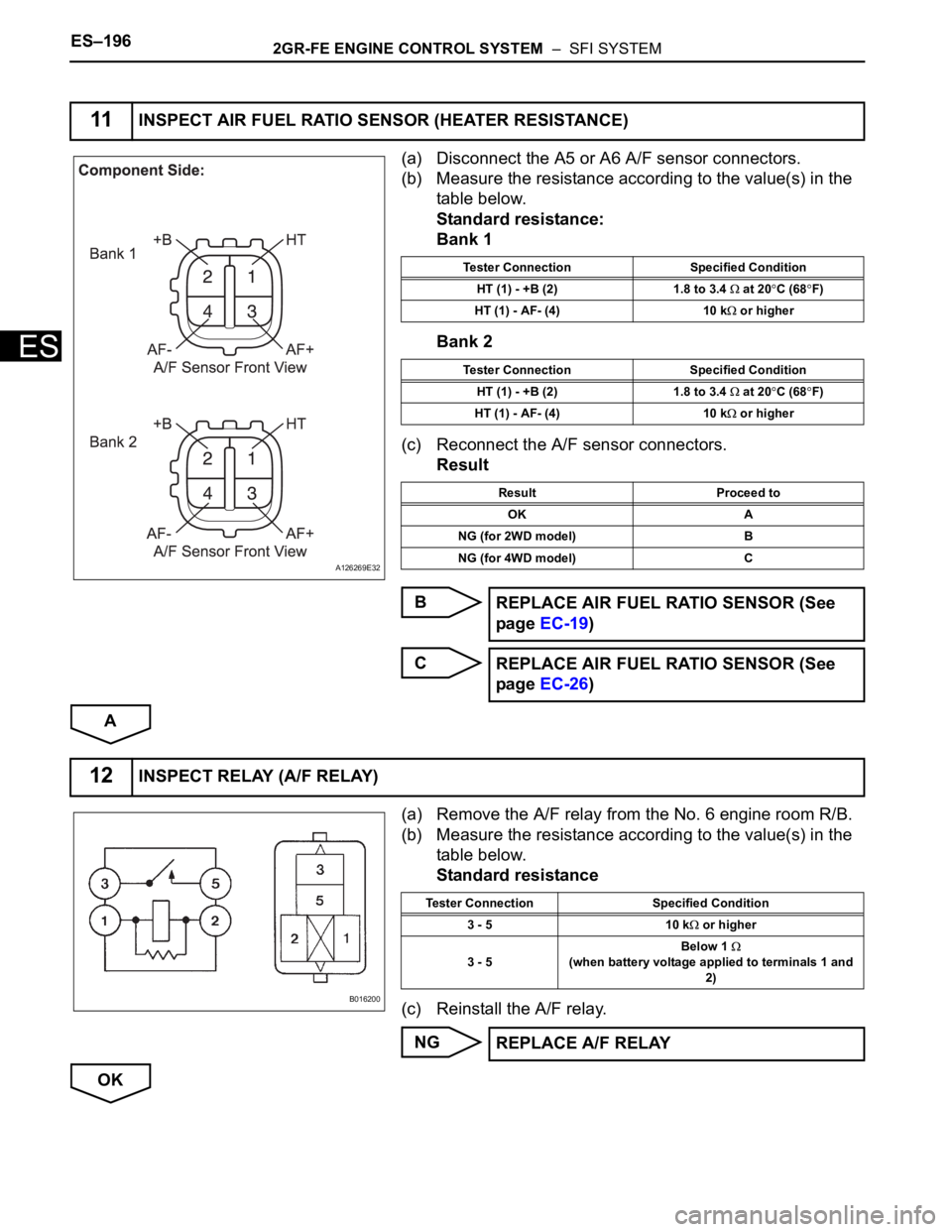
(a) Disconnect the A5 or A6 A/F sensor connectors.
(b) Measure the resistance according to the value(s) in the
table below.
Standard resistance:
Bank 1
Bank 2
(c) Reconnect the A/F sensor connectors.
Result
B
C
A
(a) Remove the A/F relay from the No. 6 engine room R/B.
(b) Measure the resistance according to the value(s) in the
table below.
Standard resistance
(c) Reinstall the A/F relay.
NG
OK
11INSPECT AIR FUEL RATIO SENSOR (HEATER RESISTANCE)
A126269E32
Tester Connection Specified Condition
HT (1) - +B (2) 1.8 to 3.4
at 20C (68F)
HT (1) - AF- (4) 10 k
or higher
Tester Connection Specified Condition
HT (1) - +B (2) 1.8 to 3.4
at 20C (68F)
HT (1) - AF- (4) 10 k
or higher
Result Proceed to
OK A
NG (for 2WD model) B
NG (for 4WD model) C
REPLACE AIR FUEL RATIO SENSOR (See
page EC-19)
REPLACE AIR FUEL RATIO SENSOR (See
page EC-26)
12INSPECT RELAY (A/F RELAY)
B016200
Tester Connection Specified Condition
3 - 5 10 k
or higher
3 - 5Below 1
(when battery voltage applied to terminals 1 and
2)
REPLACE A/F RELAY
Page 513 of 3000
2GR-FE ENGINE CONTROL SYSTEM – SFI SYSTEMES–207
ES
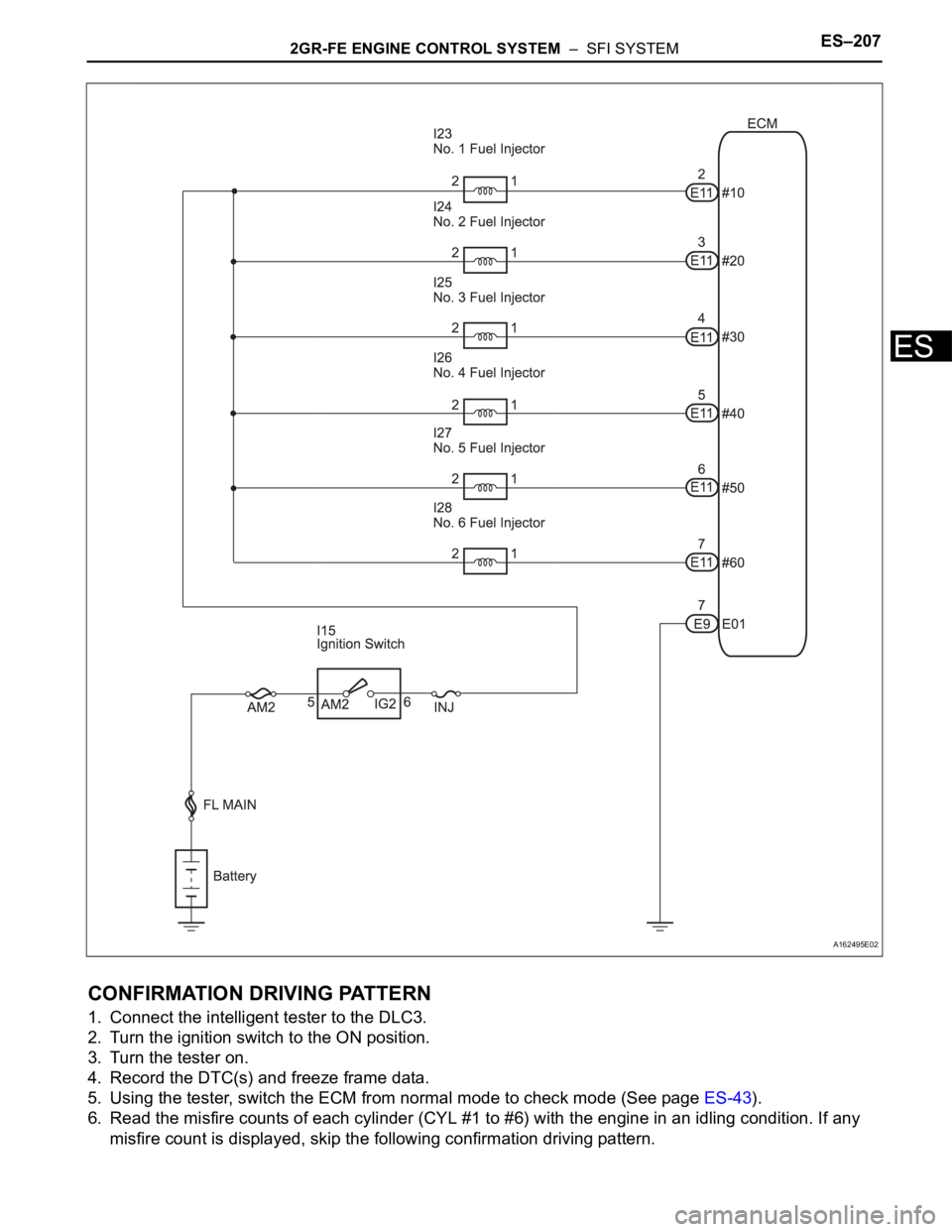
CONFIRMATION DRIVING PATTERN
1. Connect the intelligent tester to the DLC3.
2. Turn the ignition switch to the ON position.
3. Turn the tester on.
4. Record the DTC(s) and freeze frame data.
5. Using the tester, switch the ECM from normal mode to check mode (See page ES-43).
6. Read the misfire counts of each cylinder (CYL #1 to #6) with the engine in an idling condition. If any
misfire count is displayed, skip the following confirmation driving pattern.
A162495E02
Page 514 of 3000

ES–2082GR-FE ENGINE CONTROL SYSTEM – SFI SYSTEM
ES
7. Drive the vehicle several times with the conditions, such as engine rpm and engine load, shown in
MISFIRE RPM and MISFIRE LOAD in the Data List.
HINT:
• In order to store misfire DTCs, it is necessary to operate the vehicle for the period of time shown in
the table below, using the MISFIRE RPM and MISFIRE LOAD in the Data List.
8. Check whether misfires have occurred by checking DTCs and freeze frame data.
HINT:
Do not turn the ignition switch off until the stored DTC(s) and freeze frame data have been recorded.
When the ECM returns to normal mode (default), the stored DTC(s), freeze frame data and other data
will be erased.
9. Record the DTC(s), freeze frame data and misfire counts.
10.Turn the ignition switch OFF and wait for at least 5 seconds.
INSPECTION PROCEDURE
HINT:
• If any DTCs other than misfire DTCs are output, troubleshoot those DTCs first.
• Read freeze frame data using the intelligent tester or Techstream. Freeze frame data records the
engine condition when malfunctions are detected. When troubleshooting, freeze frame data can help
determine if the vehicle was moving or stationary, if the engine was warmed up or not, if the air-fuel
ratio was lean or rich, and other data from the time the malfunction occurred.
• If the misfire does not recur when the vehicle is brought to the workshop, reproduce the conditions
stored in the ECM as freeze frame data.
• If the misfire still cannot be reproduced even though the conditions stored in the ECM as freeze frame
data have been reproduced, one of the following factors is considered to be a possible cause of the
problem:
(a) There was insufficient fuel volume in the tank.
(b) Improper fuel is used.
(c) The spark plugs have been contaminated.
• After finishing repairs, check the misfire counts of the cylinders (CYL #1, #2, #3, #4, #5, #6).
• Be sure to confirm that no misfiring cylinder DTCs are set again by conducting the confirmation driving
pattern after finishing repairs.
• For 6 and 8 cylinder engines, the ECM intentionally does not set the specific misfiring cylinder DTCs at
high engine RPM. If misfires occur only in high engine RPM areas, only DTC P0300 is set.
In the event of DTC P0300 being present, perform the following operations:
(a) Clear the DTC (See page ES-39).
(b) Start the engine and conduct the confirmation driving pattern.
(c) Read the misfiring rates of each cylinder or DTC(s) using the tester.
(d) Repair the cylinder(s) that has a high misfiring rate or is indicated by the DTC.
(e) After finishing repairs, conduct the confirmation driving pattern again, in order to verify that DTC
P0300 is not set.
• When one of SHORT FT #1, LONG FT #1, SHORT FT #2 or LONG FT #2 in the freeze frame data is
outside the range of +/-20%, the air-fuel ratio may be Rich (-20% or less) or Lean (+20% or more).
• When the COOLANT TEMP in the freeze frame data is less than 75
C (167F), the misfire have
occurred only while warming up the engine.
Engine RPM Duration
Idling 3.5 minutes or more
1000 3 minutes or more
2000 1.5 minutes or more
3000 1 minute or more
Page 602 of 3000
2GR-FE ENGINE CONTROL SYSTEM – SFI SYSTEMES–309
ES
NOTICE:
In this operation, the engine must be cold (the same level
as the engine coolant temperature recorded in the freeze
frame data).
(a) Connect the intelligent tester to the DLC3.
(b) Turn the ignition switch to the ON position.
(c) Turn the tester on.
(d) Clear the DTCs (See page ES-39).
(e) Switch the ECM from normal mode to check mode using
the tester (See page ES-43).
(f) Start the engine to idle for a minute.
OK:
Stable fast idling.
(g) Read the DTCs.
OK:
No DTC output.
NEXT
15CHECK WHETHER DTC OUTPUT RECURS (DTC P050A)
END