tire pressure TOYOTA SIENNA 2007 Service Repair Manual
[x] Cancel search | Manufacturer: TOYOTA, Model Year: 2007, Model line: SIENNA, Model: TOYOTA SIENNA 2007Pages: 3000, PDF Size: 52.26 MB
Page 50 of 3000

IN–38INTRODUCTION – HOW TO TROUBLESHOOT ECU CONTROLLED SYSTEMS
IN
HINT:
• In troubleshooting, confirm that the problem symptoms
have been accurately identified. Preconceptions should be
discarded in order to make an accurate judgment. To
clearly understand what the problem symptoms are, it is
extremely important to ask the customer about the
problem and the conditions at the time the malfunction
occurred.
• Gather as much information as possible for reference.
Past problems that seem unrelated may also help in some
cases.
• The following 5 items are important points in the problem
analysis:
3. SYMPTOM CONFIRMATION AND DIAGNOSTIC
TROUBLE CODE
HINT:
The diagnostic system in the SIENNA has various
functions.
• The first function is the Diagnostic Trouble Code
(DTC) check. A DTC is a code stored in the ECU
memory whenever a malfunction in the signal circuits
to the ECU occurs. In a DTC check, a previous
malfunction's DTC can be checked by a technician
during troubleshooting.
• Another function is the Input Signal Check, which
checks if the signals from various switches are sent to
the ECU correctly.
By using these functions, the problem areas can be
narrowed down and troubleshooting is more effective.
Diagnostic functions are incorporated in the following
system in the SIENNA.
What Vehicle model, system name
When Date, time, occurrence frequency
Where Road conditions
Under what conditions? Running conditions, driving conditions, weather conditions
How did it happen? Problem symptoms
SystemSYMPTOM CONFIRMATION AND DIAGNOSTIC TROUBLE CODE
DTC Check
(Normal Mode)DTC Check
(Check Mode)Sensor Check/
Test Mode
(Input Signal
Check)Data List Active Test
2GR-FE SFI System
X
U151E Automatic Transaxle SystemX
U151F Automatic Transaxle SystemX
Tire pressure warning systemXX
Anti-lock Brake System
X
Vehicle Stability Control SystemX
Air Conditioning System (for Manual Air
Conditioning System)XXXXX
Air Conditioning System (for Automatic Air
Conditioning System)
XX
Airbag SystemXX
Occupant Classification System
XXX
Page 68 of 3000

IN–38INTRODUCTION – HOW TO TROUBLESHOOT ECU CONTROLLED SYSTEMS
IN
HINT:
• In troubleshooting, confirm that the problem symptoms
have been accurately identified. Preconceptions should be
discarded in order to make an accurate judgment. To
clearly understand what the problem symptoms are, it is
extremely important to ask the customer about the
problem and the conditions at the time the malfunction
occurred.
• Gather as much information as possible for reference.
Past problems that seem unrelated may also help in some
cases.
• The following 5 items are important points in the problem
analysis:
3. SYMPTOM CONFIRMATION AND DIAGNOSTIC
TROUBLE CODE
HINT:
The diagnostic system in the SIENNA has various
functions.
• The first function is the Diagnostic Trouble Code
(DTC) check. A DTC is a code stored in the ECU
memory whenever a malfunction in the signal circuits
to the ECU occurs. In a DTC check, a previous
malfunction's DTC can be checked by a technician
during troubleshooting.
• Another function is the Input Signal Check, which
checks if the signals from various switches are sent to
the ECU correctly.
By using these functions, the problem areas can be
narrowed down and troubleshooting is more effective.
Diagnostic functions are incorporated in the following
system in the SIENNA.
What Vehicle model, system name
When Date, time, occurrence frequency
Where Road conditions
Under what conditions? Running conditions, driving conditions, weather conditions
How did it happen? Problem symptoms
SystemSYMPTOM CONFIRMATION AND DIAGNOSTIC TROUBLE CODE
DTC Check
(Normal Mode)DTC Check
(Check Mode)Sensor Check/
Test Mode
(Input Signal
Check)Data List Active Test
2GR-FE SFI System
X
U151E Automatic Transaxle SystemX
U151F Automatic Transaxle SystemX
Tire pressure warning systemXX
Anti-lock Brake System
X
Vehicle Stability Control SystemX
Air Conditioning System (for Manual Air
Conditioning System)XXXXX
Air Conditioning System (for Automatic Air
Conditioning System)
XX
Airbag SystemXX
Occupant Classification System
XXX
Page 173 of 3000
TIRE AND WHEEL – TIRE AND WHEEL SYSTEMTW–3
TW
INSPECTION
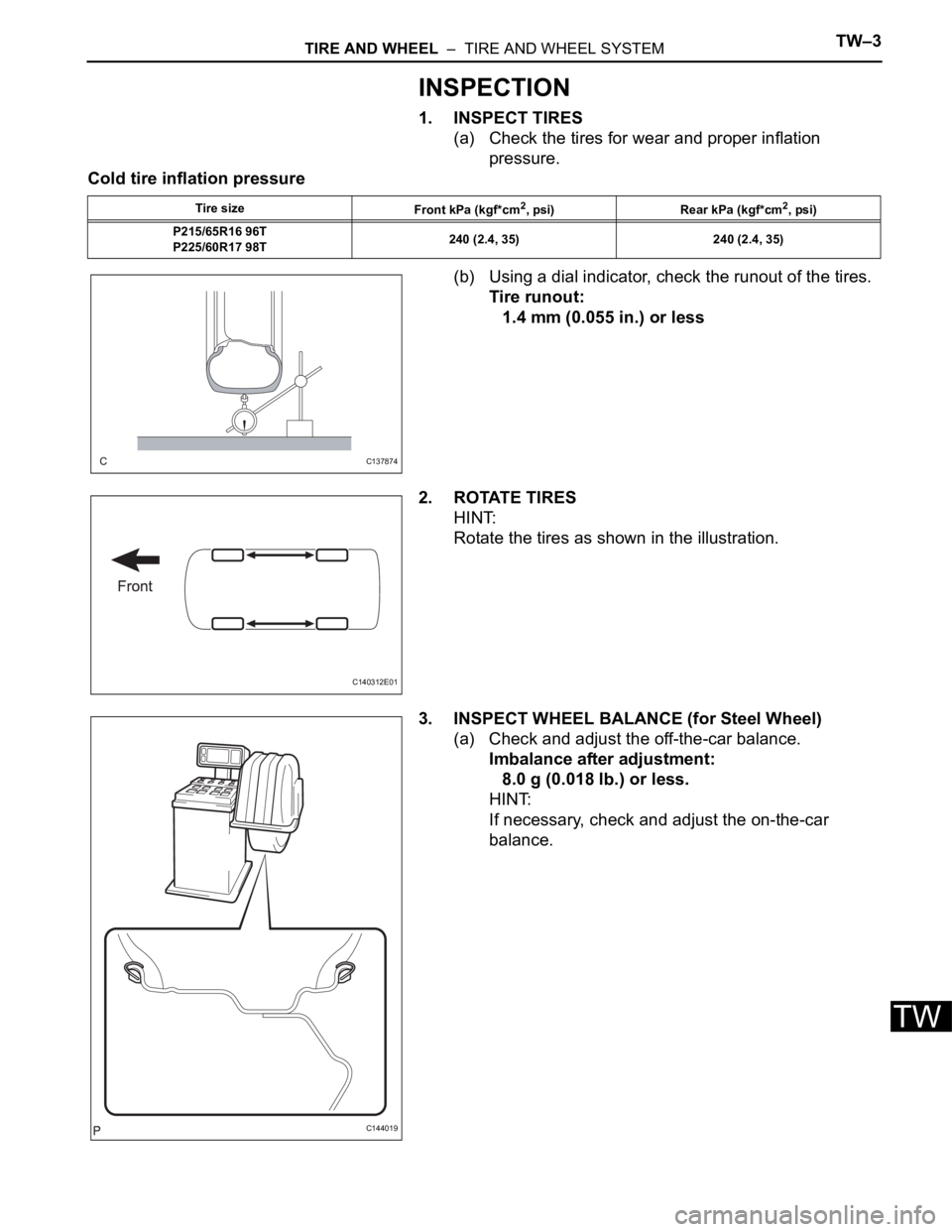
1. INSPECT TIRES
(a) Check the tires for wear and proper inflation
pressure.
Cold tire inflation pressure
(b) Using a dial indicator, check the runout of the tires.
Tire runout:
1.4 mm (0.055 in.) or less
2. ROTATE TIRES
HINT:
Rotate the tires as shown in the illustration.
3. INSPECT WHEEL BALANCE (for Steel Wheel)
(a) Check and adjust the off-the-car balance.
Imbalance after adjustment:
8.0 g (0.018 lb.) or less.
HINT:
If necessary, check and adjust the on-the-car
balance.
Tire size
Front kPa (kgf*cm2, psi) Rear kPa (kgf*cm2, psi)
P215/65R16 96T
P225/60R17 98T240 (2.4, 35) 240 (2.4, 35)
C137874
C140312E01
C144019
Page 175 of 3000

TIRE AND WHEEL – TIRE AND WHEEL SYSTEMTW–5
TW
REPAIR
1. INTRODUCTION
(a) This section introduces ways to determine whether
the run-flat tire is repairable or not. Repair must be
performed by following the appropriate procedures.
If a flat tire occurs, it is possible to drive a maximum
of 160 km (100 miles) at a speed below 90 km/h (55
mph) due to the reinforced sidewalls. However, if
the customer continues to drive with low tire
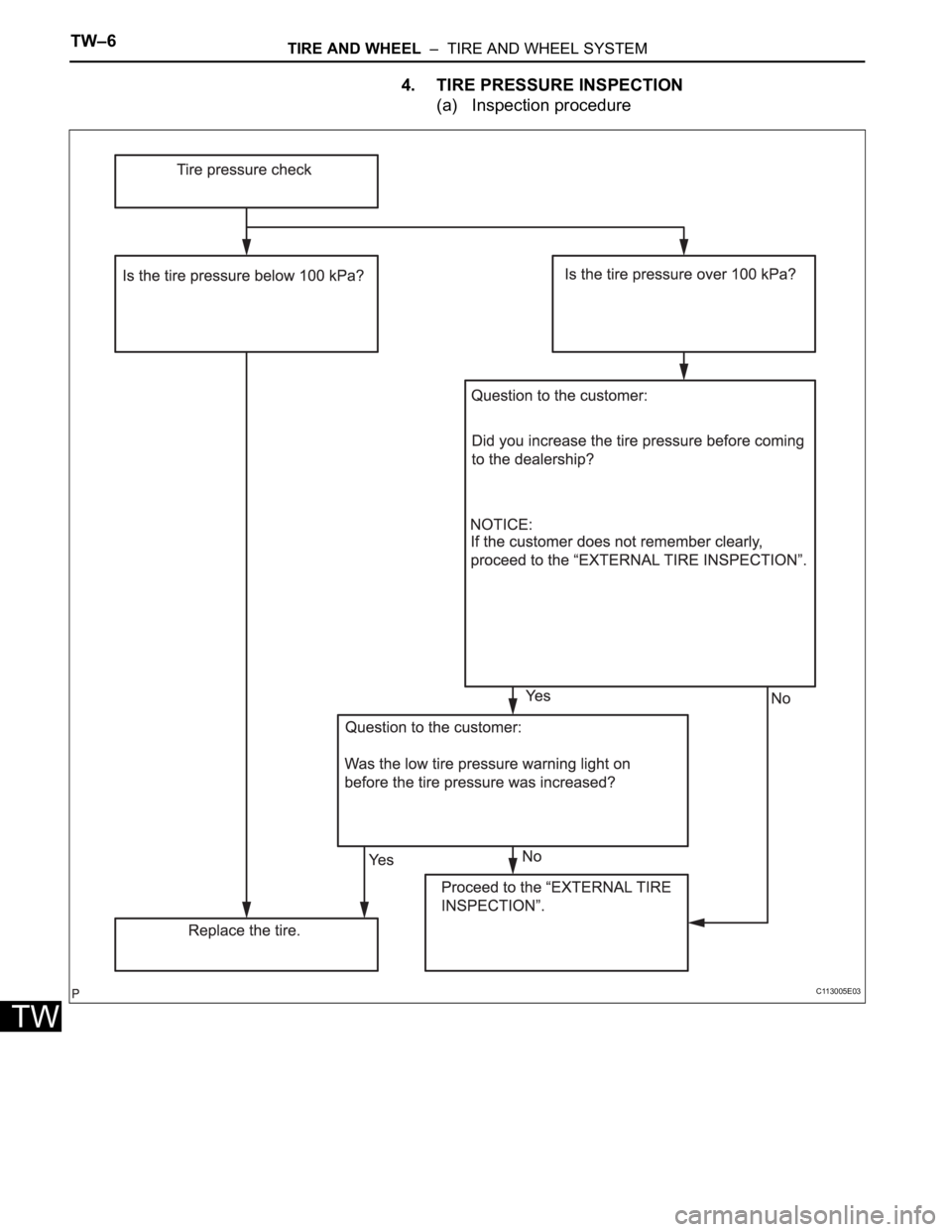
pressure (less than about 100 kPa (1.0 kgf/cm
2,
14.5 psi) and tire pressure warning light is on), the
inside of the sidewall will gradually deteriorate and
the run-flat performance may be reduced.
Therefore, the tires may require replacement.
However, there are some cases where it is possible
to repair a run-flat tire using the same repair method
as for normal tires. Use the following flowchart to
determine if a run-flat tire is repairable.
NOTICE:
When performing repairs, follow the Rubber
Manufacturers Association (RMA) repair
procedures.
2. REPAIR PROCEDURE (CUSTOMER INTERVIEW)
(a) The tire pressure warning system can help
determine the history of the tire's use. The driving
conditions the tire was subjected to while the tire
pressure warning light was on should be obtained
from the customer. Also, make sure to ask the
following questions.
(1) Was the vehicle driven at a speed over 90 km/h
(55 mph) with the tire pressure warning light
on?
(2) Was the vehicle driven over 160 km (100 miles)
with the tire pressure warning light on?
A "Yes" response to either of the above will
greatly reduce the chance of tire repairability.
3. TECHNICIAN TIRE INSPECTION
(a) After the customer interview, it is necessary to
conduct a thorough inspection of the tire after it has
been removed from the wheel. As it is difficult to
identify a tire with low pressure visually, check the
pressure of each tire to determine the tire(s) causing
the low-pressure warning. If the tire is found to be
repairable, follow the RMA repair procedures.
NOTICE:
The deflated tire may be extremely hot, which
may cause injury, so allow the tire to cool prior
to handling.
Page 176 of 3000
TW–6TIRE AND WHEEL – TIRE AND WHEEL SYSTEM
TW
4. TIRE PRESSURE INSPECTION
(a) Inspection procedure
C113005E03
Page 218 of 3000

SS–24SERVICE SPECIFICATIONS – U151E AUTOMATIC TRANSAXLE
SS
U151E AUTOMATIC TRANSAXLE
SERVICE DATA
Line pressure (Wheel locked)
Engine
idling
D position
370 to 410 kPa (3.8 to 4.2 kgf*cm
2, 54 to 60 psi)
R position
670 to 740 kPa (6.8 to 7.5 kgf*cm
2, 97 to 106 psi)
AT s t a l l
(Throttle
valve fully
opened)
D position
931 to 1,031 kPa (9.5 to 10.5 kgf*cm
2, 135 to 150 psi)
R position
1,768 to 1,968 kPa (18.0 to 20 kgf*cm
2, 256 to 285 psi)
Engine stall revolution D and R
positions2,300 +- 150 rpm
Time lag N
D
positionLess than 1.2 seconds
N
R
positionLess than 1.5 seconds
Engine idle speed (A/C OFF) N position 650 +- 50 rpm
Drive plate runout Max. 0.20 mm (0.0079 in.)
Torque converter runout Max. 0.30 mm (0.0118 in.)
Differential oil seal drive in depth LH side 0 +- 0.5 mm (0 +- 0.020 in.)
RH side 0 +- 0.5 mm (0 +- 0.020 in.)
TIRE: 215/65R16
Shift schedule
Throttle valve fully open
(Normal)
1
2 47 to 54 km/h (29 to 34 mph)
2
3 94 to 100 km/h (58 to 62 mph)
3
4 152 to 163 km/h (94 to 101 mph)
4
5 227 to 238 km/h (141 to 148 mph)
5
4 218 to 229 km/h (135 to 142 mph)
4
3 146 to 157 km/h (91 to 98 mph)
3
2 89 to 95 km/h (55 to 59 mph)
2
1 37 to 43 km/h (23 to 27 mph)
Throttle valve fully closed
(Normal)4
5 66 to 72 km/h (41 to 45 mph)
5
4 38 to 44 km/h (24 to 27 mph)
Throttle valve fully open
(Cold)
1
2 29 to 36 km/h (18 to 22 mph)
2
3 47 to 53 km/h (29 to 33 mph)
3
4 77 to 83 km/h (48 to 52 mph)
4
3 72 to 78 km/h (45 to 48 mph)
3
2 42 to 48 km/h (26 to 30 mph)
2
1 23 to 29 km/h (14 to 18 mph)
Throttle valve fully open
(Failure)
1
3 29 to 36 km/h (18 to 22 mph)
3
4 77 to 83 km/h (48 to 52 mph)
4
3 72 to 78 km/h (45 to 48 mph)
3
1 23 to 29 km/h (14 to 18 mph)
Page 2109 of 3000

PP–52PREPARATION – SUSPENSION
PP
EQUIPMENT
To r q u e w r e n c h
Dial indicator with magnetic base
Wheel balancer
Tire pressure gauge
Alignment tester
Camber-caster-kingpin gauge
Toe-in gauge
Angle gauge
Drill
Plastic hammer
Engine Sling Device
Universal Engine Lifter
Chain Block
Slide calipers
Wooden block
Page 2248 of 3000
TIRE AND WHEEL – TIRE PRESSURE WARNING SYSTEMTW–13
TW
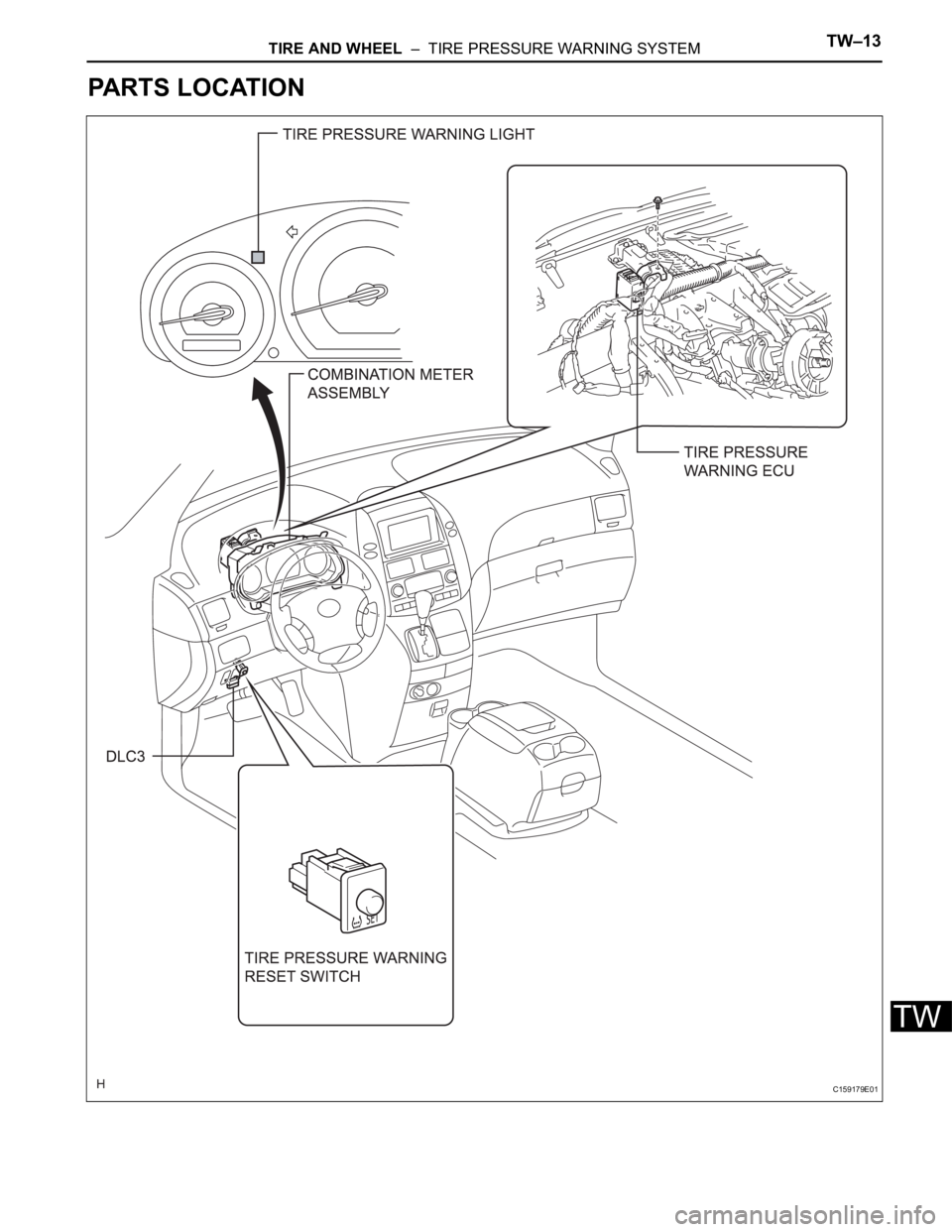
PARTS LOCATION
C159179E01
Page 2249 of 3000
TW–14TIRE AND WHEEL – TIRE PRESSURE WARNING SYSTEM
TW
C159178E01
Page 2250 of 3000
TIRE AND WHEEL – TIRE PRESSURE WARNING SYSTEMTW–15
TW
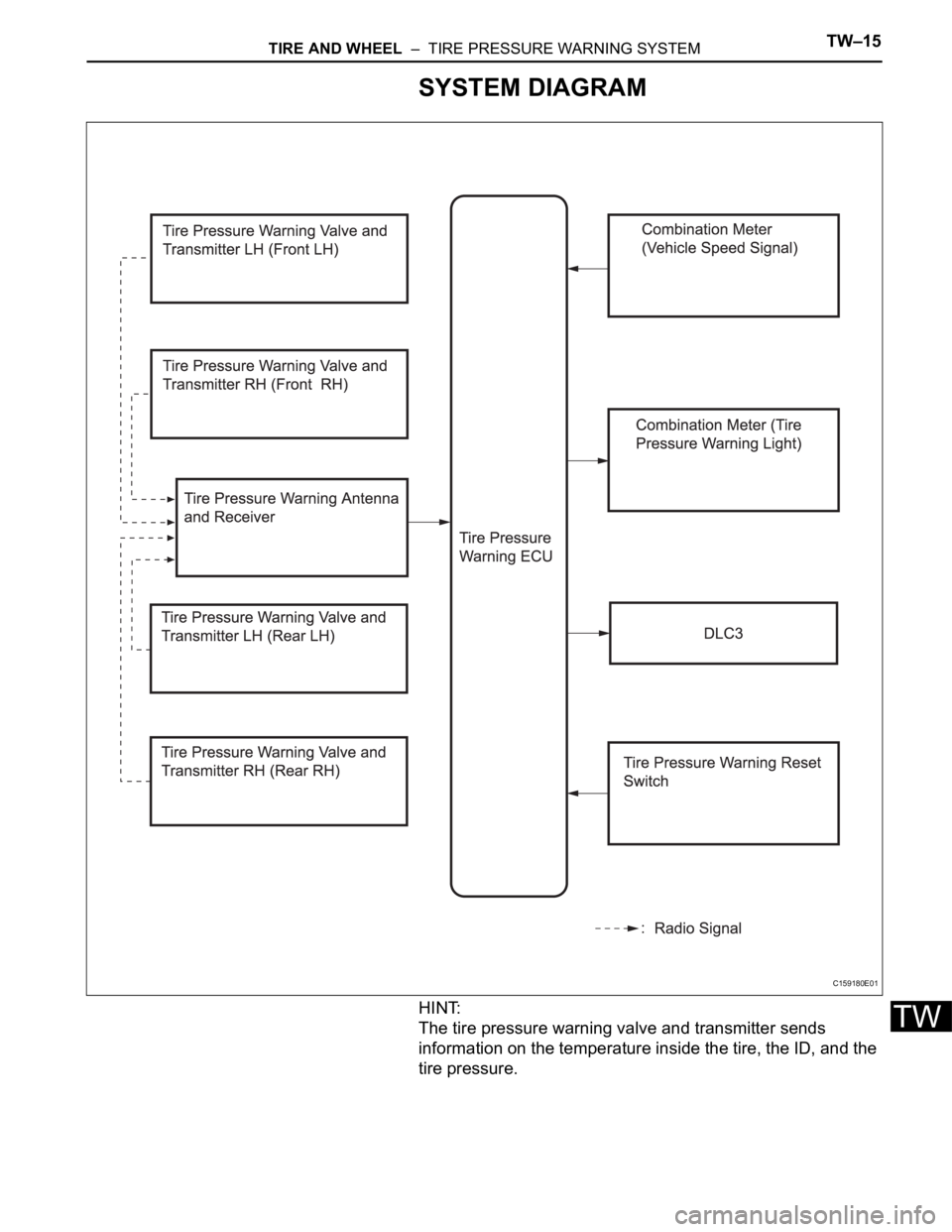
SYSTEM DIAGRAM
HINT:
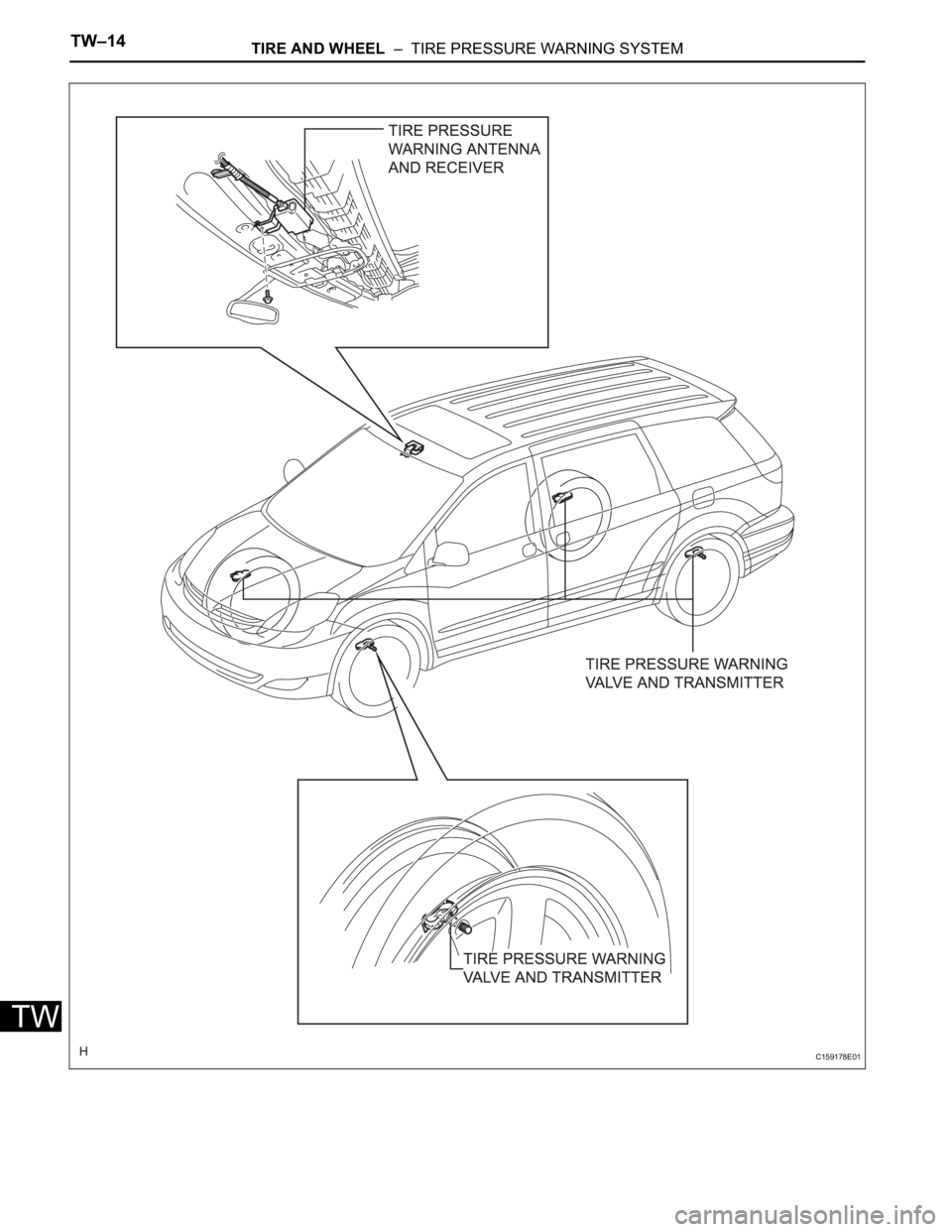
The tire pressure warning valve and transmitter sends
information on the temperature inside the tire, the ID, and the
tire pressure.
C159180E01