engine coolant TOYOTA SIENNA 2017 XL30 / 3.G User Guide
[x] Cancel search | Manufacturer: TOYOTA, Model Year: 2017, Model line: SIENNA, Model: TOYOTA SIENNA 2017 XL30 / 3.GPages: 672, PDF Size: 17.01 MB
Page 543 of 672
543
SIENNA_OM_OM08007U_(U)
8
When trouble arises
8-2. Steps to take in an emergency
If you think something is wrong
●Fluid leaks under the vehicle
(Water dripping from the air co nditioning after use is normal.)
● Flat-looking tires or uneven tire wear
● Engine coolant temperature gauge needle continually points higher
than normal
● Changes in exhaust sound
● Excessive tire squeal when cornering
● Strange noises related to the suspension system
● Pinging or other noises related to the engine
● Engine missing, stumbling or running rough
● Appreciable loss of power
● Vehicle pulls heavily to one side when braking
● Vehicle pulls heavily to one side when driving on a level road
● Loss of brake effectiveness, spon gy feeling, pedal almost touches
the floor
If you notice any of the follow ing symptoms, your vehicle proba-
bly needs adjustment or repair. Contact your Toyota dealer as
soon as possible.
Visible symptoms
Audible symptoms
Operational symptoms
Page 559 of 672
5598-2. Steps to take in an emergency
SIENNA_OM_OM08007U_(U)
8
When trouble arises
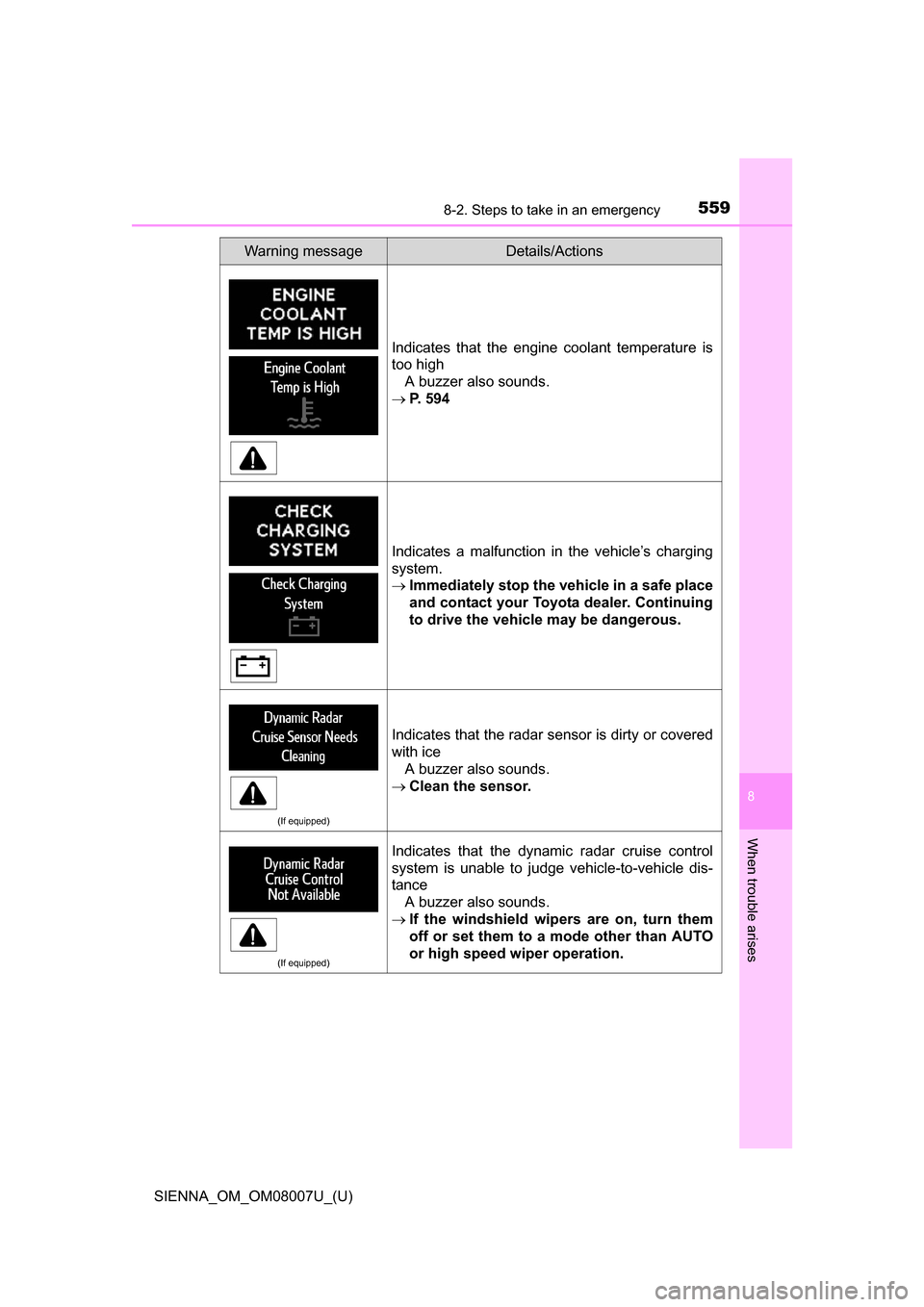
Indicates that the engine coolant temperature is
too highA buzzer also sounds.
P. 594
Indicates a malfunction in the vehicle’s charging
system.
Immediately stop the vehicle in a safe place
and contact your Toyota dealer. Continuing
to drive the vehicle may be dangerous.
(If equipped)
Indicates that the radar sensor is dirty or covered
with ice A buzzer also sounds.
Clean the sensor.
(If equipped)
Indicates that the dynamic radar cruise control
system is unable to judge vehicle-to-vehicle dis-
tance
A buzzer also sounds.
If the windshield wipers are on, turn them
off or set them to a mode other than AUTO
or high speed wiper operation.
Warning messageDetails/Actions
Page 594 of 672
594
SIENNA_OM_OM08007U_(U)
8-2. Steps to take in an emergency
If your vehicle overheats
●The needle of the engine coolant temperature gauge ( P. 8 8 )
enters the red zone or a loss of engine power is experienced. (For
example, the vehicle sp eed does not increase.)
● The warning message indicating overheats is shown on the multi-
information display. ( P. 559)
● Steam is coming from under the hood.
Stop the vehicle in a safe place and turn off the air conditioning sys-
tem, and then stop the engine.
If you see steam:
Carefully lift the hood after the steam subsides.
If you do not see steam:
Carefully lift the hood.
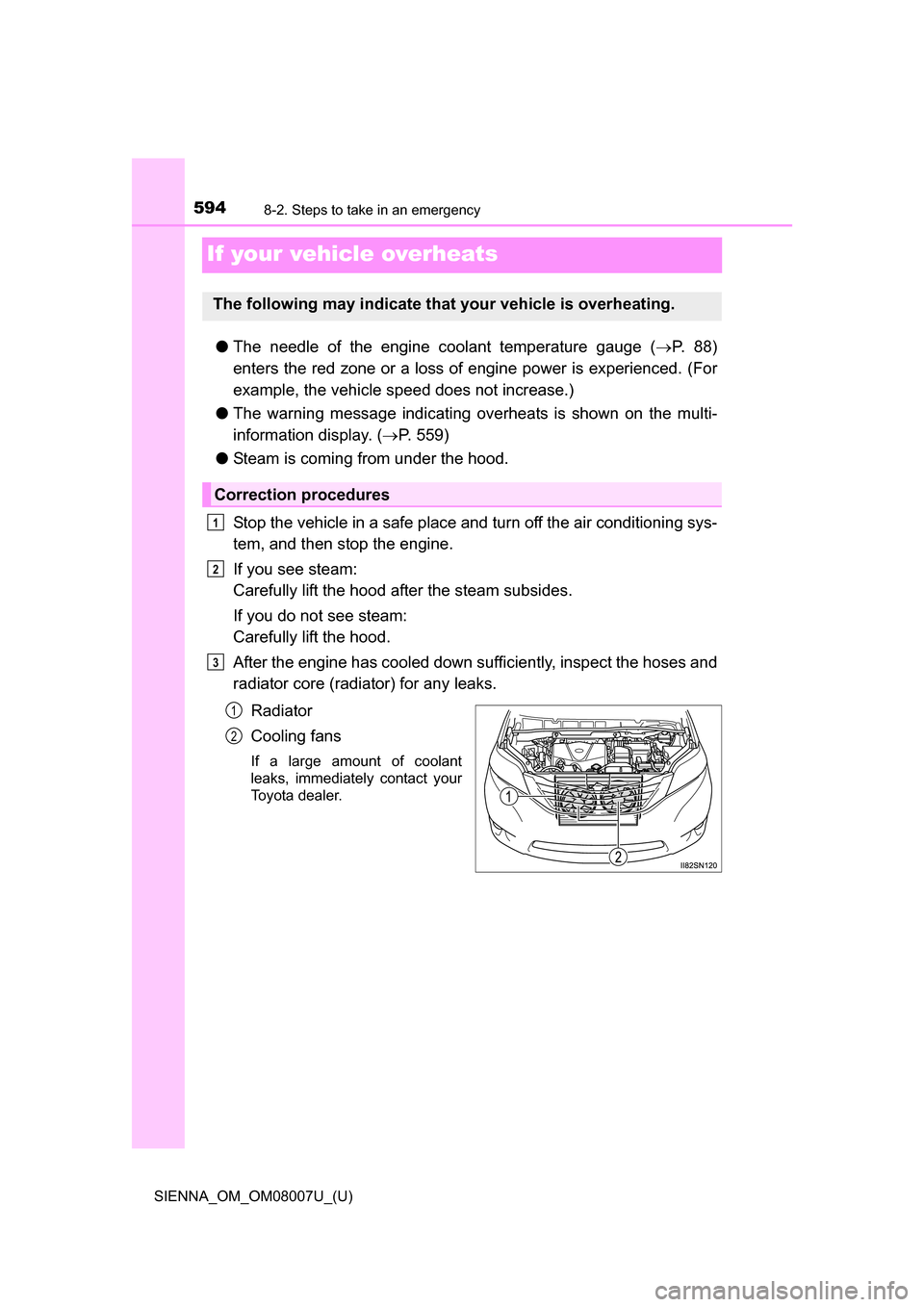
After the engine has cooled down su fficiently, inspect the hoses and
radiator core (radiator) for any leaks.
Radiator
Cooling fans
If a large amount of coolant
leaks, immediately contact your
Toyota dealer.
The following may indicate that your vehicle is overheating.
Correction procedures
1
2
3
1
2
Page 595 of 672
5958-2. Steps to take in an emergency
SIENNA_OM_OM08007U_(U)
8
When trouble arises
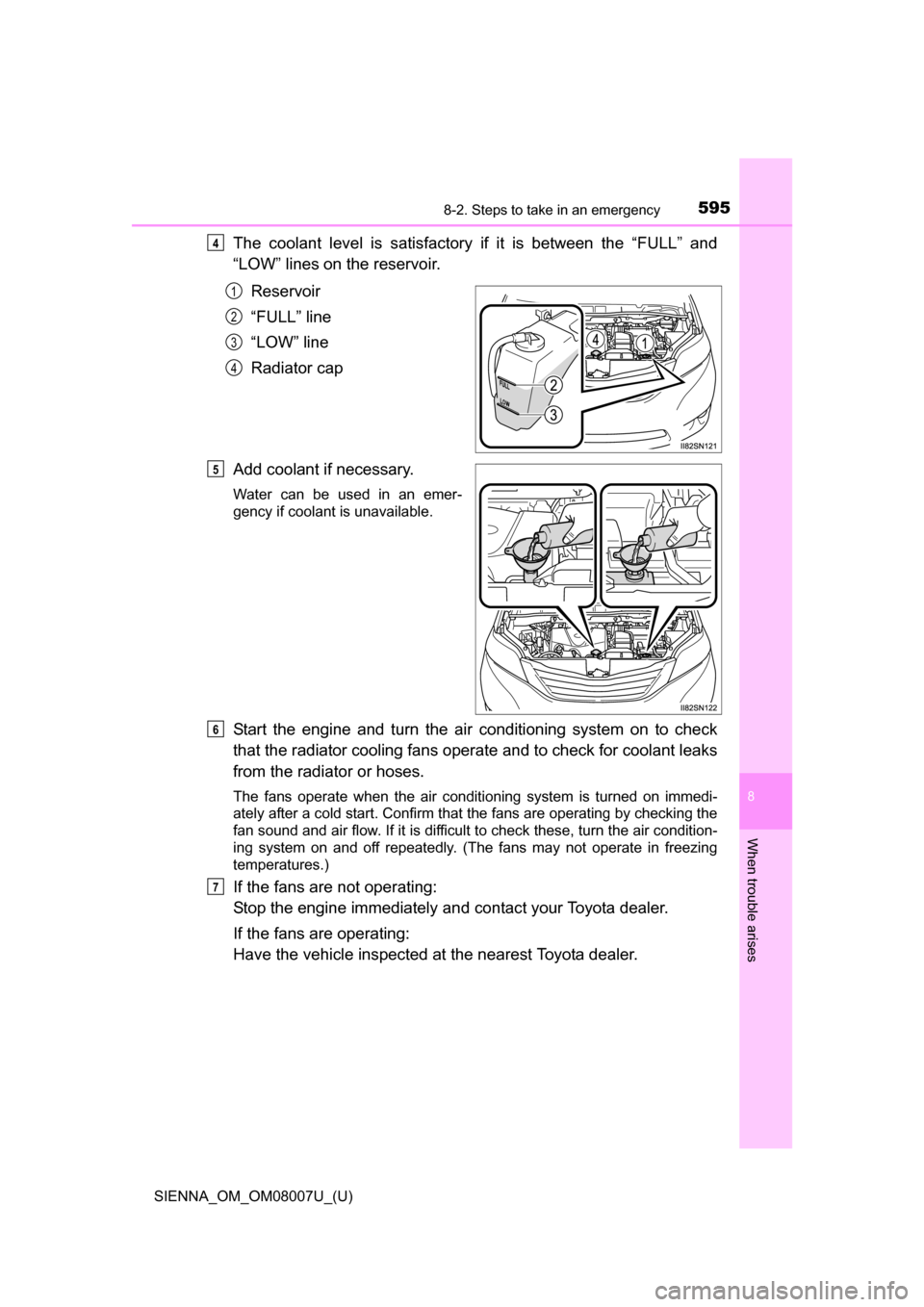
The coolant level is satisfactory if it is between the “FULL” and
“LOW” lines on the reservoir.
Reservoir
“FULL” line
“LOW” line
Radiator cap
Add coolant if necessary.
Water can be used in an emer-
gency if coolant is unavailable.
Start the engine and turn the air conditioning system on to check
that the radiator cooling fans oper ate and to check for coolant leaks
from the radiator or hoses.
The fans operate when the air conditioning system is turned on immedi-
ately after a cold start. Confirm that the fans are operating by checking the
fan sound and air flow. If it is difficult to check these, turn the air condition-
ing system on and off repeatedly. (The fans may not operate in freezing
temperatures.)
If the fans are not operating:
Stop the engine immediately an d contact your Toyota dealer.
If the fans are operating:
Have the vehicle in spected at the nearest Toyota dealer.
4
1
2
3
4
5
6
7
Page 596 of 672
5968-2. Steps to take in an emergency
SIENNA_OM_OM08007U_(U)
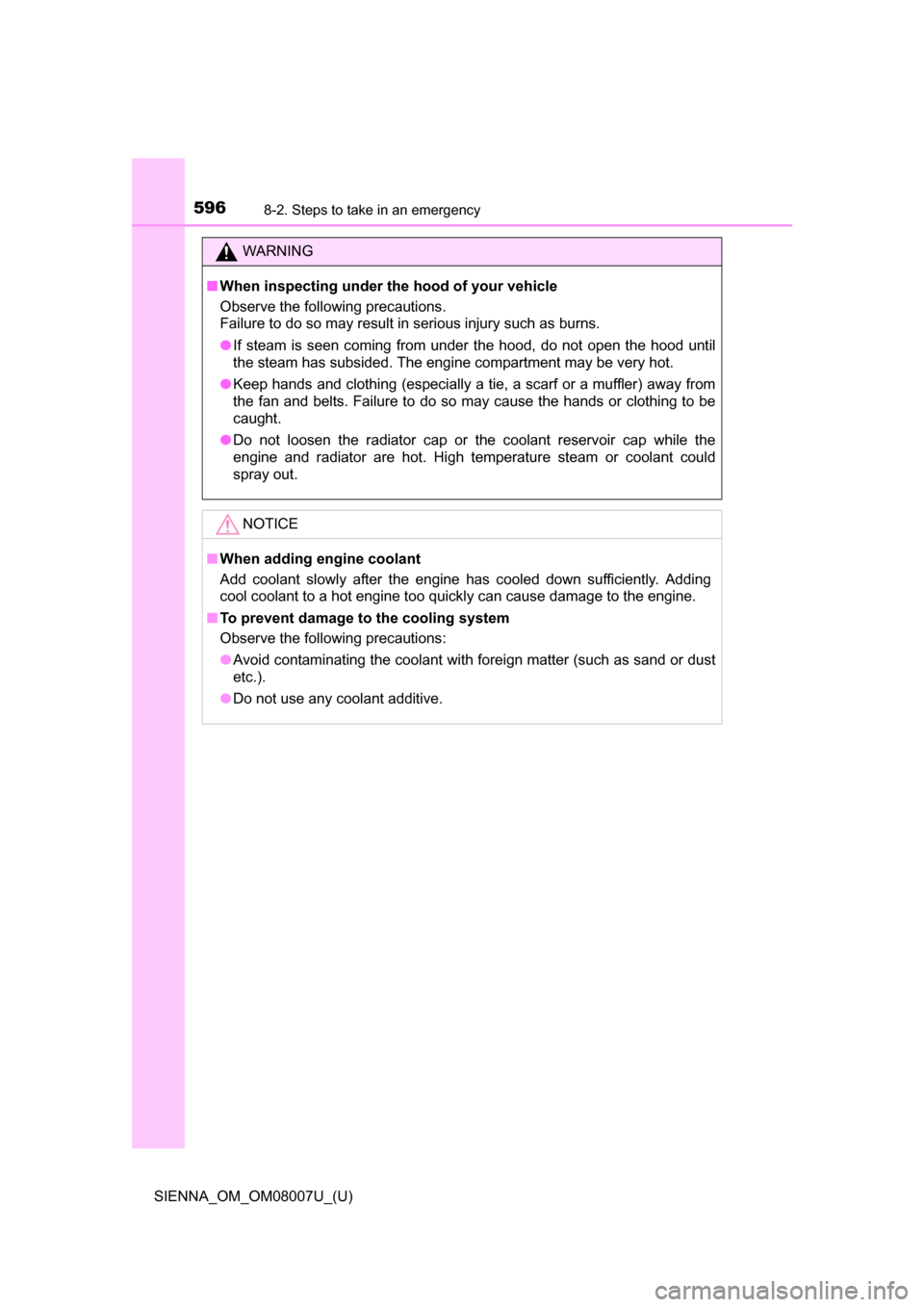
WARNING
■When inspecting under the hood of your vehicle
Observe the following precautions.
Failure to do so may result in serious injury such as burns.
●If steam is seen coming from under the hood, do not open the hood until
the steam has subsided. The engine compartment may be very hot.
● Keep hands and clothing (especially a tie, a scarf or a muffler) away from
the fan and belts. Failure to do so may cause the hands or clothing to be
caught.
● Do not loosen the radiator cap or the coolant reservoir cap while the
engine and radiator are hot. High temperature steam or coolant could
spray out.
NOTICE
■When adding engine coolant
Add coolant slowly after the engine has cooled down sufficiently. Adding
cool coolant to a hot engine too quickly can cause damage to the engine.
■ To prevent damage to the cooling system
Observe the following precautions:
●Avoid contaminating the coolant with foreign matter (such as sand or dust
etc.).
● Do not use any coolant additive.
Page 604 of 672
604
SIENNA_OM_OM08007U_(U)
9-1. Specifications
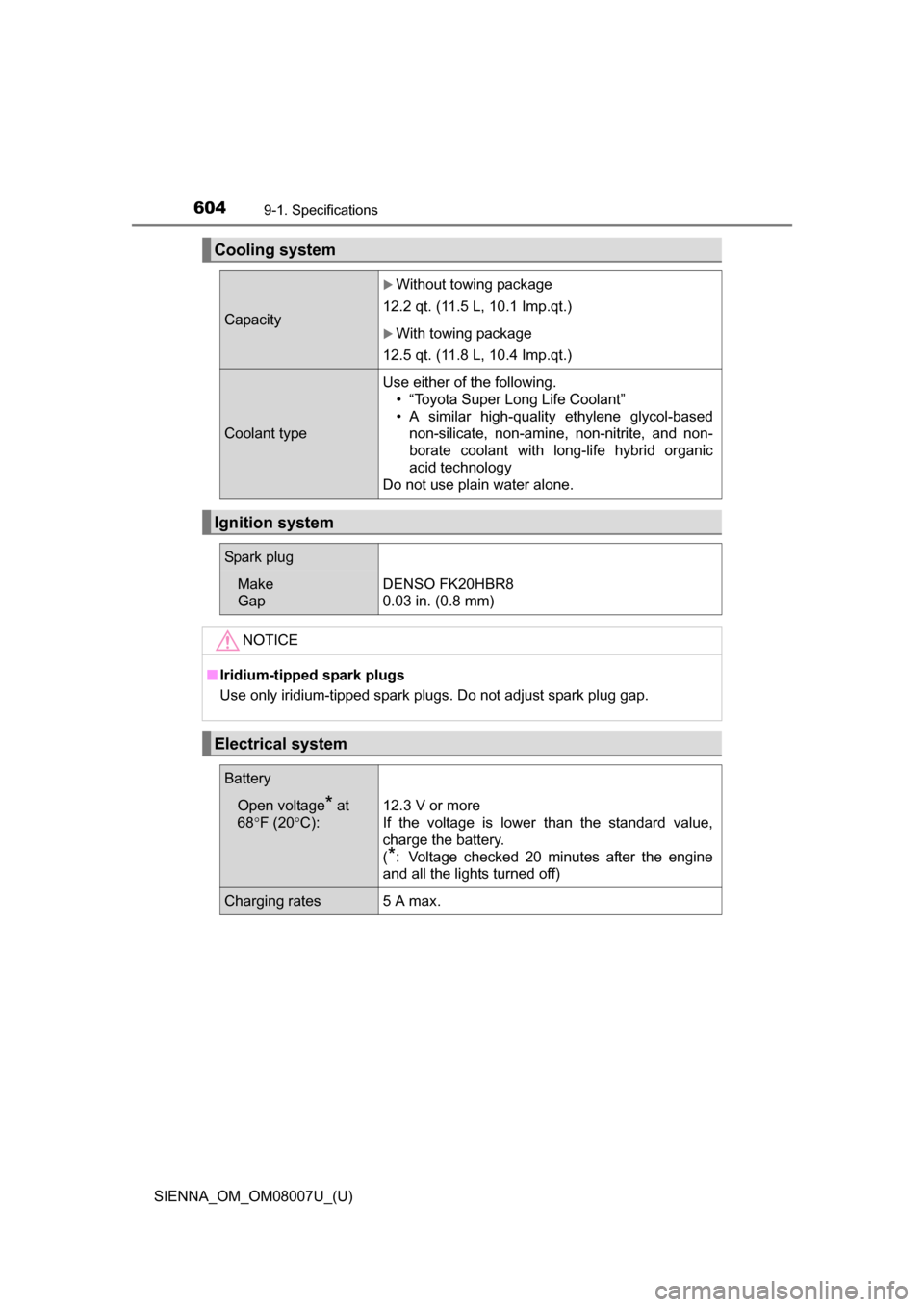
Cooling system
Capacity
Without towing package
12.2 qt. (11.5 L, 10.1 Imp.qt.)
With towing package
12.5 qt. (11.8 L, 10.4 Imp.qt.)
Coolant type Use either of the following.
• “Toyota Super Long Life Coolant”
• A similar high-quality ethylene glycol-basednon-silicate, non-amine, non-nitrite, and non-
borate coolant with long-life hybrid organic
acid technology
Do not use plain water alone.
Ignition system
Spark plug
Make
Gap DENSO FK20HBR8
0.03 in. (0.8 mm)
NOTICE
■
Iridium-tipped spark plugs
Use only iridium-tipped spark plugs. Do not adjust spark plug gap.
Electrical system
Battery
Open voltage* at
68 F (20 C): 12.3 V or more
If the voltage is lower than the standard value,
charge the battery.
(
*: Voltage checked 20 minutes after the engine
and all the lights turned off)
Charging rates 5 A max.
Page 618 of 672
618
SIENNA_OM_OM08007U_(U)
9-1. Specifications
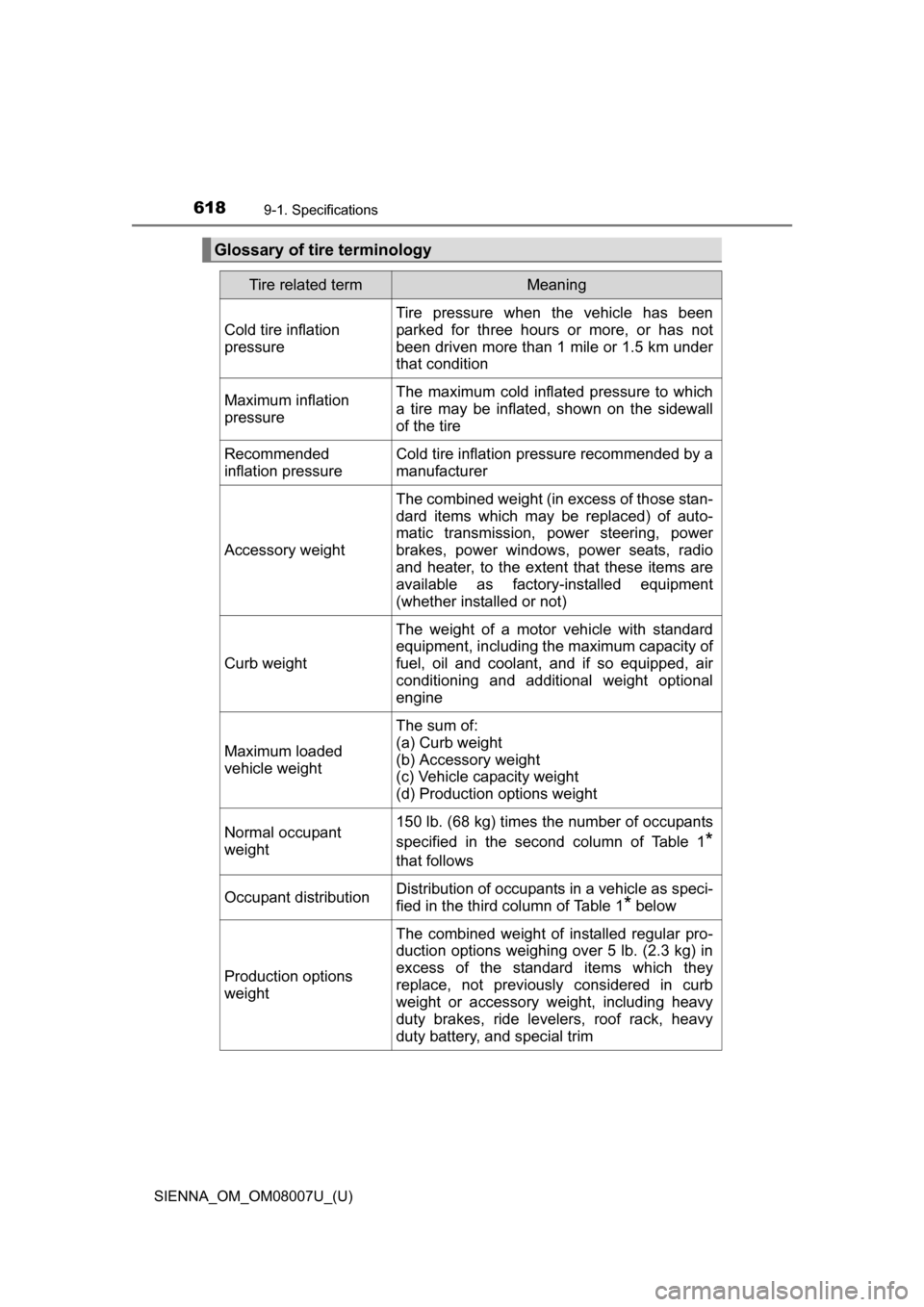
Glossary of tire terminology
Tire related termMeaning
Cold tire inflation
pressure Tire pressure when the vehicle has been
parked for three hours or more, or has not
been driven more than 1 mile or 1.5 km under
that condition
Maximum inflation
pressure The maximum cold inflat
ed pressure to which
a tire may be inflated, shown on the sidewall
of the tire
Recommended
inflation pressure Cold tire inflation pressure recommended by a
manufacturer
Accessory weight The combined weight (in excess of those stan-
dard items which may be replaced) of auto-
matic transmission, power steering, power
brakes, power windows, power seats, radio
and heater, to the extent
that these items are
available as factory-installed equipment
(whether installed or not)
Curb weight The weight of a motor vehicle with standard
equipment, including the maximum capacity of
fuel, oil and coolant, and if so equipped, air
conditioning and additional weight optional
engine
Maximum loaded
vehicle weight The sum of:
(a) Curb weight
(b) Accessory weight
(c) Vehicle capacity weight
(d) Production options weight
Normal occupant
weight 150 lb. (68 kg) times the number of occupants
specified in the second column of Table 1
*
that follows
Occupant distribution Distribution of occupants in a vehicle as speci-
fied in the third column of Table 1
* below
Production options
weight The combined weight of installed regular pro-
duction options weighing over 5 lb. (2.3 kg) in
excess of the standard items which they
replace, not previously considered in curb
weight or accessory weight, including heavy
duty brakes, ride levelers, roof rack, heavy
duty battery, and special trim
Page 659 of 672
659Alphabetical index
SIENNA_OM_OM08007U_(U)
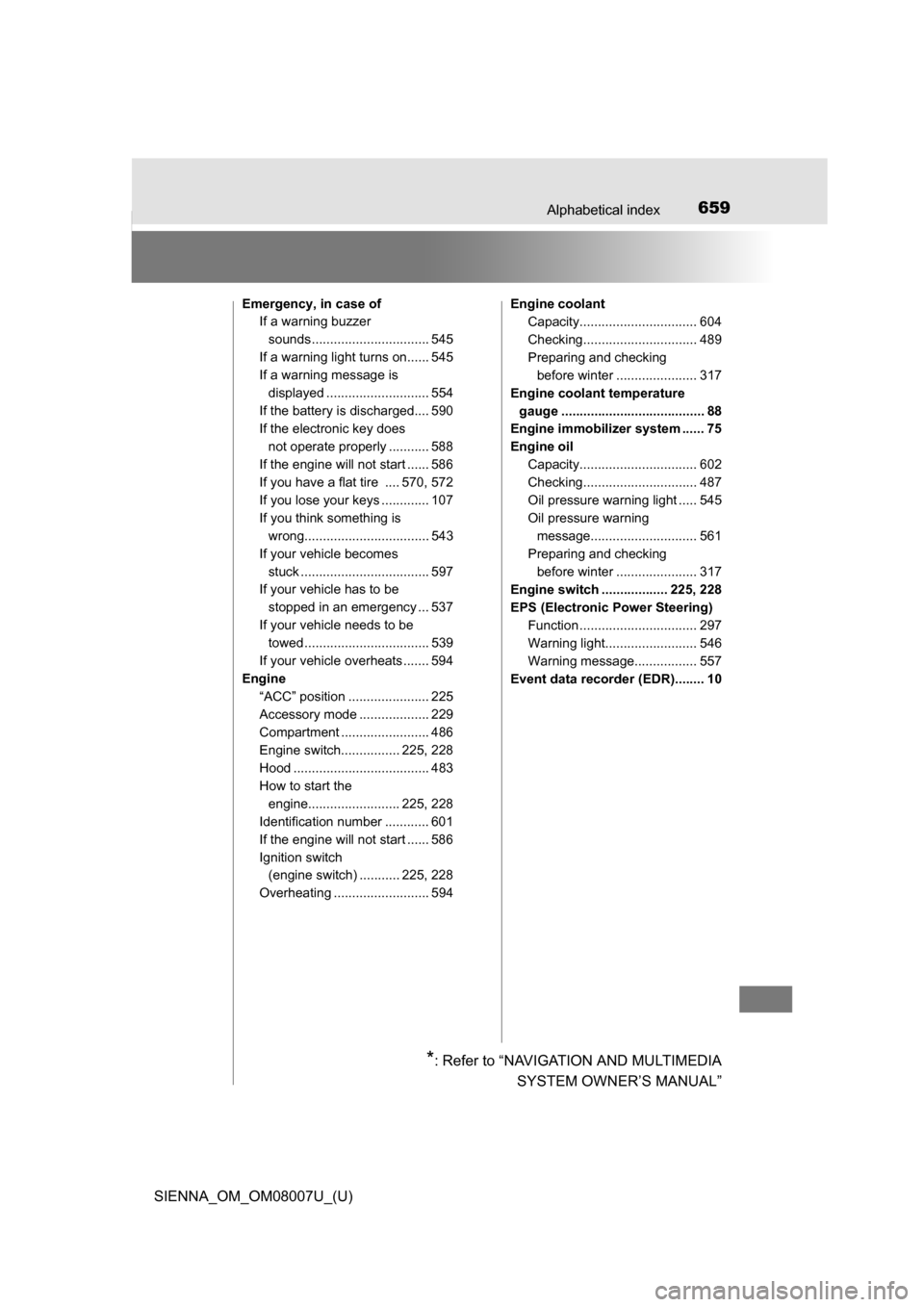
Emergency, in case ofIf a warning buzzer
sounds ................................ 545
If a warning light turns on...... 545
If a warning message is displayed ............................ 554
If the battery is discharged.... 590
If the electronic key does not operate properly ........... 588
If the engine will not start ...... 586
If you have a flat tire .... 570, 572
If you lose your keys ............. 107
If you think something is wrong.................................. 543
If your vehicle becomes stuck ................................... 597
If your vehicle has to be
stopped in an emergency ... 537
If your vehicle needs to be towed .................................. 539
If your vehicle overheats ....... 594
Engine “ACC” position ...................... 225
Accessory mode ................... 229
Compartment ........................ 486
Engine switch................ 225, 228
Hood ..................................... 483
How to start the
engine......................... 225, 228
Identification number ............ 601
If the engine will not start ...... 586
Ignition switch (engine switch) ........... 225, 228
Overheating .......................... 594 Engine coolant
Capacity................................ 604
Checking............................... 489
Preparing and checking before winter ...................... 317
Engine coolant temperature gauge ....................................... 88
Engine immobilizer system ...... 75
Engine oil
Capacity................................ 602
Checking............................... 487
Oil pressure warning light ..... 545
Oil pressure warning message............................. 561
Preparing and checking before winter ...................... 317
Engine switch .................. 225, 228
EPS (Electronic Power Steering)
Function ................................ 297
Warning light......................... 546
Warning message................. 557
Event data recorder (EDR)........ 10
*: Refer to “NAVIGATION AND MULTIMEDIA
SYSTEM OWNER’S MANUAL”