spare wheel TOYOTA SIENNA 2020 Warranties & Maintenance Guides (in English)
[x] Cancel search | Manufacturer: TOYOTA, Model Year: 2020, Model line: SIENNA, Model: TOYOTA SIENNA 2020Pages: 260, PDF Size: 8.54 MB
Page 51 of 260
BRIDGESTONE / FIRESTONE
49
• To use a full-size spare in the rotation pattern on vehicles with
dual rear wheels, consult your vehicle owner’s manual for the
recommended procedures or consult the vehicle manufacturer.
Your Spare Tire
Consult your vehicle owner’s manual for proper application of your
spare tire. Your car may be equipped with a “temporary use” spare tire;
this spare may differ in size and construction from the other tires on
your vehicle.
SAFETY WARNING
Check inflation pressure before use. Failure to have proper inflation
pressure when using your spare tire can result in serious personal
injury or death. See “Tire Inflation Pressure” in this manual.
SAFETY WARNING
Mounting a “temporary use” tire on a wheel which is not specifically
designed for it, or placing another type tire on a wheel designated
for temporary use can be dangerous. Your vehicle’s handling
characteristics can be seriously affected. You could have an accident
resulting in serious personal injury or death. Consult your vehicle
owner’s manual for proper application of your “temporary use”
spare tire.
The spare tire in your vehicle is intended to be used as a spare when
needed. The spare tire carrier is not intended to be used for long
term storage, except for “temporary use” tires. If your spare is t\
he
same size, load rating, and type of tire as your road tires, it should b\
e
included in the tire rotation process; see “Radial Tire Rotation” in this
manual for more information.
The spare should be included in regular tire inspections and inflation
pressure checks. In addition, it should be replaced 10 years after
date of manufacture, regardless of condition or tread depth. For more
information, see the “Tire Damage, Inspection and Service Life” in
this manual.
Page 53 of 260
BRIDGESTONE / FIRESTONE
51
Tire Registration
Registration of your tires is an important safety precaution since it
enables the manufacturer to notify you in the event of a recall. When
you purchase replacement tires, the retailer will provide a registration\
card on which the tire identification numbers have been recorded;
fill in your name and address on the card and mail it promptly. Some
retailers may submit the registration for you. You do not need to
register tires which come as original equipment on new vehicles—the
vehicle and tire manufacturers handle that for you.
RFT Tires with Run-Flat Technology
If your vehicle is equipped with Bridgestone or Firestone brand RFT
tires, this chapter presents specific maintenance and safety issues
associated with these tires that are in addition to those covered
elsewhere in this manual.
What is RFT? Run-Flat Technology tires are extraordinary tires that
utilize specially designed components to temporarily support your
vehicle in the event of inflation pressure loss, such as from a puncture.
This gives you the ability to drive to a convenient and safe location
to change your tire (if equipped with a spare) or have it inspected for
possible repair or replacement.
Naturally, certain run-flat and low pressure operating limitations
apply, which varies according to the specific self-supporting tire design.
Like all tires, during normal operation, they must be properly inflated
and maintained. Regardless of the design or quality, no tire
is indestructible.
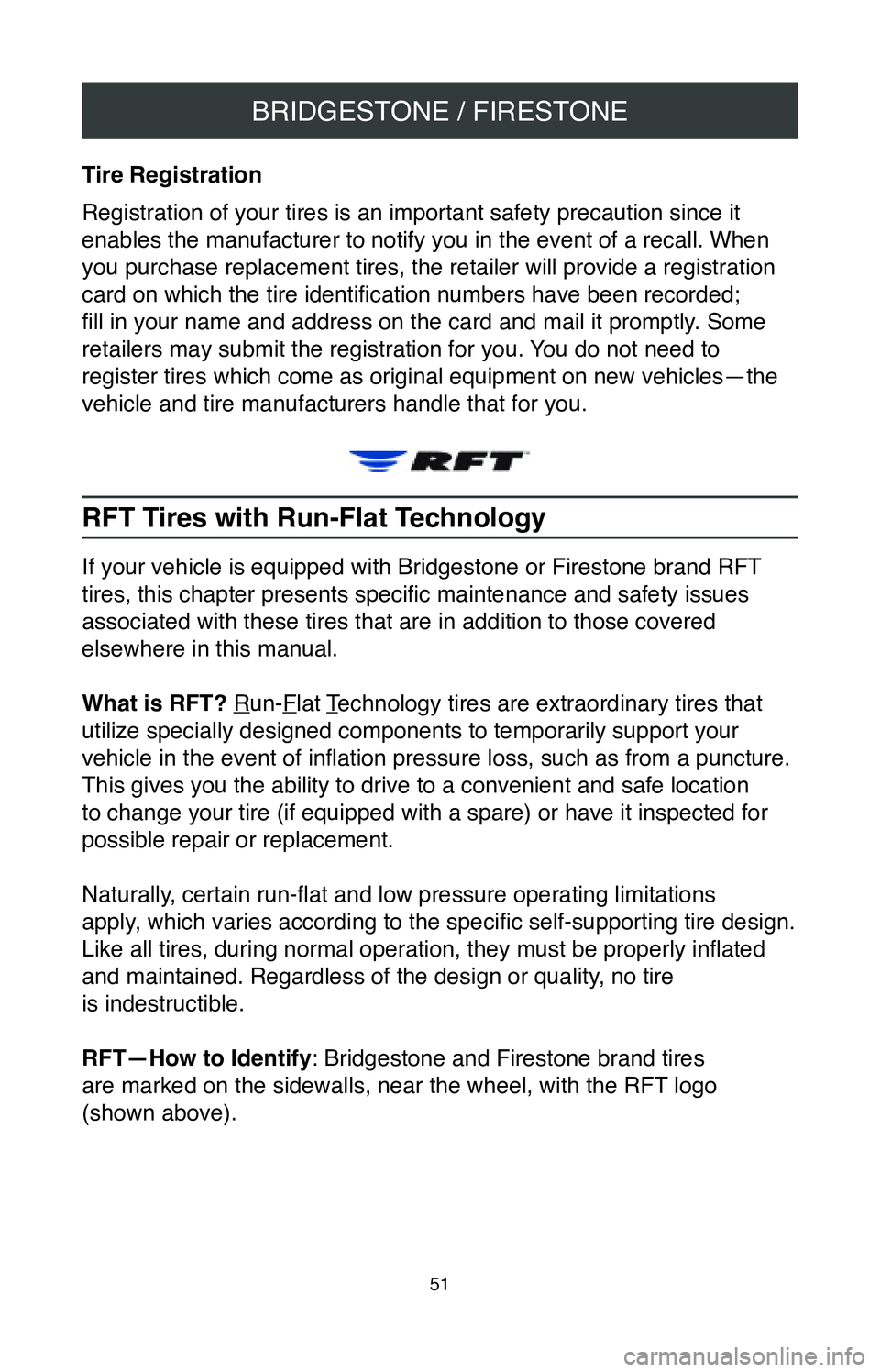
RFT—How to Identify : Bridgestone and Firestone brand tires
are marked on the sidewalls, near the wheel, with the RFT logo
(shown above).
Page 76 of 260
FALKEN
74
Original Equipment Limited Warranty and Tire
Care Guide
Tire Care and Recommendations
Proper Inflation and Fuel Economy
Ensure maximum performance and a long life from your tires by
checking the air pressures at least once a month and set them to
the vehicle manufacturer’s recommended pressure(s) listed on the
vehicle’s tire placard or in your owner’s manual. Always check and
adjust your air pressure when your tires are cold, preferably first thing
in the morning before driving. Never release air pressure from tires
when they are hot. Wait until the tires cool down and recheck, adding
air or releasing as required. Falken endorses the use of nitrogen in
your tires because it helps your tires maintain optimal pressure for
longer periods of time and reduces the amount of moisture inside of
the tire and wheel assembly.
*Some plus size applications may require different air pressure(s)
than what is listed on your vehicle’s placard or owner’s manual. In this
case, please consult your tire dealer or Falken Tires for proper inflation
pressure(s).
Tire Inflation Pressure
Tires need to be properly inflated to effectively operate and perform
as intended. Tires carry the weight of the vehicle, passengers, and
cargo as well as bear the forces of braking, accelerating, and turning. \
The vehicle manufacturer sets the inflation pressures for the original
equipment tires that are on your vehicle.
Driving with improperly inflated tires is dangerous. An under inflated
tire will generate excessive heat build-up that will cause damage to
the internal structure and inner liner of the tire. Besides tire damage,\
improper tire inflation pressures can also affect your vehicle’s ride
and handling, tire tread wear, and fuel economy. It is recommended
to always keep all of your tires, including the spare, at the vehicle
manufacturer’s recommended inflation pressures and be sure to check
the air pressure monthly and before going on long road trips or carrying
extra weight in your vehicle.
Page 79 of 260
FALKEN
77
Tire Replacement
Falken recommends replacing your tires when the tread wears down
to the wear bars at 1.6mm (2/32 of an inch), which are located across
the tread in several locations around the tire. If only two tires are be\
ing
replaced, the two new tires should always be installed on the rear of
the vehicle to aid in preventing your vehicle from hydroplaning, even
if your car is front wheel drive. It’s always recommended to have your
new tires balanced during installation, and alignment checked if the
previous tires show and irregular wear. Tires that have been in use for
6 (six) years or more should continue to be inspected by a qualified tire
specialist, at least annually. It is recommended that any tires 10 (ten)
years old or older from the date of manufacture, including spare tires, \
be replaced with new tires as a precaution even if such tires appear
serviceable and even if they have not reached the legal worn out limit
at 1.6mm (2/32 of an inch).
Tire Repairs
In the event that you get a flat tire while driving, it is best to find a
nearby, safe place to stop and install your spare tire or call a tow truck.
The less distance that you drive on your low or flat tire, the better
chances your tire has of being repairable. Once you are able to get
to your local servicing tire dealer, have them dismount the tire from
the rim and thoroughly inspect the inside of the tire. It is important t\
o
know the difference between a proper tire repair and an improper one
because it can be critical to you and your vehicle’s safety. An improper
repair could pose a safety threat to you and your family and could
also affect your tire’s manufacturer warranty. Here are some tips in
determining if your damaged tire can be properly repaired or not:•
Always have the tire removed from the wheel and inspected before
any repair is performed.
•
Tires with less than 1.6mm (2/32 of an inch) of tread should NOT
be repaired.
•
Never repair a tire with a puncture larger than 6mm
(1/4 of an inch).
•
Repairs should be limited to the tread area only.
•
Repairs cannot overlap one another.
Page 107 of 260
KENDA
105
Check Tire Inflation Pressures (Including The Spare,
At Least’ Once a Month When Tires Are Cold and
Before Long Trips. All Tires Lose Air Over Time.
Failure to maintain correct inflation may result in improper vehicle
handling, and may cause rapid and irregular tire wear, sudden tire
destruction, loss of vehicle control and serious personal injury or death.
Therefore, inflation pressures should be checked at least once a month
and always prior to long distance trips. Any tire is susceptible to losing
air pressure if not properly maintained.
Pressures should be checked when tires are cold; in other words,
before they have been driven on. Driving, even for a short distance,
causes tires to heat up and air pressure to increase.
High Speed Driving Can Be Dangerous
Correct inflation pressure is especially important. However, at high
speeds, even with the correct inflation pressures, a road hazard, for
example, is more difficult to avoid and if contact is made, has a greater
chance of causing tire damage than at a lower speed. Moreover,
driving at high speed reduces the reaction time available to avoid
accidents and bring your vehicle to a safe stop. Never exceed the legal \
speed limit.
Inspect Your Tires
Do Not Drive on a Damaged Tire or Wheel
Any time you see any damage to your tires or wheels replace with
spare at once and immediately see your tire dealer. When inspecting
your tires, including the spare, check your air pressures. If your
pressure check indicates that one of your tires has lost pressure of two\
pounds or more, look for signs of penetrations, valve leakage, or wheel \
damage that may account for the air loss.
Always look for bulges, cracks, cuts, penetrations and abnormal tire
wear particularly on the edges of the tire tread which may be caused
by misalignment or underinflatlon. If any such damage is found, the tire
Page 114 of 260
MAXXIS
11 2
• The Tire has been properly cared for, and reasonable and
necessary maintenance has been performed, in accordance with
the Vehicle Owner’s Manual and/or this Limited Warranty.
•
The Tire has been operated only under normal service conditions.
•
The Tire’s owner resides in the United States or Canada.
What Is Warranted and for How Long
• Failures, defects, and malfunctions due to defective materials
and/or defective workmanship.
•
Ride problems, vibration problems, and/or out-of-round
•
Tires, if the Tire is within the first 1/32nd inch of tread depth
(0.8 mm).
•
Within 60 months from the date of your purchase of the new
Vehicle, or at least 2/32nd inch (1.6 mm) of tread depth remaining
on the Tire, whichever comes first, except if the Tire is a temporary
spare tire, in which case the tire must be within the first 1/32nds
inch (0.8 mm) of tread depth.
What Is Not Covered by this Limited Warranty Policy
• Tire failure, defect, malfunction or damage resulting from
improper operation or maintenance such as, but not limited to,
overloading, excessive speed and inflation practices causing
excessive operational temperatures that exceed specifications,
misapplication, tire/wheel imbalance, vandalism, use of puncture
sealants and/or chemical corrosion.
•
Road hazards, including but not limited to cuts, snags, punctures,
bruises, impact brakes, tire plugs, and/or any other damage
caused by tire repair.
•
Ride problems, vibration problems, and/or out-of-round Tires,
if Maxxis determines the problem is not the result of a defect
covered under this Limited Warranty, regardless of the tread depth
of the Tire.
•
Irregular treadwear resulting from improper wheel alignment, under
or over inflation, tire abuse (such as spinning), improper mounting
or dismounting, vehicle mechanical problems (such as faulty, worn
Page 118 of 260
MAXXIS
11 6
of internal damage will require dismounting of the tire and
examination by trained tire personnel.
•
Improper tire mounting and inflation procedures may cause the tire
beads to break with explosive force during installation of the tire on
the rim. Tire and rim must match in size. Rim parts must match by
manufacturer’s design. Clean rim. Lubricate rim and beads. Do not
exceed the maximum recommended pressure to seat the beads.
Only trained tire personnel should mount tires.
•
Use of worn-out tires (less than 2/32nd inch (1.6 mm) of tread
depth) increases the probability of tire failure.
•
Excessive speeds create heat buildup in a tire, leading to possible
tire failure.
•
Maxxis strongly recommends tire rotation every 5,000 to 7,500
miles (8,000 to 12,000 kilometers).
•
The Maxxis brand temporary spare tire weighs less than a
conventional radial tire. The temporary tire should be used only in
emergencies and returned to the trunk as soon as it is convenient
to have your standard tire repaired or replaced.
Contact Information
Any time you see damage to your Tires or wheels, immediately
contact a Vehicle Manufacturer Dealer or Maxxis Dealer. If
further assistance is required, please contact:
Maxxis International - U.S.A.
1-866-509-7067
Or write:
Maxxis Technology Center
480 Old Peachtree Road
Suwanee, GA 30024
USA
Page 125 of 260
MICHELIN
123
Safety Maintenance Information
Read this Owner’s Manual, the information on the sidewall of your
tires, your vehicle owner’s manual and the tire information placard
that came on your vehicle, for essential safety and maintenance
information.
While you should have complete confidence in your new MICHELIN
®
tires, it’s important to register your tires so we can contact you
about any new safety developments. For online tire registration, visit
tireregistration.com.
Tire Failure – Safety Warning
Any tire may fail as a result of an improperly repaired puncture,
impact damage, improper inflation, overloading, a crack, a bulge or
other distortion, or other conditions resulting from use or misuse. Tire
failures, such as a rapid air loss or a tread and belt detachment, may
increase risk of injury, death, or property damage. To reduce the risk
ofa tire failure, you should thoroughly read and follow the instructions\
in this manual, your vehicle owner’s manual, the tire information
placard on the vehicle (located in the vehicle’s door jamb, inside
the fuel hatch, or on the glove compartment door), and tire sidewall
information regarding safety warnings, proper tire use, and proper
tire maintenance.
Controlling a Vehicle When a Tire Failure Occurs
If a tire failure occurs, you may hear a loud noise, feel a vibration, o\
r
feel the vehicle pull toward the side of the failed tire. If that happen\
s,
DO NOT BRAKE OR ABRUPTLY TURN THE STEERING WHEEL.
Instead, slowly remove your foot from the accelerator and hold the
steering wheel firmly while steering to remain in your lane. Once
the vehicle has slowed and is fully in your control, apply the brakes
gently, safely pull over to the shoulder, and come to a stop in the
safest location possible. Inspect all tires. If any tire looks flat or low ,
or shows detachment or any other damage, replace the wheel and
tire with a properly inflated spare after first inspecting the spare for
Page 128 of 260
MICHELIN
126
of the event causing air loss, the ambient temperature, the speed at
which the tire is operated, and the conditions under which the tire
is operated. In particular, hard braking, cornering, and other sharp
maneuvers will greatly reduce the length of time the tire can perform at\
low or zero inflation. Continuous use of an underinflated tire may lead
to sudden tire failure and an accident. If a tire at low or zero pressur\
e
begins to vibrate or cause difficulty in vehicle handling, replace it
immediately with the temporary spare. If Self-Supporting Zero Pressure
(ZP) tires are supplied as original equipment, refer to the vehicle
owner’s manual for complete details on the low tire pressure warning
system designed to alert you in the event of a low pressure condition.
MICHELIN
® SELF-SUPPORTING ZERO PRESSURE™ (ZP) TIRES
MUST BE USED ONLY WITH AN OPERATIONAL, MICHELIN
APPROVED, LOW TIRE PRESSURE WARNING SYSTEM. Otherwise,
all provisions of the limited warranty are void. For a list of approved \
systems, see your Michelin tire retailer or call 1-800-847- 3435. NOTE:
Some MICHELIN Self-Supporting Zero Pressure (ZP) tires can only be
mounted on special SH-M (Symmetric Hump - Modified) wheels. These
tires bear the special SH-M designation, molded into the sidewall of
the tire, next to the ZP designation. DO NOT MOUNT A TIRE WITH
THE SH-M DESIGNATION ON THE SIDEWALL ON A STANDARD
WHEEL. DOING SO VOIDS THIS LIMITED WARRANTY AND COULD
CAUSE THE TIRE TO BECOME UNSERVICEABLE AT LOW OR
ZERO PRESSURE, RESULTING IN SERIOUS PERSONAL INJURY
OR DEATH. For a list of approved systems, see your participating
Michelin
® tire retailer, or call 1-800-847-3435. For all types of tires,
consult your vehicle owner’s manual or the tire information placard
that came on your vehicle (located in the vehicle’s door jamb, inside
the fuel hatch, or on the glove compartment door) for recommended
operating pressures. Recommended operating pressures will be
provided by a Michelin tire retailer for self-supporting ZP tires. These
inflation pressures must be maintained as a minimum. Never exceed
the Maximum Pressure rating shown on the tire sidewall.
Page 130 of 260
MICHELIN
128
vehicle owner’s manual and is on a placard located in the vehicle’s
door jamb, inside the fuel hatch, or on the glove compartment door. If
you have plus-size tires that require a higher inflation pressure, your
tire pressure monitoring system will require re-calibration to the new
proper inflation pressure. Refer to your tire dealer/installer of plus-size
tires for proper inflation pressure. You should check air pressure in all
your tires, including the spare, once each month and before every long
trip. Regardless whether your spare is a full-size spare or a mini-spare,
make sure that it is properly inflated. If the TPMS generates improper
monitoring or signals, you should consult your vehicle owner’s manual
and follow up with your vehicle’s manufacturer.
TIRE SPINNING
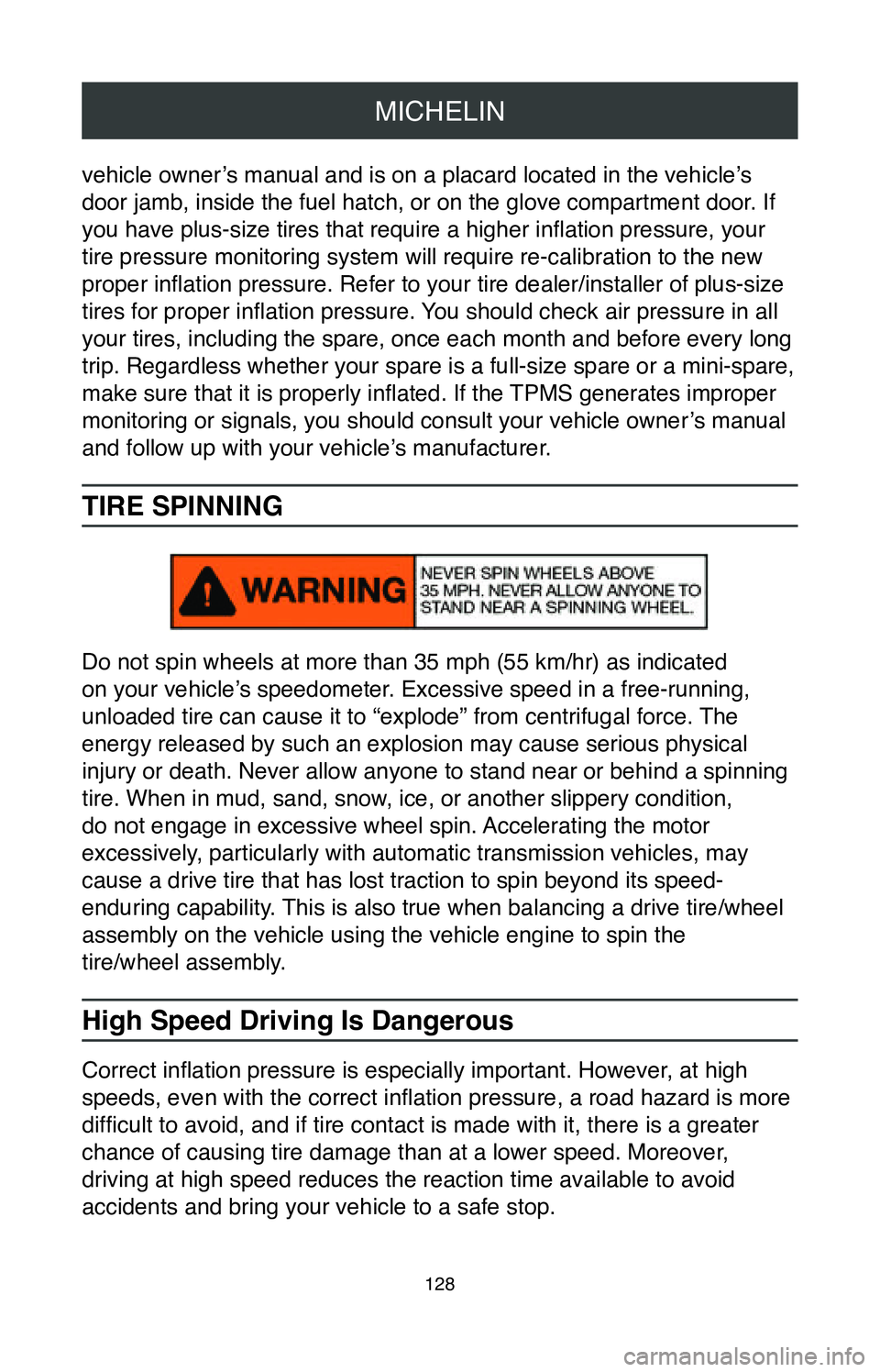
Do not spin wheels at more than 35 mph (55 km/hr) as indicated
on your vehicle’s speedometer. Excessive speed in a free-running,
unloaded tire can cause it to “explode” from centrifugal force. The
energy released by such an explosion may cause serious physical
injury or death. Never allow anyone to stand near or behind a spinning
tire. When in mud, sand, snow, ice, or another slippery condition,
do not engage in excessive wheel spin. Accelerating the motor
excessively, particularly with automatic transmission vehicles, may
cause a drive tire that has lost traction to spin beyond its speed-
enduring capability. This is also true when balancing a drive tire/wheel
assembly on the vehicle using the vehicle engine to spin the
tire/wheel assembly.
High Speed Driving Is Dangerous
Correct inflation pressure is especially important. However, at high
speeds, even with the correct inflation pressure, a road hazard is more
difficult to avoid, and if tire contact is made with it, there is a greater
chance of causing tire damage than at a lower speed. Moreover,
driving at high speed reduces the reaction time available to avoid
accidents and bring your vehicle to a safe stop.