wheel TOYOTA SUPRA 1996 Owner's Guide
[x] Cancel search | Manufacturer: TOYOTA, Model Year: 1996, Model line: SUPRA, Model: TOYOTA SUPRA 1996Pages: 188, PDF Size: 3.84 MB
Page 160 of 188

158Low tire pressure results in excessive
wear, poor handling, reduced fuel econo-
my, and the possibility of blowouts fromoverheated tires. Also, low tire pressure
can cause poor sealing of the tire bead. If
the tire pressure is excessively low, there
is the possibility of wheel deformation and/or tire separation.
High tire pressure produces a harsh ride,
handling problems, excessive wear at the center of the tire tread, and a greater
pos-
sibility of tire damage from road hazards.
If a tire frequently needs refilling, have it
checked by your Toyota dealer.
The following instructions for check-
ing tire pressure should be observed: The pressure should be checked
only when the tires are cold. If your
vehicle has been parked for at least 3 hours and has not been driven for mo-
re than 1.5 km or 1 mile since, you willget an accurate cold tire pressure reading.
Always use a tire pressure gauge.
The appearance of a tire can be mis-
leading. Besides, tire pressures that
are even just a few pounds off can de-
grade handling and ride.
Take special care when adding air
to the compact spare tire. The small-
er tire size can gain pressure very
quickly. Add compressed air in small
quantities and check the pressure
often until it reaches the specifiedpressure.
Do not bleed or reduce tire pres-sure after driving. It is normal for the
tire pressure to be higher after driving.
Never exceed the vehicle capacityweight. The passenger and luggage
weight should be located so that the
vehicle is balanced.
Be sure to reinstall the tire inflation
valve caps. Without the valve caps,
dirt or moisture could get into the valve
core and cause air leakage. If the capshave been lost, have new ones put onas soon as possible.
CHECKING YOUR TIRES Check the tire tread for the tread wear
indicators. If the indicators show, re-
place the tires.
The tires on your Toyota have built-in tread wear indicators to help you know
when the tires need replacement. When
the tread depth wears to 1.6 mm (0.06 in.)
or less, the indicators will appear. If you
can see the indicators in two or more adja-
cent grooves, the tire should be replaced.
The lower the tread, the higher the risk of skidding.
Checking and replacing tires
Page 161 of 188
159
Your Supra has been fitted with specially
developed
tires which provide exceptional
dynamic performance under general road
conditions. However, you may also notice
that your tires wear more rapidly than standard tires as a result of their superiorperformance. The effectiveness of snow tires is lost
if the tread wears down below 4 mm(0.16 in.).
Check the tires regularly for damage
such as cuts, splits and cracks. If anydamage is found, consult with a tech-
nician and have the tire repaired or re- placed. Even if the damage does not appear seri-
ous, a qualified technician should ex-
amine the damage. Objects which havepenetrated the tire may have caused in- ternal damage.
Any tires which are over six years old
must be checked by a qualified techni-
cian even if damage is not obvious.
Tires deteriorate with age even if they
have never or seldom been used.
This also applies to the spare tire and tires
stored for future use. REPLACING YOUR TIRES
When replacing a tire, use only the
same size and construction as origi-
nally installed and with the same or
greater load capacity.
Using
any other size or type of tire may se-
riously affect handling, ride, speedome-
ter/odometer calibration, ground clear-
ance, and clearance between the body
and tires or snow chains.
CAUTION
Do not mix radial, bias belted, or
bias-ply tires on your vehicle. It can cause dangerous handling charac-
teristics, resulting in loss of control.!
Toyota recommends all four tires, or at least both of the front or rear tires be
replaced at a time as a set.
See If you have a flat tireº in Part 4 for tire
change procedure.
When a tire is replaced, the wheel
should always be balanced.
An unbalanced wheel may affect vehicle
handling and tire life. Wheels can get out
of balance with regular use and should
therefore be balanced occasionally.
When replacing a tubeless tire, the air
valve should also be replaced with a
new one.
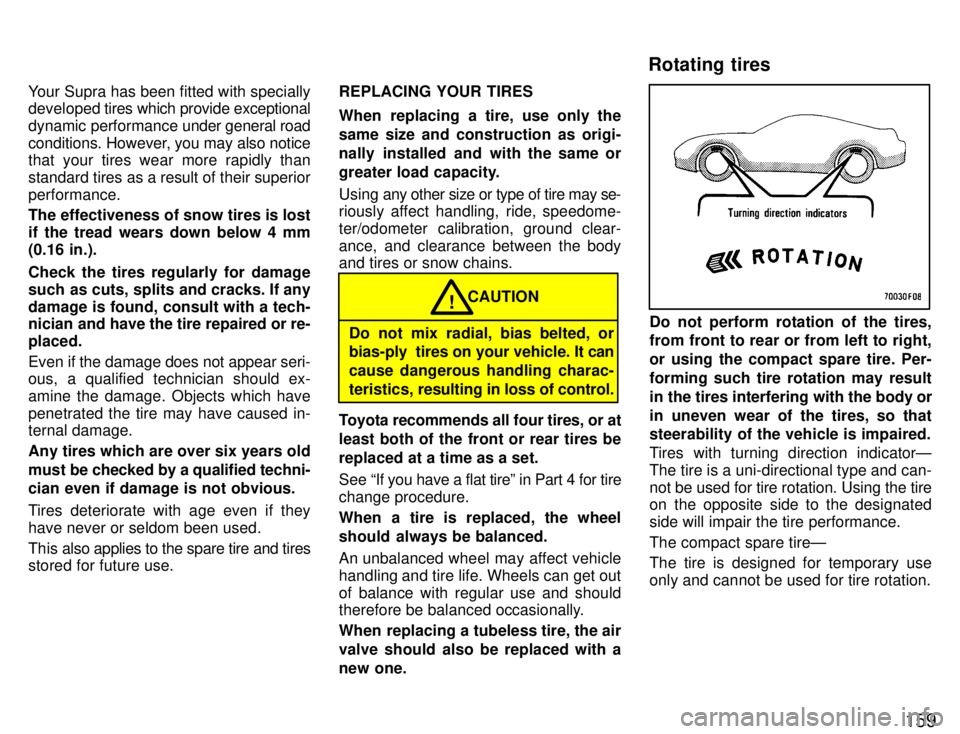
Do not perform rotation of the tires,
from front to rear or from left to right,
or using the compact spare tire. Per-forming such tire rotation may result
in the tires interfering with the body or
in uneven wear of the tires, so that
steerability of the vehicle is impaired.
Tires with turning direction indicatorÐ
The tire is a uni-directional type and can-not be used for tire rotation. Using the tire
on the opposite side to the designated
side will impair the tire performance. The compact spare tireÐ
The tire is designed for temporary use
only and cannot be used for tire rotation.
Rotating tires
Page 162 of 188
160WHEN TO USE SNOW TIRES OR CHAINS
Snow tires or chains are recom-
mended when driving on snow or ice.
On wet or dry roads, conventional tires
provide better traction than snow tires. SNOW TIRE SELECTION
If you need snow tires, select tires of
the same size, construction and loadcapacity as the original tires on your
Toyota.
Do not use tires other than those men-
tioned above. Do not install studded tires
without first checking local regulations for
possible restrictions.
SNOW TIRE INSTALLATION
Snow tires should be installed on all wheels.
Installing snow tires on the rear wheels
only can lead to an excessive difference
in road grip capability between the front
and rear tires which could cause loss of
vehicle control.
When storing removed tires, you should
store them in a cool dry place.
Mark the direction of rotation and be sure to install them in the same direction when replacing.
Do not drive with the snow tires
incorrectly inflated.
Never drive over 120 km/h (75
mph) with any type of snow tires.
CAUTION!
TIRE CHAIN SELECTION Use the tire chains of correct size and type. Use SAE Class Sº type radial tire chains
except radial cable chains or V-bar type chains.
Regulations regarding the use of tire
chains vary according to location or
type of r oad, so always check them be-
fore installing chains.
Do not install tire chains on the
255/40ZR17 tires, as this could dam-
age the vehicle body.
NOTICE
CHAIN INSTALLATION
Install the chains on the rear tires as
tightly as possible. Do not use tirechains on the front tires. Retighten
chains after driving 0.5 '1.0 km
(1/4 '1/2 mile).
When installing chains on your tires, care-fully follow the instructions of the chain
manufacturer.
If wheel covers are used, they will be
scratched by the chain band, so removethe covers before putting on the chains.
Do not exceed 50 km/h (30 mph) or
the chain manufacturer's recom-
mended speed limit, whichever is
lower.
Drive carefully avoiding bumps,
holes, and sharp turns, which maycause the vehicle to bounce.
Avoid sharp turns or locked-wheel
braking, as use of chains may ad-
versely affect vehicle handling.
CAUTION!
Do not attempt to use a tire chain on
the compact spare tire, as it may
result in damage to the vehicle as well as the tire.
NOTICE
Installing snow tires and chains
Page 163 of 188

161
WHEN TO REPLACE YOUR WHEELS
If you have wheel damage such as
bending, cracks or heavy corrosion,
the wheel should be replaced.
If you fail to replace damaged wheels, the
tire may slip off the wheel or they may cause loss of handling control. WHEEL SELECTION
When replacing wheels,
care should be
taken to ensure that the wheels are re- placed by ones with the same load ca-
pacity, diameter, rim width, and offset. This must be observed on compact spare
tires, too.
Correct replacement wheels are available
at your Toyota dealer.
A wheel of a different size or type may ad-
versely affect handling, wheel and bear-
ing life, brake cooling, speedometer/
odometer calibration, stopping ability,
headlight aim, bumper height, vehicle
ground clearance, and tire or snow chainclearance to the body and chassis. Replacement
with used wheels is not rec-
ommended as they may have been sub-jected to rough treatment or high mileageand could fail without warning. Also, bent
wheels which have been straightened
may have structural damage and there-
fore should not be used. Never use an in-
ner tube in a leaking wheel which is de-
signed for a tubeless tire.
After driving your vehicle the first 1600
km (1000 miles), check that the wheel
nuts are tight.
If you have repaired or changed your
tires, check that the wheel nuts are still
tight after driving 1600 km (1000miles).
When using tire chains, be careful not
to damage the aluminum wheels.
Use only the Toyota wheel nuts and
wrench designed for your aluminumwheels.
When balancing your wheels, use only
Toyota balance weights or equivalent
and a plastic or rubber hammer.
As with any wheel, periodically checkyour aluminum wheels for damage. If
damaged, replace immediately.
Replacing wheels
Aluminum wheel precautions
Page 181 of 188

Part 8Dimensions and weight Engine
179
SPECIFICATIONS
Dimensions and weight
Engine
Fuel
Service specifications
Tires
Fuses
Overall length mm (in.) 4515 (177.7)
Overall width mm (in.) 1810 ( 71.3)
Overall height mm (in.) 1265 ( 49.8)*
1275 ( 50.2)*
Wheelbase mm (in.) 2550 (100.4)
Front tread mm (in.) 1520 ( 59.9)
Rear tread mm (in.) 1525 ( 60.1)
Vehicle capacity weight (occupants + luggage) kg (lb.) 330 (725)
* : Unladen vehicle plus two occupants
* : Unladen vehicle Model:
2JZ-GE and 2JZ-GTE
Type: 2JZ-GE engine 6 cylinder in line, 4 cycle, gasoline
2JZ-GTE engine 6 cylinder in line, 4 cycle, gasoline (with turbocharger)
Bore and stroke, mm (in.): 86.0 x 86.0 (3.39 x 3.39)
Displacement, cm 3
(cu. in.):
2997 (182.9)
Page 184 of 188

182STEERING Wheel freeplay:
Less than 30 mm (1.2 in.)
Power steering fluid type: Automatic transmission fluid DEXRON )
-II or -III Tire size:
Spare tireT145/70 R 17
Except spare tire 2JZ-GE engine
225/50R 16 (for front use only) 245/50R 16 (for rear use only)
2JZ-GTE engine
235/45 ZR 17 (for front use only)255/40 ZR 17 (for rear use only)
Tire pressure, kPa (kgf/cm 2
or bar, psi):
Spare tire 420 (4.2, 60)Except spare tire 225/50 ZR 16 230 (2.3, 33)
others 250 (2.5, 36)
Wheel size:
225/50 ZR 16 16 x 8JJ
245/50 ZR 16 16 x 9JJ
235/45 ZR 17 17 x 8JJ
255/40 ZR 17 17 x 9.5JJ
T145/70 R 17 17 x 4T
Wheel nut torque, N Vm (kgf Vm, ft Vlbf):
103 (10.5, 76)
Fuses (type A)
1. WIPER 20 A: Windshield wipers and
washer, rear window wiper and washer
2. HTR 7.5 A: Air conditioning system
3. SEAT-HTR 7.5 A: Seat heater
4. ST 7.5 A: Starter system
5. IGN 7.5 A: Charging system, dis-
charge warning light, multiport fuel injec- tion system/sequential multiport fuel in-
jection system, SRS airbag system
6. PANEL 10 A: Instrument panel lights,
instrument panel lights control
7. MIR-HTR 10 A: Mirror heaters
8. TURN 7.5 A: Turn signal lights
Tires Fuses
Page 188 of 188

186Traction A, B, CÐ
The traction grades,
from highest to lowest, are A, B, and C,
and they represent the tire's ability to stop
on wet pavement as measured under
controlled conditions on specified govern-
ment test surfaces of asphalt and con-
crete. A tire marked C may have poor trac-
tion performance.
Warning: The traction grade assigned to this tire is based on braking (straight
ahead) traction tests and does not include
cornering (turning) traction.
Temperature A, B, CÐ The temperature
grades are A (the highest), B, and C, rep-
resenting the tire's resistance to the gen-
eration of heat and its ability to dissipate heat when tested under controlled condi-tions on a specified indoor laboratory test
wheel. Sustained high temperature can
cause the material of the tire to degener- ate and reduce tire life, and excessive
temperature can lead to sudden tire fail-
ure. The grade C corresponds to a level of
performance which all passenger car tires
must meet under the Federal Motor Ve-
hicle Safety Standard No. 109. Grades B
and A represent higher levels of perfor- mance on the laboratory test wheel than
the minimum required by law. Warning: The temperature grade for this
tire is
established for a tire that is properly
inflated and not overloaded. Excessivespeed, underinflation, or excessive load- ing, either separately or in combination,can cause heat buildup and possible tire failure.