washer fluid TOYOTA SUPRA 1996 Owners Manual
[x] Cancel search | Manufacturer: TOYOTA, Model Year: 1996, Model line: SUPRA, Model: TOYOTA SUPRA 1996Pages: 188, PDF Size: 3.84 MB
Page 49 of 188
47
If the washer does not work, check to see
whether the washer tank is empty. For in-
formation on adding washer fluid, see
Adding washer fluidº in Chapter 7-3.
In cold weather, warm the windshield with
the defroster before using the washer.
This will help prevent icing, which could
block your vision.
NOTICE
Do not operate the wipers if the windshield is dry. It may scratch the
glass.
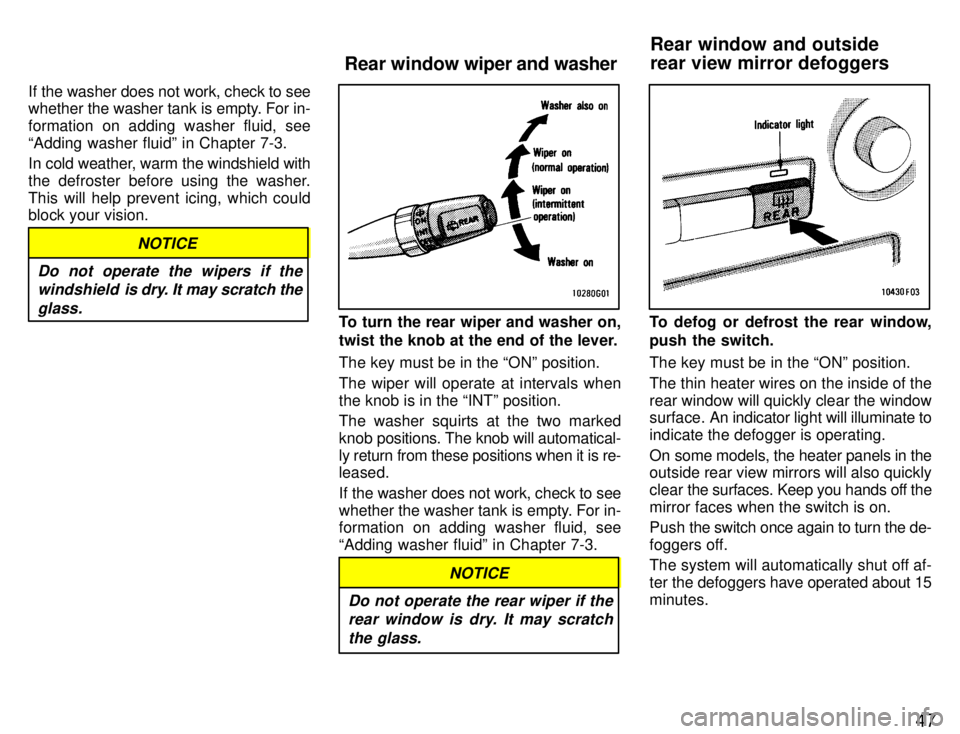
To turn the rear wiper and washer on,
twist the knob at the end of the lever. The key must be in the ONº position.
The wiper will operate at intervals when the knob is in the INTº position.
The washer squirts at the two marked
knob positions. The knob will automatical-
ly return from these positions when it is re- leased.
If the washer does not work, check to see
whether the washer tank is empty. For in-
formation on adding washer fluid, see
Adding washer fluidº in Chapter 7-3.
NOTICE
Do not operate the rear wiper if the rear window is dry. It may scratch
the glass.
To defog or defrost the rear window,
push the switch. The key must be in the ONº position.
The thin heater wires on the inside of the rear window will quickly clear the window
surface. An indicator light will illuminate to
indicate the defogger is operating.
On some models, the heater panels in the
outside rear view mirrors will also quickly
clear the surfaces. Keep you hands off the
mirror faces when the switch is on. Push the switch once again to turn the de-
foggers off.
The system will automatically shut off af-
ter the defoggers have operated about 15minutes.
Rear window w
iper and washer Rear window and outside rear view mirror defoggers
Page 122 of 188
120Make sure you have ethylene-glycol
antifreeze in the radiator.
Do not use alcohol type antifreeze.
NOTICE
Check the condition of the battery and cables. Cold temperatures reduce the capacity of
any battery, so it must be in top shape to provide enough power for winter starting.Chapter 7-3 tells you how to visually in-
spect the battery. Your Toyota dealer and
most service stations will be pleased tocheck the level of charge.
Make sure the engine oil viscosity is
suitable for the cold weather.
See Chapter 7-2 for recommended vis-
cosity.
Leaving a heavy summer oil in your
vehicle during winter months may cause
harder starting. If you are not sure about
which oil to use, call your Toyota dealerÐ
he will be pleased to help. Keep the door locks from freezing. Squirt lock de-icer or glycerine into the
locks to keep them from freezing. To open
a frozen lock, try heating the key before in-serting it. Use a washer fluid containing an anti-
freeze solution.
This product is available at your Toyota
dealer and most auto parts stores. Follow
the manufacturer's directions for how
much to mix with water.NOTICE
Do not use engine antifreeze or any other substitute as washer fluid be-
cause it may damage your vehicle's
paint.
Do not use your parking brake when there is a possibility it could freeze. When parking, put the transmission into
Pº (automatic) or into first or reverse
(manual) and block the rear wheels. Do
not use the parking brake, or snow or wa-
ter accumulated in and around the parkingbrake mechanism may freeze, making it
hard to release. Keep ice and snow from accumulating
under the fenders.
Ice and snow built up under your fenders
can make steering difficult. During bad winter driving, stop and check under the
fenders occasionally. Depending on where you are driving,
we recommend you carry some emer- gency equipment.
Some of
the things you might put in the ve-
hicle are tire chains, window scraper, bag of sand or salt, flares, small shovel, jump- er cables, etc.
Winter driving tips
Page 147 of 188

145
Service reminder indicators and
warn-
ing buzzers Check that all service reminder indicators
and warning buzzers function properly. Steering wheel
Be alert for changes in steering condition, such as hard steering or strange noise. Seats Check that all front seat controls such as
seat adjusters, seatback recliner, etc. op- erate smoothly and that all latches lock
securely in any position. For folding-down
rear seatback, check that the latches lock
securely. Make sure the front headrestsare firmly secured. Seat belts
Check that the seat belt system such as
buckles, retractors and anchors operate
properly and smoothly. Make sure the belt
webbing is not cut, frayed, worn or dam- aged. Accelerator pedal Check the pedal for smooth operation and
uneven pedal effort or catching. Clutch pedal Check the pedal for smooth operation. Brake pedal Check
the pedal for smooth operation and
that the pedal has the proper clearance. Check the brake booster function. Brakes
At a safe place, check that the brakes do not pull to one side when applied. Parking brake Check that the lever has the proper travel and that, on a safe incline, your vehicle is
held securely with only the parking brake applied.
Automatic transmission Parkº mech-
anismCheck the lock release button of the selec-
tor lever for proper and smooth operation.
On a safe incline, check that your vehicle is held securely with the selector lever inPº position and all brakes released.
IN THE ENGINE COMPARTMENT Items listed below should be checked
from time to time , e.g. each time when
refueling.
Washer fluid
Make sure there is sufficient fluid in the
tank. See Chapter 7-3 for additional infor-
mation.
Engine coolant level Make sure the coolant level is between
the FULLº and LOWº lines on the see-
through reservoir when the engine is cold.
See Chapter 7-2 for additional informa-tion. Battery electrolyte level Make sure the electrolyte level of all bat-
tery cells is correct. Add only distilled wa-
ter when replenishing. See Chapter 7-3
for additional information. Brake fluid level
Make sure the brake fluid level is correct. See Chapter 7-2 for additional informa- tion.
Engine oil level
Check the l
evel on the dipstick with the en-
gine turned off and the vehicle parked on
a level spot. See Chapter 7-2 for addition-
al information. Power steering fluid level Check the level on the dipstick. The level
should be in the HOTº or COLDº range
depending on the fluid temperature. See Chapter 7-2 for additional information. Exhaust system
If you notice any change in the sound of
the exhaust or smell exhaust fumes, have the cause located and corrected immedi-
ately. (See engine exhaust cautions in
Part 2.)
Page 154 of 188

152Here is a list of parts and tools you will
need on performing do-it-yourself main-
tenance. Remember all Toyota parts are
designed in metric sizes, so your tools
must be metric. Checking the engine oil level Parts (if level is low):
Engine oil API SH, Energy-Conserv-
ing IIº multigrade or ILSAC multigrade
having viscosity proper for your cli-mate
Tools: Rag or paper towel
Funnel (only for adding oil)
Checking the engine coolant level Parts (if level is low): Ethylene-glycol antifreeze
Demineralized or distilled water
Tools: Funnel (only for adding coolant)
Checking brake fluid Parts (if level is low): SAE J1703 or FMVSS No. 116 DOT 3 brake fluid
Tools: Rag or paper towel
Funnel (only for adding fluid) Checking power steering fluid Parts (if level is low):
Automatic transmission fluid DEXRON )
-II or -III
Tools: Rag or paper towel
Funnel (only for adding fluid)
Checking battery condition Non-maintenance batteriesÐ
Tools: Warm water
Baking soda
Grease
Conventional wrench (for terminal clamp bolts)
Maintenance type batteriesÐ Parts (if level is low): Distilled water
Tools: Warm water
Baking soda
Grease
Conventional wrench (for terminal clamp bolts)
Coin (for vent plugs)
Funnel (only for adding distilled water) Checking and replacing fuses Parts (if replacement is necessary):
Fuse with same amperage rating as original
Adding washer fluid Parts: Water
Washer fluid containing antifreeze (for winter use)
Tools: Funnel
Replacing light bulbs Parts: Bulb with same number and wattage rating as original (See charts in Re-
placing light bulbsº in Chapter 7-3.)
Tools: Screwdriver
Parts and tools
Page 165 of 188
Part 7Checking battery conditionÐ ÐPrecautions
163
DO-IT-YOURSELF MAINTENANCEÐ
Chapter 7-3 Electrical components
Checking battery condition
Battery recharging precautions
Checking and replacing fuses
Adding washer fluid
Checking the headlight aim
Replacing light bulbs
BATTERY PRECAUTIONS
The battery produces flammable
and explosive hydrogen gas.
Do not cause a spark from the bat-
tery with tools.
Do not smoke or light a match near
the battery.
The electrolyte contains poisonous
and corrosive sulfuric acid. Avoid contact with eyes, skin or clothes.
Never ingest electrolyte.
Wear protective safety glasses
when working near the battery.
Keep children away from the bat-
tery.
EMERGENCY MEASURES If electrolyte gets in your eyes,
flush your eyes with clean water
for at least 15 minutes and get im-
mediate medical attention. If pos-
sible, continue to apply water with
a sponge or cloth while en route to
the medical office.
If electrolyte gets on your skin,
thoroughly wash the contact area.
If you feel pain or burning, get
medical attention immediately. CAUTION
!
If electrolyte gets on your clothes,
there is a possibility of its soaking
through to your skin, so immedi- ately take off the exposed cloth-
ing and follow the procedure
above, if necessary.
If you happen to swallow electro-
lyte, drink a large quantity of wa-
ter or milk. Follow with milk of
magnesia, beaten raw egg or veg-
etable oil. Then go immediately
for emergency help.
Page 170 of 188
168
Never use a fuse with a higher am-
perage rating, or any other object, in
place of a fuse. This may cause ex-
tensive damage and possibly a fire.CAUTION
!
If any washer does not work, the wash-
er tank may be empty. Add washer fluid.
You may use plain water as washer fluid.
However, in cold areas where tempera-
tures range below freezing point, use
washer fluid containing antifreeze. This
product is available at your Toyota dealer
and most auto parts stores. Follow the
manufacturer 's directions for how much
to mix with water.
NOTICE
Do not use engine antifreeze or any other substitute because it may
damage your vehicle's paint.
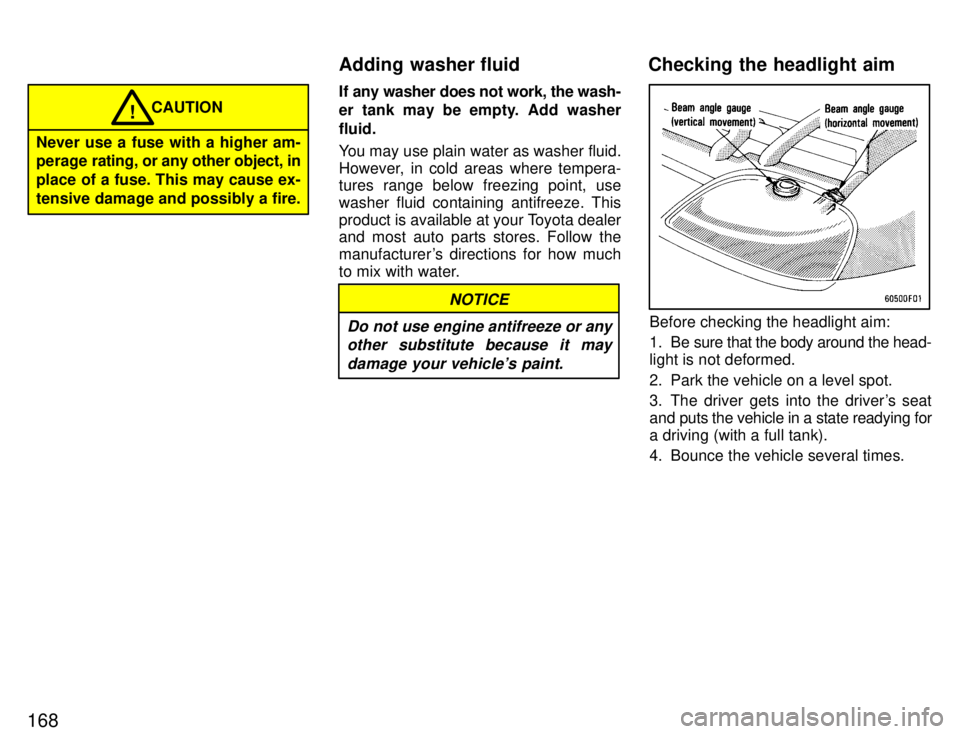
Before checking the headlight aim:
1. Be sure that the body around the head-
light is not deformed.
2. Park the vehicle on a level spot.
3. The driver gets into the driver's seat
and puts the vehicle in a state readying fora driving (with a full tank).
4. Bounce the vehicle several times.
Adding washer fluid Checking the headlight aim
Page 184 of 188

182STEERING Wheel freeplay:
Less than 30 mm (1.2 in.)
Power steering fluid type: Automatic transmission fluid DEXRON )
-II or -III Tire size:
Spare tireT145/70 R 17
Except spare tire 2JZ-GE engine
225/50R 16 (for front use only) 245/50R 16 (for rear use only)
2JZ-GTE engine
235/45 ZR 17 (for front use only)255/40 ZR 17 (for rear use only)
Tire pressure, kPa (kgf/cm 2
or bar, psi):
Spare tire 420 (4.2, 60)Except spare tire 225/50 ZR 16 230 (2.3, 33)
others 250 (2.5, 36)
Wheel size:
225/50 ZR 16 16 x 8JJ
245/50 ZR 16 16 x 9JJ
235/45 ZR 17 17 x 8JJ
255/40 ZR 17 17 x 9.5JJ
T145/70 R 17 17 x 4T
Wheel nut torque, N Vm (kgf Vm, ft Vlbf):
103 (10.5, 76)
Fuses (type A)
1. WIPER 20 A: Windshield wipers and
washer, rear window wiper and washer
2. HTR 7.5 A: Air conditioning system
3. SEAT-HTR 7.5 A: Seat heater
4. ST 7.5 A: Starter system
5. IGN 7.5 A: Charging system, dis-
charge warning light, multiport fuel injec- tion system/sequential multiport fuel in-
jection system, SRS airbag system
6. PANEL 10 A: Instrument panel lights,
instrument panel lights control
7. MIR-HTR 10 A: Mirror heaters
8. TURN 7.5 A: Turn signal lights
Tires Fuses