light TOYOTA SUPRA 1998 User Guide
[x] Cancel search | Manufacturer: TOYOTA, Model Year: 1998, Model line: SUPRA, Model: TOYOTA SUPRA 1998Pages: 191, PDF Size: 3.65 MB
Page 26 of 191
SUPRA (U)
26
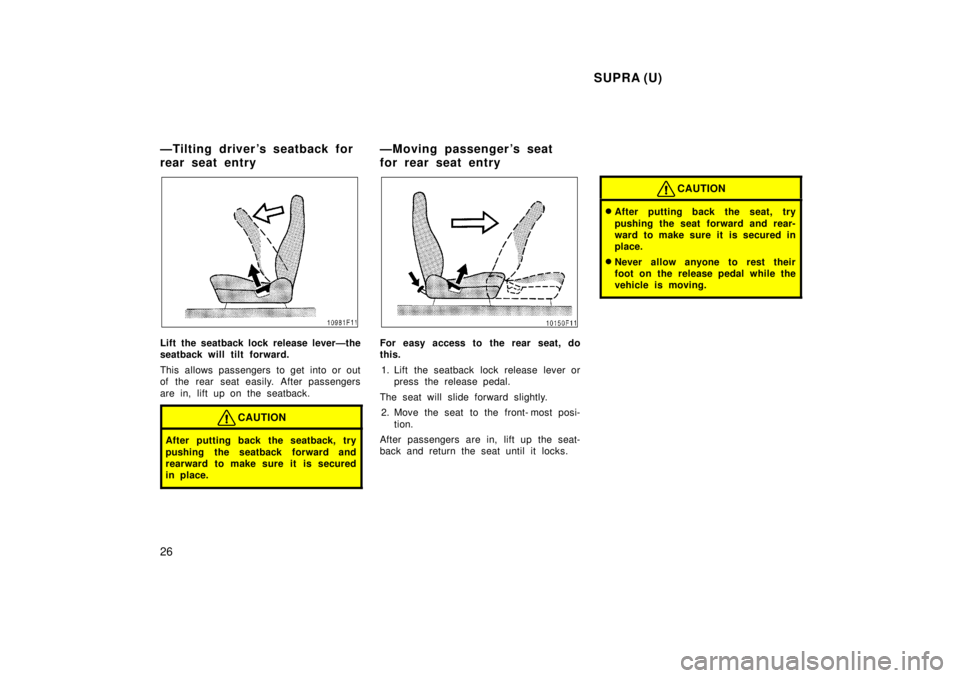
Lift the seatback lock release leverÐthe
seatback will tilt forward.
This allows passengers to get into or out
of the rear seat easily. After passengers
are in, lift up on the seatback.
CAUTION
After putting back the seatback, try
pushing the seatback forward and
rearward to make sure it is secured
in place.
For easy access to the rear seat, do
this. 1. Lift the seatback lock release lever or press the release pedal.
The seat will slide forward slightly. 2. Move the seat to the front- most posi- tion.
After passengers are in, lift up the seat-
back and return the seat until it locks.
CAUTION
After putting back the seat, try
pushing the seat forward and rear-
ward to make sure it is secured in
place.
Never allow anyone to rest their
foot on the release pedal while the
vehicle is moving.
ÐTilting driver 's seatback for
rear seat entry ÐMoving passenger 's seat
for rear seat entry
Page 29 of 191
SUPRA (U)29
If the seat belt cannot be pulled out of the
retractor, firmly pull the belt and release
it. You will then be able to smoothly pull
the belt out of the retractor.
When a passenger 's shoulder belt is com-
pletely extended and is then retracted
even slightly, the belt is locked in that
position and cannot be extended. This fea-
ture is used to hold the child restraint
system securely. (For details, see ºChild
restraintº in this chapter.) To free the belt
again, fully retract the belt and then pull
the belt out once more.
CAUTION
After inserting the tab, make sure
the tab and buckle are locked and
that the belt is not twisted.
Do not insert coins, clips, etc. in
the buckle as this may prevent you
from properly latching the tab and
buckle.
If the seat belt does not function
normally, immediately contact your
Toyota dealer. Do not use the seat
until the seat belt is fixed. It cannot
protect an adult occupant or your
child from injury.
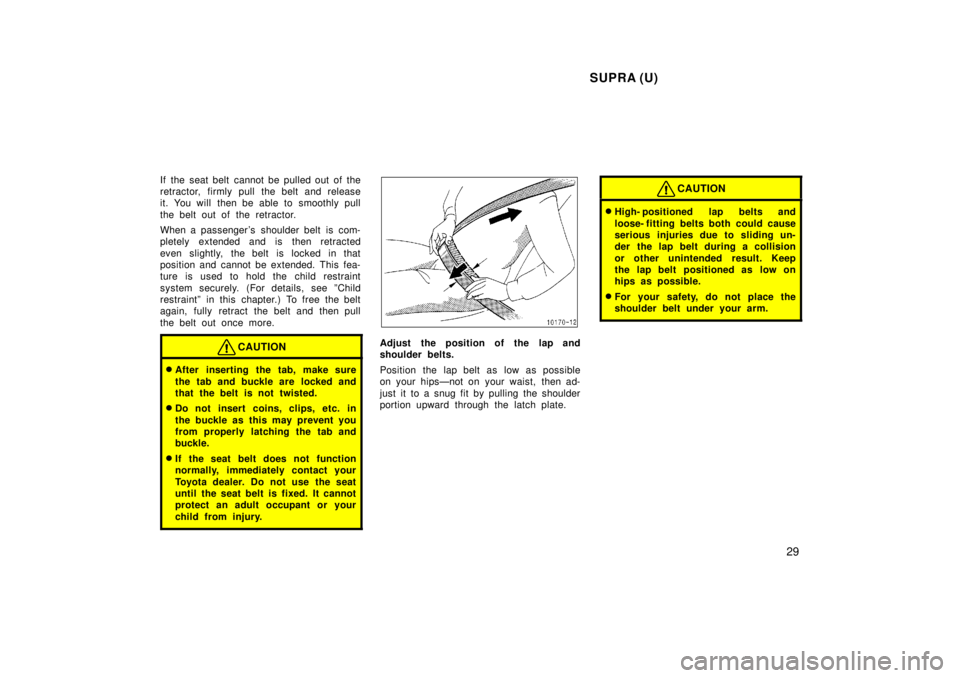
Adjust the position of the lap and
shoulder belts.
Position the lap belt as low as possible
on your hipsÐnot on your waist, then ad-
just it to a snug fit by pulling the s houlder
portion upward through the latch plate.
CAUTION
High- positioned lap belts and
loose- fitting belts both could cause
serious injuries due to sliding un-
der the lap belt during a collision
or other unintended result. Keep
the lap belt positioned as low on
hips as possible.
For your safety, do not place the
shoulder belt under your arm.
Page 32 of 191
SUPRA (U)
32
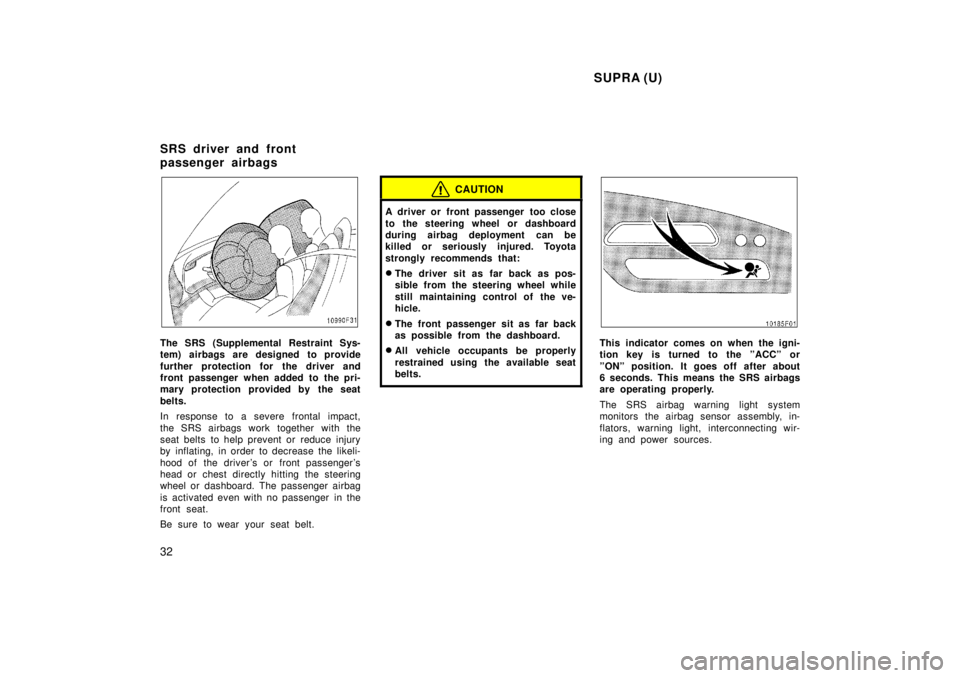
The SRS (Supplemental Restraint Sys-
tem) airbags are designed to provide
further protection for the driver and
front passenger when added to the pri-
mary protection provided by the seat
belts.
In response to a severe frontal impact,
the SRS airbags work together with the
seat belts to help prevent or reduce injury
by inflating, in order to decrease the likeli-
hood of the driver 's or front passenger 's
head or chest directly hitting the steering
wheel or dashboard. The passenger airbag
is activated even with no passenger in the
front seat.
Be sure to wear your seat belt.
CAUTION
A driver or front passenger too close
to the steering wheel or dashboard
during airbag deployment can be
killed or seriously injured. Toyota
strongly recommends that: The driver sit as far back as pos-
sible from the steering wheel while
still maintaining control of the ve-
hicle.
The front passenger sit as far back
as possible from the dashboard.
All vehicle occupants be properly
restrained using the available seat
belts.
This indicator comes on when the igni-
tion key is turned to the ºACCº or
ºONº position. It goes off after about
6 seconds. This means the SRS airbags
are operating properly.
The SRS airbag warning light system
monitors the airbag sensor assembly, in-
flators, warning light, interconnecting wir-
ing and power sources.
SRS driver and front
passenger airbags
Page 37 of 191
SUPRA (U)37
Do not modify or remove any wir-
ing. Do not modify, remove, strike
or open any components such as
the steering wheel column cover,
front passenger airbag cover, front
passenger airbag, airbag sensor as-
sembly. Doing any of these may
cause sudden SRS airbag inflation
or disable the system, which could
result in death or serious injury.
Failure to follow these instructions
can result in death or serious inju-
ries.
NOTICE
Do not perform any of the following changes without consulting yourToyota dealer. Such changes can in- terfere with proper operation of the
SRS airbag system in some cases.
Installation of electronic items suchas a mobile two- way radio, cassette
tape player or compact disc player
Modification of the suspension sys-tem
Modification of the front end struc-ture
Attachment of a grille guard (bullbar, kangaroo bar, etc.), snowplow,
winches or any other equipment tothe front end
Repairs made on or near the front end structure, console, steering col-
umn, steering wheel or dashboard
near the front passenger airbag
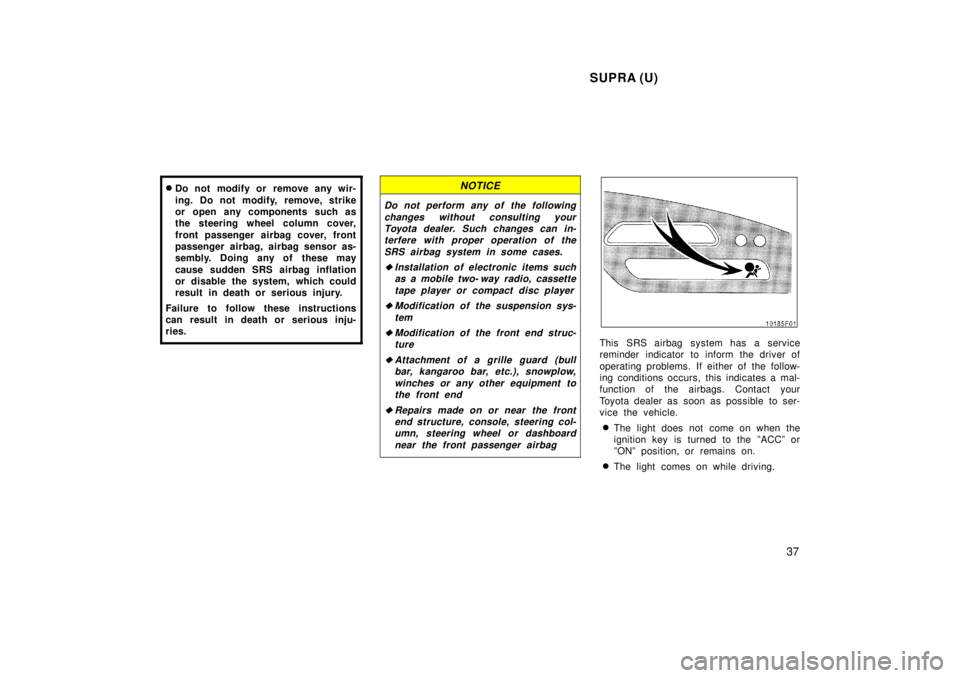
This SRS airbag system has a service
reminder indicator to inform the driver of
operating problems. If either of the follow-
ing conditions occurs, this indicates a mal-
function of the airbags. Contact your
Toyota dealer as soon as possible to ser-
vice the vehicle.
The light does not come on when the
ignition key is turned to the ºACCº or
ºONº position, or remains on.
The light comes on while driving.
Page 42 of 191

SUPRA (U)
42
1. Run the lap and shoulder belt through or around the infant seat following the
instructions provided by its manufactur-
er and insert the tab into the buckle
taking care not to twist the belt. Keep
the lap portion of the belt tight.
CAUTION
After inserting the tab, make sure
the tab and buckle are locked and
that the lap and shoulder portions
of the belt are not twisted.
Do not insert coins, clips, etc. in
the buckle as this may prevent you
from properly latching the tab and
buckle.
If the seat belt does not function
normally, it cannot protect your
child from injury. Contact your
Toyota dealer immediately. Do not
use the seat until the seat belt is
fixed.
2. Fully extend the shoulder belt to put it
in the lock mode. When the belt is
then retracted even slightly, it cannot
be extended.
To hold the infant seat securely, make
sure the belt is in the lock mode before
letting the belt retract.
Page 46 of 191
SUPRA (U)
46
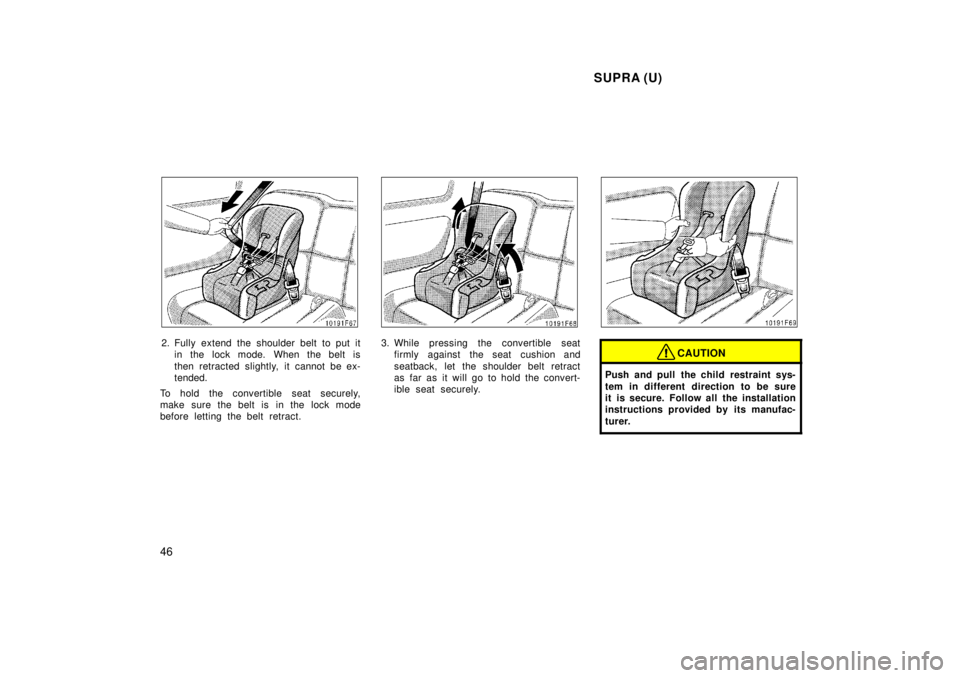
2. Fully extend the shoulder belt to put it in the lock mode. When the belt is
then retracted slightly, it cannot be ex-
tended.
To hold the convertible seat securely,
make sure the belt is in the lock mode
before letting the belt retract.3. While pressing the convertible seat firmly against the seat cushion and
seatback, let the shoulder belt retract
as far as it will go to hold the convert-
ible seat securely.CAUTION
Push and pull the child restraint sys-
tem in different direction to be sure
it is secure. Follow all the installation
instructions provided by its manufac-
turer.
Page 52 of 191

SUPRA (U)
52
Pull the lever toward you to reduce
glare from the headlights of the vehicle
behind you during night driving.
Before adjusting the mirror to the position
with most clarity, push the day- night
change lever away from you (daylight driv-
ing position).
Remember that by reducing glare you also
lose some rear view clarity.
Anti- glare inside rear view
mirror
Page 53 of 191
SUPRA (U)53
Part 1
OPERATION OF
INSTRUMENTS
AND CONTROLSÐ
Chapter 1- 4
Lights, Wipers and Defogger
Headlights and turn signals
Emergency flashers
Instrument panel light control
Front fog lights
Interior lights
Ignition switch light
Luggage compartment light
Windshield wipers and washer
Rear window wiper and washer
Rear window and outside rear view
mirror defoggers
Headlights and turn signals
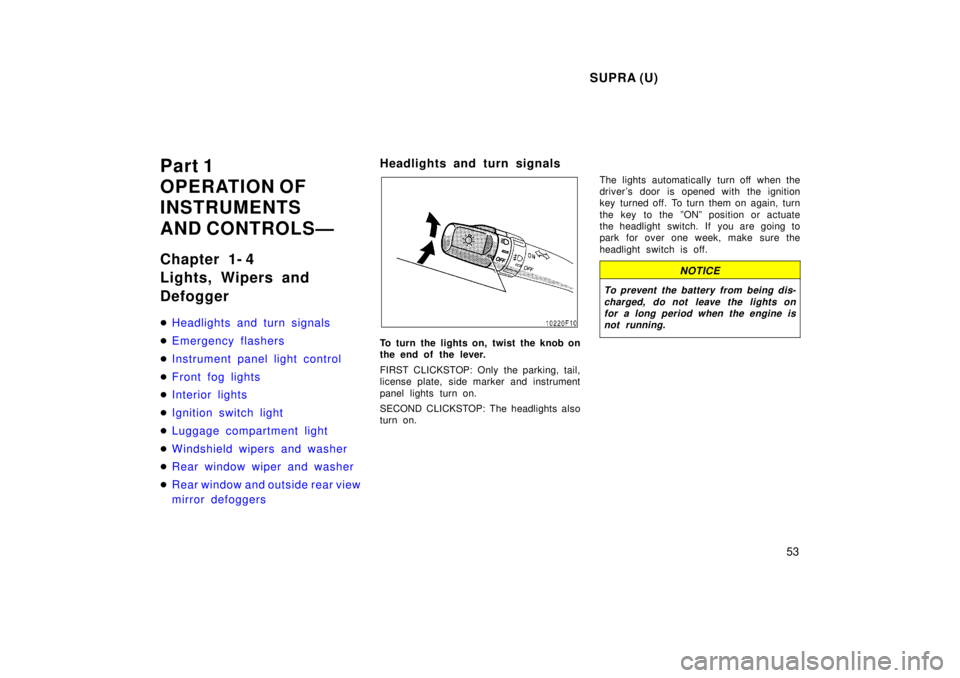
To turn the lights on, twist the knob on
the end of the lever.
FIRST CLICKSTOP: Only the parking, tail,
license plate, side marker and instrument
panel lights turn on.
SECOND CLICKSTOP: The headlights also
turn on.
The lights automatically turn off when the
driver 's door is opened with the ignition
key turned off. To turn them on again, turn
the key to the ºONº position or actuate
the headlight switch. If you are going to
park for over one week, make sure the
headlight switch is off.
NOTICE
To prevent the battery from being dis-
charged, do not leave the lights onfor a long period when the engine is not running.
Page 54 of 191

SUPRA (U)
54
For high beam, push the lever away
from you. Pull it toward you for low
beam. For the headlight flasher, pull it
further back.
A blue light in the instrument panel indi-
cates high beam is on.
The headlight flasher works even when
the headlight switch is off.For signaling turns, move the lever up
or down in the conventional manner.
The key must be in the ºONº position.
The turn signal is self- cance lling after a
turn, but after a lane change, you may
have to cancel it by hand. You can also
signal a lane change by moving the turn
signal lever partway and holding it there.
If the green light in the instrument panel
flashes faster than normal, it indicates
that the front or rear turn signal bulb has
burned out. Emergency flashersTo turn on the emergency flashers,
push the switch.
All the turn signal lights will flash.
Turn on the emergency flashers to warn
other drivers if your vehicle must be
stopped where it might be a traffic hazard.
Always pull as far off the road as pos-
sible.
The turn signal light switch will not work
when the emergency flashers are operat-
ing.
Page 55 of 191

SUPRA (U)55
NOTICE
To prevent the battery from being dis-charged, do not leave the switch onfor a long period when the engine isnot running.
Instrument panel light control
To adjust the brightness of the instru-
ment panel lights, turn the knob. Front fog lightsTo turn on the front fog lights, twist
the knob of the headlight and turn sig-
nal switch lever. They will come on
when the headlights are turned on low
beam.