service TOYOTA SUPRA 1998 User Guide
[x] Cancel search | Manufacturer: TOYOTA, Model Year: 1998, Model line: SUPRA, Model: TOYOTA SUPRA 1998Pages: 191, PDF Size: 3.65 MB
Page 126 of 191
SUPRA (U)
126
(b) Starting a flooded engine
If the engine will not start, your engine
may be flooded because of repeated
cranking.
If this happens, turn the key to ºSTARTº
with the accelerator pedal held down.
Keep the key and accelerator pedal so for
15 seconds and release them. Then try
starting the engine with your foot off the
accelerator pedal.
If the engine does not start after 15 se-
conds of cranking, release the key, wait
a few minutes and try again.
If the engine still will not start, it needs
adjustment or repair. Call a Toyota dealer
or qualified repair shop for assistance.
NOTICE
Do not crank for more than 30 se-
conds at a time. This may overheatthe starter and wiring systems.
(c) Jump starting
To avoid serious personal injury and
damage to your vehicle which might re-
sult from battery explosion, acid burns,
electrical burns, or damaged electronic
components, these instructions must be
followed precisely.
If you are unsure about how to follow this
procedure, we strongly recommend that
you seek the help of a competent me-
chanic or towing service.
CAUTION
Batteries contain sulfuric acid
which is poisonous and corrosive.
Wear protective safety glasses when
jump starting, and avoid spilling
acid on your skin, clothing, or ve-
hicle.
If you should accidentally get acid
on yourself or in your eyes, remove
any contaminated clothing and flush
the affected area with water im-
mediately. Then get immediate medi-
cal attention. If possible, continue
to apply water with a sponge or
cloth while en route to the medical
office.
The gas normally produced by a
battery will explode if a flame or
spark is brought near. Use only
standardized cables designed for
jump starting and do not smoke or
light a match while jump starting.
NOTICE
The battery used for boosting must
be 12 V. Do not jump start unless youare sure that the booster battery is correct.
Page 131 of 191
SUPRA (U)131
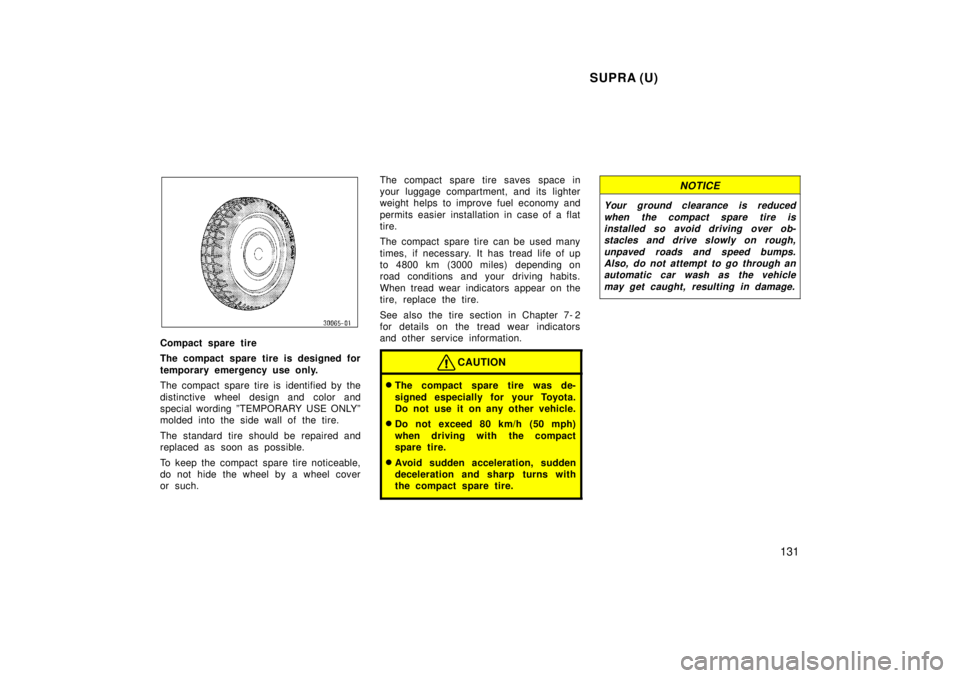
Compact spare tire
The compact spare tire is designed for
temporary emergency use only.
The compact spare tire is identified by the
distinctive wheel design and color and
special wording ºTEMPORARY USE ONLYº
molded into the side wall of the tire.
The standard tire should be repaired and
replaced as soon as possible.
To keep the compact spare tire noticeable,
do not hide the wheel by a wheel cover
or such. The compact spare tire saves space in
your luggage compartment, and its lighter
weight helps to improve fuel economy and
permits easier installation in case of a flat
tire.
The compact spare tire can be used many
times, if necessary. It has tread life of up
to 4800 km (3000 miles) depending on
road conditions and your driving habits.
When tread wear indicators appear on the
tire, replace the tire.
See also the tire section in Chapter 7- 2
for details on the tread wear indicators
and other service information.
CAUTION
The compact spare tire was de-
signed especially for your Toyota.
Do not use it on any other vehicle.
Do not exceed 80 km/h (50 mph)
when driving with the compact
spare tire.
Avoid sudden acceleration, sudden
deceleration and sharp turns with
the compact spare tire.
NOTICE
Your ground clearance is reduced
when the compact spare tire isinstalled so avoid driving over ob- stacles and drive slowly on rough,
unpaved roads and speed bumps.Also, do not attempt to go through anautomatic car wash as the vehicle
may get caught, resulting in damage.
Page 137 of 191
SUPRA (U)137
ÐAfter changing wheels
11. Check the air pressure of the re-
placed tire.
Adjust the air pressure to the specification
designated in Part 8. If the pressure is
lower, drive slowly to the nearest service
station and fill to the correct pressure.
Do not forget to reinstall the tire inflation
valve cap as dirt and moisture could get
into the valve core and possibly cause air
leakage. If the cap is missing, have a new
one put on as soon as possible.
12. Restow all the tools, jack and flat
tire securely.
As soon as possible after changing
wheels, tighten the wheel nuts to the
torque specified in Part 8 with a torque
wrench, have a technician repair the flat
tire and replace the spare tire with it.
CAUTION
Before driving, make sure all the
tools, jack and flat tire are securely
in place in their storage location to
reduce the possibility of personal in-
jury during a collision or s
udden
braking.
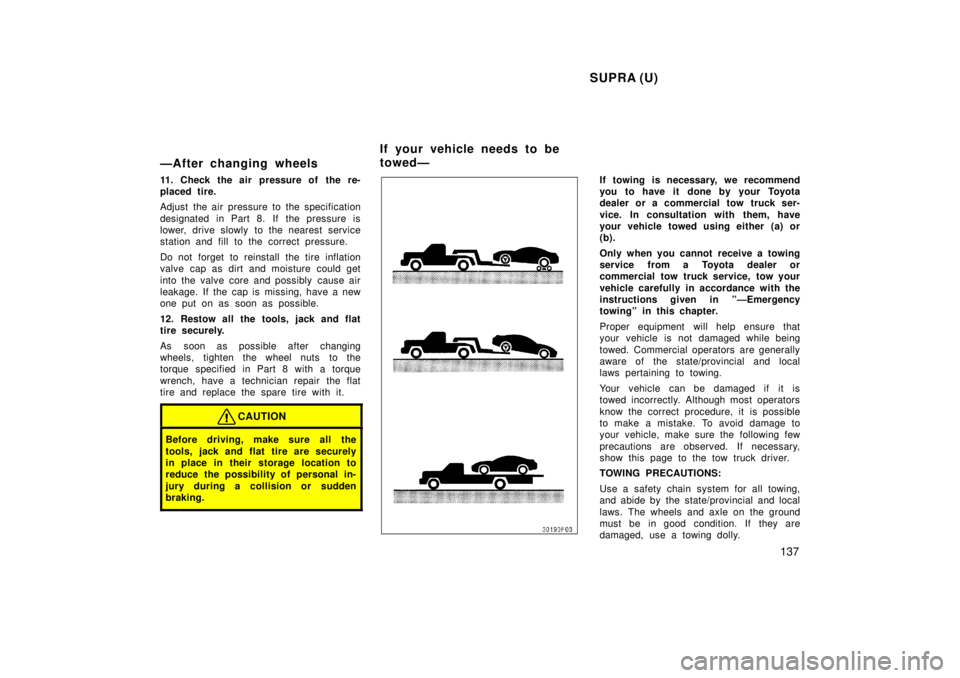
If towing is necessary, we recommend
you to have it done by your Toyota
dealer or a commercial tow truck ser-
vice. In consultation with them, have
your vehicle towed using either (a) or
(b).
Only when you cannot receive a towing
service from a Toyota dealer or
commercial tow truck service, tow your
vehicle carefully in accordance with the
instructions given in ºÐEmergency
towingº in this chapter.
Proper equipment will help ensure that
your vehicle is not damaged while being
towed. Commercial operators are generally
aware of the state/provincial and local
laws pertaining to towing.
Your vehicle can be damaged if it is
towed incorrectly. Although most operators
know the correct procedure, it is possible
to make a mistake. To avoid damage to
your vehicle, make sure the following few
precautions are observed. If necessary,
show this page to the tow truck driver.
TOWING PRECAUTIONS:
Use a safety chain system for all towing,
and abide by the state/provincial and local
laws. The wheels and axle on the ground
must be in good condition. If they are
damaged, use a towing dolly.
If your vehicle needs to be
towedÐ
Page 139 of 191
SUPRA (U)139
ÐEmergency towing
If towing is necessary, we recommend
you to have it done by your Toyota
dealer or a commercial tow truck ser-
vice.
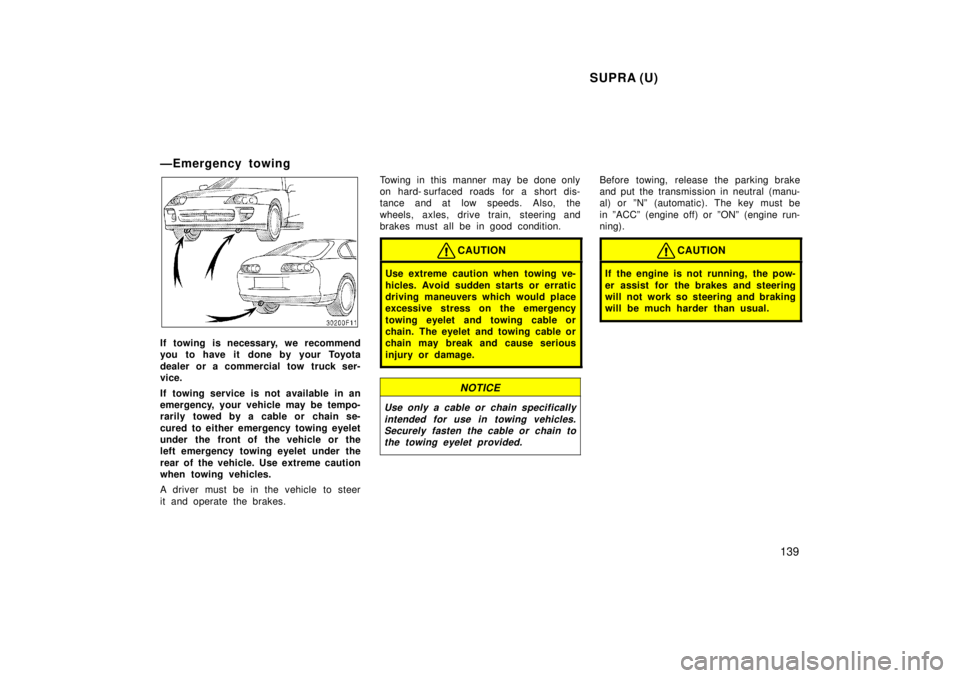
If towing service is not available in an
emergency, your vehicle may be tempo-
rarily towed by a cable or chain se-
cured to either emergency towing eyelet
under the front of the vehicle or the
left emergency towing eyelet under the
rear of the vehicle. Use extreme caution
when towing vehicles.
A driver must be in the vehicle to steer
it and operate the brakes.
Towing in this manner may be done only
on hard- surfaced roads for a short dis-
tance and at low speeds. Also, the
wheels, axles, drive train, steering and
brakes must all be in good condition.
CAUTION
Use extreme caution when towing ve-
hicles. Avoid sudden starts or erratic
driving maneuvers which would place
excessive stress on the emergency
towing eyelet and towing cable or
chain. The eyelet and towing cable or
chain may break and cause serious
injury or damage.
NOTICE
Use only a cable or chain specifically
intended for use in towing vehicles.Securely fasten the cable or chain to the towing eyelet provided.
Before towing, release the parking brake
and put the transmission in neutral (manu-
al) or ºNº (automatic). The key must be
in ºACCº (engine off) or ºONº (engine run-
ning).
CAUTION
If the engine is not running, the pow-
er assist for the brakes and steering
will not work so steering and braking
will be much harder than usual.
Page 148 of 191
SUPRA (U)
148
Part 6
VEHICLE
MAINTENANCE
AND CARE
Maintenance requirements
General maintenance
Does your vehicle need
repairing?
For scheduled maintenance informa-
tion, please refer to the separate
ºOwner 's Manual Supplement/Main-
tenance Scheduleº. Maintenance requirements
Your Toyota vehicle has been designed for
fewer maintenance requirements with long-
er service intervals to save both your time
and money. However, each regular mainte-
nance, as well as day- to- day care, is
more important than ever before to ensure
smooth, trouble- free, safe, and economical
drivings.
It is the owner 's responsib
ility to make
sure the specified maintenance, including
general maintenance service is performed.
Note that both the new vehicle and emis-
sion control system warranties specify that
proper maintenance and care must be per-
formed. See Owner 's Guide, Owner 's
Manual Supplement or Warranty Booklet
for complete warranty information.
General maintenance
General maintenance items are those day-
to- day care practices that are important to
your vehicle for proper operation. It is the
owner 's responsib ility to ensure that the
general maintenance items are performed
regularly.
These checks or inspections can be done
either by yourself or a qualified technician,
or if you prefer, your Toyota dealer will be
pleased to do them at a nominal cost. Scheduled maintenance
The scheduled maintenance items listed in
the ºOwner 's Manual Supplement/Mainte-
nance Scheduleº are those required to be
serviced at regular intervals.
For details of your maintenance Schedule,
read the separate ºOwner 's Manual
Supplement/Maintenance Scheduleº.
It is recommended that any replacement
parts used for maintenance or for the
repair of the emission control system
be Toyota supplied.
The owner may elect to use non- Toyota
supplied parts for replacement pur-
poses without invalidating the emission
control system warranty. However, use
of replacement parts which are not of
equivalent quality may impair the effec-
tiveness of the emission control sys-
tems.
You may also elect to have mainte-
nance, replacement, or repair of the
emission control devices and system
performed by any automotive repair es-
tablishment or individual without invali-
dating this warranty. See Owner's
Guide, Owner 's Manual Supplement or
Warranty Booklet for complete warranty
information.
Page 149 of 191
SUPRA (U)149
Where to go for service?
Toyota technicians are well- trained spe-
cialists and are kept up to date with the
latest service information through technical
bulletins, service tips, and in- dealership
training programs. They learn to work on
Toyotas before they work on your vehicle,
rather than while they are working on it.
You can be confident that your Toyota
dealer 's service department performs the
best job to meet the maintenance require-
ments on your vehicle±reliably and eco-
nomically.
Your copy of the repair order is proof that
all required maintenance has been per-
formed for warranty coverage. And if any
problems should arise with your vehicle
while under warranty, your Toyota dealer
will promptly take care of it. Again, be
sure to keep a copy of the repair order
for any service performed on your Toyota.
What about do- it- yourself maintenance?
Many of the maintenance items are easy
to do yourself if you have a little mechani-
cal ability and a few basic automotive
tools. Simple instructions for how to per-
form them are presented in Part 7.
If you are a skilled do- it- yourself mechan-
ic, the Toyota service manuals are recom-
mended. Please be aware that do- it- your-
self maintenance can affect your warranty
coverage. See Owner 's Guide, Owner 's
Manual Supplement or Warranty Booklet
for the details
General maintenance
Listed below are the general maintenance
items that should be performed as fre-
quently as specified. In addition to check-
ing the items listed, if you notice any
unusual noise, smell or vibration, you
should investigate the cause or take your
vehicle to your Toyota dealer or a quali-
fied service shop immediately. It is recom-
mended that any problem you notice be
brought to the attention of your dealer or
the qualified service shop for their advice.
CAUTION
Make these checks only where ade-
quate ventilation can be obtained if
you run the engine.
OUTSIDE THE VEHICLE
Items listed below should be performed
from time to time, unless otherwise
specified.
Tire pressure
Check the pressure with a gauge every
two weeks, or at least once a month. See
Chapter 7- 2 for additional information.
Page 150 of 191

SUPRA (U)
150
Tire surface and wheel nuts
Check the tires carefully for cuts, damage
or excessive wear. See Chapter 7- 2 for
additional information. When checking the
tires, make sure no nuts are missing, and
check the nuts for looseness. Tighten
them if necessary.
Fluid leaks
Check underneath for leaking fuel, oil, wa-
ter or other fluid after the vehicle has
been parked for a while. If you smell fuel
fumes or notice any leak, have the cause
found and corrected immediately.
Doors and engine hood
Check that all doors including back door
operate smoothly and all latches lock se-
curely. Make sure the engine hood sec-
ondary latch secures the hood from open-
ing when the primary latch is released.
INSIDE THE VEHICLE
Items listed below should be checked
regularly, e.g. while performing periodic
services, cleaning the vehicle, etc.
Lights
Make sure the headlights, stop lights, tail
lights, turn signal lights, and other lights
are all working. Check headlight aim.
Service reminder indicators and warning
buzzers
Check that all service reminder indicators
and warning buzzers function properly.
Steering wheel
Be alert for changes in steering condition,
such as hard steering or strange noise.
Seats
Check that all front seat controls such as
seat adjusters, seatback recliner, etc. op-
erate smoothly and that all latches lock
securely in any position. For folding- down
rear seatback, check that the latches lock
securely. Make sure the front headrests
are firmly secured.
Seat belts
Check that the seat belt system such as
buckles, retractors and anchors operate
properly and smoothly. Make sure the belt
webbing is not cut, frayed, worn or dam- aged.
Accelerator pedal
Check the pedal for smooth operation and
uneven pedal effort or catching.
Clutch pedal
Check the pedal for smooth operation.
Brake pedal
Check the pedal for smooth operation and
that the pedal has the proper clearance.
Check the brake booster function.Brakes
At a safe place, check that the brakes do
not pull to one side when applied.
Parking brake
Check that the lever has the proper travel
and that, on a safe incline, your vehicle
is held securely with only the parking
brake applied.
Automatic transmission ºParkº mecha-
nism
Check the lock release button of the se-
lector lever for proper and smooth opera-
tion. On a safe incline, check that your
vehicle is held securely with the selector
lever in ºPº position and all brakes re-
leased.
IN THE ENGINE COMPARTMENT
Items listed below should be checked
from time to time, e.g. each time when
refueling.
Washer fluid
Make sure there is sufficient fluid in the
tank. See Chapter 7- 3 for additional in-
formation.
Engine coolant level
Make sure the coolant level is between
the ºFULLº and ºLOWº lines on the see-
through reservoir when the engine is cold.
See Chapter 7- 2 for additional information.
Page 151 of 191
SUPRA (U)151
Battery electrolyte level
Make sure the electrolyte level of all bat-
tery cells is correct. Add only distilled
water when replenishing. See Chapter 7- 3
for additional information.
Brake fluid level
Make sure the brake fluid level is correct.
See Chapter 7- 2 for additional information.
Engine oil level
Check the level on the dipstick with the
engine turned off and the vehicle parked
on a level spot. See Chapter 7- 2 for addi-
tional information.
Power steering fluid level
Check the level on the dipstick. The level
should be in the ºHOTº or ºCOLDº range
depending on the fluid temperature. See
Chapter 7- 2 for additional information.
Exhaust system
If you notice any change in the sound of
the exhaust or smell exhaust fumes, have
the cause located and corrected immedi-
ately. (See engine exhaust cautions in
Part 2.)
Be on the alert for changes in perfor-
mance, sounds, and visual tip- offs that
indicate service is needed. Some impor-
tant clues are as follows:
Engine missing, stumbling, or pinging
Appreciable loss of power
Strange engine noises
A leak under the vehicle (however, wa-
ter dripping from the air conditioning
after use is normal.)
Change in exhaust sound (This may
indicate a dangerous carbon monoxide
leak. Drive with the windows open and
have the exhaust system checked im-
mediately.)
Flat- looking tire; excessive tire squeal
when cornering; uneven tire wear
Vehicle pulls to one side when driving
straight on a level road
Strange noises related to suspension
movement
Loss of brake effectiveness; spongy
feeling brake or clutch pedal; pedal al-
most touches floor; vehicle pulls to one
side when braking
Engine coolant temperature continually
higher than normal If you notice any of these clues, take your
vehicle to your Toyota dealer as soon as
possible. It probably needs adjustment or
repair.
CAUTION
Do not continue driving with the ve-
hicle unchecked. It could result in se-
rious vehicle damage and possibly
personal injury.
Does your vehicle need
repairing?
Page 152 of 191
SUPRA (U)153
Part 7
DO- IT- YOURSELF
MAINTENANCEÐ
Chapter 7- 1 Introduction
Engine compartment overview
Fuse locations
Do- it- yourself service
precautions
P ar t s and tools
Page 155 of 191

SUPRA (U)
156
Fuse locations
60185F11
60190F16
60190F21
If you perform maintenance by yourself,
be sure to follow the correct procedure
given in this part.
You should be aware that improper or in-
complete servicing may result in operating
problems.
Performing do- it- yourself maintenance
during the warranty period may affect your
warranty coverage. Read the separate
Toyota Warranty statement for details and
suggestions.
This part gives instructions only for those
items that are relatively easy for an owner
to perform. As explained in Part 6, there
are still a number of items that must be
done by a qualified technician with special
tools.
For information on tools and parts for do-
it- yourself maintenance, see ºParts and
toolsº.
Utmost care should be taken when work-
ing on your vehicle to prevent accidental
injury. Here are a few precautions that
you should be especially careful to ob-
serve:
Do- it- yourself service
precautions