ECU TOYOTA SUPRA 1998 Owner's Manual
[x] Cancel search | Manufacturer: TOYOTA, Model Year: 1998, Model line: SUPRA, Model: TOYOTA SUPRA 1998Pages: 191, PDF Size: 3.65 MB
Page 132 of 191

SUPRA (U)
132
ÐRequired tools and spare tire
1. Get the wheel nut wrench, jack, jack
handle and spare tire.
To prepare yourself for an emergency, you
should fam iliarize yourself with the use of
the jack, each of the tools and their stor-
age locations.To remove the jack, loosen the bolt and
remove it.
When storing the jack, secure it by follow-
ing removal step in reverse order to pre-
vent it from flying forward during a colli-
sion or sudden braking.To remove the spare tire:
1. Remove the spare tire cover.
2. Loosen the bolt and remove it.
When storing the spare tire, put it in place
with the outer side of the wheel facing up.
Then secure the tire by repeating the
above removal steps in reverse order to
prevent it from flying forward during a
collision or s udden braking.
Page 136 of 191
SUPRA (U)
136
ÐLowering your vehicle
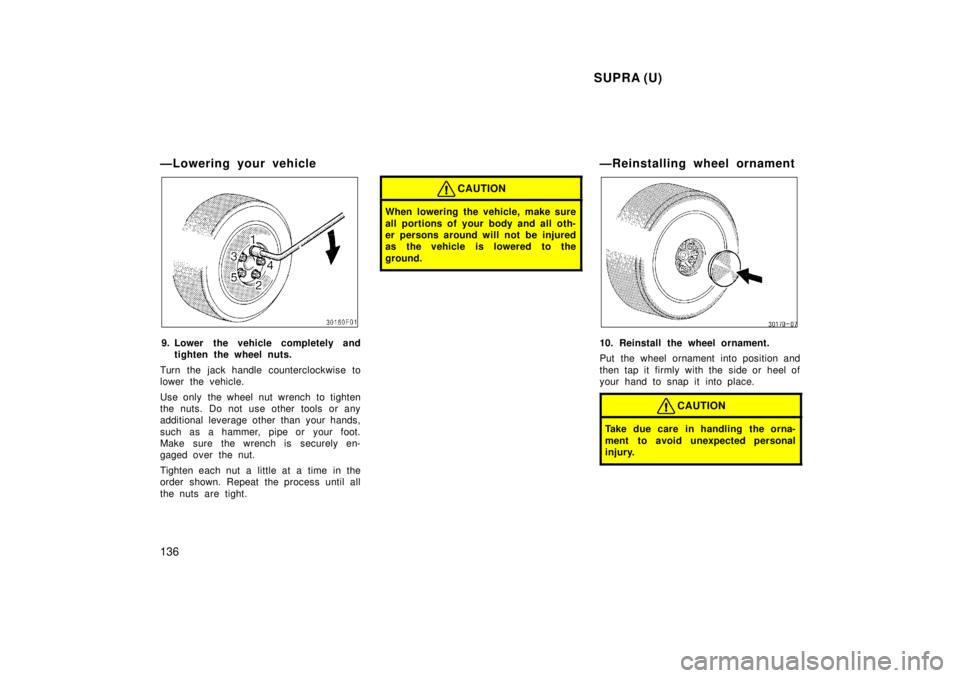
9. Lower the vehicle completely and
tighten the wheel nuts.
Turn the jack handle counterclockwise to
lower the vehicle.
Use only the wheel nut wrench to tighten
the nuts. Do not use other tools or any
additional leverage other than your hands,
such as a hammer, pipe or your foot.
Make sure the wrench is securely en-
gaged over the nut.
Tighten each nut a little at a time in the
order shown. Repeat the process until all
the nuts are tight.
CAUTION
When lowering the vehicle, make sure
all portions of your body and all oth-
er persons around will not be injured
as the vehicle is lowered to the
ground.
ÐReinstalling wheel ornament
10. Reinstall the wheel ornament.
Put the wheel ornament into position and
then tap it firmly with the side or heel of
your hand to snap it into place.
CAUTION
Take due care in handling the orna-
ment to avoid unexpected personal
injury.
Page 137 of 191
SUPRA (U)137
ÐAfter changing wheels
11. Check the air pressure of the re-
placed tire.
Adjust the air pressure to the specification
designated in Part 8. If the pressure is
lower, drive slowly to the nearest service
station and fill to the correct pressure.
Do not forget to reinstall the tire inflation
valve cap as dirt and moisture could get
into the valve core and possibly cause air
leakage. If the cap is missing, have a new
one put on as soon as possible.
12. Restow all the tools, jack and flat
tire securely.
As soon as possible after changing
wheels, tighten the wheel nuts to the
torque specified in Part 8 with a torque
wrench, have a technician repair the flat
tire and replace the spare tire with it.
CAUTION
Before driving, make sure all the
tools, jack and flat tire are securely
in place in their storage location to
reduce the possibility of personal in-
jury during a collision or s
udden
braking.
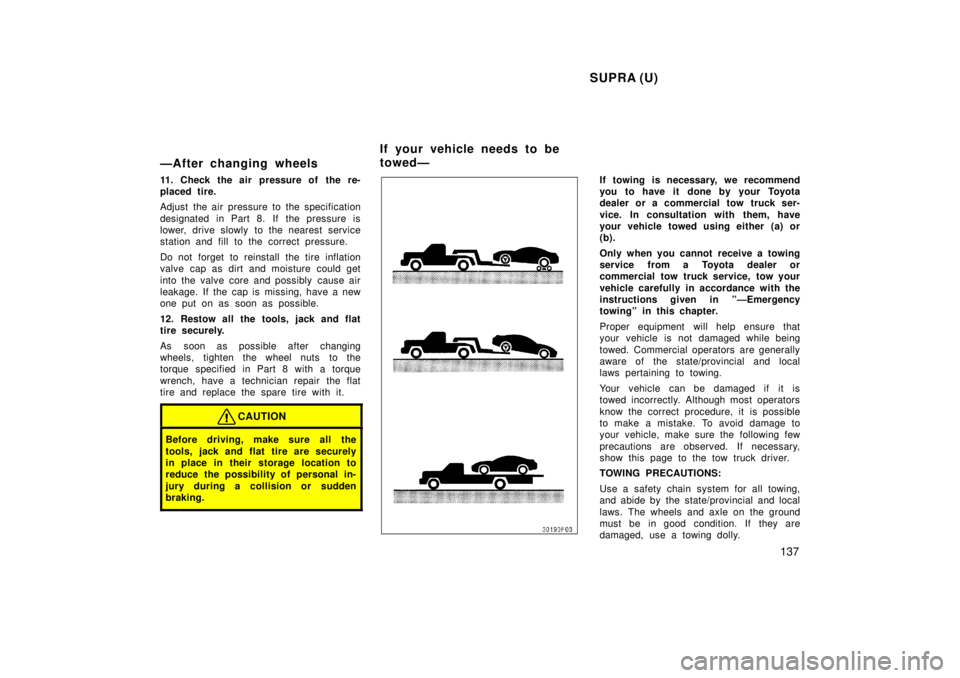
If towing is necessary, we recommend
you to have it done by your Toyota
dealer or a commercial tow truck ser-
vice. In consultation with them, have
your vehicle towed using either (a) or
(b).
Only when you cannot receive a towing
service from a Toyota dealer or
commercial tow truck service, tow your
vehicle carefully in accordance with the
instructions given in ºÐEmergency
towingº in this chapter.
Proper equipment will help ensure that
your vehicle is not damaged while being
towed. Commercial operators are generally
aware of the state/provincial and local
laws pertaining to towing.
Your vehicle can be damaged if it is
towed incorrectly. Although most operators
know the correct procedure, it is possible
to make a mistake. To avoid damage to
your vehicle, make sure the following few
precautions are observed. If necessary,
show this page to the tow truck driver.
TOWING PRECAUTIONS:
Use a safety chain system for all towing,
and abide by the state/provincial and local
laws. The wheels and axle on the ground
must be in good condition. If they are
damaged, use a towing dolly.
If your vehicle needs to be
towedÐ
Page 139 of 191
SUPRA (U)139
ÐEmergency towing
If towing is necessary, we recommend
you to have it done by your Toyota
dealer or a commercial tow truck ser-
vice.
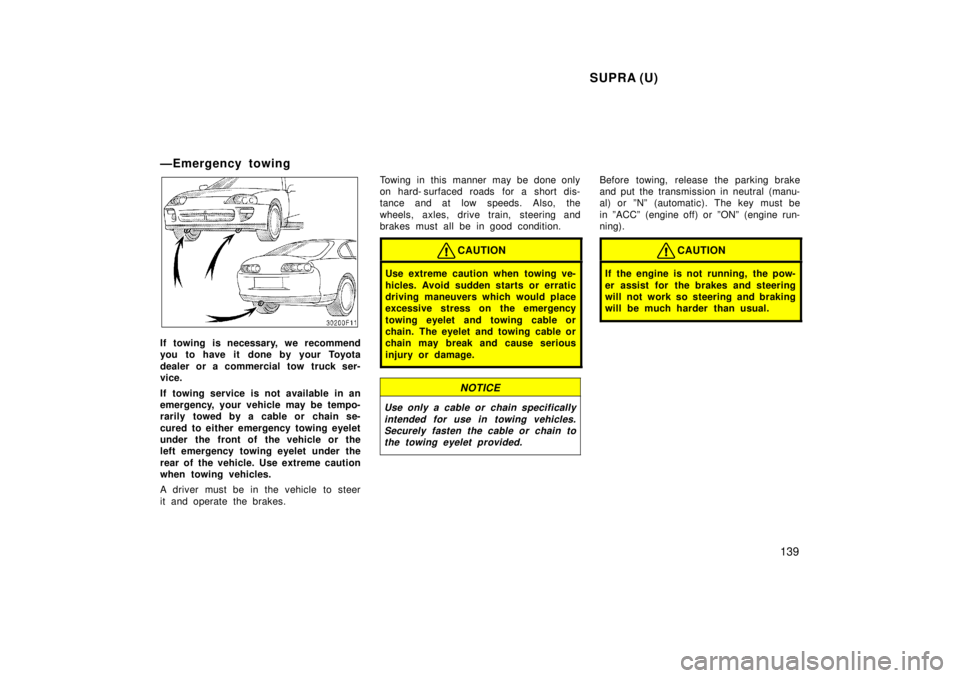
If towing service is not available in an
emergency, your vehicle may be tempo-
rarily towed by a cable or chain se-
cured to either emergency towing eyelet
under the front of the vehicle or the
left emergency towing eyelet under the
rear of the vehicle. Use extreme caution
when towing vehicles.
A driver must be in the vehicle to steer
it and operate the brakes.
Towing in this manner may be done only
on hard- surfaced roads for a short dis-
tance and at low speeds. Also, the
wheels, axles, drive train, steering and
brakes must all be in good condition.
CAUTION
Use extreme caution when towing ve-
hicles. Avoid sudden starts or erratic
driving maneuvers which would place
excessive stress on the emergency
towing eyelet and towing cable or
chain. The eyelet and towing cable or
chain may break and cause serious
injury or damage.
NOTICE
Use only a cable or chain specifically
intended for use in towing vehicles.Securely fasten the cable or chain to the towing eyelet provided.
Before towing, release the parking brake
and put the transmission in neutral (manu-
al) or ºNº (automatic). The key must be
in ºACCº (engine off) or ºONº (engine run-
ning).
CAUTION
If the engine is not running, the pow-
er assist for the brakes and steering
will not work so steering and braking
will be much harder than usual.
Page 150 of 191

SUPRA (U)
150
Tire surface and wheel nuts
Check the tires carefully for cuts, damage
or excessive wear. See Chapter 7- 2 for
additional information. When checking the
tires, make sure no nuts are missing, and
check the nuts for looseness. Tighten
them if necessary.
Fluid leaks
Check underneath for leaking fuel, oil, wa-
ter or other fluid after the vehicle has
been parked for a while. If you smell fuel
fumes or notice any leak, have the cause
found and corrected immediately.
Doors and engine hood
Check that all doors including back door
operate smoothly and all latches lock se-
curely. Make sure the engine hood sec-
ondary latch secures the hood from open-
ing when the primary latch is released.
INSIDE THE VEHICLE
Items listed below should be checked
regularly, e.g. while performing periodic
services, cleaning the vehicle, etc.
Lights
Make sure the headlights, stop lights, tail
lights, turn signal lights, and other lights
are all working. Check headlight aim.
Service reminder indicators and warning
buzzers
Check that all service reminder indicators
and warning buzzers function properly.
Steering wheel
Be alert for changes in steering condition,
such as hard steering or strange noise.
Seats
Check that all front seat controls such as
seat adjusters, seatback recliner, etc. op-
erate smoothly and that all latches lock
securely in any position. For folding- down
rear seatback, check that the latches lock
securely. Make sure the front headrests
are firmly secured.
Seat belts
Check that the seat belt system such as
buckles, retractors and anchors operate
properly and smoothly. Make sure the belt
webbing is not cut, frayed, worn or dam- aged.
Accelerator pedal
Check the pedal for smooth operation and
uneven pedal effort or catching.
Clutch pedal
Check the pedal for smooth operation.
Brake pedal
Check the pedal for smooth operation and
that the pedal has the proper clearance.
Check the brake booster function.Brakes
At a safe place, check that the brakes do
not pull to one side when applied.
Parking brake
Check that the lever has the proper travel
and that, on a safe incline, your vehicle
is held securely with only the parking
brake applied.
Automatic transmission ºParkº mecha-
nism
Check the lock release button of the se-
lector lever for proper and smooth opera-
tion. On a safe incline, check that your
vehicle is held securely with the selector
lever in ºPº position and all brakes re-
leased.
IN THE ENGINE COMPARTMENT
Items listed below should be checked
from time to time, e.g. each time when
refueling.
Washer fluid
Make sure there is sufficient fluid in the
tank. See Chapter 7- 3 for additional in-
formation.
Engine coolant level
Make sure the coolant level is between
the ºFULLº and ºLOWº lines on the see-
through reservoir when the engine is cold.
See Chapter 7- 2 for additional information.
Page 176 of 191

SUPRA (U)177
ÐHeadlights (low beam)
60463F38
1. Open the hood.
RIGHT SIDE HEADLIGHT: Release the
clips of the air cleaner and remove the
air cleaner cover.60463F39
2. Unplug the connector while depress- ing the lock release.
If the connector is tight, wiggle it.60473F05
3. Turn the bulb clockwise and remove it. Install a new bulb, turn it counter-
clockwise, then plug in the connec-
tor.
To install a bulb, align the tab of the bulb
socket with the cutouts of the mounting
hole.
RIGHT SIDE HEADLIGHT: Install the air
cleaner cover securely.
Aiming is not necessary after replacing
the bulb. When aiming adjustment is nec-
essary, contact your Toyota dealer.
Page 177 of 191

SUPRA (U)
178
ÐHeadlights (high beam)
60463F38
1. Open the hood.
RIGHT SIDE HEADLIGHT: Release the
clips of the air cleaner and remove the
air cleaner cover.60463F59
2. Unplug the connector while depress- ing the lock release.
If the connector is tight, wiggle it.60463F42
3. Turn the bulb counterclockwise and remove it. Install a new bulb, turn it
clockwise, then plug in the connec-
tor.
To install a bulb, align the tab of the bulb
socket with the cutouts of the mounting
hole.
RIGHT SIDE HEADLIGHT: Install the air
cleaner cover securely.
Aiming is not necessary after replacing
the bulb. When aiming adjustment is nec-
essary, contact your Toyota dealer.
Page 179 of 191

SUPRA (U)
180
60463F45
4. Release the bulb retaining spring and remove the bulb. Install a new
bulb and the bulb retaining spring.
To install the bulb, align the cutouts of the
bulb with the protrusions of the mounting
hole. 60463F46
5. Connect the cords and install the cover by turning it clockwise.
RIGHT SIDE HEADLIGHT: Install the air
cleaner cover securely. ÐParking lights60473F01
60473F02
Page 189 of 191

SUPRA (U)
190
24. CIG 15 A:
Cigarette lighter, air condi-
tioning system, SRS airbag system,
theft deterrent system, shift lock con-
trol system
25. RAD NO.2 7.5 A: Radio, cassette tape
player, power antenna
26. TAIL 10 A: Tail lights, parking lights,
front side marker lights, rear side
marker lights, licence plate lights
27. ECU- IG 10 A: Cruise control system,
anti- lock brake system, power steering,
power antenna, theft deterrent system,
shift lock control system, traction con-
trol system
28. GAUGE 10 A: Gauges and meters, ser-
vice reminder indicators and warning
buzzers (except discharge and open
door warning lights), rear window de-
fogger, charging system, cruise control
system, electronically controlled auto-
matic transmission system, traction
control system
29. ECU- B 10 A: Air conditioning system,
cruise control system, anti- lock brake
system, SRS airbag system, traction
control system
30. OBD - II 7.5A: On- board diagnosis sys-
tem Fuses (type B)
31. DOOR 30 A: Power window, power
door lock system, theft deterrent sys-
tem
32. DEFOG 30 A: Rear window defogger
Fuses (type C)
33. ALT 120 A: Charging system
34. MAIN 50 A: Starter system, headlights
35. HTR 50 A: Air conditioning system
36. FAN 30 A: Electric cooling fans
37. ABS NO.1 60 A: Anti- lock brake sys-
tem, traction control system
38. AM1 50 A: Electronic ignition system/
distributor ignition system
39. POWER 60 A: ºPANELº, ºSTOPº,
ºTAILº, ºECU- Bº, ºDEFOGº and
ºDOORº fuses