battery TOYOTA T100 1998 User Guide
[x] Cancel search | Manufacturer: TOYOTA, Model Year: 1998, Model line: T100, Model: TOYOTA T100 1998Pages: 214, PDF Size: 4.72 MB
Page 143 of 214

T100(U)143
3. If the engine in the vehicle with the
booster battery is not running, start it
and let it run for a few minutes. During
jump starting, run the engine at about
2000 rpm with the accelerator pedal
lightly depressed.
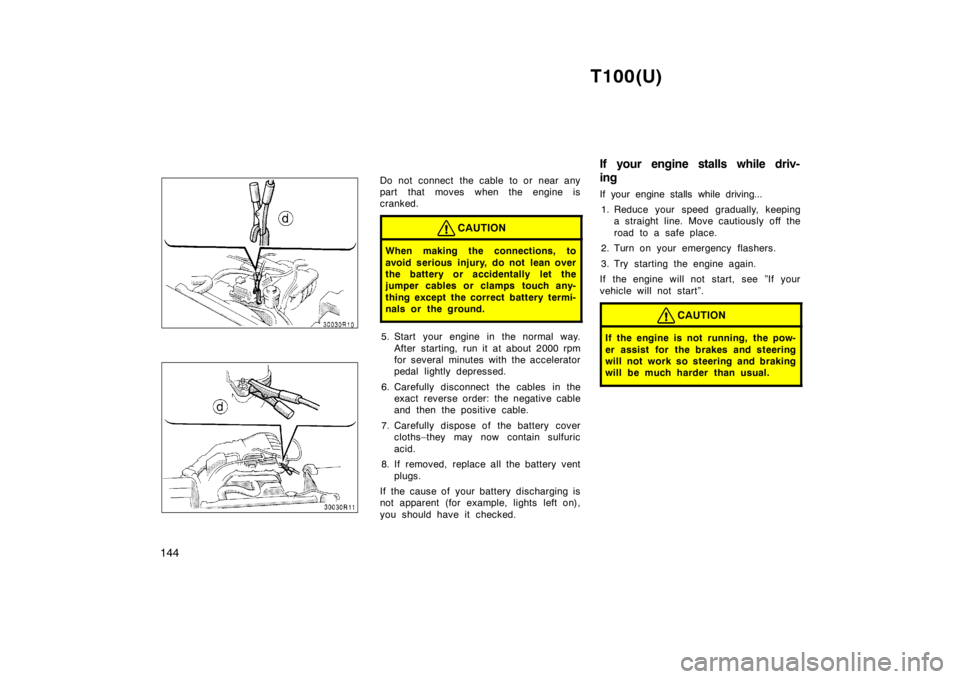
4. Make the cable connections in the or-der a, b, c, d.
a. Connect the clamp of the positive (red) jumper cable to the positive (+) termi-
nal on the discharged battery.
b. Connect the clamp at the other end of the positive (red) jumper cable to the
positive (+) terminal on the booster
battery.c. Connect the clamp of the negative(black) jumper cable to the negative (–)
terminal on the booster battery.
d. Connect the clamp at the other end of the negative (black) jumper cable to a
solid, stationary, unpainted, metallic
point of the vehicle with the discharged
battery.
The recommended connecting points are
shown in the following illustrations:
Page 144 of 214
T100(U)
144
Do not connect the cable to or near any
part that moves when the engine is
cranked.
CAUTION
When making the connections, to
avoid serious injury, do not lean over
the battery or accidentally let the
jumper cables or clamps touch any-
thing except the correct battery termi-
nals or the ground.
5. Start your engine in the normal way. After starting, run it at about 2000 rpm
for several minutes with the accelerator
pedal lightly depressed.
6. Carefully disconnect the cables in the exact reverse order: the negative cable
and then the positive cable.
7. Carefully dispose of the battery cover cloths–they may now contain sulfuric
acid.
8. If removed, replace all the battery vent plugs.
If the cause of your battery discharging is
not apparent (for example, lights left on),
you should have it checked. If your engine stalls while driv-
ing
If your engine stalls while driving...
1. Reduce your speed gradually, keeping a straight line. Move cautiously off the
road to a safe place.
2. Turn on your emergency flashers.
3. Try starting the engine again.
If the engine will not start, see ”If your
vehicle will not start”.
CAUTION
If the engine is not running, the pow-
er assist for the brakes and steering
will not work so steering and braking
will be much harder than usual.
Page 168 of 214

T100(U)
168
Engine coolant level
Make sure the coolant level is between
the ”FULL” and ”LOW” lines on the see-
through reservoir when the engine is cold.
See Chapter 7
−2 for additional information
when the engine is cold.
Battery electrolyte level
Make sure the electrolyte level of all bat-
tery cells is between upper and lower lev-
el lines on the case. Add only distilled
water when replenishing. See Chapter 7 −3
for additional information.
Brake fluid level
Make sure the brake fluid level is correct.
See Chapter 7 −2 for additional information.
Engine oil level
Check the level on the dipstick with the
engine turned off and the vehicle parked
on a level spot. See Chapter 7 −2 for addi-
tional information.
Power steering fluid level
Check the level on the dipstick. The level
should be in the ”HOT” or ”COLD” range
depending on the fluid temperature. See
Chapter 7 −2 for additional information. Exhaust system
If you notice any change in the sound of
the exhaust or smell exhaust fumes, have
the cause located and corrected immedi-
ately. (See engine exhaust cautions in
Part 2.)
Be on the alert for changes in perfor-
mance, sounds, and visual tip-offs that
indicate service is needed. Some impor-
tant clues are as follows:
Engine missing, stumbling, or pinging
Appreciable loss of power
Strange engine noises
A leak under the vehicle (however, wa-
ter dripping from the air conditioning
after use is normal.)
Change in exhaust sound (This may
indicate a dangerous carbon monoxide
leak. Drive with the windows open and
have the exhaust system checked im-
mediately.)
Flat-looking tire; excessive tire squeal
when cornering; uneven tire wear
Vehicle pulls to one side when driving
straight on a level road
Strange noises related to suspension
movement
Loss of brake effectiveness; spongy
feeling brake or clutch pedal; pedal al-
most touches floor; vehicle pulls to one
side when braking
Engine coolant temperature continually
higher than normal
Does your vehicle need
repairing?
Page 172 of 214

T100(U)
172 1. Brake fluid reservoir
2. Fuse block
3. Battery
4. Engine coolant reservoir
5. Engine oil level dipstick
6. Power steering fluid reservoir
7. Engine oil filler cap
8. Windshield washer fluid tank
Engine compartment overview (3RZ
−FE engine)
Page 173 of 214

T100(U)173
1. Brake fluid reservoir
2. Fuse block
3. Battery
4. Engine coolant reservoir
5. Engine oil level dipstick
6. Engine oil filler cap
7. Power steering fluid reservoir
8. Windshield washer fluid tank
Engine compartment overview (5VZ
−FE engine)
Page 175 of 214
T100(U)175
CAUTION
When the engine is running, keep
hands, clothing, and tools away
from the moving fan and engine
drive belts. (Removing rings,
watches, and ties is advisable.)
Right after driving, the engine
compartment—the engine, radiator,
exhaust manifold, power steering
fluid reservoir and spark plug
boots, etc.—will be hot. So be care-
ful not to touch them. Oil, fluids
and spark plugs may also be hot.
If the engine is hot, do not remove
the radiator cap or loosen the drain
plugs to prevent burning yourself.
Do not smoke, cause sparks or al-
low open flames around fuel or the
battery. Their fumes are flammable.
Be extremely cautious when work-
ing on the battery. It contains poi-
sonous and corrosive sulfuric acid.
Do not get under your vehicle with
just the body jack supporting it. Al-
ways use automotive jack stands or
other solid supports.
Use eye protection whenever you
work on or under your vehicle
where you may be exposed to flying
or falling material, fluid spray, etc.
Used engine oil contains potentially
harmful contaminants which may
cause skin disorders such as in-
flammation or skin cancer, so care
should be taken to avoid prolonged
and repeated contact with it. To re-
move used engine oil from your
skin, wash thoroughly with soap
and water.
Do not leave used oil within the
reach of children.
Dispose of used oil and filter only
in a safe and acceptable manner.
Do not dispose of used oil and fil-
ter in household trash, in sewers or
onto the ground. Call your dealer or
a service station for information
concerning recycling or disposal.NOTICE
Remember that battery and ignition
cables carry high currents or volt-
ages. Be careful of accidentally
causing a short circuit.
Add only demineralized or distilled
water to fill the radiator. And if you
spill some of the coolant, be sure
to wash it off with water to prevent
it from damaging the parts or paint.
Do not allow dirt or anything else
to fall through the spark plug holes.
Do not pry the outer electrode of a
spark plug against the center elec-
trode.
Use only spark plugs of the speci-
fied type. Using other types will
cause engine damage, loss of per-
formance or radio noise.
Do not overfill automatic transmis-
sion fluid, or the transmission
could be damaged.
Do not drive with the air cleaner
filter removed, or excessive engine
wear could result. Also backfiring
could cause a fire in the engine
compartment.
Page 176 of 214

T100(U)
176
Be careful not to scratch the glass
surface with the wiper frame.
When closing the engine hood,
check to see that you have not for-
gotten any tools, rags, etc.
Parts and tools
Here is a list of parts and tools you will
need on performing do-it-yourself mainte-
nance. Remember all Toyota parts are de-
signed in metric sizes, so your tools must
be metric.
Checking the engine oil level
Parts (if level is low):
Engine oil API grade SH, ”Energy-Con-
serving II” or SJ, “Energy −Conserving”
multigrade or ILSAC multigrade having
viscosity proper for your climate
Tools: Rag or paper towel
Funnel (only for adding oil)
Checking the engine coolant level
Parts (if level is low): Ethylene-glycol antifreeze
Demineralized or distilled water
Tools: Funnel (only for adding coolant)
Checking brake fluid
Parts (if level is low): SAE J1703 or FMVSS No.116 DOT 3
brake fluid Tools:
Rag or paper towel
Funnel (only for adding fluid)
Checking power steering fluid
Parts (if level is low): Automatic transmission fluid DEXRON
II or III
Tools: Rag or paper towel
Funnel (only for adding fluid)
Checking battery condition
Tools:
Warm water
Baking soda
Grease
Conventional wrench (for terminal
clamp bolts)
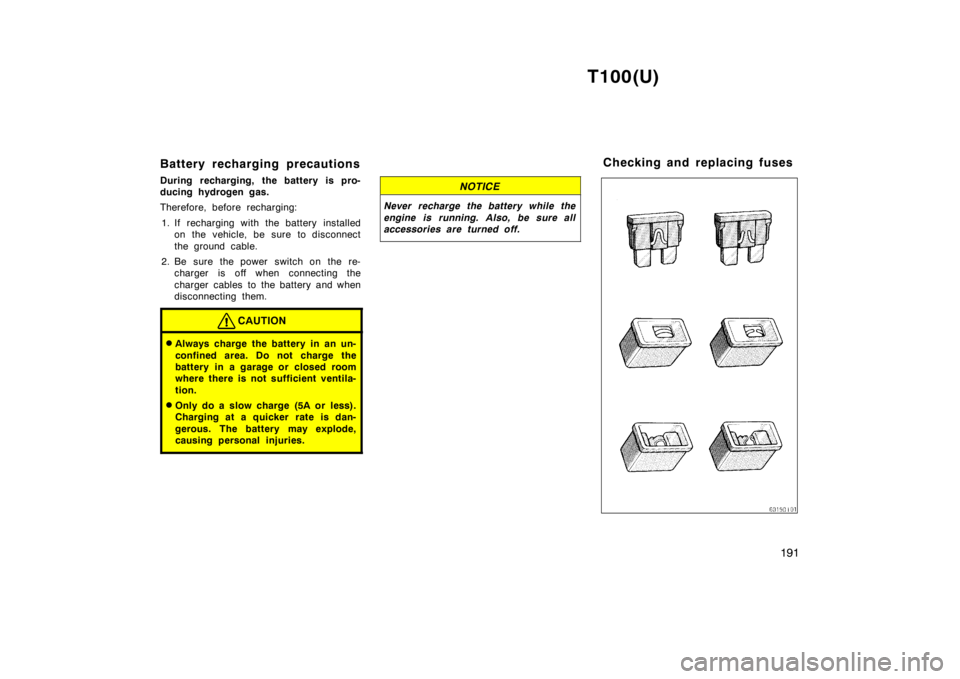
Checking and replacing fuses
Parts (if replacement is necessary): Fuse with same amperage rating as
original
Page 189 of 214
T100(U)189
Part 7
DO-IT-YOURSELF
MAINTENANCE—
Chapter 7
−3
Electrical components
Checking battery condition
Battery recharging precautions
Checking and replacing fuses
Adding washer fluid
Replacing light bulbs
CAUTION
BATTERY PRECAUTIONS
The battery produces flammable and
explosive hydrogen gas. Do not cause a spark from the bat-
tery with tools.
Do not smoke or light a match near
the battery.
The electrolyte contains poisonous
and corrosive sulfuric acid. Avoid contact with eyes, skin or
clothes.
Never ingest electrolyte.
Wear protective safety glasses when
working near the battery.
Keep children away from the bat-
tery.
EMERGENCY MEASURES If electrolyte gets in your eyes,
flush your eyes with clean water
immediately and get immediate
medical attention. If possible, con-
tinue to apply water with a sponge
or cloth while en route to the medi-
cal office.
If electrolyte gets on your skin,
thoroughly wash the contact area. If
you feel pain or burning, get medi-
cal attention immediately.
If electrolyte gets on your clothes,
there is a possibility of its soaking
through to your skin, so immediate-
ly take off the exposed clothing and
follow the procedure above, if nec-
essary.
If you happen to swallow electro-
lyte, drink a large quantity of water
or milk. Follow with milk of magne-
sia, beaten raw egg or vegetable
oil. Then go immediately for emer-
gency help.
Checking battery c ondition—
—Precautions
Page 190 of 214
T100(U)
190
—Checking battery exterior
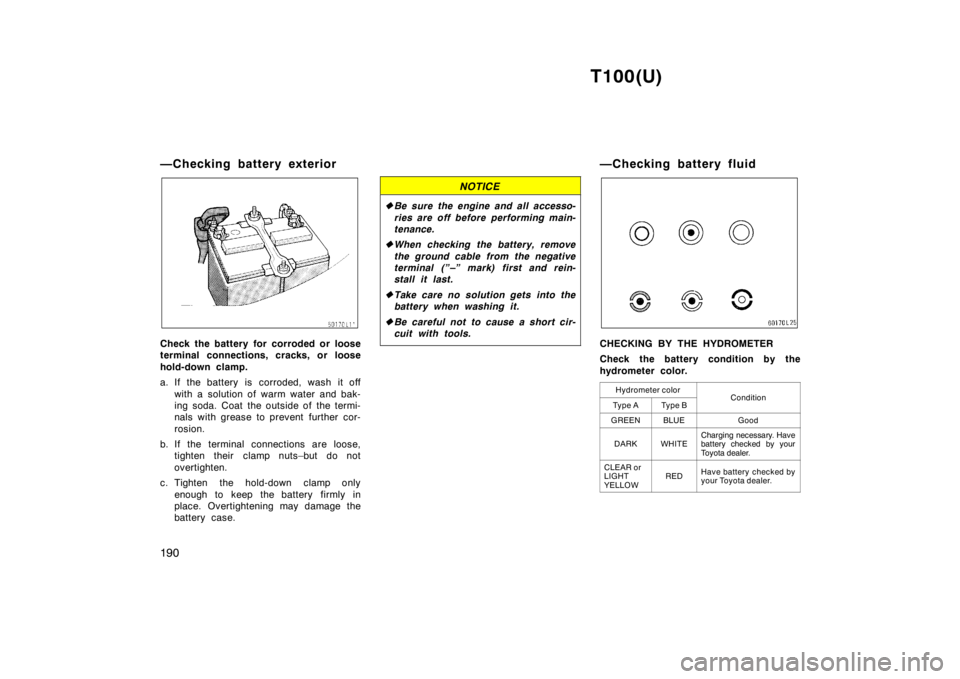
Check the battery for corroded or loose
terminal connections, cracks, or loose
hold-down clamp.
a. If the battery is corroded, wash it off
with a solution of warm water and bak-
ing soda. Coat the outside of the termi-
nals with grease to prevent further cor-
rosion.
b. If the terminal connections are loose, tighten their clamp nuts–but do not
overtighten.
c. Tighten the hold-down clamp only enough to keep the battery firmly in
place. Overtightening may damage the
battery case.
NOTICE
Be sure the engine and all accesso-
ries are off before performing main-
tenance.
When checking the battery, remove
the ground cable from the negative
terminal (”–” mark) first and rein-
stall it last.
Take care no solution gets into the
battery when washing it.
Be careful not to cause a short cir-
cuit with tools.
—Checking battery fluid
CHECKING BY THE HYDROMETER
Check the battery condition by the
hydrometer color.
Hydrometer color
ConditionTy p e ATy p e B
GREENBLUEGood
DARKWHITECharging necessary. Have
battery checked by your
Toyota dealer.
CLEAR or
LIGHT
YELLOWREDHave battery checked by
your Toyota dealer.
Page 191 of 214
T100(U)191
Battery recharging precautions
During recharging, the battery is pro-
ducing hydrogen gas.
Therefore, before recharging:
1. If recharging with the battery installed on the vehicle, be sure to disconnect
the ground cable.
2. Be sure the power switch on the re- charger is off when connecting the
charger cables to the battery and when
disconnecting them.
CAUTION
Always charge the battery in an un-
confined area. Do not charge the
battery in a garage or closed room
where there is not sufficient ventila-
tion.
Only do a slow charge (5A or less).
Charging at a quicker rate is dan-
gerous. The battery may explode,
causing personal injuries.
NOTICE
Never recharge the battery while the
engine is running. Also, be sure all
accessories are turned off.
Checking and replacing fuses