brakes TOYOTA T100 1998 User Guide
[x] Cancel search | Manufacturer: TOYOTA, Model Year: 1998, Model line: T100, Model: TOYOTA T100 1998Pages: 214, PDF Size: 4.72 MB
Page 144 of 214
T100(U)
144
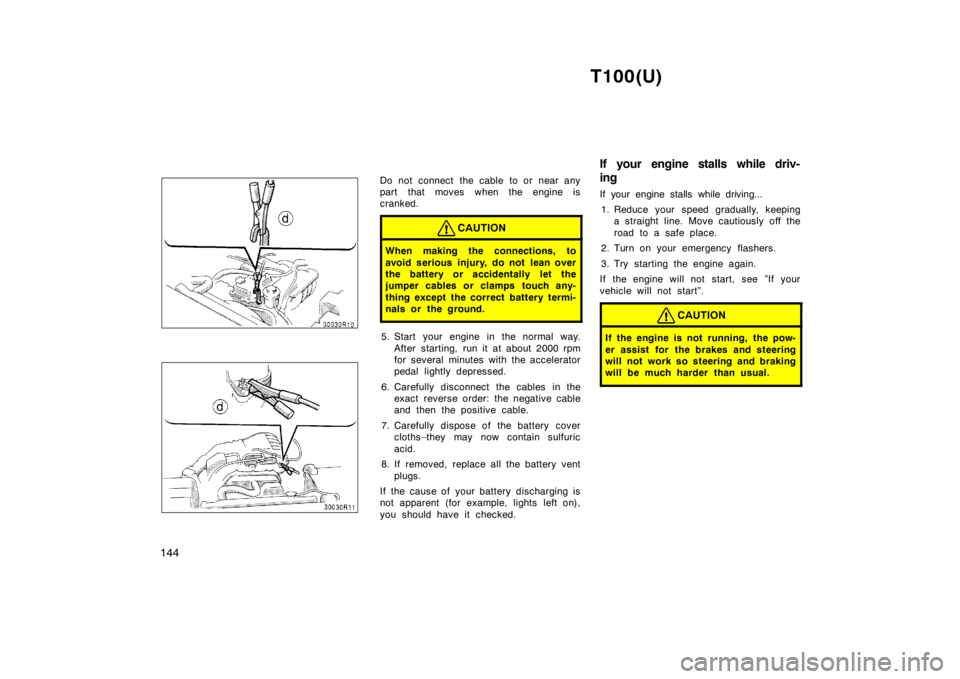
Do not connect the cable to or near any
part that moves when the engine is
cranked.
CAUTION
When making the connections, to
avoid serious injury, do not lean over
the battery or accidentally let the
jumper cables or clamps touch any-
thing except the correct battery termi-
nals or the ground.
5. Start your engine in the normal way. After starting, run it at about 2000 rpm
for several minutes with the accelerator
pedal lightly depressed.
6. Carefully disconnect the cables in the exact reverse order: the negative cable
and then the positive cable.
7. Carefully dispose of the battery cover cloths–they may now contain sulfuric
acid.
8. If removed, replace all the battery vent plugs.
If the cause of your battery discharging is
not apparent (for example, lights left on),
you should have it checked. If your engine stalls while driv-
ing
If your engine stalls while driving...
1. Reduce your speed gradually, keeping a straight line. Move cautiously off the
road to a safe place.
2. Turn on your emergency flashers.
3. Try starting the engine again.
If the engine will not start, see ”If your
vehicle will not start”.
CAUTION
If the engine is not running, the pow-
er assist for the brakes and steering
will not work so steering and braking
will be much harder than usual.
Page 157 of 214
T100(U)157
From rear—
We recommend using a tow-
ing dolly under the front wheels. If you do
not use a towing dolly, place the ignition
key in the ”ACC” position, put the trans-
mission in neutral and the transfer in
”H2”.
NOTICE
Do not tow with the key removed or
in the ”LOCK” position when towing
from the rear without a towing dolly.
The steering lock mechanism is not
strong enough to hold the front
wheels straight.
(b) Using flat bed truck
(c) Towing with sling type truck from front
Follow the instructions for towing from
front in ”(a) Towing with wheel lift type
truck”.
All models
(d) Towing with sling type truck from rear
NOTICE
Do not tow with sling type truck. This
may cause body damage.
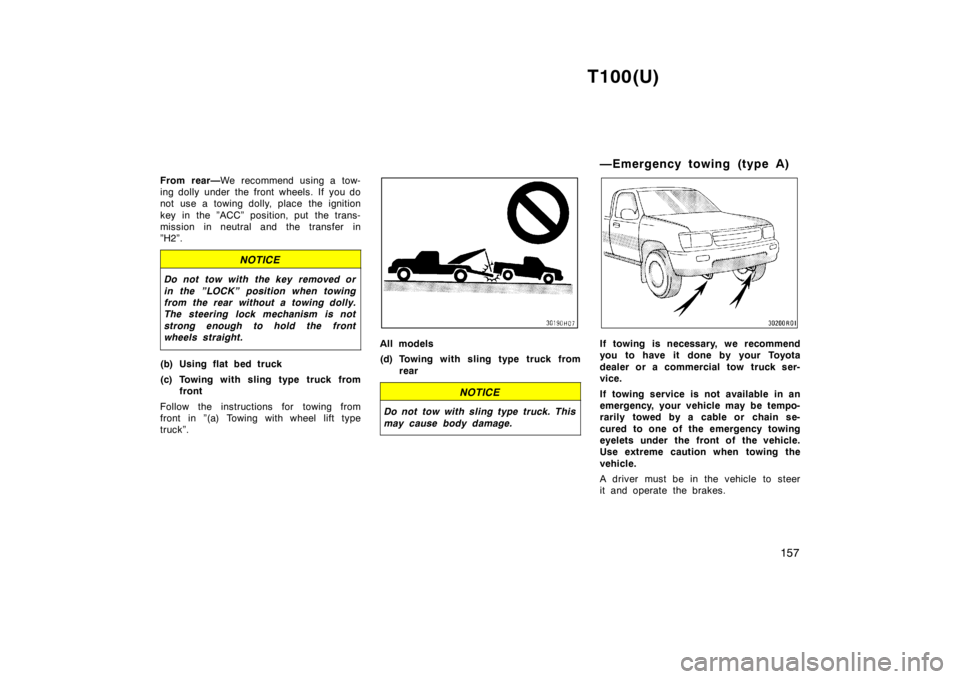
—Emergency towing (type A)
If towing is necessary, we recommend
you to have it done by your Toyota
dealer or a commercial tow truck ser-
vice.
If towing service is not available in an
emergency, your vehicle may be tempo-
rarily towed by a cable or chain se-
cured to one of the emergency towing
eyelets under the front of the vehicle.
Use extreme caution when towing the
vehicle.
A driver must be in the vehicle to steer
it and operate the brakes.
Page 158 of 214

T100(U)
158
Towing in this manner may be done only
on hard-surfaced roads for a short dis-
tance and at low speeds. Also, the
wheels, axles, drive train, steering and
brakes must all be in good condition.
CAUTION
Use extreme caution when towing the
vehicle. Avoid sudden starts or errat-
ic driving maneuvers which would
place excessive stress on the emer-
gency towing eyelet and towing cable
or chain. The eyelet and towing cable
or chain may break and cause serious
injury or damage.
NOTICE
Use only a cable or chain specifically
intended for use in towing vehicles.
Securely fasten the cable or chain to
the towing eyelet provided.
Before towing, release the parking brake
and put the transmission in neutral (manu-
al) or ”N” (automatic) and the transfer in
”H2” (four-wheel drive models). The key
must be in ”ACC” (engine off) or ”ON”
(engine running).
CAUTION
If the engine is not running, the pow-
er assist for the brakes and steering
will not work so steering and braking
will be much harder than usual.
—Emergency towing (type B)
If towing is necessary, we recommend
you to have it done by your Toyota
dealer or a commercial tow truck ser-
vice.
If towing service is not available in an
emergency, your vehicle may be tempo-
rarily towed by a cable or chain se-
cured to the emergency towing hook
under the front of the vehicle. Use ex-
treme caution when towing the vehicle.
A driver must be in the vehicle to steer
it and operate the brakes.
Page 159 of 214

T100(U)159
Towing in this manner may be done only
on hard-surfaced roads for a short dis-
tance and at low speeds. Also, the
wheels, axles, drive train, steering and
brakes must all be in good condition.
CAUTION
Use extreme caution when towing the
vehicle. Avoid sudden starts or errat-
ic driving maneuvers which would
place excessive stress on the emer-
gency towing hook and towing cable
or chain. The hook and towing cable
or chain may break and cause serious
injury or damage.
NOTICE
Use only a cable or chain specifically
intended for use in towing vehicles.
Securely fasten the cable or chain to
the towing eyelet provided.
Before towing, release the parking brake,
put the transmission in neutral (manual) or
”N” (automatic) and the transfer in ”H2”.
The key must be in ”ACC” (engine off) or
”ON” (engine running).
CAUTION
If the engine is not running, the pow-
er assist for the brakes and steering
will not work so steering and braking
will be much harder than usual.
Before emergency towing, check that
the hook or eyelet is not broken or
damaged and that the installation bolts
are not loose.
Fasten the towing cable or chain se-
curely to the hook or eyelet.
Do not jerk the hook or eyelet. Apply
steady and even force.
To avoid damaging the hook or eyelet,
do not pull from the side or at a verti-
cal angle. Always pull straight ahead.
—Emergency towing hook
or eyelet precautions
(four-wheel drive models)
Page 167 of 214

T100(U)167
Tire surface and wheel nuts
Check the tires carefully for cuts, damage
or excessive wear. See Chapter 7
−2 for
additional information. When checking the
tires, make sure no nuts are missing, and
check the nuts for looseness. Tighten
them if necessary.
Tire rotation
Rotate the tires every 12000 km (7500
miles). See Chapter 7 −2 for additional in-
formation.
Fluid leaks
Check underneath for leaking fuel, oil, wa-
ter or other fluid after the vehicle has
been parked for a while. If you smell fuel
fumes or notice any leak, have the cause
found and corrected immediately.
Doors and engine hood
Check that all doors including tailgate op-
erate smoothly and all latches lock se-
curely. Make sure the engine hood sec-
ondary latch secures the hood from
opening when the primary latch is re-
leased.
INSIDE THE VEHICLE
Items listed below should be checked
regularly, e.g. while performing periodic
services, cleaning the vehicle, etc. Lights
Make sure the headlights, stop lights, tail
lights, turn signal lights, and other lights
are all working. Check headlight aim.
Service reminder indicators and warning
buzzers
Check that all service reminder indicators
and warning buzzers function properly.
Steering wheel
Be alert for changes in steering condition,
such as hard steering or strange noise.
Seats
Check that all seat controls such as seat
adjusters, seatback recliner, etc. operate
smoothly and that all latches lock securely
in any position. Check that the head re-
straints move up and down smoothly and
that the locks hold securely in any latched
position. For folding
−down seatback
(bench seat), check that the latches lock
security.
Seat belts
Check that the seat belt system such as
buckles, retractors and anchors operate
properly and smoothly. Make sure that the
belt webbing is not cut, frayed, worn or
damaged.
Accelerator pedal
Check the pedal for smooth operation and
uneven pedal effort or catching. Clutch pedal
Check the pedal for smooth operation.
Brake pedal
Check the pedal for smooth operation and
that the pedal has the proper clearance.
Check the brake booster function.
Brakes
At a safe place, check that the brakes do
not pull to one side when applied.
Parking brake
Check that the lever has the proper travel
and that, on a safe incline, your vehicle
is held securely with only the parking
brake applied.
Automatic transmission ”Park” mecha-
nism
On a safe incline, check that your vehicle
is held securely with the selector lever in
”P” position and all brakes released.
IN THE ENGINE COMPARTMENT
Items listed below should be checked
from time to time, e.g. each time when
refueling.
Washer fluid
Make sure there is sufficient fluid in the
tank. See Chapter 7
−3 for additional in-
formation.
Page 203 of 214

T100(U)203
Oil type:
Gear oil API GL −4 or GL −5
Recommended oil viscosity:
SAE 75W −90
AUTOMATIC TRANSMISSION
Fluid capacity (drain and refill),
L (qt., Imp. qt.): Two-wheel drive models Up to 1.6 (1.7, 1.4)
Four-wheel drive models
Up to 2.0 (2.1, 1.8)
Fluid type:
Automatic transmission fluid D−II or DEXRON
III (
DEXRON
II)
TRANSFER
Oil capacity, L (qt., Imp. qt.): 1.1 (1.2, 1.0)
Oil type: Gear oil API GL −4 or GL −5
Recommended oil viscosity: SAE 75W −90
DIFFERENTIAL
Oil capacity, L (qt., Imp. qt.): Two-wheel drive models 2.75 (2.9, 2.4)
Four-wheel drive models Front 1.9 (2.0, 1.7)
Rear 2.95 (3.1, 2.6) Oil type:
Hypoid gear oil API GL −5
Recommended oil viscosity: Front SAE 75W −90
Rear
Above −18 °C (0 °F)
SAE 90
Below −18 °C (0 °F)
SAE 80W or 80W −90
CHASSIS LUBRICATION
Wheel bearings: Lithium base wheel bearing grease,
NLGI No.2
Front drive shaft thrust bushings: Synthetic oil and lithium soap base
chassis grease, NLGI No.1
Propeller shafts: Spiders and slide yokes Lithium base chassis grease,
NLGI No.2
Double cardan joint Molybdenum-disulfide lithium base
chassis grease, NLGI No.2
BRAKES
Minimum pedal clearance when depressed
with the pressure of 490 N (50 kgf. 110
lbf) with the engine running, mm (in.): Two-wheel drive models
1-ton models 78 (3.1)
1/2-ton models 73 (2.9)
Four-wheel drive models 1-ton models 70 (2.8)
1/2-ton models 73 (2.9)
Pedal freeplay, mm (in.): 3—6 (0.12—0.24)
Pad wear limit, mm (in.): 1.0 (0.04)
Lining wear limit, mm (in.):
1.0 (0.04)
Parking brake adjustment when pulled with
the force of 196 N (20 kgf, 44 lbf):
11—17 clicks
Fluid type: SAE J1703 or FMVSS No.116 DOT 3
STEERING
Wheel freeplay: Less than 30 mm (1.2 in.)
Power steering fluid type: Automatic transmission fluid DEXRON
II or III