tow TOYOTA T100 1998 User Guide
[x] Cancel search | Manufacturer: TOYOTA, Model Year: 1998, Model line: T100, Model: TOYOTA T100 1998Pages: 214, PDF Size: 4.72 MB
Page 67 of 214
T100(U)67
Your automatic transmission has a shift
lock system to minimize the possibility of
incorrect operation. This means you can
only shift out of ”P” position when the
brake pedal is depressed (with the ignition
switch in ”ON” position and selector lever
pulled toward you).
(a) Normal driving
1. Start the engine as instructed in ”How to start the engine” in Part 3. The
transmission must be in ”P” or ”N”.
2. With your foot holding down the brake pedal, shift the selector lever to ”D”.
In ”D” position, the automatic transmission
system will select the most suitable gear
for running conditions such as normal
cruising, hill climbing, hard towing, etc.
Always turn the overdrive switch on for
better fuel economy and quieter driving.
Two-wheel drive models–If the engine
coolant temperature is low, the transmis-
sion will not shift into the overdrive gear
even with the overdrive switch on. Four-wheel drive models–If the engine
coolant temperature is low and the vehicle
is travelling at low speed or when the
four-wheel drive control lever is in ”L4”
(four-wheel drive, low range), the trans-
mission will not shift into the overdrive
gear even with the overdrive switch on.
(See ”Four-wheel drive system” in this
Chapter for information of the four-wheel
drive control lever.)
CAUTION
Never put your foot on the accelera-
tor pedal while shifting.
3. Release the parking brake and brake
pedal. Depress the accelerator pedal
slowly for smooth starting.
(b) Using engine braking
To use engine braking, you can downshift
the transmission as follows: Turn off the overdrive switch. The ”O/D
OFF” indicator light will come on and
the transmission will downshift to the
third gear.
Shift into the ”2” position. The trans-
mission will downshift to the second
gear when the vehicle speed drops
down to or lower than the following
speed, and more powerful engine brak-
ing will be obtained.
Tw o −wheel drive models—
3RZ −FE engine.....112 km/h (70 mph)
5VZ −FE engine.....117 km/h (73 mph)
Four −wheel drive models—
—Four −wheel drive control lever
in ”H2” and ”H4”.....112 km/h (70 mph)
—Four −wheel drive control lever
in ”L4”.....38 km/h (24 mph)
Shift into the ”L” position. The trans-
mission will downshift to the first gear
When the vehicle speed drops down to
or lower than the following speed, and
maximum engine braking will be ap-
plied.
Tw o −wheel drive models—
3RZ −FE engine.....54 km/h (34 mph)
5VZ −FE engine.....56 km/h (35 mph)
Four −wheel drive models—
—Four −wheel drive control lever
in ”H2” and ”H4”.....54 km/h (34 mph)
—Four −wheel drive control lever
in ”L4”.....10 km/h (6 mph)
Page 68 of 214
T100(U)
68
Vehicles with cruise control–When the
cruise control is being used, even if you
downshift the transmission by turning off
the overdrive switch, engine braking will
not be applied because the cruise control
is not cancelled. For ways to decrease
the vehicle speed, see ”Cruise control” in
this chapter.
CAUTION
Be careful when downshifting on a
slippery surface. Abrupt shifting
could cause the vehicle to spin or
skid.
(c) Using ”2” and ”L” positions
The ”2” and ”L” positions are used for
strong engine braking as described pre-
viously.
With the selector lever in ”2” or ”L”, you
can start the vehicle in motion as with the
lever in ”D”.
With the selector lever in ”2”, the vehicle
will start in the first gear and automatical-
ly shift to the second gear.
With the selector lever in ”L”, the trans-
mission is engaged in the first gear.
NOTICE
Be careful not to overrev the en-
gine. Watch the tachometer to keep
engine rpm from going into the red
zone. The approxmate maximum al-
lowable speed for each position is
given below for your reference:
Two-wheel drive models—
”2” 100 km/h (62 mph)
”L” 55 km/h (34 mph)
Four-wheel drive models—
—Four-wheel drive control lever
in ”H2” and ”H4” ”2” 100 km/h (62 mph)
”L” 55 km/h (34 mph)
—Four-wheel drive control lever
in ”L4” ”2” 35 km/h (21 mph)
”L” 20 km/h (12 mph)
Do not continue hill climbing for a
long time in the ”2” or ”L” posi-
tion. This may cause severe auto-
matic transmission damage from
overheating. To prevent such dam-
age, use ”D” position for hill climb-
ing or hard towing.
(d) Backing up
1. Bring the vehicle to a complete stop.
2. With the brake pedal held down with your foot, shift the selector lever to the
”R” position.
NOTICE
Never shift into reverse while the ve-
hicle is moving.
(e) Parking
1. Bring the vehicle to a complete stop. Pull the parking brake lever up fully to
securely apply the parking brake.
With the brake pedal pressed down,
shift the selector lever to the ”P” posi-
tion.
CAUTION
While the vehicle is moving, never
attempt to move the selector lever
into ”P” position under any circum-
stances. Serious mechanical damage
and loss of vehicle control may re-
sult.
Page 69 of 214
T100(U)69
(f) Good driving practice
If the transmission is repeatedly up-
shifted and downshifted between third
gear and overdrive when climbing a
gentle slope, the overdrive switch
should be turned off. Be sure to turn
the switch on immediately afterward.
When towing a trailer, in order to main-
tain engine braking efficiency, do not
use overdrive.
CAUTION
Always keep your foot on the brake
pedal while stopped with the engine
running. This prevents the vehicle
from creeping.
NOTICE
Do not hold the vehicle on an up-
grade with the accelerator pedal. It
can cause the transmission to over-
heat. Always use the brake pedal or
parking brake.
(g) Rocking your vehicle if stuck
CAUTION
To rock your vehicle if it becomes
stuck in snow, mud, sand, etc., first
check that there are no objects or
people around the vehicle. During the
rocking operation the vehicle may
suddenly move forward or backward
as it becomes unstuck, causing injury
or damage to nearby people or ob-
jects.
NOTICE
If you rock your vehicle, observe the
following precautions to prevent dam-
age to the transmission and other
parts. Do not depress the accelerator ped-
al while shifting the selector lever
or before the transmission is com-
pletely shifted to forward or reverse
gear.
Do not race the engine and avoid
spinning the wheels.
If your vehicle remains stuck after
rocking the vehicle several times,
consider other ways such as tow-
ing.
Page 71 of 214
T100(U)71
1/2-ton models
3RZ-FE engine
gear km/h (mph) 1 40 (25)
2 75 (47)
3 115 (71)
4 165(103)
5VZ-FE engine gear km/h (mph)
1 40 (25)
2 75 (47)
3 115 (71)
4 165(103)
Four-wheel drive models
gear km/h (mph) ”H2” and ”H4” ”L4”
1 40 (25) 15 (9)
2 75 (47) 30 (18)
3 115 (71) 40 (25)
4 165(103) 60 (37)
NOTICE
Do not downshift if you are going
faster than the maximum allowable
speed for the next lower gear.
Good driving practice
If it is difficult to shift into reverse, put
the transmission in neutral, release the
clutch pedal momentarily, and then try
again.
When towing a trailer, in order to main-
tain engine braking efficiency, do not
use the fifth gear.
CAUTION
Be careful when downshifting on a
slippery surface. Abrupt shifting
could cause the vehicle to spin or
skid.
NOTICE
Make sure the vehicle is completely
stopped before shifting into reverse.
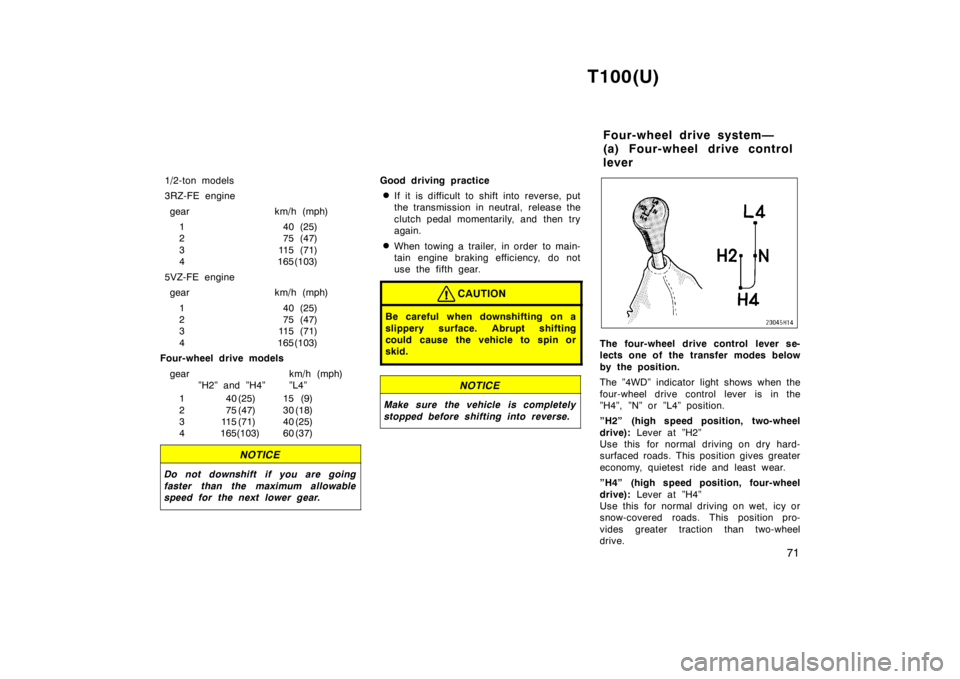
The four-wheel drive control lever se-
lects one of the transfer modes below
by the position.
The ”4WD” indicator light shows when the
four-wheel drive control lever is in the
”H4”, ”N” or ”L4” position.
”H2” (high speed position, two-wheel
drive): Lever at ”H2”
Use this for normal driving on dry hard-
surfaced roads. This position gives greater
economy, quietest ride and least wear.
”H4” (high speed position, four-wheel
drive): Lever at ”H4”
Use this for normal driving on wet, icy or
snow-covered roads. This position pro-
vides greater traction than two-wheel
drive. Four-wheel drive system—
(a) Four-wheel drive controllever
Page 108 of 214

T100(U)
108
Heating
For best results, set controls to:
Fan speed —Any setting except ”OFF”
Temperature —Towards WA R M
(red zone)
Air intake —FRESH (outside air)
Air flow —FLOOR
Air conditioning —OFF
For quick heating, select recirculated
air for a few minutes. To keep the
windows from fogging, select fresh af-
ter the vehicle interior has been
warmed.
Press the ”A/C” button on for dehumidi-
fied heating.
Choose floor/windshield air flow to heat
the vehicle interior while defrosting or
defogging the windshield. Air conditioning
For best results, set controls to:
Fan speed —Any setting except ”OFF”
Temperature —Towards COLD
(blue zone)
Air intake —FRESH (outside air)
Air flow —PA N E L
Air conditioning —ONFor quick cooling, move the air intake
selector to recirculate for a few min-
utes.
Ventilation
For best results, set controls to:
Fan speed —Any setting except ”OFF”
Temperature —Towards COLD
(blue zone)
Air intake —FRESH (outside air)
Air flow —PA N E L
Air conditioning —OFF
Defogging
The inside of the windshield
For best results, set controls to:
Fan speed —Any setting except ”OFF”
Temperature —Towards WARM
(red zone) to heat; COLD (blue zone) to
cool
Air intake —FRESH (outside air)
Air flow —WINDSHIELD
Vehicles with ”A/C” button—
Moving the air flow selector lever to the
windshield position turns on the defroster −
linked air conditioning. This is to clear up
the front view more quickly.
When the ”A/C” button is not pressed in,
moving the air flow selector lever to
another position turns off the air condition-
ing.
On humid days, do not blow cold air
on the windshield—the difference be-
tween the outside and inside tempera-
tures could make the fogging worse.
Page 109 of 214

T100(U)109
Defrosting
The outside of the windshield
For best results, set controls to:
Fan speed —Any setting except ”OFF”
Temperature —Towards WA R M
(red zone)
Air intake —FRESH (outside air)
Air flow —WINDSHIELD
Vehicles with ”A/C” button—
Moving the air flow selector lever to the
windshield position turns on the defroster −
linked air conditioning. This is to clear up
the front view more quickly.
When the ”A/C” button is not pressed in,
moving the air flow selector lever to
another position turns off the air condition-
ing.
To heat the vehicle interior while de-
frosting the windshield, choose
floor/windshield air flow. —Instrument panel vents
If air flow control is not satisfactory, check
the instrument panel vents. The instrument
panel vents may be opened or closed as
shown.
Page 115 of 214
T100(U)11 5
Part 2
INFORMATION
BEFORE DRIVING
YOUR TOYOTA
Off
−road vehicle precautions
Break −in period
Fuel
Operation in foreign countries
Three −way catalytic converter
Engine exhaust cautions
Facts about engine oil
consumption
Twin ground electrode
spark plugs
Brake system
Brake pad wear limit indicators
Luggage stowage precautions
Your Toyota’s identification
Theft prevention labels
Suspension and chassis
Types of tires
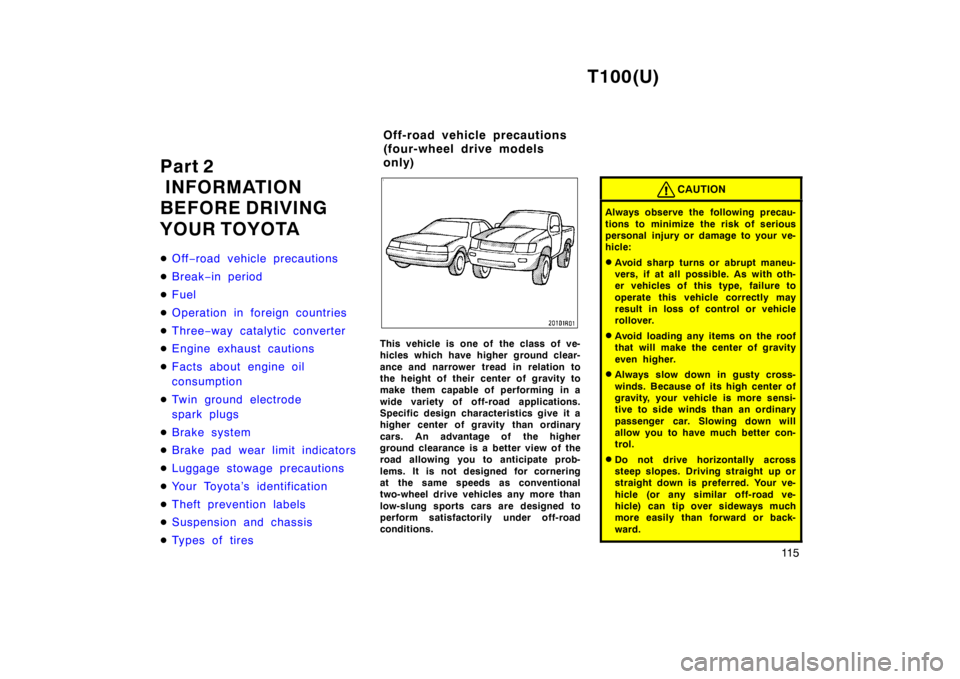
This vehicle is one of the class of ve-
hicles which have higher ground clear-
ance and narrower tread in relation to
the height of their center of gravity to
make them capable of performing in a
wide variety of off-road applications.
Specific design characteristics give it a
higher center of gravity than ordinary
cars. An advantage of the higher
ground clearance is a better view of the
road allowing you to anticipate prob-
lems. It is not designed for cornering
at the same speeds as conventional
two-wheel drive vehicles any more than
low-slung sports cars are designed to
perform satisfactorily under off-road
conditions.
CAUTION
Always observe the following precau-
tions to minimize the risk of serious
personal injury or damage to your ve-
hicle: Avoid sharp turns or abrupt maneu-
vers, if at all possible. As with oth-
er vehicles of this type, failure to
operate this vehicle correctly may
result in loss of control or vehicle
rollover.
Avoid loading any items on the roof
that will make the center of gravity
even higher.
Always slow down in gusty cross-
winds. Because of its high center of
gravity, your vehicle is more sensi-
tive to side winds than an ordinary
passenger car. Slowing down will
allow you to have much better con-
trol.
Do not drive horizontally across
steep slopes. Driving straight up or
straight down is preferred. Your ve-
hicle (or any similar off-road ve-
hicle) can tip over sideways much
more easily than forward or back-
ward.
Off-road vehicle pr ecautions
(four-wheel drive models
only)
Page 116 of 214
T100(U)
11 6
When driving off-road or in rugged
terrain, do not drive at excessive
speeds, jump the vehicle, or strike
objects, etc. This may cause loss of
control or vehicle rollover. You are
also risking expensive damage to
your vehicle’s suspension and chas-
sis.
Break-in period
Drive gently and avoid high speeds.
Your vehicle does not need an elaborate
break-in. But following a few simple tips
for the first 1600 km (1000 miles) can add
to the future economy and long life of
your vehicle:
Do not drive over 88 km/h (55 mph).
Run the engine at moderate speed be-
tween 2000 and 4000 rpm.
Avoid full-throttle starts.
Try to avoid hard stops during the first
300 km (200 miles).
Do not drive slowly with the manual
transmission in a high gear.
Do not drive for a long time at any
single speed, either fast or slow.
Do not tow a trailer during the first 800
km (500 miles). Fuel
Selecting the proper fuel is essential
for satisfactory engine performance.
Engine damage caused by use of improp-
er fuels is not covered under Toyota’s new
vehicle warranty.
FUEL TYPE
Use only unleaded gasoline.
To help prevent gas station mixups, ve-
hicles designed for use with unleaded gas-
oline have a new smaller fuel tank open-
ing. The special nozzle on pumps with
unleaded fuel will fit it, but the larger
standard nozzle on pumps with leaded gas
will not.
At a minimum, the gasoline you use
should meet specifications of ASTM
D4814 in the U.S.A. and CGSB 3.5
−M93
in Canada.
NOTICE
Do not use leaded gasoline. Use of
leaded gasoline will cause the three-
way catalytic converter to lose its ef-
fectiveness and the emission control
system to function improperly. Also,
this can increase maintenance costs.
Page 124 of 214
T100(U)
124
Brake pad wear limit indicators
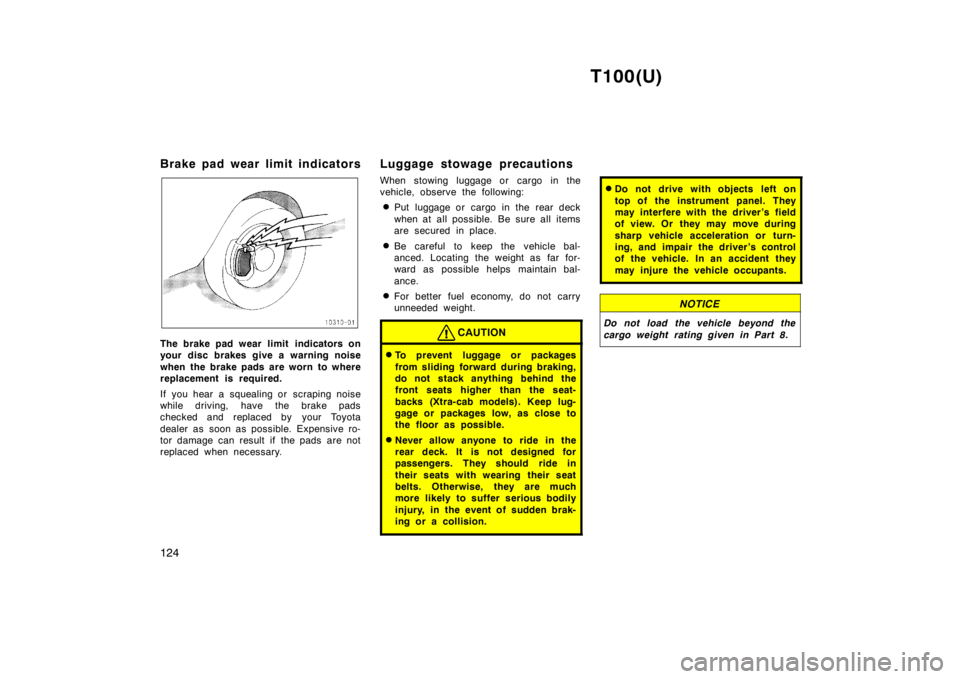
The brake pad wear limit indicators on
your disc brakes give a warning noise
when the brake pads are worn to where
replacement is required.
If you hear a squealing or scraping noise
while driving, have the brake pads
checked and replaced by your Toyota
dealer as soon as possible. Expensive ro-
tor damage can result if the pads are not
replaced when necessary.
Luggage stowage pr
ecautions
When stowing luggage or cargo in the
vehicle, observe the following: Put luggage or cargo in the rear deck
when at all possible. Be sure all items
are secured in place.
Be careful to keep the vehicle bal-
anced. Locating the weight as far for-
ward as possible helps maintain bal-
ance.
For better fuel economy, do not carry
unneeded weight.CAUTION
To prevent luggage or packages
from sliding forward during braking,
do not stack anything behind the
front seats higher than the seat-
backs (Xtra-cab models). Keep lug-
gage or packages low, as close to
the floor as possible.
Never allow anyone to ride in the
rear deck. It is not designed for
passengers. They should ride in
their seats with wearing their seat
belts. Otherwise, they are much
more likely to suffer serious bodily
injury, in the event of sudden brak-
ing or a collision.
Do not drive with objects left on
top of the instrument panel. They
may interfere with the driver’s field
of view. Or they may move during
sharp vehicle acceleration or turn-
ing, and impair the driver’s control
of the vehicle. In an accident they
may injure the vehicle occupants.
NOTICE
Do not load the vehicle beyond the
cargo weight rating given in Part 8.
Page 129 of 214

T100(U)129
Part 3
STARTING AND
DRIVING
Before starting the engine
How to start the engine
Tips for driving in various
conditions
Off
−road driving precautions
Winter driving tips
Tr ailer towing
How to save fuel and make your
vehicle last longer, too
Before starting the engine
1. Check the area around the vehicle be- fore entering it.
2. Adjust seat position, seatback angle, head restraint height and steering
wheel angle.
3. Adjust inside and outside rear view mirrors.
4. Lock all doors.
5. Fasten seat belts. 1. Apply the parking brake firmly.
2. Turn off unnecessary lights and acces-
sories.
3. Manual transmission:
Press the clutch
pedal to the floor and shift the trans-
mission into neutral. Hold the clutch
pedal to the floor until the engine is
started. A starter safety device will pre-
vent the starter from operating if the
clutch pedal is not fully depressed.
Automatic transmission: Put the se-
lector lever in ”P”. If you need to re-
start the engine while the vehicle is
moving, put the selector lever in ”N”.
A starter safety device will prevent the
starter from operating if the selector
lever is in any drive position.
4. Automatic transmission only : De-
press the brake pedal and hold it to
the floor until driving off.
How to start the engine—
(a) Before cranking