window TOYOTA T100 1998 User Guide
[x] Cancel search | Manufacturer: TOYOTA, Model Year: 1998, Model line: T100, Model: TOYOTA T100 1998Pages: 214, PDF Size: 4.72 MB
Page 164 of 214
T100(U)
164
NOTICE
Do not use solvent, thinner, gasoline
or window cleaner on the interior.
Carpets
Use a good foam-type shampoo to
clean the carpets.
Begin by vacuuming thoroughly to remove
as much dirt as possible. Several types of
foam cleaners are available; some are in
aerosol cans and others are powders or
liquids which you mix with water to pro-
duce a foam. To shampoo the carpets,
use a sponge or brush to apply the foam.
Rub in overlapping circles.
Do not apply water–the best results are
obtained by keeping the carpet as dry as
possible. Read the shampoo instructions
and follow them closely.
Seat belts
The seat belts may be cleaned with
mild soap and water or with lukewarm
water.
Use a cloth or sponge. As you are clean-
ing, check the belts for excessive wear,
fraying, or cuts.
NOTICE
Do not use dye or bleach on the belt-
s—it may weaken them.
Windows
The windows may be cleaned with any
household window cleaner.
NOTICE
When cleaning the inside of the win-
dows, be careful not to scratch or
damage the heater wires on the rear
window.
Air conditioning control panel, car au-
dio, instrument panel, console panel,
and switches
Use a soft damp cloth for cleaning.
Soak a clean soft cloth in water or luke-
warm water then lightly wipe off any dirt.
NOTICE
Do not use organic substances (sol-
vents, kerosene, alcohol, gasoline,
etc.) or alkaline or acidic solutions.
These chemicals can cause discol-
oring, staining or peeling of the
surface.
If you use cleaners or polishing
agents, make sure their ingredients
do not include the substances men-
tioned above.
If you use a liquid car freshener, do
not spill the liquid onto the ve-
hicle’s interior surfaces. It may con-
tain the ingredients mentioned
above. Immediately clean any spill
using the method mentioned above.
If you have any questions about the
cleaning of your Toyota, your local
Toyota dealer will be pleased to answer
them.
Page 168 of 214
T100(U)
168
Engine coolant level
Make sure the coolant level is between
the ”FULL” and ”LOW” lines on the see-
through reservoir when the engine is cold.
See Chapter 7
−2 for additional information
when the engine is cold.
Battery electrolyte level
Make sure the electrolyte level of all bat-
tery cells is between upper and lower lev-
el lines on the case. Add only distilled
water when replenishing. See Chapter 7 −3
for additional information.
Brake fluid level
Make sure the brake fluid level is correct.
See Chapter 7 −2 for additional information.
Engine oil level
Check the level on the dipstick with the
engine turned off and the vehicle parked
on a level spot. See Chapter 7 −2 for addi-
tional information.
Power steering fluid level
Check the level on the dipstick. The level
should be in the ”HOT” or ”COLD” range
depending on the fluid temperature. See
Chapter 7 −2 for additional information. Exhaust system
If you notice any change in the sound of
the exhaust or smell exhaust fumes, have
the cause located and corrected immedi-
ately. (See engine exhaust cautions in
Part 2.)
Be on the alert for changes in perfor-
mance, sounds, and visual tip-offs that
indicate service is needed. Some impor-
tant clues are as follows:
Engine missing, stumbling, or pinging
Appreciable loss of power
Strange engine noises
A leak under the vehicle (however, wa-
ter dripping from the air conditioning
after use is normal.)
Change in exhaust sound (This may
indicate a dangerous carbon monoxide
leak. Drive with the windows open and
have the exhaust system checked im-
mediately.)
Flat-looking tire; excessive tire squeal
when cornering; uneven tire wear
Vehicle pulls to one side when driving
straight on a level road
Strange noises related to suspension
movement
Loss of brake effectiveness; spongy
feeling brake or clutch pedal; pedal al-
most touches floor; vehicle pulls to one
side when braking
Engine coolant temperature continually
higher than normal
Does your vehicle need
repairing?
Page 207 of 214
T100(U)207
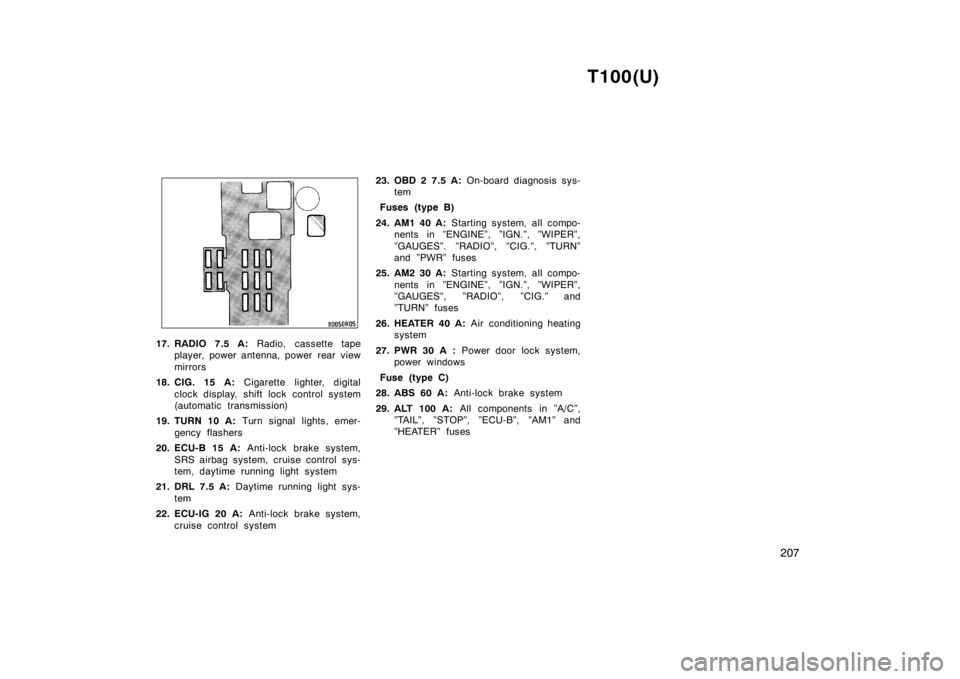
17. RADIO 7.5 A: Radio, cassette tape
player, power antenna, power rear view
mirrors
18. CIG. 15 A: Cigarette lighter, digital
clock display, shift lock control system
(automatic transmission)
19. TURN 10 A: Turn signal lights, emer-
gency flashers
20. ECU-B 15 A: Anti-lock brake system,
SRS airbag system, cruise control sys-
tem, daytime running light system
21. DRL 7.5 A: Daytime running light sys-
tem
22. ECU-IG 20 A: Anti-lock brake system,
cruise control system 23. OBD 2 7.5 A:
On-board diagnosis sys-
tem
Fuses (type B)
24. AM1 40 A: Starting system, all compo-
nents in ”ENGINE”, ”IGN.”, ”WIPER”,
”GAUGES”. ”RADIO”, ”CIG.”, ”TURN”
and ”PWR” fuses
25. AM2 30 A: Starting system, all compo-
nents in ”ENGINE”, ”IGN.”, ”WIPER”,
”GAUGES”, ”RADIO”, ”CIG.” and
”TURN” fuses
26. HEATER 40 A: Air conditioning heating
system
27. PWR 30 A : Power door lock system,
power windows
Fuse (type C)
28. ABS 60 A: Anti-lock brake system
29. ALT 100 A: All components in ”A/C”,
”TAIL”, ”STOP”, ”ECU-B”, ”AM1” and
”HEATER” fuses