belt TOYOTA T100 1998 Owner's Guide
[x] Cancel search | Manufacturer: TOYOTA, Model Year: 1998, Model line: T100, Model: TOYOTA T100 1998Pages: 214, PDF Size: 4.72 MB
Page 46 of 214
T100(U)
46
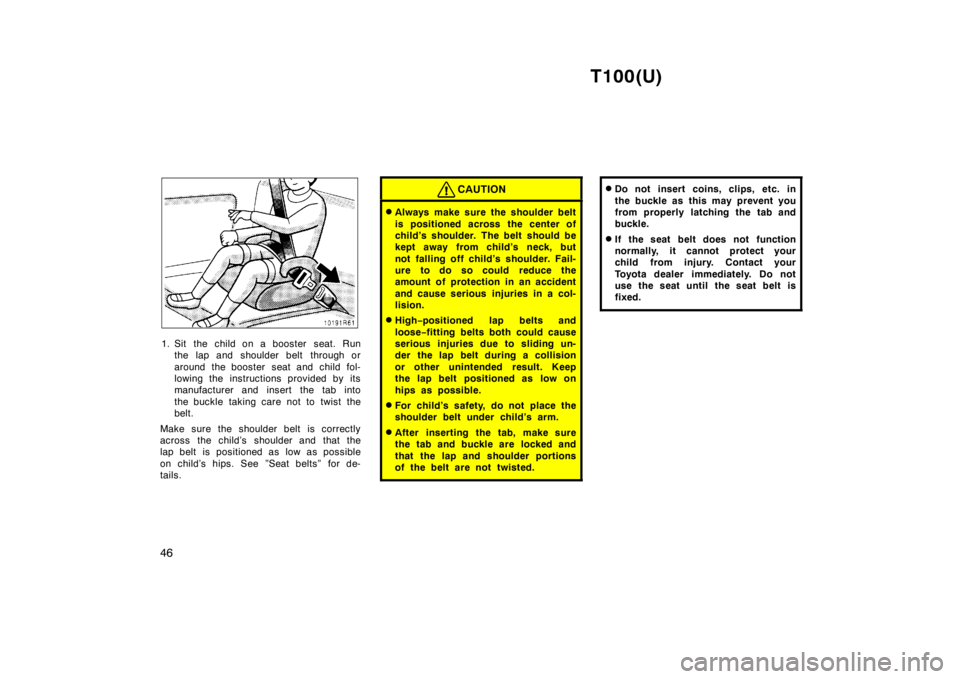
1. Sit the child on a booster seat. Run the lap and shoulder belt through or
around the booster seat and child fol-
lowing the instructions provided by its
manufacturer and insert the tab into
the buckle taking care not to twist the
belt.
Make sure the shoulder belt is correctly
across the child’s shoulder and that the
lap belt is positioned as low as possible
on child’s hips. See ”Seat belts” for de-
tails.
CAUTION
Always make sure the shoulder belt
is positioned across the center of
child’s shoulder. The belt should be
kept away from child’s neck, but
not falling off child’s s houlder. Fail-
ure to do so could reduce the
amount of protection in an accident
and cause serious injuries in a col-
lision.
High −positioned lap belts and
loose −fitting belts both could cause
serious injuries due to sliding un-
der the lap belt during a collision
or other unintended result. Keep
the lap belt positioned as low on
hips as possible.
For child’s safety, do not place the
shoulder belt under child’s arm.
After inserting the tab, make sure
the tab and buckle are locked and
that the lap and shoulder portions
of the belt are not twisted.
Do not insert coins, clips, etc. in
the buckle as this may prevent you
from properly latching the tab and
buckle.
If the seat belt does not function
normally, it cannot protect your
child from injury. Contact your
Toyota dealer immediately. Do not
use the seat until the seat belt is
fixed.
Page 47 of 214
T100(U)47
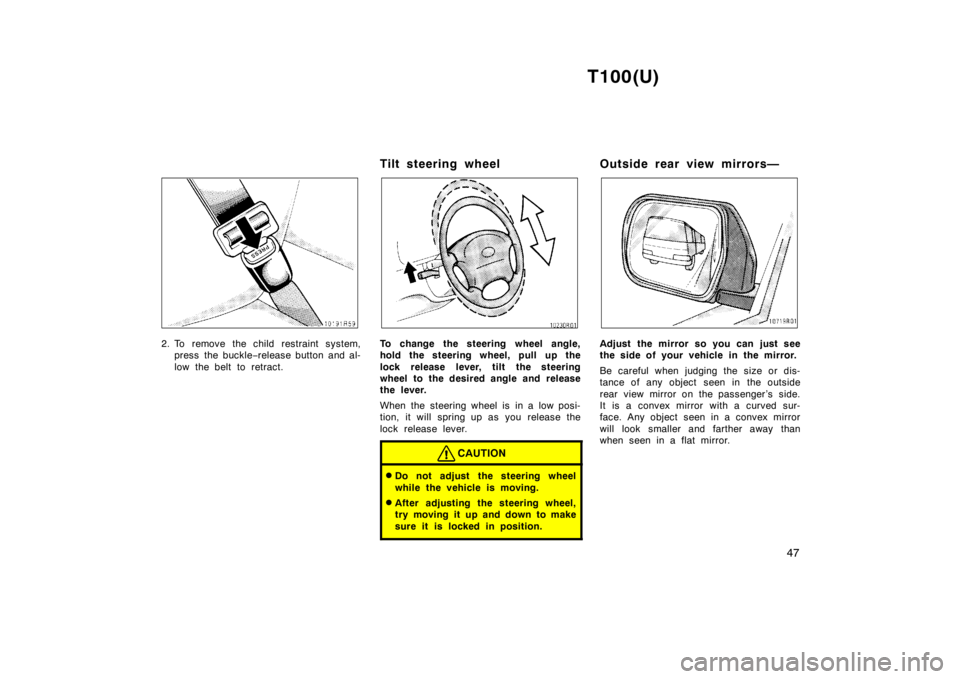
2. To remove the child restraint system,press the buckle −release button and al-
low the belt to retract. Tilt steering wheelTo change the steering wheel angle,
hold the steering wheel, pull up the
lock release lever, tilt the steering
wheel to the desired angle and release
the lever.
When the steering wheel is in a low posi-
tion, it will spring up as you release the
lock release lever.
CAUTION
Do not adjust the steering wheel
while the vehicle is moving.
After adjusting the steering wheel,
try moving it up and down to make
sure it is locked in position.
Outside rear view mirrors—
Adjust the mirror so you can just see
the side of your vehicle in the mirror.
Be careful when judging the size or dis-
tance of any object seen in the outside
rear view mirror on the passenger ’s side.
It is a convex mirror with a curved sur-
face. Any object seen in a convex mirror
will look smaller and farther away than
when seen in a flat mirror.
Page 61 of 214

T100(U)61
If the indicator or Do this.
buzzer comes on...
(a) If parking brake is off,stop and check.
(b) Fasten seat belts.
(c) Stop and check.
(d) Stop and check.
(e) Fill up tank.
(f) Take vehicle to Toyota dealer.
(Indicator and buzzer)
Low fuel level
warning light
(type B)(type A)
10302
(h) Take vehicle toTo y o t ad ealer
immediately.
If the indicator or Do this.
buzzer comes on...
(g)
Take vehicle to
(type A) Toyota dealer.
(i) Light reminder Turn off lights. buzzer
(j) Key reminder Remove key.
buzzer
(type B)
(k) Shift four-wheel drive
control out of
”N”. 10302
If the indicator or Do this.
buzzer comes on...
(l) Stop and check.
(m) Add washer fluid.
10302
Service reminder indicators
an d warn in g bu zzers
Page 62 of 214
T100(U)
62
(a) Brake System Warning Light
This light has the following functions:
Parking brake reminder
If this light is on, make sure the parking
brake is fully released. The light should
go off.
Low brake fluid level warning
If this light comes on and stays on while
you are driving, slow down and pull off
the road. Then stop the vehicle carefully.
Remember that stopping distance pedal
effort may be increased. There may be a
problem somewhere in the brake system.
Check the fluid level of the see-through
reservoir.
To make sure the parking brake has not
caused the warning light to come on,
check to see that the parking brake is
fully released.
If the brake fluid level is low...
At a safe place, test your brakes by start-
ing and stopping.
If you judge that the brakes still work
adequately, drive cautiously to your
nearest dealer or shop for repairs.
If the brakes are not working, have the
vehicle towed in for repairs. (For tow-
ing information, see Part 4.)
CAUTION
It is dangerous to continue driving
normally when the brake fluid level is
low.
If the brake fluid level is correct...
Have the warning system checked by your
Toyota dealer.
(b) Seat Belt Reminder Light and Buzz-
er
Once the ignition key is turned to ”ON” or
”START”, the reminder light and buzzer
come on if the driver’s seat belt is not
fastened. Unless the driver fastens the
belt, the light stays on and the buzzer
stops after about 4 to 8 seconds.
(c) Discharge Warning Light
This light warns that the battery is being
discharged.
If it comes on while you are driving, there
is a problem somewhere in the charging
system. The engine ignition will continue to oper-
ate, however, until the battery is dis-
charged. Turn off the air conditioning,
blower, radio, etc., and drive directly to
the nearest Toyota dealer or repair shop.
NOTICE
Do not continue driving if the engine
drive belt is broken or loose.
(d) Low Oil Pressure Warning Light
This light warns that the engine oil pres-
sure is too low.
If it flickers or stays on while you are
driving, pull off the road to a safe place
and stop the engine immediately. Call a
Toyota dealer or qualified repair shop for
assistance.
The light may occasionally flicker when
the engine is idling or it may come on
briefly after a hard stop. There is no
cause for concern if it then goes out when
the engine is accelerated slightly.
The light may come on when the oil level
is extremely low. It is not designed to
indicate low oil level, and the oil level
must be checked using the level dipstick.
Page 124 of 214
T100(U)
124
Brake pad wear limit indicators
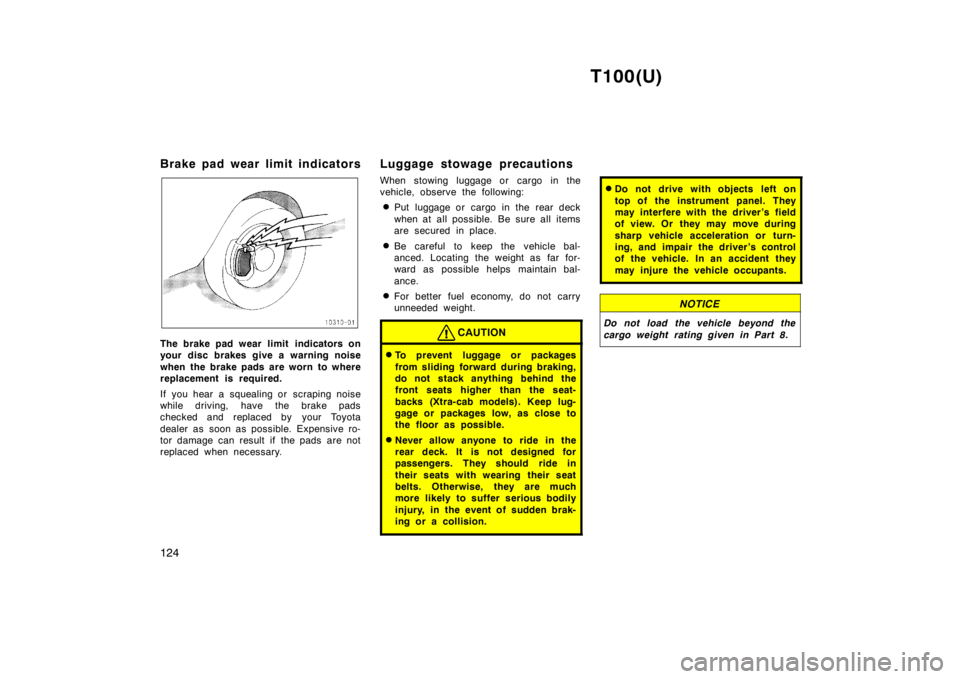
The brake pad wear limit indicators on
your disc brakes give a warning noise
when the brake pads are worn to where
replacement is required.
If you hear a squealing or scraping noise
while driving, have the brake pads
checked and replaced by your Toyota
dealer as soon as possible. Expensive ro-
tor damage can result if the pads are not
replaced when necessary.
Luggage stowage pr
ecautions
When stowing luggage or cargo in the
vehicle, observe the following: Put luggage or cargo in the rear deck
when at all possible. Be sure all items
are secured in place.
Be careful to keep the vehicle bal-
anced. Locating the weight as far for-
ward as possible helps maintain bal-
ance.
For better fuel economy, do not carry
unneeded weight.CAUTION
To prevent luggage or packages
from sliding forward during braking,
do not stack anything behind the
front seats higher than the seat-
backs (Xtra-cab models). Keep lug-
gage or packages low, as close to
the floor as possible.
Never allow anyone to ride in the
rear deck. It is not designed for
passengers. They should ride in
their seats with wearing their seat
belts. Otherwise, they are much
more likely to suffer serious bodily
injury, in the event of sudden brak-
ing or a collision.
Do not drive with objects left on
top of the instrument panel. They
may interfere with the driver’s field
of view. Or they may move during
sharp vehicle acceleration or turn-
ing, and impair the driver’s control
of the vehicle. In an accident they
may injure the vehicle occupants.
NOTICE
Do not load the vehicle beyond the
cargo weight rating given in Part 8.
Page 129 of 214
T100(U)129
Part 3
STARTING AND
DRIVING
Before starting the engine
How to start the engine
Tips for driving in various
conditions
Off
−road driving precautions
Winter driving tips
Tr ailer towing
How to save fuel and make your
vehicle last longer, too
Before starting the engine
1. Check the area around the vehicle be- fore entering it.
2. Adjust seat position, seatback angle, head restraint height and steering
wheel angle.
3. Adjust inside and outside rear view mirrors.
4. Lock all doors.
5. Fasten seat belts. 1. Apply the parking brake firmly.
2. Turn off unnecessary lights and acces-
sories.
3. Manual transmission:
Press the clutch
pedal to the floor and shift the trans-
mission into neutral. Hold the clutch
pedal to the floor until the engine is
started. A starter safety device will pre-
vent the starter from operating if the
clutch pedal is not fully depressed.
Automatic transmission: Put the se-
lector lever in ”P”. If you need to re-
start the engine while the vehicle is
moving, put the selector lever in ”N”.
A starter safety device will prevent the
starter from operating if the selector
lever is in any drive position.
4. Automatic transmission only : De-
press the brake pedal and hold it to
the floor until driving off.
How to start the engine—
(a) Before cranking
Page 132 of 214
T100(U)
132
When driving your vehicle off-road, please
observe the following precautions to en-
sure your driving enjoyment and to help
prevent the closure of areas to off-road
vehicles. a.
Drive your vehicle only in areas where
off-road vehicles are permitted to travel.
b. Respect private property. Get owner ’s permission before entering private prop-
erty.
c. Do not enter areas that are closed. Honor gates, barriers and signs that
restrict travel.
d. Stay on established roads. When condi- tions are wet, driving techniques should
be changed or travel delayed to pre-
vent damage to roads.
For owners in U.S. mainland, Hawaii and
Puerto Rico:
To obtain additional information pertaining
to driving your vehicle off-road, consult
the following organizations. State and Local Parks and Recreation
Departments
State Motor Vehicle Bureau
Recreational Vehicle Clubs
U.S. Forest Service and Bureau of
Land Management
CAUTION
Always observe the following precau-
tions to minimize the risk of serious
personal injury or damage to your ve-
hicle: Drive carefully when off the road. Do
not take unnecessary risks by driving
in dangerous places.
Do not grip the steering wheel spokes
when driving off -ro a d . A b a d b u mp
could jerk the wheel and injure your
hands. Keep both hands and especially
your thumbs on the outside of the rim.
Always check your brakes for effective-
ness immediately after driving in sand,
mud, water or snow.
After driving through tall grass, mud,
rock, sand, rivers, etc., check that there
is no grass, bush, paper, rags, stone, sand,
etc. adhering or trapped on the under-
body. Clear off any such matter from
the underbody. If the vehicle is used
with these materials trapped or adhered
to the underbody, a breakdown or fire
could occur.
The driver and all passengers
should fasten their seat belts when-
ever the vehicle is moving.
Off -road driving precautions
(four -wheel drive models only)
Page 145 of 214
T100(U)145
If your vehicle overheats
If your engine coolant temperature
gauge indicates overheating, if you ex-
perience a loss of power, or if you hear
a loud knocking or pinging noise, the
engine has probably over-heated. You
should follow this procedure...
1. Pull safely off the road, stop the ve- hicle and turn on your emergency
flashers. Put the transmission in ”P”
(automatic) or neutral (manual) and ap-
ply the parking brake. Turn off the air
conditioning if it is being used.
2. If coolant or steam is boiling out of the radiator or reservoir, stop the engine.
Wait until the steam subsides before
opening the hood. If there is no coolant
boiling over or steam, leave the engine
running.
CAUTION
To help avoid personal injury, keep
the hood closed until there is no
steam. Escaping steam or coolant is
a sign of very high pressure.
3. Visually check to see if the engine drive belt (fan belt) is broken or loose.
Look for obvious coolant leaks from the
radiator, hoses, and under the vehicle.
However, note that water draining from
the air conditioning is normal if it has
been used.
CAUTION
When the engine is running, keep
hands and clothing away from the
moving fan and engine drive belts.
4. If the engine drive belt is broken or thecoolant is leaking, stop the engine im-
mediately. Call a Toyota dealer for as-
sistance.
5. If the engine drive belt is O.K. and there are no obvious leaks, you may
help the engine cool down more quickly
by running it at about 1500 rpm for a
few minutes with the accelerator pedal
lightly depressed.
6. Check the coolant reservoir. If it is dry, add coolant to the reservoir while the
engine is running. Fill it about half full.
CAUTION
Do not attempt to remove the radiator
cap when the engine and radiator are
hot. Serious injury could result from
scalding hot fluid and steam blown
out under pressure.
7. After the engine coolant temperaturehas cooled to normal, again check the
coolant level in the reservoir. If neces-
sary, bring it up to half full again. Seri-
ous coolant loss indicates a leak in the
system. You s hould have it checked as
soon as possible at your Toyota dealer.
Page 164 of 214
T100(U)
164
NOTICE
Do not use solvent, thinner, gasoline
or window cleaner on the interior.
Carpets
Use a good foam-type shampoo to
clean the carpets.
Begin by vacuuming thoroughly to remove
as much dirt as possible. Several types of
foam cleaners are available; some are in
aerosol cans and others are powders or
liquids which you mix with water to pro-
duce a foam. To shampoo the carpets,
use a sponge or brush to apply the foam.
Rub in overlapping circles.
Do not apply water–the best results are
obtained by keeping the carpet as dry as
possible. Read the shampoo instructions
and follow them closely.
Seat belts
The seat belts may be cleaned with
mild soap and water or with lukewarm
water.
Use a cloth or sponge. As you are clean-
ing, check the belts for excessive wear,
fraying, or cuts.
NOTICE
Do not use dye or bleach on the belt-
s—it may weaken them.
Windows
The windows may be cleaned with any
household window cleaner.
NOTICE
When cleaning the inside of the win-
dows, be careful not to scratch or
damage the heater wires on the rear
window.
Air conditioning control panel, car au-
dio, instrument panel, console panel,
and switches
Use a soft damp cloth for cleaning.
Soak a clean soft cloth in water or luke-
warm water then lightly wipe off any dirt.
NOTICE
Do not use organic substances (sol-
vents, kerosene, alcohol, gasoline,
etc.) or alkaline or acidic solutions.
These chemicals can cause discol-
oring, staining or peeling of the
surface.
If you use cleaners or polishing
agents, make sure their ingredients
do not include the substances men-
tioned above.
If you use a liquid car freshener, do
not spill the liquid onto the ve-
hicle’s interior surfaces. It may con-
tain the ingredients mentioned
above. Immediately clean any spill
using the method mentioned above.
If you have any questions about the
cleaning of your Toyota, your local
Toyota dealer will be pleased to answer
them.
Page 167 of 214

T100(U)167
Tire surface and wheel nuts
Check the tires carefully for cuts, damage
or excessive wear. See Chapter 7
−2 for
additional information. When checking the
tires, make sure no nuts are missing, and
check the nuts for looseness. Tighten
them if necessary.
Tire rotation
Rotate the tires every 12000 km (7500
miles). See Chapter 7 −2 for additional in-
formation.
Fluid leaks
Check underneath for leaking fuel, oil, wa-
ter or other fluid after the vehicle has
been parked for a while. If you smell fuel
fumes or notice any leak, have the cause
found and corrected immediately.
Doors and engine hood
Check that all doors including tailgate op-
erate smoothly and all latches lock se-
curely. Make sure the engine hood sec-
ondary latch secures the hood from
opening when the primary latch is re-
leased.
INSIDE THE VEHICLE
Items listed below should be checked
regularly, e.g. while performing periodic
services, cleaning the vehicle, etc. Lights
Make sure the headlights, stop lights, tail
lights, turn signal lights, and other lights
are all working. Check headlight aim.
Service reminder indicators and warning
buzzers
Check that all service reminder indicators
and warning buzzers function properly.
Steering wheel
Be alert for changes in steering condition,
such as hard steering or strange noise.
Seats
Check that all seat controls such as seat
adjusters, seatback recliner, etc. operate
smoothly and that all latches lock securely
in any position. Check that the head re-
straints move up and down smoothly and
that the locks hold securely in any latched
position. For folding
−down seatback
(bench seat), check that the latches lock
security.
Seat belts
Check that the seat belt system such as
buckles, retractors and anchors operate
properly and smoothly. Make sure that the
belt webbing is not cut, frayed, worn or
damaged.
Accelerator pedal
Check the pedal for smooth operation and
uneven pedal effort or catching. Clutch pedal
Check the pedal for smooth operation.
Brake pedal
Check the pedal for smooth operation and
that the pedal has the proper clearance.
Check the brake booster function.
Brakes
At a safe place, check that the brakes do
not pull to one side when applied.
Parking brake
Check that the lever has the proper travel
and that, on a safe incline, your vehicle
is held securely with only the parking
brake applied.
Automatic transmission ”Park” mecha-
nism
On a safe incline, check that your vehicle
is held securely with the selector lever in
”P” position and all brakes released.
IN THE ENGINE COMPARTMENT
Items listed below should be checked
from time to time, e.g. each time when
refueling.
Washer fluid
Make sure there is sufficient fluid in the
tank. See Chapter 7
−3 for additional in-
formation.