lock TOYOTA T100 1998 Repair Manual
[x] Cancel search | Manufacturer: TOYOTA, Model Year: 1998, Model line: T100, Model: TOYOTA T100 1998Pages: 214, PDF Size: 4.72 MB
Page 157 of 214
T100(U)157
From rear—
We recommend using a tow-
ing dolly under the front wheels. If you do
not use a towing dolly, place the ignition
key in the ”ACC” position, put the trans-
mission in neutral and the transfer in
”H2”.
NOTICE
Do not tow with the key removed or
in the ”LOCK” position when towing
from the rear without a towing dolly.
The steering lock mechanism is not
strong enough to hold the front
wheels straight.
(b) Using flat bed truck
(c) Towing with sling type truck from front
Follow the instructions for towing from
front in ”(a) Towing with wheel lift type
truck”.
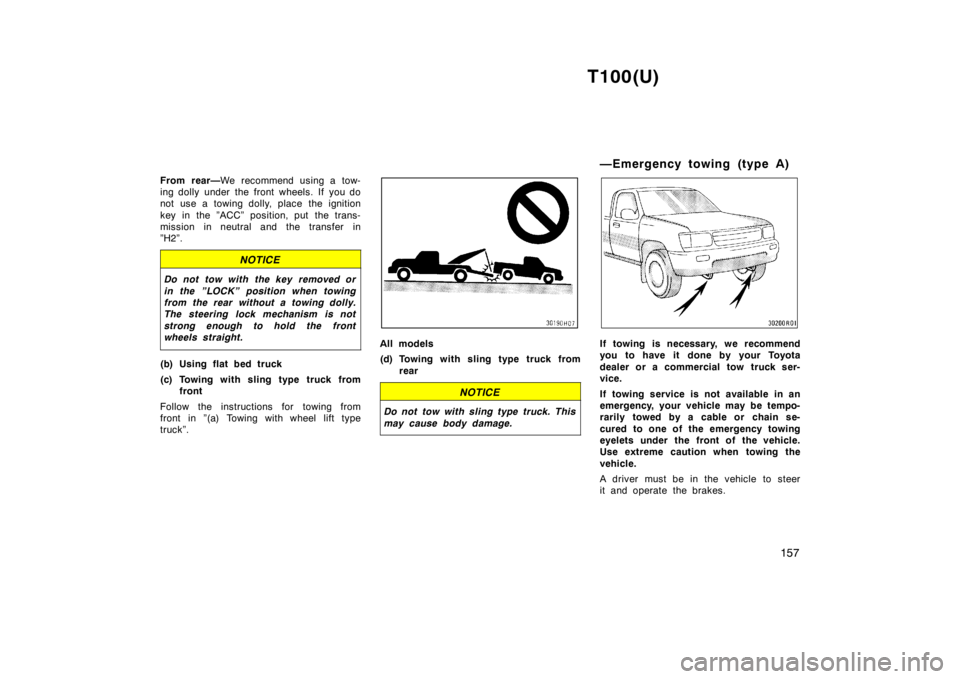
All models
(d) Towing with sling type truck from rear
NOTICE
Do not tow with sling type truck. This
may cause body damage.
—Emergency towing (type A)
If towing is necessary, we recommend
you to have it done by your Toyota
dealer or a commercial tow truck ser-
vice.
If towing service is not available in an
emergency, your vehicle may be tempo-
rarily towed by a cable or chain se-
cured to one of the emergency towing
eyelets under the front of the vehicle.
Use extreme caution when towing the
vehicle.
A driver must be in the vehicle to steer
it and operate the brakes.
Page 160 of 214

T100(U)
160
CAUTION
If the emergency towing hook or eye-
let is used to get out when your ve-
hicle becomes stuck in the mud, sand
or other condition from which the ve-
hicle cannot be driven out under its
own power, make sure to observe the
precautions mentioned below. Other-
wise, excessive stress will be put on
the hook or eyelet and the towing
cable or chain may break, causing
serious injury or damage. If the towing vehicle can hardly
move, do not forcibly continue the
towing. Contact your Toyota dealer
or a commercial tow truck service
for assistance.
Tow the vehicle as straight ahead
as possible.
Keep away from the vehicle during
towing.
The following methods are effective to
use when your vehicle is stuck in the
mud, sand or other condition from
which the vehicle cannot be driven out
under its own power. Use extreme cau-
tion when towing the vehicle. In addi-
tion, keep away from the vehicles and
towing cable or chain when towing.
Remove the sand and soil in the front
and the back of the tires.
Place stones or wood under the tires. If you lose your keys
Many Toyota dealers can make a new
key if you can give them the key num-
ber.
See the suggestion given in ”Keys” in
Chapter 1
−2.
If your key is locked in the vehicle and
you cannot get a duplicate, many Toyota
dealers can still open the door for you,
using their special tools. If you must
break a window to get in, we suggest
breaking the smallest side window be-
cause it is the least expensive to replace.
Be extremely cautious to avoid cuts from
the glass.
—Tips for towing a stuck
vehicle (four
−wheel drive models)
Page 167 of 214

T100(U)167
Tire surface and wheel nuts
Check the tires carefully for cuts, damage
or excessive wear. See Chapter 7
−2 for
additional information. When checking the
tires, make sure no nuts are missing, and
check the nuts for looseness. Tighten
them if necessary.
Tire rotation
Rotate the tires every 12000 km (7500
miles). See Chapter 7 −2 for additional in-
formation.
Fluid leaks
Check underneath for leaking fuel, oil, wa-
ter or other fluid after the vehicle has
been parked for a while. If you smell fuel
fumes or notice any leak, have the cause
found and corrected immediately.
Doors and engine hood
Check that all doors including tailgate op-
erate smoothly and all latches lock se-
curely. Make sure the engine hood sec-
ondary latch secures the hood from
opening when the primary latch is re-
leased.
INSIDE THE VEHICLE
Items listed below should be checked
regularly, e.g. while performing periodic
services, cleaning the vehicle, etc. Lights
Make sure the headlights, stop lights, tail
lights, turn signal lights, and other lights
are all working. Check headlight aim.
Service reminder indicators and warning
buzzers
Check that all service reminder indicators
and warning buzzers function properly.
Steering wheel
Be alert for changes in steering condition,
such as hard steering or strange noise.
Seats
Check that all seat controls such as seat
adjusters, seatback recliner, etc. operate
smoothly and that all latches lock securely
in any position. Check that the head re-
straints move up and down smoothly and
that the locks hold securely in any latched
position. For folding
−down seatback
(bench seat), check that the latches lock
security.
Seat belts
Check that the seat belt system such as
buckles, retractors and anchors operate
properly and smoothly. Make sure that the
belt webbing is not cut, frayed, worn or
damaged.
Accelerator pedal
Check the pedal for smooth operation and
uneven pedal effort or catching. Clutch pedal
Check the pedal for smooth operation.
Brake pedal
Check the pedal for smooth operation and
that the pedal has the proper clearance.
Check the brake booster function.
Brakes
At a safe place, check that the brakes do
not pull to one side when applied.
Parking brake
Check that the lever has the proper travel
and that, on a safe incline, your vehicle
is held securely with only the parking
brake applied.
Automatic transmission ”Park” mecha-
nism
On a safe incline, check that your vehicle
is held securely with the selector lever in
”P” position and all brakes released.
IN THE ENGINE COMPARTMENT
Items listed below should be checked
from time to time, e.g. each time when
refueling.
Washer fluid
Make sure there is sufficient fluid in the
tank. See Chapter 7
−3 for additional in-
formation.
Page 172 of 214

T100(U)
172 1. Brake fluid reservoir
2. Fuse block
3. Battery
4. Engine coolant reservoir
5. Engine oil level dipstick
6. Power steering fluid reservoir
7. Engine oil filler cap
8. Windshield washer fluid tank
Engine compartment overview (3RZ
−FE engine)
Page 173 of 214

T100(U)173
1. Brake fluid reservoir
2. Fuse block
3. Battery
4. Engine coolant reservoir
5. Engine oil level dipstick
6. Engine oil filler cap
7. Power steering fluid reservoir
8. Windshield washer fluid tank
Engine compartment overview (5VZ
−FE engine)
Page 182 of 214
T100(U)
182
Checking brake fluid
To check the fluid levels, simply look at
the see-through reservoirs. The level
should be between the ”MAX” and
”MIN” lines on the reservoir.
It is normal for the brake fluid level to go
down slightly as the brake pads wear. So
be sure to keep the reservoir filled.
If the reservoir needs frequent refilling, it
may indicate a serious mechanical prob-
lem.
If the level is low, add SAE J1703 or
FMVSS No.116 DOT 3 brake fluid to the
brake reservoir.
Remove and replace the reservoir cover
by hand. Fill the brake fluid to the dotted
line. This brings the fluid to the correct
level when you put the cover back on.
Use only newly opened brake fluid. Once
opened, brake fluid absorbs moisture from
the air, and excess moisture can cause a
dangerous loss of braking.
CAUTION
Take care when filling the reservoir
because brake fluid can harm your
eyes and damage painted surfaces. If
fluid gets in your eyes, flush your
eyes with clean water.
NOTICE
If you spill the fluid, be sure to wash
it off with water to prevent it from
damaging the parts or paint.
Checking power steering fluid
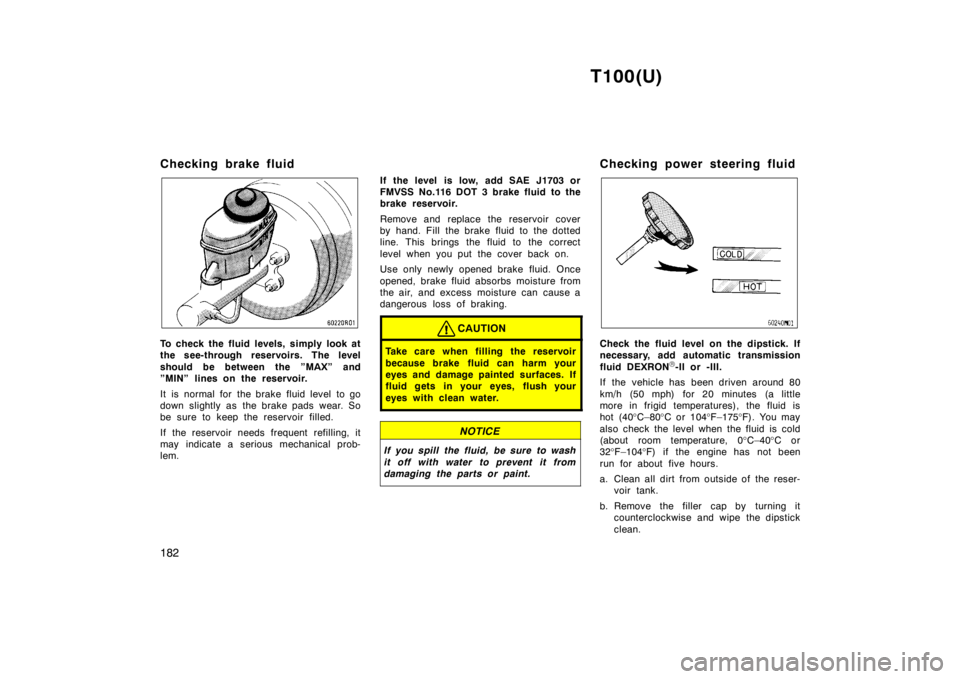
Check the fluid level on the dipstick. If
necessary, add automatic transmission
fluid DEXRON
-II or -III.
If the vehicle has been driven around 80
km/h (50 mph) for 20 minutes (a little
more in frigid temperatures), the fluid is
hot (40 °C–80 °C or 104 °F–175 °F). You may
also check the level when the fluid is cold
(about room temperature, 0 °C–40 °C or
32 °F–104 °F) if the engine has not been
run for about five hours.
a. Clean all dirt from outside of the reser- voir tank.
b. Remove the filler cap by turning it counterclockwise and wipe the dipstick
clean.
Page 186 of 214
T100(U)
186
CAUTION
Do not drive with the snow tires
incorrectly inflated.
Never drive over 120 km/h (75 mph)
with any type of snow tires.
TIRE CHAIN SELECTION
Use the tire chains of correct size.
Regulations regarding the use of tire
chains vary according to location or
type of road, so always check them
before installing chains.
CHAIN INSTALLATION
Install the chains on the rear tires as
tightly as possible. Do not use tire
chains on the front tires. Retighten
chains after driving 0.5–1.0 km (1/4–1/2
mile).
When installing chains on your tires, care-
fully follow the instructions of the chain
manufacturer.
If wheel covers are used, they will be
scratched by the chain band, so remove
the covers before putting on the chains.
CAUTION
Do not exceed 50 km/h (30 mph) or
the chain manufacturer ’s recom-
mended speed limit, whichever is
lower.
Drive carefully avoiding bumps,
holes, and sharp turns, which may
cause the vehicle to bounce.
Avoid sharp turns or locked-wheel
braking as use of chains may ad-
versely affect vehicle handling.
Replacing wheels
WHEN TO REPLACE YOUR WHEELS
If you have wheel damage such as
bending, cracks or heavy corrosion, the
wheel should be replaced.
If you fail to replace damaged wheels, the
tire may slip off the wheel or they may
cause loss of handling control.
WHEEL SELECTION
When replacing wheels, care should be
taken to ensure that the wheels are re-
placed by ones with the same load ca-
pacity, diameter, rim width, and offset.
Correct replacement wheels are available
at your Toyota dealer.
A wheel of a different size or type may
adversely affect handling, wheel and bear-
ing life, brake cooling, speedometer/odom-
eter calibration, stopping ability, headlight
aim, bumper height, vehicle ground clear-
ance, and tire or snow chain clearance to
the body and chassis.
Replacement with used wheels is not rec-
ommended as they may have been sub-
jected to rough treatment or high mileage
and could fail without warning. Also, bent
wheels which have been straightened may
have structural damage and therefore
should not be used. Never use an inner
tube in a leaking wheel which is designed
for a tubeless tire.
Page 194 of 214

T100(U)
194 Light bulbs
Bulb
No.WTy p e
Headlights900360/55A
Parking lights1685C
Front turn signal lights115627B
Rear turn signal lights115627B
Stop and tail lights115727/8B
Back-up lights115627B
High mounted stoplight1685C
License plate light1685C
Interior light—8D
Personal lights—5D
Glovebox light—5C
Step lights—5C
A: HB2 halogen bulbs
B: Single end bulbs
C: Wedge base bulbs
D: Double end bulbs —Headlights
1. Open the hood. Unplug the connec-
tor. Turn the plastic cover counter-
clockwise and remove it.
If the connector is tight wiggle it.2. Remove the rubber cover.
Page 195 of 214

T100(U)195
3. Release the bulb retaining springand remove the bulb. Install a new
bulb and the bulb retaining spring.
To install a bulb, align the tabs of the
bulb with the cutout of the mounting hole.4. Install the rubber cover and snuggle on the boss.
Make sure the rubber cover fits snugly on
the connector and the headlight body.5. Install the plastic cover with the ”ON” mark upward and turn it clock-
wise. Insert the connector.
Aiming is not necessary after replacing
the bulb. When aiming adjustment is nec-
essary, contact your Toyota dealer.
Page 206 of 214

T100(U)
206
Fuses
Fuses (type A)
1. HEAD (LH) 10 A: Left-hand headlight
2. HEAD (RH) 10 A: Right-hand headlight
3. A/C 10 A: Air conditioning cooling sys-
tem
4. EFI 15 A: Multiport fuel injection sys-
tem/sequential multiport fuel injection
system, electronically controlled auto-
matic transmission system
5. HAZ-HORN 15 A: Emergency flashers,
horns
6. DOME 15 A: Interior light, personal
lights, step lights, ignition switch light,
radio, cassette tape player, power an-
tenna, clock7. HEAD (LH-HI) 10 A: Left-hand head-
light (high beam)
8. HEAD (RH-HI) 10 A: Right-hand head-
light (high beam)
9. HEAD (LH-LO) 10 A: Left-hand head-
light (low beam)
10. HEAD (RH-LO) 10 A: Right-hand head-
light (low beam)
11. ENGINE 10 A: Charging system, cruise
control system
12. IGN. 7.5 A: Charging system, dis-
charge warning light, multiport fuel in-
jection system/sequential multiport fuel
injection system13. TAIL 15 A: Tail lights, parking lights,
license plate lights, instrument panel
lights, glovebox light
14. WIPER 20 A: Windshield wiper and
washer
15. GAUGES 10 A: (except discharge warn-
ing light), A.D.D. control system, cruise
control system, back-up lights, power
door lock system
16. STOP 15 A: Stop lights, High-mounted
stoplight, cruise control system, elec-
tronically controlled automatic transmis-
sion system