check engine light TOYOTA TACOMA 1996 User Guide
[x] Cancel search | Manufacturer: TOYOTA, Model Year: 1996, Model line: TACOMA, Model: TOYOTA TACOMA 1996Pages: 196, PDF Size: 1.8 MB
Page 125 of 196
121
NOTICE
The battery used for boosting must be 12 V. Do not jump start unless
you are sure that the booster batteryis correct.
JUMP STARTING PROCEDURE
1. If the booster battery is installed in
another vehicle, make sure the vehicles
are not touching. Turn off all unnecessary
lights and accessories.
2. If required, remove all the vent plugs from the booster and discharged batter- ies. Lay a cloth over the open vents on the
batteries. (This helps reduce the explo-
sion hazard, personal injuries and burns.)
3. If the engine in the vehicle with the booster battery is not running, start it and
let it run for a few minutes. During jump
starting, run the engine at about 2000 rpm
with the accelerator pedal lightly de- pressed. 4. Connect
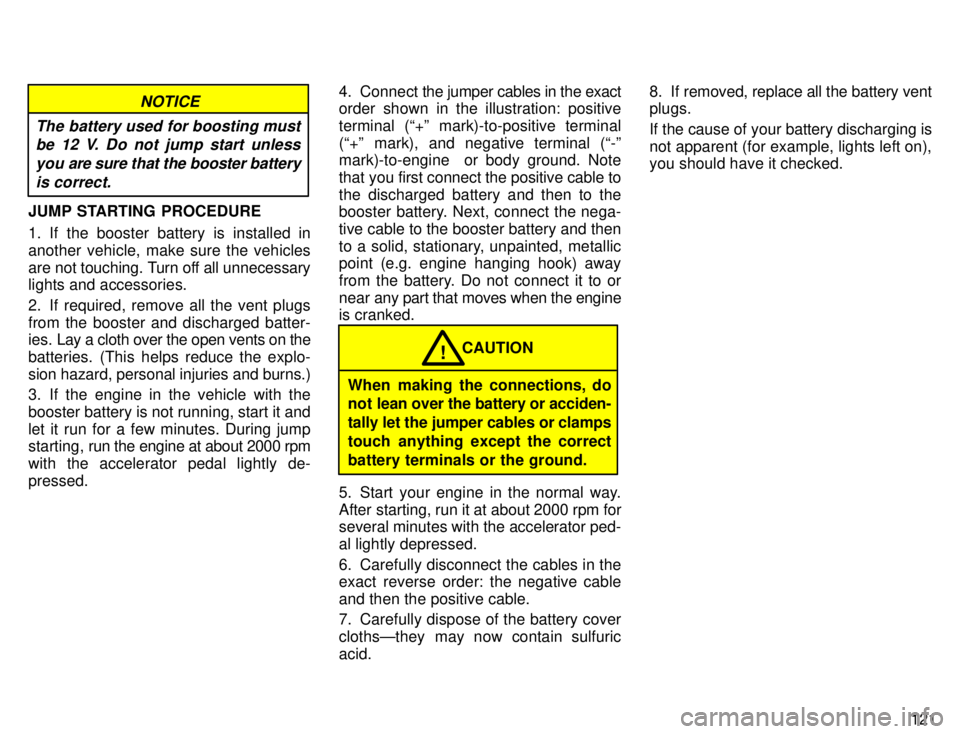
the jumper cables in the exact
order shown in the illustration: positiveterminal (+º mark)-to-positive terminal
(+º mark), and negative terminal (-º
mark)-to-engine or body ground. Note
that you first connect the positive cable to
the discharged battery and then to the
booster battery. Next, connect the nega-
tive cable to the booster battery and then
to a solid, stationary, unpainted, metallic
point (e.g. engine hanging hook) away
from the battery. Do not connect it to or
near any part that moves when the engine
is cranked.
When making the connections, do
not lean over the battery or acciden- tally let the jumper cables or clamps
touch anything except the correctbattery terminals or the ground. CAUTION
!
5. Start your engine in the normal way.
After starting, run it at about 2000 rpm for several minutes with the accelerator ped-
al lightly depressed.
6. Carefully disconnect the cables in the
exact reverse order: the negative cable
and then the positive cable.
7. Carefully dispose of the battery cover
clothsÐthey may now contain sulfuricacid. 8. If removed, replace all the battery vent plugs.
If the cause of your battery discharging is
not apparent (for example, lights left on), you should have it checked.
Page 126 of 196
122If your engine stalls while driving
0
1. Reduce your speed gradually, keeping
a straight line. Move cautiously off the
road to a safe place.
2. Turn on your emergency flashers.
3. Try starting the engine again.
If the engine will not start, see If your ve-
hicle will not startº.
If the engine is not running, the
power assist for the brakes and
steering will not work so steering
and braking will be much harder
than usual. CAUTION
! If your engine coolant temperature
gauge indicates overheating, if you
experience a loss of power, or if you
hear a
loud knocking or pinging noise,
the engine has probably overheated.
You should follow this procedure 0
1. Pull safely off the road, stop the vehicle
and turn on your emergency flashers. Put
the transmission in Pº (automatic) or neu-
tral ( manual) and apply the parking brake.
Turn off the air conditioning if it is beingused.
2. If coolant or steam is boiling out of the
radiator or reservoir, stop the engine. Wait
until the steam subsides before opening
the hood. If there is no coolant boiling over or steam, leave the engine running.
To help avoid personal injury, keep
the hood closed until there is no steam. Escaping steam or coolant is
a sign of very high pressure. CAUTION
!
3. Visually check to see if the engine drive
belt (fan belt) is broken or loose. Look for
obvious coolant leaks from the radiator,
hoses, and under the vehicle. However, note that water draining from the air condi-
tioning is normal if it has been used.
When the engine is running, keep
hands and clothing away from the
moving fan and engine drive belts. CAUTION
!
4. If the engine drive belt is broken or the
coolant is leaking, stop the engine immedi-
ately. Call a Toyota dealer for assistance.
5. If the engine drive belt is O.K. and there
are no obvious leaks, you may help the en-
gine cool down more quickly by running it at
about 1500 rpm for a few minutes with the
accelerator pedal lightly depressed.
6. Check the coolant reservoir. If it is dry,
add coolant to the reservoir while the en- gine is running. Fill it about half full.
Do not attempt to remove the radia-
tor cap when the engine and radia-
tor are hot. Serious injury could re-
sult from scalding hot fluid and
steam blown out under pressure. CAUTION
!
7. After the engine coolant temperature
has cooled to normal, again check the
coolant level in the reservoir. If necessary,
bring it up to half full again. Serious cool- ant loss indicates a leak in the system.
You should have it checked as soon as
possible at your Toyota dealer.
If your engine stalls while
driving
If your vehicle overheats
Page 147 of 196

143
Tire surface and wheel nuts Check the tires carefully
for cuts, damage
or excessive wear. See Chapter 7-2 for
additional information. When checking the tires, make sure no nuts are missing,
and check the nuts for looseness. T ighten
them if necessary.
Tire rotation
Rotate the tires every 12000 km (7500
miles). See Chapter 7-2 for additional in-formation.
Fluid leaks Check underneath for leaking fuel, oil, wa-
ter or other fluid after the vehicle has been
parked for a while. If you smell fuel fumes
or notice any leak, have the cause found
and corrected immediately. Doors and engine hood Check that all doors including tailgate op- erate smoothly and all latches lock se-
curely. M ake sure the engine hood secon-
dary latch secures the hood from opening
when the primary latch is released. INSIDE THE VEHICLE Items listed below should be checked
regularly, e.g. while performing peri-
odic services, cleaning the vehicle,etc. Lights Make sure the headlights, stop lights, tail lights, turn signal lights, and other lights are all working. Check headlight aim. Service reminder indicators and
warn-
ing buzzers Check that all service reminder indicators
and warning buzzers function properly. Steering wheel
Be alert for changes in steering condition, such as hard steering or strange noise. Seats Check that all front seat controls such as
seat adjusters, seatback recliner, etc. op-erate smoothly and that all latches lock
securely in any position. Check that the
head restraints move up and down
smoothly and that the locks hold securely
in any latched position. For folding-down
seatback (bench seat), check that the
latches lock securely. Seat belts
Check that the seat belt system such as
buckles, retractors and anchors operate
properly
and smoothly. Make sure the belt
webbing is not cut, frayed, worn or dam-aged. Accelerator pedal Check the pedal for smooth operation and
uneven pedal effort or catching. Clutch pedal Check the pedal for smooth operation. Brake pedal Check the pedal for smooth operation and
that the pedal has the proper clearance. Check the brake booster function. Brakes
At a safe place, check that the brakes do not pull to one side when applied. Parking brake Check that the lever has the proper travel and that, on a safe incline, your vehicle is
held securely with only the parking brake applied.
Automatic transmission Parkº mech-
anism
Check the lock release button of the se- lector lever (floor shift type) for proper and
smooth operation. On a safe incline, check that your vehicle is held securely
with the selector lever in Pº position andall brakes released.
Page 159 of 196
Part 7Checking the engine oil level
155
DO-IT-YOURSELF MAINTENANCEÐ
Chapter 7-2 Engine and Chassis
Checking the engine oil level
Checking the engine coolant level
Checking brake fluid
Checking power steering fluid
Checking tire pressure
Checking and replacing tires
Rotating tires
Installing snow tires and chains
Replacing wheels
Aluminum wheel precautions
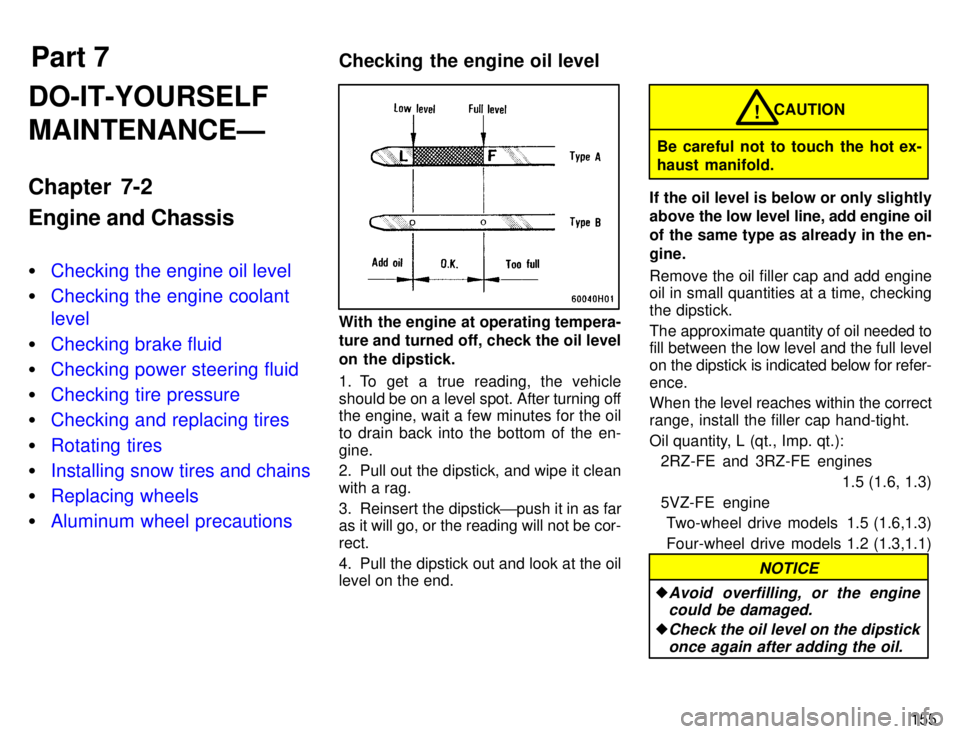
With the engine at operating tempera- ture and turned off, check the oil level
on the dipstick.
1. To get a true reading, the vehicle
should be on a
level spot. After turning off
the engine, wait a few minutes for the oil
to drain back into the bottom of the en-gine.
2. Pull out the dipstick, and wipe it clean with a rag.
3. Reinsert the dipstick 'push it in as far
as it will go, or the reading will not be cor- rect.
4. Pull the dipstick out and look at the oil level on the end.
CAUTION
Be careful not to touch the hot ex-
haust manifold.!
If the oil level is below or only slightly
above the low level line, add engine oil
of the same type as already in the en- gine. Remove the oil filler cap and add engine oil in small quantities at a time, checking the dipstick.
The approximate quantity of oil needed to fill between the low level and the full level
on the dipstick is indicated below for refer-ence.
When the level reaches within the correct range, install the filler cap hand-tight.
Oil quantity, L (qt., Imp. qt.):
2RZ-FE and 3RZ-FE engines
1.5 (1.6, 1.3)
5VZ-FE engine Two-wheel drive models 1.5 (1.6,1.3)
Four-wheel drive models 1.2 (1.3,1.1)
Avoid overfilling, or the engine could be damaged.
Check the oil level on the dipstick
once again after adding the oil.
NOTICE
Page 162 of 196
158To check the fluid level, simply look at
the see-through reservoir. The level
should be between the MAXº and
MINº lines on the reservoir. It is normal for the brake fluid level to go
down slightly as the brake pads wear. So be sure to keep the reservoir filled.
If the reservoir needs frequent refilling, it may indicate a serious mechanical prob- lem.
If the level is low, add SAE J1703 or
FMVSS No. 116 DOT 3 brake fluid to the
brake reservoir. Remove and replace the reservoir cover
by hand. Fill the brake fluid to the dotted
line.
This brings the fluid to the correct lev-
el when you put the cover back on. Use only newly opened brake fluid. Once
opened, brake fluid absorbs moisture
from the air, and excess moisture can cause a dangerous loss of braking.
CAUTION
Take care when filling the reservoir
because brake fluid can harm your
eyes and damage painted surfaces.
If fluid gets in your eyes, flush your
eyes with clean water.!
If you spill the fluid, be sure to wash it off with water to prevent it from
damaging the parts or paint.
NOTICE
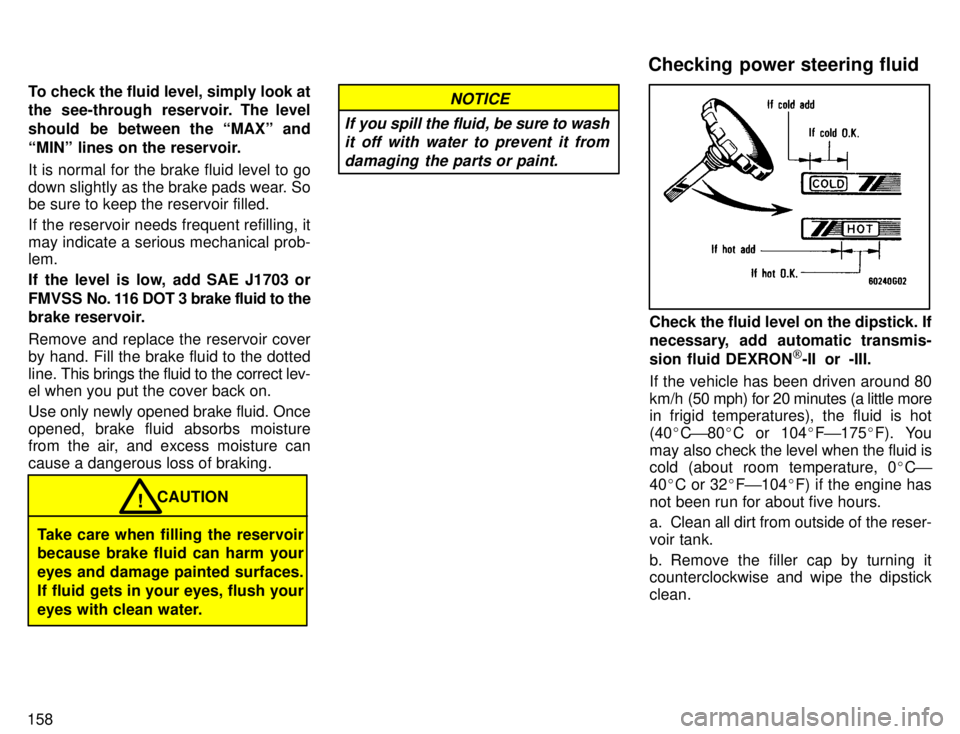
Check the fluid level on the dipstick. If
necessary, add automatic transmis-
sion fluid DEXRON [
-II or -III.
If the vehicle has been driven around 80
km/h (50 mph) for 20 minutes (a little more
in frigid temperatures), the fluid is hot (40 C ' 80 C or 104 F ' 175 F). You
may also check the level when the fluid is
cold (about room temperature, 0 C '
40 C or 32 F ' 104 F) if the engine has
not been run for about five hours.
a. Clean all dirt from outside of the reser- voir tank.
b. Remove the filler cap by turning it
counterclockwise and wipe the dipstick clean.
Checking power steering fluid
Page 184 of 196

180ENGINE LUBRICATION Oil capacity (drain and refill), L (qt., Imp. qt.):
Two-wheel drive models2RZ-FE engine
With filter 5.5 (5.8, 4.8)
Without filter 4.8 (5.0, 4.2)
5VZ-FE engine
With filter 5.4 (5.7, 4.8)
Without filter 5.1 (5.4, 4.5)
Four-wheel drive models
3RZ-FE engineWith filter 5.4 (5.7, 4.8)
Without filter 4.7 (5.0, 4.1)
5VZ-FE engine With filter 5.2 (5.5, 4.6)
Without filter 4.9 (5.2, 4.3)
Oil grade: API SH, Energy-Conserving IIº multi-
grade engine oil or ILSAC multigrade
engine oil is recommended. Recommended oil viscosity (SAE):
COOLING SYSTEM
Total capacity, L (qt., Imp. qt.):
Two-wheel drive models With manual transmission
2RZ-FE engine 8.0 (8.5, 7.0)
5VZ-FE engine
10.1 (10.7, 8.9)
With automatic transmission 2RZ-FE engine
7.8 (8.2, 6.9)
5VZ-FE engine 10.0 (10.5, 8.8) Four-wheel drive models
With manual transmission
3RZ-FE engine 8.3 (8.8, 7.3)
5VZ-FE engine
10.1 (10.7, 8.9)
With automatic transmission 3RZ-FE engine
8.2 (8.7, 7.2)
5VZ-FE engine 10.0 (10.5, 8.8)
Coolant type: With ethylene-glycol antifreeze (Do not use alcohol type.)
BATTERY Open voltage* at 20 C (68 F):
12.7 V Fully charged
12.3 V Half charged
11.9 V Discharged
*Voltage that is checked 20 minutes after
the key is removed with all the lights
turned off Charging rates:
5 A max.