ECU TOYOTA TACOMA 1996 Owners Manual
[x] Cancel search | Manufacturer: TOYOTA, Model Year: 1996, Model line: TACOMA, Model: TOYOTA TACOMA 1996Pages: 196, PDF Size: 1.8 MB
Page 14 of 196
13
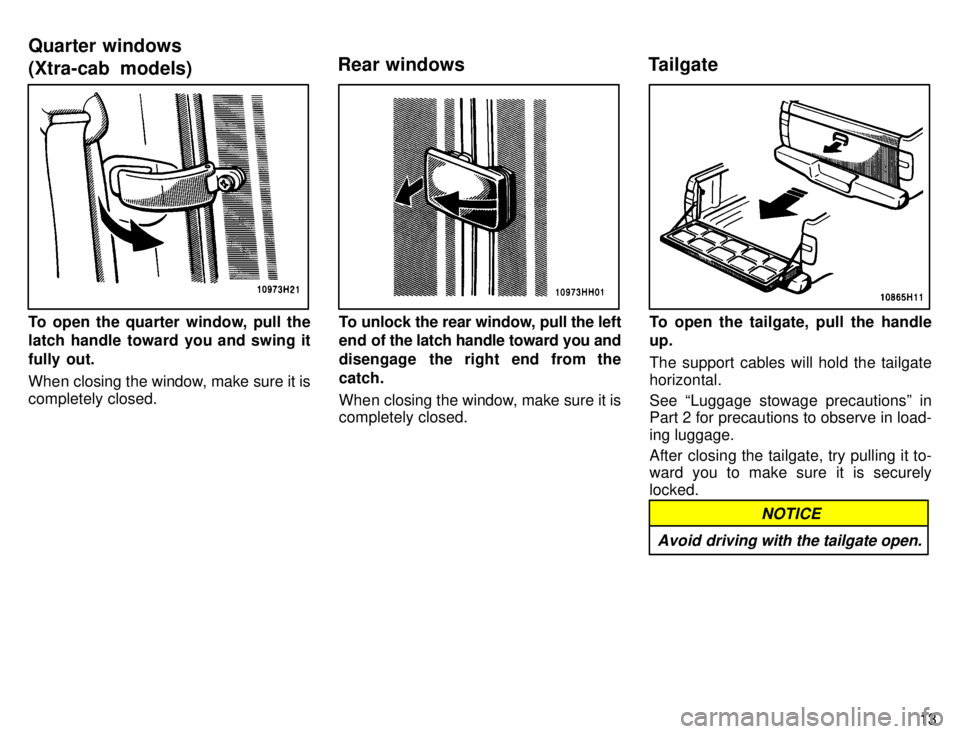
To open the quarter window, pull the
latch handle toward you and swing it
fully out.
When closing the window, make sure it is completely closed.To unlock the rear window, pull the left
end of the latch handle toward you and
disengage the right end from thecatch.
When closing the window, make sure it is completely closed.To open the tailgate, pull the handle up.
The support cables will hold the tailgate horizontal. See Luggage stowage precautionsº in
Part 2 for precautions to observe in load- ing luggage.
After closing the tailgate, try pulling it to-
ward you to make sure it is securely locked.
Avoid driving with the tailgate open.
NOTICE
Tailgate
Quarter windows (Xtra-cab models)
Rear windows
Page 15 of 196
14
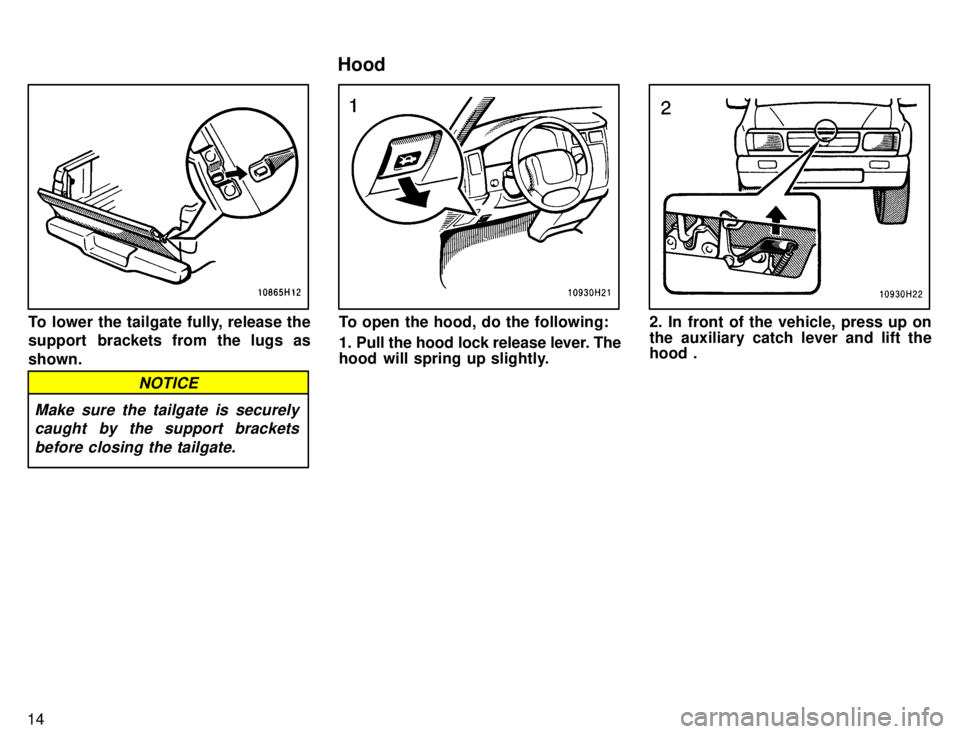
To lower the tailgate fully, release the
support brackets from the lugs as shown.
Make sure the tailgate is securelycaught by the support brackets
before closing the tailgate.
NOTICE
To open the hood, do the following:
1. Pull the hood lock release lever. The
hood will spring up slightly.2. In front of the vehicle, press up on
the auxiliary catch lever and lift the
hood .
Hood
Page 16 of 196
15
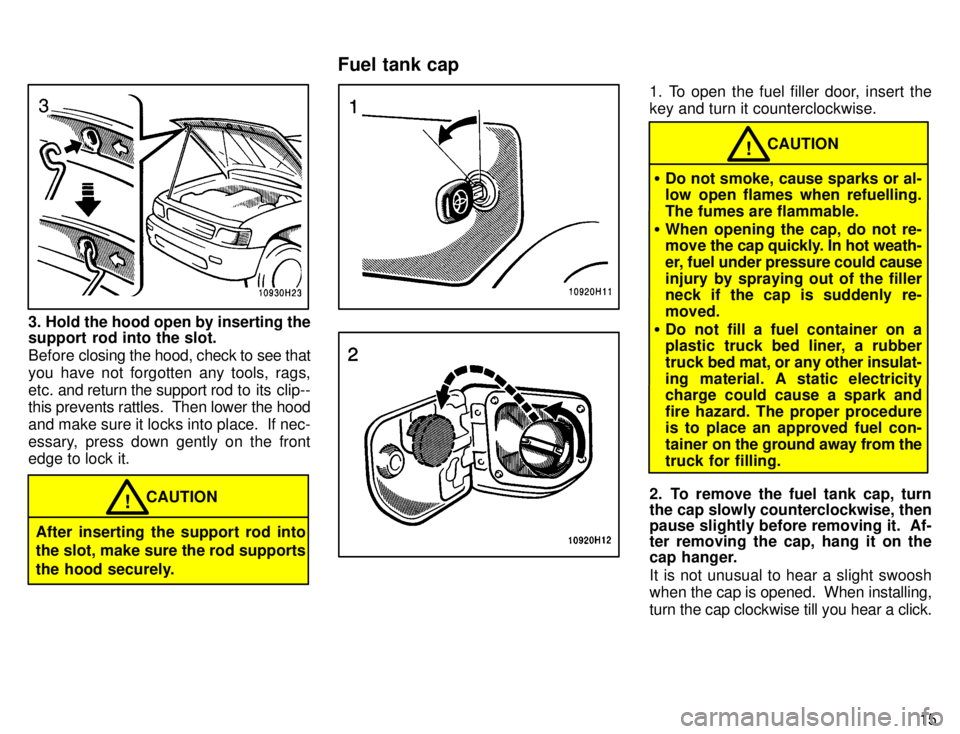
3. Hold the hood open by inserting the
support rod into the slot.
Before closing the hood, check to see that
you have not forgotten any tools, rags,
etc. and return the support rod to its clip--
this prevents rattles. Then lower the hood
and make sure it locks into place. If nec-
essary, press down gently on the front
edge to lock it.
CAUTION!
After inserting the support rod into
the slot, make sure the rod supports
the hood securely.
1. To open the fuel filler door, insert the key and turn it counterclockwise.
CAUTION!
Do not smoke, cause sparks or al-
low open flames when refuelling.
The fumes are flammable.
When opening the cap, do not re-
move the cap quickly. In hot weath-
er, fuel under pressure could cause
injury by spraying out of the filler
neck if the cap is suddenly re- moved.
Do not fill a fuel container on a
plastic truck bed liner, a rubber truck bed mat, or any other insulat-
ing material. A static electricity
charge could cause a spark and fire hazard. The proper procedure
is to place an approved fuel con-
tainer on the ground away from the
truck for filling.
2. To remove the fuel tank cap, turn
the cap slowly counterclockwise, then
pause slightly before removing it. Af-
ter removing the cap, hang it on the
cap hanger.
It is not unusual to hear a slight swoosh
when the cap is opened. When installing,
turn the cap clockwise till you hear a click.
Fuel tank cap
Page 17 of 196
16Four-wheel drive models-
If the cap is not tightened securely, the malfunction indicator lamp comes on.
Make sure the cap is tightened securely.
The indicator lamp goes off after driving
several times. If the indicator lamp does
not go off, contact your Toyota dealer as soon as possible.
CAUTION!
Make sure the cap is tightened se-
curely to prevent fuel spillage in
case of an accident.
Use only a genuine Toyota fuel
tank cap for replacement. It has a
built in check valve to reduce fueltank vacuum.
CAUTION!
To avoid serious personal injury,
you must do the following. While the vehicle is moving, al- ways keep the head, hands and
other parts of the body of all occu-
pants away from the roof opening.
Otherwise, you could be seriously
injured if the vehicle stops sud-
denly or if the vehicle is involved
in anaccident.
Never sit on top of the vehicle
around the roof opening.
Never attempt to remove the moon
roof panel while driving. Other-
wise, the panel may become a haz-
ard by falling into or flying off thevehicle.
After installing the moon roof pan-
el, make sure they are firmly se-
cured by pushing up on the under-
side of the panel.
Never put your hands between the
moon roof panel and the sur-
rounding roof.
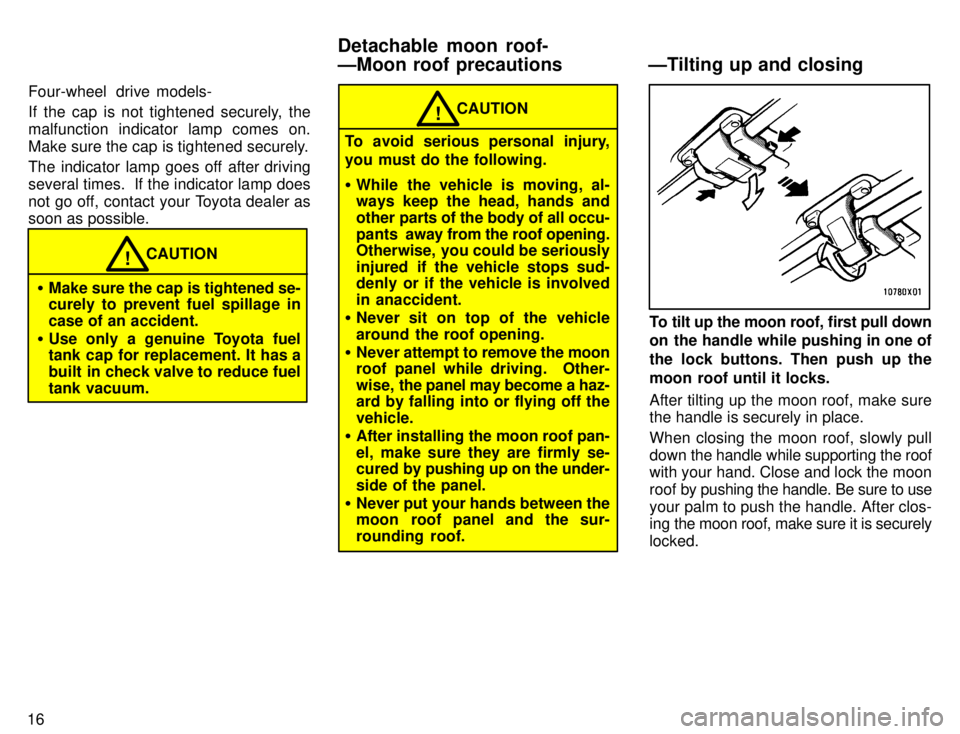
To tilt up the moon roof, first pull down
on the handle while pushing in one of
the lock buttons. Then push up the
moon roof until it locks. After tilting up the moon roof, make sure the handle is securely in place.
When closing the moon roof, slowly pull
down the handle while supporting the roof
with your hand. Close and lock the moon
roof by pushing the handle. Be sure to use
your palm to push the handle. After clos-
ing the moon roof, make sure it is securely locked.
Detachable moon roof-
ÐMoon roof precautions ÐTilting up and closing
Page 21 of 196
20
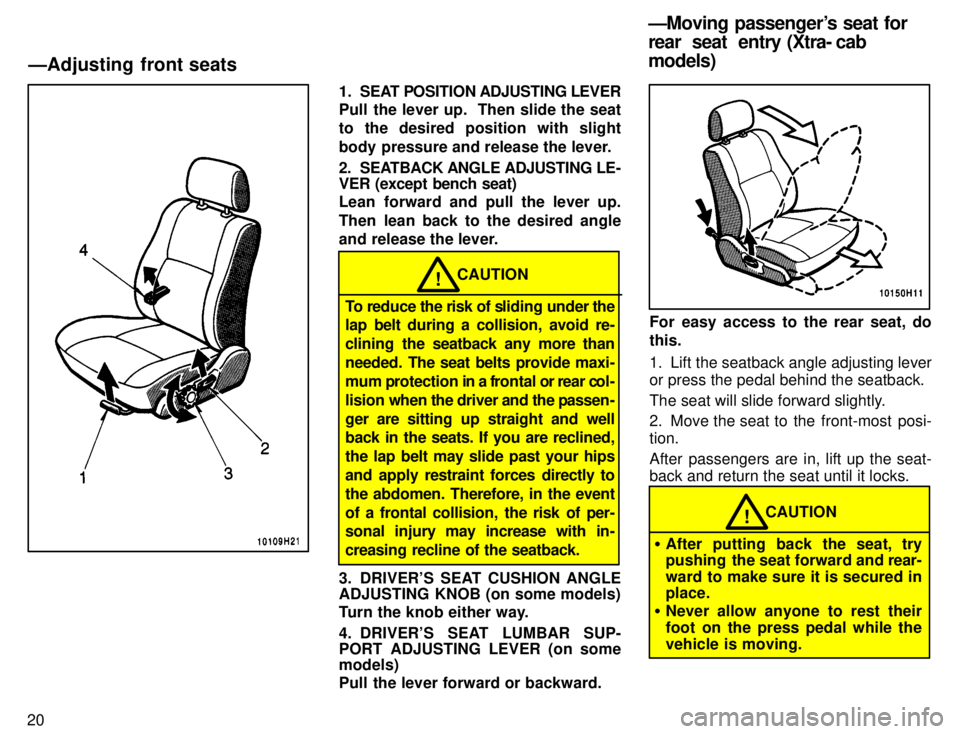
1. SEAT POSITION ADJUSTING LEVER
Pull the lever up. Then slide the seat
to the desired position with slight
body pressure and release the lever.
2. SEATBACK ANGLE ADJUSTING LE-
VER (except bench seat)
Lean forward and pull the lever up.
Then lean back to the desired angle
and release the lever.
CAUTION!
To reduce the risk of sliding under the
lap belt during a collision, avoid re-
clining the seatback any more than
needed. The seat belts provide maxi-
mum protection in a frontal or rear col-
lision when the driver and the passen-
ger are sitting up straight and well
back in the seats. If you are reclined,
the lap belt may slide past your hips
and apply restraint forces directly to
the abdomen. Therefore, in the event
of a frontal collision, the risk of per-
sonal injury may increase with in-
creasing recline of the seatback.
3. DRIVER'S SEAT CUSHION ANGLE
ADJUSTING KNOB (on some models)
Turn the knob either way.
4. DRIVER'S SEAT LUMBAR SUP-
PORT ADJUSTING LEVER (on somemodels)
Pull the lever forward or backward.
For easy access to the rear seat, do this.
1. Lift the seatback angle adjusting lever or press the pedal behind the seatback.
The seat will slide forward slightly.
2. Move the seat to the front-most posi- tion.
After passengers are in, lift up the seat- back and return the seat until it locks.
CAUTION!
After putting back the seat, try
pushing the seat forward and rear-
ward to make sure it is secured inplace.
Never allow anyone to rest their
foot on the press pedal while the
vehicle is moving.
ÐAdjusting front seats
ÐMoving passenger's seat for
rear seat entry (Xtra- cab
models)
Page 22 of 196
21
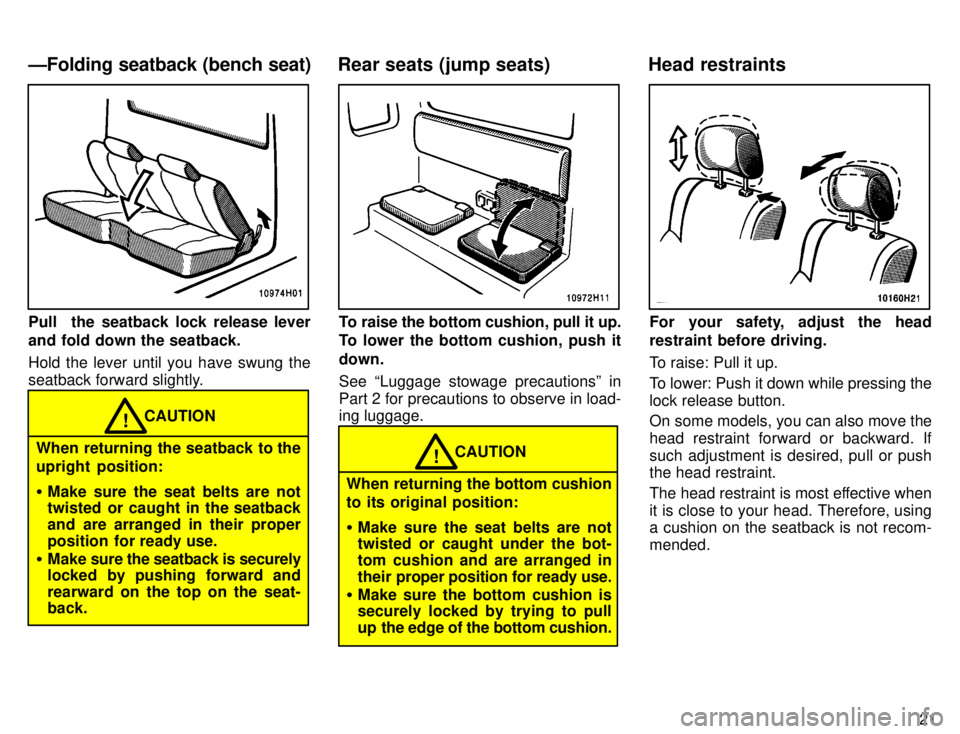
Pull the seatback lock release lever
and fold down the seatback.
Hold the lever until you have swung the
seatback forward slightly.
CAUTION!
When returning the seatback to the upright position: Make sure the seat belts are not
twisted or caught in the seatback
and are arranged in their proper
position for ready use.
Make sure the seatback is securely
locked by pushing forward and rearward on the top on the seat- back.
To raise the bottom cushion, pull it up.
To lower the bottom cushion, push it down. See Luggage stowage precautionsº in
Part 2 for precautions to observe in load- ing luggage.
CAUTION!
When returning the bottom cushion
to its original position: Make sure the seat belts are not twisted or caught under the bot-
tom cushion and are arranged in
their proper position for ready use.
Make sure the bottom cushion is securely locked by trying to pull
up the edge of the bottom cushion.
For your safety, adjust the head
restraint before driving.
To raise: Pull it up.
To lower: Push it down while pressing the lock release button.
On some models, you can also move the
head restraint forward or backward. If
such adjustment is desired, pull or push the head restraint.
The head restraint is most effective when
it is close to your head. Therefore, using a cushion on the seatback is not recom- mended.
ÐFolding seatback (bench seat) Rear seats (jump seats) Head restraints
Page 25 of 196
23
Small-framed person or youth in a
3-point type seat belt.
On models with
a bench seat, have a small-framed per-
son or youth sit slightly closer to the center
of the vehicle (so the shoulder belt does
not cross over the neck). On models withseparate seats, move the seat fully back- ward.
Pregnant woman. Toyota recommends
the use of a seat belt. Ask your doctor for
specific recommendations. The lap belt
should be worn securely and as low as
possible over the hips and not on the waist.
Injured person. Toyota recommends the
use of a seat belt. Depending on the injury,
however, first check with your doctor.
CAUTION!
Persons should ride in their seats
properly wearing their seat belts whenever the vehicle is moving.
Otherwise, they are much more like-
ly to suffer serious bodily injury in
the event of sudden braking or acollision.
When using the seat belts, observe the following: Use the belt for only one person at
a time. Do not use a single belt for
two or more peopleÐeven children.
Avoid reclining the seatbacks too
much. The seat belts provide max-
imum protection when the seat-
backs are in the upright position. (See the seat adjustment instruc-tions.)
Be careful not to damage the belt
webbing or hardware. Take care
that they do not get caught or
pinched in the seat or side doors.
Inspect the belt system periodical-
ly. Check for cuts, fraying, and
loose parts. Damaged parts
should be replaced. Do not disas- semble or modify the system.
Keep the belts clean and dry. If
they need cleaning, use a mild
soap solution or lukewarm water.
Never use bleach, dye, or abrasive
cleanersÐthey may severely
weaken the belts.
Replace the belt assembly (includ-
ing bolts) If it has been used in a
severe impact. The entire assem-
bly should be replaced even if
damage is not obvious.
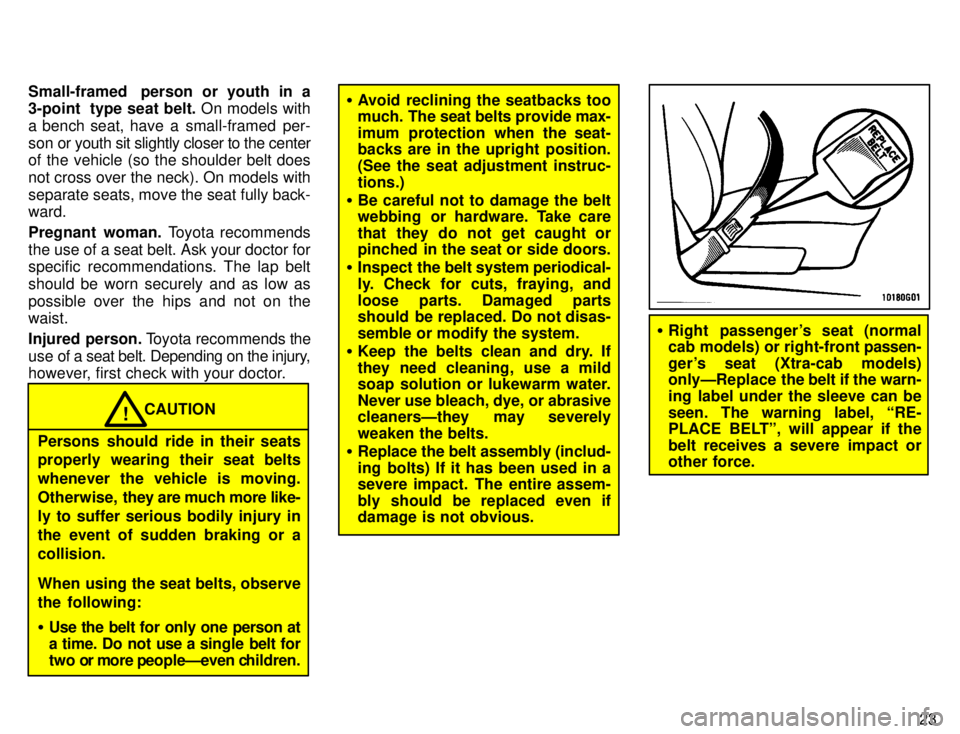
Right passenger's seat (normal
cab models) or right-front passen-
ger 's seat (Xtra-cab models)
onlyÐReplace the belt if the warn-
ing label under the sleeve can be
seen. The warning label, RE-
PLACE BELTº, will appear if the
belt receives a severe impact or
other force.
Page 26 of 196
24
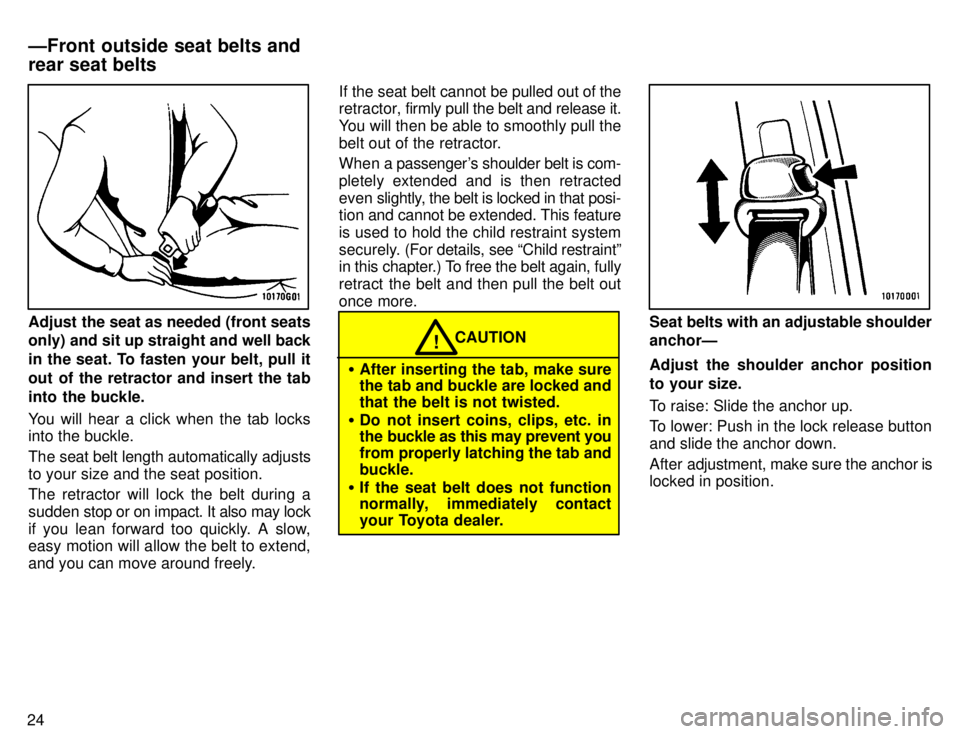
Adjust the seat as needed (front seats only) and sit up straight and well back
in the seat. To fasten your belt, pull it
out of the retractor and insert the tab
into the buckle.
You will hear a click when the tab locks into the buckle.
The seat belt length automatically adjusts
to your size and the seat position.
The retractor will lock the belt during a
sudden stop or on impact. It also may lock
if you lean forward too quickly. A slow, easy motion will allow the belt to extend,
and you can move around freely. If the seat belt cannot be pulled out of the
retractor,
firmly pull the belt and release it.
You will then be able to smoothly pull the
belt out of the retractor.
When a passenger's shoulder belt is com-
pletely extended and is then retracted
even slightly, the belt is locked in that posi-
tion and cannot be extended. This feature
is used to hold the child restraint system
securely. (For details, see Child restraintº
in this chapter.) To free the belt again, fully
retract the belt and then pull the belt out
once more.CAUTION!
After inserting the tab, make sure
the tab and buckle are locked and
that the belt is not twisted.
Do not insert coins, clips, etc. in
the buckle as this may prevent you
from properly latching the tab andbuckle.
If the seat belt does not function
normally, immediately contact
your Toyota dealer.
Seat belts with an adjustable shoulder anchorÐ
Adjust the shoulder anchor position
to your size.
To raise: Slide the anchor up.
To lower: Push in the lock release button and slide the anchor down.
After adjustment, make sure the anchor is
locked in position.
ÐFront outside seat belts and rear seat belts
Page 36 of 196
33
A child restraint system for a small
child or baby must itself be restrained
on the seat with the lap portion of thelap/shoulder belt.
The child restraint system should conform
to the size of the child and properly fit the
vehicle seat. For greater safety, the child
restraint
system should be installed in the
rear seat if your vehicle is equipped with rear seats. According to accident statis-
tics, children are safer when properly re-strained in the rear seat than in the front
seat. However, the shape of a child re-
straint system may not allow to be
installed securely in the rear seat. In this
case, we recommend to install the child
restraint system in the front seat. When installing a child restraint system,
follow the instructions provided by the
manufacturer of the system. General di- rections are also provided under the fol-
lowing illustrations.
CAUTION!
After installing the child restraint system, make sure it is secured in
place. If it is not restrained securely,
it may cause injury to the child in theevent of a sudden stop or accident. When not using the child restraint system, keep it secured with
the seat belt or place
it somewhere other than in passenger
compartment. This will prevent it injuring passengers in the event of a sudden stop or accident.
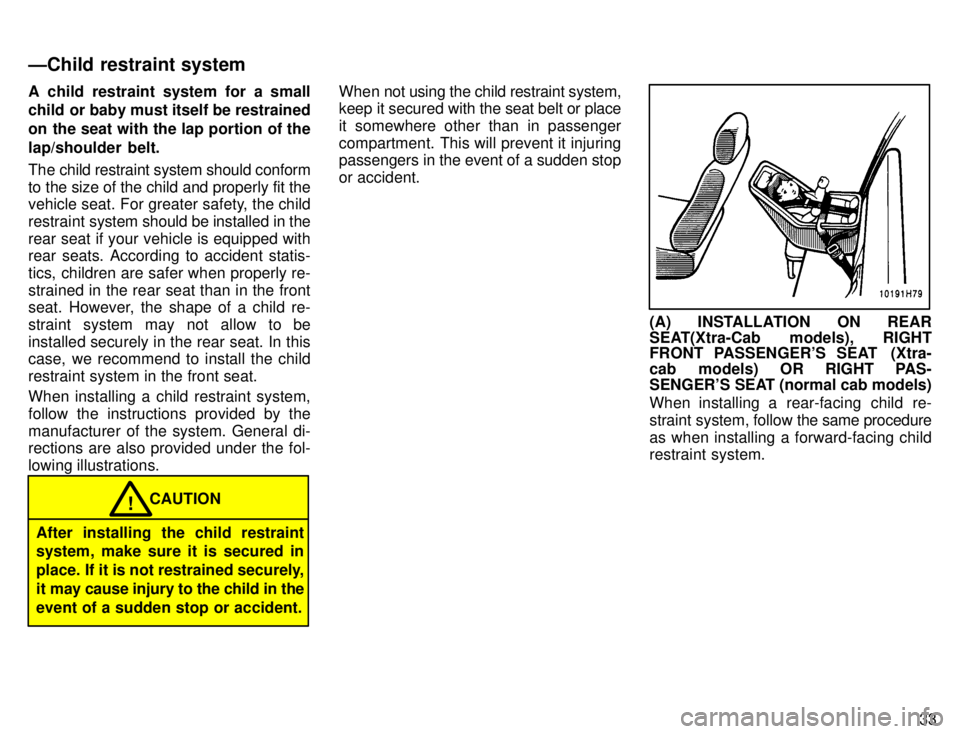
(A) INSTALLATION ON REAR
SEAT(Xtra-Cab models), RIGHT
FRONT PASSENGER'S SEAT (Xtra-
cab models) OR RIGHT PAS-
SENGER'S SEAT (normal cab models)
When installing a rear-facing child re-
straint system, follow the same procedure
as when installing a forward-facing child
restraint system.
ÐChild restraint system
Page 38 of 196
35
CAUTION!
After inserting the tab, make sure
the tab and buckle are locked.
Do not insert coins, clips, etc. in
the buckle as this may prevent you
from properly latching the tab and buckle.
If the seat belt does not function
normally, immediately contact
your Toyota dealer.
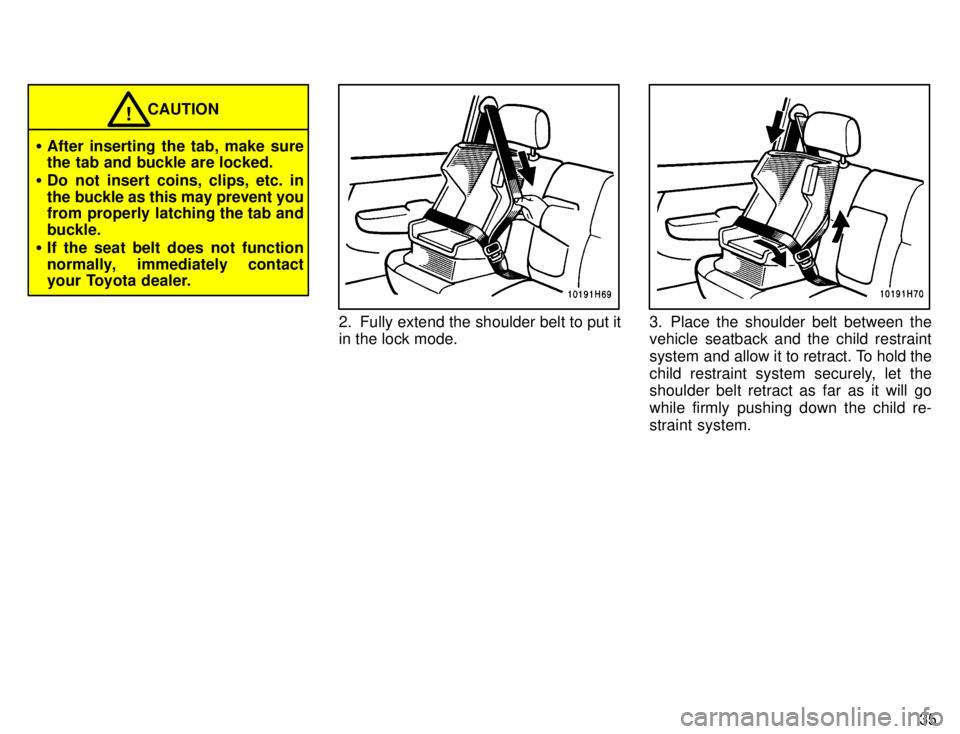
2. Fully extend the shoulder belt to put it in the lock mode.3. Place the shoulder belt between the vehicle seatback and the child restraint
system and allow it to retract. To hold the
child restraint system securely, let the
shoulder belt retract as far as it will go
while firmly pushing down the child re-
straint system.