traction control TOYOTA TACOMA 1996 Owners Manual
[x] Cancel search | Manufacturer: TOYOTA, Model Year: 1996, Model line: TACOMA, Model: TOYOTA TACOMA 1996Pages: 196, PDF Size: 1.8 MB
Page 68 of 196
64Maximum allowable speeds
To get on a highway or to pass slower traf- fic, maximum acceleration may be neces-
sary.
Make sure you observe the following
maximum allowable speeds in each gear:
Two-wheel drive models 2RZ-FE enginegear km/h (mph)
1 48 (30)
2 88 (55)
3 136 (85)
4 165 (103)
5VZ-FE engine gear km/h (mph)
1 54 (34)
2 101 (63)
3 144 (89)
4 165 (103)
Four-wheel drive models 3RZ-FE engine
gear km/h (mph) H2º and H4º L4º
1 46 (29) 17 (11)
2 86 (53) 33 (21)
3 135 (84) 52 (32)
4 165 (103) 66 (41) 5VZ-FE engine
gear km/h (mph)
H2º and H4º L4º
1 48 (30) 18 (11)
2 88 (55) 34 (21)
3 128 (80) 49 (30)
4 165 (103) 72 (45)
NOTICE
Do not downshift if you are going faster than the maximum allowable
speed for the next lower gear.
Good driving practice If it is difficult to shift into reverse, put
the transmission in neutral, release
the clutch pedal momentarily, and then
try again.
When towing a trailer, in order to main-
tain engine braking efficiency, do not
use the fifth gear.
Be careful when downshifting on a
slippery surface. Abrupt shifting
could cause the vehicle to spin orskid. CAUTION
!
NOTICE
Make sure the vehicle is completely stopped before shifting into
reverse.
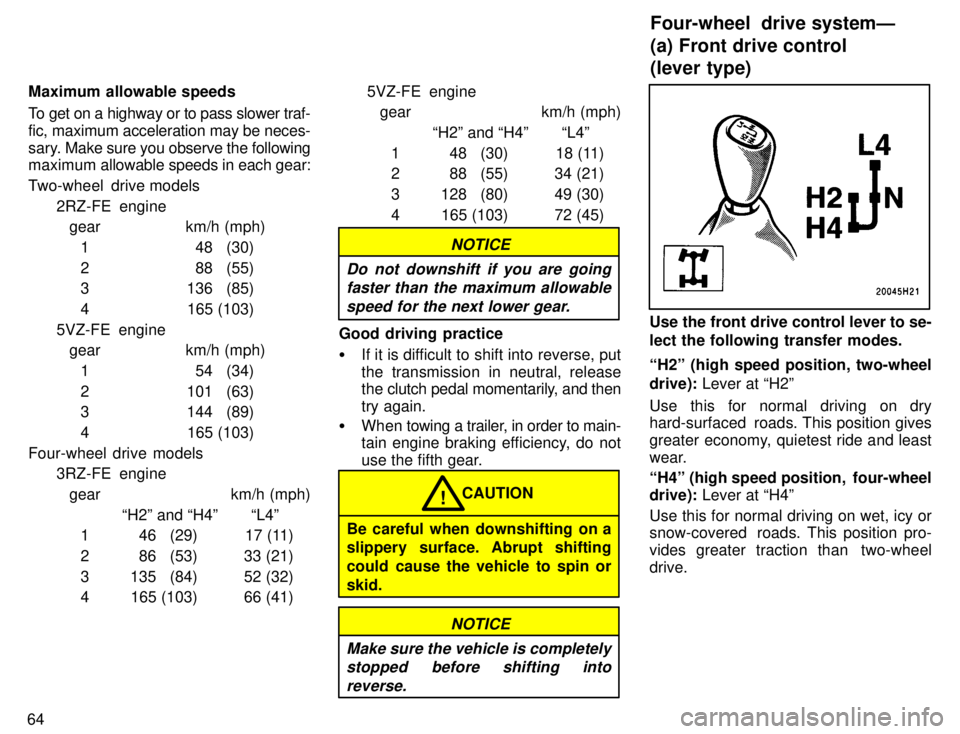
Use the front drive control lever to se-
lect the following transfer modes. H2º (high speed position, two-wheel
drive): Lever at H2º
Use this for normal driving on dry
hard-surfaced roads. This position gives
greater economy, quietest ride and least
wear.
H4º (high speed position, four-wheel drive): Lever at H4º
Use this for normal driving on wet, icy or
snow-covered roads. This position pro-
vides greater traction than two-wheeldrive. Four-wheel drive systemÐ (a) Front drive control (lever type)
Page 69 of 196

65
Nº (neutral position):
Lever at Nº
No power is delivered to the wheels. The vehicle must be stopped.
L4º (low speed position, four-wheel
drive): Lever at L4º
Use this for maximum power and traction. Use L4º for climbing or descending steep
hills, off-road driving, and hard pulling in
sand, mud or deep snow.
The four-wheel drive indicator light
comes on when the H4º, Nº or L4º mode is selected.
See (d) Shifting procedure (lever type)º
for further instructions.
Use the front drive control lever and
4WDº button to select the following transfer modes. H2º (high speed position, two-wheel
drive): Lever at Hº, 4WDº button left out
Use this for normal driving on dry
hard-surfaced roads. This position gives
greater economy, quietest ride and least
wear.
H4º (high speed position, four-wheel drive): Lever at Hº, 4WDº button
pushed in Use this for normal driving on wet, icy or
snow-covered roads. This position pro-
vides greater traction than two-wheeldrive. Nº (neutral position):
Lever at Nº
No power is delivered to the wheels. Thevehicle must be stopped.
L4º (low speed position, four-wheel
drive): Lever at L4º
Use this for maximum power and traction. Use L4º for climbing or descending steep
hills, off-road driving, and hard pulling in
sand, mud or deep snow.
The four-wheel drive indicator light
comes on when the H4º, Nº or L4º mode
is selected.
See (d) Shifting procedure (lever/button
type)º for further instructions.
(a) Front drive control
(lever/button type)
Page 111 of 196

107
2RZ-FE and 3RZ-FE engines
5VZ-FE engineThe engine number is stamped on the
engine block as shown.
Make sure what kind of tires your ve-
hicle is originally equipped with.
1. Summer tires
Summer tires are high-speed capability
tires best suited to highway driving underdry conditions. Since
summer tires do not have the same
traction performance as snow tires, sum-
mer tires are inadequate for driving on
snow-covered or icy roads. For driving on
snow-covered or icy roads, we recom-
mend using snow tires. If installing snow tires, be sure to replace all four tires.
2. All season tires
All season tires are designed to provide
better traction in snow and to be adequate
for driving in most winter conditions, as
well as for use all year round.
All season tires, however, do not have ad-
equate traction performance compared
with snow tires in heavy or loose snow.
Also, all season tires fall short in accelera-
tion and handling performance compared with summer tires in highway driving.
CAUTION!
Do not mix summer and all season
tires on your vehicle as this can
cause dangerous handling charac-
teristics, resulting in loss of control.
ÐEngine number
Types of tires
Page 165 of 196

161
Two-wheel drive models with steel wheels
Two-wheel drive models with alumi-
num wheels and four-wheel drivemodelsTo equalize tire wear and help extend
tire life, Toyota recommends that you
rotate your tires approximately every
12000 km (7500 miles). However, the
most appropriate timing for tire rota-
tion may vary according to your driv-
ing habits and road surface condi- tions.
See If you have a flat tireº in Part 4 for tire
change procedure. When rotating tires, check for uneven
wear
and damage. Abnormal wear is usu-
ally caused by incorrect tire pressure, im-
proper wheel alignment, out-of-balance
wheels, or severe braking. WHEN TO USE SNOW TIRES OR CHAINS
Snow tires or chains are recom-
mended when driving on snow or ice.
On wet or dry roads, conventional tires
provide better traction than snow tires. SNOW TIRE SELECTION
If you need snow tires, select the same
size, construction and load capacity
as the original tires on your Toyota.
Do not use tires other than those men-
tioned above. Do not install studded tires
without first checking local regulations for
possible restrictions.
SNOW TIRE INSTALLATION
Snow tires should be installed on all wheels. Installing snow tires on the front wheels
only can lead to an excessive difference
in road grip capability between the front
and rear tires which could cause loss of
vehicle control.
When storing removed tires, you should
store them in a cool dry place.
Mark the direction of rotation and be sure to install them in the same direction whenreplacing.
Installing snow tires and chains
Rotating tires
Page 192 of 196

188Traction A, B, C
ÐThe traction grades,
from highest to lowest, are A, B, and C,
and they represent the tire's ability to stop
on wet pavement as measured under
controlled conditions on specified govern-
ment test surfaces of asphalt and con-
crete. A tire marked C may have poor trac-
tion performance.
Warning: The traction grade assigned to this tire is based on braking (straight
ahead) traction tests and does not include
cornering (turning) traction.
Temperature A, B, C ÐThe temperature
grades are A (the highest), B, and C, rep-
resenting the tire's resistance to the gen-
eration of heat and its ability to dissipate heat when tested under controlled condi- tions on a specified indoor laboratory test
wheel. Sustained high temperature can
cause the material of the tire to degener- ate and reduce tire life, and excessive
temperature can lead to sudden tire fail-
ure. The grade C corresponds to a level of
performance which all passenger car tires
must meet under the Federal Motor Ve-
hicle Safety Standard No. 109. Grades B
and A represent higher levels of perfor-mance on the laboratory test wheel than
the minimum required by law. Warning: The temperature grade for this
tire is
established for a tire that is properly
inflated and not overloaded. Excessive speed, underinflation, or excessive load- ing, either separately or in combination, can cause heat buildup and possible tirefailure. This
information has been prepared in ac-
cordance with regulation issued by the
National Highway Traffic Safety Adminis-
tration of the U.S. Department of Trans-
portation. It provides the purchasers and/
or prospective purchasers of Toyota
vehicles with information on truck-camp-
er loading. Your Toyota dealer will help an-
swer any questions you may have as you
read this information.
Camper informationÐ