warning light TOYOTA TACOMA 1996 Owners Manual
[x] Cancel search | Manufacturer: TOYOTA, Model Year: 1996, Model line: TACOMA, Model: TOYOTA TACOMA 1996Pages: 196, PDF Size: 1.8 MB
Page 7 of 196

6
Anti-lock brake system warning light* 1
Brake system warning light* 1
Seat belt reminder light* 1
Discharge warning light* 1
Low oil pressure warning light* 1
Malfunction indicator light* 1
Low fuel level warning light* 1
SRS airbag warning light* 1 Automatic transmission fluid temperature warning light*
1
Turn signal indicator lights
Headlight high beam indicator light
Over-drive indicator light
Unengaged Parkº warning light* 1
Low windshield washer fluid level light*1
Driving pattern (POWERº mode) indicator light
Four-wheel drive indicator light
Automatic transmission indicator lights
Indicator symbols on the instrument panel
Page 25 of 196
23
Small-framed person or youth in a
3-point type seat belt.
On models with
a bench seat, have a small-framed per-
son or youth sit slightly closer to the center
of the vehicle (so the shoulder belt does
not cross over the neck). On models withseparate seats, move the seat fully back- ward.
Pregnant woman. Toyota recommends
the use of a seat belt. Ask your doctor for
specific recommendations. The lap belt
should be worn securely and as low as
possible over the hips and not on the waist.
Injured person. Toyota recommends the
use of a seat belt. Depending on the injury,
however, first check with your doctor.
CAUTION!
Persons should ride in their seats
properly wearing their seat belts whenever the vehicle is moving.
Otherwise, they are much more like-
ly to suffer serious bodily injury in
the event of sudden braking or acollision.
When using the seat belts, observe the following: Use the belt for only one person at
a time. Do not use a single belt for
two or more peopleÐeven children.
Avoid reclining the seatbacks too
much. The seat belts provide max-
imum protection when the seat-
backs are in the upright position. (See the seat adjustment instruc-tions.)
Be careful not to damage the belt
webbing or hardware. Take care
that they do not get caught or
pinched in the seat or side doors.
Inspect the belt system periodical-
ly. Check for cuts, fraying, and
loose parts. Damaged parts
should be replaced. Do not disas- semble or modify the system.
Keep the belts clean and dry. If
they need cleaning, use a mild
soap solution or lukewarm water.
Never use bleach, dye, or abrasive
cleanersÐthey may severely
weaken the belts.
Replace the belt assembly (includ-
ing bolts) If it has been used in a
severe impact. The entire assem-
bly should be replaced even if
damage is not obvious.
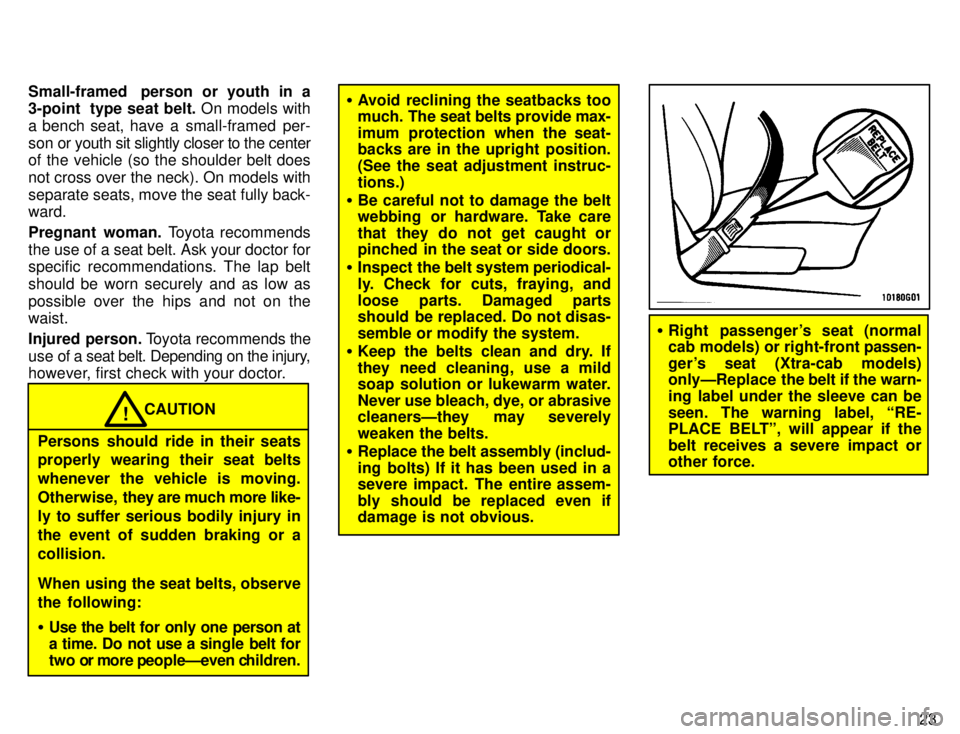
Right passenger's seat (normal
cab models) or right-front passen-
ger 's seat (Xtra-cab models)
onlyÐReplace the belt if the warn-
ing label under the sleeve can be
seen. The warning label, RE-
PLACE BELTº, will appear if the
belt receives a severe impact or
other force.
Page 31 of 196

29
This indicator comes on when the
ignition key is turned to the ACCº or
ONº position. It goes off after about 6
seconds. This means the SRS airbag
is operating properly.
The SRS airbag warning light system
monitors the airbag sensor assembly,
inflator, warning light, interconnecting wir-
ing and power sources.The SRS airbag system is designed to
activate in response to a severe frontal
impact within the shaded area be-
tween the arrows in the illustration.
The SRS airbags will deploy if the severity
of the impact is above the designed
threshold level, comparable to an approxi-
mate 20 km/h (14 mph) collision when im-
pacting straight into a fixed barrier that
does not move or deform.
If the severity of the impact is below the
above threshold level, the SRS airbag
may not deploy. However, this threshold velocity will be
considerably higher if the vehicle strikes
an object, such as a parked vehicle or sign
pole, which can move or deform on im-
pact, or if it is
involved in an underride col-
lision (a collision in which the nose of the
vehicle underridesº, or goes under, the
bed of a truck).
For your safety, be sure to always wear your seat belt.
Page 32 of 196

30
The SRS airbag is not designed to in-
flate if the vehicle is subjected to a side
or rear impact, if it rolls over, or if it is in-
volved in a low- speed frontal collision.The SRS airbag system mainly consists
of the following components and their
locations are shown in the illustration.
1. SRS airbag warning light
2. Steering wheel pad (airbag and inflator)
3. Airbag sensor assembly
The airbag sensor assembly consists of a
safing sensor and airbag sensor.In a severe frontal impact, sensor detects
deceleration and the system triggers the
airbag inflator. Then a chemical reaction
in the inflator momentarily fills the airbag
with non-toxic nitrogen gas to help re-
strain the forward motion of the driver. When the airbag inflates, it produces a fairly loud noise and releases some
smoke along with the nitrogen gas. This isnot harmful and does not indicate a fire.
Be sure to wash off any residue as soon
as possible to prevent minor skin irritation.
Deployment of the airbag happens in a
fraction of a
second, so the airbag must in-
flate with considerable force. While the
system is designed to reduce serious inju-
ries, it may also cause minor burns or
abrasions and swellings.
The steering wheel hub may be hot for
several m inutes, but the airbag will not be
hot. The airbag is designed to inflate only once.
Page 51 of 196
Part 1Fuel gauge
47
OPERATION OF INSTRUMENTS AND CONTROLSÐ
Chapter 1-5 Gauges, Meters and Service reminder indicators
Fuel gauge
Engine coolant temperature gauge
Tachometer
Odometer and trip meter
Service reminder indicators and warning buzzers
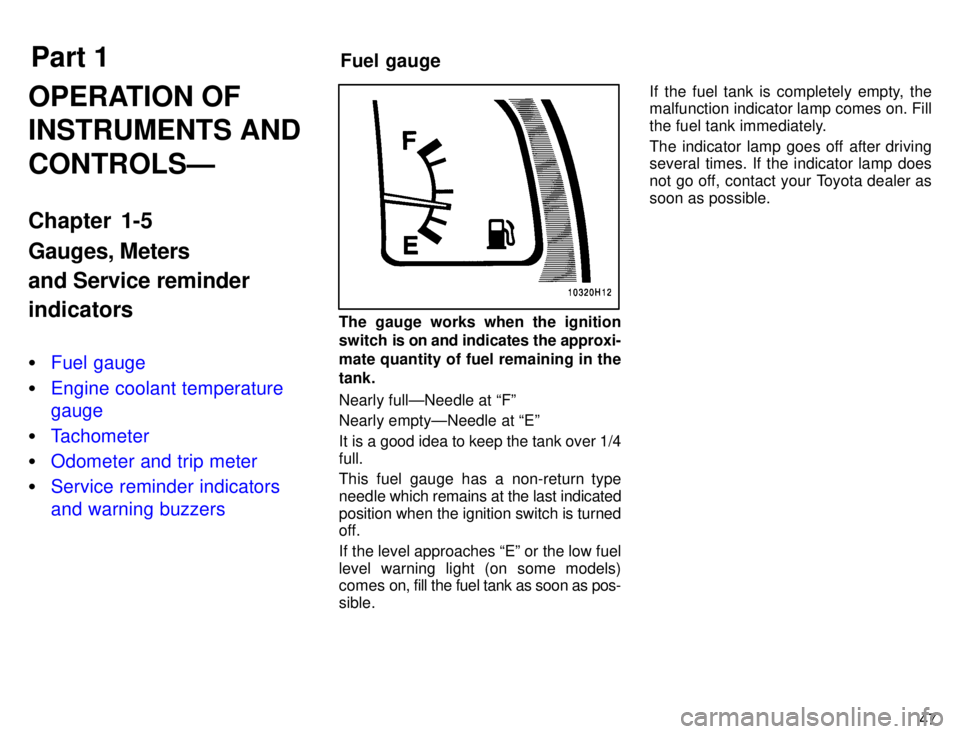
The gauge works when the ignition
switch is on
and indicates the approxi-
mate quantity of fuel remaining in the tank. Nearly fullÐNeedle at Fº Nearly emptyÐNeedle at Eº
It is a good idea to keep the tank over 1/4 full.
This fuel gauge has a non-return type
needle wh ich remains at the last indicated
position when the ignition switch is turned
off.
If the level approaches Eº or the low fuel
level warning light (on some models)
comes on, fill the fuel tank as soon as pos- sible. If the fuel tank is completely empty, the malfunction indicator lamp comes on. Fill
the fuel tank immediately.
The indicator lamp goes off after driving several times. If the indicator lamp does
not go off, contact your Toyota dealer assoon as possible.
Page 54 of 196
50
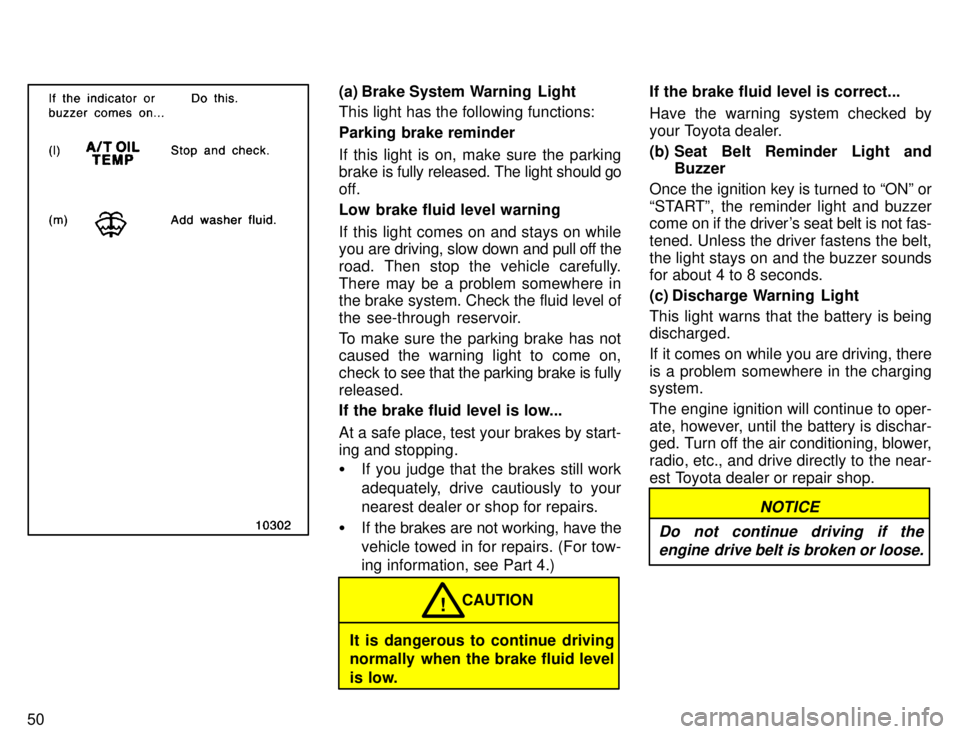
(a) Brake System Warning Light This light has the following functions: Parking brake reminder
If this light is on, make sure the parking
brake is fully released. The light should go
off.
Low brake fluid level warning
If this light comes on and stays on while
you are driving, slow down and pull off the
road. Then stop the vehicle carefully.There may be a problem somewhere in
the brake system. Check the fluid level of
the see-through reservoir.
To make sure the parking brake has not
caused the warning light to come on,
check to see that the parking brake is fully
released.
If the brake fluid level is low...
At a safe place, test your brakes by start-
ing and stopping. If you judge that the brakes still work
adequately, drive cautiously to yournearest dealer or shop for repairs.
If the brakes are not working, have the
vehicle towed in for repairs. (For tow- ing information, see Part 4.)
It is dangerous to continue driving
normally when the brake fluid level
is low. CAUTION
! If the brake fluid level is correct...
Have the warning system checked by
your Toyota dealer.
(b) Seat Belt Reminder Light and
Buzzer
Once the ignition key is turned to ONº or
STARTº, the reminder light and buzzer
come on if the driver's seat belt is not fas-
tened. Unless the driver fastens the belt, the light stays on and the buzzer sounds for about 4 to 8 seconds.
(c) Discharge Warning Light
This light warns that the battery is being discharged.
If it comes on while you are driving, there
is a problem somewhere in the charging system.
The engine ignition will continue to oper-
ate, however, until the battery is dischar-
ged. Turn off the air conditioning, blower,
radio, etc., and drive directly to the near-
est Toyota dealer or repair shop.
NOTICE
Do not continue driving if the engine drive belt is broken or loose.
Page 55 of 196

51
(d) Low Oil Pressure Warning Light
This light warns that the engine oil pres-
sure is too low.
If it flickers or stays on while you are driving,
pull off the road to a safe place and stop the
engine immediately. Call a Toyota dealer or
qualified repair shop for assistance.
The light may occasionally flicker when
the engine is idling or it may come on brief-
ly after a hard stop. There is no cause for concern if it then goes out when the en-
gine is accelerated slightly.
The light may come on when the oil level
is extremely low. It is not designed to indi- cate low oil level, and the oil level must bechecked using the level dipstick.
NOTICE
Do not drive the vehicle with the warning light onÐeven for one
block. It may ruin the engine.
(e) Low Fuel Level Warning Light
This light comes on when the fuel level in
the tank becomes nearly empty. Fill up the
tank as soon as possible. (f) Malfunction Indicator Lamp
This lamp comes on in the following cases.
a. The fuel tank is completely empty. (See Fuel gaugeº in Chapter 1-5 for instruc- tions.)
b. The fuel tank cap is not tightened se-
curely. (See Fuel tank capº in Chapter
1-2 for instructions.)
c. There is a problem somewhere in your
engine or automatic transmission electri- cal system.
If it comes on while you are driving in case
c, have your vehicle checked/repaired by
your Toyota dealer as soon as possible.
(g) ABSº Warning Light
This light warns that there is a problem
somewhere in your anti-lock brake sys-tem.
If the light comes on while you are driving,
have your vehicle checked by your T
oyota
dealer as soon as possible.
The light will come on when the ignition key is turned to the ONº position. After
about 3 seconds, the light will go off. When the ABSº warning light is on (and
the brake system warning light is off), thebrake system operates conventionally but
without anti-lock function. Vehicles with rear differential lock systemÐ
The anti-lock brake system does not op-
erate when the rear differential is locked.
It is normal operation for the ABSº warn-
ing light to be on at this time.
(h) SRS Airbag Warning Light
This light will come on when the igni-
tion
key is turned to the ACCº or ONº
position. After about 6 seconds, the
light will go off. This means the airbag
system is operating properly.
The warning light system monitors the air-
bag sensor assembly, inflator, warning light, interconnecting wiring and powersources.
If either of the following conditions occurs, this indicates a malfunction somewhere inthe parts monitored by the warning light
system. Contact your Toyota dealer as
soon as possible to service the vehicle. The light does not come on when the
ignition key is turned to the ACCº or
ONº position or remains on.
The light comes on while driving.
(i) Light Reminder Buzzer
This buzzer will sound if the driver's door is opened while the ignition switch is turned to the LOCKº position with the
headlight switch on. Removing the key will
not stop the buzzer as long as the head-light switch is on.
Page 56 of 196
52(j) Key Reminder Buzzer
This buzzer reminds you to remove the
key when you open the driver's door withthe ignition key in the ACCº or LOCKº position.
(k) Unengaged Parkº Warning Light
(vehicles with automatic transmis-sion)
This light warns that the transmission
Parkº mechanism is not engaged. If the
front drive control lever is in the Nº posi-
tion while the selector lever is in the Pº
position, the transmission will disengage
and the wheels will not lock.
To restore the park function, shift
the front drive control lever out of Nº.
CAUTION
!
(l) Automatic Transmission Fluid
Temperature Warning Light
This light warns that the automatic trans- mission fluid temperature is too high.
If this light comes on while you are driving,
slow down and pull off the road. Stop the
vehicle at a safe place and put the selector
lever in Pº. With the engine idling, wait
until the light goes off. If the light goes off,
you may start the vehicle again. If the light
does not go off, call a Toyota dealer or
qualified repair shop for assistance. (m) Low Windshield Washer Fluid
Level Warning Light (Canada)
The light warns that the windshield wash-
er fluid level is too low. Add washer fluid at
your earliest opportunity. (For instruc-
tions, see Adding washer fluidº in Chap- ter 7-3.)
CHECKING SERVICE REMINDER
INDI-
CATORS (except the low fuel level
warning light)
1. Apply the parking brake.
2. Turn ignition key to ACCº.
The SRS airbag warning light should
come on. It goes off after about 6 sec- onds.
3. Turn the ignition key to ONº, but do not
start the engine.
All the service reminder indicators except
the SRS airbag warning light should come
on. The ABSº warning light goes off after
about 3 seconds.
If any service reminder indicator or warn-
ing buzzer does not function as described above, either the bulb is burned out or the
circuit is in need of repair. Have it checked
by your Toyota dealer as soon as pos- sible.
Page 79 of 196

75
RESUMING THE PRESET SPEED
If the preset speed is cancelled by pulling
the control lever or by depressing the
brake pedal or clutch pedal, pushing the
lever up in the RES/ACCº direction will
restore
the speed set prior to cancellation.
However, once the vehicle speed falls be-
low about 40 km/h (25 mph), the preset
speed will not be resumed.
CRUISE CONTROL FAILURE WARNING
If the CRUISEº indicator light in the in-
strument cluster flashes when using the
cruise control, press the CRUISE
ON-OFFº button to turn the system off
and then press it again to turn it on.
If any of the following conditions then oc-
curs, there is some trouble in the cruise control system. The indicator light does not come on.
The indicator light flashes again.
The indicator light goes out after it
comes on.
If this is the case, contact your Toyota
dealer and have your vehicle inspected.
To crank the engine without depress- ing the clutch pedal, push the switch
with the ignition on.
The switch stays on as long as the ignition
is on. And it will automatically turn off
when the ignition is off.
This switch cancels the clutch start sys-
tem, which is designed to keep the starter
motor from operating if the clutch pedal is
not depressed all the way down.
The switch allows the vehicle to be driven
out of difficult situations by cranking the
engine with the clutch engaged. Never use the switch for normal engine
starting. Be sure to
follow the starting pro-
cedure instructed in How to start the en- gineº in Part 3.
Clutch start cancel switch
(four-wheel
drive models with
manual transmission)
Page 107 of 196
103
TANDEM MASTER CYLINDER BRAKE SYSTEM
The tandem master cylinder brake sys-
tem is a hydraulic system with two sepa-
rate sub-systems. If either sub-system
should fa
il, the other will still work. Howev-
er, the pedal will be harder to press, and
your stopping distance will be longer.
Also, the brake system warning light may come on.
CAUTION!
Do not drive your vehicle with only
a single brake system. Have your
brakes fixed immediately.
BRAKE BOOSTER
The brake booster uses engine vacuum to
power-assist the brakes. If the engine
should quit while you are driving, you can
bring the vehicle to a stop with normal
pedal pressure. There is enough reserve vacuum for one or two stopsÐbut no more!
CAUTION!
Do not pump the brake pedal if the
engine stalls. Each push on the
pedal uses up your vacuum re- serve.
Even if the power assist is com-
pletely lost, the brakes will still
work. But you will have to push the
pedal hardÐmuch harder than
normal. And your braking distance
will be longer.
ANTI-LOCK BRAKE SYSTEM (with ABSº warning light)
The anti-lock brake system is designed to prevent lock-up of the wheels during sud-
den braking or braking on slippery road surfaces. This assists the driver in con-
trolling the vehicle under these circum-stances.
The anti-lock brake system becomes op- erative after the vehicle has accelerated
to a speed in excess of approximately 10
km/h (6 mph). It stops operating when the
vehicle decelerates to a speed below
approximately 5 km/h (3 mph).
You may hear a sound in the engine
compartment for a few seconds when the
engine is started or just after the vehicleis started. This means that the anti-lock
brake system is in the self check mode,
and does not indicate a malfunction.
When the anti-lock brake system function is in action, you may feel the brake pedal
pulsating and hear a noise. In this situa-
tion, to let the anti-lock brake systemwork for you, just hold the brake pedal
down more firmly. Do not pump the brake. The brake pedal pulsation caused by the
anti-lock brake system may indicate haz- ardous road surface conditions. Althoughthe anti-lock brake system assists in pro-
viding
vehicle control, it is still important to
drive with all due care, because the anti-
lock brake system cannot overcome the
laws of physics that act on your vehicle: Braking capab ility is dependent on tire
friction with the road surface.
Even though the anti-lock brake sys-
tem is operating, a driver cannot main- tain full control on certain slippery road
surfaces, when cornering at highspeeds, or in violent maneuvers.
Avoid high speeds on wet roads. The
anti-lock brake system cannot elimi-
nate the risk of hydroplaning and lossof tire friction.
Always maintain a safe distance from the
vehicle in front of you. Compared with ve-
hicles not fitted with an anti-lock brake
system, your vehicle may require a longer
stopping distance in the following cases: Driving on rough, gravel or snow-cov-
ered roads.
Driving with tire chains installed.
Driving on roads where the road sur-
face is pitted or has other differences in surface height.
Brake system