warning TOYOTA TACOMA 1998 User Guide
[x] Cancel search | Manufacturer: TOYOTA, Model Year: 1998, Model line: TACOMA, Model: TOYOTA TACOMA 1998Pages: 246, PDF Size: 4.33 MB
Page 144 of 246
'98 Tacoma (U)
144
Brake system
TANDEM MASTER CYLINDER BRAKE SYSTEM
The tandem master cylinder brake system
is a hydraulic system with two separate
sub-systems. If either sub-system s
hould
fail, the other will still work. However, the
pedal will be harder to press, and your
stopping distance will be longer. Also, the
brake system warning light may come on.
CAUTION
Do not drive your vehicle with only a
single brake system. Have your
brakes fixed immediately.
BRAKE BOOSTER
The brake booster uses engine vacuum to
power-assist the brakes. If the engine
should quit while you are driving, you can
bring the vehicle to a stop with normal
pedal pressure. There is enough reserve
vacuum for one or two stops±but no more!
CAUTION
Do not pump the brake pedal if the
engine stalls. Each push on the
pedal uses up your vacuum reserve.
Even if the power assist is com-
pletely lost, the brakes will still
work. But you will have to push the
pedal hardÐmuch harder than nor-
mal. And your braking distance will
be longer.
ANTI-LOCK BRAKE SYSTEM
(with ºABSº warning light)
The anti-lock brake system is designed to
automatically help prevent lock- up of the
wheels during sudden braking or braking
on slippery road surfaces. This assists in
providing directional stab ility and steering
performance of the vehicle under these
circumstances.
The anti-lock brake system becomes op-
erative after the vehicle has accelerated
to a speed in excess of approximately 10
km/h (6 mph). It stops operating when the
vehicle decelerates to a speed below
approximately 5 km/h (3 mph).
You may hear a sound in the engine
compartment for a few seconds when the
engine is started or just after the vehicle
is started. This means that the anti-lock
brake system is in the self check mode,
and does not indicate a malfunction.
Effective way to press the ºABSº brake
pedal: When the anti- lock brake system
function is in action, you may feel the
brake pedal pulsating and hear a noise.
In this situation, to let the anti- lock
brake system work for you, just hold the
brake pedal down more firmly. Do not
pump the brake. This will result in re-
duced braking performance.
The brake pedal pulsation caused by the
anti-lock brake system may indicate haz-
ardous road surface conditions. Although
the anti-lock brake system assists in pro-
viding vehicle control, it is still important
to drive with all due care, because the
anti-lock brake system cannot overcome
the laws of physics that act on your ve-
hicle: Braking capab ility is dependent on tire
friction with the road surface.
Even though the anti-lock brake system
is operating, a driver cannot maintain
full control on certain slippery road sur-
faces, when cornering at high speeds,
or in violent maneuvers.
Avoid high speeds on wet roads. The
anti-lock brake system cannot eliminate
the risk of hydroplaning and loss of tire
friction.
Page 145 of 246
'98 Tacoma (U)145
Always maintain a safe distance from the
vehicle in front of you. Compared with
vehicles not fitted with an anti-lock brake
system, your vehicle may r
equire a longer
stopping distance in the following cases:
Driving on rough, gravel or snow-cov-
ered roads.
Driving with tire chains installed.
Driving on roads where the road sur-
face is pitted or has other differences
in surface height.
CAUTION
Do not use tires other than the
manufacturer 's designated tires, and
do not mix tires or wheels of differ-
ent sizes. You may prevent the anti-
lock brake system from operating at
full effectiveness.
Vehicles with rear differential lock
systemÐ
The anti-lock brake system does not oper-
ate when the rear differential is locked. It
is normal operation for the ºABSº warning
light to be on at this time.
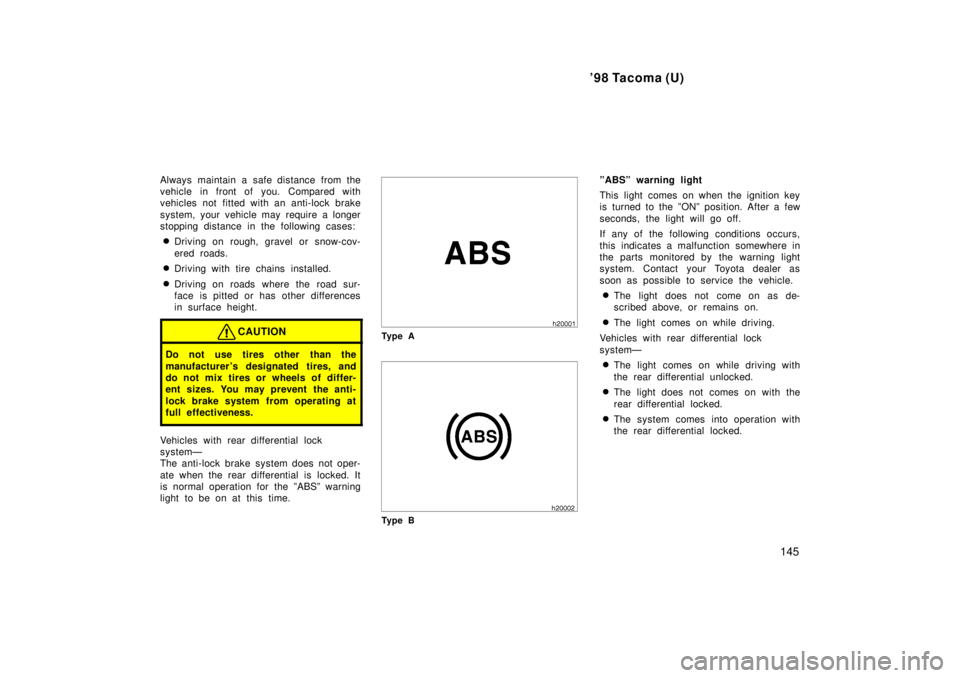
Ty p e A
Ty p e B ºABSº warning light
This light comes on when the ignition key
is turned to the ºONº position. After a few
seconds, the light will go off.
If any of the following conditions occurs,
this indicates a malfunction somewhere in
the parts monitored by the warning light
system. Contact your Toyota dealer as
soon as possible to service the vehicle.
The light does not come on as de-
scribed above, or remains on.
The light comes on while driving.
Vehicles with rear differential lock
systemÐ The light comes on while driving with
the rear differential unlocked.
The light does not comes on with the
rear differential locked.
The system comes into operation with
the rear differential locked.
Page 146 of 246
'98 Tacoma (U)
146
Even if the anti-lock brake system should
fail, the brake system will still operate
conventionally. However, when the ºABSº
warning light is on (and the brake system
warning light is off), the anti- lock brake
system is not assisting brake performance
so that the wheels can lock- up during
sudden braking or braking on slippery
road surfaces. Have your vehicle checked
by your Toyota dealer as soon as pos-
sible.
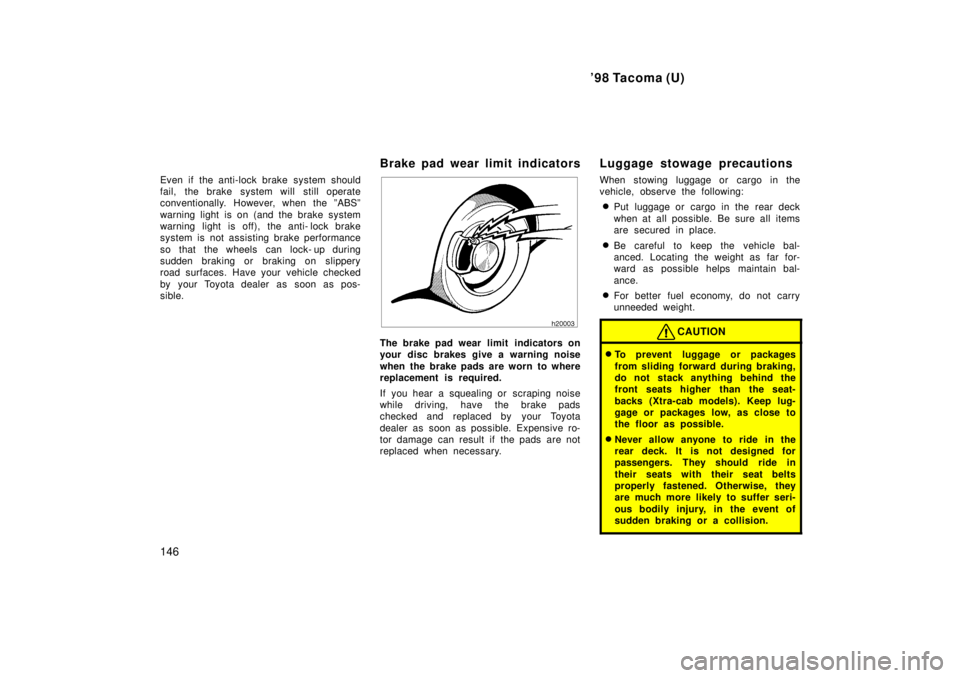
Brake pad wear limit indicators
The brake pad wear limit indicators on
your disc brakes give a warning noise
when the brake pads are worn to where
replacement is required.
If you hear a squealing or scraping noise
while driving, have the brake pads
checked and replaced by your Toyota
dealer as soon as possible. Expensive ro-
tor damage can result if the pads are not
replaced when necessary.Luggage stowage pr
ecautions
When stowing luggage or cargo in the
vehicle, observe the following: Put luggage or cargo in the rear deck
when at all possible. Be sure all items
are secured in place.
Be careful to keep the vehicle bal-
anced. Locating the weight as far for-
ward as possible helps maintain bal-
ance.
For better fuel economy, do not carry
unneeded weight.CAUTION
To prevent luggage or packages
from sliding forward during braking,
do not stack anything behind the
front seats higher than the seat-
backs (Xtra-cab models). Keep lug-
gage or packages low, as close to
the floor as possible.
Never allow anyone to ride in the
rear deck. It is not designed for
passengers. They should ride in
their seats with their seat belts
properly fastened. Otherwise, they
are much more likely to suffer seri-
ous bodily injury, in the event of
sudden braking or a co llision.
Page 194 of 246

'98 Tacoma (U)
194
Tire surface and wheel nuts
Check the tires carefully for cuts, damage
or excessive wear. See Chapter 7- 2 for
additional information. When checking the
tires, make sure no nuts are missing, and
check the nuts for looseness. Tighten
them if necessary.
Tire rotation
Rotate the tires every 12000 km (7500
miles). See Chapter 7- 2 for additional in-
formation.
Fluid leaks
Check underneath for leaking fuel, oil, wa-
ter or other fluid after the vehicle has
been parked for a while. If you smell fuel
fumes or notice any leak, have the cause
found and corrected immediately.
Doors and engine hood
Check that all doors including tailgate op-
erate smoothly and all latches lock se-
curely. Make sure the engine hood sec-
ondary latch secures the hood from
opening when the primary latch is re-
leased.
INSIDE THE VEHICLE
Items listed below should be checked
regularly, e.g. while performing periodic
services, cleaning the vehicle, etc.
Lights
Make sure the headlights, stop lights, tail
lights, turn signal lights, and other lights
are all working. Check headlight aim.
Service reminder indicators and warning
buzzers
Check that all service reminder indicators
and warning buzzers function properly.
Steering wheel
Be alert for changes in steering condition,
such as hard steering or strange noise.
Seats
Check that all seat controls such as seat
adjusters, seatback recliner, etc. operate
smoothly and that all latches lock securely
in any position. Check that the head re-
straints move up and down smoothly and
that the locks hold securely in any latched
position. For folding-down seatback (bench
seat), check that the latches lock secure-
ly.Seat belts
Check that the seat belt system such as
buckles, retractors and anchors operate
properly and smoothly. Make sure the belt
webbing is not cut, frayed, worn or dam-aged.
Accelerator pedal
Check the pedal for smooth operation and
uneven pedal effort or catching.
Clutch pedal
Check the pedal for smooth operation.
Brake pedal
Check the pedal for smooth operation and
that the pedal has the proper clearance.
Check the brake booster function.
Brakes
At a safe place, check that the brakes do
not pull to one side when applied.
Parking brake
Check that the lever has the proper travel
and that, on a safe incline, your vehicle
is held securely with only the parking
brake applied.
Page 214 of 246

'98 Tacoma (U)
214
Replacement with used wheels is not rec-
ommended as they may have been sub-
jected to rough treatment or high mileage
and could fail without warning. Also, bent
wheels which have been straightened may
have structural damage and therefore
should not be used. Never use an inner
tube in a leaking wheel which is designed
for a tubeless tire.
Aluminum wheel precautions
After driving your vehicle the first 1600
km (1000 miles), check that the wheel
nuts are tight.
If you have rotated, repaired, or
changed your tires, check that the
wheel nuts are still tight after driving
1600 km (1000 miles).
When using tire chains, be careful not
to damage the aluminum wheels.
Use only the Toyota wheel nuts and
wrench designed for your aluminum
wheels.
When balancing your wheels, use only
Toyota balance weights or equivalent
and a plastic or rubber hammer.
As with any wheel, periodically check
your aluminum wheels for damage. If
damaged, replace immediately.
Page 233 of 246

'98 Tacoma (U)233
Engine compartment (Canada)
6. HEAD (LO LH) 10 A: Left-hand head-
light (low beam)
7. TAIL 10 A: Tail lights, licence plate
lights
8. PANEL 10 A: Emergency flashers,
heater control system, air conditioning
system, g auges and meters, clock, car
audio system, overdrive indicator light,
glovebox light, cigarette lighter, instru-
ment panel lights, rear differential lock
system, Multiport fuel injection system/
sequential multiport fuel injection sys-
tem, electronically controlled automatic
transmission system
9. A.C 10 A: Air conditioning systemInstrument panel
10. STOP 15 A: Stop lights, high-mounted
stoplight, cruise control system
11. ALT-S 7.5 A: Charging system
12. DOME 15 A: Car audio system, power
antenna, interior light, clock, ignition
switch light, personal lights, door cour-
tesy lights
13. OBD 10 A: On-board diagnosis system
14. HORN 15 A: Emergency flashers,
horns
15. EFI 15 A: Multiport fuel injection sys-
tem/sequential multiport fuel injection
system
16. HEAD (RH) 10 A: Right-hand headlight17. HEAD (LH) 10 A:
Left-hand headlight
18. STA 7.5 A: Clutch start cancel system,
starting system, gauges and meters
19. 4WD 20 A: A.D.D. control system,
four-wheel drive control system, rear
differential lock system
20. GAUGE 10 A: Gauges and meters,
back-up lights, cruise control system,
power antenna, power door lock control
system, electronically controlled auto-
matic transmission system, starting
system, charging system, air c ondition-
ing system
21. TURN 10 A: Turn signal lights, emer-
gency flashers
22. ECU-IG 15 A: Cruise control system,
anti-lock brake system, automatic
transmission shift lock system
23. WIPER 20 A: Windshield wipers and
washer
24. IGN 7.5 A: Discharge warning light,
SRS airbag system, Multiport fuel injec-
tion system/sequential multiport fuel in-
jection system
25. RADIO 7.5 A: Car audio system, pow-
er antenna
Page 234 of 246

'98 Tacoma (U)
234
26. CIG 15 A:
Cigarette lighter, clock, pow-
er rear view mirrors, back-up lights,
automatic transmission shift lock sys-
tem
27. ECU-B 15 A: SRS airbag warning light,
daytime running light system, cruise
control system
Fuses (type B)
28. POWER 30 A: Power windows
29. AM1 40 A: Starting system
30. AM2 30 A: Ignition system
Fuses (type C)
31. ABS 60 A: Anti-lock brake system
32. HEATER 40 A: ºA.Cº fuse
33. ALT 80 A: ºABSº, ºAM1º, ºHEATERº,
ºA.Cº, ºTAILº, ºPANELº, ºSTOPº and
ºALT-Sº, ºPWR OUTLETº fuses
Page 237 of 246

'98 Tacoma (U)237
Traction A, B, C
ÐThe traction grades,
from highest to lowest, are A, B, and C,
and they represent the tire's ability to stop
on wet pavement as measured under con-
trolled conditions on specified government
test surfaces of asphalt and concrete. A
tire marked C may have poor traction per-
formance.
Warning: The traction grade assigned to
this tire is based on braking (straight
ahead) traction tests and does not include
cornering (turning) traction.
Temperature A, B, CÐ The temperature
grades are A (the highest), B, and C,
representing the tire's resistance to the
generation of heat and its ab ility to dissi-
pate heat when tested under controlled
conditions on a specified indoor laboratory
test wheel. Sustained high temperature
can cause the material of the tire to de-
generate and reduce tire life, and exces-
sive temperature can lead to sudden tire
failure. The grade C corresponds to a lev-
el of performance which all passenger car
tires must meet under the Federal Motor
Vehicle Safety Standard No. 109. Grades
B and A represent higher levels of perfor-
mance on the laboratory test wheel than
the minimum required by law. Warning: The temperature grades for this
tire are established for a tire that is prop-
erly inflated and not overloaded. Exces-
sive speed, underinflation, or excessive
loading, either separately or in combina-
tion, can cause heat buildup and possible
tire failure.
Camper informationÐ
This information has been prepared in ac-
cordance with regulation issued by the Na-
tional Highway Traffic Safety Administra-
tion of the U.S. Department of
Transportation. It provides the purchasers
and/or prospective purchasers of Toyota
vehicles with information on truck- camper
loading. Your Toyota dealer will help an-
swer any questions you may have as you
read this information.
Page 245 of 246
v
Important information about this manual
Safety and vehicle damage warnings
In this manual, you will see CAUTION and NOTICE warn-
ings. These are used in the following ways:
CAUTION
This is a warning against something which may
cause injury to people if the warning is ignored.
You are informed what you must or must not do in
order to avoid or reduce the risk to yourself and
other people.
NOTICE
This is a warning against something which maycause damage to the vehicle or its equipment if thewarning is ignored. You are informed what youmust or must not do in order to avoid or reducethe risk of damage to your vehicle and its equip-ment.
Safety symbol
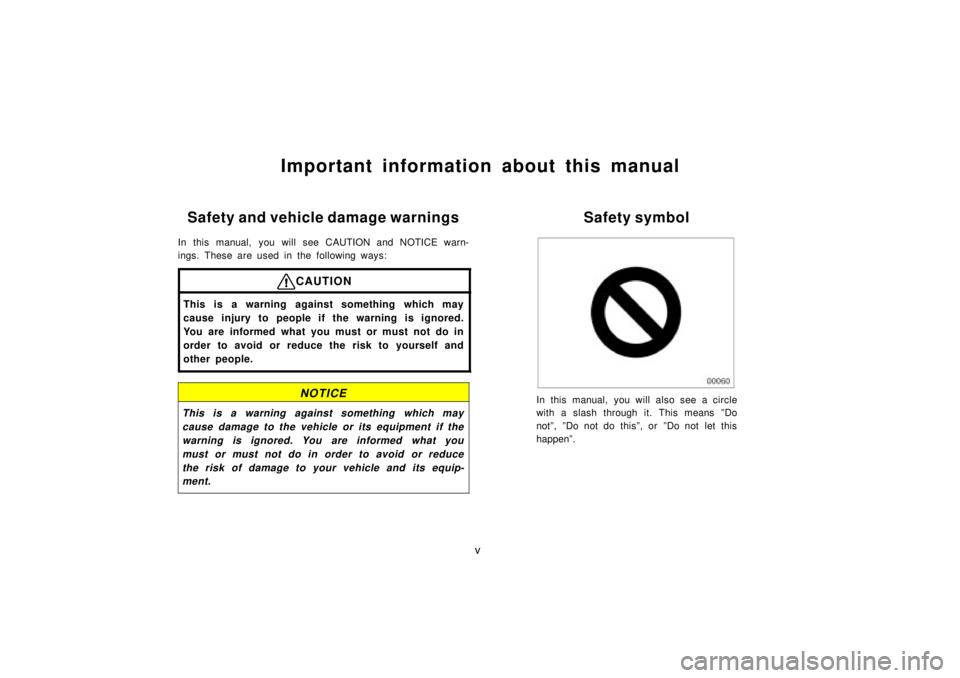
In this manual, you will also see a circle
with a slash through it. This means ºDo
notº, ºDo not do thisº, or ºDo not let this
happenº.
Page 246 of 246

Publication No. OM35729U
Part No. 01999-35729
Printed in Japan 01-9801-00
(U)
Quick index
If a service reminder indicator or warning buzzer comes on 70 . . . . . . . .
If your vehicle will not start 164
. . . . . . . . . . . . . . . . . . . . . . . . . . . . . . . . . . . . .
If your engine stalls while driving 167
. . . . . . . . . . . . . . . . . . . . . . . . . . . . . . . .
If your vehicle overheats 168
. . . . . . . . . . . . . . . . . . . . . . . . . . . . . . . . . . . . . . . .
If you have a flat tire 169
. . . . . . . . . . . . . . . . . . . . . . . . . . . . . . . . . . . . . . . . . . .
If your vehicle needs to be towed 177
. . . . . . . . . . . . . . . . . . . . . . . . . . . . . . .
Tips for driving during break-in period 138 . . . . . . . . . . . . . . . . . . . . . . . . . . . .
How to start the engine 151
. . . . . . . . . . . . . . . . . . . . . . . . . . . . . . . . . . . . . . . . .
General maintenance 193
. . . . . . . . . . . . . . . . . . . . . . . . . . . . . . . . . . . . . . . . . . . .
Complete index NO TAG
. . . . . . . . . . . . . . . . . . . . . . . . . . . . . . . . . . . . . . . . . . . . .
Gas station information
Fuel type: UNLEADED gasoline, Octane Rating 87 (Research Octane Number 91)
or higher
See page 138 for detailed information.
Fuel tank capacity: Two-wheel drive models except Pre Runner
57 L (15.1 gal., 12.5 lmp. gal.)
Four-wheel drive models and Pre Runner
68 L (18.0 gal., 15.0 lmp. gal.)
Engine oil:
API grade SH, ºEnergy- Conserving IIº or SJ, Energy- Conservingº
multigrade engine oil or ILSAC multigrade engine oil is recommended.
See page 207 for detailed information.
Tire information: See pages 210 through 214.
Tire pressure: See page 232. f
U 2
I