check engine TOYOTA TACOMA 1999 User Guide
[x] Cancel search | Manufacturer: TOYOTA, Model Year: 1999, Model line: TACOMA, Model: TOYOTA TACOMA 1999Pages: 247, PDF Size: 4.17 MB
Page 158 of 247
'99 Tacoma (U)
158
(b) Starting the engine
Before starting the engine, be sure to fol-
low the instructions in º(a) Before crank-
ingº.
Normal starting procedure
The multiport fuel injection system/sequen-
tial multiport fuel injection system in your
engine automatically controls the proper
air- fuel mixture for starting. You can start
a cold or hot engine as follows:
1. With your foot off the accelerator ped- al, crank the engine by turning the key
to ºSTARTº. Release it when the en-
gine starts.
2. After the engine runs for about 10 se- conds, you are ready to drive.
If the weather is below freezing, let the
engine warm up for a few minutes before
driving.
If the engine stalls...
Simply restart it, using the correct proce-
dure given in normal starting.
If the engine will not start...
See ºIf your vehicle will not startº in Part 4.
NOTICE
Do not crank for more than 30 se- conds at a time. This may overheatthe starter and wiring systems.
Do not race a cold engine.
If the engine becomes difficult tostart or stalls frequently, have the
engine checked immediately.
Always slow down in gusty crosswinds.
This will allow you much better control.
Drive slowly onto curbs and, if pos-
sible, at a right angle. Avoid driving
onto high, sharp- edged objects and
other road hazards. Failure to do so
can lead to severe tire damage result-
ing in tire bursts.
When parking on a hill, turn the front
wheels until they touch the curb so
that the vehicle will not roll. Apply the
parking brake, and place the transmis-
sion in ºPº (automatic) or in first or
reverse (manual). If necessary, block
the wheels.
Washing your vehicle or driving through
deep water may get the brakes wet. To
see whether they are wet, check that
there is no traffic near you, and then
press the pedal lightly. If you do not
feel a normal braking force, the brakes
are probably wet. To dry them, drive
the vehicle cautiously while lightly
pressing the brake pedal with the park-
ing brake pulled. If they still do not
work safely, pull to the side of the road
and call a Toyota dealer for assistance.
Tips for driving in various
conditions
Page 160 of 247
'99 Tacoma (U)
160
When driving your vehicle off- road, please
observe the following precautions to en-
sure your driving enjoyment and to help
prevent the closure of areas to off- road
vehicles.
a. Drive your vehicle only in areas where
off- road vehicles are permitted to travel.
b. Respect private property. Get owner 's
permission before entering private proper-
ty.
c. Do not enter areas that are closed.
Honor gates, barriers and signs that re-
strict travel.
d. Stay on established roads. When condi-
tions are wet, driving techniques should
be changed or travel delayed to prevent
damage to roads.
For owners in U.S. mainland, Hawaii and
Puerto Rico:
To obtain additional information pertaining
to driving your vehicle off- road, consult
the following organizations.
State and Local Parks and Recreation
Departments
State Motor Vehicle Bureau
Recreational Vehicle Clubs
U.S. Forest Service and Bureau of
Land Management
CAUTION
Always observe the following precau-
tions to minimize the risk of serious
personal injury or damage to your ve-
hicle: Drive carefully when off the road.
Do not take unnecessary risks by
driving in dangerous places.
Do not grip the steering wheel
spokes when driving off- road. A
bad bump could jerk the wheel and
injure your hands. Keep both hands
and especially your thumbs on the
outside of the rim.
Always check your brakes for effec-
tiveness immediately after driving in
sand, mud, water or snow.
After driving through tall grass,
mud, rock, sand, rivers, etc., check
that there is no grass, bush, paper,
rags, stone, sand, etc. adhering or
trapped on the underbody. Clear off
any such matter from the under-
body. If the vehicle is used with
these materials trapped or adhering
to the underbody, a breakdown or
fire could occur.
The driver and all passengers
should fasten their seat belts when-
ever the vehicle is moving.
NOTICE
If driving through water, such as
when crossing shallow streams,first check the depth of the waterand the bottom of the river bed for
firmness. Drive slowly and avoiddeep water.
Take all necessary safety measures
to ensure that water damage to theengine or other components doesnot occur.
Water entering the engine air intakewill cause severe engine damage.
Water can wash the grease fromwheel bearings, causing rusting and
premature failure, and may also en-ter the differentials, transmission and transfer case, reducing the gear
oil's lubricating qualities.
Off- road driving precautions
(four- wheel drive models
only)
Page 161 of 247
'99 Tacoma (U)
161
Sand and mud that has accumulated
in brake drums and around brakediscs may affect braking efficiency and may damage brake system com-
ponents.
Always perform a maintenance in-spection after each day of off- road
driving that has taken you throughrough terrain, sand, mud, or water.For scheduled maintenance in-
formation, refer to the separateºScheduled Maintenance Guideº orºOwner 's Manual Supplementº.
Winter driving tips
Make sure you have a proper freeze
protection of engine coolant.
Your coolant must contain ethylene- glycol
type coolant for a proper corrosion
protection of aluminum components. Use
ºToyota Long Life Coolantº or equivalent.
See Chapter 7- 2 for details about coolant
type selection.
NOTICE
Do not use alcohol type antifreeze or
plain water alone.
When it is extremely cold, we recommend
to use 60% solution for your Toyota, to
provide protection down to about -50 5C
(- 58 5F). Do not use more than 70% solu-
tion for better coolant performance.
Check the condition of the battery and
cables.
Cold temperatures reduce the capacity of
any battery, so it must be in top shape
to provide enough power for winter start-
ing. Chapter 7- 3 tells you how to visually
inspect the battery. Your Toyota dealer
and most service stations will be pleased
to check the level of charge. Make sure the engine oil viscosity is
suitable for the cold weather.
See Chapter 7- 2 for recommended viscos-
ity. Leaving a heavy summer oil in your
vehicle during winter months may cause
harder starting. If you are not sure about
which oil to use, call your Toyota deal-
erÐhe will be pleased to help.
Keep the door locks from freezing.
Squirt lock de- icer or glycerine into the
locks to keep them from freezing. To open
a frozen lock, try heating the key before
inserting it.
Use a washer fluid containing an ant-
freeze solution.
This product is available at your Toyota
dealer and most auto parts stores. Follow
the manufacturer 's directions for how
much to mix with water.
NOTICE
Do not use engine antifreeze or any
other substitute because it may dam-age your vehicle's paint.
Page 162 of 247
'99 Tacoma (U)
162
Do not use your parking brake when
there is a possibility it could freeze.
When parking, put the transmission into
ºPº (automatic) or into first or reverse
(manual) and block the front wheels. Do
not use the parking brake, or snow or
water accumulated in and around the
parking brake mechanism may freeze,
making it hard to release.
Keep ice and snow from accumulating
under the fenders.
Ice and snow built up under your fenders
can make steering difficult. During bad
winter driving, stop and check under the
fenders occasionally.
Depending on where you are driving,
we recommend you carry some emer-
gency equipment.
Some of the things you might put in the
vehicle are tire chains, window scraper,
bag of sand or salt, flares, small shovel,
jumper cables, etc.
Trailer towing
Your vehicle is designed primarily as a
passenger- and- load- carrying vehicle. Tow-
ing a trailer will have an adverse effect on
handling, performance, braking, durab
ility
and driving economy (fuel consumption,
etc.). Your safety and satisfaction depend
on the proper use of correct equipment
and cautious driving habits. For your safe-
ty and the safety of others, you must not
overload your vehicle or trailer. Ask your
local Toyota dealer for further details be-
fore towing.
WEIGHT LIMITS
Before towing, make sure the total trail-
er weight, gross combination weight,
gross vehicle weight, gross axle weight
and trailer tongue load are all within
the limits.
The total trailer weight and tongue load
can be measured with platform scales
found at a highway weighing station, build-
ing supply company, trucking company,
junk yard, etc.
CAUTION
The maximum gross trailer weight
(trailer weight plus cargo weight)
must never exceed the following.
2RZ- FE and 3RZ- FE engines
1587 kg (3500 lb.)
5VZ- FE engine 2267 kg (5000 lb.)
If towing a trailer and cargo weigh-
ing over 907 kg (2000 lb.), it is
necessary to use a sway control
device with sufficient capacity. The
combination of the gross trailer
weight added to the total weight of
the vehicle, occupants and vehicle
cargo must never exceed a total of
the following.
Page 165 of 247
'99 Tacoma (U)
165
CAUTION
If the total trailer weight exceeds
453 kg (1000 lb.), trailer brakes are
required.
Never tap into your vehicle's hy-
draulic system as it would lower its
braking effectiveness.
Never tow a trailer without using a
safety chain securely attached to
both the trailer and the vehicle. If
damage occurs to the coupling unit
or hitch ball, there is danger of the
trailer wandering over into another
lane.
TIRES
Ensure that your vehicle's tires are
properly inflated. See Chapter 7- 2 for
instructions.
The trailer tires should be inflated to
the pressure recommended by the trail-
er manufacturer in respect to the total
trailer weight. TRAILER LIGHTS
Trailer lights must comply with federal,
state/provincial and local regulations.
See your local recreational vehicle
dealer or rental agency for the correct
type of wiring and relays for your trail-
er. Check for correct operation of the
turn signals and stop lights each time
you hitch up. Direct splicing may dam-
age your vehicle's electrical system
and cause a malfunction of your lights.
BREAK- IN SCHEDULE Toyota recommends that you do not
tow a trailer with a new vehicle or a
vehicle with any new power train com-
ponent (engine, transmission, differen-
tial, wheel bearing, etc.) for the first
800 km (500 miles) of driving.
MAINTENANCE
If you tow a trailer, your vehicle will
require more frequent maintenance due
to the additional load. For this informa-
tion, please refer to the scheduled
maintenance information in the ºSched-
uled Maintenance Guideº or ºOwner 's
Manual Supplementº.
Retighten all fixing bolts of the towing
ball and bracket after approximately
1000 km (600 miles) of trailer driving.
PRE- TOWING SAFETY CHECK Check that your vehicle remains level
when a loaded or unloaded trailer is
hitched. Do not drive if the vehicle has
an abnormal nose- up or nose- down
condition, and check for improper
tongue load, overload, worn suspension
or other possible causes.
Make sure the trailer cargo is securely
loaded so that it cannot shift.
Check that your rear view mirrors con-
form to any applicable federal, state/
provincial or local regulation. If not,
install the rear view mirrors required
for towing purpose.
Page 166 of 247

'99 Tacoma (U)
166
TRAILER TOWING TIPS
When towing a trailer, your vehicle will
handle differently than when not tow-
ing. The three main causes of vehicle-
trailer accidents are driver error, exces-
sive speed and improper trailer loading.
Keep these in mind when towing:
Before starting out, check operation of
the lights and all vehicle- trailer connec-
tions. After driving a short distance,
stop and recheck the lights and con-
nections. Before actually towing a trail-
er, practice turning, stopping and back-
ing with a trailer in an area away from
traffic until you learn the feel.
Backing with a trailer is difficult and
requires practice. Grip the bottom of
the steering wheel and move your hand
to the left to move the trailer to the
left. Move your hand to the right to
move the trailer to the right. (This pro-
cedure is generally opposite to that
when backing without a trailer). Also,
just turn the steering wheel a little at
a time, avoiding sharp or prolonged
turning. Have someone guide you when
backing to reduce the risk of an acci-
dent.
Because stopping distance may be in-
creased, vehicle- to- vehicle distance
should be increased when towing a
trailer. For each 16 km/h (10 mph) of
speed, allow at least one vehicle and
trailer length between you and the ve-
hicle ahead. Avoid sudden braking as
you may skid, resulting in jackknifing
and loss of control. This is especially
true on wet or slippery surfaces.
Avoid jerky starts or sudden accelera-
tion. If your vehicle has a manual
transmission, prevent excessive clutch
slippage by keeping engine rpm low
and not racing the engine. Always start
out in first gear.
Avoid jerky steering and sharp turns.
The trailer could hit your vehicle in a
tight turn. Slow down before making a
turn to avoid the necessity of sudden
braking.
Remember that when making a turn,
the trailer wheels will be closer than
the vehicle wheels to the inside of the
turn. Therefore, compensate for this by
making a larger than normal turning
radius with your vehicle.
Crosswinds and rough roads will ad-
versely affect handling of your vehicle
and trailer, causing sway. Pay attention
to the rear from time to time to pre-
pare yourself for being passed by large
trucks or buses, which may cause your
vehicle and trailer to sway. If swaying
happens, firmly grip the steering wheel
and reduce speed immediately but
gradually. Never increase speed. Steer
straight ahead. If you make no extreme
correction with the steering or brakes,
the vehicle and trailer will stabilize.
Page 171 of 247
'9 9 Ta co ma (U)
171
Part 4
IN CASE OF AN
EMERGENCY
If your vehicle will not start
If your engine stalls while
driving
If your vehicle overheats
If you have a flat tire
If your vehicle needs to
be towed
If you cannot shift automatic
transmission selector lever
If you lose your keys
Before making these checks, make sure
you have followed the correct starting pro-
cedure given in ºHow to start the engineº
in Part 3 and that you have sufficient fuel.
If the engine is not turning over or is
turning over too slowlyÐ
1. Check that the battery terminals are tight and clean.
2. If the battery terminals are O.K., switch on the interior light.
3. If the light is out, dim or goes out when the starter is cranked, the battery
is discharged. You may try jump start-
ing. See º(c) Jump startingº for further
instructions.
If the light is O.K., but the engine still will
not start, it needs adjustment or repair.
Call a Toyota dealer or qualified repair
shop.
NOTICE
Do not pull- or push- start the ve- hicle. It may damage the vehicle orcause a collision when the engine starts. Also the three- way catalytic
converter may overheat and become afire hazard.
If the engine turns over at its normal
speed but will not startÐ
1. Check that all the push- on connectors are tight. (For example, connectors at
the spark plugs, ignition coil and/or dis-
tributor)
2. If the connectors are O.K., the engine may be flooded because of repeated
cranking. See º(b) Starting a flooded
engineº for further instructions.
If your vehicle will not startÐ
(a) Simple checks
Page 174 of 247
'99 Tacoma (U)
174
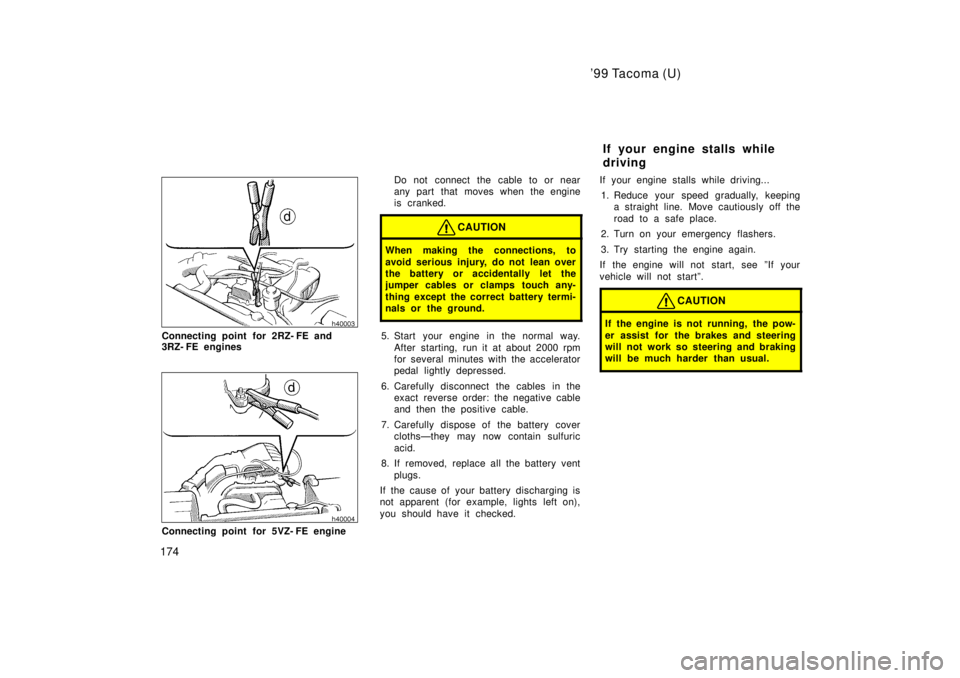
Connecting point for 2RZ- FE and
3RZ- FE engines
Connecting point for 5VZ- FE engine Do not connect the cable to or near
any part that moves when the engine
is cranked.
CAUTION
When making the connections, to
avoid serious injury, do not lean over
the battery or accidentally let the
jumper cables or clamps touch any-
thing except the correct battery termi-
nals or the ground.
5. Start your engine in the normal way.
After starting, run it at about 2000 rpm
for several minutes with the accelerator
pedal lightly depressed.
6. Carefully disconnect the cables in the exact reverse order: the negative cable
and then the positive cable.
7. Carefully dispose of the battery cover clothsÐthey may now contain sulfuric
acid.
8. If removed, replace all the battery vent plugs.
If the cause of your battery discharging is
not apparent (for example, lights left on),
you should have it checked. If your engine stalls while driving...
1. Reduce your speed gradually, keeping a straight line. Move cautiously off the
road to a safe place.
2. Turn on your emergency flashers.
3. Try starting the engine again.
If the engine will not start, see ºIf your
vehicle will not startº.
CAUTION
If the engine is not running, the pow-
er assist for the brakes and steering
will not work so steering and braking
will be much harder than usual.
If your engine stalls while
driving
Page 175 of 247
'99 Tacoma (U)
175
If your vehicle overheats
If your engine coolant temperature
gauge indicates overheating, if you ex-
perience a loss of power, or if you hear
a loud knocking or pinging noise, the
engine has probably overheated. You
should follow this procedure...
1. Pull safely off the road, stop the ve- hicle and turn on your emergency
flashers. Put the transmission in ºPº
(automatic) or neutral (manual) and ap-
ply the parking brake. Turn off the air
conditioning if it is being used.
2. If coolant or steam is boiling out of the radiator or reservoir, stop the engine.
Wait until the steam subsides before
opening the hood. If there is no coolant
boiling over or steam, leave the engine
running.
CAUTION
To help avoid personal injury, keep
the hood closed until there is no
steam. Escaping steam or coolant is
a sign of very high pressure.
3. Visually check to see if the engine drive belt (fan belt) is broken or loose.
Look for obvious coolant leaks from the
radiator, hoses, and under the vehicle.
However, note that water draining from
the air conditioning is normal if it has
been used.
CAUTION
When the engine is running, keep
hands and clothing away from the
moving fan and engine drive belts.
4. If the engine drive belt is broken or thecoolant is leaking, stop the engine im-
mediately. Call a Toyota dealer for as-
sistance.
5. If the engine drive belt is O.K. and there are no obvious leaks, you may
help the engine cool down more quickly
by running it at about 1500 rpm for a
few minutes with the accelerator pedal
lightly depressed.
6. Check the coolant reservoir. If it is dry, add coolant to the reservoir while the
engine is running. Fill it about half full.
CAUTION
Do not attempt to remove the radiator
cap when the engine and radiator are
hot. Serious injury could result from
scalding hot fluid and steam blown
out under pressure.
7. After the engine coolant temperaturehas cooled to normal, again check the
coolant level in the reservoir. If neces-
sary, bring it up to half full again. Seri-
ous coolant loss indicates a leak in the
system. You s hould have it checked as
soon as possible at your Toyota dealer.
Page 190 of 247

'99 Tacoma (U)
190
If you cannot shift the selector lever
out of ºPº position to other positions
even though the brake pedal is de-
pressed, use the shift lock override but-
ton as follows: 1. Turn the ignition key to ºLOCKº position. Make sure the parking
brake is set.
2. Pry up the cover with a flat- bladed screwdriver or equivalent.3. Insert the screwdriver or equivalent into the hole to push up the shift
lock override button. You can shift
out of ºPº position only while push-
ing the button.
4. Shift into ºNº position.
5. Insert the cover.
6. Start the engine. For your safety, keep the brake pedal depressed.
Be sure to have the system checked by
your Toyota dealer as soon as possible.If you cannot shift the selector lever
out of ºPº position to other positions
even though the brake pedal is de-
pressed, use the shift lock override but-
ton as follows: 1. Turn the ignition key to ºLOCKº position. Make sure the parking
brake is set.
2. Pry up the cover with a flat- bladed screwdriver or equivalent.
If you cannot shift automatic
transmission selector lever
(column shift)
If you cannot shift automatic
transmission selector lever
(floor shift)