gas type TOYOTA TACOMA 2010 Owners Manual (in English)
[x] Cancel search | Manufacturer: TOYOTA, Model Year: 2010, Model line: TACOMA, Model: TOYOTA TACOMA 2010Pages: 532, PDF Size: 15.03 MB
Page 73 of 532

73
1
1-4. Opening and closing the windows
Before driving
Back window (vehicles with sliding type)
■Closing the back window
Make sure that the back window is securely closed after closing it.
CAUTION
■While driving
Keep the back window closed.
This not only keeps personal belongings from being thrown out, but also pre-
vents exhaust gases from entering the vehicle.
The back window can be opened and closed using the lock release
lever.
Open/close
Push the lock release lever
and slide the back window.
Page 75 of 532

75 1-5. Refueling
1
Before driving
Closing the fuel tank cap
When replacing the fuel tank
cap, turn it until a clicking sound
is heard.
After releasing your hand, the cap
will turn slightly to the opposite
direction.
■Fuel types
Use unleaded gasoline. (Octane Rating 87 [Research Octane Number 91] or
higher)
■Fuel tank capacity
Approximately 21.1 gal. (80.0 L, 17.6 Imp. gal.)
Page 85 of 532
85 1-7. Safety information
1
Before driving
Your vehicle is equipped with ADVANCED AIRBAGS designed based
on US motor vehicle safety standards (FMVSS208). The airbag sys-
tem controls airbag deployment power for the driver and right front
passenger. The driver airbag system consists of the driver seat’s
position sensor etc. The front passenger’s airbag system consists of
the front passenger occupant classification sensor etc.
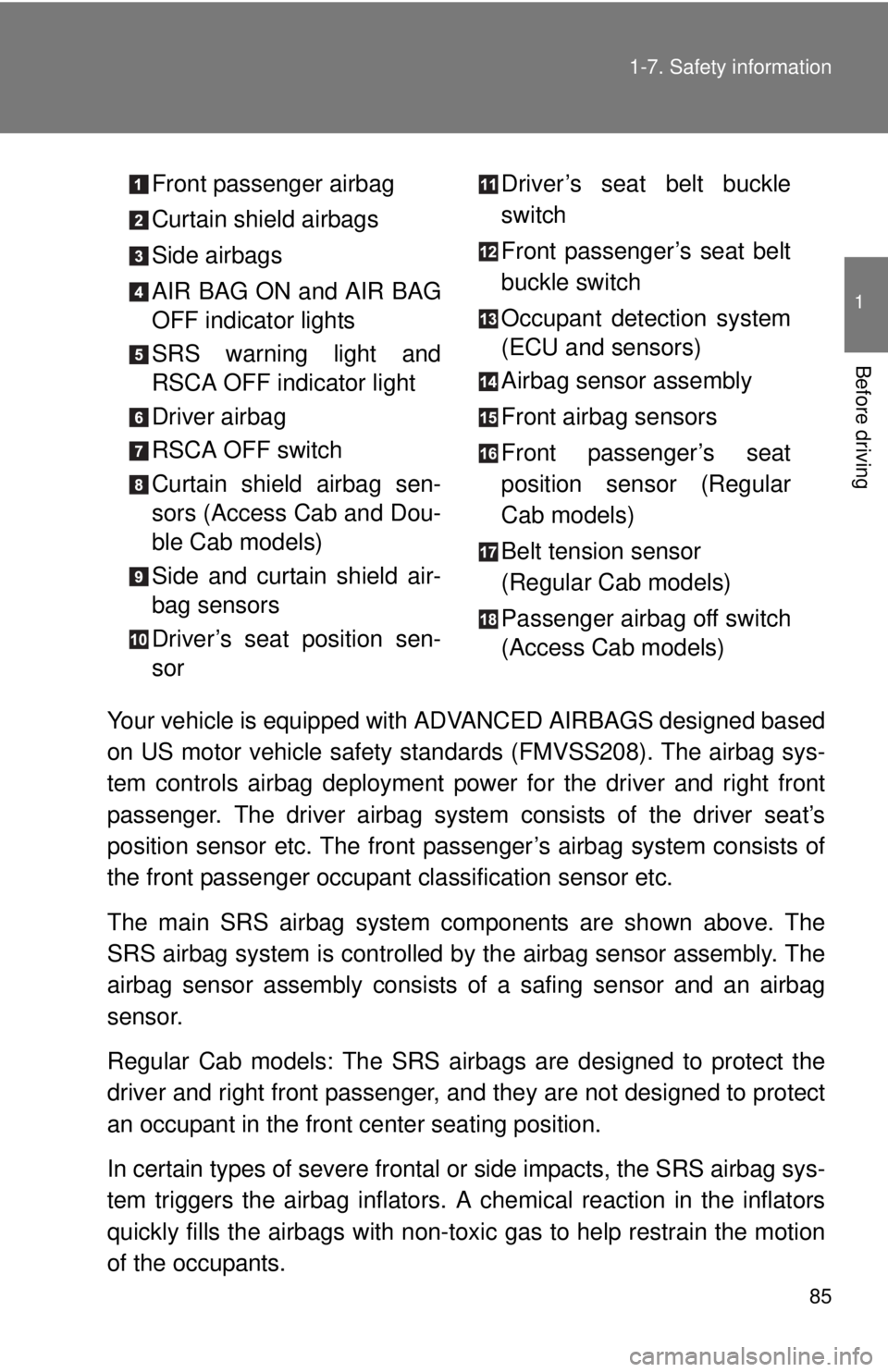
The main SRS airbag system components are shown above. The
SRS airbag system is controlled by the airbag sensor assembly. The
airbag sensor assembly consists of a safing sensor and an airbag
sensor.
Regular Cab models: The SRS airbags are designed to protect the
driver and right front passenger, and they are not designed to protect
an occupant in the front center seating position.
In certain types of severe frontal or side impacts, the SRS airbag sys-
tem triggers the airbag inflators. A chemical reaction in the inflators
quickly fills the airbags with non-toxic gas to help restrain the motion
of the occupants. Front passenger airbag
Curtain shield airbags
Side airbags
AIR BAG ON and AIR BAG
OFF indicator lights
SRS warning light and
RSCA OFF indicator light
Driver airbag
RSCA OFF switch
Curtain shield airbag sen-
sors (Access Cab and Dou-
ble Cab models)
Side and curtain shield air-
bag sensors
Driver’s seat position sen-
sorDriver’s seat belt buckle
switch
Front passenger’s seat belt
buckle switch
Occupant detection system
(ECU and sensors)
Airbag sensor assembly
Front airbag sensors
Front passenger’s seat
position sensor (Regular
Cab models)
Belt tension sensor
(Regular Cab models)
Passenger airbag off switch
(Access Cab models)
Page 141 of 532
141 2-1. Driving procedures
2
When driving
CAUTION
●The exhaust should be checked occasionally. If there is a hole or crack
caused by corrosion, damage to a joint or abnormal exhaust noise, be
sure to have the vehicle inspected and repaired by your Toyota dealer.
Failure to do so may allow exhaust gases to enter the vehicle, resulting in
death or a serious health hazard.
●Toyota does not recommend occupying the rear cargo area when it is fitted
with a slide-in camper, camper shell or other type cover while the engine is
running. This caution applies to both driving and stopped or parked situa-
tions with the engine running. Particular care should be taken to prevent
exhaust gases from entering camper bodies, trailers or other enclosures
on or around your vehicle. If exhaust fumes are detected, open all win-
dows and thoroughly ventilate the area.
■When taking a nap in the vehicle
Always turn the engine off. Otherwise, you may accidentally move the shift
lever or depress the accelerator pedal, which could cause an accident or fire
due to engine overheating. Additionally, if the vehicle is parked in a poorly
ventilated area, exhaust gases may collect and enter the vehicle, leading to
death or a serious health hazard.
■When braking the vehicle
●When the brakes are wet, drive more cautiously.
Braking distance increases when the brakes are wet, and may cause one
side of the vehicle to brake differently than the other side. Also the parking
brake may not securely hold the vehicle.
●If the power brake assist function does not operate, do not follow other
vehicles closely and avoid downhills or sharp turns that require braking.
In this case, braking is still possible, but it will require more force on the
pedal than usual. Braking distance may also increase.
●Do not pump the brake pedal if the engine stalls.
Each push on the brake pedal uses up the reserve for the power-assisted
brakes.
Page 475 of 532

475 6-1. Specifications
6
Vehicle specifications
Engine
2.7 L 4-cylinder (2TR-FE) engine
4.0 L V6 (1GR-FE) engine
Fuel
Model 2TR-FE
Type 4-cylinder in line, 4-cycle, gasoline
Bore and stroke 3.74 3.74 in. (95.0 95.0 mm)
Displacement 164.3 cu.in. (2694 cm3)
Drive belt tension Automatic adjustment
Valve clearance
(engine cold)
Intake
ExhaustAutomatic adjustment
Model 1GR-FE
Type 6-cylinder V type, 4-cycle, gasoline
Bore and stroke 3.70 3.74 in. (94.0 95.0 mm)
Displacement 241.4 cu.in. (3956 cm3)
Drive belt tension Automatic adjustment
Valve clearance
(engine cold)
Intake
Exhaust0.006 0.010 in. (0.15 0.25 mm)
0.011 0.015 in. (0.29 0.39 mm)
Fuel type Unleaded gasoline only
Octane rating 87 (Research octane number 91) or higher
Fuel tank capacity
(Reference)21.1 gal. (80.0 L, 17.6 lmp.gal.)
Page 489 of 532

489 6-1. Specifications
6
Vehicle specifications
■Toyota recommends the use of gasoline containing detergent additives
●Toyota recommends the use of gasoline that contains detergent additives
to avoid build-up of engine deposits.
●All gasoline sold in the US contains detergent additives to clean and/or
keep clean intake systems.
■Toyota recommends the use of cleaner burning gasoline
Cleaner burning gasoline, including reformulated gasoline that contains
oxygenates such as ethanol or MTBE (Methyl Tertiary Butyl Ether) is
available in many areas.
Toyota recommends the use of cleaner burning gasoline and appropriately
blended reformulated gasoline. These types of gasoline provide excellent
vehicle performance, reduce vehicle emissions and improve air quality.
■Toyota does not recommend blended gasoline
●Toyota allows the use of oxygenate blended gasoline where the
oxygenate content is up to 10% ethanol or 15% MTBE.
●If you use gasohol in your Toyota, be sure that it has an octane rating no
lower than 87.
●Toyota does not recommend the use of gasoline containing methanol.
■Toyota does not recommend gasoline containing MMT
Some gasoline contains octane enhancing additive called MMT
(Methylcyclopentadienyl Manganese Tricarbonyl).
Toyota does not recommend the use of gasoline that contains MMT. If fuel
containing MMT is used, your emission control system may be adversely
affected.
The malfunction indicator lamp on the instrument cluster may come on. If
this happens, contact your Toyota dealer for service.
Page 490 of 532

490 6-1. Specifications
NOTICE
■Notice on fuel quality
●Do not use improper fuels.
If improper fuels are used the engine will be damaged.
●Do not use leaded gasoline.
Leaded gasoline can cause damage to your vehicle’s three-way catalytic
converters causing the emission control system to malfunction.
●Do not use gasohol other than that stated here.
Other gasohol may cause fuel system damage or vehicle performance
problems.
●Using unleaded gasoline with an octane number or rating lower than the
level previously stated will cause persistent heavy knocking.
At worst, this will lead to engine damage.
■Fuel-related poor driveability
If after using a different type of fuel, poor driveability is encountered (poor
hot starting, vaporization, engine knocking, etc.), discontinue the use of that
type of fuel.
■When refueling with gasohol
Take care not to spill gasohol.
It can damage your vehicle’s paint.
Page 521 of 532

521 Alphabetical index
Front passenger’s seat belt
reminder light ........................ 434
Front passenger’s seat belt
warning buzzer...................... 434
Front seats
Adjustment ............................. 45
Front side marker lights
Replacing light bulbs ............ 412
Switch ................................... 164
Wattage ................................ 487
Front turn signal lights
Lever .................................... 156
Replacing light bulbs ............ 413
Switch ................................... 156
Wattage ................................ 487
Fuel
Capacity ............................... 475
Fuel gauge ........................... 157
Fuel pump shut off system ... 428
Gas station information ........ 532
Information ........................... 488
Refueling ................................ 74
Type ..................................... 475
Warning light ........................ 434
Fuel door .................................... 74
Fuel filler door ........................... 74
Fuel pump shut off system .... 428
Fuses
Fuses.................................... 398
Locations ...................... 401, 405
Garage door opener box ........ 333
Gas station information .......... 532
Gauges ..................................... 157
Glove box ................................. 302
Hands-free system
(for cellular phone) ............... 268
Hazard lights
Switch ................................... 420
Head restraints
Adjusting ................................ 54Headlights
Replacing light bulbs .............409
Switch....................................164
Wattage .................................487
High mounted stoplight
Replacing ..............................415
Wattage .................................487
Hill-start assist control ............191
Hood ..........................................360
Hooks
Cargo net ..............................332
Deck hooks ...........................326
Shopping bag ........................331
Tie-down cleats .....................327
Horn...........................................160
I/M test.......................................355
Identification
Engine ...................................474
Tire ........................................492
Vehicle ..................................473
Ignition switch ..........................146
Illuminated entry system .........300
Immobilizer system....................78
Indicator lights .........................160
Initialization
Items to initialize....................503
Inside rear view mirror ..............65
Interior lights
Interior lights..........................301
Personal lights.......................301
Switch....................................301
Wattage .................................487
Instrument panel light
control ....................................158
Jack
Positioning the jack ...............448
Vehicle-equipped jack ...........440
Jack handle ..............................445
G
H
I
J
Page 532 of 532

532
GAS STATION INFORMATION
STYPIAF008
Auxiliary catch lever
P. 360Fuel filler door
P. 7 4
Tire inflation pressure
P. 484
Hood lock release lever
P. 3 6 0
Fuel tank capacity 21.1 gal. (80.0 L, 17.6 lmp.gal.)
Fuel typeUnleaded gasoline, Octane Rating 87
(Research Octane Number 91) or higher
Cold tire inflation
pressureP. 4 8 4
Engine oil capacity
(Drain and refill)P. 4 7 6
Engine oil typeToyota Genuine Motor Oil or equivalent
Oil grade: P. 476
ILSAC multigrade engine oil
Recommended oil viscosity:
SAE 5W-20 or 0W-20 (2.7 L 4-cylinder
[2TR-FE] engine)
SAE 5W-30 (4.0 L V6 [1GR-FE] engine)