inflation pressure TOYOTA TACOMA 2010 Owners Manual (in English)
[x] Cancel search | Manufacturer: TOYOTA, Model Year: 2010, Model line: TACOMA, Model: TOYOTA TACOMA 2010Pages: 532, PDF Size: 15.03 MB
Page 4 of 532

TABLE OF CONTENTSIndex
4
3-5. Using the storage features
List of storage features....... 302
• Glove box ......................... 302
• Console boxes ................. 303
• Cup holders ...................... 304
• Bottle holders ................... 306
• Auxiliary boxes ................. 307
• Overhead console ............ 309
3-6. Other interior features
Sun visors .......................... 310
Vanity mirrors ..................... 311
Clock .................................. 312
Outside temperature display
(vehicles with accessory
meter) ............................... 313
Cigarette lighter .................. 314
Power outlet (12V DC) ....... 315
Power outlet (115V AC) ..... 316
Seatback table ................... 322
Floor mat ............................ 323
Luggage compartment
features ............................ 324
Garage door opener box .... 333
Compass (vehicles with
accessory meter).............. 337
4-1. Maintenance and care
Cleaning and protecting
the vehicle exterior ........... 344
Cleaning and protecting
the vehicle interior ............ 3474-2. Maintenance
Maintenance
requirements .................... 350
General maintenance ......... 352
Emission inspection and
maintenance (I/M)
programs .......................... 355
4-3. Do-it-yourself maintenance
Do-it-yourself service
precautions ....................... 356
Hood ................................... 360
Engine compartment .......... 362
Tires.................................... 378
Tire inflation pressure ......... 386
Wheels................................ 391
Air conditioning filter ........... 393
Wireless remote control
battery .............................. 396
Checking and replacing
fuses ................................. 398
Light bulbs .......................... 408
5-1. Essential information
Emergency flashers ............ 420
If your vehicle needs to be
towed ................................ 421
If you think something is
wrong ................................ 427
Fuel pump shut off
system .............................. 428
Event data recorder ............ 429
4Maintenance and care
5When trouble arises
Page 7 of 532
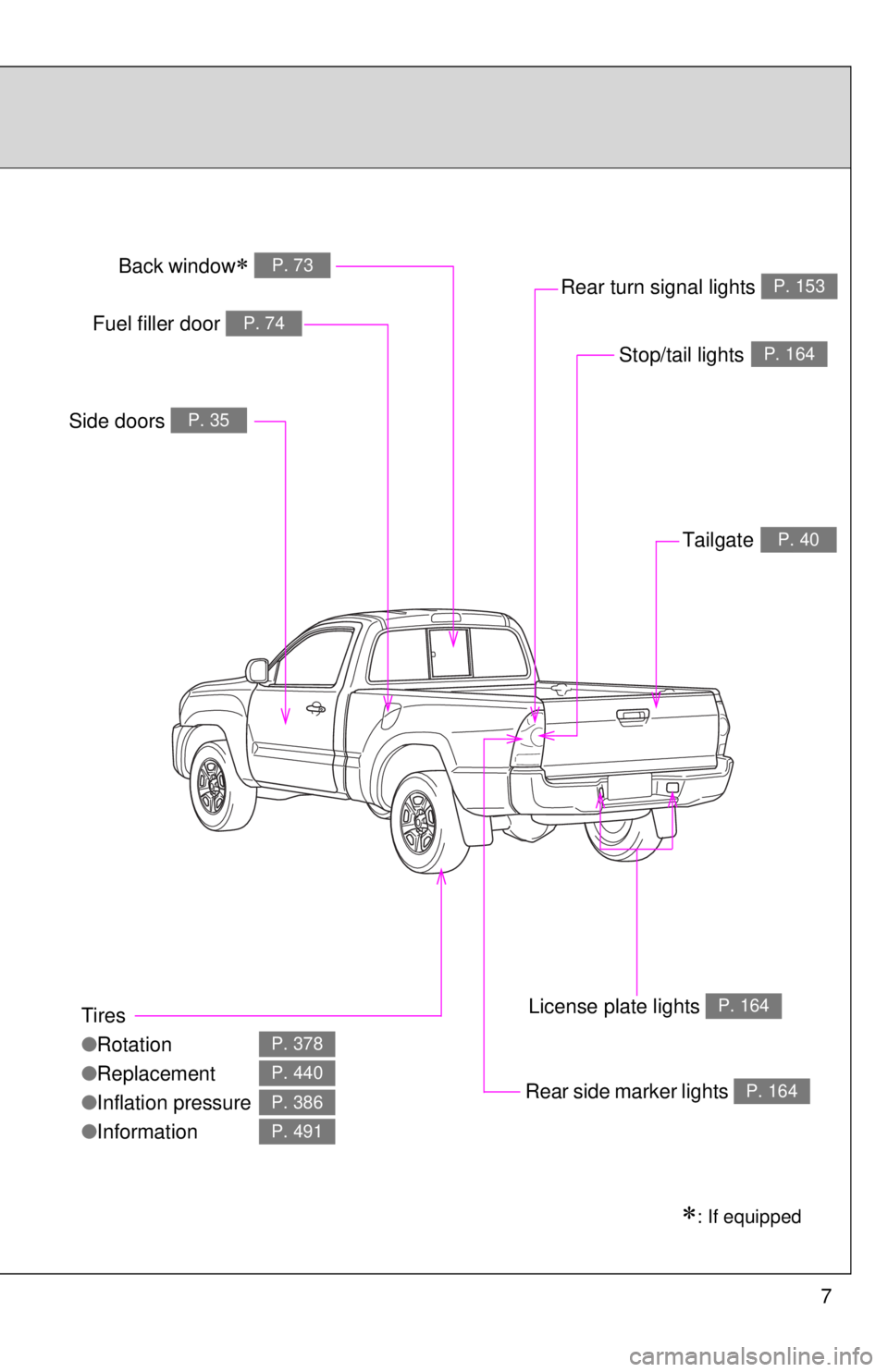
7
Tires
●Rotation
●Replacement
●Inflation pressure
●Information
P. 378
P. 440
P. 386
P. 491
Fuel filler door P. 74
Rear turn signal lights P. 153
Rear side marker lightsP. 164
Side doors P. 35
Stop/tail lightsP. 164
TailgateP. 40
License plate lights P. 164
Back window P. 73
: If equipped
Page 9 of 532
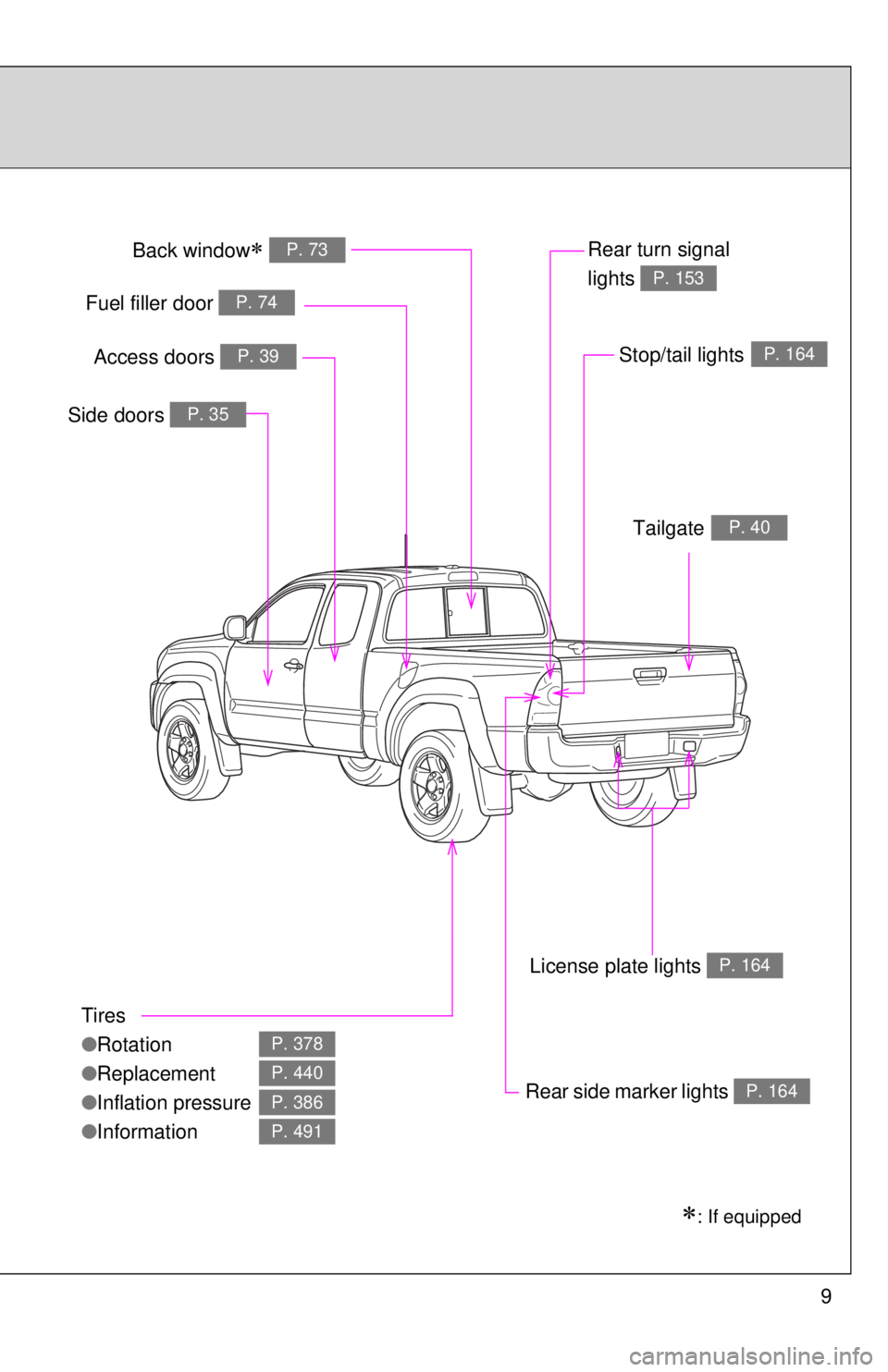
9
Tires
●Rotation
●Replacement
●Inflation pressure
●Information
P. 378
P. 440
P. 386
P. 491
Fuel filler door P. 74
Rear turn signal
lights
P. 153
Rear side marker lightsP. 164
Side doors P. 35
: If equipped
Stop/tail lightsP. 164
TailgateP. 40
License plate lights P. 164
Access doors P. 39
Back window P. 73
Page 11 of 532
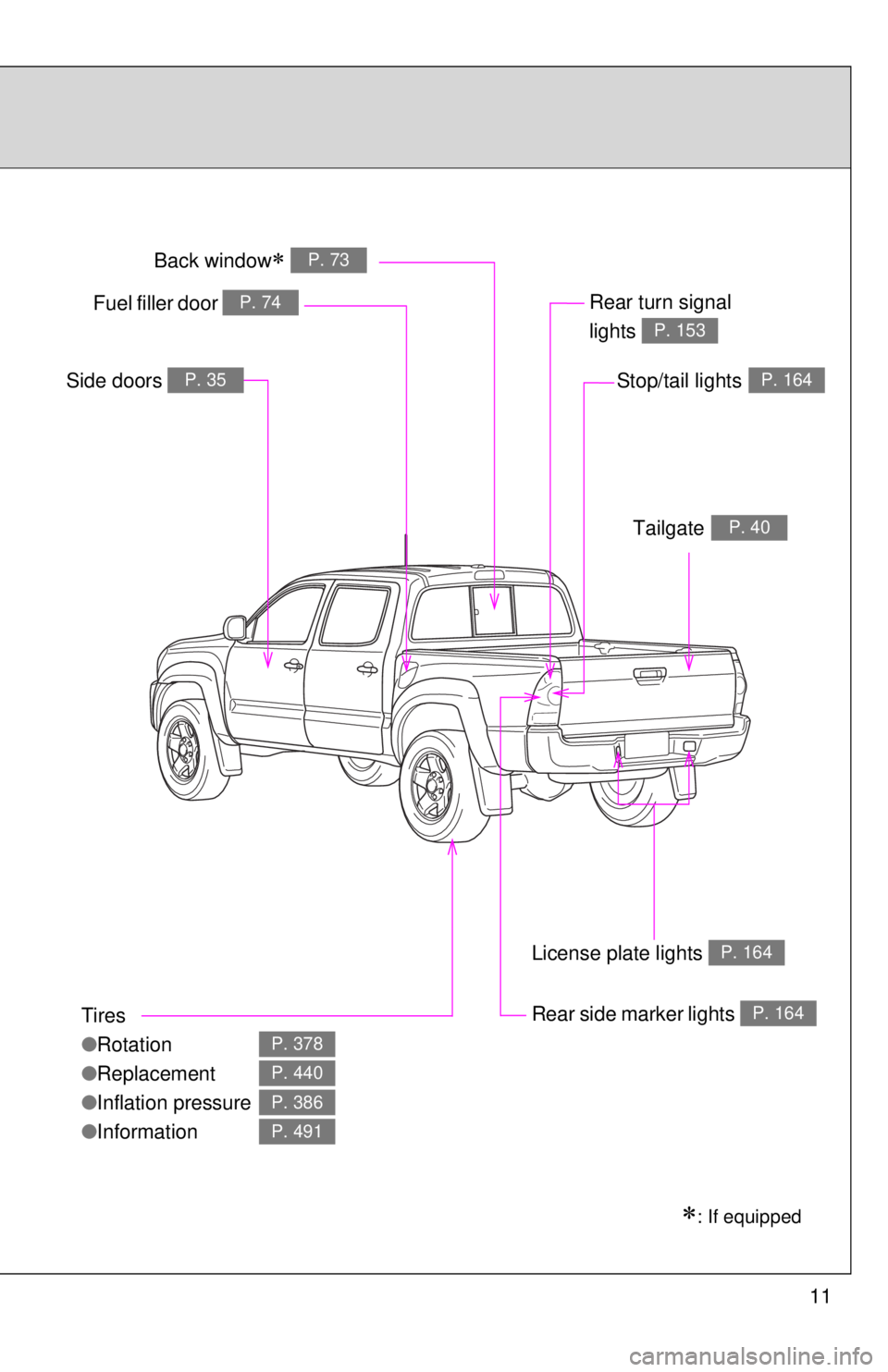
11
Tires
●Rotation
●Replacement
●Inflation pressure
●Information
P. 378
P. 440
P. 386
P. 491
Fuel filler door P. 74Rear turn signal
lights
P. 153
Rear side marker lightsP. 164
Side doors P. 35
: If equipped
Stop/tail lightsP. 164
TailgateP. 40
License plate lights P. 164
Back window P. 73
Page 343 of 532
Maintenance and care4
343
4-1. Maintenance and care
Cleaning and protecting
the vehicle exterior ......... 344
Cleaning and protecting
the vehicle interior .......... 347
4-2. Maintenance
Maintenance
requirements .................. 350
General maintenance....... 352
Emission inspection and
maintenance (I/M)
programs........................ 355
4-3. Do-it-yourself maintenance
Do-it-yourself service
precautions .................... 356
Hood ................................ 360
Engine compartment ........ 362
Tires ................................. 378
Tire inflation pressure ...... 386
Wheels ............................. 391
Air conditioning filter......... 393
Wireless remote control
battery ............................ 396
Checking and replacing
fuses .............................. 398
Light bulbs........................ 408
Page 354 of 532
354 4-2. Maintenance
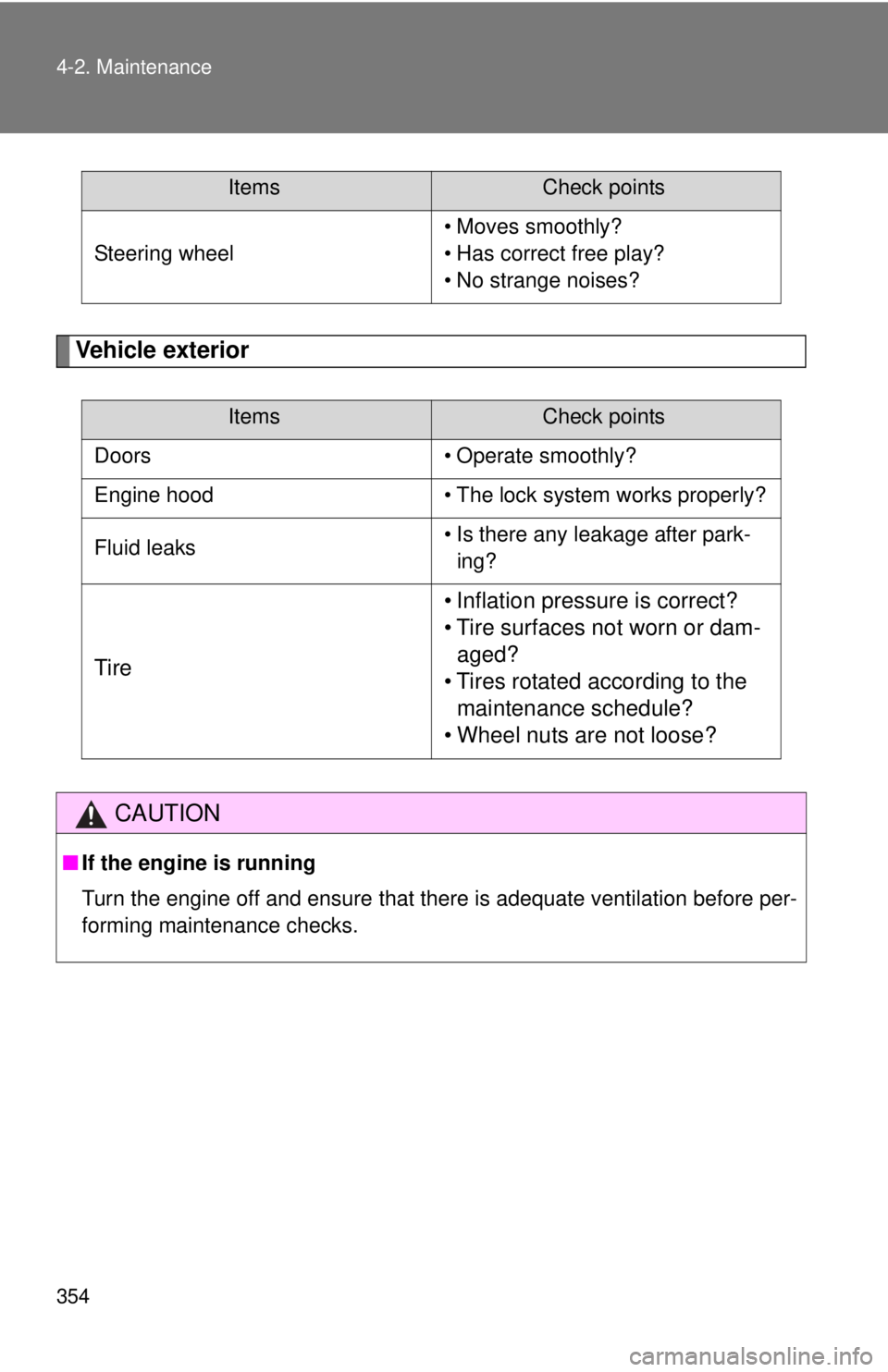
Vehicle exterior
Steering wheel• Moves smoothly?
• Has correct free play?
• No strange noises?
ItemsCheck points
Doors • Operate smoothly?
Engine hood • The lock system works properly?
Fluid leaks• Is there any leakage after park-
ing?
Tire• Inflation pressure is correct?
• Tire surfaces not worn or dam-
aged?
• Tires rotated according to the
maintenance schedule?
• Wheel nuts are not loose?
CAUTION
■If the engine is running
Turn the engine off and ensure that there is adequate ventilation before per-
forming maintenance checks.
ItemsCheck points
Page 357 of 532
357 4-3. Do-it-yourself maintenance
4
Maintenance and care
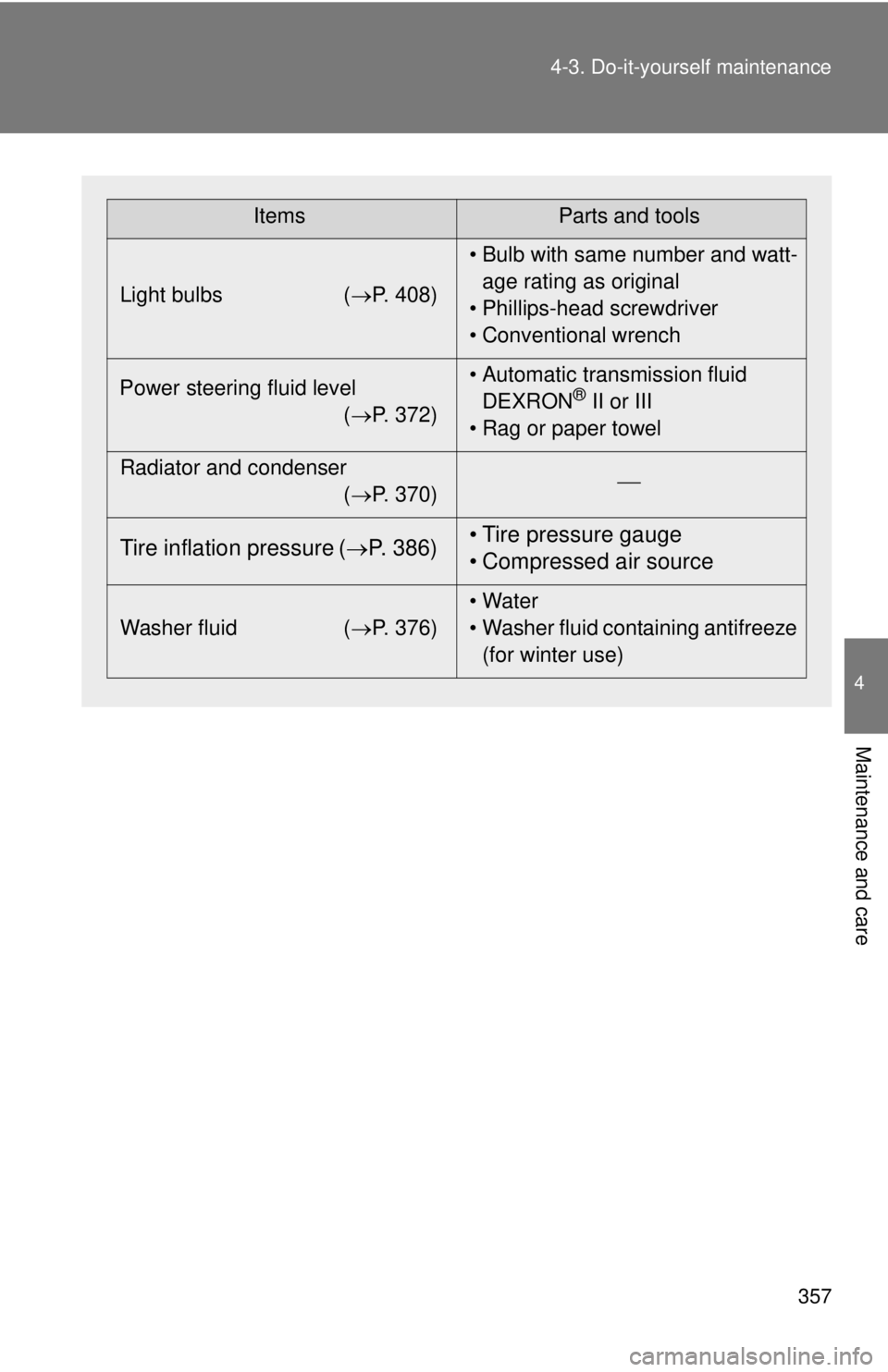
ItemsParts and tools
Light bulbs (P. 408)• Bulb with same number and watt-
age rating as original
• Phillips-head screwdriver
• Conventional wrench
Power steering fluid level
(P. 372)• Automatic transmission fluid
DEXRON
® II or III
• Rag or paper towel
Radiator and condenser
(P. 370)
Tire inflation pressure (P. 386)• Tire pressure gauge
• Compressed air source
Washer fluid (P. 376)• Water
• Washer fluid containing antifreeze
(for winter use)
Page 378 of 532
378
4-3. Do-it-yourself maintenance
Tires
Replace or rotate tires in accordance with maintenance sched-
ules and treadwear.
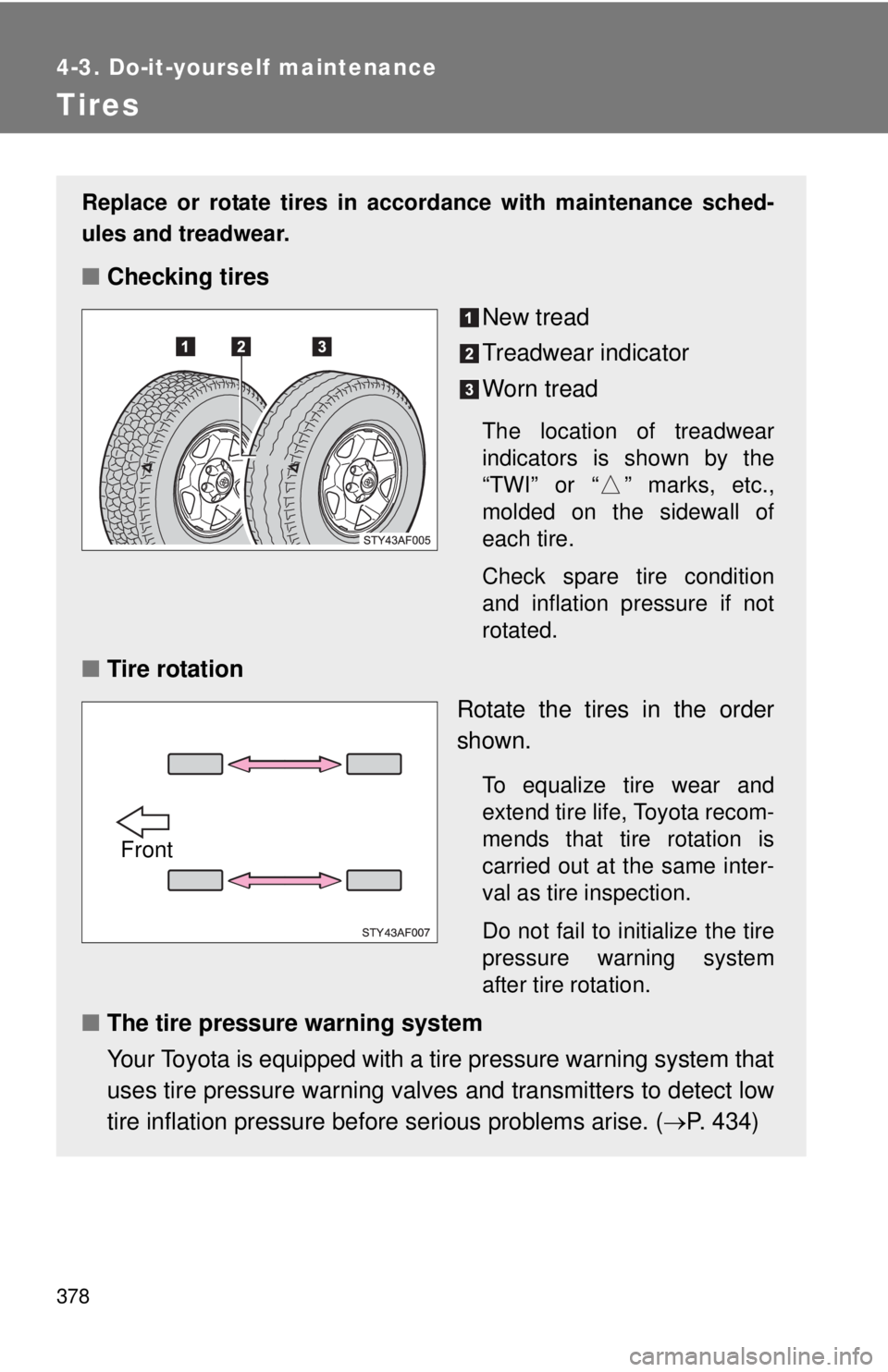
■Checking tires
New tread
Treadwear indicator
Worn tread
The location of treadwear
indicators is shown by the
“TWI” or “ ” marks, etc.,
molded on the sidewall of
each tire.
Check spare tire condition
and inflation pressure if not
rotated.
■Tire rotation
Rotate the tires in the order
shown.
To equalize tire wear and
extend tire life, Toyota recom-
mends that tire rotation is
carried out at the same inter-
val as tire inspection.
Do not fail to initialize the tire
pressure warning system
after tire rotation.
■The tire pressure warning system
Your Toyota is equipped with a tire pressure warning system that
uses tire pressure warning valves and transmitters to detect low
tire inflation pressure before serious problems arise. (P. 434)
Front
Page 379 of 532

379 4-3. Do-it-yourself maintenance
4
Maintenance and care
Installing tire pressure warning valves and transmitters
When replacing tires or wheels, tire pressure warning valves and
transmitters must also be installed.
When new tire pressure warning valves and transmitters are installed,
new tire pressure warning valve and transmitter ID codes must be regis-
tered in the tire pressure warning computer and tire pressure warning
system must be initialized. Have tire pressure warning valve and trans-
mitter ID codes registered by your Toyota dealer. (P. 380)
Initializing the tire pressure warning system
■The tire pressure warning system must be initialized in the fol-
lowing circumstances:
●When rotating the tires on vehicles differing with front and rear
tire inflation pressures.
●When changing the tire inflation pressure by changing traveling
speed or load weight, etc.
●When changing the tire size.
When the tire pressure warning system is initialized, the current
tire inflation pressure is set as the pressure benchmark.
■How to initialize the tire pressure warning system
Park the vehicle in safe place and turn the engine switch off.
While the vehicle is moving, initialization is not performed.
Adjust the tire inflation pressure to the specified cold tire infla-
tion pressure level. (P. 484)
Make sure to adjust the tire pressure to the specified cold tire
inflation pressure level. The tire pressure warning system will
operate based on this pressure
level.
Turn the engine switch to the ON position.
Page 381 of 532
381 4-3. Do-it-yourself maintenance
4
Maintenance and care
■When to replace your vehicle's tires
Tires should be replaced if:
●You have tire damage such as cuts, splits, cracks deep enough to
expose the fabric or bulges indicating internal damage
●A tire goes flat repeatedly or cannot be properly repaired due to the
size or location of a cut or other damage
If you are not sure, consult with your Toyota dealer.
■Replacing tires and wheels
If the ID code of the tire pressure warning valve and transmitter is not
registered, the tire pressure warning system will not work properly. After
driving for about 20 minutes, the tire pressure warning light comes on
after blinking for 1 minute to indicate a system malfunction.
■Tire life
Any tire over 6 years old must be checked by a qualified technician even
if they have seldom or never been used or damage is not obvious.
■If the tread wears down below 0.16 in. (4 mm) on snow tires
The effectiveness of snow tires is lost.
■Maximum load of tire
Check that the number given by dividing the maximum load by 1.10 of
the replacement tire is greater than 1/2 of the Gross Axle Weight Ratings
(GAWR) of either the front axle or the rear axle, whichever is greater.
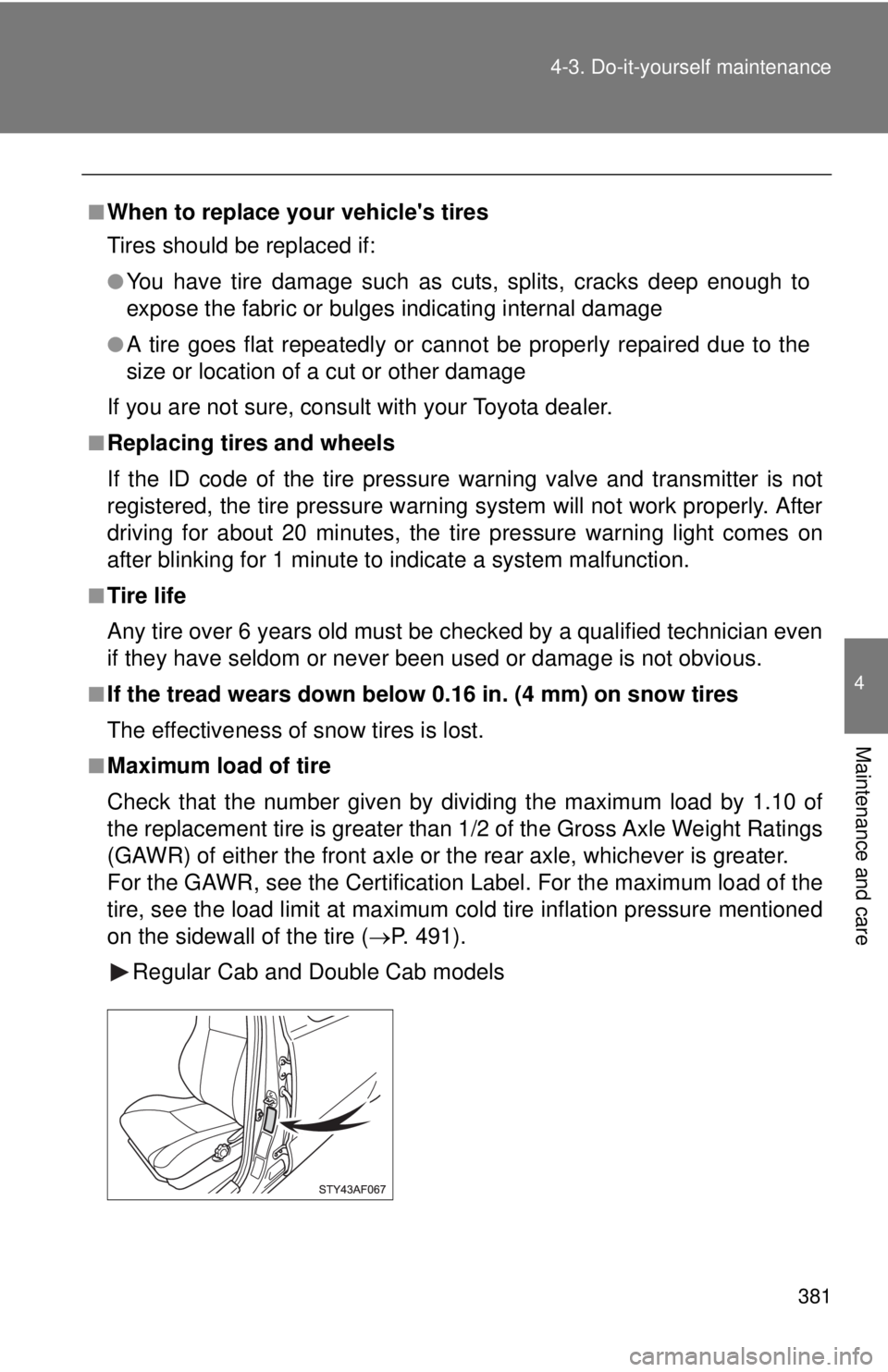
For the GAWR, see the Certification Label. For the maximum load of the
tire, see the load limit at maximum cold tire inflation pressure mentioned
on the sidewall of the tire (P. 491).
Regular Cab and Double Cab models