length TOYOTA TACOMA 2010 Owners Manual (in English)
[x] Cancel search | Manufacturer: TOYOTA, Model Year: 2010, Model line: TACOMA, Model: TOYOTA TACOMA 2010Pages: 532, PDF Size: 15.03 MB
Page 203 of 532
203 2-5. Driving information
2
When driving
Capacity and distribution
Cargo capacity depends on the total weight of the occupants.
(Cargo capacity) = (Total load capacity) (Total weight of occupants)
Steps for Determining Correct Load Limit—
(1) Locate the statement “The combined weight of occupants and
cargo should never exceed XXX kg or XXX lbs.” on your vehicle’s
placard.
(2) Determine the combined weight of the driver and passengers that
will be riding in your vehicle.
(3)Subtract the combined weight of the driver and passengers from
XXX kg or XXX lbs.
(4) The resulting figure equals the available amount of cargo and lug-
gage load capacity.
For example, if the “XXX” amount equals 1400 lbs. and there will
be five 150 lb passengers in your vehicle, the amount of available
cargo and luggage load capacity is 650 lbs. (1400 750 (5 150)
= 650 lbs.)
(5) Determine the combined weight of luggage and cargo being
loaded on the vehicle. That weight may not safely exceed the
available cargo and luggage load capacity calculated in Step 4.
CAUTION
■When you secure cargo with the deck rails
●Spread out tie-down/support locations evenly along the length of the
rails.
●Do not exceed a total tensile load of 440 lb. (200 kg) per deck rail.
●To prevent luggage or cargo from sliding forward during braking, make
sure the deck rail accessories such as storage box are securely
attached on the deck rails.
Page 217 of 532
217 2-5. Driving information
2
When driving
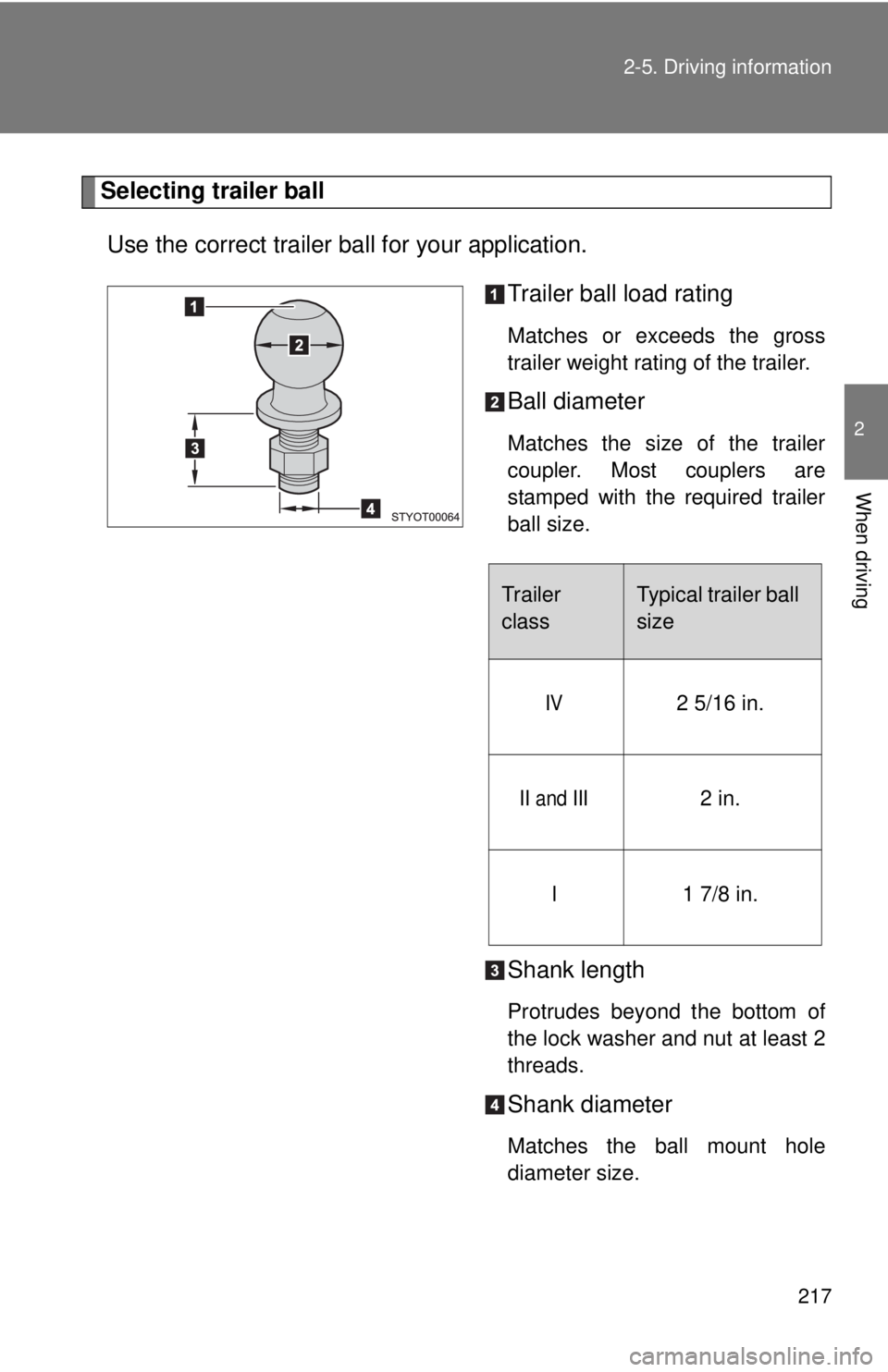
Selecting trailer ball
Use the correct trailer ball for your application.
Trailer ball load rating
Matches or exceeds the gross
trailer weight rating of the trailer.
Ball diameter
Matches the size of the trailer
coupler. Most couplers are
stamped with the required trailer
ball size.
Shank length
Protrudes beyond the bottom of
the lock washer and nut at least 2
threads.
Shank diameter
Matches the ball mount hole
diameter size.
Trailer
classTypical trailer ball
size
IV2 5/16 in.
II and III2 in.
I1 7/8 in.
Page 223 of 532
223 2-5. Driving information
2
When driving
Trailer towing tips
Your vehicle will handle differently when towing a trailer. The three
main causes of vehicle-trailer accidents are driver error, excessive
speed and improper trailer loading. Keep these in mind when towing.
●Before starting out, check the trailer’s light and the vehicle-trailer
connections. Recheck after driving a short distance.
●Practice turning, stopping and reversing with the trailer attached in
an area away from traffic until you become accustomed to the feel
of the vehicle.
●Reversing with a trailer attached is difficult and requires practice.
Grip the bottom of the steering wheel and move your hand to the
left to move the trailer to the left. Move your hand to the right to
move the trailer to the right. (This is generally opposite to reversing
without a trailer attached.) Avoid sharp or prolonged turning. Have
someone guide you when reversing to reduce the risk of an acci-
dent.
●As stopping distance is increased when towing a trailer, vehicle-to-
vehicle distance should be increased. For each 10 mph (16 km/h)
of speed, allow at least one vehicle and trailer length.
●Avoid sudden braking as you may skid, resulting in jackknifing and
loss of control. This is especially true on wet or slippery surfaces.
●Avoid jerky starts or sudden acceleration. For vehicles with a man-
ual transmission, prevent excessive clutch slippage by keeping
engine rpm low and not racing the engine. Always start out in first
gear.
●Avoid jerky steering and sharp turns, and slow down before mak-
ing a turn.
Page 224 of 532
224 2-5. Driving information
●Note that when making a turn, the trailer wheels will be closer than
the vehicle wheels to the inside of the turn. Compensate by making
a larger than normal turning radius.
●Crosswinds and rough roads will adversely affect handling of your
vehicle and trailer, causing sway. Periodically check the rear to
prepare for being passed by large trucks or buses, which may
cause your vehicle and trailer to sway. If swaying occurs, firmly grip
the steering wheel, reduce speed immediately but gradually, and
steer straight ahead. Never increase speed. If you make no
extreme correction with the steering or brakes, your vehicle and
trailer will stabilize.
●Take care when passing other vehicles. Passing requires consider-
able distance. After passing a vehicle, do not forget the length of
your trailer, and be sure you have plenty of room before changing
lanes.
●In order to maintain engine braking efficiency, do not use fifth gear
(5-speed manual transmission) or sixth gear (6-speed manual
transmission), or do not put the transmission in “D” (automatic
transmission).
●Due to the added load of the trailer, your vehicle’s engine may
overheat on hot days (at temperatures over 85°F [30°C]) when
driving up a long or steep grade. If the engine coolant temperature
gauge indicates overheating, immediately turn off the air condition-
ing (if in use), pull your vehicle off the road and stop in a safe spot.
(P. 463)
●Always place wheel blocks under both the vehicle and the trailer
wheels when parking. Apply the parking brake firmly, and put the
transmission in P (automatic transmission) or in 1 or R (manual
transmission). Avoid parking on a slope, but if unavoidable, do so
only after performing the following:
Page 257 of 532
257 3-2. Using the audio system
3
Interior and exterior features
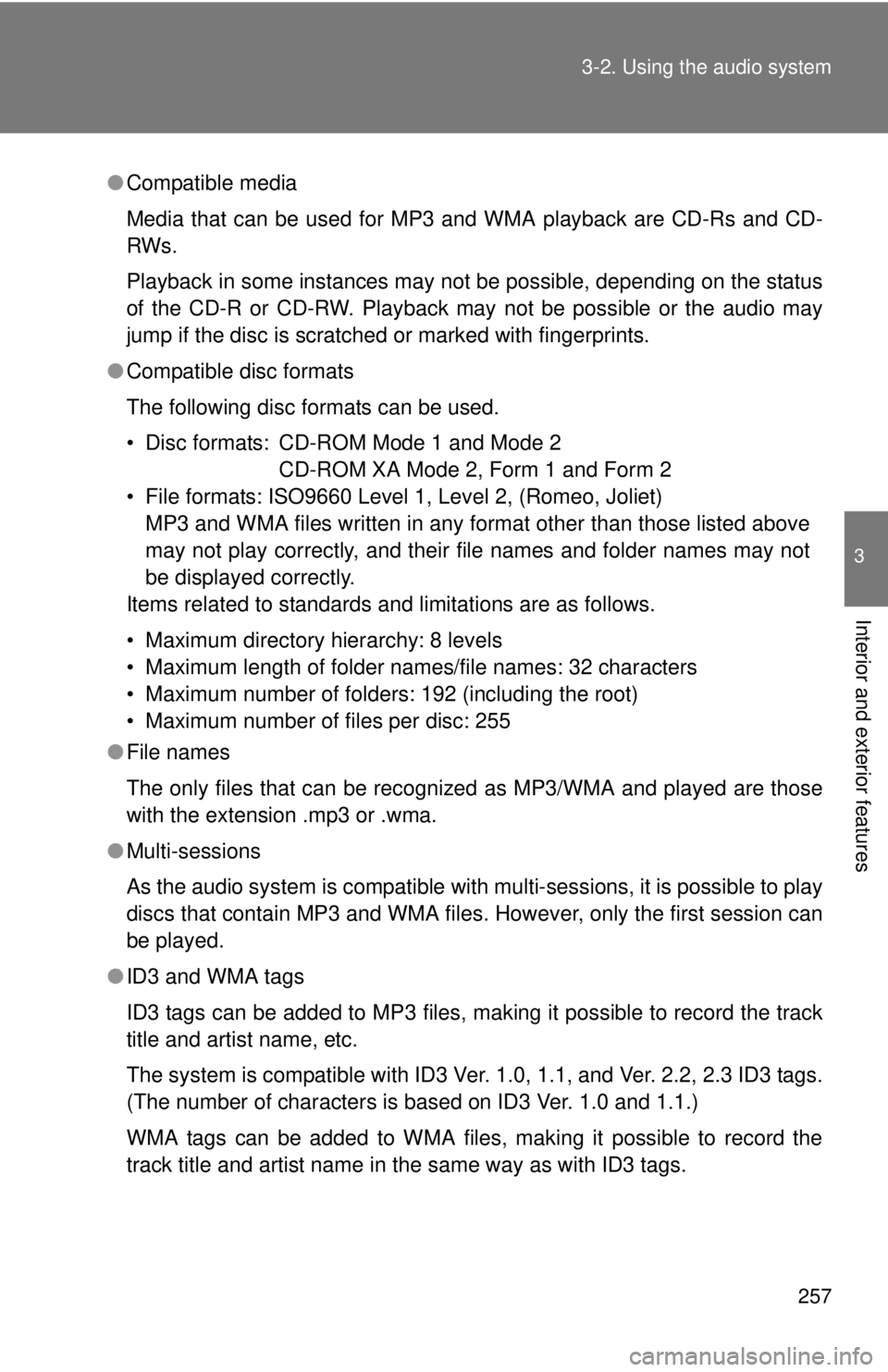
●Compatible media
Media that can be used for MP3 and WMA playback are CD-Rs and CD-
RWs.
Playback in some instances may not be possible, depending on the status
of the CD-R or CD-RW. Playback may not be possible or the audio may
jump if the disc is scratched or marked with fingerprints.
●Compatible disc formats
The following disc formats can be used.
• Disc formats: CD-ROM Mode 1 and Mode 2
CD-ROM XA Mode 2, Form 1 and Form 2
• File formats: ISO9660 Level 1, Level 2, (Romeo, Joliet)
MP3 and WMA files written in any format other than those listed above
may not play correctly, and their file names and folder names may not
be displayed correctly.
Items related to standards and limitations are as follows.
• Maximum directory hierarchy: 8 levels
• Maximum length of folder names/file names: 32 characters
• Maximum number of folders: 192 (including the root)
• Maximum number of files per disc: 255
●File names
The only files that can be recognized as MP3/WMA and played are those
with the extension .mp3 or .wma.
●Multi-sessions
As the audio system is compatible with multi-sessions, it is possible to play
discs that contain MP3 and WMA files. However, only the first session can
be played.
●ID3 and WMA tags
ID3 tags can be added to MP3 files, making it possible to record the track
title and artist name, etc.
The system is compatible with ID3 Ver. 1.0, 1.1, and Ver. 2.2, 2.3 ID3 tags.
(The number of characters is based on ID3 Ver. 1.0 and 1.1.)
WMA tags can be added to WMA files, making it possible to record the
track title and artist name in the same way as with ID3 tags.
Page 470 of 532
470
6-1. Specifications
Maintenance data (fuel, oil level, etc.)
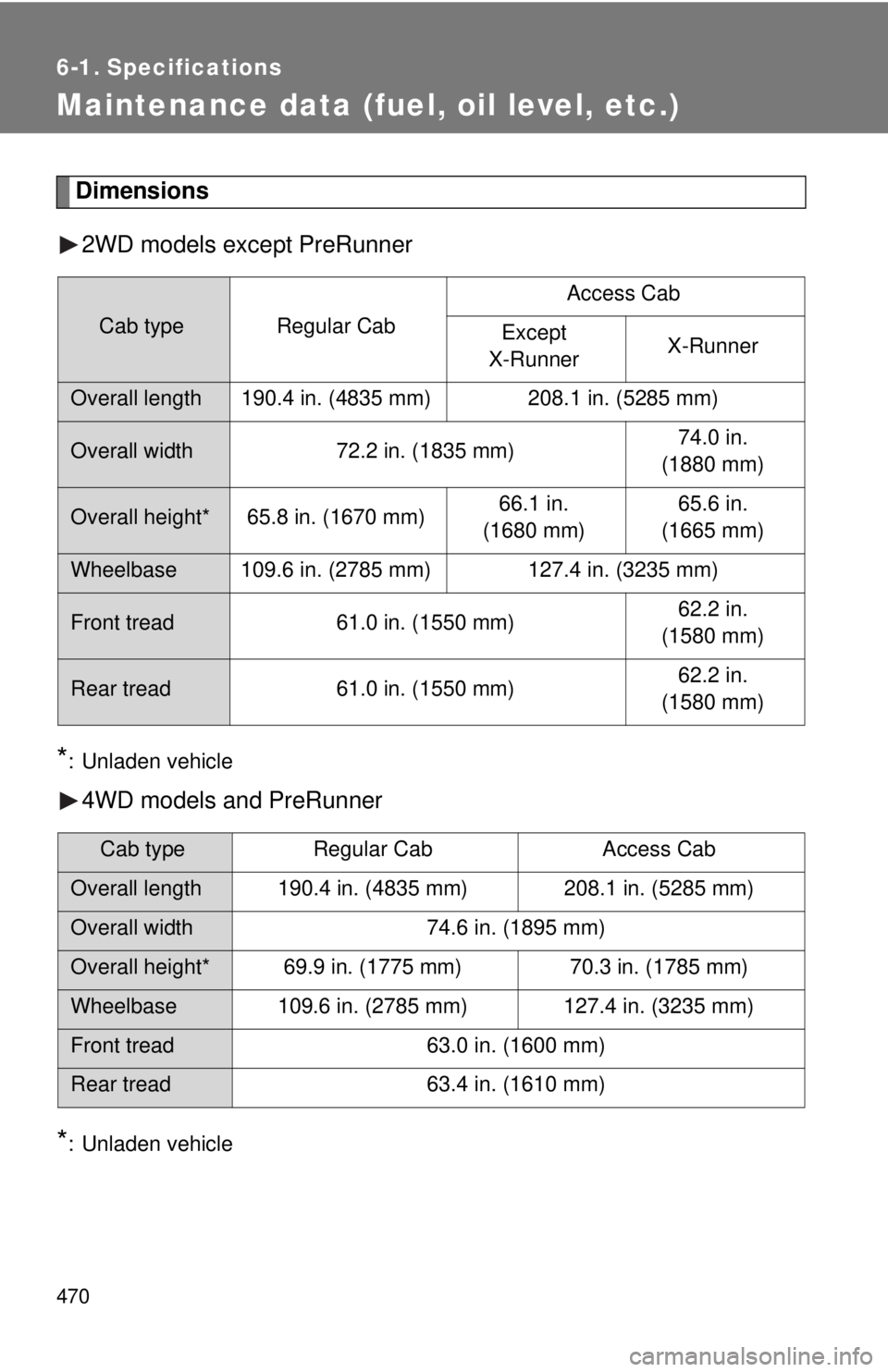
Dimensions
2WD models except PreRunner
*: Unladen vehicle
4WD models and PreRunner
*: Unladen vehicle
Cab typeRegular Cab
Access Cab
Except
X-RunnerX-Runner
Overall length 190.4 in. (4835 mm) 208.1 in. (5285 mm)
Overall width 72.2 in. (1835 mm)74.0 in.
(1880 mm)
Overall height* 65.8 in. (1670 mm)66.1 in.
(1680 mm)65.6 in.
(1665 mm)
Wheelbase 109.6 in. (2785 mm) 127.4 in. (3235 mm)
Front tread 61.0 in. (1550 mm)62.2 in.
(1580 mm)
Rear tread 61.0 in. (1550 mm)62.2 in.
(1580 mm)
Cab typeRegular CabAccess Cab
Overall length 190.4 in. (4835 mm) 208.1 in. (5285 mm)
Overall width 74.6 in. (1895 mm)
Overall height* 69.9 in. (1775 mm) 70.3 in. (1785 mm)
Wheelbase 109.6 in. (2785 mm) 127.4 in. (3235 mm)
Front tread 63.0 in. (1600 mm)
Rear tread 63.4 in. (1610 mm)
Page 471 of 532
471 6-1. Specifications
6
Vehicle specifications
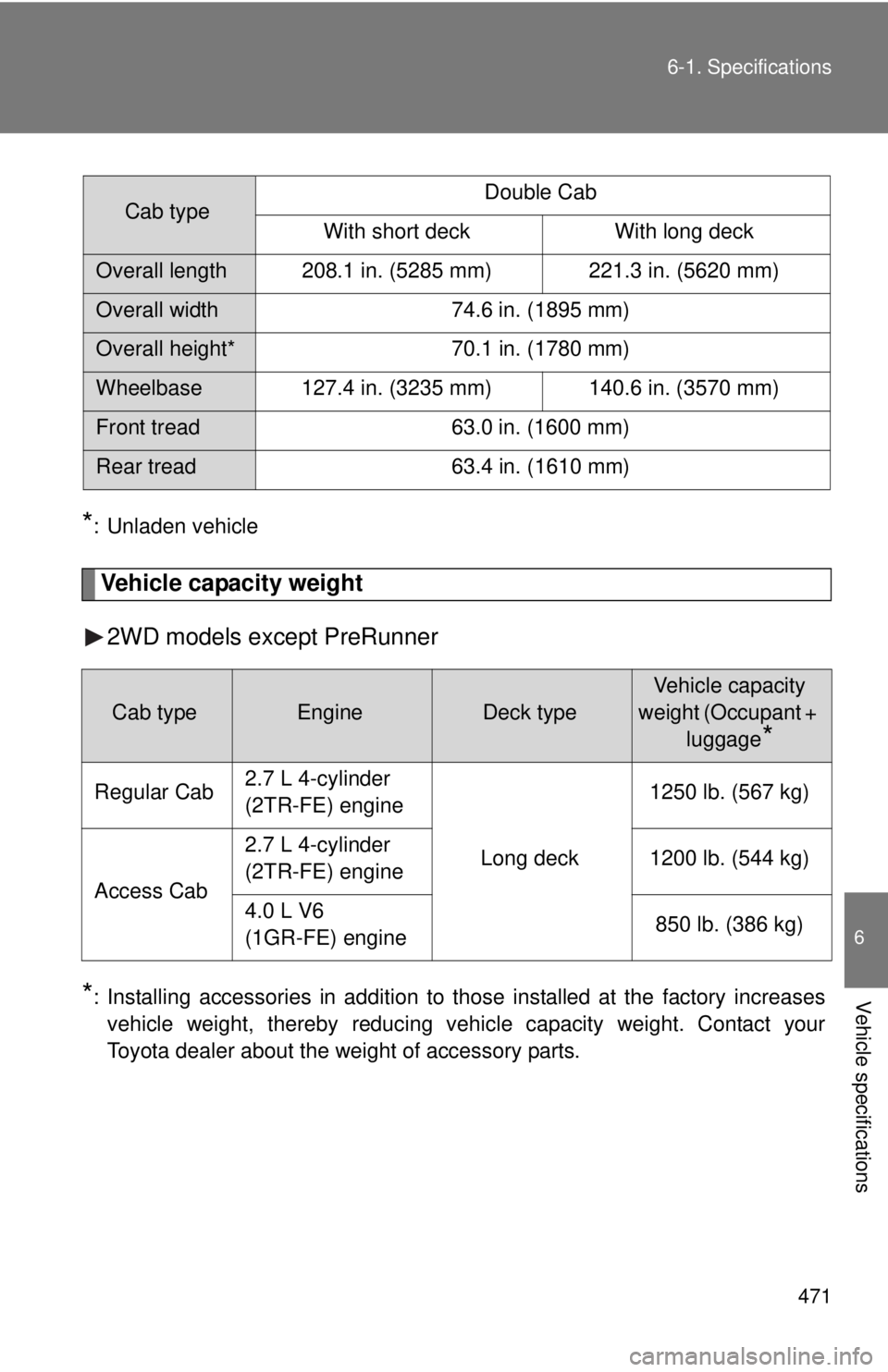
*: Unladen vehicle
Vehicle capacity weight
2WD models except PreRunner
*: Installing accessories in addition to those installed at the factory increases
vehicle weight, thereby reducing vehicle capacity weight. Contact your
Toyota dealer about the weight of accessory parts.
Cab typeDouble Cab
With short deckWith long deck
Overall length 208.1 in. (5285 mm) 221.3 in. (5620 mm)
Overall width 74.6 in. (1895 mm)
Overall height* 70.1 in. (1780 mm)
Wheelbase 127.4 in. (3235 mm) 140.6 in. (3570 mm)
Front tread 63.0 in. (1600 mm)
Rear tread 63.4 in. (1610 mm)
Cab typeEngineDeck type
Vehicle capacity
weight (Occupant +
luggage
*
Regular Cab2.7 L 4-cylinder
(2TR-FE) engine
Long deck
1250 lb. (567 kg)
Access Cab
2.7 L 4-cylinder
(2TR-FE) engine1200 lb. (544 kg)
4.0 L V6
(1GR-FE) engine850 lb. (386 kg)