snow chains TOYOTA TACOMA 2010 Owners Manual (in English)
[x] Cancel search | Manufacturer: TOYOTA, Model Year: 2010, Model line: TACOMA, Model: TOYOTA TACOMA 2010Pages: 532, PDF Size: 15.03 MB
Page 195 of 532

195 2-4. Using other driving systems
2
When driving
CAUTION
■The ABS does not operate effectively when
●The limits of the gripping performance have been exceeded.
●The vehicle hydroplanes while driving at high speed on the wet or slick
road.
■Stopping distance when the ABS is operating will exceed that of nor-
mal conditions
The ABS is not designed to shorten the vehicle’s stopping distance. Always
maintain a safe distance from the vehicle in front of you in the following situ-
ations.
●When driving on dirt, gravel or snow-covered roads
●When driving with tire chains
●When driving over bumps in the road
●When driving over roads with potholes or roads with uneven roads
■When VSC is activated
The slip indicator flashes and a warning buzzer sounds. Always drive care-
fully. Reckless driving may cause an accident. Exercise particular care when
the indicator flashes and a buzzer sounds.
■TRAC may not operate effectively when
Directional control and power may not be achievable while driving on slip-
pery road surfaces, even if TRAC is operating.
Do not drive the vehicle in conditions where stability and power may be lost.
■If the hill-start assist control does not operate effectively
Do not overly rely on the hill-start assist control. The hill start assist control
may not operate effectively on steep inclines and roads covered in ice.
■Replacing tires
Make sure that all tires are of the same size, brand, tread pattern and total
load capacity. In addition, make sure that the tires are inflated to the appro-
priate tire pressure level.
The ABS and VSC will not function correctly if different tires are fitted on the
vehicle.
Contact your Toyota dealer for further information when replacing tires or
wheels.
Page 209 of 532
209
2-5. Driving information
2
When driving
Winter driving tips
Carry out the necessary preparations and inspections before driving
the vehicle in winter. Always drive the vehicle in a manner appropri-
ate to the prevailing weather conditions.
■Pre-winter preparations
●Use fluids that are appropriate to the prevailing outside tem-
peratures.
• Engine oil
• Engine coolant
• Washer fluid
●Have a service technician inspect the level and specific grav-
ity of battery electrolyte.
●Have the vehicle fitted with four snow tires or purchase a set
of tire chains for the rear tires.
Ensure that all tires are the same size and brand, and that chains
match the size of the tires.
■Before driving the vehicle
Perform the following according to the driving conditions.
●Do not try to forcibly open a window, scrape an outside rear
view mirror surface or move a wiper or outside rear view mir-
ror that is frozen. Pour warm water over the frozen area to
melt the ice. Wipe away the water immediately to prevent it
from freezing.
●To ensure proper operation of the climate control system fan,
remove any snow that has accumulated on the air inlet vents
in front of the windshield.
●Remove any ice that has accumulated on the vehicle chassis.
●Periodically check for and remove any excess ice or snow
that may have accumulated in the wheel well or on the
brakes.
Page 210 of 532
210 2-5. Driving information
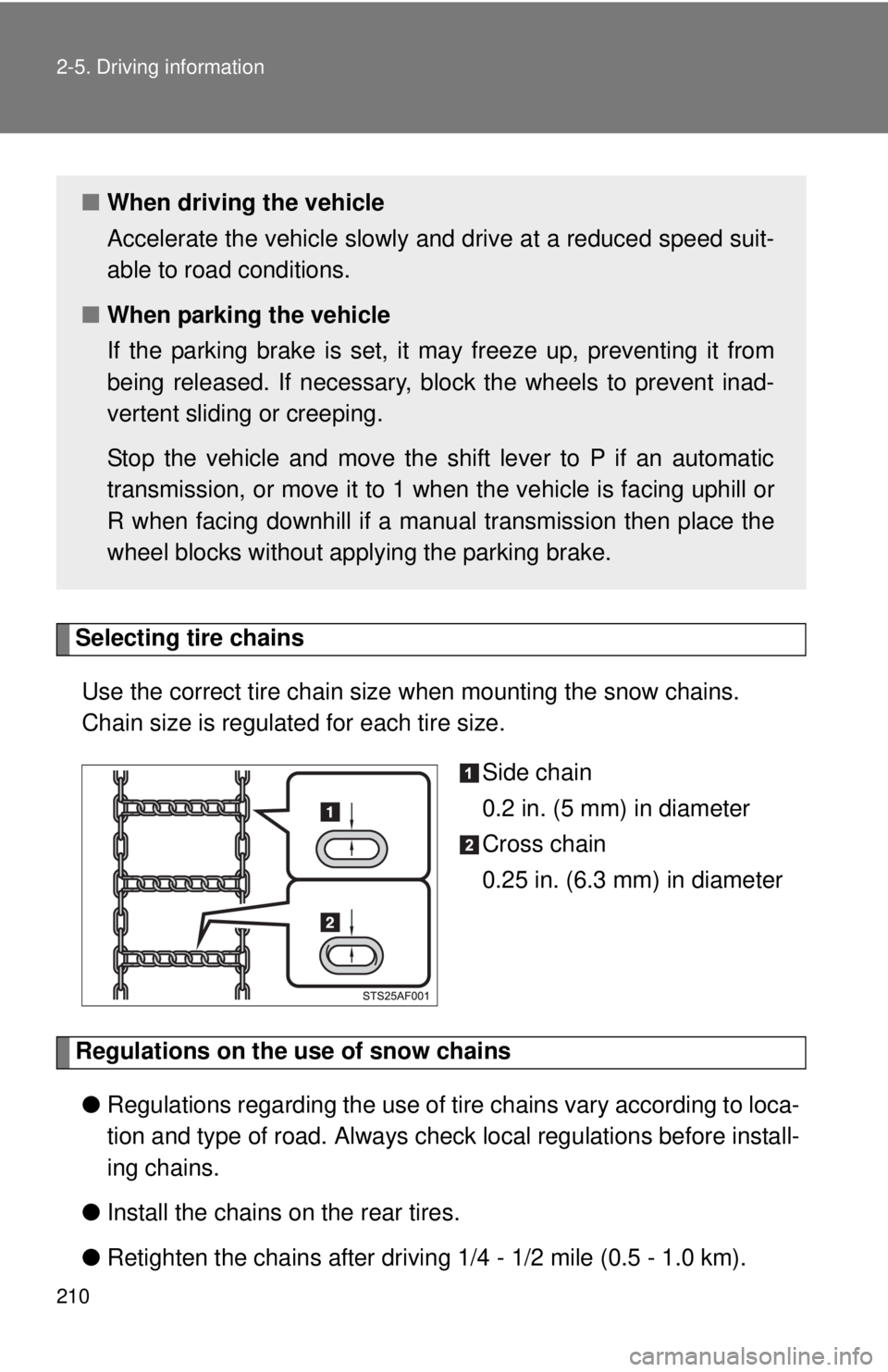
Selecting tire chains
Use the correct tire chain size when mounting the snow chains.
Chain size is regulated for each tire size.
Side chain
0.2 in. (5 mm) in diameter
Cross chain
0.25 in. (6.3 mm) in diameter
Regulations on the use of snow chains
●Regulations regarding the use of tire chains vary according to loca-
tion and type of road. Always check local regulations before install-
ing chains.
●Install the chains on the rear tires.
●Retighten the chains after driving 1/4 - 1/2 mile (0.5 - 1.0 km).
■When driving the vehicle
Accelerate the vehicle slowly and drive at a reduced speed suit-
able to road conditions.
■When parking the vehicle
If the parking brake is set, it may freeze up, preventing it from
being released. If necessary, block the wheels to prevent inad-
vertent sliding or creeping.
Stop the vehicle and move the shift lever to P if an automatic
transmission, or move it to 1 when the vehicle is facing uphill or
R when facing downhill if a manual transmission then place the
wheel blocks without applying the parking brake.
Page 211 of 532
211 2-5. Driving information
2
When driving
■Snow chain installation
Observe the following precautions when installing and removing chains.
●Install and remove tire chains in a safe location.
●Install tire chains on the rear tires only. Do not install tire chains on the
front tires.
●Install tire chains following the instructions provided in the accompanying
instructions.
CAUTION
■Driving with snow tires
Observe the following precautions to reduce the risk of accidents.
Failing to do so may result in a loss of vehicle control and cause death or
serious injury.
●Use tires of the size specified for your vehicle.
●Maintain the recommended level of air pressure.
●Do not drive in excess of 75 mph (120 km/h) regardless of the type of
snow tires being used.
●Snow tires should be installed on all wheels.
●4WD models:
Do not mix tires of different makes, models, tread patterns or treadwear.
■Driving with snow chains
Observe the following precautions to reduce the risk of accidents.
Failing to do so may result in the vehicle being unable to be driven safely,
and may cause death or serious injury.
●Do not drive in excess of the speed limit specified for the tire chains being
used or 30 mph (50 km/h), whichever is lower.
●Avoid driving on bumpy road surfaces or over potholes.
●Avoid sudden turns and braking.
●Slow down sufficiently before entering a curve to ensure that vehicle con-
trol is maintained.
Page 212 of 532

212 2-5. Driving information
CAUTION
■When parking the vehicle
Always use wheel blocks when parking without the parking brake. Failure to
do so may allow the vehicle to move, resulting in an accident.
NOTICE
■Repairing or replacing snow tires
Request repairs of and obtain replacement snow tires from Toyota dealers or
legitimate tire retailers.
This is because the removal and attachment of snow tires affects the opera-
tion of the tire pressure warning valves and transmitters.
■Fitting tire chains
The tire pressure warning valves and transmitters may not function correctly
when tire chains are fitted.
Page 437 of 532

5
When trouble arises
437 5-2. Steps to take in an emergency
The tire pressure warning system may be disabled in the following condi-
tions:
(When the condition becomes normal, the system will work properly.)
●If electronic devices or facilities using similar radio wave frequencies
are nearby.
●If a radio set at similar frequencies is in use in the vehicle.
●If a window tint that affects the radio wave signals is installed.
●If there is a lot of snow or ice on the vehicle, in particular around the
wheels or wheel housings.
●If non-genuine Toyota wheels are used. (Even if you use Toyota
wheels, the tire pressure warning system may not work properly with
some types of tires.)
●If tire chains are used.
■If the tire pressure warning light comes on after blinking for 1
minute frequently
If the tire pressure warning light comes on after blinking for 1 minute fre-
quently when the engine switch is turned to the ON position, have it
checked by your Toyota dealer.
■After changing the engine oil (U.S.A. only)
Make sure to reset the oil maintenance data. (P. 367)
■Customization that can be configured at Toyota dealer
The vehicle speed linked seat belt reminder buzzer can be disabled.
(Customizable features P. 502)
Page 525 of 532

525 Alphabetical index
Tail lights
Replacing light bulbs ............ 417
Switch ................................... 164
Wattage ................................ 487
Talk switch ............................... 273
Telephone switch .................... 273
Theft deterrent system
Engine immobilizer system..... 78
Tire inflation pressure ............ 484
Tire information
Glossary ............................... 496
Size ...................................... 493
Tire identification number ..... 492
Uniform tire quality grading .. 494
Tires
Chains .................................. 210
Checking .............................. 378
If you have a flat tire ............. 440
Identification number ............ 492
Inflation pressure .................. 484
Inflation pressure sensor ...... 379
Information ........................... 491
Replacing ..................... 378, 440
Rotating tires ........................ 378
Size ...................................... 484
Snow tires............................. 211
Spare tire .............................. 440
Tire pressure warning
reset switch ........................ 380
Tire pressure warning
system........................ 378, 436
Warning light ........................ 434
Tools......................................... 440
Total load capacity .................. 207
Towing
Bumper towing ..................... 218
Dinghy towing ....................... 226
Emergency towing ................ 421
Fifth wheel trailer .................. 218
Trailer towing ........................ 213
Traction control ....................... 191
TRAC ........................................ 191
Trip meter................................. 158Turn signal lights
Lever .....................................156
Replacing light
bulbs ...........................413, 414
Switch....................................156
Wattage .................................487
Valet key .....................................30
Vanity mirrors...........................311
Vehicle identification
number ...................................473
Vehicle stability control...........191
VSC............................................191
Warning buzzers
Key reminder .........................435
Brake system ........................431
Seat belt reminder .................434
Warning lights
ABS .......................................433
Airbag system .......................433
Anti-lock brake system ..........433
Automatic transmission fluid
temperature ........................433
Brake system ........................431
Charging system ...................432
Driver’s seat belt ...................434
Electronic engine control
system ................................432
Engine oil replacement..........435
Front passenger occupant
classification system ........... 433
Front passenger’s seat belt ...434
Low brake fluid ......................431
Low engine oil pressure ........432
Low fuel level ........................434
Low tire inflation pressure .....434
Malfunction indicator lamp ....432
Open door .............................434
Seat belt ................................434
Seat belt pretensioner
system ................................433
V
W