tire type TOYOTA TACOMA 2010 Owners Manual (in English)
[x] Cancel search | Manufacturer: TOYOTA, Model Year: 2010, Model line: TACOMA, Model: TOYOTA TACOMA 2010Pages: 532, PDF Size: 15.03 MB
Page 210 of 532
210 2-5. Driving information
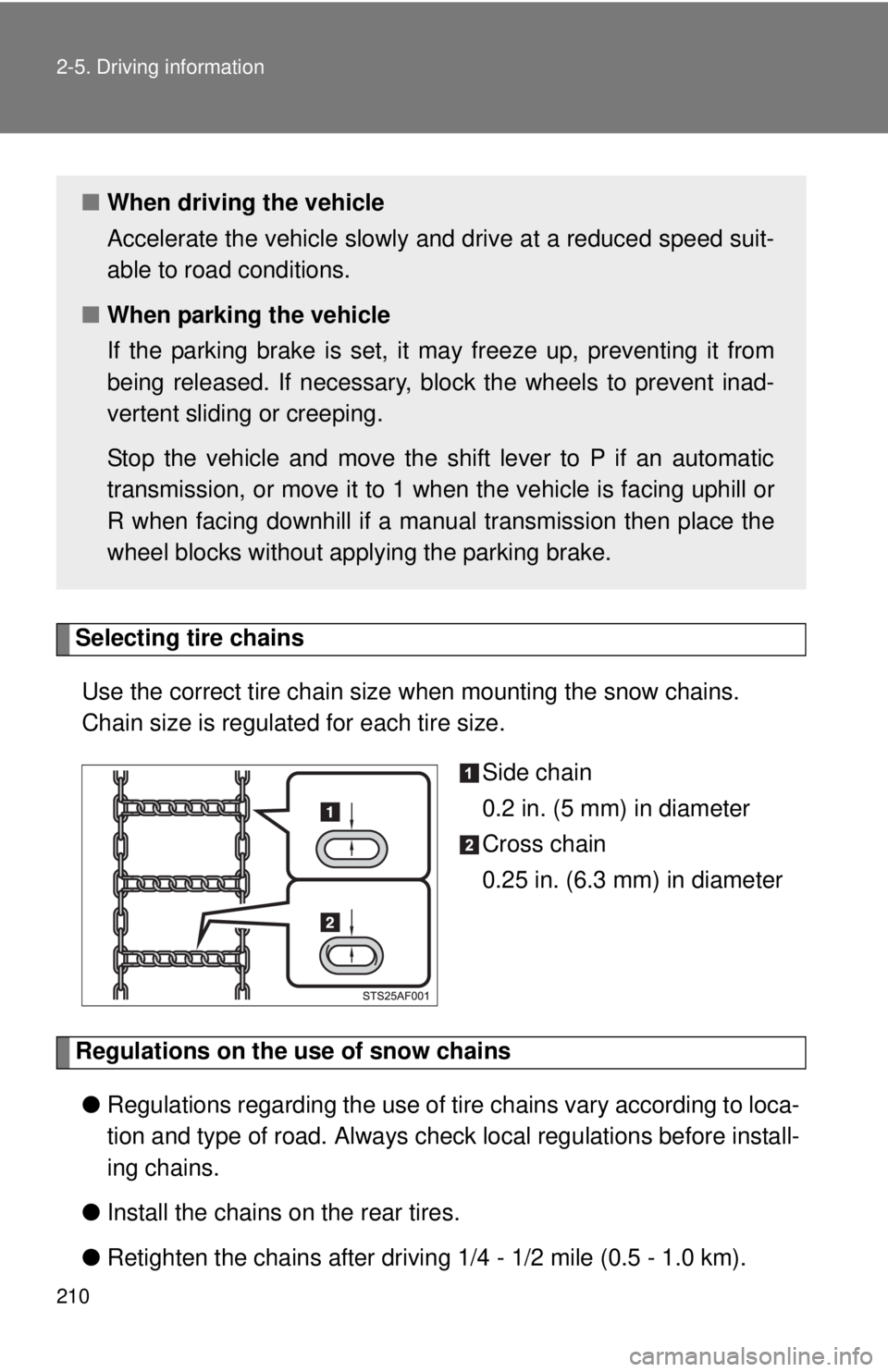
Selecting tire chains
Use the correct tire chain size when mounting the snow chains.
Chain size is regulated for each tire size.
Side chain
0.2 in. (5 mm) in diameter
Cross chain
0.25 in. (6.3 mm) in diameter
Regulations on the use of snow chains
●Regulations regarding the use of tire chains vary according to loca-
tion and type of road. Always check local regulations before install-
ing chains.
●Install the chains on the rear tires.
●Retighten the chains after driving 1/4 - 1/2 mile (0.5 - 1.0 km).
■When driving the vehicle
Accelerate the vehicle slowly and drive at a reduced speed suit-
able to road conditions.
■When parking the vehicle
If the parking brake is set, it may freeze up, preventing it from
being released. If necessary, block the wheels to prevent inad-
vertent sliding or creeping.
Stop the vehicle and move the shift lever to P if an automatic
transmission, or move it to 1 when the vehicle is facing uphill or
R when facing downhill if a manual transmission then place the
wheel blocks without applying the parking brake.
Page 211 of 532
211 2-5. Driving information
2
When driving
■Snow chain installation
Observe the following precautions when installing and removing chains.
●Install and remove tire chains in a safe location.
●Install tire chains on the rear tires only. Do not install tire chains on the
front tires.
●Install tire chains following the instructions provided in the accompanying
instructions.
CAUTION
■Driving with snow tires
Observe the following precautions to reduce the risk of accidents.
Failing to do so may result in a loss of vehicle control and cause death or
serious injury.
●Use tires of the size specified for your vehicle.
●Maintain the recommended level of air pressure.
●Do not drive in excess of 75 mph (120 km/h) regardless of the type of
snow tires being used.
●Snow tires should be installed on all wheels.
●4WD models:
Do not mix tires of different makes, models, tread patterns or treadwear.
■Driving with snow chains
Observe the following precautions to reduce the risk of accidents.
Failing to do so may result in the vehicle being unable to be driven safely,
and may cause death or serious injury.
●Do not drive in excess of the speed limit specified for the tire chains being
used or 30 mph (50 km/h), whichever is lower.
●Avoid driving on bumpy road surfaces or over potholes.
●Avoid sudden turns and braking.
●Slow down sufficiently before entering a curve to ensure that vehicle con-
trol is maintained.
Page 382 of 532

382 4-3. Do-it-yourself maintenance
Access Cab models
■Tire types
1 Summer tires
Summer tires are high-speed performance tires best suited to highway
driving under dry conditions. Since summer tires do not have the same
traction performance as snow tires, summer tires are inadequate for
driving on snow-covered or icy roads. For driving on snow-covered
roads or icy roads, the use of snow tires is recommended. When
installing snow tires, be sure to replace all four tires.
2 All season tires
All season tires are designed to provide better traction in snow and to
be adequate for driving in most winter conditions, as well as for use
year round. All season tires, however, do not have adequate traction
performance compared with snow tires in heavy or loose snow. Also,
all season tires fall short in acceleration and handling performance
compared with summer tires in highway driving.
3Snow tires
For driving on snow-covered roads or icy roads, we recommend using
snow tires. If you need snow tires, select tires of the same size, con-
struction and load capacity as the originally installed tires. Since your
vehicle has radial tires as original equipment, make sure your snow
tires also have radial construction. Do not install studded tires without
first checking local regulations for possible restriction. Snow tires
should be installed on all wheels. (P. 209)
■Initializing the tire pressure warning system
Initialize the tire pressure warning system with the tire inflation pressure
adjusted to the specified level.
Page 391 of 532

391
4-3. Do-it-yourself maintenance
4
Maintenance and care
Wheels
If a wheel is bent, cracked or heavily corroded, it should be
replaced.
Otherwise, the tire may separate from the wheel or cause loss of
handling control.
■Wheel selection
When replacing wheels, care should be taken to ensure that
they are equivalent to those removed in load capacity, diameter,
rim width, and inset*.
Replacement wheels are available at your Toyota dealer.
*: Conventionally referred to as “offset”.
Toyota does not recommend using:
●Wheels of different sizes or types
●Used wheels
●Bent wheels that have been straightened
■Wheel precautions
●Use only Toyota wheel nuts and wrench designed for use with
your aluminum wheels.
●When rotating, repairing or changing your tires, check that the
wheel nuts are still tight after driving 100 miles (160 km).
●Be careful not to damage the aluminum wheels when using
tire chains.
●Use only Toyota genuine balance weights or equivalent and a
plastic or rubber hammer when balancing your wheels.
Page 437 of 532
5
When trouble arises
437 5-2. Steps to take in an emergency
The tire pressure warning system may be disabled in the following condi-
tions:
(When the condition becomes normal, the system will work properly.)
●If electronic devices or facilities using similar radio wave frequencies
are nearby.
●If a radio set at similar frequencies is in use in the vehicle.
●If a window tint that affects the radio wave signals is installed.
●If there is a lot of snow or ice on the vehicle, in particular around the
wheels or wheel housings.
●If non-genuine Toyota wheels are used. (Even if you use Toyota
wheels, the tire pressure warning system may not work properly with
some types of tires.)
●If tire chains are used.
■If the tire pressure warning light comes on after blinking for 1
minute frequently
If the tire pressure warning light comes on after blinking for 1 minute fre-
quently when the engine switch is turned to the ON position, have it
checked by your Toyota dealer.
■After changing the engine oil (U.S.A. only)
Make sure to reset the oil maintenance data. (P. 367)
■Customization that can be configured at Toyota dealer
The vehicle speed linked seat belt reminder buzzer can be disabled.
(Customizable features P. 502)
Page 484 of 532

484 6-1. Specifications
Steering
Tires and wheels
Type A
*: If you affix the spare tire to a front position, please make sure to adjust
the tire to the correct inflation pressure as soon as possible.
Free playLess than 1.2 in. (30 mm)
Power steering fluid typeAutomatic transmission fluid DEXRON® II or
III
Tire size P215/70R15 97S
Tire inflation pressure
(Recommended cold tire
inflation pressure)Front tires:
30 psi (210 kPa, 2.1 kgf/cm
2 or bar)
Rear tires:
33 psi (230 kPa, 2.3 kgf/cm
2 or bar)
Spare tire
*:
33 psi (230 kPa, 2.3 kgf/cm2 or bar)
Driving at high speeds above 100 mph
(160 km/h) (in countries where such
speeds are permitted by law)
Add 3 psi (20 kPa, 0.2 kgf/cm
2 or bar) to
the front tires and rear tires. Never
exceed the maximum cold tire inflation
pressure indicated on the tire sidewall.
Wheel size 15 6 J, 15 6 JJ
Wheel nut torque 85 ft·lbf (113 N·m, 11.5 kgf·m)
Page 485 of 532

485 6-1. Specifications
6
Vehicle specifications
Type B
Type C
*:If you affix the spare tire to a front position, please make sure to adjust
the tire to the correct inflation pressure as soon as possible.
Tire size P245/75R16 109S
Tire inflation pressure
(Recommended cold tire
inflation pressure)Front tires:
30 psi (210 kPa, 2.1 kgf/cm
2 or bar)
Rear tires:
30 psi (210 kPa, 2.1 kgf/cm
2 or bar)
Spare tire:
30 psi (210 kPa, 2.1 kgf/cm
2 or bar)
Driving at high speeds above 100 mph
(160 km/h) (in countries where such
speeds are permitted by law)
Add 3 psi (20 kPa, 0.2 kgf/cm
2 or bar) to
the front tires and rear tires. Never
exceed the maximum cold tire inflation
pressure indicated on the tire sidewall.
Wheel size 16 7 J, 16 7 JJ
Wheel nut torque 85 ft·lbf (113 N·m, 11.5 kgf·m)
Tire size P265/70R16 111T
Tire inflation pressure
(Recommended cold tire
inflation pressure)Front tires:
29 psi (200 kPa, 2.0 kgf/cm
2 or bar)
Rear tires:
32 psi (220 kPa, 2.2 kgf/cm
2 or bar)
Spare tire
*:
32 psi (220 kPa, 2.2 kgf/cm2 or bar)
Driving at high speeds above 100 mph
(160 km/h) (in countries where such
speeds are permitted by law)
Add 3 psi (20 kPa, 0.2 kgf/cm
2 or bar) to
the front tires and rear tires. Never
exceed the maximum cold tire inflation
pressure indicated on the tire sidewall.
Wheel size 16 7 JJ
Wheel nut torque 85 ft·lbf (113 N·m, 11.5 kgf·m)
Page 486 of 532

486 6-1. Specifications
Type D
Type E
Tire size P265/65R17 110S
Tire inflation pressure
(Recommended cold tire
inflation pressure)Front tires:
29 psi (200 kPa, 2.0 kgf/cm
2 or bar)
Rear tires:
29 psi (200 kPa, 2.0 kgf/cm
2 or bar)
Spare tire:
29 psi (200 kPa, 2.0 kgf/cm
2 or bar)
Driving at high speeds above 100 mph
(160 km/h) (in countries where such
speeds are permitted by law)
Add 3 psi (20 kPa, 0.2 kgf/cm
2 or bar) to
the front tires and rear tires. Never
exceed the maximum cold tire inflation
pressure indicated on the tire sidewall.
Wheel size 17 7 1/2 JJ
Wheel nut torque 85 ft·lbf (113 N·m, 11.5 kgf·m)
Tire size P255/45R18 99V
Tire inflation pressure
(Recommended cold tire
inflation pressure)Front tires:
35 psi (240 kPa, 2.4 kgf/cm
2 or bar)
Rear tires:
35 psi (240 kPa, 2.4 kgf/cm
2 or bar)
Spare tire:
35 psi (240 kPa, 2.4 kgf/cm
2 or bar)
Driving at high speeds above 100 mph
(160 km/h) (in countries where such
speeds are permitted by law)
Add 4 psi (30 kPa, 0.3 kgf/cm
2 or bar) to
the front tires and rear tires. Never
exceed the maximum cold tire inflation
pressure indicated on the tire sidewall.
Wheel size 18 8 JJ
Wheel nut torque 85 ft·lbf (113 N·m, 11.5 kgf·m)
Page 491 of 532

491
6-1. Specifications
6
Vehicle specifications
Tire infor mation
Typical tire symbols
Tire size (P. 493)
DOT and Tire Identification Number (TIN) (P. 492)
Location of treadwear indicators (P. 378)
Tire ply composition and materials
Plies are layers of rubber-coated parallel cords. Cords are the
strands which form the plies in a tire.
Uniform tire quality grading
For details, see “Uniform tire quality grading” that follows.
Load limit at maximum cold tire inflation pressure (P. 496)
Maximum cold tire inflation pressure (P. 496)
This means the pressure to which a tire may be inflated.
TUBELESS or TUBE TYPE
A tubeless tire does not have a tube and air is directly filled in the
tire. A tube type tire has a tube inside the tire and the tube
maintains the air pressure.
Page 492 of 532

492 6-1. Specifications
Typical DOT and tire identification number (TIN)
DOT symbol
*
Tire Identification Number
(TIN)
Tire manufacturer’s
identification mark
Tire size code
Manufacturer’s optional tire
type code (3 or 4 letters)
Manufacturing week
Manufacturing year
*:The DOT symbol certifies that
the tire conforms to applicable
Federal Motor Vehicle Safety
Standards.
Radial tires or bias-ply tires
A radial tire has RADIAL on the sidewall. A tire not marked RADIAL
is a bias-ply tire.
Summer tire or all season tire (P. 382)
An all season tire has M+S on the sidewall. A tire not marked M+S
is a summer tire.